Explanatory Modeling of Tuberculosis Treatment Outcomes: The Role of Community Engagement and Clinical Governance


Highlights
- Drug-resistant tuberculosis (DR-TB) remains a critical public health challenge in rural South Africa, where treatment outcomes are influenced by both biological resistance and health system factors.
- This study examines how community engagement and clinical governance interact with clinical predictors to shape treatment outcomes using real-world program data.
- The findings demonstrate that severe resistance phenotypes and programmatic conditions significantly affect DR-TB treatment success, highlighting the need for integrated clinical and system-level approaches.
- The study advances explanatory predictive modeling as a tool for understanding how structural health system processes influence outcomes beyond individual patient-level factors.
- Strengthening clinical governance and community engagement strategies can improve treatment adherence, care coordination, and overall program performance in DR-TB settings.
- Enhancing routine health information systems to capture governance and community-level indicators is essential for improving program evaluation and predictive modeling in public health.
Abstract
1. Introduction
2. Methods
2.1. Study Design and Setting
2.2. Study Population and Data Source
2.3. Data Handling and Variable Selection
2.4. Operationalization of Community Engagement and Clinical Governance (CE–CG)
2.5. Data Cleaning and Complete-Case Analysis
2.6. Descriptive Analysis
2.7. Multivariable Logistic Regression
2.8. Statistical Modeling and Model Evaluation
2.9. Comparative Predictive Modeling
2.10. Model Diagnostics and Goodness-of-Fit
2.11. Statistical Software
3. Results
3.1. Study Population and Data Completeness
3.2. Baseline Characteristics
3.3. Comparison of Included and Excluded Patients
3.4. Multivariable Explanatory Predictive Modeling
3.5. Comparative Model Performance: Logistic Regression vs. Tree-Based Models
3.6. Model Diagnostics and Goodness-of-Fit
4. Discussion
Strengths and Limitations
5. Conclusions
Author Contributions
Funding
Institutional Review Board Statement
Informed Consent Statement
Data Availability Statement
Acknowledgments
Conflicts of Interest
Abbreviation
| DR-TB | Drug-Resistant Tuberculosis |
| MDR-TB | Multidrug-Resistant Tuberculosis |
| RR-TB | Rifampicin-Resistant Tuberculosis |
| XDR-TB | Extensively Drug-Resistant Tuberculosis |
| Pre-XDR | Pre-Extensively Drug-Resistant Tuberculosis |
| CE–CG | Community Engagement–Clinical Governance |
| TB | Tuberculosis |
| HIV | Human Immunodeficiency Virus |
| CHW | Community Health Worker |
| aOR | Adjusted Odds Ratio |
| CI | Confidence Interval |
| ROC | Receiver Operating Characteristic |
| AUC | Area Under the Curve |
| VIF | Variance Inflation Factor |
| SD | Standard Deviation |
| LR | Likelihood Ratio |
| CE | Community Engagement |
| CG | Clinical Governance |
| WHO | World Health Organization |
References
- Xiong, X.; Zhong, F. Global, Regional, and National Burden and Trends of Tuberculosis Among Children and Adolescents From 1990 to 2021: A Comparative Analysis of Drug-Susceptible and Multidrug-Resistant Tuberculosis with Projections to 2045. J. Paediatr. Child Health 2026, 62, 23–34. [Google Scholar] [CrossRef] [Scilit]
- World Health Organization. Tuberculosis. 2025. Available online: https://www.who.int/health-topics/tuberculosis (accessed on 3 April 2026).
- Akalu, T.Y.; Clements, A.C.A.; Wolde, H.F.; Alene, K.A. Economic Burden of Multidrug-Resistant Tuberculosis on Patients and Households: A Global Systematic Review and Meta-Analysis. Sci. Rep. 2023, 13, 22361. [Google Scholar] [CrossRef] [Scilit] [PubMed]
- Farhat, M.; Cox, H.; Ghanem, M.; Denkinger, C.M.; Rodrigues, C.; Abd El Aziz, M.S.; Enkh-Amgalan, H.; Vambe, D.; Ugarte-Gil, C.; Furin, J.; et al. Drug-resistant tuberculosis: A persistent global health concern. Nat. Rev. Microbiol. 2024, 22, 617–635. [Google Scholar] [CrossRef] [Scilit] [PubMed]
- Masuku, S.D.; Berhanu, R.; Van Rensburg, C.; Ndjeka, N.; Rosen, S.; Long, L.; Evans, D.; Nichols, B.E. Managing Multidrug-Resistant Tuberculosis in South Africa: A Budget Impact Analysis. Int. J. Tuberc. Lung Dis. 2020, 24, 376–382. [Google Scholar] [CrossRef] [Scilit] [PubMed]
- Hosu, M.C.; Faye, L.M.; Apalata, T. Comorbidities and Treatment Outcomes in Patients Diagnosed with Drug-Resistant Tuberculosis in Rural Eastern Cape Province, South Africa. Diseases 2024, 12, 296. [Google Scholar] [CrossRef] [Scilit]
- Spies, R.; Schutz, C.; Ward, A.; Balfour, A.; Shey, M.; Nicol, M.; Burton, R.; Sossen, B.; Wilkinson, R.; Barr, D.; et al. Rifampicin Resistance and Mortality in Patients Hospitalized with HIV-Associated Tuberculosis. S. Afr. J. HIV Med. 2022, 23, 1396. [Google Scholar] [CrossRef] [Scilit]
- Naidoo, K.; Perumal, R.; Cox, H.; Mathema, B.; Loveday, M.; Ismail, N.; Omar, S.V.; Georghiou, S.B.; Daftary, A.; O’DOnnell, M.; et al. Epidemiology, transmission, diagnosis, and management of drug-resistant TB: Lessons from the South African experience. Lancet Infect. Dis. 2024, 24, e559–e575. [Google Scholar] [CrossRef] [Scilit]
- Dookie, N.; Ngema, S.L.; Perumal, R.; Naicker, N.; Padayatchi, N.; Naidoo, K. The changing paradigm of drug-resistant TB treatment: Successes, pitfalls, and future perspectives. Clin. Microbiol. Rev. 2022, 35, e00180-19. [Google Scholar] [CrossRef] [Scilit]
- Loveday, M.; Wallengren, K.; Reddy, T.; Besada, D.; Brust, J.C.M.; Voce, A.; Desai, H.; Ngozo, J.; Radebe, Z.; Master, I.; et al. Cost-effectiveness of five models of MDR-TB care in KwaZulu-Natal, South Africa. PLoS ONE 2018, 13, e0196003. [Google Scholar] [CrossRef] [Scilit]
- Hosu, M.C.; Faye, L.M.; Apalata, T. Optimizing DR-TB outcomes in a high HIV-burden setting: Sputum conversion and regimen efficacy. Pathogens 2025, 14, 441. [Google Scholar] [CrossRef] [Scilit]
- World Health Organization. Engaging Communities in Tuberculosis Care and Prevention; World Health Organization: Geneva, Switzerland, 2017.
- Hosu, M.C.; Tsuro, U.; Dlatu, N.; Faye, L.M.; Apalata, T. Strengthening clinical governance to improve drug-resistant TB outcomes in rural South Africa. Healthcare 2025, 13, 2093. [Google Scholar] [CrossRef] [Scilit] [PubMed]
- Kumah, A. Building community networks for effective TB case management. Front. Public Health 2025, 13, 1576875. [Google Scholar] [CrossRef] [Scilit] [PubMed]
- World Health Organization. Case Studies on Engagement of Communities and Civil Society to End Tuberculosis; WHO Press: Geneva, Switzerland, 2024.
- TB Accountability Consortium. Community Engagement Remains Key in Reaching People at Risk of TB in South Africa; TB Accountability Consortium: Johannesburg, South Africa, 2025. [Google Scholar]
- Malaka, D.; Lowane, M.P. Community health worker perspectives on tracing HIV and TB patients in rural South Africa. Open AIDS J. 2026, 20, e18746136444692. [Google Scholar] [CrossRef] [Scilit]
- Sinha, P.; Shenoi, S.V.; Friedland, G.H. Opportunities for Community Health Workers to Contribute to Global Efforts to End Tuberculosis. Glob. Public Health 2020, 15, 474–484. [Google Scholar] [CrossRef] [Scilit]
- Ngcobo, S.; Olorunju, S.; Nkwenika, T.; Rossouw, T. Effect of a Ward-Based Outreach Team and Adherence Game on Retention and Viral Load Suppression. S. Afr. J. HIV Med. 2022, 23, 1446. [Google Scholar] [CrossRef] [Scilit]
- Kalonji, D.; Mahomed, O.H. Health System Challenges Affecting HIV and Tuberculosis Integration at Primary Healthcare Clinics in Durban, South Africa. Afr. J. Prim. Health Care Fam. Med. 2019, 11, e1–e7. [Google Scholar] [CrossRef] [Scilit]
- Piquer-Martinez, C.; Urionagüena, A.; Benrimoj, S.I.; Calvo, B.; Dineen-Griffin, S.; Garcia-Cardenas, V.; Fernandez-Llimos, F.; Martinez-Martinez, F.; Gastelurrutia, M.A. Theories, models, and frameworks for health systems integration: A scoping review. Health Policy 2024, 141, 104997. [Google Scholar] [CrossRef] [Scilit]
- Belloni, G.; Dumont, F. Health systems governance, shocks, and resilience. BMJ Glob. Health 2025, 10, e017358. [Google Scholar] [CrossRef] [Scilit]
- Pyone, T.; Smith, H.; van den Broek, N. Frameworks to assess health systems governance: A systematic review. BMC Health Serv. Res. 2017, 17, 617. [Google Scholar] [CrossRef] [Scilit]
- Astbury, C.C.; Lee, K.M.; McGill, E.; Clarke, J.; Egan, M.; Halloran, A.; Malykh, R.; Rippin, H.; Wickramasinghe, K.; Penney, T.L. Systems Thinking and Complexity Science Methods and the Policy Process in Non-Communicable Disease Prevention: A Systematic Scoping Review. Int. J. Health Policy Manag. 2023, 12, 6772. [Google Scholar] [CrossRef] [Scilit]
- Vadakunnel, M.J.; Nehru, V.J.; Brammacharry, U.; Ramachandra, V.; Palavesam, S.; Muthukumar, A.; Mani, B.R.; Pradhabane, G.; Sriramkumar, S.R.; Venkatchalam, K.; et al. Factors Associated with Unfavorable Treatment Outcomes Among Patients with Multidrug-Resistant Tuberculosis Receiving Outpatient Care. Sci. Rep. 2025, 15, 28335. [Google Scholar] [CrossRef] [Scilit]
- Seloma, N.M.; Makgatho, M.E.; Maimela, E. Evaluation of drug-resistant tuberculosis treatment outcome in Limpopo province, South Africa. Afr. J. Prim. Health Care Fam. Med. 2023, 15, e1–e7. [Google Scholar] [CrossRef] [Scilit] [PubMed]
- Faye, L.M.; Hosu, M.C.; Iruedo, J.; Vasaikar, S.; Nokoyo, K.A.; Tsuro, U.; Apalata, T. Treatment Outcomes and Associated Factors among Tuberculosis Patients from Selected Rural Eastern Cape Hospitals: An Ambidirectional Study. Trop. Med. Infect. Dis. 2023, 8, 315. [Google Scholar] [CrossRef] [Scilit] [PubMed]
- Panford, V.; Kumah, E.; Kokuro, C.; Adoma, P.O.; Baidoo, M.A.; Fusheini, A.; Ankomah, S.E.; Agyei, S.K.; Agyei-Baffour, P. Treatment Outcomes and Associated Factors Among Patients with Multidrug-Resistant Tuberculosis in Ashanti Region, Ghana: A Retrospective, Cross-Sectional Study. BMJ Open 2022, 12, e062857. [Google Scholar] [CrossRef] [Scilit]
- Lyakurwa, D.M.; Lekule, I.A.; Mziray, S.R.; Balama, R.F.; Sililo, G.; Kisonga, R.M.; Yao, W.; Ai, F. Success Rates of DR-TB Patients and Associated Factors in Tanzania: A Six-Year Cohort Study. BMC Infect. Dis. 2026, 26, 586. [Google Scholar] [CrossRef] [Scilit] [PubMed]
- Kruk, M.E.; Gage, A.D.; Arsenault, C.; Jordan, K.; Leslie, H.H.; Roder-DeWan, S.; Adeyi, O.; Barker, P.; Daelmans, B.; Doubova, S.V.; et al. High-Quality Health Systems in the Sustainable Development Goals Era: Time for a Revolution. Lancet Glob. Health 2018, 6, e1196–e1252. [Google Scholar] [CrossRef] [Scilit]
- Debie, A.; Khatri, R.B.; Assefa, Y. Successes and Challenges of Health Systems Governance Towards Universal Health Coverage and Global Health Security: A Narrative Review and Synthesis of the Literature. Health Res. Policy Syst. 2022, 20, 50. [Google Scholar] [CrossRef] [Scilit]
- Hassab, T.M.; Hamachila, A.; Kalungia, A.C.; Nyazema, N.; Mukosha, M.; Banda, C.; Munkombwe, D. Determinants of Tuberculosis Treatment Outcomes in Patients with TB/HIV Co-Infection During Tuberculosis Treatment at Selected Level One Hospitals in Lusaka, Zambia. Antibiotics 2025, 14, 664. [Google Scholar] [CrossRef] [Scilit]
- Perumal, R.; Padayatchi, N.; Naidoo, K.; Knight, S. Understanding the Profile of Tuberculosis and Human Immunodeficiency Virus Coinfection: Insights from Expanded HIV Surveillance at a Tuberculosis Facility in Durban, South Africa. ISRN AIDS 2014, 2014, 260329. [Google Scholar] [CrossRef] [Scilit]
- Murdoch, J.; Curran, R.; van Rensburg, A.J.; Meyer, E.; Bachmann, M.; Zwarenstein, M.; Cornick, R.; Fairall, L.; Picken, S. Identifying contextual determinants of problems in tuberculosis care provision in South Africa: A theory-generating case study. Infect. Dis. Poverty 2021, 10, 67. [Google Scholar] [CrossRef] [Scilit]
- Gengiah, S.; Naidoo, K.; Mlobeli, R.; Mansoor, L.E.; Voce, A.; Abdool Karim, Q. A quality improvement intervention to inform scale-up of integrated HIV-TB services: Lessons learned from KwaZulu-Natal, South Africa. Glob. Health Sci. Pract. 2021, 9, 444–458. [Google Scholar] [CrossRef] [Scilit] [PubMed]
- Naidoo, K.; Gengiah, S.; Yende-Zuma, N.; Perumal, R.; Beggero, N.P.; Naidoo, K.; Abdool Karim, S.S. Mortality in HIV and tuberculosis patients following implementation of integrated HIV-TB treatment. eClinicalMedicine 2022, 44, 101298. [Google Scholar] [CrossRef] [Scilit]
- Nidoi, J.; Muttamba, W.; Walusimbi, S.; Imoko, J.F.; Kabaalu, A.; Ayakaka, I.; Sekandi, J.N.; Joloba, M.L.; Buregyeya, E. Impact of socio-economic factors on tuberculosis treatment outcomes in north-eastern Uganda: A mixed-methods study. BMC Public Health 2021, 21, 2167. [Google Scholar] [CrossRef] [Scilit] [PubMed]
- Scally, G.; Donaldson, L.J. Clinical governance and the drive for quality improvement in the new NHS. BMJ 1998, 317, 61–65. [Google Scholar] [CrossRef] [Scilit] [PubMed]
- Sun, Q.; Zhang, K.; Xu, Y.; Luo, M.; Yang, Z.; Liu, Q.; Liu, S.; Liu, A. Explainable Machine Learning for Predicting Clinical Outcomes in HIV/TB Co-Infection: A Comparative Retrospective Study. BMC Infect. Dis. 2025, 25, 1589. [Google Scholar] [CrossRef] [Scilit]
- Kazemian, S.V.; Shakeri, M.; Nazar, E.; Nasehi, M.; Sharafi, S.; Dadgarmoghaddam, M. Prevalence, treatment outcomes, and determinants of TB/HIV coinfection. Heliyon 2024, 10, e26615. [Google Scholar] [CrossRef] [Scilit]
- Migliori, G.B.; Ong, C.W.; Petrone, L.; D’Ambrosio, L.; Centis, R.; Goletti, D. The definition of tuberculosis infection is based on the spectrum of tuberculosis disease. Breathe 2021, 17, 210079. [Google Scholar] [CrossRef] [Scilit]
- Zhang, S.-X.; Wang, J.-C.; Yang, J.; Lv, S.; Duan, L.; Lu, Y.; Tian, L.-G.; Chen, M.-X.; Liu, Q.; Wei, F.-N.; et al. Epidemiological features and temporal trends of TB–HIV coinfection from the Global Burden of Disease Study. Infect. Dis. Poverty 2024, 13, 30. [Google Scholar] [CrossRef] [Scilit]


| Characteristic | Value |
|---|---|
| Age (mean ± SD) | 40.69 ± 17.38 |
| Male, n (%) | 409 (58.9%) |
| Female, n (%) | 285 (41.1%) |
| Treatment success, n (%) | 416 (59.9%) |
| Short regimen, n (%) | 616 (88.8%) |
| Long regimen, n (%) | 47 (6.8%) |
| Severe resistance (Pre-XDR/XDR), n (%) | 12 (1.7%) |
| Predictor | Adjusted OR | 95% CI | p-Value |
|---|---|---|---|
| Constant | 1.293 | 0.395–4.236 | 0.671 |
| Age (centered) | 0.999 | 0.983–1.015 | 0.871 |
| Gender | 1.334 | 0.777–2.291 | 0.296 |
| CE–CG period | 0.443 | 0.240–0.818 | 0.009 |
| Regimen at initiation | 1.220 | 0.515–2.890 | 0.652 |
| Severe resistance (Pre-XDR/XDR) | 0.303 | 0.089–1.029 | 0.056 |
| Any comorbidity | 0.935 | 0.542–1.612 | 0.808 |
| Metric | Result | Interpretation |
|---|---|---|
| Pseudo-R2 | 0.029 | Modest explanatory strength |
| LR χ2 | 10.70 (p = 0.098) | Borderline overall model improvement |
| VIF | ~1.0 | No multicollinearity |
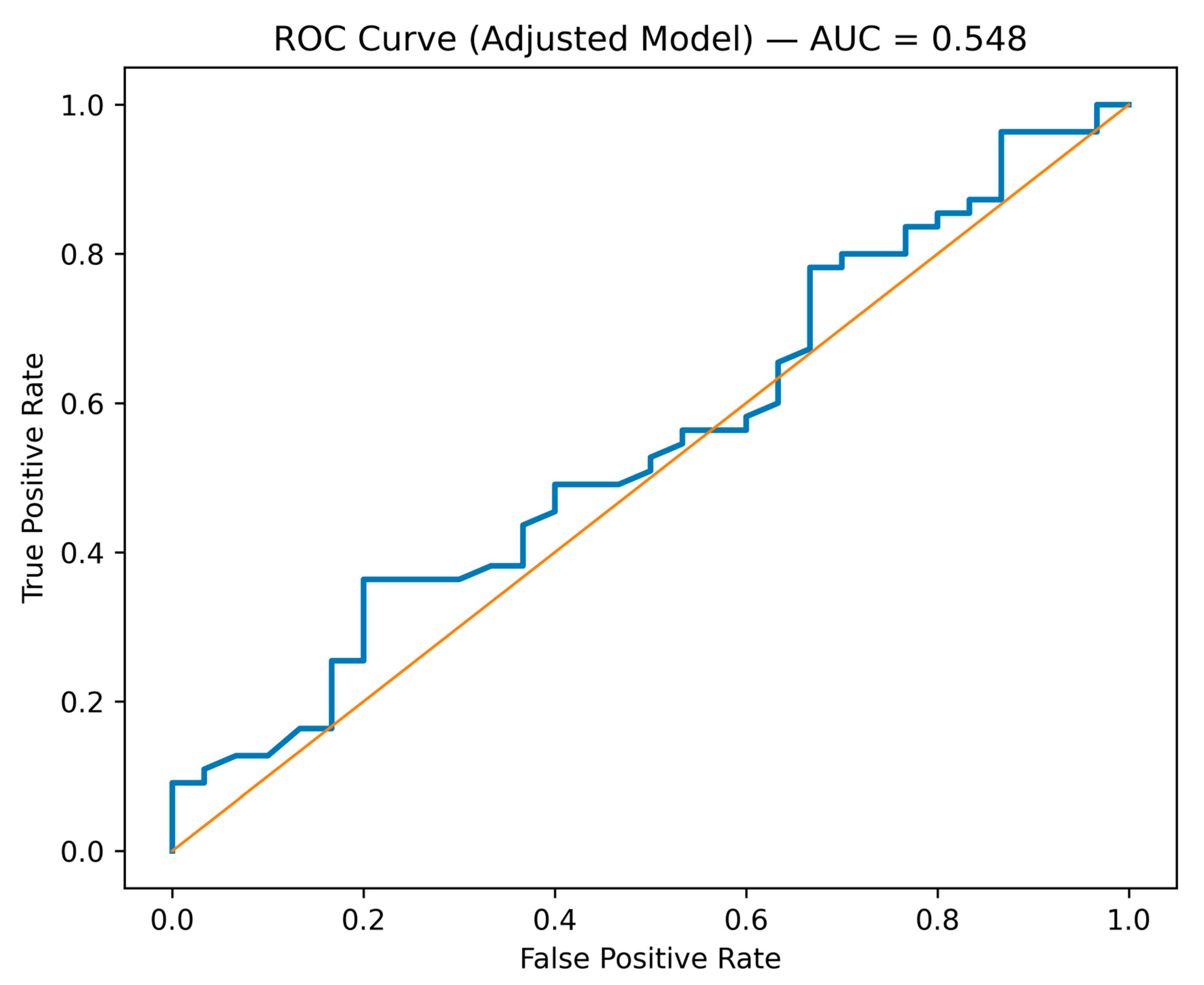
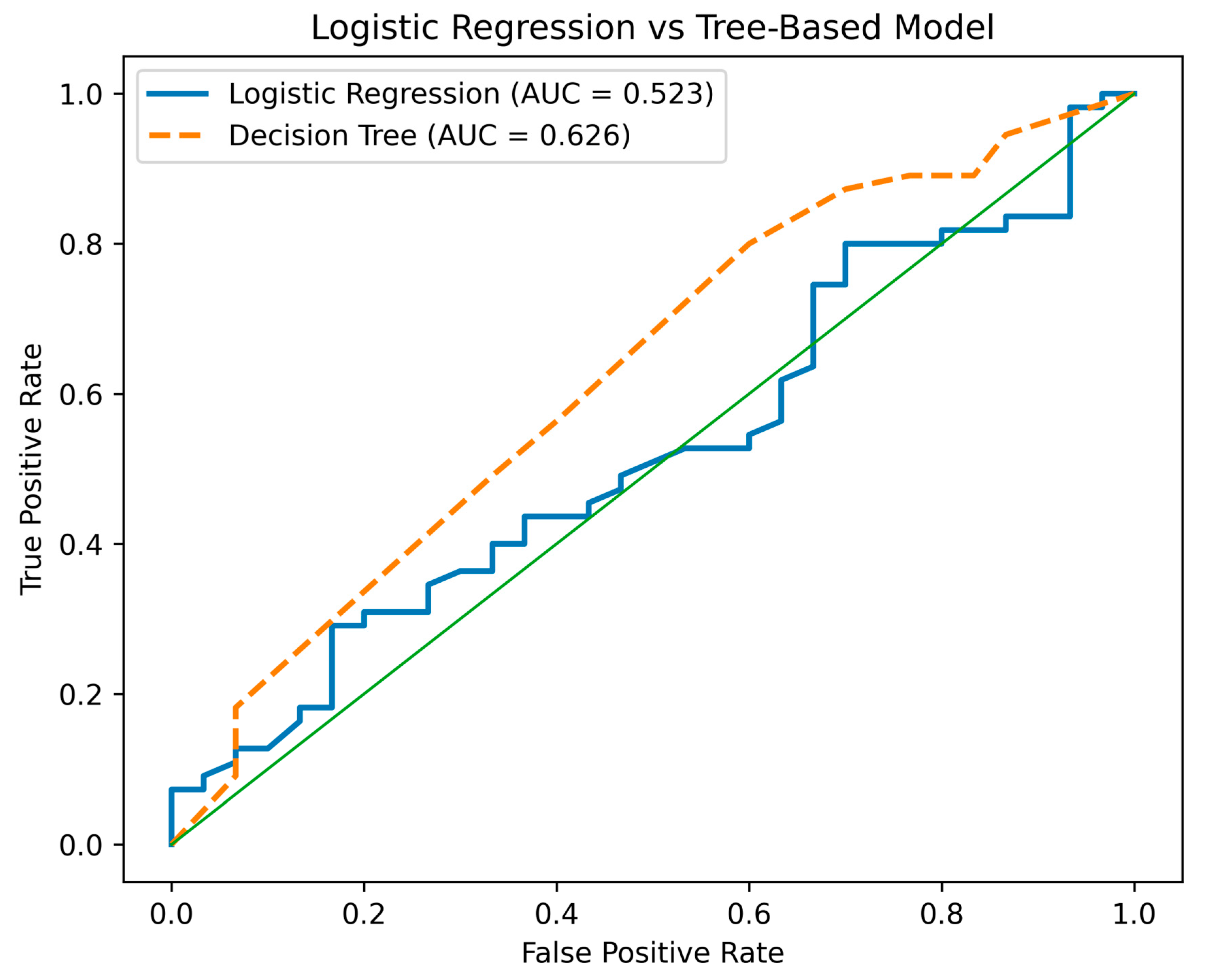
| AUC (previous) | 0.52–0.55 | Weak discrimination |
Disclaimer/Publisher’s Note: The statements, opinions and data contained in all publications are solely those of the individual author(s) and contributor(s) and not of MDPI and/or the editor(s). MDPI and/or the editor(s) disclaim responsibility for any injury to people or property resulting from any ideas, methods, instructions or products referred to in the content. |
© 2026 by the authors. Licensee MDPI, Basel, Switzerland. This article is an open access article distributed under the terms and conditions of the Creative Commons Attribution (CC BY) license.
Share and Cite
Dlatu, N.; Faye, L.M. Explanatory Modeling of Tuberculosis Treatment Outcomes: The Role of Community Engagement and Clinical Governance. Int. J. Environ. Res. Public Health 2026, 23, 511. https://doi.org/10.3390/ijerph23040511
Dlatu N, Faye LM. Explanatory Modeling of Tuberculosis Treatment Outcomes: The Role of Community Engagement and Clinical Governance. International Journal of Environmental Research and Public Health. 2026; 23(4):511. https://doi.org/10.3390/ijerph23040511
Chicago/Turabian StyleDlatu, Ntandazo, and Lindiwe Modest Faye. 2026. "Explanatory Modeling of Tuberculosis Treatment Outcomes: The Role of Community Engagement and Clinical Governance" International Journal of Environmental Research and Public Health 23, no. 4: 511. https://doi.org/10.3390/ijerph23040511
APA StyleDlatu, N., & Faye, L. M. (2026). Explanatory Modeling of Tuberculosis Treatment Outcomes: The Role of Community Engagement and Clinical Governance. International Journal of Environmental Research and Public Health, 23(4), 511. https://doi.org/10.3390/ijerph23040511