Smart Vape Detection in Schools for Mitigating Student E-Cigarette Use


Highlights
- Youth vaping has emerged as a significant public health concern, particularly in school environments where exposure to e-cigarette aerosols can occur in confined indoor spaces.
- Monitoring indoor air quality in high-risk school locations, such as restrooms, may provide new approaches for identifying and responding to vaping behaviour.
- This study presents a real-world deployment of environmental sensors across multiple school restrooms to detect aerosol signatures associated with vaping events.
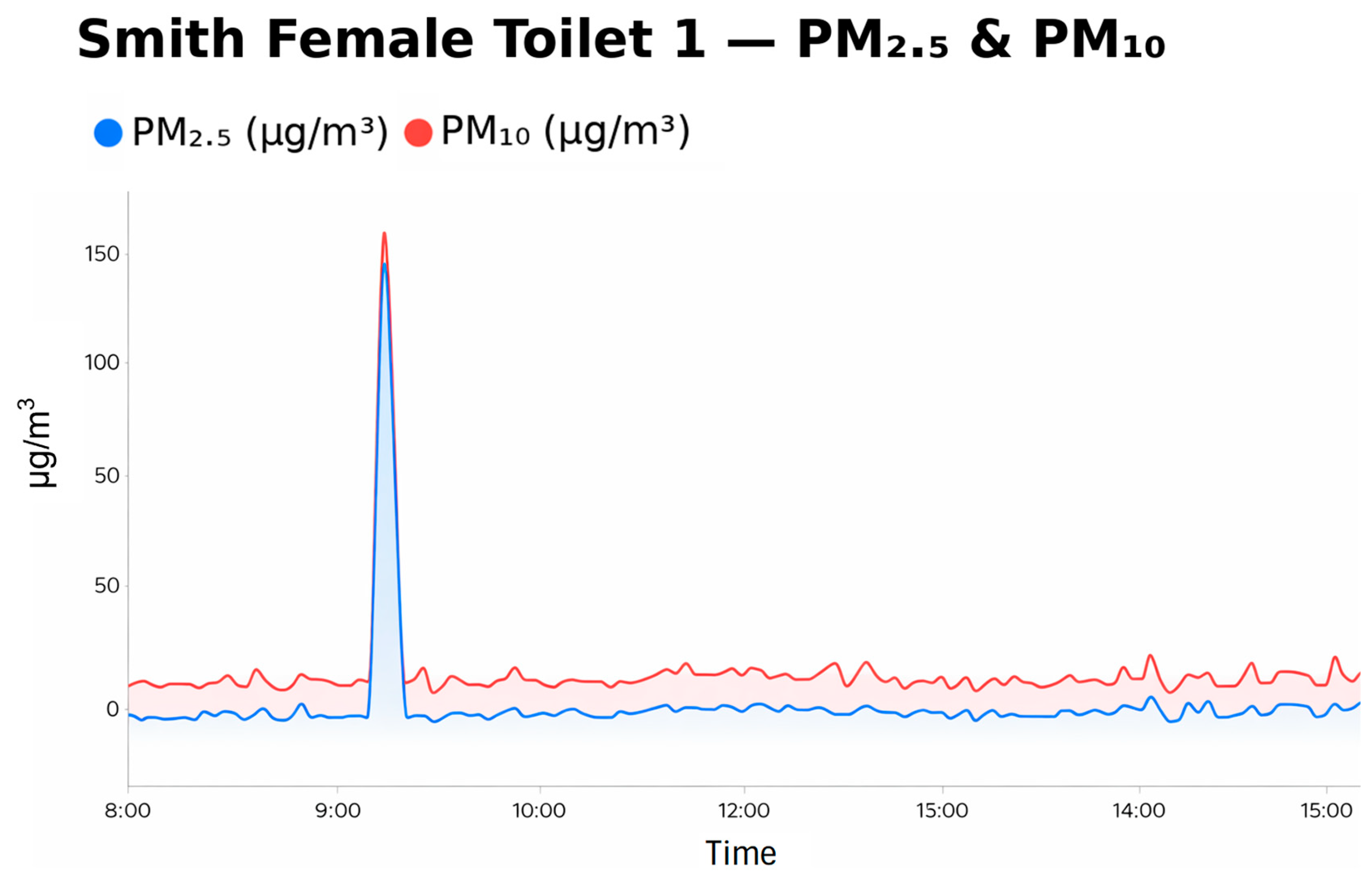
- The results demonstrate that e-cigarette use generates rapid spikes in particulate matter concentrations that can be detected using low-cost indoor air quality monitoring systems.
- Environmental monitoring systems may assist schools in identifying vaping activity and implementing targeted prevention or response strategies.
- Effective deployment requires integration of sensor systems with clear governance, response protocols, and stakeholder engagement to ensure that monitoring data leads to meaningful action.
Abstract
1. Introduction
2. Methods
2.1. Study Design and Setting
2.2. Sensor Selection and Parameters
2.3. Sensor Calibration
2.4. System Architecture
2.5. Thresholds and Alert Logic
2.6. Data Collection
2.7. Ethical Considerations
3. Results
3.1. False Positives and External Interference
3.2. Platform Usage and System Limitations
4. Discussion
4.1. Adolescent Vaping and School-Based Interventions
4.2. Vape Aerosols and Detection Targets
4.3. IoT-Based Vape Detection Systems
4.4. Human Factors and Intelligent Building Systems
4.5. Policy Frameworks and Standards
4.6. System Effectiveness and Limitations
4.7. Behavioural Engagement and Institutional Fatigue
4.8. False Positives and Environmental Context
4.9. Broader Implications & Future Directions
5. Conclusions
Author Contributions
Funding
Institutional Review Board Statement
Informed Consent Statement
Data Availability Statement
Acknowledgments
Conflicts of Interest
Appendix A. Definitions, Acronyms, and Units
Appendix B. System Architecture (Technical Details)
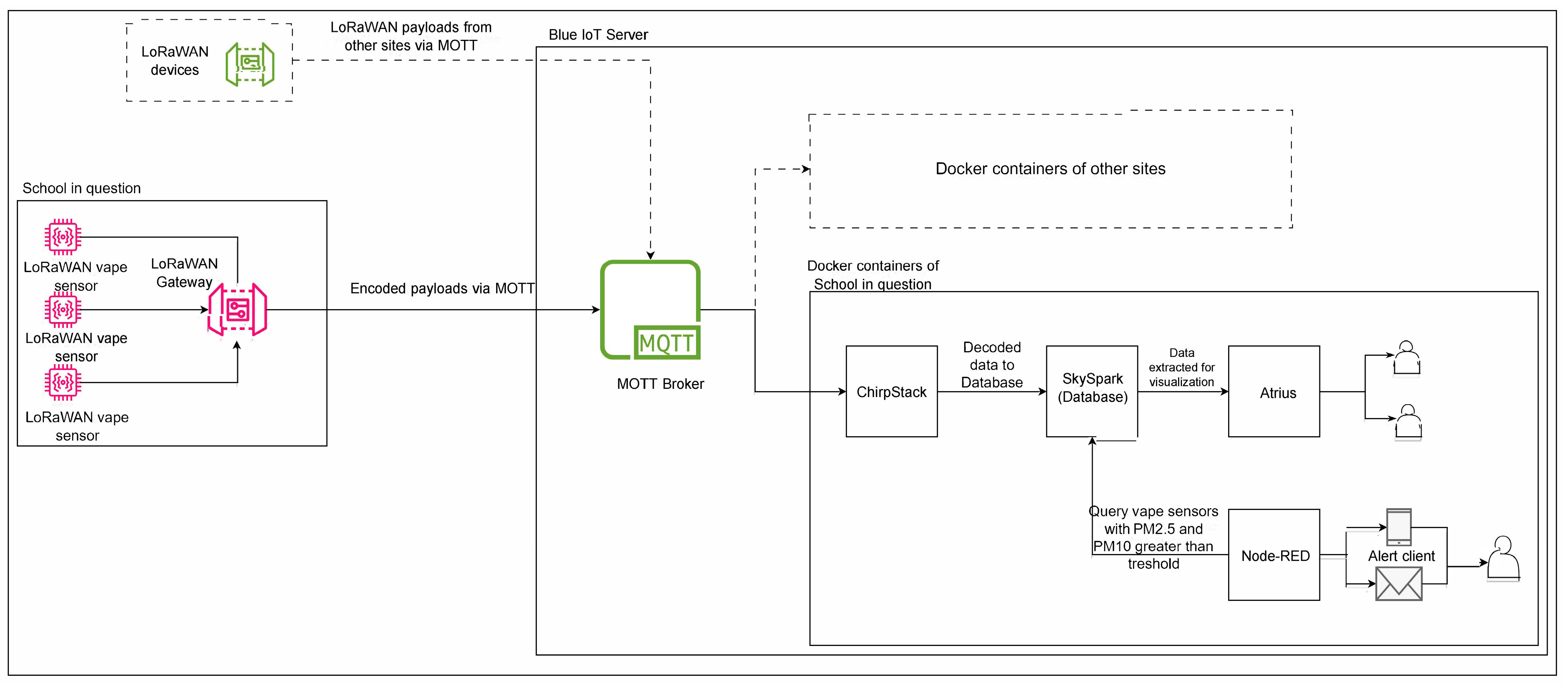
- Network Infrastructure and Data Flow
- Alerting, Visualisation, and Hosting

- System Topology and Performance Characteristics
- Topology
- Sampling
- Alert Logic (baseline)
- PM2.5 ≥ 125 µg/m3 or PM10 ≥ 175 µg/m3 (single breach).
- Debounce window: suppress duplicate alerts within 5–10 min for the same device.
- Escalation (optional): ≥3 alerts in 24 h at the same location → notify Pastoral/Wellbeing staff.
- Reliability and Hosting
- Tier IV Micron21 data centre (Melbourne).
- TLS-encrypted transport and network segmentation.
- Reported platform uptime >99.99%.
- Gateways configured with high-gain antennas for campus coverage.
- Known Limitations and Planned Upgrades (2025)
- Vendor-managed user provisioning.
- Hard-coded rule updates in the legacy platform.
- Planned enhancements include API-based AQI ingestion, machine-learning pattern matching (vape vs. smoke/deodorant), self-service alert rules, granular role-based access control, and audit trails.
Appendix C. Cybersecurity and Privacy Controls
- LoRaWAN Security Architecture
- Transport and Cloud Security
- Data Minimisation and Privacy Protection
- Access Control and Auditability
- Summary
Appendix D. Sensor & Gateway Specifications
- Milesight UG67 (outdoor)/UG65 (indoor) LoRaWAN/4G Gateways (Milesight Technology Co., Ltd., Xiamen, China).
- LoRaWAN packet forwarder; backhaul via Ethernet/4G.
- LoRaWAN network server: ChirpStack v3.x (most commonly v3.13.x–v3.15.x), representative of stable releases during the deployment period (2022).
- Antennas: ~6 dBi; IP67 for UG67; site-wide coverage with 6 × UG67 as supplied with the gateways.
- Firmware version: v60.x.x.x (representative of firmware available during deployment period, 2022).
- Sensor Selection and Interoperability
- Available parameters: PM2.5, PM10, formaldehyde (HCHO), temperature, and relative humidity.
- Parameters collected: PM2.5, PM10, HCHO, temperature, and relative humidity.
- Parameters used in analysis: PM2.5, PM10, HCHO.
- Range: PM 0–1000 µg/m3 (1 µg/m3 resolution); HCHO 0–1.25 mg/m3 (±10%).
- Power: USB (mains) for 60 s telemetry cadence
- Calibration: Factory; baseline cross-checks prior to deployment.
- Measured Parameters and Relevance to Vaping Detection
- Operational Suitability for School Environments
- Factory Calibration
- Laser-Scattering Algorithm Calibration
- Environmental Compensation
- Long-Term Stability Measures
- No User Calibration Required
Appendix D.1. Data Sheet—AM319 Sensor
Appendix D.2. Data Sheet—UG67 Gateway
Appendix E. Deployment Map and Location Index

| Description | Building Name | Grand Total | |||||
|---|---|---|---|---|---|---|---|
| Abacus | Generic | Harris | Evans | Sustain | Millennium | ||
| Male Toilet/change rooms/disabled | 2 | 6 | 1 | 6 | 1 | 1 | |
| Female Toilet/change rooms/disabled | 2 | 6 | 1 | 7 | 1 | 1 | |
| Unisex toilets | 2 | ||||||
| Total Sensors | 4 | 12 | 2 | 13 | 4 | 2 | 37 |
Appendix F. Thresholds, Event Logic, and Tuning
- Ratio check PM2.5:PM10 > 0.6 (typical vape signature).
- Temporal pattern: rising edge ≥ 3 consecutive mins.
- Suppression: if ≥ N nearby sensors breach simultaneously → likely external smoke → suppress & banner “Regional smoke event”.
Appendix G. Data Dictionary
| Field | Type | Example | Description |
|---|---|---|---|
| timestamp_local | datetime (ISO) | 2023-08-13T23:10:00 + 10:00 | Local time (AEST/AEDT) |
| device_id | String | AM319-B01-F-T1 | Unique sensor code |
| building_code | String | B01 | De-identified building |
| room_code | String | F-T1 | Room type/index |
| pm25 | float (µg/m3) | 186 | 1 min average |
| pm10 | float (µg/m3) | 214 | 1 min average |
| hcho | float (mg/m3) | 0.00 | As reported |
| alert_flag | Bool | 1 | Trigger met this minute |
| alert_id | String | EVT-2023-08-13-B01-001 | Aggregated event key |
| aqi_external | Int | 157 | Optional external AQI |
| action_taken | Enum | IMMEDIATE/REVIEW/NONE | Staff response outcome |
Appendix H. Event Logs (Operational)
| Areas | 28-Feb-2023 | 31-Mar-2023 | 30-Apr-2023 | 31-May-2023 | 30-Jun-2023 | 31-Jul-2023 | 31-Aug-2023 | 30-Sep-2023 | 31-Oct-2023 | 30-Nov-2023 |
|---|---|---|---|---|---|---|---|---|---|---|
| Female Total | 14 | 14 | 4 | 11 | 10 | 18 | 8 | 7 | 21 | 6 |
| Male Total | 5 | 20 | 0 | 7 | 12 | 11 | 7 | 12 | 7 | 5 |
| Unisex Total | 0 | 0 | 0 | 3 | 1 | 0 | 5 | 6 | 1 | 1 |
| Grand Total | 19 | 34 | 4 | 21 | 23 | 29 | 20 | 25 | 29 | 12 |
| % Change from 12 months earlier | ||||||||||
| Areas | 31-Dec-2023 | 31-Jan-2024 | 29-Feb-2024 | 31-Mar-2024 | 30-Apr-2024 | 31-May-2024 | 30-Jun-2024 | 30-Jul-2024 | 28-Feb-2023 | Totals |
| Female Total | 12 | 10 | 16 | 16 | 18 | 14 | 10 | 18 | 0 | 227 |
| Male Total | 14 | 5 | 5 | 8 | 2 | 8 | 1 | 3 | 0 | 132 |
| Unisex Total | 1 | 0 | 0 | 1 | 1 | 1 | 1 | 0 | 0 | 22 |
| Grand Total | 27 | 15 | 21 | 25 | 21 | 23 | 12 | 21 | 381 | |
| % Change from 12 months earlier | 111% | 74% | 525% | 110% | 52% | 72% |
| Date | Time | Location | Number of Students | M/F | School Year | PM2.5 Reading | PM10 Reading | Notes |
|---|---|---|---|---|---|---|---|---|
| 6 March 2023 | 08:34 a.m. | Girls’ Shower/Toilet/changing room | 2 | F | 10 | 161 | 242 | |
| 8 March 2023 | 08:26 a.m. | Girls’ Shower/Toilet/changing room | 1 | F | 11 | |||
| 8 March 2023 | 08:21 a.m. | Girls’ Shower/Toilet/changing room | 2 | F | 12 | 116 | 122 | |
| 8 March 2023 | 08:33 a.m. | Girls’ Shower/Toilet/changing room | 3 | F | 11 | 152 | 226 | *** Vape seen in hand CCTV |
| 9 March 2023 | 08:33 a.m. | Boys’ Shower/Toilet/changing room | 1 | M | 12 | 327 | 519 | |
| 10 March 2023 | 2:45 p.m. | Boys’ Shower/Toilet/changing room | 2 | M | 11 | |||
| 22 March 2023 | 08:33 a.m. | Boys’ Shower/Toilet/changing room | 1 × Parent | M | Adult | 153 | 157 | |
| 22 March 2023 | 08:33 a.m. | Girls’ Shower/Toilet/changing room | 7 | F | 11 | 109 | 178 | *** Vape seen in hand CCTV |
| 22 March 2023 | 08:47 a.m. | Boys’ Shower/Toilet/changing room | 1 | M | 11 | 85 | 130 | |
| 24 March 2023 | 1:02 p.m. | Boys’ Shower/Toilet/changing room | 1 | M | 12 | 215 | 254 | |
| 24 March 2023 | 8:32 a.m. | Boys’ Shower/Toilet/changing room | 1 | M | 12 | 141 | 211 | |
| 26 March 2023 | 04:32 p.m. | Boys’ Shower/Toilet/changing room | 2 | M | 12 | 65 | 93 | |
| 28 March 2023 | 6:47 p.m. | Boys’ Shower/Toilet/changing room | 1 × Parent | M | Adult | 1047 | 1222 | |
| 28 March 2023 | 12:47 p.m. | Boys’ Shower/Toilet/changing room | 1 | M | 12 | 174 | 230 | |
| 29 March 2023 | 10:32 a.m. | Girls’ Shower/Toilet/changing room | 1 | F | 12 | 140 | 192 | |
| 30 March 2023 | 2:47 p.m. | Boys’ Shower/Toilet/changing room | 1 | M | 12 | 161 | 187 | |
| 30 March 2023 | 11:18 a.m. | Boys’ Shower/Toilet/changing room | 1 | M | 12 | 170 | 228 | |
| 30 March 2023 | 9:17 a.m. | Girls’ Shower/Toilet/changing room | 2 | F | 11 | 150 | 372 | |
| 18 April 2023 | 3:33 p.m. | Girls’ Shower/Toilet/changing room | 1 | F | 12 | 160 | 253 | |
| 19 April 2023 | 8:33 a.m. | Girls’ Shower/Toilet/changing room | 3 | F | 12 | 131 | 199 | |
| 26 April 2023 | 9:34 a.m. | Girls’ Shower/Toilet/changing room | 1 | F | 12 | 170 | 175 | |
| 2 May 2023 | 8:32 a.m. | Girls’ Shower/Toilet/changing room | 4 | F | 12 | 138 | 224 | |
| 3 May 2023 | 08:32 a.m. | Girls’ Shower/Toilet/changing room | 5 | F | 11 | 178 | 279 | |
| 5 May 2023 | 3:47 p.m. | Girls’ Shower/Toilet/changing room | 1 | F | 12 | 200 | 249 | |
| 8 May 2023 | 12:32 p.m. | Girls’ Shower/Toilet/changing room | 3 | F | 11 | 129 | 197 | |
| 9 May 2023 | 10:20 a.m. | Girls’ Shower/Toilet/changing room | 1 | F | 12 | 237 | 254 | |
| 12 May 2023 | 1:02 p.m. | Girls’ Shower/Toilet/changing room | 3 | F | 12 | 287 | 467 | |
| 15 May 2023 | 1:17 p.m. | Boys’ Shower/Toilet/changing room | 1 × Teacher | M | Adult | |||
| 17 May 2023 | 8:22 a.m. | Girls’ Shower/Toilet/changing room | 1 | F | 12 | 71 | 91 | |
| 17 May 2023 | 8:22 a.m. | Girls’ Shower/Toilet/changing room | 2 | F | 11 | 165 | 239 | |
| 23 May 2023 | 3:32 p.m. | Girls’ Shower/Toilet/changing room | 1 | F | 11 | 82 | 124 | |
| 25 May 2023 | 10:47 a.m. | Disabled Toilets | 1 | M | 10 | 165 | 181 | |
| 11 June 2023 | 11:02 a.m. | Girls’ Shower/Toilet/changing room | 2 | F | 11 | 136 | 204 | |
| 12 July 2023 | 8:38 a.m. | Girls’ Shower/Toilet/changing room | 1 | F | 11 | 471 | 518 | |
| 13 July 2023 | 11:23 a.m. | Girls’ Shower/Toilet/changing room | 1 | F | 12 | 254 | 267 | |
| 18 July 2023 | 8:22 a.m. | Boys’ Shower/Toilet/changing room | 1 | M | 11 | 327 | 355 | |
| 19 July 2023 | 1:37 p.m. | Boys’ Shower/Toilet/changing room | 1 | M | 12 | |||
| 27 July 2023 | 3:48 p.m. | Girls’ Shower/Toilet/changing room | 1 | F | 12 | 381 | 441 |
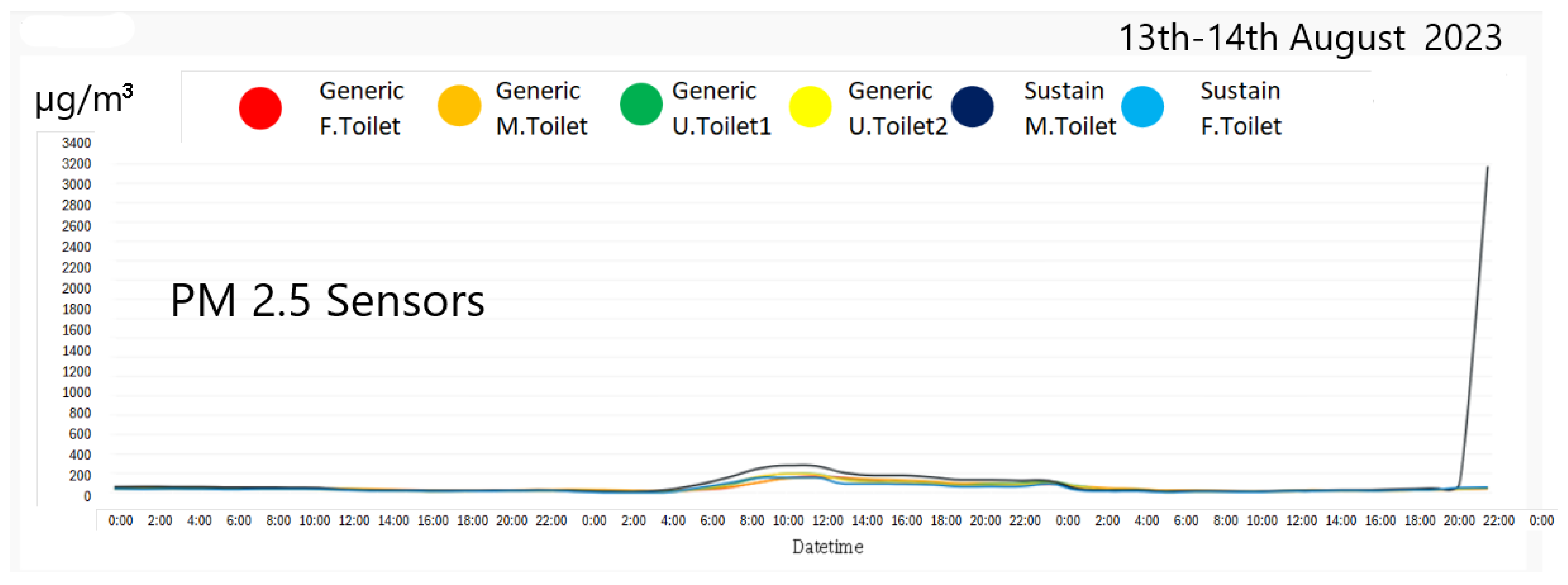
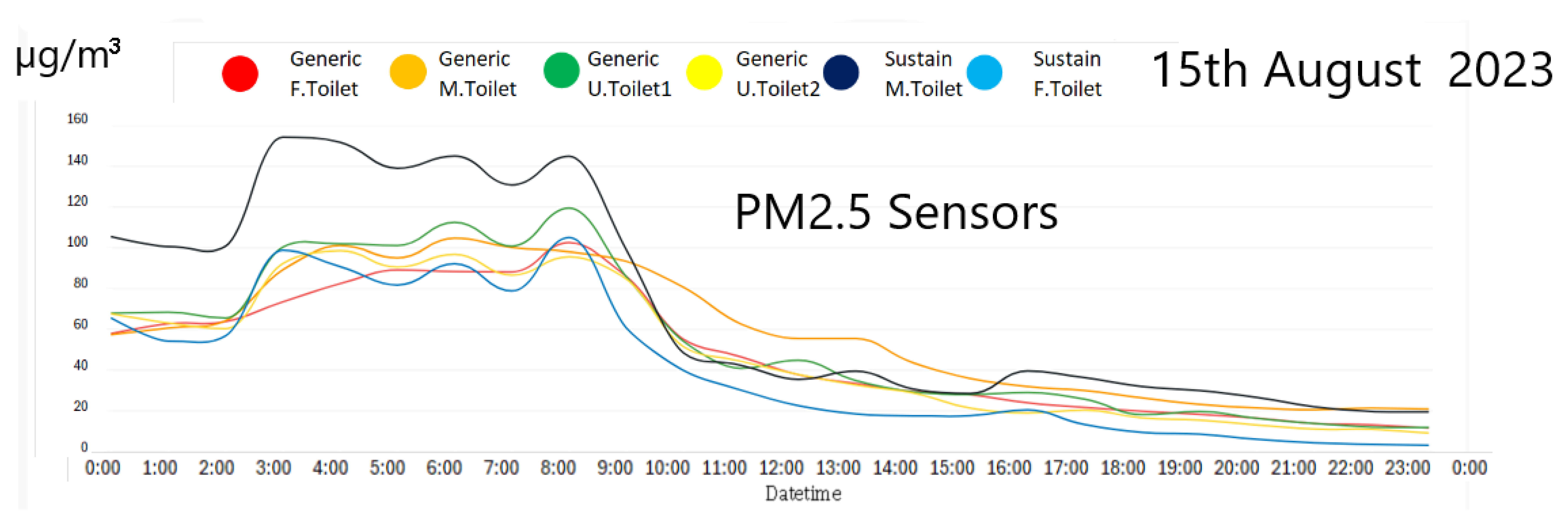
Appendix I. False Positives & External Events (Case Study)

Appendix J. Ethics, Consent, and Governance
- Human data: Not collected; environmental signals only.
- Consent: School community notice about IAQ monitoring for health/safety; no student tracking.
- Governance: Oversight by School Leadership & Facilities; periodic review with vendor; data retention 24 months; deletion on request per policy.
- Template: Community Notice (short form)
- “Our school monitors IAQ in selected amenities to deter e-cigarette use and protect health. Sensors measure particles (PM2.5/PM10) only; no cameras or audio are used. Data are de-identified and used for safety, wellbeing, and facility management.”
Appendix K. Limitations and Risk Register (Expanded)
| Risk | Description | Likelihood | Impact | Mitigation |
|---|---|---|---|---|
| External smoke | Regional burns/bushfires elevate PM | Medium | High | AQI integration; campus-wide correlation; suppression |
| Alert fatigue | Repeated alerts reduce responsiveness | High | High | Cool-downs; escalations; monthly reviews |
| User provisioning | Vendor-managed onboarding | Medium | Medium | Next-gen self-service admin |
| Sensor drift | LCS accuracy over time | Medium | Medium | QA/QC schedule; swap-outs |
| Power loss | USB power disruption | Low | Medium | UPS at outlets; device offline alerts |
Appendix L. System-Level Enhancement Options
| Proposed Upgrade | Description | Operational Limitation Addressed (Study Finding) | Expected Benefit |
|---|---|---|---|
| Enhanced dashboards | Redesigned UI with trend visualisation, daily summaries, and comparative room analysis | Dashboard misinterpretation and high cognitive load reduced staff responsiveness | Improves data interpretability, reduces cognitive burden, and supports timely decision-making |
| User-defined dashboards | Customisable dashboards tailored to user roles (facilities, wellbeing, leadership) | Generic dashboards lacked contextual relevance for different stakeholder groups | Increases sustained engagement and aligns insights with user responsibilities |
| Regional air quality integration | API-based cross-referencing with government ambient AQI data | External pollution events caused temporary false positives | Suppresses false positives and improves confidence in alerts |
| Outdoor contextual sensing | Deployment of outdoor PM2.5, PM10, and TVOC sensors | Lack of environmental context limited indoor event interpretation | Provides site-level context and improves event classification accuracy |
| Anthropic AI model analytics (cloud + edge) | Cloud-based large language models combined with lightweight edge AI trained on particulate patterns | Difficulty distinguishing vaping from confounding aerosol sources (e.g., deodorants, smoke) | Reduces alert fatigue and increases classification precision |
| Policy-linked alerts | Embedded escalation logic aligned with school wellbeing policies | Alerts did not consistently trigger structured follow-up actions | Ensures consistent, policy-aligned responses and institutional follow- through |
| Monthly review automation | Automated monthly reports on incidents, trends, and response rates | Lack of routine reflection and governance-level oversight | Encourages accountability, learning, and evidence-based governance |
| Alert confidence scoring | Assigns probabilistic confidence levels to alerts based on signal strength, rate of rise, and duration | Binary alerts contributed to alert fatigue and difficulty prioritising responses | Improves trust in alerts, prioritisation, and response quality |
| Temporal alert suppression | Implements cool-down logic to suppress repeated alerts from the same location within a defined time window | Multiple alerts triggered by single events increased cognitive load | Reduces redundant notifications and alert fatigue |
| Response capture and tagging | Allows staff to classify alert outcomes (e.g., verified event, false positive, no action) | Lack of feedback limited learning and system refinement | Enables response-rate analytics and improves AI training datasets |
| Embedded staff training module | Short, role-specific onboarding explaining alert logic, interpretation, and actions | Limited user training reduced effective system use | Improves interpretation, confidence, and institutional uptake |
| Ventilation correlation analytics | Correlates aerosol persistence with ventilation status or inferred decay rates | Limited insight into environmental drivers beyond behaviour detection | Strengthens IAQ governance and health-focused outcomes |
| Privacy-preserving analytics | Ensures analytics focus on locations and temporal patterns without individual attribution | Ethical and policy concerns risk limiting acceptance | Improves trust, compliance, and long-term adoption |
| System health and sensor drift monitoring | Automated diagnostics for sensor uptime, drift detection, and data quality flags | Undetected sensor degradation risks silent performance failure | Maintains long-term reliability and confidence in the system |
References
- Schober, W.; Szendrei, K.; Matzen, W.; Osiander-Fuchs, H.; Heitmann, D.; Schettgen, T.; Jörres, R.A.; Fromme, H. Use of electronic cigarettes (e-cigarettes) impairs indoor air quality and increases FeNO levels of e-cigarette consumers. Int. J. Hyg. Environ. Health 2014, 217, 628–637. [Google Scholar] [CrossRef] [Scilit]
- Sousan, S.; Streuber, D.; Park, Y.M.; Coombs, V.; Pender, J.; Soule, E. Evaluation of low-cost aerosol and gas sensors for real-time measurements of electronic cigarette exposure. Aerosol Sci. Technol. 2023, 57, 153–164. [Google Scholar] [CrossRef] [Scilit]
- Caciora, T.; Ilieş, A.; Berdenov, Z.; Al-Hyari, H.S.; Ilieş, D.C.; Safarov, B.; Hassan, T.H.; Herman, G.V.; Hodor, N.; Bilalov, B.; et al. Comprehensive analysis of classroom microclimate in context to health-related national and international indoor air quality standards. Front. Public Health 2024, 12, 1440376. [Google Scholar] [CrossRef] [Scilit]
- Ruprecht, A.A.; De Marco, C.; Saffari, A.; Pozzi, P.; Mazza, R.; Veronese, C.; Angellotti, G.; Munarini, E.; Ogliari, A.C.; Westerdahl, D.; et al. Environmental pollution and emission factors of electronic cigarettes, heat-not-burn tobacco products, and conventional cigarettes. Aerosol Sci. Technol. 2017, 51, 674–684. [Google Scholar] [CrossRef] [Scilit]
- Mylocopos, G.; Wennberg, E.; Reiter, A.; Hébert-Losier, A.; Filion, K.B.; Windle, S.B.; Gore, G.; O’Loughlin, J.; Grad, R.; Eisenberg, M.J. Interventions for preventing e-cigarette use among children and youth: A systematic review. Am. J. Prev. Med. 2024, 66, 351–370. [Google Scholar] [CrossRef] [Scilit] [PubMed]
- Pettigrew, S.; Miller, M.; Kannan, A.; Raj, T.S.; Jun, M.; Jones, A. School staff perceptions of the nature and consequences of students’ use of e-cigarettes. Aust. N. Z. J. Public Health 2022, 46, 676–681. [Google Scholar] [CrossRef] [Scilit]
- Therapeutic Goods Administration. Changes to the Regulation of Vapes. 2024. Available online: https://www.tga.gov.au/products/unapproved-therapeutic-goods/vaping-hub/changes-regulation-vapes (accessed on 12 December 2025).
- Melstrom, P.; Koszowski, B.; Thanner, M.H.; Hoh, E.; King, B.; Bunnell, R.; McAfee, T. Measuring PM2.5, ultrafine particles, nicotine air and wipe samples following the use of electronic cigarettes. Nicotine Tob. Res. 2017, 19, 1055–1061. [Google Scholar] [CrossRef] [Scilit]
- Kelly, K.E.; Whitaker, J.; Petty, A.; Widmer, C.; Dybwad, A.; Sleeth, D.; Martin, R.; Butterfield, A. Ambient and laboratory evaluation of a low-cost particulate matter sensor. Environ. Pollut. 2017, 221, 491–500. [Google Scholar] [CrossRef] [Scilit]
- Feenstra, B.; Papapostolou, V.; Hasheminassab, S.; Zhang, H.; Der Boghossian, B.; Cocker, D.; Polidori, A. Performance evaluation of twelve low-cost PM2.5 sensors at an ambient air monitoring site. Atmos. Environ. 2019, 216, 116946. [Google Scholar] [CrossRef] [Scilit]
- Snyder, E.G.; Watkins, T.H.; Solomon, P.A.; Thoma, E.D.; Williams, R.W.; Hagler, G.S.W.; Shelow, D.; Hindin, D.A.; Kilaru, V.J.; Preuss, P.W. The changing paradigm of air pollution monitoring. Environ. Sci. Technol. 2013, 47, 11369–11377. [Google Scholar] [CrossRef] [Scilit]
- Bonell, C.; Jamal, F.; Harden, A.; Wells, H.; Parry, W.; Fletcher, A.; Petticrew, M.; Thomas, J.; Whitehead, M.; Campbell, R.; et al. Systematic review of the effects of schools and school environment interventions on health: Evidence mapping and synthesis. Public Health Res. 2013, 1, 1–320. [Google Scholar] [CrossRef] [Scilit]
- Morawska, L.; Cao, J. Airborne transmission of SARS-CoV-2: The world should face the reality. Environ. Int. 2020, 139, 105730. [Google Scholar] [CrossRef] [Scilit] [PubMed]
- Scollo, M.; Grace, C.; Buchanan, T.; Dessaix, A. A prescription model for vapes: The way we ‘do’ medicines policy in Australia. Public Health Res. Pract. 2024, 34, e34122405. [Google Scholar] [CrossRef] [Scilit]
- Li, L.; Nguyen, C.; Lin, Y.; Guo, Y.; Fadel, N.A.; Zhu, Y. Impacts of electronic cigarettes usage on air quality of vape shops and nearby areas. Sci. Total Environ. 2021, 760, 143423. [Google Scholar] [CrossRef] [Scilit]
- Madureira, J.; Paciência, I.; Rufo, J.; Ramos, E.; Barros, H.; Teixeira, J.P.; Oliveira Fernandes, E. Indoor air quality in schools and its relationship with children’s respiratory symptoms. Atmos. Environ. 2015, 118, 145–156. [Google Scholar] [CrossRef] [Scilit]
- Mendell, M.J.; Heath, G.A. Do indoor pollutants and thermal conditions in schools influence student performance? A critical review of the literature. Indoor Air 2005, 15, 27–52. [Google Scholar] [CrossRef] [Scilit]
- Czogala, J.; Goniewicz, M.L.; Fidelus, B.; Zielinska-Danch, W.; Travers, M.J.; Sobczak, A. Secondhand exposure to vapors from electronic cigarettes. Nicotine Tob. Res. 2014, 16, 655–662. [Google Scholar] [CrossRef] [Scilit] [PubMed]
- Raza, U.; Kulkarni, P.; Sooriyabandara, M. Low power wide area networks: An overview. IEEE Commun. Surv. Tutor. 2017, 19, 855–873. [Google Scholar] [CrossRef] [Scilit]
- Ramesh, R.; Arunachalam, M.; Atluri, H.K.; Kumar, C.; Anand, S.V.R.; Arumugam, P.; Amrutur, B. LoRaWAN for smart cities: Experimental study in a campus deployment. In LPWAN Technologies for IoT and M2M Applications; Sahay, S.K., Ed.; Elsevier: Amsterdam, The Netherlands, 2020; pp. 327–345. [Google Scholar] [CrossRef] [Scilit]
- Czeczot, G.; Rojek, I.; Mikołajewski, D. Analysis of cyber security aspects of data transmission in large-scale networks based on the LoRaWAN protocol intended for monitoring critical infrastructure sensors. Electronics 2023, 12, 2503. [Google Scholar] [CrossRef] [Scilit]
- Sundell, J.; Levin, H.; Nazaroff, W.W.; Cain, W.S.; Fisk, W.J.; Grimsrud, D.T.; Gyntelberg, F.; Li, Y.; Persily, A.K.; Pickering, A.C.; et al. Ventilation rates and health: Multidisciplinary review of the scientific literature. Indoor Air 2011, 21, 191–204. [Google Scholar] [CrossRef] [Scilit]
- Mahdavi, A.; Berger, C. Ten questions regarding buildings, occupants and the energy performance gap. J. Build. Perform. Simul. 2024, 17, 457–472. [Google Scholar] [CrossRef] [Scilit]
- Cvach, M. Monitoring alarm fatigue: An integrative review. Biomed. Instrum. Technol. 2012, 46, 268–277. [Google Scholar] [CrossRef] [Scilit] [PubMed]
- Morgan, M.G.; Fischhoff, B.; Bostrom, A.; Atman, C.J. Risk Communication: A Mental Models Approach; Cambridge University Press: Cambridge, UK, 2002. [Google Scholar]
- Kwon, M.M. Clearing the smoke: Using taxes to vaporize e-cigarette consumption among youth and reduce harm from cigarettes. Va. Tax Rev. 2023, 43, 211–256. [Google Scholar]
- Witte, K. Putting the fear back into fear appeals: The extended parallel process model. Commun. Monogr. 1992, 59, 329–349. [Google Scholar] [CrossRef] [Scilit]
- Morawska, L.; Allen, J.; Bahnfleth, W.; Bluyssen, P.M.; Boerstra, A.; Buonanno, G.; Cao, J.; Dancer, S.J.; Floto, A.; Franchimon, F.; et al. A paradigm shift to combat indoor respiratory infection. Science 2021, 372, 689–691. [Google Scholar] [CrossRef] [Scilit]
- Dorizas, P.V.; Assimakopoulos, M.-N.; Santamouris, M. A holistic approach for the assessment of the indoor environmental quality, student productivity, and energy consumption in primary schools. Environ. Monit. Assess. 2015, 187, 259. [Google Scholar] [CrossRef] [Scilit] [PubMed]
- LoRa Alliance. LoRaWAN® 1.1 Specification. 2023. Available online: https://resources.lora-alliance.org/technical-specifications/lorawan-specification-v1-1 (accessed on 9 December 2025).
- Adelantado, F.; Vilajosana, X.; Tuset-Peiro, P.; Martinez, B.; Melia-Segui, J.; Watteyne, T. Understanding the limits of LoRaWAN. IEEE Commun. Mag. 2017, 55, 34–40. [Google Scholar] [CrossRef] [Scilit]
- Milesight. AM300 Series Indoor Ambience Monitoring Sensor—Specification. 2022. Available online: https://resource.milesight.com/milesight/iot/document/am300-series-datasheet-en.pdf (accessed on 10 December 2025).
- Jayaratne, R.; Liu, X.; Thai, P.; Dunbabin, M.; Morawska, L. The influence of humidity on the performance of a low-cost air particle mass sensor and the effect of atmospheric fog. Atmos. Meas. Tech. 2018, 11, 4883–4890. [Google Scholar] [CrossRef] [Scilit]
- Sayahi, T.; Butterfield, A.; Kelly, K.E. Long-term field evaluation of the Plantower PMS low-cost particulate matter sensors. Atmos. Meas. Tech. 2019, 12, 903–920. [Google Scholar] [CrossRef] [Scilit]
- Zheng, T.; Bergin, M.H.; Johnson, K.K.; Tripathi, S.N.; Shirodkar, S.; Landis, M.S.; Sutaria, R.; Carlson, D.E. Field evaluation of low-cost particulate matter sensors in high- and low-concentration environments. Atmos. Meas. Tech. 2018, 11, 4823–4846. [Google Scholar] [CrossRef] [Scilit]
| For Schools and Educational Institutions | For System Developers | For Policy and Public Health Stakeholders |
|---|---|---|
| Adopt Clear Response Protocols: Implement tiered response guidelines based on alert frequency and time of day. For example, repeated alerts in a single location should escalate automatically to pastoral care, not just facilities staff. | Develop Context-Aware Logic: Integrate external air quality APIs and train edge models to distinguish between vape signatures and environmental interference (e.g., smoke, deodorant). | Establish National Guidelines for vaping & smoking in Schools: Use vape detection as a gateway to broader IAQ standards. |
| Integrate Vaping Detection into Behaviour Policy: Align system alerts with existing wellbeing and disciplinary frameworks to ensure vaping is treated consistently with other student safety violations. | Improve Dashboard Usability: Create mobile-friendly interfaces and summary views that highlight urgent alerts without overwhelming users with raw data. | Incentivise Technology Adoption: Provide funding mechanisms for school districts to install and maintain environmental detection systems as part of public health or mental health prevention programs. |
| Train Staff and Communicate Expectations: Provide periodic refresher training on interpreting sensor data, accessing dashboards, and using alerts as evidence. Incorporate vaping system updates into all-staff communications. | Enable Policy Triggers: Allow schools to customise automation rules (e.g., alert thresholds, escalation logic, auto-reporting) to align with institutional workflows. | Include Vape Detection in Broader Public Health Strategies: Position vaping not just as a behavioural issue, but as an environmental exposure and social determinant addressed through integrated technological and psychosocial interventions. |
| Involve Students in the Solution: Promote transparency through student assemblies, classroom discussions, or peer education campaigns explaining the system’s role in promoting wellbeing, not surveillance. | Embed adaptive calibration: context-aware analytics and transparent alert logic into system design to minimise false positives, support interpretability, and enable continuous improvement based on real-world deployment data. | Support evidence-informed guidance: Frames vape detection as a preventive public health intervention, including standards for ethical deployment, data governance, response protocols, and integration with broader school wellbeing and IAQ strategies. |
Disclaimer/Publisher’s Note: The statements, opinions and data contained in all publications are solely those of the individual author(s) and contributor(s) and not of MDPI and/or the editor(s). MDPI and/or the editor(s) disclaim responsibility for any injury to people or property resulting from any ideas, methods, instructions or products referred to in the content. |
© 2026 by the authors. Licensee MDPI, Basel, Switzerland. This article is an open access article distributed under the terms and conditions of the Creative Commons Attribution (CC BY) license.
Share and Cite
Sharon, R.; Morawska, L.; Burton, L.O. Smart Vape Detection in Schools for Mitigating Student E-Cigarette Use. Int. J. Environ. Res. Public Health 2026, 23, 501. https://doi.org/10.3390/ijerph23040501
Sharon R, Morawska L, Burton LO. Smart Vape Detection in Schools for Mitigating Student E-Cigarette Use. International Journal of Environmental Research and Public Health. 2026; 23(4):501. https://doi.org/10.3390/ijerph23040501
Chicago/Turabian StyleSharon, Robert, Lidia Morawska, and Lindy Osborne Burton. 2026. "Smart Vape Detection in Schools for Mitigating Student E-Cigarette Use" International Journal of Environmental Research and Public Health 23, no. 4: 501. https://doi.org/10.3390/ijerph23040501
APA StyleSharon, R., Morawska, L., & Burton, L. O. (2026). Smart Vape Detection in Schools for Mitigating Student E-Cigarette Use. International Journal of Environmental Research and Public Health, 23(4), 501. https://doi.org/10.3390/ijerph23040501