Prevalence of ADHD Among Saudi Children and Adolescents

 ,
,  ,
,
Highlights
- Attention-deficit/hyperactivity disorder (ADHD) is a common neurodevelopmental disorder that affects children’s academic performance, behavior, and long-term psychosocial functioning.
- Regional epidemiological data on ADHD in Saudi Arabia are limited, hindering early identification, prevention, and targeted mental health planning.
- This large cross-sectional study estimates ADHD prevalence (12.7%) among children and adolescents in the Eastern Province and identifies clinical, developmental, and familial risk factors.
- Findings demonstrate substantial functional impairment and high psychiatric comorbidity, highlighting ADHD as an important contributor to childhood mental health burden.
- Early screening and school-based detection programs, particularly for high-risk children (e.g., low birth weight or family psychiatric history), may improve timely diagnosis and intervention.
- Results support strengthening child mental health services, preventive strategies, and family-centered care to reduce long-term educational and social consequences.
Abstract
1. Introduction
2. Materials and Methods
2.1. Study Design
2.2. Survey Design and Participants
2.3. Statistical Analysis
3. Results
4. Discussion
4.1. Strengths and Limitations
4.2. Implications and Future Directions
5. Conclusions
Author Contributions
Funding
Institutional Review Board Statement
Informed Consent Statement
Data Availability Statement
Conflicts of Interest
References
- World Health Organization. World Mental Health Report: Transforming Mental Health for All. 2022. Available online: https://www.who.int/publications/i/item/9789240049338 (accessed on 16 November 2025).
- Polanczyk, G.V.; Salum, G.A.; Sugaya, L.S.; Caye, A.; Rohde, L.A. Annual research review: A meta-analysis of the worldwide prevalence of mental disorders in children and adolescents. J. Child Psychol. Psychiatry 2015, 56, 345–365. [Google Scholar] [CrossRef]
- Wolraich, M.L.; Hagan, J.F., Jr.; Allan, C.; Chan, E.; Davison, D.; Earls, M.; Evans, S.W.; Flinn, S.K.; Froehlich, T.; Frost, J.; et al. Clinical Practice Guideline for the Diagnosis, Evaluation, and Treatment of Attention-Deficit/Hyperactivity Disorder in Children and Adolescents. Pediatrics 2019, 144, e20192528. [Google Scholar] [CrossRef]
- Ayano, G.; Demelash, S.; Gizachew, Y.; Tsegay, L.; Alati, R. The global prevalence of attention deficit hyperactivity disorder in children and adolescents: An umbrella review of meta-analyses. J. Affect. Disord. 2023, 339, 860–866. [Google Scholar] [CrossRef]
- Danielson, M.L.; Bitsko, R.H.; Ghandour, R.M.; Holbrook, J.R.; Kogan, M.D.; Blumberg, S.J. Prevalence of Parent-Reported ADHD Diagnosis and Associated Treatment Among, U.S. Children and Adolescents, 2016. J. Clin. Child Adolesc. Psychol. 2018, 47, 199–212. [Google Scholar] [CrossRef]
- AlZaben, F.N.; Sehlo, M.G.; Alghamdi, W.A.; Tayeb, H.O.; Khalifa, D.A.; Mira, A.T.; Alshuaibi, A.M.; Alguthmi, M.A.; Derham, A.A.; Koenig, H.G. Prevalence of attention deficit hyperactivity disorder and comorbid psychiatric and behavioral problems among primary school students in western Saudi Arabia. Saudi Med. J. 2018, 39, 52–58. [Google Scholar] [CrossRef] [PubMed]
- AlShamrani, F.J.; AlMohish, N.; AlJaafari, D.; AlAbdali, M.; Shariff, E.; Zafar, A.; Shahid, R.; AlNahdi, A.; AlDawsari, F.; Ahmad, S.; et al. Estimated prevalence study of attention-deficit/hyperactivity disorder among eastern province children in the Kingdom of Saudi Arabia. Ann. Afr. Med. 2023, 22, 544–548. [Google Scholar] [CrossRef]
- Jenahi, E.; Khalil, M.S.; Bella, H. Prevalence of attention deficit hyperactivity symptoms in female schoolchildren in Saudi Arabia. Ann. Saudi Med. 2012, 32, 462–468. [Google Scholar] [CrossRef]
- Saudi ADHD Society. Arabic Vanderbilt Parent Informant—Evidence-Based Clinical Practice Guideline for Management of ADHD in Saudi Arabia. 2020. Available online: https://cpg.adhd.org.sa/en/guideline/rating-scales/vanderbilt-parent/ (accessed on 24 February 2026).
- Al-Wardat, M.; Etoom, M.; Almhdawi, K.A.; Hawamdeh, Z.; Khader, Y. Prevalence of attention-deficit hyperactivity disorder in children, adolescents and adults in the Middle East and North Africa region: A systematic review and meta-analysis. BMJ Open 2024, 14, e078849. [Google Scholar] [CrossRef] [PubMed]
- Loe, I.M.; Feldman, H.M. Academic and educational outcomes of children with ADHD. J. Pediatr. Psychol. 2007, 32, 643–654. [Google Scholar] [CrossRef] [PubMed]
- Jangmo, A.; Stålhandske, A.; Chang, Z.; Chen, Q.; Almqvist, C.; Feldman, I.; Bulik, C.M.; Lichtenstein, P.; D’oNofrio, B.; Kuja-Halkola, R.; et al. Attention-Deficit/Hyperactivity Disorder, School Performance, and Effect of Medication. J. Am. Acad. Child Adolesc. Psychiatry 2019, 58, 423–432. [Google Scholar] [CrossRef]
- Johnson, S.; Marlow, N. Early and long-term outcome of infants born extremely preterm. Arch. Dis. Child. 2017, 102, 97–102. [Google Scholar] [CrossRef]
- Faraone, S.V.; Larsson, H. Genetics of attention deficit hyperactivity disorder. Mol. Psychiatry 2019, 24, 562–575. [Google Scholar] [CrossRef] [PubMed]
- Khoury, E.; Acquaviva, E.; Purper-Ouakil, D.; Delorme, R.; Ellul, P. Meta-analysis of personal and familial co-occurrence of Attention Deficit/Hyperactivity Disorder and Bipolar Disorder. Neurosci. Biobehav. Rev. 2023, 146, 105050. [Google Scholar] [CrossRef] [PubMed]
- AlQurashi, F.O.; Almensif, F.S.; Alkhabbaz, F.H.; Alkhawahir, K.Y.; Abalkhail, D. Screen Time Matters: Exploring the Behavioral Effects of Devices on Saudi Children. Int. J. Environ. Res. Public Health 2025, 22, 741. [Google Scholar] [CrossRef]
- Shou, Q.; Yamashita, M.; Mizuno, Y. Association of screen time with attention-deficit/hyperactivity disorder symptoms and their development: The mediating role of brain structure. Transl. Psychiatry 2025, 15, 447. [Google Scholar] [CrossRef] [PubMed]
- Aljadani, A.H.; Alshammari, T.S.; Sadaqir, R.I.; Alrashede, N.O.E.; Aldajani, B.M.; Almehmadi, S.A.; Altuhayni, A.S.; Abouzed, M.A. Prevalence and Risk Factors of Attention Deficit-Hyperactivity Disorder in the Saudi Population: A Systematic Review and Meta-analysis. Saudi J. Med. Med. Sci. 2023, 11, 126–134. [Google Scholar] [CrossRef]
- Skogli, E.W.; Teicher, M.H.; Andersen, P.N.; Hovik, K.T.; Øie, M. ADHD in girls and boys--gender differences in co-existing symptoms and executive function measures. BMC Psychiatry 2013, 13, 298. [Google Scholar] [CrossRef]
- Ni, M.; Li, L.; Li, W.; Zhang, Q.; Zhao, J.; Shen, Q.; Yao, D.; Wang, T.; Li, B.; Ding, X.; et al. Examining the relationship between birth weight and attention-deficit hyperactivity disorder diagnosis. Front. Psychiatry 2023, 14, 1074783. [Google Scholar] [CrossRef]
- Hatch, B.; Healey, D.M.; Halperin, J.M. Associations between birth weight and attention-deficit/hyperactivity disorder symptom severity: Indirect effects via primary neuropsychological functions. J. Child Psychol. Psychiatry 2014, 55, 384–392. [Google Scholar] [CrossRef]
- Huang, X.; Li, H.Q.; Simpson, A.; Xu, J.J.; Tang, W.J.; Li, Y.Y. Differences among fathers, mothers, and teachers in symptom assessment of ADHD patients. Front. Psychiatry 2023, 14, 1029672. [Google Scholar] [CrossRef]
- Aksu Meriçli, E.; Turan, F. A Comparison between School and Home Rating Scales and Reliability-Validity of the Scales-the Scales for Diagnosing Attention-Deficit/Hyperactivity Disorder. Noro Psikiyatr. Ars. 2014, 51, 195–204. [Google Scholar] [CrossRef][Green Version]
- Nafi, O.; Shahin, A.; Tarawneh, A.; Samhan, Z. Differences in identification of attention deficit hyperactivity disorder in children between teachers and parents. East Mediterr. Health J. 2020, 26, 834–838. [Google Scholar] [CrossRef] [PubMed]
- Martin, J. Why are females less likely to be diagnosed with ADHD in childhood than males? Lancet Psychiatry 2024, 11, 303–310. [Google Scholar] [CrossRef] [PubMed]
- Madsen, K.B.; Ravn, M.H.; Arnfred, J.; Olsen, J.; Rask, C.U.; Obel, C. Characteristics of undiagnosed children with parent-reported ADHD behaviour. Eur. Child. Adolesc. Psychiatry 2018, 27, 149–158. [Google Scholar] [CrossRef] [PubMed]
- Faheem, M.; Akram, W.; Akram, H.; Khan, M.A.; Siddiqui, F.A.; Majeed, I. Gender-based differences in prevalence and effects of ADHD in adults: A systematic review. Asian J. Psychiatry 2022, 75, 103205. [Google Scholar] [CrossRef]



| Study Variables | Total Sample | ADHD | Test of Sig. | p-Value | |
|---|---|---|---|---|---|
| Yes (n = 117) | No (n = 803) | ||||
| Age of the child | 10.71 ± 3.96 | 10.64 ± 3.9 | 10.72 ± 3.97 | 0.347 | 0.556 |
| Sex of the child | 0.5 | 0.48 | |||
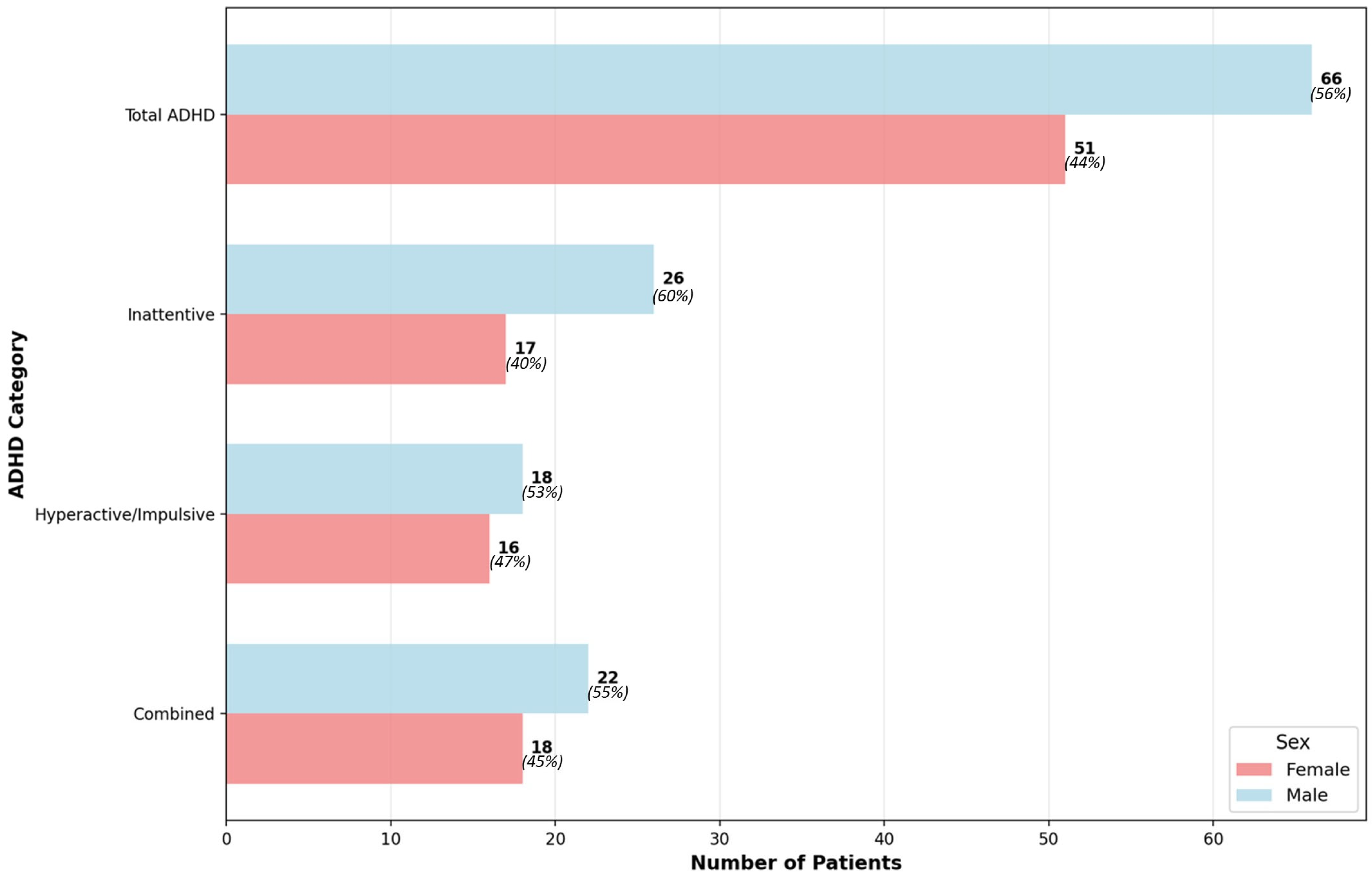
| Male | 487 (52.9%) | 66 (56.4%) | 421 (52.4%) | ||
| Female | 433 (47.1%) | 51 (43.6%) | 382 (47.6%) | ||
| Relationship with the patient | 3.826 | 0.148 | |||
| Mother | 516 (56.1%) | 71 (60.7%) | 445 (55.4%) | ||
| Father | 152 (16.5%) | 12 (10.3%) | 140 (17.4%) | ||
| Other relative | 252 (27.4%) | 34 (29.1%) | 218 (27.1%) | ||
| Age of the relative | 2.599 | 0.761 | |||
| Older than 40 years | 269 (29.2%) | 37 (31.6%) | 232 (28.9%) | ||
| 36–40 years | 176 (19.1%) | 26 (22.2%) | 150 (18.7%) | ||
| 31–35 years | 177 (19.2%) | 18 (15.4%) | 159 (19.8%) | ||
| 26–30 years | 133 (14.5%) | 14 (12.0%) | 119 (14.8%) | ||
| 20–25 years | 142 (15.4%) | 19 (16.2%) | 123 (15.3%) | ||
| Less than 20 years | 23 (2.5%) | 3 (2.6%) | 20 (2.5%) | ||
| Level of education | 2.29 | 0.808 | |||
| PhD | 63 (6.9%) | 10 (8.5%) | 53 (6.6%) | ||
| Master’s degree | 95 (10.3%) | 12 (10.3%) | 83 (10.3%) | ||
| Bachelor’s degree | 510 (55.5%) | 63 (53.8%) | 447 (55.7%) | ||
| Diploma | 110 (12.0%) | 13 (11.1%) | 97 (12.1%) | ||
| High school | 134 (14.6%) | 17 (14.5%) | 117 (14.6%) | ||
| Illiterate | 7 (0.8%) | 2 (1.7%) | 5 (0.6%) | ||
| Known ADHD or any other psychiatric disorder | 73.868 | <0.001 | |||
| No | 683 (74.2%) | 49 (41.9%) | 634 (79.0%) | ||
| ADHD | 193 (21.0%) | 54 (46.2%) | 139 (17.3%) | ||
| Other psychiatric disorders | 44 (4.8%) | 14 (12.0%) | 30 (3.7%) | ||
| Study Variables | Total Sample | ADHD | Test of Sig. | p-Value | |
|---|---|---|---|---|---|
| Yes (n = 117) | No (n = 803) | ||||
| What was the child’s weight at birth? | 8.328 | 0.08 | |||
| More than 4 kg | 56 (6.1%) | 7 (6.0%) | 49 (6.1%) | ||
| Between 4 kg and 2.5 kg | 428 (46.5%) | 59 (50.4%) | 369 (46.0%) | ||
| Between 2.5 kg and 1.5 kg | 238 (25.9%) | 22 (18.8%) | 216 (26.9%) | ||
| Less than 1.5 kg | 46 (5.0%) | 11 (9.4%) | 35 (4.4%) | ||
| Unknown | 152 (16.5%) | 18 (15.4%) | 134 (16.7%) | ||
| Mode of delivery | 8.763 | 0.033 | |||
| Normal vaginal delivery | 568 (61.7%) | 67 (57.3%) | 501 (62.4%) | ||
| Elective cesarean section | 183 (19.9%) | 19 (16.2%) | 164 (20.4%) | ||
| Emergency C/section | 107 (11.6%) | 23 (19.7%) | 84 (10.5%) | ||
| Unknown | 62 (6.7%) | 8 (6.8%) | 54 (6.7%) | ||
| At what gestational age was this childborn (Preterm/term)? | 2.765 | 0.251 | |||
| Born at or after 37 weeks of gestation | 564 (61.3%) | 72 (61.5%) | 492 (61.3%) | ||
| Born before 37 weeks of gestation | 134 (14.6%) | 22 (18.8%) | 112 (13.9%) | ||
| Unknown | 222 (24.1%) | 23 (19.7%) | 199 (24.8%) | ||
| Does the child/adolescent have a previous brain infection “meningitis”? | 10.241 | 0.006 | |||
| Yes | 49 (5.3%) | 8 (6.8%) | 41 (5.1%) | ||
| No | 790 (85.9%) | 90 (76.9%) | 700 (87.2%) | ||
| Unknown | 81 (8.8%) | 19 (16.2%) | 62 (7.7%) | ||
| Does the child/adolescent have a history of head trauma? | 13.069 | 0.0015 | |||
| Yes | 86 (9.3%) | 15 (12.8%) | 71 (8.8%) | ||
| No | 738 (80.2%) | 80 (68.4%) | 658 (81.9%) | ||
| Unknown | 96 (10.4%) | 22 (18.8%) | 74 (9.2%) | ||
| Does the child/adolescent have a previous abnormal brain imaging (CT, MRI, cranial US)? | 16.577 | <0.001 | |||
| Yes | 62 (6.7%) | 11 (9.4%) | 51 (6.4%) | ||
| No | 772 (83.9%) | 84 (71.8%) | 688 (85.7%) | ||
| Unknown | 86 (9.3%) | 22 (18.8%) | 64 (8.0%) | ||
| Did the mother have any exposure to Tobacco, Alcohol, or recreational medications during her pregnancy? | 4.627 | 0.099 | |||
| Yes | 46 (5.0%) | 9 (7.7%) | 37 (4.6%) | ||
| No | 797 (86.6%) | 94 (80.3%) | 703 (87.5%) | ||
| Unknown | 77 (8.4%) | 14 (12.0%) | 63 (7.8%) | ||
| Is there a family history (from maternal/paternal side) of any mental, behavioral, neurological disorders? | 56.935 | <0.001 | |||
| Yes | 184 (20.0%) | 48 (41.0%) | 136 (16.9%) | ||
| No | 617 (67.1%) | 43 (36.8%) | 574 (71.5%) | ||
| Unknown | 119 (12.9%) | 26 (22.2%) | 93 (11.6%) | ||
| How many hours does the child/adolescent spend on screens daily (TV, smartphones, tablets)? | 5.835 | 0.212 | |||
| More than 3 h | 417 (45.3%) | 65 (55.6%) | 352 (43.8%) | ||
| Between 2–3 h | 213 (23.2%) | 23 (19.7%) | 190 (23.7%) | ||
| Between 1–2 h | 171 (18.6%) | 18 (15.4%) | 153 (19.1%) | ||
| Less than 1 h | 76 (8.3%) | 7 (6.0%) | 69 (8.6%) | ||
| None | 43 (4.7%) | 4 (3.4%) | 39 (4.9%) | ||
| Study Variables | No ADHD (n = 803) | Inattention (n = 43) | p-Value | Hyperactivity (n = 34) | p-Value | Combined (n = 40) | p-Value |
|---|---|---|---|---|---|---|---|
| Age of the child | 10.72 ± 3.97 | 11.26 ± 3.72 | 0.363 | 10.65 ± 4.07 | 0.919 | 9.98 ± 3.9 | 0.249 |
| Sex of the child | 0.936 | 0.411 | 0.513 | ||||
| Male | 421 (52.4%) | 26 (60.5%) | 18 (52.9%) | 22 (55.0%) | |||
| Female | 382 (47.6%) | 17 (39.5%) | 16 (47.1%) | 18 (45.0%) | |||
| Relation to patient | 0.113 | 0.31 | 0.24 | ||||
| Mother | 445 (55.4%) | 27 (62.8%) | 23 (67.6%) | 21 (52.5%) | |||
| Father | 140 (17.4%) | 6 (14.0%) | 3 (8.8%) | 3 (7.5%) | |||
| Other relative | 218 (27.1%) | 10 (23.3%) | 8 (23.5%) | 16 (40.0%) | |||
| Age of the relative | 0.713 | 0.239 | 0.834 | ||||
| Older than 40 years | 232 (28.9%) | 13 (30.2%) | 7 (20.6%) | 17 (42.5%) | |||
| 36–40 years | 150 (18.7%) | 13 (30.2%) | 6 (17.6%) | 7 (17.5%) | |||
| 31–35 years | 159 (19.8%) | 6 (14.0%) | 9 (26.5%) | 3 (7.5%) | |||
| 26–30 years | 119 (14.8%) | 6 (14.0%) | 3 (8.8%) | 5 (12.5%) | |||
| 20–25 years | 123 (15.3%) | 5 (11.6%) | 7 (20.6%) | 7 (17.5%) | |||
| Less than 20 years | 20 (2.5%) | 0 (0.0%) | 2 (5.9%) | 1 (2.5%) | |||
| Level of education | 0.344 | 0.975 | 0.247 | ||||
| PhD | 53 (6.6%) | 7 (16.3%) | 3 (8.8%) | 0 (0.0%) | |||
| Master’s degree | 83 (10.3%) | 6 (14.0%) | 4 (11.8%) | 2 (5.0%) | |||
| Bachelor’s degree | 447 (55.7%) | 20 (46.5%) | 16 (47.1%) | 27 (67.5%) | |||
| Diploma | 97 (12.1%) | 5 (11.6%) | 4 (11.8%) | 4 (10.0%) | |||
| High school | 117 (14.6%) | 5 (11.6%) | 6 (17.6%) | 6 (15.0%) | |||
| Illiterate | 5 (0.6%) | 0 (0.0%) | 1 (2.9%) | 1 (2.5%) | |||
| Known ADHD or any other psychiatric disorder | <0.001 | <0.001 | <0.001 | ||||
| No | 634 (79.0%) | 14 (32.6%) | 16 (47.1%) | 19 (47.5%) | |||
| ADHD | 139 (17.3%) | 25 (58.1%) | 12 (35.3%) | 17 (42.5%) | |||
| Other psychiatric disorders | 30 (3.7%) | 4 (9.3%) | 6 (17.6%) | 4 (10.0%) | |||
| What was the child’s weight at birth? | 0.063 | 0.7 | 0.04 | ||||
| More than 4 kg | 49 (6.1%) | 2 (4.7%) | 1 (2.9%) | 4 (10.0%) | |||
| Between 4 kg and 2.5 kg | 369 (46.0%) | 21 (48.8%) | 17 (50.0%) | 21 (52.5%) | |||
| Between 2.5 kg and 1.5 kg | 216 (26.9%) | 10 (23.3%) | 6 (17.6%) | 6 (15.0%) | |||
| Less than 1.5 kg | 35 (4.4%) | 3 (7.0%) | 7 (20.6%) | 1 (2.5%) | |||
| Unknown | 134 (16.7%) | 7 (16.3%) | 3 (8.8%) | 8 (20.0%) | |||
| Mode of delivery | 0.01 | 0.735 | 0.04 | ||||
| Normal vaginal delivery | 501 (62.4%) | 24 (55.8%) | 18 (52.9%) | 25 (62.5%) | |||
| Elective cesarean section | 164 (20.4%) | 10 (23.3%) | 4 (11.8%) | 5 (12.5%) | |||
| Emergency cesarean section | 84 (10.5%) | 6 (14.0%) | 11 (32.4%) | 6 (15.0%) | |||
| Unknown | 54 (6.7%) | 3 (7.0%) | 1 (2.9%) | 4 (10.0%) | |||
| At what gestational age was this child born (Preterm/term)? | 0.343 | 0.958 | 0.03 | ||||
| Born at or after 37 weeks of gestation | 492 (61.3%) | 29 (67.4%) | 20 (58.8%) | 23 (57.5%) | |||
| Born before 37 weeks of gestation | 112 (13.9%) | 7 (16.3%) | 10 (29.4%) | 5 (12.5%) | |||
| Unknown | 199 (24.8%) | 7 (16.3%) | 4 (11.8%) | 12 (30.0%) | |||
| Does the child/adolescent have a previous brain infection, “meningitis”? | <0.001 | 0.512 | 0.02 | ||||
| Yes | 41 (5.1%) | 2 (4.7%) | 3 (8.8%) | 3 (7.5%) | |||
| No | 700 (87.2%) | 37 (86.0%) | 22 (64.7%) | 31 (77.5%) | |||
| Unknown | 62 (7.7%) | 4 (9.3%) | 9 (26.5%) | 6 (15.0%) | |||
| Does the child/adolescent have a history of head trauma? | <0.001 | 0.04 | 0.133 | ||||
| Yes | 71 (8.8%) | 3 (7.0%) | 5 (14.7%) | 7 (17.5%) | |||
| No | 658 (81.9%) | 34 (79.1%) | 22 (64.7%) | 24 (60.0%) | |||
| Unknown | 74 (9.2%) | 6 (14.0%) | 7 (20.6%) | 9 (22.5%) | |||
| Does the child/adolescent have a previous abnormal brain imaging (CT, MRI, cranial US)? | <0.001 | <0.001 | 0.124 | ||||
| Yes | 51 (6.4%) | 3 (7.0%) | 3 (8.8%) | 5 (12.5%) | |||
| No | 688 (85.7%) | 35 (81.4%) | 24 (70.6%) | 25 (62.5%) | |||
| Unknown | 64 (8.0%) | 5 (11.6%) | 7 (20.6%) | 10 (25.0%) | |||
| Did the mother have any exposure to Tobacco, Alcohol, or recreational medications during her pregnancy? | 0.175 | 0.125 | 0.378 | ||||
| Yes | 37 (4.6%) | 4 (9.3%) | 2 (5.9%) | 3 (7.5%) | |||
| No | 703 (87.5%) | 35 (81.4%) | 28 (82.4%) | 31 (77.5%) | |||
| Unknown | 63 (7.8%) | 4 (9.3%) | 4 (11.8%) | 6 (15.0%) | |||
| Is there a family history (from maternal/paternal side) of any mental, behavioral, neurological disorders? | <0.001 | <0.001 | <0.001 | ||||
| Yes | 136 (16.9%) | 19 (44.2%) | 11 (32.4%) | 18 (45.0%) | |||
| No | 574 (71.5%) | 18 (41.9%) | 12 (35.3%) | 13 (32.5%) | |||
| Unknown | 93 (11.6%) | 6 (14.0%) | 11 (32.4%) | 9 (22.5%) | |||
| How many hours does the child/adolescent spend on screens daily (TV, smartphones, tablets)? | 0.354 | 0.078 | 0.873 | ||||
| More than 3 h | 352 (43.8%) | 23 (53.5%) | 15 (44.1%) | 27 (67.5%) | |||
| Between 2–3 h | 190 (23.7%) | 9 (20.9%) | 9 (26.5%) | 5 (12.5%) | |||
| Between 1–2 h | 153 (19.1%) | 7 (16.3%) | 6 (17.6%) | 5 (12.5%) | |||
| Less than 1 h | 69 (8.6%) | 3 (7.0%) | 3 (8.8%) | 1 (2.5%) | |||
| None | 39 (4.9%) | 1 (2.3%) | 1 (2.9%) | 2 (5.0%) | |||
| Factor | Unadjusted OR (95% CI) | p-Value | Adjusted OR (95% CI) | p-Value |
|---|---|---|---|---|
| Age of the child | 0.995 (0.947–1.045) | 0.841 | 0.925 (0.862–0.992) | 0.029 |
| Female | 0.852 (0.576–1.259) | 0.42 | 0.737 (0.429–1.265) | 0.269 |
| Relationship with the patient (reference = Mother) | ||||
| Father | 0.537 (0.283–1.019) | 0.057 | 0.521 (0.217–1.255) | 0.146 |
| Other relative | 0.978 (0.63–1.517) | 0.919 | 1.039 (0.55–1.965) | 0.906 |
| Level of education (reference = Bachelor’s degree) | ||||
| PhD | 1.339 (0.648–2.765) | 0.431 | 1.749 (0.695–4.399) | 0.235 |
| Master’s degree | 1.026 (0.53–1.985) | 0.94 | 0.707 (0.281–1.779) | 0.461 |
| Diploma | 0.951 (0.503–1.796) | 0.877 | 0.637 (0.264–1.536) | 0.315 |
| High school | 1.031 (0.581–1.829) | 0.917 | 0.859 (0.387–1.905) | 0.709 |
| Illiterate | 2.838 (0.539–14.94) | 0.218 | 0.671 (0.081–5.593) | 0.713 |
| Known psychiatric disorder (reference = No) | ||||
| ADHD | 5.027 (3.276–7.712) | <0.001 | 3.561 (2.009–6.311) | <0.001 |
| Other psychiatric disorders | 6.038 (3.005–12.132) | <0.001 | 3.951 (1.498–10.42) | 0.005 |
| What was the child’s weight at birth? (reference = Between 4 kg and 2.5 kg) | ||||
| More than 4 kg | 1.411 (0.735, 2.704) | 0.3 | 1.272 (0.615–2.629) | 0.515 |
| Between 2.5 kg and 1.5 kg | 1.013 (0.678, 1.515) | 0.947 | 0.986 (0.636–1.531) | 0.953 |
| Less than 1.5 kg | 5.037 (2.688, 9.441) | <0.001 | 3.294 (1.606–6.757) | 0.0011 |
| Unknown | 0.873 (0.537, 1.419) | 0.585 | 0.669 (0.354–1.265) | 0.217 |
| Mode of delivery (reference = Normal vaginal) | ||||
| Elective cesarean section | 0.866 (0.505–1.485) | 0.602 | 0.544 (0.25–1.185) | 0.125 |
| Emergency cesarean section | 2.047 (1.209–3.468) | 0.008 | 1.916 (0.907–4.05) | 0.089 |
| Unknown | 1.108 (0.505–2.429) | 0.798 | 0.712 (0.181–2.805) | 0.628 |
| Gestational age (reference = Born at or after 37 weeks of gestation) | ||||
| Born before 37 weeks of gestation | 1.342 (0.798–2.257) | 0.267 | 0.64 (0.296–1.384) | 0.257 |
| Unknown | 0.79 (0.48–1.299) | 0.352 | 0.985 (0.462–2.102) | 0.969 |
| Previous meningitis (reference = No) | ||||
| Unknown | 2.384 (1.363–4.168) | 0.002 | 1.342 (0.461–3.909) | 0.59 |
| Yes | 1.518 (0.69–3.34) | 0.3 | 0.517 (0.146–1.833) | 0.307 |
| History of head trauma (reference = No) | ||||
| Unknown | 2.445 (1.44–4.152) | <0.001 | 1.128 (0.405–3.145) | 0.817 |
| Yes | 1.738 (0.95–3.177) | 0.073 | 1.273 (0.49–3.307) | 0.62 |
| Abnormal brain imaging (reference = No) | ||||
| Unknown | 2.815 (1.649–4.806) | <0.001 | 1.302 (0.419–4.045) | 0.648 |
| Yes | 1.767 (0.886–3.521) | 0.106 | 0.385 (0.119–1.242) | 0.11 |
| Maternal exposure during pregnancy (reference = No) | ||||
| Unknown | 1.662 (0.896–3.083) | 0.107 | 0.321 (0.098–1.054) | 0.061 |
| Yes | 1.819 (0.851–3.888) | 0.123 | 1.003 (0.287–3.505) | 0.996 |
| Family history of disorders (reference = No) | ||||
| Unknown | 3.732 (2.188–6.365) | <0.001 | 1.915 (0.807–4.542) | 0.14 |
| Yes | 4.711 (2.998–7.404) | <0.001 | 2.72 (1.482–4.992) | 0.001 |
| Screen time (reference = More than 3 h) | ||||
| Between 2–3 h | 0.993 (0.642–1.535) | 0.977 | 1.061 (0.662–1.701) | 0.805 |
| Between 1–2 h | 1.739 (1.141–2.652) | 0.01 | 1.639 (1.015–2.645) | 0.043 |
| Less than 1 h | 2.756 (1.622–4.684) | 0.051 | 2.356 (1.271–4.367) | 0.6 |
| None | 1.251 (0.575–2.721) | 0.572 | 0.68 (0.278–1.662) | 0.398 |
Disclaimer/Publisher’s Note: The statements, opinions and data contained in all publications are solely those of the individual author(s) and contributor(s) and not of MDPI and/or the editor(s). MDPI and/or the editor(s) disclaim responsibility for any injury to people or property resulting from any ideas, methods, instructions or products referred to in the content. |
© 2026 by the authors. Licensee MDPI, Basel, Switzerland. This article is an open access article distributed under the terms and conditions of the Creative Commons Attribution (CC BY) license.
Share and Cite
AlQurashi, F.O.; Alrasan, R.A.; Mohamed, R.N.; Alzahrani, N.M.; Mohammedhussain, A.A.; Sharbini, N.N.; Almanasif, B.M. Prevalence of ADHD Among Saudi Children and Adolescents. Int. J. Environ. Res. Public Health 2026, 23, 436. https://doi.org/10.3390/ijerph23040436
AlQurashi FO, Alrasan RA, Mohamed RN, Alzahrani NM, Mohammedhussain AA, Sharbini NN, Almanasif BM. Prevalence of ADHD Among Saudi Children and Adolescents. International Journal of Environmental Research and Public Health. 2026; 23(4):436. https://doi.org/10.3390/ijerph23040436
Chicago/Turabian StyleAlQurashi, Faisal O., Renad A. Alrasan, Reem N. Mohamed, Nora M. Alzahrani, Alea A. Mohammedhussain, Nersyan N. Sharbini, and Bayan M. Almanasif. 2026. "Prevalence of ADHD Among Saudi Children and Adolescents" International Journal of Environmental Research and Public Health 23, no. 4: 436. https://doi.org/10.3390/ijerph23040436
APA StyleAlQurashi, F. O., Alrasan, R. A., Mohamed, R. N., Alzahrani, N. M., Mohammedhussain, A. A., Sharbini, N. N., & Almanasif, B. M. (2026). Prevalence of ADHD Among Saudi Children and Adolescents. International Journal of Environmental Research and Public Health, 23(4), 436. https://doi.org/10.3390/ijerph23040436