Exploring the Italian Experience with Long-Acting Buprenorphine Formulations (LAIB) for the Treatment of Opioid Use Disorder: A Series of Narrative Interviews

Highlights
- Opioid Use Disorder is a chronic public health condition requiring long-term, sustainable treatment strategies that extend beyond symptom control.
- Long-acting buprenorphine (LAIB) formulations address structural and psychosocial barriers associated with daily opioid agonist therapy.
- The present analysis provides the first narrative-based evidence from Italy on patient experiences with long-acting injectable buprenorphine.
- Findings show that treatment effectiveness in OUD includes autonomy, stigma reduction, and psychosocial recovery, not only pharmacological stabilization.
- Incorporating patient narratives into addiction care can inform more personalized, recovery-oriented, and acceptable treatment pathways.
- LAIB may support broader public health goals by improving adherence, social reintegration, and long-term treatment sustainability.
Abstract
1. Introduction
2. Materials and Methods
2.1. Study Design
2.2. Participants
2.3. Data Collection
2.4. Narrative Analysis and Coding Procedure
2.5. Thematic Areas
2.5.1. Time and Personal Freedom
2.5.2. Economic and Practical Aspects
2.5.3. Perception of Dependence and Autonomy
2.5.4. Emotional Experience
2.5.5. Impact on Daily Life
2.5.6. Barriers and Adherence Difficulties
2.5.7. Craving and Control of Desire
2.5.8. Motivation and Determination to Change
2.5.9. Craving Combined with Adherence Difficulties
2.5.10. Overall Impact on Life
3. Results
3.1. Life Background and Early Context
3.2. Initiation and Escalation of Opioid Use
3.3. Experience with Standard-of-Care Treatment
3.4. Experience with Long-Acting Subcutaneous Buprenorphine (LAIB)
3.5. Cross-Phase Comparative Synthesis
4. Discussion
5. Conclusions
Supplementary Materials
Author Contributions
Funding
Institutional Review Board Statement
Informed Consent Statement
Data Availability Statement
Acknowledgments
Conflicts of Interest
References
- Opioid Overdose. Available online: https://www.who.int/news-room/fact-sheets/detail/opioid-overdose (accessed on 9 December 2025).
- Dietze, P.; Colledge-Frisby, S.; Gerra, G.; Poznyak, V.; Campello, G.; Kashino, W.; Dzhonbekov, D.; Kiriazova, T.; Nikitin, D.; Terlikbayeva, A.; et al. Impact of UNODC/WHO S-O-S (stop-overdose-safely) training on opioid overdose knowledge and attitudes among people at high or low risk of opioid overdose in Kazakhstan, Kyrgyzstan, Tajikistan and Ukraine. Harm Reduct. J. 2025, 22, 20. [Google Scholar] [CrossRef]
- Opioid Agonist Treatment—The Current Situation in Europe (European Drug Report 2024)|www.euda.europa.eu. Available online: https://www.euda.europa.eu/publications/european-drug-report/2024/opioid-agonist-treatment_en#level-6 (accessed on 23 October 2024).
- Relazione Annuale al Parlamento sul Fenomeno Delle Tossicodipendenze in Italia Anno 2025 (Dati 2024). Dipartimento Delle Politiche Contro la Droga e le Altre Dipendenze. Available online: https://www.politicheantidroga.gov.it/it/notizie-e-approfondimenti/relazioni-annuali-al-parlamento/relazione-annuale-al-parlamento-sul-fenomeno-delle-tossicodipendenze-in-italia-anno-2025/ (accessed on 9 December 2025).
- Sordo, L.; Barrio, G.; Bravo, M.J.; Indave, B.I.; Degenhardt, L.; Wiessing, L.; Ferri, M.; Pastor-Barriuso, R. Mortality risk during and after opioid substitution treatment: Systematic review and meta-analysis of cohort studies. BMJ 2017, 357, j1550. [Google Scholar] [CrossRef]
- Drug Misuse and Dependence: UK Guidelines on Clinical Management. GOVUK. 2017. Available online: https://www.gov.uk/government/publications/drug-misuse-and-dependence-uk-guidelines-on-clinical-management (accessed on 9 December 2025).
- Anno IV Numero 2 2021. Patient and Clinical Practice. Available online: https://www.patientandclinicalpractice.com/anno-iv-numero-2-2021/ (accessed on 13 December 2025).
- Abuse NI on D. Opioid Use Disorder Treatment|National Institute on Drug Abuse (NIDA). 2023. Available online: https://nida.nih.gov/nidamed-medical-health-professionals/treatment/opioid-use-disorder-treatment (accessed on 9 December 2025).
- Johnson, B.; Monwell, B.; Capusan, A.J. Long-acting injectable depot buprenorphine from a harm reduction perspective in patients with ongoing substance use and multiple psychiatric comorbidities: A qualitative interview study. Harm Reduct. J. 2024, 21, 68. [Google Scholar] [CrossRef]
- Riglietta, M.; D’Egidio, P.F.; Lucchini, A.; D’Aloisio, N.; Buzzi, M.L. Le formulazioni long term dei farmaci agonisti nella clinica del disturbo da uso di oppiacei in Italia. Mission 2020, 53, 45–64. [Google Scholar] [CrossRef]
- Agenzia Italiana del Farmaco (AIFA). Buprenorfina. Riassunto Delle Caratteristiche del Prodotto. Available online: https://share.google/aSE4hAhBmZZSoFoca (accessed on 3 February 2026).
- Lofwall, M.R.; Walsh, S.L. A review of buprenorphine diversion and misuse: The current evidence base and experiences from around the world. J. Addict. Med. 2014, 8, 315–326. [Google Scholar] [CrossRef]
- Wright, N.; D’Agnone, O.; Krajci, P.; Littlewood, R.; Alho, H.; Reimer, J.; Roncero, C.; Somaini, L.; Maremmani, I. Addressing misuse and diversion of opioid substitution medication: Guidance based on systematic evidence review and real-world experience. J. Public Health 2016, 38, e368–e374. [Google Scholar] [CrossRef] [PubMed]
- Adams, J.W.; Duprey, M.; Khan, S.; Cance, J.; Rice, D.P.; Bobashev, G. Examining buprenorphine diversion through a harm reduction lens: An agent-based modeling study. Harm Reduct. J. 2023, 20, 150. [Google Scholar] [CrossRef] [PubMed]
- Search|European Medicines Agency (EMA). 2019. Available online: https://www.ema.europa.eu/en/search (accessed on 13 December 2025).
- Frost, M.; Bailey, G.L.; Lintzeris, N.; Strang, J.; Dunlop, A.; Nunes, E.V.; Jansen, J.B.; Frey, L.C.; Weber, B.; Haber, P.; et al. Long-term safety of a weekly and monthly subcutaneous buprenorphine depot (CAM2038) in the treatment of adult out-patients with opioid use disorder. Addiction 2019, 114, 1416–1426. [Google Scholar] [CrossRef]
- Jones, A.K.; Ngaimisi, E.; Gopalakrishnan, M.; Young, M.A.; Laffont, C.M. Population Pharmacokinetics of a Monthly Buprenorphine Depot Injection for the Treatment of Opioid Use Disorder: A Combined Analysis of Phase II and Phase III Trials. Clin. Pharmacokinet. 2021, 60, 527–540. [Google Scholar] [CrossRef]
- Rosenthal, R.N.; Lofwall, M.R.; Kim, S.; Chen, M.; Beebe, K.L.; Vocci, F.J.; PRO-814 Study Group. Effect of Buprenorphine Implants on Illicit Opioid Use Among Abstinent Adults with Opioid Dependence Treated with Sublingual Buprenorphine: A Randomized Clinical Trial. Jama 2016, 316, 282–290. [Google Scholar] [CrossRef]
- Lintzeris, N.; Dunlop, A.J.; Haber, P.S.; Lubman, D.I.; Graham, R.; Hutchinson, S.; Arunogiri, S.; Hayes, V.; Hjelmström, P.; Svedberg, A.; et al. Patient-Reported Outcomes of Treatment of Opioid Dependence With Weekly and Monthly Subcutaneous Depot vs. Daily Sublingual Buprenorphine: A Randomized Clinical Trial. JAMA Netw. Open 2021, 4, e219041. [Google Scholar] [CrossRef]
- Allen, E.; Samadian, S.; Altobelli, G.; Johnson, J.; Holmwood, C. Exploring patient experience and satisfaction with depot buprenorphine formulations: A mixed-methods study. Drug Alcohol Rev. 2023, 42, 791–802. [Google Scholar] [CrossRef]
- Barnett, A.; Pienaar, K.; Lubman, D.I.; Arunogiri, S.; Phan, V.; Hayes, V.; Lintzeris, N.; Savic, M. The dynamics of more-than-human care in depot buprenorphine treatment: A new materialist analysis of Australian patients’ experiences. Int. J. Drug Policy 2024, 127, 104399. [Google Scholar] [CrossRef]
- Scurti, P.; Nunzi, M.; Leonardi, C.; Pierlorenzi, C.; Marenzi, R.; Lamartora, V. The experience of buprenorphine implant in patients with opioid use disorder: A series of narrative interviews. Front. Psychiatry 2023, 14, 1205285. [Google Scholar] [CrossRef] [PubMed]
- Johnson, B.; Flensburg, O.L.; Capusan, A.J. Patient perspectives on depot buprenorphine treatment for opioid addiction—A qualitative interview study. Subst. Abuse Treat. Prev. Policy 2022, 17, 40. [Google Scholar] [CrossRef] [PubMed]
- Neale, J.; Tompkins, C.N.E.; Strang, J. Depot buprenorphine injections for opioid use disorder: Patient information needs and preferences. Drug Alcohol Rev. 2019, 38, 510–518. [Google Scholar] [CrossRef]
- Ariano, C.; Balestra, R.; Casella, P.; Consoli, A.; Pagano, A.M.; Ranieri, R.; Sciortino, B.; Somaini, L.; Tamussi, E. Un nuovo approccio per il trattamento della dipendenza da oppiacei nel contesto italiano. Il parere degli esperti. Mission 2024, XVIII, 10–15. [Google Scholar] [CrossRef]
- Greenhalgh, T. Cultural Contexts of Health: The Use of Narrative Research in the Health Sector; WHO Regional Office for Europe: Copenhagen, Denmark, 2016. Available online: http://www.ncbi.nlm.nih.gov/books/NBK391066/ (accessed on 9 December 2025).
- Nordgren, J.; Monwell, B.; Johnson, B.; Gunnarsson, N.V.; Capusan, A.J. Healthcare staff’s perspectives on long-acting injectable buprenorphine treatment: A qualitative interview study. Addict. Sci. Clin. Pract. 2024, 19, 25. [Google Scholar] [CrossRef]
- Wakeman, S.E.; Larochelle, M.R.; Ameli, O.; Chaisson, C.E.; McPheeters, J.T.; Crown, W.H.; Azocar, F.; Sanghavi, D.M. Comparative Effectiveness of Different Treatment Pathways for Opioid Use Disorder. JAMA Netw. Open 2020, 3, e1920622. [Google Scholar] [CrossRef]
- Korthuis, P.T.; McCarty, D.; Weimer, M.; Bougatsos, C.; Blazina, I.; Zakher, B.; Grusing, S.; Devine, B.; Chou, R. Primary Care-Based Models for the Treatment of Opioid Use Disorder: A Scoping Review. Ann. Intern. Med. 2017, 166, 268–278. [Google Scholar] [CrossRef]
- D’Onofrio, G.; O’Connor, P.G.; Pantalon, M.V.; Chawarski, M.C.; Busch, S.H.; Owens, P.H.; Bernstein, S.L.; Fiellin, D.A. Emergency department-initiated buprenorphine/naloxone treatment for opioid dependence: A randomized clinical trial. Jama 2015, 313, 1636–1644. [Google Scholar] [CrossRef] [PubMed]
- D’Onofrio, G.; Chawarski, M.C.; O’Connor, P.G.; Pantalon, M.V.; Busch, S.H.; Owens, P.H.; Hawk, K.; Bernstein, S.L.; Fiellin, D.A. Emergency Department-Initiated Buprenorphine for Opioid Dependence with Continuation in Primary Care: Outcomes During and After Intervention. J. Gen. Intern. Med. 2017, 32, 660–666. [Google Scholar] [CrossRef] [PubMed]
- DeFulio, A.; Rzeszutek, M.J.; Furgeson, J.; Ryan, S.; Rezania, S. A smartphone-smartcard platform for contingency management in an inner-city substance use disorder outpatient program. J. Subst. Abus. Treat. 2021, 120, 108188. [Google Scholar] [CrossRef] [PubMed]
- Estimated Numbers of People Prescribed Opioid Substitution Therapy in Scotland (2021 to 2022)—Estimated Numbers of People Prescribed Opioid Substitution Therapy in Scotland—Publications—Public Health Scotland. Available online: https://publichealthscotland.scot/publications/estimated-numbers-of-people-prescribed-opioid-substitution-therapy-in-scotland/estimated-numbers-of-people-prescribed-opioid-substitution-therapy-in-scotland-2021-to-2022/?utm_source=chatgpt.com (accessed on 13 December 2025).
- Long-Acting Injectable Buprenorphine (LAIB) for Opioid Dependence Treatment. Available online: https://www.health.nsw.gov.au:443/aod/resources/Pages/laib.aspx (accessed on 13 December 2025).
- Linee Guida Per il Trattamento Farmacologico e Psicosociale Della Dipendenza da Oppiacei. ISS. Available online: https://www.iss.it/-/linee-guida-per-il-trattamento-farmacologico-e-psicosociale-della-dipendenza-da-oppiacei-3 (accessed on 13 December 2025).


| Theme | Description | Patients (n) | Statements |
|---|---|---|---|
| Early exposure to problematic social environments | Growing up in environments where drug use was present. | 6 | ‘The people I spent time with were already experimenting with substances.’ ‘In my area, drugs were easy to find; it was part of the environment.’ |
| School difficulties and early disengagement | School dropout, poor performance, lack of interest, or early behavioural issues. | 7 | ‘School didn’t feel like a place where I belonged.’ ‘I left school early because I couldn’t stay focused or motivated.’ |
| Emotional distress in youth | Feelings of sadness, anxiety, inadequacy, or early emotional fragility. | 8 | ‘Even as a teenager, I felt emotionally overwhelmed without knowing how to cope.’ ‘I often felt uneasy and tense inside, even when nothing was happening.’ |
| Loneliness or social marginality | Feeling different, excluded, or isolated. | 5 | ‘I always felt a bit different from the people around me.’ ‘I didn’t have many meaningful friendships growing up.’ |
| Early responsibilities or premature adulthood | Needing to work early, taking care of family needs, or confronting difficulties too soon. | 3 | ‘I started working young because my family needed help.’ ‘I had to manage many things alone from an early age.’ |
| Theme | Description | Patients (n) | Statements |
|---|---|---|---|
| Curiosity or experimentation during adolescence | Substance use began as exploration, imitation of peers, or youthful experimentation. | 6 | ‘At first I tried it out of curiosity, without understanding the risks.’ ‘I experimented because others my age were doing the same.’ |
| Substance use triggered by peer group influence | Initial use occurred within a social group already involved with substances. | 9 | ‘I started because everyone around me was already using.’ ‘Being with that group made it feel normal to try.’ |
| Emotional or psychological triggers | Substances used to cope with anxiety, sadness, trauma, or emotional pain | 8 | ‘Substances made me feel calmer when I couldn’t manage my emotions.’ ‘I used to escape from situations I felt unable to handle.’ |
| Self-medication for discomfort | Substances were used to manage physical symptoms or internal discomfort. | 7 | ‘At the beginning, it helped me feel balanced enough to get through the day.’ ‘I used the substance because it eased a sense of inner discomfort I couldn’t describe.’ |
| Environmental exposure in early adulthood | First use occurred in contexts such as nightlife, work environments, or street settings | 7 | ‘Where I was working, drugs were always around.’ ‘I came across it in the street, and it slowly became part of my routine.’ |
| Escalation from ‘lighter’ substances to opioids | Initial use of non-opioid substances later progressed to heroin or other opioids. | 6 | ‘It started with milder substances and gradually escalated.’ ‘What began as occasional use became something stronger over time.’ |
| Theme | Description | Patients (n) | Statements |
|---|---|---|---|
| Physical deterioration and health issues | Physical decline, withdrawal-related suffering, exhaustion, or illness linked to substance use. | 11 | ‘My body couldn’t take it anymore; I felt physically drained most of the time.’ ‘I often felt sick, weak, and unable to function normally.’ |
| Impact on work and daily functioning | Difficulty maintaining employment, instability, loss of routine. | 8 | ‘I couldn’t keep a job because the substance controlled everything I did.’ ‘My days revolved around getting and using the substance; working was impossible.’ |
| Negative effects on family relationships | Tension, loss of trust, emotional distance, or family suffering. | 8 | ‘My family suffered a lot because of my addiction; they didn’t know how to help me.’ ‘My relationships at home fell apart as my use got worse.’ |
| Social isolation and marginalisation | Loss of friendships, distancing from healthy networks, and stigmatisation. | 9 | ‘Little by little, I isolated myself and stopped seeing people who cared about me.’ ‘I ended up alone because my whole life was centred around using.’ |
| Financial strain | Spending money on substances, debt, and loss of economic stability. | 6 | ‘All my money went into drugs; I couldn’t manage even basic expenses.’ ‘I lost financial control completely and couldn’t keep up with bills.’ |
| Legal problems or risky behaviours | Police encounters, theft, unsafe environments, and dangerous situations. | 6 | ‘I got into trouble with the law because of the life surrounding the substance.’ ‘I found myself in risky environments and situations just to get what I needed.’ |
| Loss of personal identity and self-worth | Feeling defeated, ashamed, or disconnected from one’s sense of self. | 9 | ‘I didn’t recognise myself anymore; everything revolved around the drug.’ ‘I felt like I had lost all dignity; the substance dictated who I was.’ |
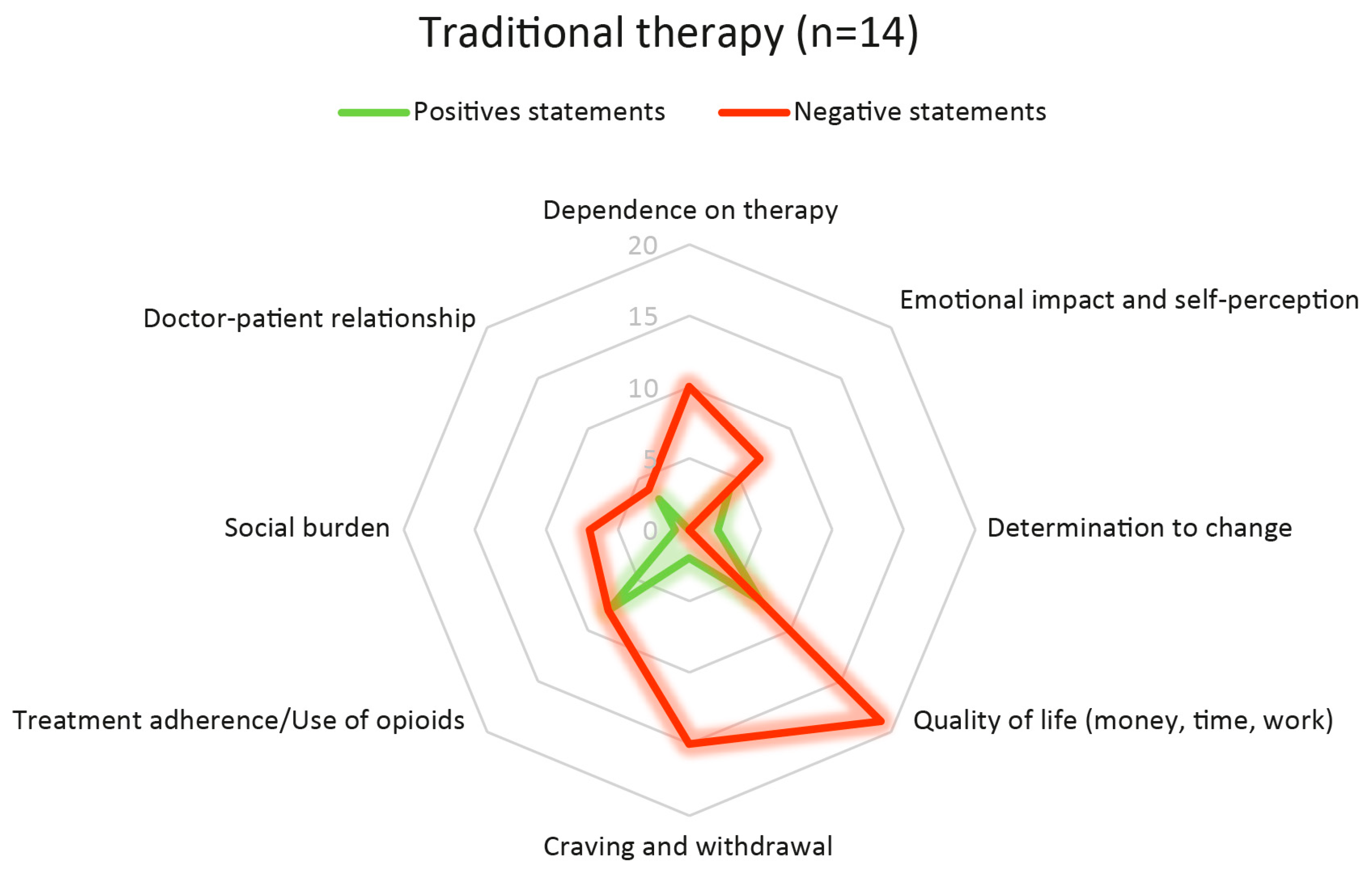
| Total | Positive Statements | Negative Statements |
|---|---|---|
| Dependence on the daily demands of the treatment regimen | 0 | 10 |
| Emotional impact and self-perception | 4 | 7 |
| Determination to change | 2 | 0 |
| QoL (money, time, work) | 7 | 19 |
| Craving and withdrawal symptoms | 2 | 15 |
| Treatment adherence/Use of opioids | 8 | 8 |
| Social burden | 1 | 7 |
| Doctor–patient relationship | 3 | 4 |
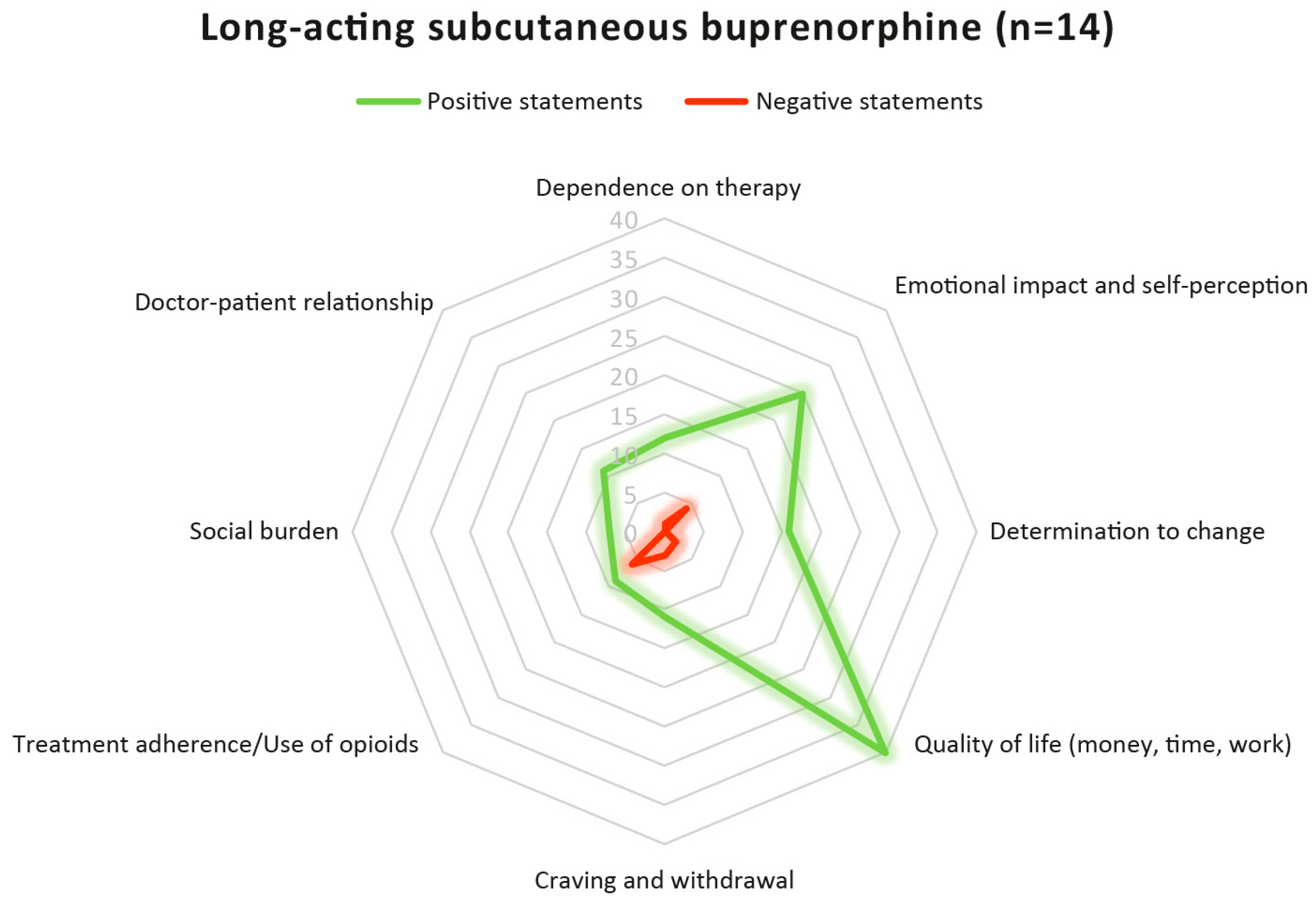
| Total | Positive Statements | Negative Statements |
|---|---|---|
| Dependence on the daily demands of the treatment regimen | 12 | 1 |
| Emotional impact and self-perception | 25 | 4 |
| Determination to change | 16 | 0 |
| QoL (money, time, work) | 40 | 2 |
| Craving and withdrawal symptoms | 11 | 3 |
| Treatment adherence/Use of opioids | 9 | 6 |
| Social burden | 7 | 0 |
| Doctor–patient relationship | 11 | 0 |
Disclaimer/Publisher’s Note: The statements, opinions and data contained in all publications are solely those of the individual author(s) and contributor(s) and not of MDPI and/or the editor(s). MDPI and/or the editor(s) disclaim responsibility for any injury to people or property resulting from any ideas, methods, instructions or products referred to in the content. |
© 2026 by the authors. Licensee MDPI, Basel, Switzerland. This article is an open access article distributed under the terms and conditions of the Creative Commons Attribution (CC BY) license.
Share and Cite
Ariano, V.; Costanzo, A.F.; Ferrante, G.; Garofano, R.; Lamartora, V.; Manfré, S.; Nordici, D.; Somaini, L. Exploring the Italian Experience with Long-Acting Buprenorphine Formulations (LAIB) for the Treatment of Opioid Use Disorder: A Series of Narrative Interviews. Int. J. Environ. Res. Public Health 2026, 23, 336. https://doi.org/10.3390/ijerph23030336
Ariano V, Costanzo AF, Ferrante G, Garofano R, Lamartora V, Manfré S, Nordici D, Somaini L. Exploring the Italian Experience with Long-Acting Buprenorphine Formulations (LAIB) for the Treatment of Opioid Use Disorder: A Series of Narrative Interviews. International Journal of Environmental Research and Public Health. 2026; 23(3):336. https://doi.org/10.3390/ijerph23030336
Chicago/Turabian StyleAriano, Vincenza, Anna Francesca Costanzo, Gemma Ferrante, Rossella Garofano, Vincenzo Lamartora, Sergio Manfré, Deborah Nordici, and Lorenzo Somaini. 2026. "Exploring the Italian Experience with Long-Acting Buprenorphine Formulations (LAIB) for the Treatment of Opioid Use Disorder: A Series of Narrative Interviews" International Journal of Environmental Research and Public Health 23, no. 3: 336. https://doi.org/10.3390/ijerph23030336
APA StyleAriano, V., Costanzo, A. F., Ferrante, G., Garofano, R., Lamartora, V., Manfré, S., Nordici, D., & Somaini, L. (2026). Exploring the Italian Experience with Long-Acting Buprenorphine Formulations (LAIB) for the Treatment of Opioid Use Disorder: A Series of Narrative Interviews. International Journal of Environmental Research and Public Health, 23(3), 336. https://doi.org/10.3390/ijerph23030336