What Makes a Neighborhood? Associations Between Behavioral and Psychosocial Factors and Perceptions of Neighborhood Environments Among Community-Dwelling Older Black and Latino Adults

 ,
,  , , , ,
Highlights
- How people perceive their neighborhood environments can impact their aging trajectories, independent of objective measures.
- Previous studies largely do not emphasize how non-Latino Black and Latino older adults perceive their neighborhood environments and the impact of behavioral and psychosocial factors.
- Non-Latino Black and Latino older adults reported overall neutral perceptions of their neighborhoods.
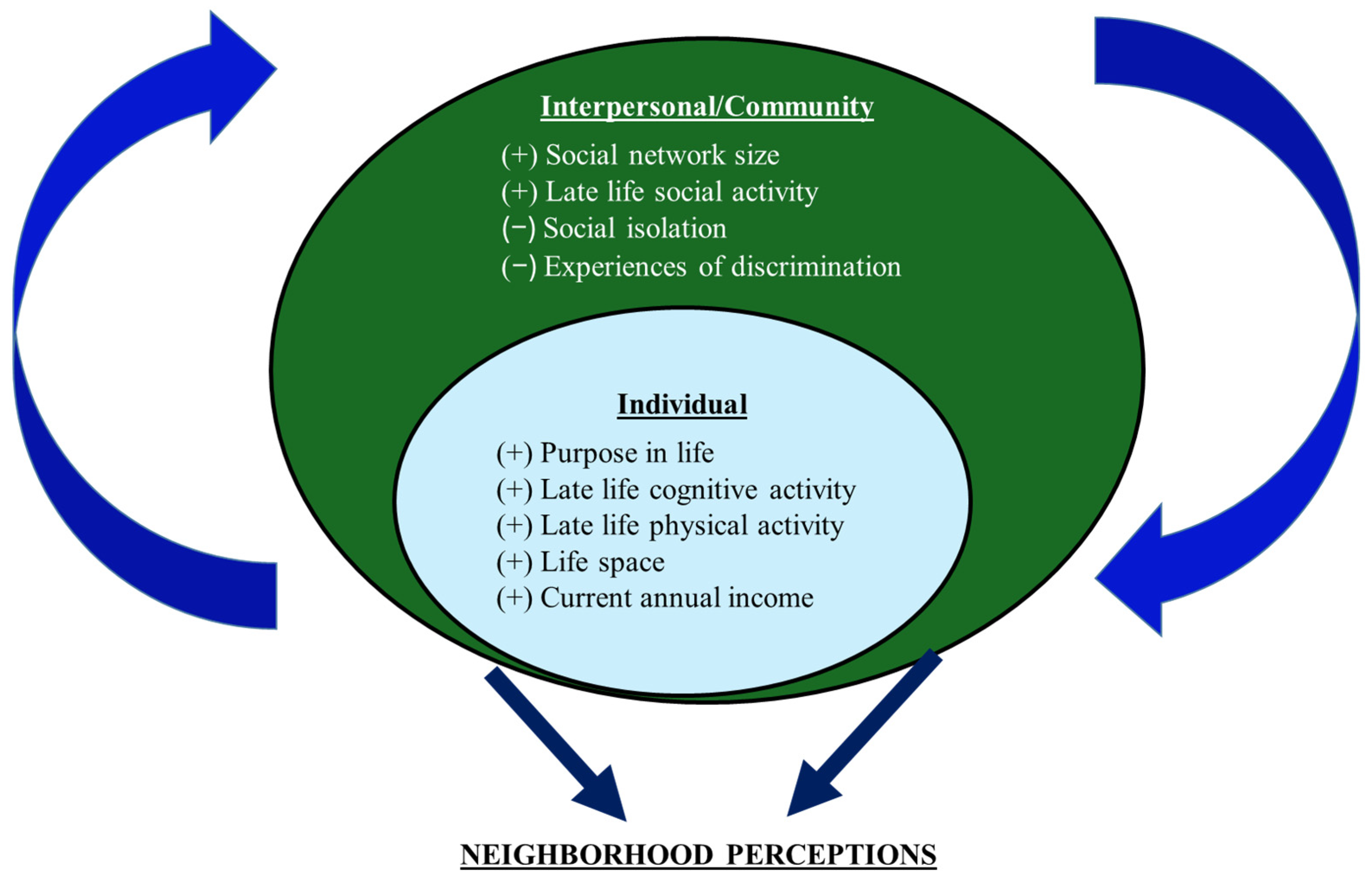
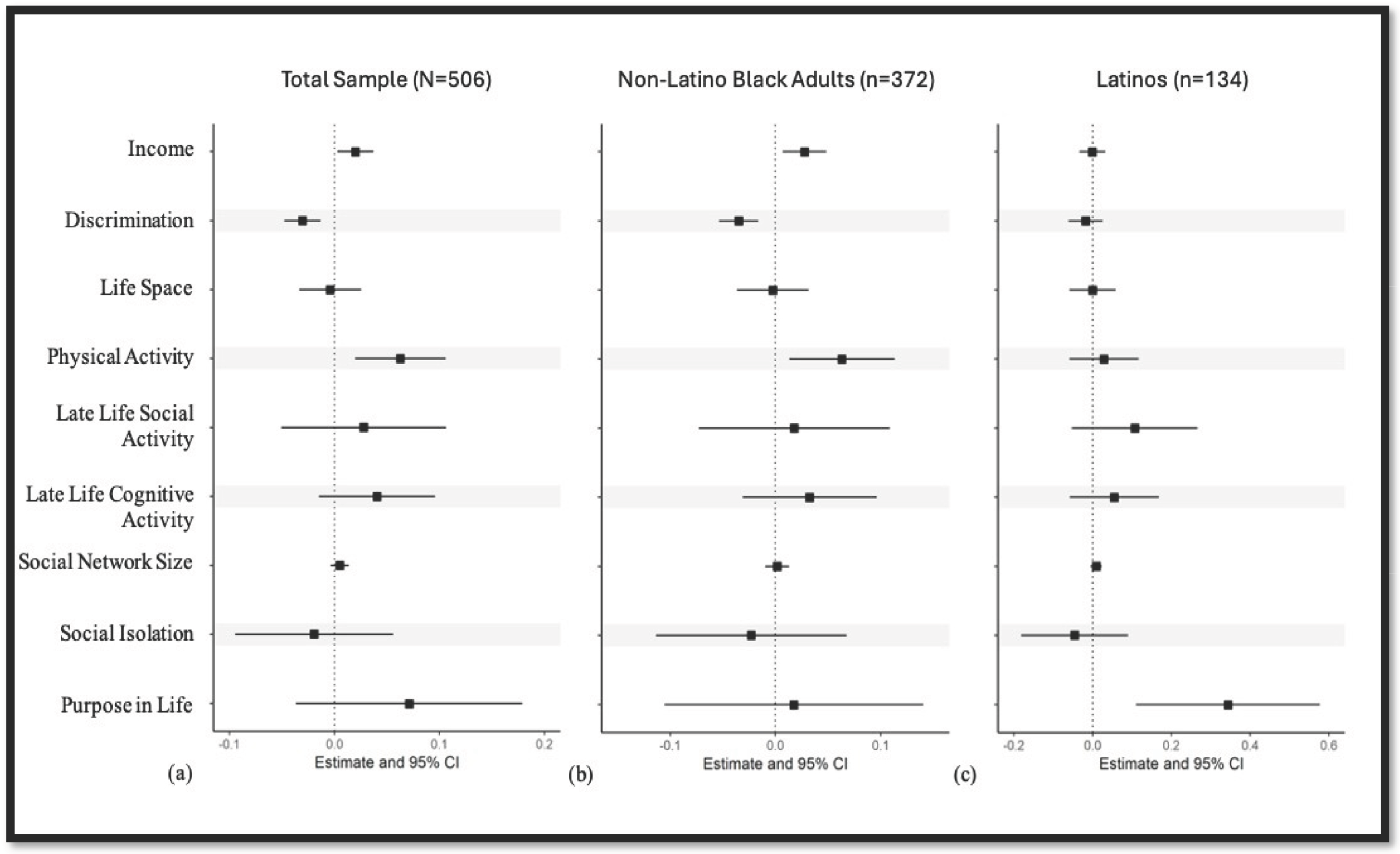
- Better neighborhood perceptions were associated with less discrimination and higher income for non-Latino Black older adults, while more purpose in life was related to better neighborhood perceptions among older Latinos.
- Intervention strategies must exist at the individual, social, and structural levels and focus on income, discrimination, physical activity, late life social activity, and purpose in life among non-Latino Black and Latino older adults.
- When combined, these multilevel strategic efforts may benefit structural and social characteristics of neighborhood environments as well as neighborhood perceptions which, in turn, can facilitate overall health and quality of life for non-Latino Black and Latino older adults.
Abstract
1. Introduction
2. Materials and Methods
2.1. Participants
2.2. Outcome Variable: Modified Perceptions of Neighborhood Environments Scale (mPNES)
2.3. Behavioral and Psychosocial Factors
2.4. Behavioral Factors
2.5. Psychosocial Factors
2.6. Analyses
3. Results
3.1. Participant Characteristics
3.2. Perceptions of Neighborhood Environments
3.3. Associations Between Behavioral and Psychosocial Factors and Neighborhood Perceptions
3.3.1. mPNES Total Scale
3.3.2. mPNES Community Cohesiveness Subscale
3.3.3. mPNES Health Opportunities Subscale
3.3.4. mPNES Ambient Surroundings Subscale
4. Discussion
5. Conclusions
Author Contributions
Funding
Institutional Review Board Statement
Informed Consent Statement
Data Availability Statement
Acknowledgments
Conflicts of Interest
Abbreviations
| NL | Non-Latino |
| WHO | World Health Organization |
| RADC | Rush Alzheimer’s Disease Center |
| MAP | Rush Memory and Aging Project |
| MARS | Minority Aging Research Study |
| mPNES | Modified Perceptions of Neighborhood Environments Scale |
Appendix A


| Item |
| Subscale 1: Community Cohesiveness |
|
| Subscale 2: Health Opportunities |
|
| Subscale 3: Ambient Surroundings |
|
| Variables | Full Sample (N = 506) | Non-Latino Black Older Adults (n = 372) | Older Latinos (n = 134) |
| Demographic Characteristics | |||
| Age | 79.09 (6.53; 62.56–98.59) | 80.66 (6.05; 66.72–98.59) | 74.73 (5.83; 62.56–93.11) |
| Gender, Women | 423 (84%) | 320 (86%) | 103 (77%) |
| Years of Education | 14.26 (4.05; 0.00–30.00) | 15.36 (3.13; 5.00–30.00) | 11.22 (4.71; 0.00–22.00) |
| MMSE Score | 28.00 (26.00–30.00) | 28.00 (26.00–30.00) | 28.00 (26.00–29.00) |
| Outcome: Modified Perceptions of Neighborhood Environments | |||
| Total Scale | 47.69 (6.85; 26.00–66.00) | 49.65 (6.26; 32.00–66.00) | 42.26 (5.32; 26.00–55.00) |
| Community Cohesiveness Subscale | 3.74 (0.55; 1.83–5.00) | 3.76 (0.55; 1.83–5.00) | 3.70 (0.54; 26.00–55.00) |
| Health Opportunities Subscale ** | 2.06 (0.71; −0.25–3.50) | 2.04 (0.73; 0.00–3.50) | 2.12 (0.65; −0.25–3.50) |
| Ambient Surroundings Subscale | 3.25 (0.78; 1.00–5.00) | 3.25 (0.80; 1.00–5.00) | 3.25 (0.74; 1.50–5.00) |
| Behavioral and Psychosocial Factors | |||
| Purpose in Life | 3.75 (0.44; 2.00–5.00) | 3.83 (0.43; 2.00–5.00) | 3.53 (0.38; 2.60–4.60) |
| Social Isolation | 2.33 (0.58; 1.00–4.20) | 2.26 (0.55; 1.00–4.20) | 2.56 (0.60; 1.00–4.00) |
| Social Network Size | 4.62 (4.48; 0.00–33.00) | 4.17 (4.14; 0.00–33.00) | 5.84 (5.13; 0.00–28.00) |
| Late Life Cognitive Activity | 2.63 (0.78; 1.00–4.67) | 2.74 (0.77; 1.00–4.67) | 2.34 (0.73; 1.00–4.33) |
| Late Life Social Activity | 1.74 (0.54; 1.00–3.50) | 1.76 (0.54; 1.00–3.50) | 1.67 (0.52; 1.00–3.17) |
| Physical Activity | 1.14 (0.92; 0.00–3.00) | 1.04 (0.92; 0.00–3.00) | 1.44 (0.86; 0.00–3.00) |
| Life Space | 5.00 (5.00–6.00) | 5.00 (5.00–6.00) | 5.00 (5.00–6.00) |
| Discrimination | 1.67 (2.22; 0.00–9.00) | 1.66 (2.35; 0.00–9.00) | 1.69 (1.83; 0.00–7.00) |
| Income | 6.43 (2.65; 1–10) | 6.82 (2.55; 1–10) | 5.33 (2.63; 1–10) |

| Factors | Full Sample (N = 506) | Non-Latino Black Older Adults (n = 372) | Latino Older Adults (n = 134) | ||||||
| Model 1: Initial Saturated Linear Regression Models | |||||||||
| Adjusted R2 | 0.11 | 0.14 | 0.13 | ||||||
| Est | SE | p | Est | SE | p | Est | SE | p | |
| Purpose in Life | 0.07 | 0.05 | 0.20 | 0.02 | 0.06 | 0.78 | 0.34 | 0.12 | 0.005 |
| Social Isolation | −0.02 | 0.04 | 0.61 | −0.02 | 0.05 | 0.62 | −0.05 | 0.07 | 0.51 |
| Social Network Size | 0.01 | 0.00 | 0.26 | 0.00 | 0.01 | 0.78 | 0.01 | 0.01 | 0.22 |
| Late Life Cognitive Activity | 0.04 | 0.03 | 0.15 | 0.03 | 0.03 | 0.32 | 0.05 | 0.06 | 0.34 |
| Late Life Social Activity | 0.03 | 0.04 | 0.49 | 0.02 | 0.05 | 0.70 | 0.11 | 0.08 | 0.19 |
| Physical Activity | 0.06 | 0.02 | 0.005 | 0.06 | 0.03 | 0.01 | 0.03 | 0.04 | 0.52 |
| Life Space | −0.00 | 0.02 | 0.79 | −0.00 | 0.02 | 0.88 | 0.00 | 0.03 | 1.00 |
| Discrimination | −0.03 | 0.01 | 0.001 | −0.03 | 0.01 | <0.001 | −0.02 | 0.02 | 0.43 |
| Income | 0.02 | 0.01 | 0.02 | 0.03 | 0.01 | 0.01 | −0.00 | 0.02 | 0.97 |
| Model 2: Final Stepwise Linear Regression Models | |||||||||
| Adjusted R2 | 0.11 | 0.15 | 0.13 | ||||||
| Est | SE | p | Est | SE | p | Est | SE | p | |
| Purpose in Life | 0.10 | 0.05 | 0.04 | 0.44 | 0.10 | <0.001 | |||
| Social Isolation | |||||||||
| Social Network Size | 0.01 | 0.01 | 0.04 | ||||||
| Late Life Cognitive Activity | |||||||||
| Late Life Social Activity | |||||||||
| Physical Activity | 0.07 | 0.02 | <0.001 | 0.07 | 0.02 | 0.01 | |||
| Life Space | |||||||||
| Discrimination | −0.03 | 0.01 | <0.001 | −0.04 | 0.01 | <0.001 | |||
| Income | 0.02 | 0.01 | 0.01 | 0.03 | 0.01 | 0.001 | |||
| Factors | Full Sample (N = 506) | Non-Latino Black Older Adults (n = 372) | Latino Older Adults (n = 134) | ||||||
| Model 1: Initial Saturated Linear Regression Models | |||||||||
| Adjusted R2 | 0.10 | 0.13 | 0.08 | ||||||
| Est | SE | p | Est | SE | p | Est | SE | p | |
| Purpose in Life | 0.14 | 0.07 | 0.04 | 0.08 | 0.07 | 0.30 | 0.39 | 0.15 | 0.01 |
| Social Isolation | −0.04 | 0.05 | 0.34 | −0.07 | 0.06 | 0.21 | −0.01 | 0.09 | 0.94 |
| Social Network Size | 0.01 | 0.01 | 0.14 | 0.01 | 0.01 | 0.38 | 0.01 | 0.01 | 0.29 |
| Late Life Cognitive Activity | 0.04 | 0.03 | 0.23 | 0.02 | 0.04 | 0.59 | 0.12 | 0.07 | 0.11 |
| Late Life Social Activity | 0.05 | 0.05 | 0.29 | 0.04 | 0.06 | 0.46 | 0.13 | 0.10 | 0.21 |
| Physical Activity | 0.05 | 0.03 | 0.05 | 0.06 | 0.03 | 0.04 | −0.01 | 0.06 | 0.59 |
| Life Space | 0.00 | 0.02 | 0.84 | 0.01 | 0.02 | 0.49 | −0.02 | 0.04 | 0.89 |
| Discrimination | −0.03 | 0.01 | 0.004 | −0.04 | 0.01 | 0.001 | −0.01 | 0.03 | 0.60 |
| Income | 0.02 | 0.01 | 0.07 | 0.03 | 0.01 | 0.04 | −0.00 | 0.02 | 0.95 |
| Model 2: Final Stepwise Linear Regression Models | |||||||||
| Adjusted R2 | 0.10 | 0.14 | 0.09 | ||||||
| Est | SE | p | Est | SE | p | Est | SE | p | |
| Purpose in Life | 0.19 | 0.06 | <0.001 | 0.48 | 0.13 | <0.001 | |||
| Social Isolation | −0.11 | 0.05 | 0.02 | ||||||
| Social Network Size | |||||||||
| Late Life Cognitive Activity | |||||||||
| Late Life Social Activity | |||||||||
| Physical Activity | 0.06 | 0.03 | 0.01 | 0.07 | 0.03 | 0.02 | |||
| Life Space | |||||||||
| Discrimination | −0.03 | 0.01 | 0.001 | −0.04 | 0.01 | <0.001 | |||
| Income | 0.02 | 0.01 | 0.05 | 0.03 | 0.01 | 0.003 | |||
| Factors | Full Sample (N = 506) | Non-Latino Black Older Adults (n = 372) | Latino Older Adults (n = 134) | |||||||
| Model 1: Initial Saturated Linear Regression Models | ||||||||||
| Adjusted R2 | 0.08 | 0.10 | 0.10 | |||||||
| Est | SE | p | Est | SE | p | Est | SE | p | ||
| Purpose in Life | 0.02 | 0.09 | 0.84 | −0.03 | 0.10 | 0.80 | 0.23 | 0.18 | 0.22 | |
| Social Isolation | −0.05 | 0.06 | 0.46 | −0.07 | 0.08 | 0.36 | −0.08 | 0.11 | 0.47 | |
| Social Network Size | 0.01 | 0.01 | 0.23 | 0.00 | 0.01 | 0.60 | 0.01 | 0.01 | 0.25 | |
| Late Life Cognitive Activity | 0.03 | 0.05 | 0.55 | 0.01 | 0.05 | 0.88 | 0.03 | 0.09 | 0.71 | |
| Late Life Social Activity | 0.03 | 0.06 | 0.66 | 0.02 | 0.08 | 0.84 | 0.17 | 0.13 | 0.18 | |
| Physical Activity | 0.07 | 0.04 | 0.06 | 0.06 | 0.04 | 0.14 | 0.06 | 0.07 | 0.42 | |
| Life Space | 0.01 | 0.02 | 0.70 | −0.01 | 0.03 | 0.60 | 0.07 | 0.05 | 0.15 | |
| Discrimination | −0.02 | 0.01 | 0.13 | −0.03 | 0.02 | 0.03 | 0.02 | 0.03 | 0.59 | |
| Income | 0.02 | 0.01 | 0.08 | 0.05 | 0.02 | 0.005 | −0.02 | 0.03 | 0.36 | |
| Model 2: Final Stepwise Linear Regression Models | ||||||||||
| Adjusted R2 | 0.08 | 0.11 | 0.09 | |||||||
| Est | SE | p | Est | SE | p | Est | SE | p | ||
| Purpose in Life | ||||||||||
| Social Isolation | ||||||||||
| Social Network Size | ||||||||||
| Late Life Cognitive Activity | ||||||||||
| Late Life Social Activity | 0.28 | 0.11 | 0.02 | |||||||
| Physical Activity | 0.07 | 0.03 | 0.03 | |||||||
| Life Space | ||||||||||
| Discrimination | −0.03 | 0.02 | 0.02 | |||||||
| Income | 0.03 | 0.01 | 0.01 | 0.05 | 0.02 | 0.001 | ||||
| Factors | Full Sample (N = 506) | Non-Latino Black Older Adults (n = 372) | Latino Older Adults (n = 134) | ||||||
| Model 1: Initial Saturated Linear Regression Models | |||||||||
| Adjusted R2 | 0.06 | 0.04 | 0.14 | ||||||
| Est | SE | p | Est | SE | p | Est | SE | p | |
| Purpose in Life | 0.19 | 0.10 | 0.05 | 0.11 | 0.12 | 0.33 | 0.62 | 0.20 | 0.002 |
| Social Isolation | 0.01 | 0.07 | 0.84 | 0.04 | 0.09 | 0.62 | −0.09 | 0.12 | 0.42 |
| Social Network Size | −0.00 | 0.01 | 1.00 | −0.00 | 0.01 | 0.88 | 0.00 | 0.01 | 0.94 |
| Late Life Cognitive Activity | 0.04 | 0.05 | 0.43 | 0.09 | 0.06 | 0.14 | −0.14 | 0.10 | 0.17 |
| Late Life Social Activity | −0.00 | 0.07 | 0.97 | −0.02 | 0.09 | 0.86 | 0.01 | 0.14 | 0.94 |
| Physical Activity | 0.06 | 0.04 | 0.12 | 0.03 | 0.05 | 0.54 | 0.11 | 0.08 | 0.15 |
| Life Space | −0.07 | 0.03 | 0.01 | −0.07 | 0.03 | 0.04 | −0.05 | 0.05 | 0.30 |
| Discrimination | −0.04 | 0.02 | 0.01 | −0.04 | 0.02 | 0.04 | −0.04 | 0.04 | 0.30 |
| Income | 0.04 | 0.02 | 0.01 | 0.04 | 0.02 | 0.04 | 0.04 | 0.03 | 0.14 |
| Model 2: Final Stepwise Linear Regression Models | |||||||||
| Adjusted R2 | 0.06 | 0.03 | 0.15 | ||||||
| Est | SE | p | Est | SE | p | Est | SE | p | |
| Purpose in Life | 0.19 | 0.09 | 0.03 | 0.72 | 0.18 | <0.001 | |||
| Social Isolation | |||||||||
| Social Network Size | |||||||||
| Late Life Cognitive Activity | |||||||||
| Late Life Social Activity | |||||||||
| Physical Activity | |||||||||
| Life Space | −0.07 | 0.03 | 0.01 | ||||||
| Discrimination | −0.04 | 0.02 | 0.02 | ||||||
| Income | 0.05 | 0.02 | 0.001 | 0.05 | 0.02 | 0.01 | 0.06 | 0.03 | 0.03 |
References
- Besser, L.M.; Rodriguez, D.A.; McDonald, N.; Kukull, W.A.; Fitzpatrick, A.L.; Rapp, S.R.; Seeman, T. Neighborhood built environment and cognition in non-demented older adults: The Multi-Ethnic Study of Atherosclerosis. Soc. Sci. Med. 2018, 200, 27–35. [Google Scholar] [CrossRef]
- Braveman, P.A.; Egerter, S.A.; Woolf, S.H.; Marks, J.S. When do we know enough to recommend action on the social determinants of health? Am. J. Prev. Med. 2011, 40, S58–S66. [Google Scholar] [CrossRef]
- Franco, M.; Roux, A.V.D.; Glass, T.A.; Caballero, B.; Brancati, F.L. Neighborhood characteristics and availability of healthy foods in Baltimore. Am. J. Prev. Med. 2008, 35, 561–567. [Google Scholar] [CrossRef]
- Towfighi, A.; Berger, R.P.; Corley, A.M.; Glymour, M.M.; Manly, J.J.; Skolarus, L.E. Recommendations on social determinants of health in neurologic disease. Neurology 2023, 101, S17–S26. [Google Scholar] [CrossRef] [PubMed]
- Griffith, D.M.; Towfighi, A.; Manson, S.M.; Littlejohn, E.L.; Skolarus, L.E. Determinants of inequities in neurologic disease, health, and well-being: The NINDS social determinants of health framework. Neurology 2023, 101, S75–S81. [Google Scholar] [CrossRef]
- Peters, M.; Muellmann, S.; Christianson, L.; Stalling, I.; Bammann, K.; Drell, C.; Forberger, S. Measuring the association of objective and perceived neighborhood environment with physical activity in older adults: Challenges and implications from a systematic review. Int. J. Health Geogr. 2020, 19, 47. [Google Scholar] [CrossRef] [PubMed]
- Powell, W.R.; Buckingham, W.R.; Larson, J.L.; Vilen, L.; Yu, M.; Salamat, M.S.; Bendlin, B.B.; Rissman, R.A.; Kind, A.J. Association of neighborhood-level disadvantage with Alzheimer disease neuropathology. JAMA Netw. Open 2020, 3, e207559. [Google Scholar] [CrossRef]
- Wong, C.G.; Miller, J.B.; Zhang, F.; Rissman, R.A.; Raman, R.; Hall, J.R.; Petersen, M.; Yaffe, K.; Kind, A.J.; O’Bryant, S.E. Evaluation of neighborhood-level disadvantage and cognition in Mexican American and non-Hispanic White adults 50 years and older in the US. JAMA Netw. Open 2023, 6, e2325325. [Google Scholar] [CrossRef]
- Buckley, T.D. A Scoping Review of Psychological Sense of Community among Community-Dwelling Older Adults. Int. J. Environ. Res. Public Health 2022, 19, 8395. [Google Scholar] [CrossRef] [PubMed]
- Echeverria, S.E.; Diez-Roux, A.V.; Link, B.G. Reliability of self-reported neighborhood characteristics. J. Urban Health 2004, 81, 682–701. [Google Scholar] [CrossRef]
- Echeverría, S.; Diez-Roux, A.V.; Shea, S.; Borrell, L.N.; Jackson, S. Associations of neighborhood problems and neighborhood social cohesion with mental health and health behaviors: The Multi-Ethnic Study of Atherosclerosis. Health Place 2008, 14, 853–865. [Google Scholar] [CrossRef]
- Maisel, J.L. Impact of older adults’ neighborhood perceptions on walking behavior. J. Aging Phys. Act. 2016, 24, 247–255. [Google Scholar] [CrossRef]
- Schulz, A.J.; Zenk, S.N.; Israel, B.A.; Mentz, G.; Stokes, C.; Galea, S. Do neighborhood economic characteristics, racial composition, and residential stability predict perceptions of stress associated with the physical and social environment? Findings from a multilevel analysis in Detroit. J. Urban Health 2008, 85, 642–661. [Google Scholar] [CrossRef] [PubMed]
- Curl, A.; Mason, P. Neighbourhood perceptions and older adults’ wellbeing: Does walking explain the relationship in deprived urban communities? Transp. Res. Part A Policy Pract. 2019, 123, 119–129. [Google Scholar] [CrossRef]
- Barile, J.P.; Kuperminc, G.P.; Thompson, W.W. Resident characteristics and neighborhood environments on health-related quality of life and stress. J. Community Psychol. 2017, 45, 1011–1025. [Google Scholar] [CrossRef]
- Wen, M.; Hawkley, L.C.; Cacioppo, J.T. Objective and perceived neighborhood environment, individual SES and psychosocial factors, and self-rated health: An analysis of older adults in Cook County, Illinois. Soc. Sci. Med. 2006, 63, 2575–2590. [Google Scholar] [CrossRef] [PubMed]
- Thierry, A.D.; Sherman-Wilkins, K.; Armendariz, M.; Sullivan, A.; Farmer, H.R. Perceived neighborhood characteristics and cognitive functioning among diverse older adults: An intersectional approach. Int. J. Environ. Res. Public Health 2021, 18, 2661. [Google Scholar] [CrossRef]
- Boslaugh, S.E.; Luke, D.A.; Brownson, R.C.; Naleid, K.S.; Kreuter, M.W. Perceptions of neighborhood environment for physical activity: Is it “who you are” or “where you live?”. J. Urban Health 2004, 81, 671–681. [Google Scholar] [CrossRef][Green Version]
- Whitfield, G.P.; Carlson, S.A.; Ussery, E.N.; Watson, K.B.; Brown, D.R.; Berrigan, D.; Fulton, J.E. Racial and ethnic differences in perceived safety barriers to walking, United States National Health Interview Survey–2015. Prev. Med. 2018, 114, 57–63. [Google Scholar] [CrossRef]
- Lawton, M.P. Environment and Aging; Center for the Study of Aging: Albany, NY, USA, 1986. [Google Scholar]
- Lawton, M.P.; Nahemow, L. Ecology and the aging process. In The Psychology of Adult Development and Aging; Eisdorfer, C., Lawton, M.P., Eds.; American Psychological Association: Washington, DC, USA, 1973; pp. 619–674. [Google Scholar] [CrossRef]
- World Health Organization. Global Age-Friendly Cities: A Guide; World Health Organization: Geneva, Switzerland, 2007; Available online: https://iris.who.int/handle/10665/43755 (accessed on 30 January 2026).
- Bennett, D.A.; Buchman, A.S.; Boyle, P.A.; Barnes, L.L.; Wilson, R.S.; Schneider, J.A. Religious orders study and rush memory and aging project. J. Alzheimer’s Dis. 2018, 64, S161–S189. [Google Scholar] [CrossRef]
- Barnes, L.L.; Shah, R.C.; Aggarwal, N.T.; Bennett, D.A.; Schneider, J.A. The Minority Aging Research Study: Ongoing efforts to obtain brain donation in African Americans without dementia. Curr. Alzheimer Res. 2012, 9, 734–745. [Google Scholar] [CrossRef] [PubMed]
- Marquez, D.X.; Glover, C.M.; Lamar, M.; Leurgans, S.E.; Shah, R.C.; Barnes, L.L.; Aggarwal, N.T.; Buchman, A.S.; Bennett, D.A. Representation of older Latinxs in cohort studies at the Rush Alzheimer’s Disease Center. Neuroepidemiology 2020, 54, 404–418. [Google Scholar] [CrossRef] [PubMed]
- Burke-Miller, J.K.; Weber, K.M.; Cohn, S.E.; Hershow, R.C.; Sha, B.; French, A.L.; Cohen, M.H. Measurement of neighborhood context in an urban cohort of HIV-infected or at risk low-income women. J. Poverty 2017, 21, 80–96. [Google Scholar] [CrossRef] [PubMed]
- Mujahid, M.S.; Diez Roux, A.V.; Morenoff, J.D.; Raghunathan, T. Assessing the measurement properties of neighborhood scales: From psychometrics to ecometrics. Am. J. Epidemiol. 2007, 165, 858–867. [Google Scholar] [CrossRef]
- Barnes, L.L.; Wilson, R.S.; Mendes de Leon, C.F.; Bennett, D.A. The relation of lifetime cognitive activity and lifetime access to resources to late-life cognitive function in older African Americans. Aging Neuropsychol. Cogn. 2006, 13, 516–528. [Google Scholar] [CrossRef]
- Glover, C.M.; Yu, L.; Stewart, C.C.; Wilson, R.S.; Bennett, D.A.; Boyle, P.A. The association of late life cognitive activity with healthcare and financial decision-making in community-dwelling, nondemented older adults. Am. J. Geriatr. Psychiatry 2021, 29, 117–125. [Google Scholar] [CrossRef]
- James, B.D.; Wilson, R.S.; Barnes, L.L.; Bennett, D.A. Late-life social activity and cognitive decline in old age. J. Int. Neuropsychol. Soc. 2011, 17, 998–1005. [Google Scholar] [CrossRef]
- Ryff, C.D.; Keyes, C.L.M. The structure of psychological well-being revisited. J. Personal. Soc. Psychol. 1995, 69, 719–727. [Google Scholar] [CrossRef]
- Glover, C.M.; Stewart, C.C.; Yu, L.; Wilson, R.S.; Lamar, M.; Bennett, D.A.; Boyle, P.A. Psychological Well-being Relates to Healthcare and Financial Decision Making in a Study of Predominantly White Older Adults. J. Appl. Gerontol. 2023, 42, 1770–1780. [Google Scholar] [CrossRef]
- Wilson, R.S.; Krueger, K.R.; Arnold, S.E.; Schneider, J.A.; Kelly, J.F.; Barnes, L.L.; Tang, Y.; Bennett, D.A. Loneliness and risk of Alzheimer disease. Arch. Gen. Psychiatry 2007, 64, 234–240. [Google Scholar] [CrossRef]
- Bennett, D.A.; Schneider, J.A.; Tang, Y.; Arnold, S.E.; Wilson, R.S. The effect of social networks on the relation between Alzheimer’s disease pathology and level of cognitive function in old people: A longitudinal cohort study. Lancet Neurol. 2006, 5, 406–412. [Google Scholar] [CrossRef] [PubMed]
- Barnes, L.L.; Wilson, R.S.; Bienias, J.L.; Mendes de Leon, C.F.; Kim, H.J.N.; Buchman, A.S.; Bennett, D.A. Correlates of life space in a volunteer cohort of older adults. Exp. Aging Res. 2007, 33, 77–93. [Google Scholar] [CrossRef]
- Barnes, L.L.; De Leon, C.F.M.; Lewis, T.T.; Bienias, J.L.; Wilson, R.S.; Evans, D.A. Perceived discrimination and mortality in a population-based study of older adults. Am. J. Public Health 2008, 98, 1241–1247. [Google Scholar] [CrossRef]
- Barnes, L.L.; Lewis, T.T.; Begeny, C.T.; Yu, L.; Bennett, D.A.; Wilson, R.S. Perceived discrimination and cognition in older African Americans. J. Int. Neuropsychol. Soc. 2012, 18, 856–865. [Google Scholar] [CrossRef]
- Huntley, J.; Ostfeld, A.M.; Taylor, J.O.; Wallace, R.B.; Blazer, D.; Berkman, L.F.; Evans, D.A.; Kohout, F.J.; Lemke, J.H.; Scherr, P.A. Established populations for epidemiologic studies of the elderly: Study design and methodology. Aging Clin. Exp. Res. 1993, 5, 27–37. [Google Scholar] [CrossRef]
- Besser, L.M.; McDonald, N.C.; Song, Y.; Kukull, W.A.; Rodriguez, D.A. Neighborhood environment and cognition in older adults: A systematic review. Am. J. Prev. Med. 2017, 53, 241–251. [Google Scholar] [CrossRef]
- Heuer, S.; Besser, L.; Dominguez, B.; Huynh, S.; Le, B.N.; Nguyen, B.S.; Pham, J.; Vu, U.; Meyer, O. See Something, Say Something: A Qualitative Study of Neighborhood Perceptions And Brain Health. Innov. Aging 2024, 8, 1333. [Google Scholar] [CrossRef]
- Arcaya, M.C.; Ellen, I.G.; Steil, J. Neighborhoods and Health: Interventions at the Neighborhood Level Could Help Advance Health Equity: Article Examines Interventions at the Neighborhood Level That Could Help Advance Health Equity. Health Aff. 2024, 43, 156–163. [Google Scholar] [CrossRef]
- Sallis, J.F.; Saelens, B.E.; Frank, L.D.; Conway, T.L.; Slymen, D.J.; Cain, K.L.; Chapman, J.E.; Kerr, J. Neighborhood built environment and income: Examining multiple health outcomes. Soc. Sci. Med. 2009, 68, 1285–1293. [Google Scholar] [CrossRef] [PubMed]
- Hunt, M.O.; Wise, L.A.; Jipguep, M.C.; Cozier, Y.C.; Rosenberg, L. Neighborhood racial composition and perceptions of racial discrimination: Evidence from the Black Women’s Health Study. Soc. Psychol. Q. 2007, 70, 272–289. [Google Scholar] [CrossRef]
- Stokes, J.E. Trajectories of perceived neighborhood quality across the life course: Sociodemographic determinants and implications for well-being. Soc. Sci. Res. 2019, 79, 181–193. [Google Scholar] [CrossRef] [PubMed]
- Song, Y.; Liu, Y.; Bai, X.; Yu, H. Effects of neighborhood built environment on cognitive function in older adults: A systematic review. BMC Geriatr. 2024, 24, 194. [Google Scholar] [CrossRef] [PubMed]
- Yang, H.W.; Wu, Y.H.; Lin, M.C.; Liao, S.F.; Fan, C.C.; Wu, C.S.; Wang, S.H. Association between neighborhood availability of physical activity facilities and cognitive performance in older adults. Prev. Med. 2023, 175, 107669. [Google Scholar] [CrossRef]
- Sullivan, A.; Armendariz, M.; Thierry, A.D. A scoping review of neighborhoods and cognitive health disparities among US midlife and older adults. J. Aging Health 2024, 36, 257–270. [Google Scholar] [CrossRef] [PubMed]
- Anderson, E. The white space. Sociol. Race Ethn. 2015, 1, 10–21. [Google Scholar] [CrossRef]
- DeAngelis, R.; Fisher, V.; Dou, J.; Bakulski, K.; Rigby, D.; Hicken, M. Residential Segregation and Epigenetic Age Acceleration Among Older-Age Black and White Americans. Int. J. Environ. Res. Public Health 2025, 22, 837. [Google Scholar] [CrossRef]
- Mao, S.; Lou, V.W.; Lu, N. Perceptions of neighborhood environment and loneliness among older Chinese adults: The mediator role of cognitive and structural social capital. Aging Ment. Health 2023, 27, 595–603. [Google Scholar] [CrossRef]
- Bhatt, R.; Lori, A.; Liu, J.; Mei, Z.; Wingo, T.S.; Wingo, A.P. Important Correlates of Purpose in Life in a Diverse Population-Based Cohort: A Machine Learning Approach. Am. J. Geriatr. Psychiatry 2023, 31, 691–703. [Google Scholar] [CrossRef]
- Ayón, C.; Marsiglia, F.F.; Bermudez-Parsai, M. Latino family mental health: Exploring the role of discrimination and familismo. J. Community Psychol. 2010, 38, 742–756. [Google Scholar] [CrossRef]
- Calzada, E.J.; Tamis-LeMonda, C.S.; Yoshikawa, H. Familismo in Mexican and Dominican families from low-income, urban communities. J. Fam. Issues 2013, 34, 1696–1724. [Google Scholar]
- Chavez-Korell, S.; Benson-Flórez, G.; Rendón, A.D.; Farías, R. Examining the relationships between physical functioning, ethnic identity, acculturation, familismo, and depressive symptoms for Latino older adults. Couns. Psychol. 2014, 42, 255–277. [Google Scholar] [CrossRef]
- Nicasio, A.V.; Cassisi, J.E.; Negy, C.; Jentsch, F. Attitude–behavior discrepancy in familism and its relation to symptoms of depression among Latinos. J. Latinx Psychol. 2019, 7, 154. [Google Scholar] [CrossRef]
- Ruiz, M.E.; Ransford, H.E. Latino elders reframing familismo: Implications for health and caregiving support. J. Cult. Divers. 2012, 19, 50. [Google Scholar] [PubMed]
Disclaimer/Publisher’s Note: The statements, opinions and data contained in all publications are solely those of the individual author(s) and contributor(s) and not of MDPI and/or the editor(s). MDPI and/or the editor(s) disclaim responsibility for any injury to people or property resulting from any ideas, methods, instructions or products referred to in the content. |
© 2026 by the authors. Licensee MDPI, Basel, Switzerland. This article is an open access article distributed under the terms and conditions of the Creative Commons Attribution (CC BY) license.
Share and Cite
Glover, C.M.; Capuano, A.W.; Wang, T.; Lange-Maia, B.S.; Bennett, D.A.; Marquez, D.X.; Barnes, L.L.; Schneider, J.A.; Lamar, M. What Makes a Neighborhood? Associations Between Behavioral and Psychosocial Factors and Perceptions of Neighborhood Environments Among Community-Dwelling Older Black and Latino Adults. Int. J. Environ. Res. Public Health 2026, 23, 196. https://doi.org/10.3390/ijerph23020196
Glover CM, Capuano AW, Wang T, Lange-Maia BS, Bennett DA, Marquez DX, Barnes LL, Schneider JA, Lamar M. What Makes a Neighborhood? Associations Between Behavioral and Psychosocial Factors and Perceptions of Neighborhood Environments Among Community-Dwelling Older Black and Latino Adults. International Journal of Environmental Research and Public Health. 2026; 23(2):196. https://doi.org/10.3390/ijerph23020196
Chicago/Turabian StyleGlover, Crystal M., Ana W. Capuano, Tianhao Wang, Brittney S. Lange-Maia, David A. Bennett, David X. Marquez, Lisa L. Barnes, Julie A. Schneider, and Melissa Lamar. 2026. "What Makes a Neighborhood? Associations Between Behavioral and Psychosocial Factors and Perceptions of Neighborhood Environments Among Community-Dwelling Older Black and Latino Adults" International Journal of Environmental Research and Public Health 23, no. 2: 196. https://doi.org/10.3390/ijerph23020196
APA StyleGlover, C. M., Capuano, A. W., Wang, T., Lange-Maia, B. S., Bennett, D. A., Marquez, D. X., Barnes, L. L., Schneider, J. A., & Lamar, M. (2026). What Makes a Neighborhood? Associations Between Behavioral and Psychosocial Factors and Perceptions of Neighborhood Environments Among Community-Dwelling Older Black and Latino Adults. International Journal of Environmental Research and Public Health, 23(2), 196. https://doi.org/10.3390/ijerph23020196