Home Visiting Interventions and Their Impact on Mental Health, Psychosocial, and Parenting Practice Outcomes of Vulnerable Caregivers: A Systematic Review and Meta-Analysis

Highlights
- Having a caregiver with high vulnerability and complex needs can negatively impact child development, particularly during the early years of life.
- Home visiting interventions can improve caregiver outcomes and, in turn, the caregiving environment.
- Improvements in the caregiving environment can positively impact child health and development.
- While home visiting interventions were found to improve a range of caregiver outcomes no one intervention was suitable to address all the varied needs of caregivers with high vulnerability and complex needs.
- Given the limited number of studies on each intervention and the inclusion of primarily female caregivers in participant samples, more research with diverse samples, notably male caregivers, is required.
Abstract
1. Introduction
2. Aim
- What home-visiting interventions have been administered with caregivers who have young children and high vulnerability/complex needs?
- What impacts (primary or secondary) do home-visiting interventions have on caregiver mental health, psychosocial wellbeing, and parenting practices for caregivers with young children and high vulnerability/complex needs?
3. Method
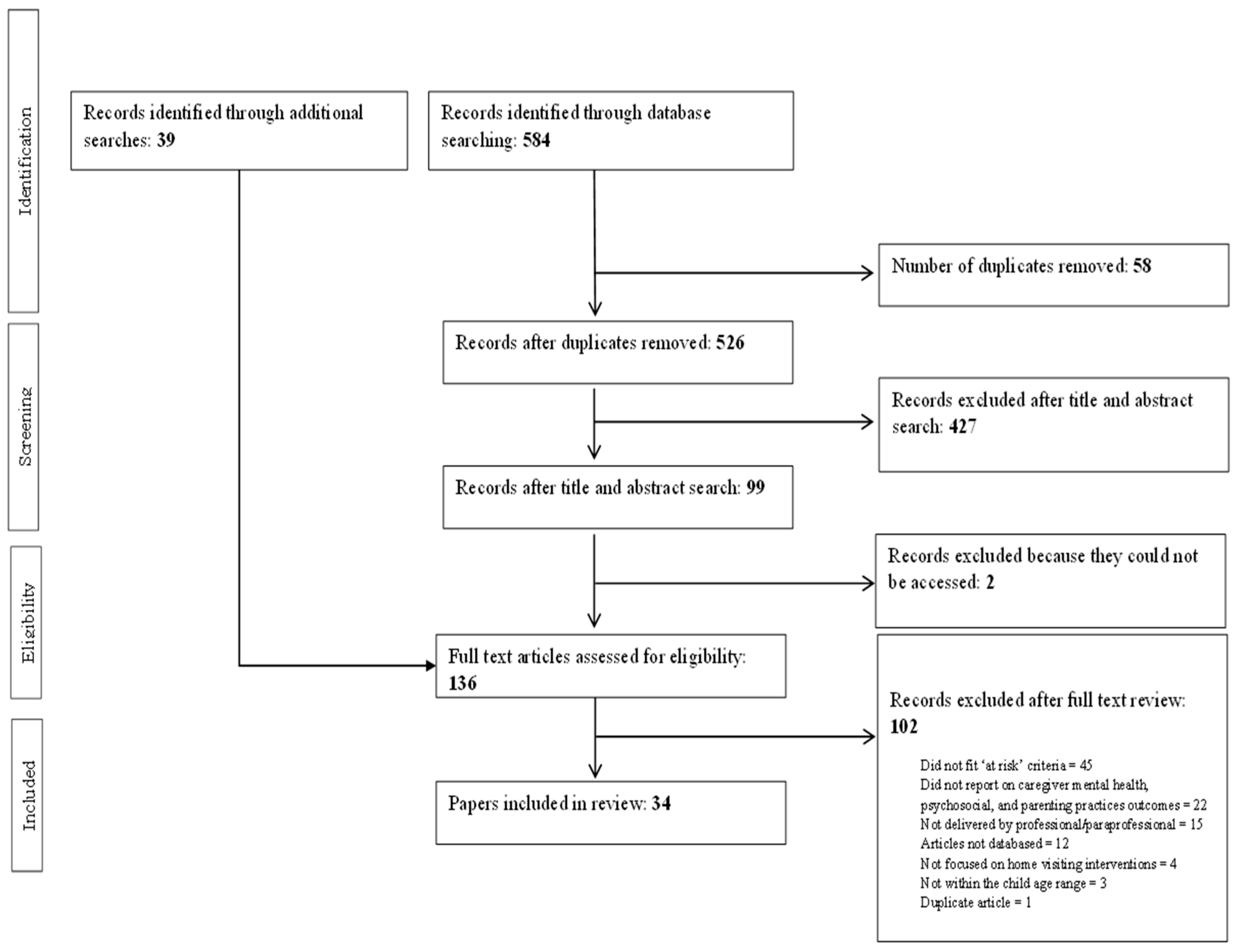
3.1. Search Strategy
3.2. Inclusion and Exclusion Criteria
3.3. Quality Assessment and Data Analysis
3.4. Data Extraction
3.5. Meta-Analysis
| (a) Non-randomised Studies | ||||||||||
| Citation | ||||||||||
| Qualitative Studies | ||||||||||
| Is the qualitative approach appropriate to answer the research question? | Are the qualitative data collection methods adequate to address the research question? | Are the findings adequately derived from the data? | Is the interpretation of results sufficiently substantiated by data? | Is there coherence between qualitative data sources, collection, analysis and interpretation? | ||||||
| Zapart et al. (2016) [23] | Yes | Yes | Yes | Yes | Yes | |||||
| Quantitative nonrandomized | ||||||||||
| Are the participants representative of the target population? | Are measurements appropriate regarding both the outcome and intervention (or exposure)? | Are there complete outcome data? | Are the confounders accounted for in the design and analysis? | During the study period, is the intervention administered (or exposure occurred) as intended? | ||||||
| Ammerman et al. (2005) [24] | Yes | Yes | Can’t tell | Can’t tell | Can’t tell | |||||
| Ammerman et al. (2011) [25] | Yes | Yes | No | Yes | Yes | |||||
| Ammerman et al. (2012) [26] | Yes | Yes | Yes | Yes | Can’t tell | |||||
| O’Malley et al. (2021) [8] | Yes | Yes | Yes | No | Yes | |||||
| Reuter et al. (2016) [9] | Yes | Yes | Yes | Yes | Yes | |||||
| Stacks et al. (2019) [27] | Yes | Yes | No | Can’t tell | Yes | |||||
| Stacks et al. (2022) [28] | Can’t tell | Yes | Yes | Yes | Yes | |||||
| van Grieken et al. (2019) [29] | Yes | Yes | No | Yes | Can’t tell | |||||
| Mixed Methods | ||||||||||
| Is there an adequate rationale for using a mixed methods design to address the research question? | Are the different components of the study effectively integrated to answer the research question? | Are the outputs of the integration of qualitative and quantitative components adequately interpreted? | Are divergences and inconsistencies between quantitative and qualitative results adequately addressed? | Do the different components of the study adhere to the quality criteria of each tradition of the methods involved? | ||||||
| Giallo et al. (2021) [30] | Yes | Yes | Yes | Yes | Yes | |||||
| O’Donnell et al. (2023) [31] | Yes | Yes | Yes | Can’t tell | Yes | |||||
| (b) Randomised Control Trials | ||||||||||
| Random Sequence Generation | Allocation Concealment | Blinding of Participants and Researchers | Blinding of Outcome Assessment | Incomplete Outcome Data | Selective Reporting | Anything Else | Overall Bias | |||
| Bair-Merritt et al. (2010) [32] | + | + | + | + | + | + | + | Low | ||
| Barlow et al. (2007) [33] | + | + | + | + | + | + | + | Low | ||
| Bartu et al. (2006) [34] | + | + | ? | ? | + | + | + | Low | ||
| Black et al. (1994) [35] | ? | ? | ? | + | − | + | + | High | ||
| Butz et al. (2001) [36] | + | + | ? | ? | + | + | + | Low | ||
| Catherine et al. (2020) [37] | + | − | − | + | + | + | + | Low | ||
| Duggan et al. (2004) [38] | + | + | + | + | − | + | + | High | ||
| Fergusson et al. (2006) [39] | + | ? | ? | ? | + | + | + | Unclear | ||
| Fraser et al. (2000) [40] | + | + | + | + | − | + | + | High | ||
| Goldfeld et al. (2019) [41] | + | + | − | + | − | + | + | High | ||
| Goldfeld et al. (2021) [42] | + | + | − | + | − | + | + | High | ||
| Goldfeld et al. (2022) [7] | + | + | − | + | − | + | + | High | ||
| Kemp et al. (2011) [43] | + | + | − | + | − | + | + | High | ||
| LeCroy & Lopez (2020) [44] | + | + | ? | ? | − | + | + | High | ||
| Lowell et al. (2011) [45] | + | + | + | ? | + | + | + | Low | ||
| Mejdoubi et al. (2013) [46] | + | ? | ? | ? | + | + | + | Unclear | ||
| Mejdoubi et al. (2014) [46] | + | + | ? | + | + | + | + | Low | ||
| Oxford et al. (2023) [47] | + | + | ? | + | + | + | + | Low | ||
| Rosenblum et al. (2020) [48] | + | + | − | + | + | + | + | Low | ||
| Sharps et al. (2016) [49] | + | + | + | + | − | + | + | High | ||
| Tamaki (2008) [50] | + | + | + | ? | + | + | + | Low | ||
| Van Doesum et al. (2008) [51] | + | + | ? | + | + | + | + | Low | ||
| Van Horne et al. (2022) [52] | + | + | + | ? | − | + | + | High | ||
4. Results
| Article | Target Problem | Intervention | Study Design | Country | Demographics |
|---|---|---|---|---|---|
| Ammerman et al. (2005) [24] | Mental health (depression) | IH-CBT * | Quasi-experimental | USA | N = 26 women, M age = 22.52 (SD 3.95). |
| Ammerman et al. (2011) [25] | Mental health (depression) | IH-CBT * | Quasi-experimental | USA | N = 307 women; Intervention n = 64, M age = 22.57 (SD 4.96); Control n = 241, M age = 20.15 (SD 4.18). |
| Ammerman et al. (2012) [26] | Mental health (depression) | IH-CBT * | Quasi-experimental | USA | N = 60 women; M age = 22.4 years (SD 5.0); Child M age = 152.0 days (SD 73.0). |
| Bair-Merritt et al. (2010) [32] | Partner violence | Hawaii Healthy Start Program | RCT | USA | N = 643 women; Intervention n = 373, M age not provided; Control n = 270, M age not provided. |
| Barlow et al. (2007) [33] | Mental health (depression) | Health visiting intervention | RCT | United Kingdom | N = 131 women; Intervention n = 68, M age not provided; Control n = 63, M age not provided. |
| Bartu et al. (2006) [34] | Mental health (substance use) | Home visiting intervention | RCT | Australia | N = 152 women; Intervention n = 76 women, median age = 27 years (17–39), Control group n = 76 women, median age = 25 years (18–41). |
| Black et al. (1994) [35] | Mental health (substance use) | SPICE | RCT | USA | N = 60 women; Intervention n = 31, M age = 26.4 (SD 0.9); Control n = 29, M age = 27.9 (SD 0.7) |
| Butz et al. (2001) [36] | Mental health (substance use) | Home visiting intervention | RCT | USA | N = 117 women; Intervention n = 59, M age = 28.0 (SD 4.6); Control n = 58, M age = 28.9 (SD 4.5) |
| Catherine et al. (2020) [37] | Mental health (substance use) | Nurse-Family Partnership | RCT | Canada | N = 739 women; Intervention n = 368, M age not provided; Control n = 371, M age not provided. |
| Duggan et al. (2004) [38] | Child maltreatment | Hawaii Healthy Start Program | RCT | USA | N = 643 women; Intervention n = 373, M age = 23.7 years (SD 5.8); Control n = 270, M age = 23.3 years (SD 5.8) |
| Fergusson et al. (2005) [39] | At risk families (including mental health difficulties and domestic violence) | Early start | RCT | New Zealand | N = 391 women; Intervention n = 184 women, M age not provided; Control n = 207, M age not provided. |
| Fraser et al. (2000) [40] | Child maltreatment | Home visiting intervention | RCT | Australia | N = 181 women; Intervention n = 90 women, M age = 25.72 years (SD 5.61); Control n = 91 women, M age = 26.67 years (SD 6.08). |
| Giallo et al. (2021) [30] | Child maltreatment | HoPES | Mixed methods | Australia | N = 30 families; mother n = 29, M age = 28.9 years (SD 7.1); father n = 11, M age = 34.09 years (SD 10.8); children n = 31, M age = 14.4 months (SD 9.7), 46.7% female. |
| Goldfeld et al. (2019) [41] | Women experiencing adversity (including mental health difficulties) | right@home | RCT | Australia | N = 722 women; Intervention n = 306 women, M age = 27.6 years (SD 6.1); Control n = 359 women, M age = 27.4 years (SD 6.2). |
| Goldfeld et al. (2021) [42] | At risk women (including mental health difficulties) | right@home | RCT | Australia | N = 495 women; Intervention n = 255 women, M age = 27.6 years (SD 5.9); Control n = 240 women, M age = 28.3 years (SD 6.4). |
| Goldfeld et al. (2022) [7] | Women experiencing adversity (including mental health difficulties) | right@home | RCT | Australia | N = 426 women; Intervention n = 225 women, M age = 27.9 years (SD 6.0); Control n = 201 women, M age = 28.7 years (SD 6.4). |
| Kemp et al. (2011) [43] | Women experiencing adversity (including mental health difficulties and domestic violence) | Sustained structured nurse home visiting program | RCT | Australia | N = 208 women; Intervention n = 111 women, M age = 27.6 years (SD 6.7); Control n = 97 women, M age = 27.7 years (SD 5.9). |
| LeCroy & Lopez (2020) [44] | Mental health | Healthy Families Arizona | RCT | USA | N = 245 families; Intervention n = 98 women, M age not provided; Control n = 147 women, M age not provided. Father demographics not provided. |
| Lowell et al. (2011) [45] | Child emotional/behavioural problems and/or parent psychosocial risk | Child FIRST | RCT | USA | N = 157; Intervention n = 78 mothers, mother M age = 27.7 years (SD = 7.0), child M = 19.0 months, (SD = 9.2), 42.3% male; Control n = 79, mother M = 26.9 years, (SD = 6.9), child M = 18.0, (SD = 8.8), 45.6% male. |
| Mejdoubi et al. (2013) [46] | Partner violence | VoorZorg | RCT | Netherlands | N = 460 women; Intervention n = 237 women, M age = 19.5 years (SD 2.8); Control n = 223 women, M age = 19.2 years (SD 2.6) |
| Mejdoubi et al. (2014) [53] | At risk women (including substance use and domestic violence) | VoorZorg | RCT | Netherlands | N = 460 women; Intervention n = 223, M age = 19.5 years (SD 2.8); Control n = 237; M age = 19.2 years (SD 2.6). |
| O’Malley et al. (2021) [8] | Mental health (substance use) | TIES | Quasi-experimental | USA | N = 220 women, M age not provided. |
| O’Donnell (2023) [31] | Families with multiple risk factors (e.g., family violence, substance use, mental health concerns, Child Protection involvement) | Cradle to Kinder | Mixed methods | Australia | Quantitative component: N = 57 families, metropolitan families n = 24 (29% = Aboriginal or Torres Strait Islander), mother M age = 19.33 years (SD = 2.31), father involvement in program = 33%; rural families n = 33 (32% = Aboriginal or Torres Strait Islander), mother M = 18.44 (SD = 0.68, father involvement in program = 48%. Qualitative component: N = 14, 11 months, 3 fathers, M age = 22.5 (SD = 3.04), 29% = Aboriginal or Torres Strait Islander. |
| Oxford et al. (2023) [47] | Mental health | Moms and Babies Program (Promoting First Relationships) | RCT | USA | N = 252 women; Intervention n = 127, [low distress: n = 85, mother M age = 28.81 years (SD 5.67), child’s M age = 1.85 months (SD 0.46); high distress n = 42, mother M age = 28.64 years (SD 6.25), child’s M age = 1.83 months (SD 0.45); Control n = 125, [low distress: maternal M age = 27.94 years (SD 5.27), child M age = 1.82 months (SD 0.45); high distress: maternal M age = 26.26 years (SD 6.22), child M age = 1.92 months (SD 0.53)]. |
| Reuter et al. (2016) [9] | Mental Health | PFF | Quasi-experimental | USA | N = 215 caregivers, M age = 34.04 years (SD 9.65). Child protective services -referred families n = 84, M age = 37.85 years (SD 10.07); Prenatal-referred families n = 131, M age = 31.49 (SD 8.47). |
| Rosenblum et al. (2020) [48] | Parents with adverse childhood experiences | Michigan Model of IMH-HV | RCT | USA | N = 62 families; Intervention n = 32, mother M age = 32.38 years (SD 5.72), child M age = 23.59 months (SD 6.57). |
| Sharps et al. (2016) [49] | Partner violence | DOVE a | RCT | USA | N = 239 women, Intervention n = 124, M age = 24.3 (SD 5.6); Control n = 115, M age = 23.4 (SD 5.4). |
| Stacks et al. (2019) [27] | Child maltreatment | Michigan Model of IMH-HV | Quasi-experimental | USA | N = 16 parents, 68% female, M age = 21.69 years (SD 4.53), M child age 18.57 months (SD 7.1). |
| Stacks et al. (2022) [28] | Mental health | Michigan Model of IMH-HV | Quasi-experimental | USA | N = 75 women, M age = 26.67 years (SD 6.11); child M age = 9.64 months. |
| Tamaki (2008) [50] | Mental health (depression) | Home visiting intervention | RCT | Japan | N = 16 women; Intervention n = 7, M age = 33.86 years (SD 3.02); Control n = 9, M age = 33.78 (SD 5.33). |
| van Doesum et al. (2008) [51] | Mental health (depression) | Home visiting intervention | RCT | Netherlands | N = 85 women; Intervention n = 36 women, M age = 30.4 years (SD 4.1); Control n = 35 women, M age = 29.9 years (SD 3.6) |
| van Grieken et al. (2019) [29] | Mental health (stress) | The Supportive Parenting intervention | Quasi-experimental | Netherlands | N = 301 families; Intervention n = 124, mother M age = 31.0 years (SD 7.0), father M age = 34.0 years (SD 7.3), child M age = 7.6 months (SD 3.4), 47% child as girls; control n = 177, mother M age = 30.7 (SD 5.3), father M age = 32.6 years (SD 6.0), child M age = 5.1 months (SD 2.8). |
| van Horne et al. (2022) [52] | Mental health (depression) | Home visiting intervention | RCT | USA | N = 156 women; Intervention n = 72 women, M age = 30.65 years (SD 5.96); Control n = 46 women, M age = 29.4 years (SD 6.01). |
| Zapart et al. (2016) [23] | Women experiencing adversity (including mental health difficulties and domestic violence) | Sustained structured nurse home visiting program | Qualitative | Australia | N = 36 women, M age = 27.5 years (SD = 7.4). |
4.1. Overview of Included Studies
4.2. Interventions
4.3. Intervention Components
4.4. Outcomes
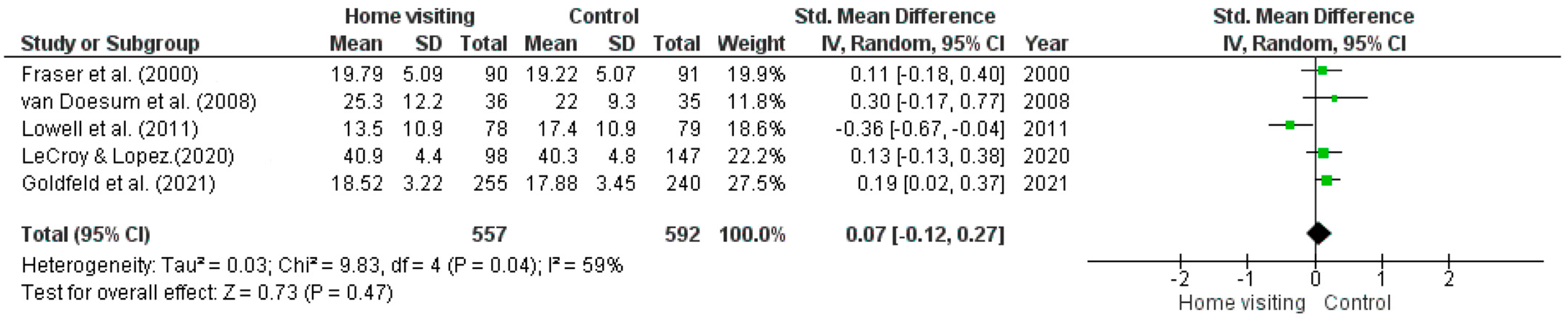
4.4.1. Maternal Mental Health Outcomes
Depression
Substance Use
Stress
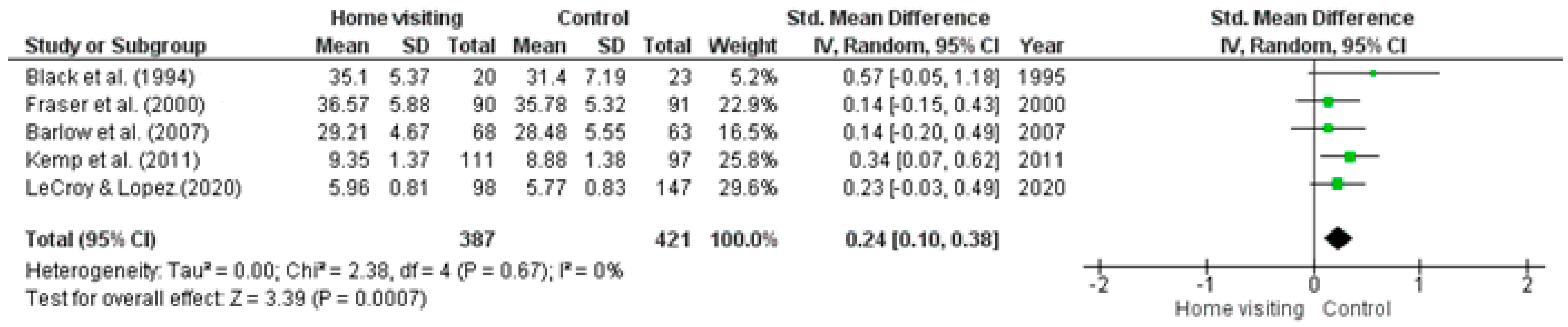
4.4.2. Parenting Practices
Practical Parenting Skills
Maternal Sensitivity/Warmth/Responsiveness
Breast Feeding
Reflective Functioning
Parent-Child Bonding/Relationship
4.4.3. Intimate Partner Violence
| (a) RCT studies | ||||||
| Outcome | Citation | Target Problem | Intervention | Results | Intervention Components | |
| Sig. | Non. Sig. | |||||
| Maternal mental health | Barlow et al. (2007) [33] | Mental health (depression) | Health visiting intervention | x | Parent-infant interaction | |
| Bartu et al. (2006) [34] | Mental health (substance use) | Home visiting intervention | x | Social support Child development Parenting skills Parent-infant interaction Provision of resources | ||
| Black et al. (1994) [35] | Mental health (substance use) | SPICE | x | Social support Parenting skills and child development Parent-infant interaction Provision of resources | ||
| Butz et al. (2001) [36] | Mental health (substance use) | Home visiting intervention | x | Parenting skills Child development Parent-infant interaction Provision of resources | ||
| Catherine et al. (2020) [37] | Mental health (substance use) | Nurse-Family Partnership | x | Social support | ||
| Duggan et al. (2004) [38] | Child maltreatment | Hawaii Healthy Start Program | x | Social supports Parenting skills | ||
| Fergusson et al. (2005) [39] | At risk families (including mental health difficulties and domestic violence) | Early start | x | Social supports Problem solving Parenting skills | ||
| Fraser et al. (2000) [40] | Child maltreatment | Home visiting intervention | x | Social supports Provision of resources | ||
| Goldfeld et al. (2021) [42] | At risk women (including mental health difficulties) | right@home | x | Parenting skills Parent-infant interaction Provision of resources | ||
| Goldfeld et al. (2022) [7] | Women experiencing adversity (including mental health difficulties) | right@home | x | Parenting skills Parent-infant interaction Provision of resources | ||
| LeCroy & Lopez. (2020) [44] | Mental health | Healthy Families Arizona | x | Parent-infant interaction | ||
| Lowell et al. (2011) [45] | Child emotional/behavioural problems and/or parent psychosocial risk | Child FIRST | x | Counselling or Psychological Support | ||
| Mejdoubi et al. (2014) [53] | At risk women (including substance use and domestic violence) | VoorZorg | x | Parenting skills and child development Parent infant interaction Social supports | ||
| Tamaki (2008) [50] | Mental health (depression) | Home visiting intervention | x | Counselling or Psychological support Parenting skills and child development Parent-infant interaction Problem solving Social supports Provision of resources | ||
| van Doesum et al. (2008) [51] | Mental health (depression) | Home visiting intervention | x | Parenting skills and child development Parent-infant interaction Problem solving Provision of resources | ||
| van Horne et al. (2022) [52] | Mental health (depression) | Home visiting intervention | x | Counselling or Psychological support Parenting skills and child development Parent-infant interaction Problem solving Provision of resources | ||
| Parenting practices | Barlow et al. (2007) [33] | Mental health (depression) | Health visiting intervention | x | Parent-infant interaction | |
| Bartu et al. (2006) [34] | Mental health (substance use) | Home visiting intervention | x | Social support Child development Parenting skills Parent-infant interaction Provision of resources | ||
| Fraser et al. (2000) [40] | Child maltreatment | Home visiting intervention | x | Social supports Provision of resources | ||
| Goldfeld et al. (2019) [41] | Women experiencing adversity (including mental health difficulties) | right@home | x | Parenting skills Parent-infant interaction Provision of resources | ||
| Goldfeld et al. (2022) [7] | Women experiencing adversity (including mental health difficulties) | right@home | x | Parenting skills Parent-infant interaction Provision of resources | ||
| Kemp et al. (2011) [43] | Women experiencing adversity (including mental health difficulties and domestic violence) | Sustained structured nurse home visiting program | x | Parenting skills Parent-infant interaction Provision of resources | ||
| LeCroy & Lopez. (2020) [44] | Mental health | Healthy Families Arizona | x | Parent-infant interaction | ||
| Mejdoubi et al. (2014) [53] | At risk women (including substance use and domestic violence) | VoorZorg | x | Parenting skills and child development Parent infant interaction Social supports | ||
| Oxford et al. (2023) [47] | Mental health | Moms and Babies Program (Promoting First Relationships) | x | Parenting skills and child development Parent infant interaction | ||
| van Horne et al. (2022) [52] | Mental health (depression) | Home visiting intervention | x | Counselling or Psychological support Parenting skills and child development Parent-infant interaction Problem solving Provision of resources | ||
| Intimate partner violence | Bair-Merritt et al. (2010) [32] | Partner violence | Hawaii Healthy Start Program | x | Social support Problem solving Parenting skills Parent-infant interaction Provision of resources | |
| Duggan et al. (2004) [38] | Child maltreatment | Hawaii Healthy Start Program | x | Social supports Parenting skills | ||
| Fergusson et al. (2005) [39] | At risk families (including mental health difficulties and domestic violence) | Early start | x | Social supports Problem solving Parenting skills | ||
| Mejdoubi et al. (2013) [46] | Partner violence | VoorZorg | x | Parenting skills and child development Parent infant interaction Social supports | ||
| Sharps et al. (2016) [49] | Partner violence | DOVE | x | Social support Parenting skills and child development | ||
| (b) Non-RCT studies | ||||||
| Outcomes | Citation | Target Problem | Intervention | Results | Intervention Components | |
| Sig. | Non. Sig. | |||||
| Maternal mental health | Ammerman et al. (2011) [25] | Mental health (depression) | IH-CBT | x | Counselling or Psychological Support | |
| Ammerman et al. (2005) [24] | Mental health (depression) | IH-CBT | x | Counselling or Psychological Support | ||
| Giallo et al. (2021) [30] | Child maltreatment | HoPES | x | Parenting skills Parent-infant interaction | ||
| O’Donnell (2023) [31] | Families with multiple risk factors (e.g., family violence, substance use, mental health concerns, Child Protection involvement) | Cradle to Kinder | x | Counselling or Psychological Support Parenting skills and child development Parent infant interaction Social supports Provision of resources | ||
| O’Malley et al. (2021) [8] | Mental health (substance use) | TIES | x | Parenting skills and child development Parent infant interaction Provision of resources | ||
| Stacks et al. (2019) [27] | Child maltreatment | Michigan Model of IMH-HV | x | Social support Parenting skills and child development Parent-infant interaction Provision of resources | ||
| Parenting practices | Ammerman et al. (2011) [25] | Mental health (depression) | IH-CBT | x | Counselling or Psychological Support | |
| Ammerman et al. (2005) [24] | Mental health (depression) | IH-CBT | x | Counselling or Psychological Support | ||
| Giallo et al. (2021) [30] | Child maltreatment | HoPES | x | |||
| O’Donnell (2023) [31] | Families with multiple risk factors (e.g., family violence, substance use, mental health concerns, Child Protection involvement) | Cradle to Kinder | x | Counselling or Psychological Support Parenting skills and child development Parent infant interaction Social supports Provision of resources | ||
| O’Malley et al. (2021) [8] | Mental health (substance use) | TIES | x | Parenting skills and child development Parent infant interaction Provision of resources | ||
| Stacks et al. (2022) [28] | Mental health | Michigan Model of IMH-HV | x | Counselling or Psychological Support Social support Parent-infant interaction Parenting skills and child development | ||
| Stacks et al. (2019) [27] | Child maltreatment | Michigan Model of IMH-HV | x | Social support Parenting skills and child development Parent-infant interaction Provision of resources | ||
5. Discussion
5.1. Clinical Considerations
5.2. Strengths and Limitations
6. Conclusions
Supplementary Materials
Author Contributions
Funding
Institutional Review Board Statement
Informed Consent Statement
Data Availability Statement
Conflicts of Interest
Abbreviations
| DOVE | The Domestic Violence Enhanced Home Visitation Program |
| HomVEE | Home Visiting Evidence of Effectiveness |
| HoPES | Program, Early Start, Home Parenting Education and Support |
| IH-CBT | In Home Cognitive Behavioural Therapy |
| IMH-HV | The Michigan Model of Infant Mental Health Home Visiting |
| MMAT | Mixed Methods Appraisal Tool |
| PFF | The Partnerships for Families |
| PRISMA | Preferred Reporting Items for Systematic Reviews and Meta-Analysis |
| RCT | Randomised control trial |
| SPICE | Special Parent/Infant Care and Enrichment Program |
| TIES | The Team for Infants Exposed to Substance abuse |
| USA | United States of America |
References
- Wickramasinghe, Y.M.; Raman, S.; Garg, P.; Hurwitz, R. Burden of adverse childhood experiences in children attending paediatric clinics in South Western Sydney, Australia: A retrospective audit. BMJ Paediatr. Open 2019, 3, e000330. [Google Scholar] [CrossRef] [PubMed]
- Burke, N.J.; Hellman, J.L.; Scott, B.G.; Weems, C.F.; Carrion, V.G. The impact of adverse childhood experiences on an urban pediatric population. Child Abus. Negl. 2011, 35, 408–413. [Google Scholar] [CrossRef]
- Grasso, D.J.; Dierkhising, C.B.; Branson, C.E.; Ford, J.D.; Lee, R. Developmental patterns of adverse childhood experiences and current symptoms and impairment in youth referred for trauma-specific services. J. Abnorm. Child Psychol. 2016, 44, 871–886. [Google Scholar] [CrossRef] [PubMed]
- Mendoza Diaz, A.; Brooker, R.; Cibralic, S.; Murphy, E.; Woolfenden, S.; Eapen, V. Adapting the ‘First 2000 Days maternal and child healthcare framework’ in the aftermath of the COVID-19 pandemic: Ensuring equity in the new world. Aust. Health Rev. 2023, 47, 72–76. [Google Scholar] [CrossRef]
- Tofail, F.; Islam, M.; Akter, F.; Zonji, S.; Roy, B.; Hossain, S.J.; Horaira, A.; Akter, S.; Goswami, D.; Brooks, A.; et al. An Integrated Mother-Child Intervention on Child Development and Maternal Mental Health. Pediatrics 2023, 151, e2023060221G. [Google Scholar] [CrossRef] [PubMed]
- Tol, W.A.; Greene, M.C.; Lasater, M.E.; Le Roch, K.; Bizouerne, C.; Purgato, M.; Tomlinson, M.; Barbui, C. Impact of maternal mental health interventions on child-related outcomes in low- and middle-income countries: A systematic review and meta-analysis. Epidemiol. Psychiatr. Sci. 2020, 29, e174. [Google Scholar] [CrossRef] [PubMed]
- Goldfeld, S.; Bryson, H.; Mensah, F.; Price, A.; Gold, L.; Orsini, F.; Kenny, B.; Perlen, S.; Bohingamu Mudiyanselage, S.; Dakin, P.; et al. Nurse home visiting to improve child and maternal outcomes: 5-year follow-up of an Australian randomised controlled trial. PLoS ONE 2022, 17, e0277773. [Google Scholar] [CrossRef] [PubMed]
- O’Malley, D.; Chiang, D.F.; Siedlik, E.A.; Ragon, K.; Dutcher, M.; Templeton, O. A promising approach in home visiting to support families affected by maternal substance use. Matern. Child Health J. 2021, 25, 42–53. [Google Scholar] [CrossRef]
- Reuter, K.E.; Melchior, L.A.; Brink, A.M. An intensive mental health home visiting model for two at-risk early childhood populations. Child. Youth Serv. Rev. 2016, 61, 22–30. [Google Scholar] [CrossRef]
- Sweet, M.A.; Appelbaum, M.I. Is home visiting an effective strategy? A meta-analytic review of home visiting programs for families with young children. Child Dev. 2004, 75, 1435–1456. [Google Scholar] [CrossRef]
- Bull, J.; McCormick, G.; Swann, C.; Mulvihill, C. Ante-and Post-Natal Home Visiting Programmes: A Review of Reviews. Lond. Health Dev. Agency 2004. Available online: https://www.researchgate.net/profile/Catherine-Swann-2/publication/242494602_Ante_and_post-natal_home-visiting_programmes_a_review_of_reviews/links/0c9605356632706f7e000000/Ante-and-post-natal-home-visiting-programmes-a-review-of-reviews.pdf (accessed on 8 December 2023).
- Turnbull, C.; Osborn, D.A. Home visits during pregnancy and after birth for women with an alcohol or drug problem. Cochrane Database Syst. Rev. 2012, 2012, Cd004456. [Google Scholar] [CrossRef] [PubMed]
- Ammerman, R.T.; Putnam, F.W.; Bosse, N.R.; Teeters, A.R.; Van Ginkel, J.B. Maternal depression in home visitation: A systematic review. Aggress. Violent Behav. 2010, 15, 191–200. [Google Scholar] [CrossRef]
- Cibralic, S.; Wu, W.T.; Ahinkorah, B.O.; Lam-Cassettari, C.; Woolfenden, S.; Kohlhoff, J.; Grace, R.; Kemp, L.; Johnson, P.; Murphy, E.; et al. Systematic review and meta-analysis of home visiting interventions aimed at enhancing child mental health, psychosocial, and developmental outcomes in vulnerable families. BMC Pediatr. 2025, 25, 314. [Google Scholar] [CrossRef] [PubMed]
- Page, M.J.; McKenzie, J.E.; Bossuyt, P.M.; Boutron, I.; Hoffmann, T.C.; Mulrow, C.D.; Shamseer, L.; Tetzlaff, J.M.; Akl, E.A.; Brennan, S.E.; et al. The PRISMA 2020 statement: An updated guideline for reporting systematic reviews. BMJ 2021, 372, n71. [Google Scholar] [CrossRef] [PubMed]
- HomeVEE. Early Childhood Home Visiting Models: Reviewing Evidence of Effectiveness 2023. Available online: https://homvee.acf.hhs.gov/ (accessed on 29 November 2023).
- Higgins, J.P.; Altman, D.G.; Gøtzsche, P.C.; Jüni, P.; Moher, D.; Oxman, A.D.; Savović, J.; Schulz, K.F.; Weeks, L.; Sterne, J.A. The Cochrane Collaboration’s tool for assessing risk of bias in randomised trials. BMJ 2011, 343, d5928. [Google Scholar] [CrossRef]
- Hong, Q.N.; Pluye, P.; Fàbregues, S.; Bartlett, G.; Boardman, F.; Cargo, M.; Dagenais, P.; Gagnon, M.-P.; Griffiths, F.; Nicolau, B.J.R.O.C. Mixed Methods Appraisal Tool (MMAT), Version 2018; 2018. Available online: http://mixedmethodsappraisaltoolpublic.pbworks.com/w/file/fetch/127916259/MMAT_2018_criteria-manual_2018-08-01_ENG.pdf (accessed on 14 September 2023).
- Glenton, C.; Bohren, M.; Downe, S.; Paulsen, E.; Lewin, S.; EPOC. EPOC Qualitative Evidence Synthesis: Protocol and Review Template; Version 1.3; EPOC Resources for Review Authors; Norwegian Institute of Public Health: Oslo, Norway, 2022; Available online: http://epoc.cochrane.org/epoc-specific-resources-review-authors (accessed on 1 September 2023).
- Deeks, J.J.; Higgins, J.P.T.; Altman, D.G. Chapter 10: Analysing data and undertaking meta-analyses. In Cochrane Handbook for Systematic Reviews of Interventions Version 6.4; Higgins, J.P.T., Chandler, J., Cumpston, M., Li, T., Page, M.J., Welch, V.A., Eds.; Cochrane: West Sussex, UK, 2023. [Google Scholar]
- Review Manager (RevMan) (Version 5.4.1) [Compute Softwear]; The Cochrane Collaboration: 2020. Available online: https://www.cochrane.org/learn (accessed on 1 September 2023).
- Higgins, J.P.T.; Li, T.; Deeks, J.J. Chapter 6: Choosing effect measures and computing estimates of effect. In Cochrane Handbook for Systematic Reviews of Interventions Version 6.3 (Updated February 2022); Higgins, J.P.T., Chandler, J., Cumpston, M., Li, T., Page, M.J., Welch, V.A., Eds.; Cochrane: West Sussex, UK, 2022. [Google Scholar]
- Zapart, S.; Knight, J.; Kemp, L. ‘It Was Easier Because I Had Help’: Mothers’ Reflections on the Long-Term Impact of Sustained Nurse Home Visiting. Matern. Child Health J. 2016, 20, 196–204. [Google Scholar] [CrossRef]
- Ammerman, R.T.; Putnam, F.W.; Stevens, J.; Holleb, L.J.; Novak, A.L.; Van Ginkel, J.B. In-Home Cognitive-Behavior Therapy for depression. Best Pract. Ment. Health 2005, 1, 1–14. [Google Scholar] [CrossRef]
- Ammerman, R.T.; Putnam, F.W.; Stevens, J.; Bosse, N.R.; Short, J.A.; Bodley, A.L.; Van Ginkel, J.B. An open trial of in-home CBT for depressed mothers in home visitation. Matern. Child Health J. 2011, 15, 1333–1341. [Google Scholar] [CrossRef]
- Ammerman, R.T.; Peugh, J.L.; Putnam, F.W.; van Ginkel, J.B. Predictors of treatment tesponse in depressed mothers receiving In-Home Cognitive-Behavioral Therapy and concurrent home visiting. Behav. Modif. 2012, 36, 462–481. [Google Scholar] [CrossRef]
- Stacks, A.M.; Barron, C.C.; Wong, K. Infant mental health home visiting in the context of an infant—Toddler court team: Changes in parental responsiveness and reflective functioning. Infant Ment. Health J. 2019, 40, 523–540. [Google Scholar] [CrossRef]
- Stacks, A.M.; Jester, J.M.; Wong, K.; Huth-Bocks, A.; Brophy-Herb, H.; Lawler, J.; Riggs, J.; Ribaudo, J.; Muzik, M.; Rosenblum, K.L. Infant mental health home visiting: Intervention dosage and therapist experience interact to support improvements in maternal reflective functioning. Attach. Hum. Dev. 2022, 24, 53–75. [Google Scholar] [CrossRef]
- van Grieken, A.; Horrevorts, E.M.B.; Mieloo, C.L.; Bannink, R.; Bouwmeester-Landweer, M.B.R.; Groen, E.H.; Broeren, S.; Raat, H. A controlled trial in community pediatrics to empower parents who are at risk for parenting stress: The supportive parenting intervention. Int. J. Environ. Res. Public Health 2019, 16, 4508. [Google Scholar] [CrossRef]
- Giallo, R.; Rominov, H.; Fisher, C.; Jones, A.; Evans, K.; O’Brien, J.; Fogarty, A. A mixed-methods feasibility study of the Home Parenting Education and Support Program for families at risk of child maltreatment and recurrence in Australia. Child Abus. Negl. 2021, 122, 105356. [Google Scholar] [CrossRef]
- O’Donnell, R.; Savaglio, M.; Halfpenny, N.; Morris, H.; Miller, R.; Skouteris, H. A mixed-method evaluation of Cradle to Kinder: An Australian intensive home visitation program for families experiencing significant disadvantage. Child. Youth Serv. Rev. 2023, 150, 107016. [Google Scholar] [CrossRef]
- Bair-Merritt, M.H.; Jennings, J.M.; Chen, R.; Burrell, L.; McFarlane, E.; Fuddy, L.; Duggan, A.K. Reducing maternal intimate partner violence after the birth of a child: A randomized controlled trial of the Hawaii Healthy Start Home Visitation Program. Arch. Pediatr. Adolesc. Med. 2010, 164, 16–23. [Google Scholar] [CrossRef] [PubMed]
- Barlow, J.; Davis, H.; McIntosh, E.; Jarrett, P.; Mockford, C.; Stewart-Brown, S. Role of home visiting in improving parenting and health in families at risk of abuse and neglect: Results of a multicentre randomised controlled trial and economic evaluation. Arch. Dis. Child 2007, 92, 229–233. [Google Scholar] [CrossRef]
- Bartu, A.; Sharp, J.; Ludlow, J.; Doherty, D.A. Postnatal home visiting for illicit drug-using mothers and their infants: A randomised controlled trial. Aust. New Zealand J. Obstet. Gynaecol. 2006, 46, 419–426. [Google Scholar] [CrossRef]
- Black, M.M.; Nair, P.; Kight, C.; Wachtel, R.; Roby, P.; Schuler, M. Parenting and early development among children of drug-abusing women: Effects of home intervention. Pediatrics 1994, 94, 440–448. [Google Scholar] [CrossRef] [PubMed]
- Butz, A.M.; Pulsifer, M.; Marano, N.; Belcher, H.; Lears, M.K.; Royall, R. Effectiveness of a home intervention for perceived child behavioral problems and parenting stress in children with in utero drug exposure. Arch. Pediatr. Adolesc. Med. 2001, 155, 1029–1037. [Google Scholar] [CrossRef]
- Catherine, N.L.A.; Boyle, M.; Zheng, Y.; McCandless, L.; Xie, H.; Lever, R.; Sheehan, D.; Gonzalez, A.; Jack, S.M.; Gafni, A.; et al. Nurse home visiting and prenatal substance use in a socioeconomically disadvantaged population in British Columbia: Analysis of prenatal secondary outcomes in an ongoing randomized controlled trial. CMAJ Open 2020, 8, E667–E675. [Google Scholar] [CrossRef]
- Duggan, A.; Fuddy, L.; Burrell, L.; Higman, S.M.; McFarlane, E.; Windham, A.; Sia, C. Randomized trial of a statewide home visiting program to prevent child abuse: Impact in reducing parental risk factors. Child Abus. Negl. 2004, 28, 623–643. [Google Scholar] [CrossRef]
- Fergusson, D.M.; Grant, H.; Horwood, L.J.; Ridder, E.M. Randomized trial of the Early Start program of home visitation. Pediatrics 2005, 116, e803–e809. [Google Scholar] [CrossRef]
- Fraser, J.A.; Armstrong, K.L.; Morris, J.P.; Dadds, M.R. Home visiting intervention for vulnerable families with newborns: Follow-up results of a randomized controlled trial. Child Abus. Negl. 2000, 24, 1399–1429. [Google Scholar] [CrossRef] [PubMed]
- Goldfeld, S.; Price, A.; Smith, C.; Bruce, T.; Bryson, H.; Mensah, F.; Orsini, F.; Gold, L.; Hiscock, H.; Bishop, L.; et al. Nurse home visiting for families experiencing adversity: A randomized trial. Pediatrics 2019, 143, e20181206. [Google Scholar] [CrossRef]
- Goldfeld, S.; Bryson, H.; Mensah, F.; Gold, L.; Orsini, F.; Perlen, S.; Price, A.; Hiscock, H.; Grobler, A.; Dakin, P.; et al. Nurse home visiting and maternal mental health: 3-year follow-up of a randomized trial. Pediatrics 2021, 147, e2020025361. [Google Scholar] [CrossRef]
- Kemp, L.; Harris, E.; McMahon, C.; Matthey, S.; Vimpani, G.; Anderson, T.; Schmied, V.; Aslam, H.; Zapart, S. Child and family outcomes of a long-term nurse home visitation programme: A randomised controlled trial. Arch. Dis. Child. 2011, 96, 533. [Google Scholar] [CrossRef]
- LeCroy, C.W.; Lopez, D. A Randomized Controlled Trial of Healthy Families: 6-Month and 1-Year Follow-Up. Prev. Sci. 2020, 21, 25–35. [Google Scholar] [CrossRef]
- Lowell, D.I.; Carter, A.S.; Godoy, L.; Paulicin, B.; Briggs-Gowan, M.J. A randomized controlled trial of Child FIRST: A comprehensive home-based intervention translating research into early childhood practice. Child Dev. 2011, 82, 193–208. [Google Scholar] [CrossRef] [PubMed]
- Mejdoubi, J.; van den Heijkant, S.C.C.M.; van Leerdam, F.J.M.; Heymans, M.W.; Hirasing, R.A.; Crijnen, A.A.M. Effect of nurse home visits vs. usual care on reducing intimate partner violence in young high-risk pregnant women: A randomized controlled trial. PLoS ONE 2013, 8, e78185. [Google Scholar] [CrossRef] [PubMed]
- Oxford, M.L.; Hash, J.B.; Lohr, M.J.; Fleming, C.B.; Dow-Smith, C.; Spieker, S.J. What works for whom? Mother’s psychological distress as a moderator of the effectiveness of a home visiting intervention. Infant Ment. Health J. 2023, 44, 301–318. [Google Scholar] [CrossRef]
- Rosenblum, K.L.; Muzik, M.; Jester, J.M.; Huth-Bocks, A.; Erickson, N.; Ludtke, M.; Weatherston, D.; Brophy-Herb, H.; Tableman, B.; Alfafara, E.; et al. Community-delivered infant–parent psychotherapy improves maternal sensitive caregiving: Evaluation of the Michigan model of infant mental health home visiting. Infant Ment. Health J. 2020, 41, 178–190. [Google Scholar] [CrossRef]
- Sharps, P.W.; Bullock, L.F.; Campbell, J.C.; Alhusen, J.L.; Ghazarian, S.R.; Bhandari, S.S.; Schminkey, D.L. Domestic violence enhanced perinatal home visits: The DOVE randomized clinical trial. J. Women’s Health 2016, 25, 1129–1138. [Google Scholar] [CrossRef]
- Tamaki, A. Effectiveness of home visits by mental health nurses for Japanese women with post-partum depression. Int. J. Ment. Health Nurs. 2008, 17, 419–427. [Google Scholar] [CrossRef]
- van Doesum, K.T.M.; Riksen-Walraven, J.M.; Hosman, C.M.H.; Hoefnagels, C. A randomized controlled trial of a home-visiting intervention aimed at preventing relationship problems in depressed mothers and their infants. Child Dev. 2008, 79, 547–561. [Google Scholar] [CrossRef] [PubMed]
- van Horne, B.S.; Nong, Y.H.; Cain, C.M.; Sampson, M.; Greeley, C.S.; Puryear, L. A promising new model of care for postpartum depression: A randomised controlled trial of a brief home visitation program conducted in Houston, Texas, USA. Health Soc. Care Community 2022, 30, e2203–e2213. [Google Scholar] [CrossRef] [PubMed]
- Mejdoubi, J.; van den Heijkant, S.C.C.M.; van Leerdam, F.J.M.; Crone, M.; Crijnen, A.A.M.; HiraSing, R.A. Effects of nurse home visitation on cigarette smoking, pregnancy outcomes and breastfeeding: A randomized controlled trial. Midwifery 2014, 30, 688–695. [Google Scholar] [CrossRef]
- Aslam, H.; Kemp, K. Home Visiting in South Western Sydney: An Integrative Literature Review, Description and Development of a Generic Model; Centre for Health Equity Training Research and Evaluation: Sydney, Australia, 2005. [Google Scholar]
- Adams, C.; Hooker, L.; Taft, A. A systematic review and qualitative meta-synthesis of the roles of home-visiting nurses working with women experiencing family violence. J. Adv. Nurs. 2023, 79, 1189–1210. [Google Scholar] [CrossRef]
- McGinnis, S.; Lee, E.; Kirkland, K.; Smith, C.; Miranda-Julian, C.; Greene, R. Engaging At-Risk Fathers in Home Visiting Services: Effects on Program Retention and Father Involvement. Child Adolesc. Soc. Work J. 2019, 36, 189–200. [Google Scholar] [CrossRef]
- Wynter, K.; Mansour, K.A.; Forbes, F.; Macdonald, J.A. Barriers and opportunities for health service access among fathers: A review of empirical evidence. Health Promot. J. Aust. 2024, 35, 891–910. [Google Scholar] [CrossRef]


Disclaimer/Publisher’s Note: The statements, opinions and data contained in all publications are solely those of the individual author(s) and contributor(s) and not of MDPI and/or the editor(s). MDPI and/or the editor(s) disclaim responsibility for any injury to people or property resulting from any ideas, methods, instructions or products referred to in the content. |
© 2025 by the authors. Licensee MDPI, Basel, Switzerland. This article is an open access article distributed under the terms and conditions of the Creative Commons Attribution (CC BY) license.
Share and Cite
Cibralic, S.; Wu, W.; Ahinkorah, B.O.; Lam-Cassettari, C.; Woolfenden, S.; Kohlhoff, J.; Grace, R.; Kemp, L.; Johnson, P.; Murphy, E.; et al. Home Visiting Interventions and Their Impact on Mental Health, Psychosocial, and Parenting Practice Outcomes of Vulnerable Caregivers: A Systematic Review and Meta-Analysis. Int. J. Environ. Res. Public Health 2026, 23, 63. https://doi.org/10.3390/ijerph23010063
Cibralic S, Wu W, Ahinkorah BO, Lam-Cassettari C, Woolfenden S, Kohlhoff J, Grace R, Kemp L, Johnson P, Murphy E, et al. Home Visiting Interventions and Their Impact on Mental Health, Psychosocial, and Parenting Practice Outcomes of Vulnerable Caregivers: A Systematic Review and Meta-Analysis. International Journal of Environmental Research and Public Health. 2026; 23(1):63. https://doi.org/10.3390/ijerph23010063
Chicago/Turabian StyleCibralic, Sara, Wengtong Wu, Bright Opoku Ahinkorah, Christa Lam-Cassettari, Susan Woolfenden, Jane Kohlhoff, Rebekah Grace, Lynn Kemp, Patrice Johnson, Elisabeth Murphy, and et al. 2026. "Home Visiting Interventions and Their Impact on Mental Health, Psychosocial, and Parenting Practice Outcomes of Vulnerable Caregivers: A Systematic Review and Meta-Analysis" International Journal of Environmental Research and Public Health 23, no. 1: 63. https://doi.org/10.3390/ijerph23010063
APA StyleCibralic, S., Wu, W., Ahinkorah, B. O., Lam-Cassettari, C., Woolfenden, S., Kohlhoff, J., Grace, R., Kemp, L., Johnson, P., Murphy, E., Deering, A., Raman, S., & Eapen, V. (2026). Home Visiting Interventions and Their Impact on Mental Health, Psychosocial, and Parenting Practice Outcomes of Vulnerable Caregivers: A Systematic Review and Meta-Analysis. International Journal of Environmental Research and Public Health, 23(1), 63. https://doi.org/10.3390/ijerph23010063