Exploring Inclusion in Austria’s Breast Cancer Screening:A Dual-Perspective Study of Women with Intellectual Disabilities and Their Caregivers
 , , , and
Highlights
- Demonstrates systematic exclusion within an organized national breast cancer screening program, resulting in inequitable access for an underserved population—women with intellectual disabilities.
- Connects to broader public health priorities, including health equity, disability inclusion, and preventing avoidable late-stage diagnoses through early detection.
- Identifies the complex interplay of structural, emotional, social, organizational, and attitudinal barriers, including diffusion of responsibility within the screening system, societal taboos, psychological factors, and the role of self-determination, that systematically limit screening participation.
- Generates actionable evidence to enhance program quality by incorporating accessibility and inclusion as core features of the screening rather than supplementary accommodations.
- Underscores the need for person-centered healthcare, accessible communication and information, supportive environments, and screening pathways that accommodate diverse and individual needs within standard services.
- Calls for inclusion to be standardized through clear guidelines, robust data collection, mandatory ID-specific training, and clear accountability across the entire screening continuum.
Abstract
1. Introduction
2. Methods
2.1. Research Design
2.2. Interviews and Focus Groups with Women with ID
2.2.1. Participants
2.2.2. Material
2.2.3. Procedure
2.3. Interviews with Caregivers
2.3.1. Participants
2.3.2. Material
2.3.3. Procedure
2.4. Data Analysis
3. Results
4. Discussion
4.1. Implications
4.2. Limitations
5. Conclusions
Supplementary Materials
Author Contributions
Funding
Institutional Review Boards Statement
Informed Consent Statement
Data Availability Statement
Acknowledgments
Conflicts of Interest
References
- Cuypers, M.; Schalk, B.W.M.; Boonman, A.J.N.; Naaldenberg, J.; Leusink, G.L. Cancer-Related Mortality among People with Intellectual Disabilities: A Nationwide Population-Based Cohort Study. Cancer 2022, 128, 1267–1274. [Google Scholar] [CrossRef] [Scilit]
- Breau, G. Health Inequalities and People with Intellectual Disabilities. In Contemporary Issues in Health and Social Care Policy and Practice; Routledge: Milton Park, UK, 2025; ISBN 978-1-003-34360-8. [Google Scholar]
- Krahn, G.L.; Fox, M.H. Health Disparities of Adults with Intellectual Disabilities: What Do We Know? What Do We Do? J. Appl. Res. Intellect. Disabil. 2014, 27, 431–446. [Google Scholar] [CrossRef] [Scilit]
- Noonan Walsh, P.; Heller, T. Health of Women with Intellectual Disabilities; John Wiley & Sons, Ltd.: Hoboken, NJ, USA, 2002; ISBN 978-0-470-77616-2. [Google Scholar]
- Salvador-Carulla, L.; Reed, G.M.; Vaez-Azizi, L.M.; Cooper, S.-A.; Martinez-Leal, R.; Bertelli, M.; Adnams, C.; Cooray, S.; Deb, S.; Akoury-Dirani, L.; et al. Intellectual Developmental Disorders: Towards a New Name, Definition and Framework for “Mental Retardation/Intellectual Disability” in ICD-11. World Psychiatry Off. J. World Psychiatr. Assoc. WPA 2011, 10, 175–180. [Google Scholar] [CrossRef] [Scilit]
- Schalock, R.L.; Luckasson, R.; Tassé, M.J. Intellectual Disability: Definition, Diagnosis, Classification, and Systems of Supports, 12th ed.; American Association on Intellectual and Developmental Disabilities: Silver Spring, MD, USA, 2021; ISBN 978-0-9983983-6-5. [Google Scholar]
- World Health Organization. International Classification of Diseases, Eleventh Revision (ICD-11). Available online: https://icd.who.int/browse11/l-m/en (accessed on 13 April 2023).
- Nair, R.; Chen, M.; Dutt, A.S.; Hagopian, L.; Singh, A.; Du, M. Significant Regional Inequalities in the Prevalence of Intellectual Disability and Trends from 1990 to 2019: A Systematic Analysis of GBD 2019. Epidemiol. Psychiatr. Sci. 2022, 31, e91. [Google Scholar] [CrossRef] [Scilit] [PubMed]
- Arana-Chicas, E.; Kioumarsi, A.; Carroll-Scott, A.; Massey, P.M.; Klassen, A.C.; Yudell, M. Barriers and Facilitators to Mammography among Women with Intellectual Disabilities: A Qualitative Approach. Disabil. Soc. 2020, 35, 1290–1314. [Google Scholar] [CrossRef] [Scilit] [PubMed]
- Hansford, R.L.; Ouellette-Kuntz, H.; Griffiths, R.; Hallet, J.; Decker, K.; Dawe, D.E.; Kristjanson, M.; Cobigo, V.; Shooshtari, S.; Stirling, M.; et al. Breast (Female), Colorectal, and Lung Cancer Survival in People with Intellectual or Developmental Disabilities: A Population-Based Retrospective Cohort Study. Can. J. Public Health 2024, 115, 332–342. [Google Scholar] [CrossRef] [Scilit] [PubMed]
- Heslop, P.; Cook, A.; Sullivan, B.; Calkin, R.; Pollard, J.; Byrne, V. Cancer in Deceased Adults with Intellectual Disabilities: English Population-Based Study Using Linked Data from Three Sources. BMJ Open 2022, 12, e056974. [Google Scholar] [CrossRef] [Scilit]
- Satgé, D.; Sauleau, E.-A.; Jacot, W.; Raffi, F.; Azéma, B.; Bouyat, J.-C.; El Hage Assaf, N. Age and Stage at Diagnosis: A Hospital Series of 11 Women with Intellectual Disability and Breast Carcinoma. BMC Cancer 2014, 14, 150. [Google Scholar] [CrossRef] [Scilit]
- Trétarre, B.; Bourgarel, S.; Stoebner-Delbarre, A.; Jacot, W.; Bessaoud, F.; Satge, D. Breast Cancer and Screening in Persons with an Intellectual Disability Living in Institutions in France. J. Intellect. Disabil. Res. 2017, 61, 266–278. [Google Scholar] [CrossRef] [Scilit]
- Banda, A.; Naaldenberg, J.; Timen, A.; van Eeghen, A.; Leusink, G.; Cuypers, M. Cancer Risks Related to Intellectual Disabilities: A Systematic Review. Cancer Med. 2024, 13, e7210. [Google Scholar] [CrossRef] [Scilit]
- Horsbøl, T.A.; Michelsen, S.I.; Lassen, T.H.; Juel, K.; Bigaard, J.; Hoei-Hansen, C.E.; Vejborg, I.; Thygesen, L.C. Breast Cancer Screening Among Women with Intellectual Disability in Denmark. JAMA Netw. Open 2023, 6, e2248980. [Google Scholar] [CrossRef] [Scilit] [PubMed]
- Cobigo, V.; Ouellette-Kuntz, H.; Balogh, R.; Leung, F.; Lin, E.; Lunsky, Y. Are Cervical and Breast Cancer Screening Programmes Equitable? The Case of Women with Intellectual and Developmental Disabilities: Cancer Screening and Women with Intellectual Disabilities. J. Intellect. Disabil. Res. 2013, 57, 478–488. [Google Scholar] [CrossRef] [Scilit] [PubMed]
- Khan, M.M.M.; Waqar, U.; Munir, M.M.; Woldesenbet, S.; Mavani, P.; Endo, Y.; Katayama, E.; Rawicz-Pruszyński, K.; Agnese, D.M.; Obeng-Gyasi, S.; et al. Disparities in Breast Cancer Screening Rates Among Adults with and Without Intellectual and Developmental Disabilities. Ann. Surg. Oncol. 2024, 31, 911–919. [Google Scholar] [CrossRef] [Scilit] [PubMed]
- Mcilfatrick, S.; Taggart, L.; Truesdale-Kennedy, M. Supporting Women with Intellectual Disabilities to Access Breast Cancer Screening: A Healthcare Professional Perspective. Eur. J. Cancer Care 2011, 20, 412–420. [Google Scholar] [CrossRef] [Scilit]
- Sykes, K.; McGeechan, G.J.; Giles, E.L. Exploring the Inequalities of Women with Learning Disabilities Deciding to Attend and Then Accessing Cervical and Breast Cancer Screening, Using the Social Ecological Model. Br. J. Learn. Disabil. 2024, 52, 538–548. [Google Scholar] [CrossRef] [Scilit]
- Walsh, S.; O’Mahony, M.; Hegarty, J.; Farrell, D.; Taggart, L.; Kelly, L.; Sahm, L.; Corrigan, M.; Caples, M.; Martin, A.-M.; et al. Defining Breast Cancer Awareness and Identifying Barriers to Breast Cancer Awareness for Women with an Intellectual Disability: A Review of the Literature. J. Intellect. Disabil. 2022, 26, 491–508. [Google Scholar] [CrossRef] [Scilit]
- Willis, D.S.; Kilbride, L.; Horsburgh, D.; Kennedy, C.M. Paid- and Family-Carers’ Views on Supporting Women with Intellectual Disability through Breast Screening: Carers Views on Breast Screening. Eur. J. Cancer Care 2015, 24, 473–482. [Google Scholar] [CrossRef] [Scilit]
- McMahon, M.; Flynn, S.; Johnson, S.A.; Stinton, C. The Benefits and Harms of Cancer Screening Programmes for Adults with Intellectual Disabilities: A Systematic Review. J. Cancer Policy 2026, 47, 100706. [Google Scholar] [CrossRef] [Scilit]
- Braun, V.; Clarke, V. Thematic Analysis; SAGE Publications Ltd.: Thousand Oaks, CA, USA, 2021; ISBN 978-1-4739-5324-6. [Google Scholar]
- Braun, V.; Clarke, V. Using Thematic Analysis in Psychology. Qual. Res. Psychol. 2006, 3, 77–101. [Google Scholar] [CrossRef] [Scilit]
- Tong, A.; Sainsbury, P.; Craig, J. Consolidated Criteria for Reporting Qualitative Research (COREQ): A 32-Item Checklist for Interviews and Focus Groups. Int. J. Qual. Health Care 2007, 19, 349–357. [Google Scholar] [CrossRef] [Scilit]
- Chan, D.N.S.; Law, B.M.H.; Au, D.W.H.; So, W.K.W.; Fan, N. A Systematic Review of the Barriers and Facilitators Influencing the Cancer Screening Behaviour among People with Intellectual Disabilities. Cancer Epidemiol. 2022, 76, 102084. [Google Scholar] [CrossRef] [Scilit] [PubMed]
- Gates, B.; Waight, M. Reflections on Conducting Focus Groups with People with Learning Disabilities: Theoretical and Practical Issues. J. Res. Nurs. 2007, 12, 111–126. [Google Scholar] [CrossRef] [Scilit]
- Kaehne, A.; O’Connell, C. Focus Groups with People with Learning Disabilities. J. Intellect. Disabil. 2010, 14, 133–145. [Google Scholar] [CrossRef] [Scilit] [PubMed]
- Tuffrey-Wijne, I.; Bernal, J.; Butler, G.; Hollins, S.; Curfs, L. Using Nominal Group Technique to Investigate the Views of People with Intellectual Disabilities on End-of-Life Care Provision. J. Adv. Nurs. 2007, 58, 80–89. [Google Scholar] [CrossRef] [Scilit]
- Byrnes, K.; Hamilton, S.; McGeechan, G.J.; O’Malley, C.; Mankelow, J.; Giles, E.L. Attitudes and Perceptions of People with a Learning Disability, Family Carers, and Paid Care Workers towards Cancer Screening Programmes in the United Kingdom: A Qualitative Systematic Review and Meta-Aggregation. Psychooncology 2020, 29, 475–484. [Google Scholar] [CrossRef] [Scilit]
- Merten, J.W.; Pomeranz, J.L.; King, J.L.; Moorhouse, M.; Wynn, R.D. Barriers to Cancer Screening for People with Disabilities: A Literature Review. Disabil. Health J. 2015, 8, 9–16. [Google Scholar] [CrossRef] [Scilit]
- Wagner, T.; Herscovici, A.R.; Fuchs, A.; Kabas, S.; Hilbert, M.; König, L.M.; Unseld, M.; Zeilinger, E.L. Towards Inclusive Colorectal Cancer Screening: Experiences and Needs of Adults with Intellectual Disabilities. Cancer Med. 2025, 14, e71212. [Google Scholar] [CrossRef] [Scilit]
- Zeilinger, E.L.; Gabal, A.; Adamidis, F.; Popov, P.; Jaeger, K.; Hufgard-Leitner, M.; Brettner, R.; Titzer, H.; Masel, E.K.; Unseld, M. Challenges in Palliative Care Nursing at a University Hospital: A Qualitative Interview Study. J. Hosp. Palliat. Nurs. 2022, 24, E219. [Google Scholar] [CrossRef] [Scilit]
- Kuper, H.; Andiwijaya, F.R.; Rotenberg, S.; Yip, J.L. Principles for Service Delivery: Best Practices for Cervical Screening for Women with Disabilities. Int. J. Womens Health 2024, 16, 679–692. [Google Scholar] [CrossRef] [Scilit]
- Power, R.; David, M.; Strnadová, I.; Touyz, L.; Basckin, C.; Loblinzk, J.; Jolly, H.; Kennedy, E.; Ussher, J.; Sweeney, S.; et al. Cervical Screening Participation and Access Facilitators and Barriers for People with Intellectual Disability: A Systematic Review and Meta-Analysis. Front. Psychiatry 2024, 15, 1379497. [Google Scholar] [CrossRef] [Scilit]
- Greenwood, N.W.; Dreyfus, D.; Wilkinson, J. More Than Just a Mammogram: Breast Cancer Screening Perspectives of Relatives of Women with Intellectual Disability. Intellect. Dev. Disabil. 2014, 52, 444–455. [Google Scholar] [CrossRef]
- Swaine, J.G.; Dababnah, S.; Parish, S.L.; Luken, K. Family Caregivers’ Perspectives on Barriers and Facilitators of Cervical and Breast Cancer Screening for Women with Intellectual Disability. Intellect. Dev. Disabil. 2013, 51, 62–73. [Google Scholar] [CrossRef] [Scilit]
- Truesdale-Kennedy, M.; Taggart, L.; McIlfatrick, S. Breast Cancer Knowledge among Women with Intellectual Disabilities and Their Experiences of Receiving Breast Mammography. J. Adv. Nurs. 2011, 67, 1294–1304. [Google Scholar] [CrossRef] [Scilit] [PubMed]
- Reidy, M.; Denieffe, S.; Foran, S. Exploring Breast Cancer and Screening Awareness among Irish Women with Intellectual Disabilities. Br. J. Learn. Disabil. 2018, 46, 193–201. [Google Scholar] [CrossRef] [Scilit]
- Gil, N.; Cox, A.; Whitaker, K.L.; Kerrison, R.S. Cancer Risk-Factor and Symptom Awareness among Adults with Intellectual Disabilities, Paid and Unpaid Carers, and Healthcare Practitioners: A Scoping Review. J. Intellect. Disabil. Res. 2024, 68, 193–211. [Google Scholar] [CrossRef] [Scilit] [PubMed]
- Zeilinger, E.L.; Wagner, T.; Fuchs, A.; Schroeder, M.; Brunevskaya, N.; Pietschnig, J.; Mikula, P.; Unseld, M. Healthcare Disparities in Colorectal Cancer Prevention for People with Intellectual and Developmental Disabilities: A Caregiver Perspective. Disabil. Health J. 2025, 19, 101967. [Google Scholar] [CrossRef] [Scilit]
- Klara, S.; Elmadani, M.; Éva, H.; Lívia, T.; Mbaabu, G.; Hamad, O.F.; Mesmar, A.; Andrade, D.; Mate, O. Cancer Prevention in Adults with Intellectual Disabilities: A Systematic Literature Review of Caregiver Perspectives in Institutional and Home Care Settings. Int. J. Environ. Res. Public Health 2024, 21, 1402. [Google Scholar] [CrossRef] [Scilit]
- Collins, K.; McClimens, A.; Mekonnen, S.; Wyld, L. Breast Cancer Information and Support Needs for Women with Intellectual Disabilities: A Scoping Study. Psychooncology 2014, 23, 892–897. [Google Scholar] [CrossRef] [Scilit]
- Miyashita, Y.; Yanagida, K.; Shirafuji, N.; Hoshide, R.; Sato, K.; Taku, K.; Nakamura, K. Ultrasonography Is an Effective Tool for Breast Cancer Screening in Individuals with Severe Motor and Intellectual Disabilities. J. Appl. Res. Intellect. Disabil. JARID 2024, 37, e13234. [Google Scholar] [CrossRef] [Scilit]
- Carter, A.; Strnadová, I.; Watfern, C.; Pebdani, R.; Bateson, D.; Loblinzk, J.; Guy, R.; Newman, C. The Sexual and Reproductive Health and Rights of Young People with Intellectual Disability: A Scoping Review. Sex. Res. Soc. Policy 2022, 19, 372–390. [Google Scholar] [CrossRef] [Scilit]
- Scior, K.; Richardson, L.; Osborne, M.; Randell, E.; Roche, H.; Ali, A.; Bonin, E.M.; Burke, C.; Crabtree, J.; Davies, K.; et al. Standing up for Myself (STORM): Adapting and Piloting a Web-Delivered Psychosocial Group Intervention for People with Intellectual Disabilities. Res. Dev. Disabil. 2023, 137, 104496. [Google Scholar] [CrossRef] [Scilit]
- Tuschick, E.; Barker, J.; Giles, E.L.; Jones, S.; Hogg, J.; Kanmodi, K.K.; Sill, J.; Sykes, K. Barriers and Facilitators for People with Severe Mental Illness Accessing Cancer Screening: A Systematic Review. Psychooncology 2024, 33, e6274. [Google Scholar] [CrossRef] [Scilit] [PubMed]
- Walsh, S.; Hegarty, J.; Lehane, E.; Farrell, D.; Taggart, L.; Kelly, L.; Sahm, L.; Corrigan, M.; Caples, M.; Martin, A.M.; et al. Determining the Need for a Breast Cancer Awareness Educational Intervention for Women with Mild/Moderate Levels of Intellectual Disability: A Qualitative Descriptive Study. Eur. J. Cancer Care 2022, 31, e13590. [Google Scholar] [CrossRef] [Scilit] [PubMed]
- Tolchin, D.W.; Rushin, C. Inclusive Care for Patients with Disabilities: A Practical Guide; Lippincott Williams & Wilkins: Philadelphia, PA, USA, 2025; ISBN 978-1-9752-3682-3. [Google Scholar]
- Marsden, D.; Giles, R. The 4C Framework for Making Reasonable Adjustments for People with Learning Disabilities. Nurs. Stand. 2017, 31, 45–53. [Google Scholar] [CrossRef] [Scilit] [PubMed]
- Ní Riain, M.; Wickham, S. “She Just Makes It Easier…” The Impact of Having a Dedicated Nursing Role in Supporting People with Intellectual Disability When Accessing Acute Hospitals, from the Perspective of Their Support Staff, the Irish Context. J. Intellect. Disabil. 2024, 28, 839–853. [Google Scholar] [CrossRef] [Scilit]
- Andersen, L.; Batchelor, N. Making Mammography Inclusive for Patients with Disabilities. J. Med. Imaging Radiat. Sci. 2023, 54, S10–S14. [Google Scholar] [CrossRef] [Scilit]
- Casey, H.; Trayer, Á.; Desmond, D.; Coffey, L. Experiences and Perceptions of Everyday Decision-Making in the Lives of Adults with Intellectual Disabilities, Their Care Partners and Direct Care Support Workers. J. Intellect. Disabil. 2025, 29, 683–705. [Google Scholar] [CrossRef] [Scilit]
- Komenda-Schned, S.; Landskron, S.J.; Moritz, P.; Braunstein, N.; Hochmeister, J.; Riegler, K.; Saugspier, R.; Lueger-Schuster, B.; Salvador-Carulla, L.; Zeilinger, E.L. Conceptualising Good Mental Health for People with Intellectual Disabilities: An Inclusive Delphi Study. Int. J. Clin. Health Psychol. 2025, 25, 100601. [Google Scholar] [CrossRef] [Scilit]


| Domain 1: Research Team and Reflexivity | ||
| Personal characteristics | ||
| 1. Interviewer/facilitator | Which author/s conducted the interview or focus group? | Regarding the interviews and focus groups with women with IDs, TW conducted four interviews and three focus groups. One interview and one focus group were conducted by MK. NB conducted one interview. An additional person was present at three of the interviews (AF, SK) and one focus group (LH). NM conducted the interviews with the caregivers. |
| 2. Credentials | What were the researcher’s credentials? E.g., PhD, MD | TW was an MSc in psychology and a PhD student. AF, SK, MK, NB, and LH were BSc in psychology. NM was a medical student. |
| 3. Occupation | What was their occupation at the time of the study? | TW, AF, SK, MK, NB, LH, and NM were research fellows. SK, MK, and LH were interns, while the others were employed team members. NM conducted her thesis within the project. |
| 4. Gender | Was the researcher male or female? | TW, AF, MK, NB, NM, and LH were female, and SK was male. |
| 5. Experience and training | What experience or training did the researcher have? | All had training in qualitative research methodologies. TW, NB, and NM had experience with qualitative methods, including facilitating focus groups and conducting semi-structured interviews. All received training about ID. |
| Relationship with participants | ||
| 6. Relationship established | Was a relationship established prior to study commencement? | No prior relationship was established between the researchers and participants prior to obtaining informed consent. |
| 7. Participant’s knowledge of the interviewer | What did the participants know about the researcher? E.g., personal goals, reasons for performing the research | Participants knew where the researchers worked, about the research project, and the purpose of the research. |
| 8. Interviewer characteristics | What characteristics were reported about the interviewer/facilitator? E.g., Bias, assumptions, reasons, and interests in the research topic | The professional background of the interviewer was disclosed. Participants were informed that the study was conducted as part of a research project at the University of Vienna. No assumptions were made regarding the research topic, participants, or expected outcomes. The interviewer’s interest in the research topic stemmed from its relevance to their academic work and equitable access to healthcare. |
| Domain 2: Study design | ||
| Theoretical framework | ||
| 9. Methodological orientation and Theory | What methodological orientation was stated to underpin the study? E.g., grounded theory, discourse analysis, ethnography, phenomenology, content analysis | A phenomenological approach situated within a constructivist paradigm was adopted to explore and understand individuals’ lived experiences, which emphasizes participants’ own constructions and descriptions, and treats knowledge as co-constructed within social contexts. Data were analyzed using reflexive Thematic Analysis (TA) with an inductive, data-driven, latent, and constructivist approach. |
| Participants selection | ||
| 10. Sampling | How were participants selected? E.g., purposive, convenience, consecutive, snowball | We employed purposive maximum-variation sampling to recruit women with ID and caregivers, ensuring diversity in characteristics, experiences, and perspectives. Participants were recruited via snowball sampling and continued until thematic saturation was reached. |
| 11. Method of approach | How were participants approached? E.g., face-to-face, telephone, mail, email | Women with ID were recruited through invitation flyers via email distributed through various organizations providing residential and community-based services, including supported living facilities, vocational programs, self-advocacy organizations, and day centers for people with different levels of ID. Caregivers were recruited through facilities supporting individuals with ID, while family caregivers were recruited through self-advocacy and peer support groups. |
| 12. Sample size | How many participants were in the study? | 17 women with ID and 10 caregivers participated in the study. |
| 13. Non-participation | How many people refused to participate or dropped out? Reasons? | Due to the recruitment strategy, refusals by individuals could not be systematically tracked. One woman with ID withdrew after contacting us and arranging an interview appointment. Upon arrival at the facility, she declined to proceed with the interview. A caregiver noted she was having a difficult day. |
| Setting | ||
| 14. Setting of data collection | Where was the data collected? E.g., home, clinic, workplace | Data were collected face-to-face in familiar environments for the women with IDs, such as participants’ homes, workplaces, or residences. Interviews with the caregivers were conducted face-to-face at locations chosen by the participants, mostly at their workplace or at the workplace (practice) of the interviewer. |
| 15. Presence of non-participants | Was anyone else present besides the participants and researchers? | In two focus groups, a support person was present but instructed to remain passive and not influence the discussion. |
| 16. Description of sample | What are the important characteristics of the sample? E.g., demographic data, date | Women with ID: aged 45 years or older, having an intellectual disability, ability to express oneself verbally. Caregivers: aged 18 years or older, currently or previously cared for a woman with ID aged over 45 years who had experience with mammography. |
| Data collection | ||
| 17. Interview guide | Were questions, prompts, and guides provided by the authors? Was it pilot tested? | Semi-structured guidelines were used. For the focus groups and interviews with the women with IDs, a booklet with some questions accompanied by images, voting, and pictograms was handed out. The interview guideline of the caregivers was pilot-tested and also used as a template for the focus groups and interviews with the women with IDs. |
| 18. Repeat interviews | Were repeat interviews carried out? If yes, how many? | No repeated interviews were carried out. |
| 19. Audio/visual recording | Did the research use audio or visual recording to collect the data? | The focus groups and interviews were audio-recorded. |
| 20. Field notes | Were field notes made during and/or after the interview or focus group? | Field notes were made during some focus groups and interviews to clarify unclear statements. The notes were not used for transcription or analysis. |
| 21. Duration | What was the duration of the interviews or focus group? | Focus groups and interviews with the women with IDs lasted between 45 and 65 min, whereas one interview lasted 30 min. Interviews with the caregiver lasted between 35 and 69 min. |
| 22. Data saturation | Was data saturation discussed? | Data saturation was discussed within the research team and the PI (ELZ). Recruitment was stopped once the samples had been reviewed to ensure sufficient diversity and thematic saturation. |
| 23. Transcripts returned | Were transcripts returned to participants for comment and/or correction? | None of the participants requested the return of the transcripts. |
| Domain 3: Analysis and findings | ||
| Data analysis | ||
| 24. Number of data coders | How many data coders coded the data? | Data coding process for the focus groups and interviews with the women with IDs involved four members of the research team (TW, AF, AH, MH). Data that emerged from the caregivers were coded by two members of the research team (TW, MH). A third perspective was given by NM. |
| 25. Description of the coding tree | Did the authors provide a description of the coding tree? | A description of how the coding tree was created is provided (Section 2.4.). However, due to the richness of the coding trees of both data sets, the coding trees themselves are not included. |
| 26. Derivation of themes | Were themes identified in advance or derived from the data? | Themes were derived from the data during analysis. |
| 27. Software | What software, if applicable, was used to manage the data? | The transcription process was facilitated by the software Trint. MAXQDA (2022.5) was used to support the analyses. |
| 28. Participant checking | Did participants provide feedback on the findings? | No, the participants did not provide feedback on the findings. |
| Reporting | ||
| 29. Quotations presented | Were participant quotations presented to illustrate the themes/findings? Was each quotation identified? E.g., participant number | In the Section 3, participant quotations were represented to illustrate the themes. Each quotation can be assigned to its respective sample and participant number. |
| 30. Data and findings consistent | Was there consistency between the data presented and the findings? | All findings were derived from the data. The data presented and the findings were consistent. |
| 31. Clarity of major themes | Were major themes clearly presented in the findings? | Yes, major themes were clearly presented in the Section 3. |
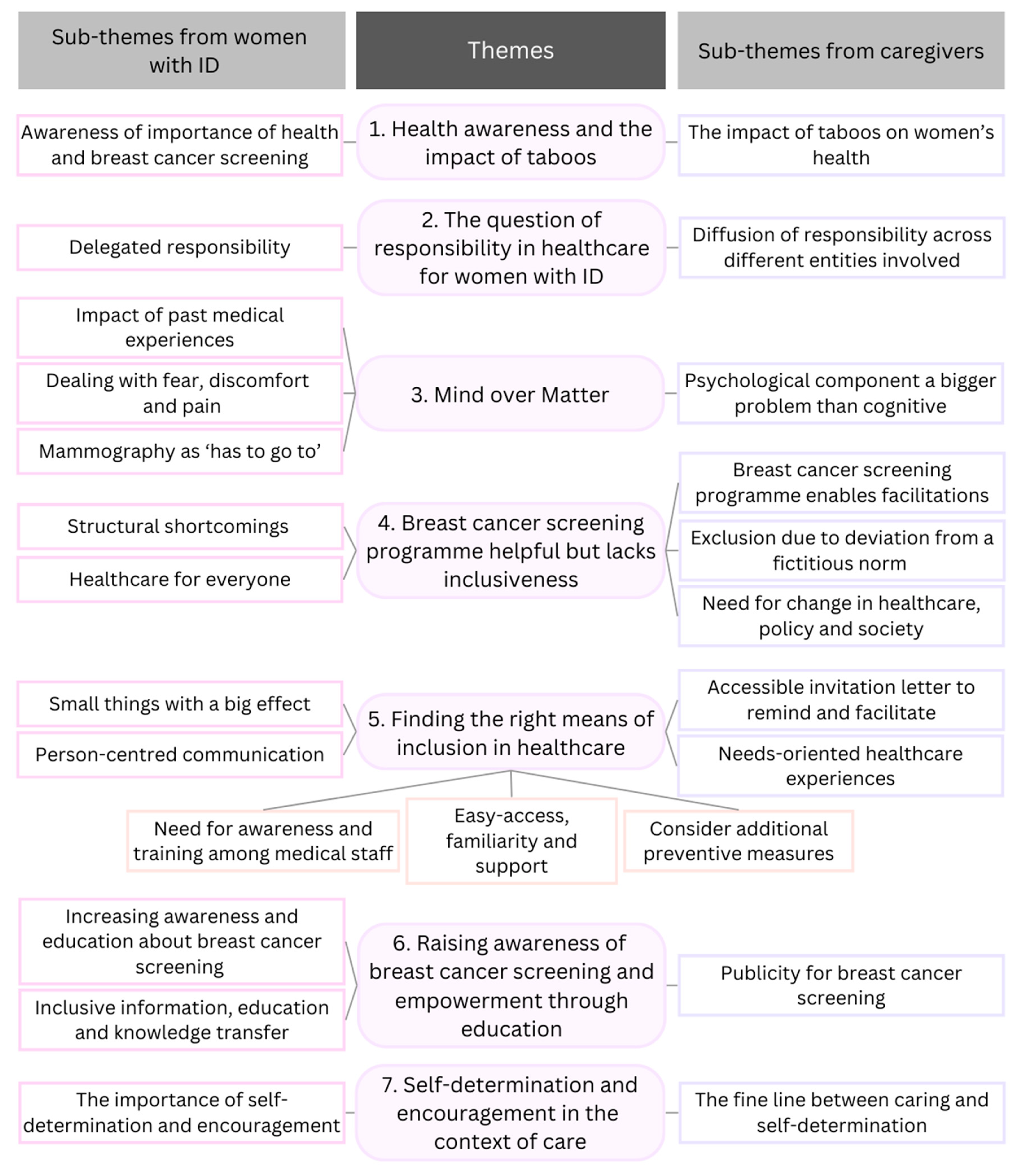
| 32. Clarity of minor themes | Is there a description of diverse cases or a discussion of minor themes? | The minor subthemes are described alongside the major themes (Figure 1) and illustrated by quotations in the Section 3. |
| Characteristic of Women with IDs * | N = 17 | ||
|---|---|---|---|
| Interviews (PID01–07) | 6 | ||
| Focus groups (PID08–18) ** | 11 | ||
| Focus group 1 Focus group 2 Focus group 3 Focus group 4 | 3 3 2 3 | ||
| Range (years) | M | SD | |
| Age | 41–69 | 56.9 | 7.5 |
| n | % | ||
| Gender | Women | 17 | 100 |
| Living Area | Urban | 17 | 100 |
| Living Situation | With Family | 5 | 29.4 |
| Alone/with Partner | 2 | 11.8 | |
| Assisted (24/7 support) | 2 | 11.8 | |
| Semi-Assisted (hourly support) | 1 | 5.9 | |
| Missing | 7 | 41.2 | |
| Legal Guardianship *** | Yes | 14 | 82.4 |
| No | 3 | 17.6 | |
| Characteristic of caregivers | N = 10 | ||
| Range (years) | M | SD | |
| Age | 29–62 | 44.8 | 11.3 |
| Work experience (n = 8) | 2–30 | 16.5 | 10.2 |
| n | % | ||
| Gender | Women | 7 | 70 |
| Men | 3 | 30 | |
| Divers **** | 0 | 0 | |
| Caregiver | Professional | 8 | 80 |
| Family | 2 | 20 | |
| Conditions mentioned of women they care for | All forms of ID, schizophrenia, spastic paralysis, motor and speech disorders, Down’s syndrome | ||
Disclaimer/Publisher’s Note: The statements, opinions and data contained in all publications are solely those of the individual author(s) and contributor(s) and not of MDPI and/or the editor(s). MDPI and/or the editor(s) disclaim responsibility for any injury to people or property resulting from any ideas, methods, instructions or products referred to in the content. |
© 2026 by the authors. Licensee MDPI, Basel, Switzerland. This article is an open access article distributed under the terms and conditions of the Creative Commons Attribution (CC BY) license.
Share and Cite
Wagner, T.; Makled, N.; Scior, K.; König, L.M.; Unseld, M.; Zeilinger, E.L. Exploring Inclusion in Austria’s Breast Cancer Screening:A Dual-Perspective Study of Women with Intellectual Disabilities and Their Caregivers. Int. J. Environ. Res. Public Health 2026, 23, 124. https://doi.org/10.3390/ijerph23010124
Wagner T, Makled N, Scior K, König LM, Unseld M, Zeilinger EL. Exploring Inclusion in Austria’s Breast Cancer Screening:A Dual-Perspective Study of Women with Intellectual Disabilities and Their Caregivers. International Journal of Environmental Research and Public Health. 2026; 23(1):124. https://doi.org/10.3390/ijerph23010124
Chicago/Turabian StyleWagner, Theresa, Nourhan Makled, Katrina Scior, Laura Maria König, Matthias Unseld, and Elisabeth Lucia Zeilinger. 2026. "Exploring Inclusion in Austria’s Breast Cancer Screening:A Dual-Perspective Study of Women with Intellectual Disabilities and Their Caregivers" International Journal of Environmental Research and Public Health 23, no. 1: 124. https://doi.org/10.3390/ijerph23010124
APA StyleWagner, T., Makled, N., Scior, K., König, L. M., Unseld, M., & Zeilinger, E. L. (2026). Exploring Inclusion in Austria’s Breast Cancer Screening:A Dual-Perspective Study of Women with Intellectual Disabilities and Their Caregivers. International Journal of Environmental Research and Public Health, 23(1), 124. https://doi.org/10.3390/ijerph23010124