Article

Food Safety in Informal Markets: How Knowledge and Attitudes Influence Vendor Practices in Namibia


by
Winnie L. N. Sheehama
and
Tanusha Singh
*
Department of Environmental Health, University of Johannesburg, Johannesburg 2038, Gauteng, South Africa
*
Author to whom correspondence should be addressed.
Int. J. Environ. Res. Public Health 2025, 22(4), 631; https://doi.org/10.3390/ijerph22040631

Submission received: 3 March 2025 / Revised: 14 April 2025 / Accepted: 15 April 2025 / Published: 17 April 2025

Abstract

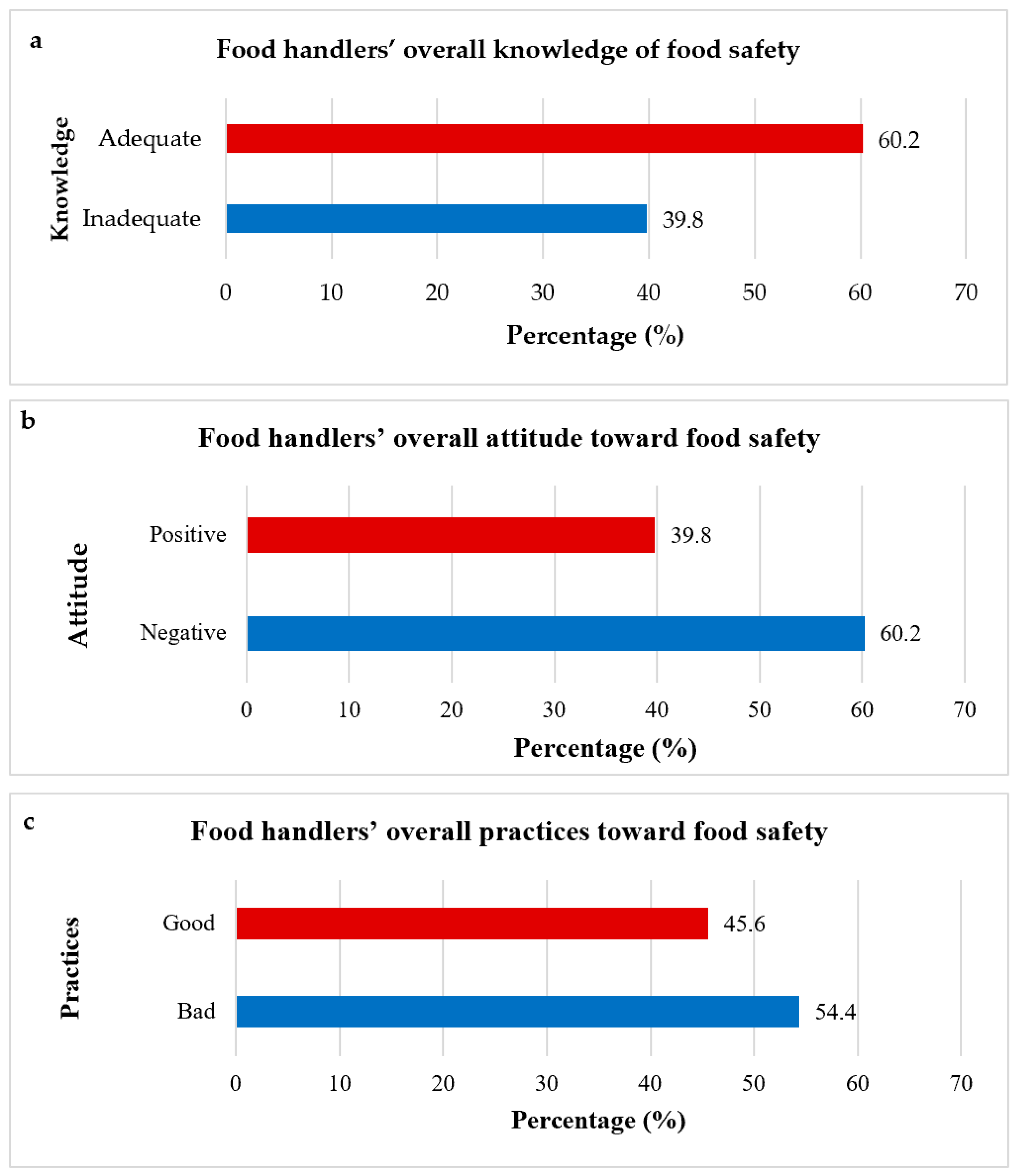
Background: Informal markets are essential to ensuring food accessibility and supporting economic livelihoods throughout sub-Saharan Africa; however, food safety in these settings remains poorly regulated and under-resourced. As such, foodborne illnesses originating from such settings pose serious public health threats. Despite the growing reliance on ready-to-eat street foods in Namibia, little is known about the food safety knowledge, attitudes, and practices (KAP) of food handlers in informal settings. This study investigated food handlers’ KAP regarding food safety at the Oshakati Mini Market, northern Namibia, to inform environmental health practitioners and guide policymakers in improving food safety measures. Methods: A cross-sectional study was conducted with 103 food handlers using a self-administered questionnaire which assessed sociodemographic characteristics, food safety knowledge (15 items), attitudes (10 items), and practices (12 items). Data were analysed using descriptive statistics, Pearson correlation, and multiple linear regression to identify associations between KAP scores and respondent characteristics. Results: The majority of respondents were female (60.2%), aged 30–49 years (69.0%), and had only primary-level education. Only 15.5% had received formal food safety training. The mean knowledge score was 64.7% (SD = 14.2), and the mean practice score was 58.2% (SD = 13.8). Attitudes were predominantly negative (60.2%), despite 95.1% acknowledging the importance of handwashing. Poor practices included low use of protective clothing (28.2%), smoking in food areas (21.4%), and inadequate utensil hygiene. Knowledge was positively correlated with good practices (r = 0.745, p < 0.01), while attitudes were negatively correlated with good practices (r = −0.745, p < 0.01). Regression analysis revealed that age negatively influenced knowledge (β = −0.265, p < 0.01), while work experience positively predicted both knowledge (β = 0.393, p < 0.01) and practices (β = 0.393, p < 0.01). Conclusions: Food handlers in Oshakati’s informal market exhibited moderate knowledge but sub-optimal food safety practices and largely negative attitudes. Limited training and education were key contributing factors. These findings highlight an urgent need for structured, context-specific food safety training and regulatory enforcement to reduce foodborne disease risk and strengthen public health interventions in Namibia’s informal food economy.
Keywords: food safety; food handlers; informal markets; public health; food safety training; KAP; foodborne diseases; street food food safety; food handlers; informal markets; public health; food safety training; KAP; foodborne diseases; street food