The Financial Costs and Effects on the Well-Being of Nursing Students’ Professional Experience Placements: A Cross-Sectional Comparative Study of Urban and Rural Experiences




Abstract
1. Introduction
- i.
- What are the financial costs nursing students incur participating in compulsory placements?
- ii.
- Are there differences between these costs for urban and rural placements?
2. Materials and Methods
2.1. Data Collection
2.2. Data Analysis
3. Results
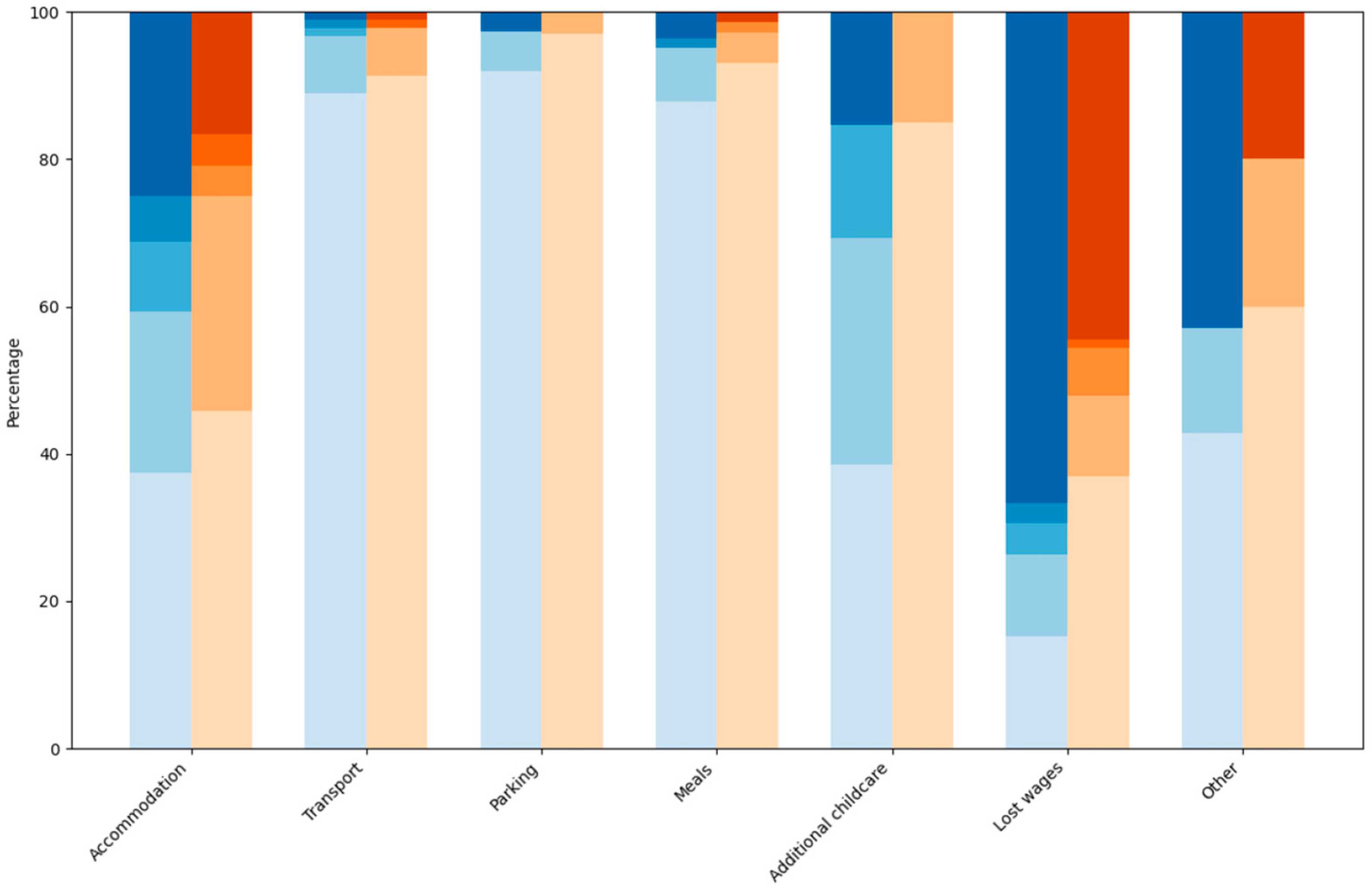
3.1. Financial Strain and Well-Being
3.2. Placement Debt
“be more financially frugal. Keep living expenses as low as possible” (urban placement respondent).
“Try to budget for meals each day and go without certain things to afford the extra petrol” (urban placement respondent).
“bin dove for free food, reduced socialising and recreational activities due to budget” (urban placement respondent).
“Work extra hours outside placement to accrue additional leave” (rural placement respondent).
“I didn’t have the option to travel with anyone else, nor do I have the option to select areas to cut costs” (rural placement respondent).
“Does not apply as we have no choice where we are sent” (rural placement respondent).
3.3. Employment Impacts
“Could not work for two weeks, was offered shifts on weekend but was too tired and run down to be able to do them” (rural placement respondent).“I had to use annual leave in order to have 1 day off per week, so 5 days of placement, 1 day of work and 1 day of annual leave as a day off” (urban placement respondent).“I cannot do placement & take shifts at work with a toddler it is far too much” (urban placement respondent).
“I was unable to work my normal hours to support my financial needs. I was working on the weekends when I could which meant I was working 19 days straight (including unpaid placement)” (rural placement respondent).“I had to work each weekend just to earn enough money to pay rent and eat as well as being on placement” (urban placement respondent).
“I was contacted to do many shifts even though I had notified them of my 6-week unavailability and this has also affected me getting shifts on my return back to my employment place as I have been seen to not to be an involved casual employee due to no shifts been undertaken in a 6 week period” (rural placement respondent).“Reduced availability due to placement lead to reduced shifts after placement” (rural placement respondent).
4. Discussion
Limitations
5. Conclusions
Author Contributions
Funding
Institutional Review Board Statement
Informed Consent Statement
Data Availability Statement
Acknowledgments
Conflicts of Interest
Abbreviations
| MMM | Modified Monash Model |
| PEP | Professional experience placements |
| RHMT | Rural Health Multidisciplinary Training |
| UTAS | University of Tasmania |
References
- Siggins Miller Consulting. Promoting Quality in Clinical Placements: Literature Review and National Stakeholder Consultation. Published by Health Workforce Australia Report. Adelaide, South Australia. 2012, cited in Department of Health (Queensland), Best Practice Clinical Learning Environments: Overview of the Evidence and Available Resources. 2014. Available online: https://www.health.qld.gov.au/__data/assets/pdf_file/0029/693335/cle-review.pdf (accessed on 29 March 2024).
- Australian Nursing & Midwifery Accreditation Council (ANMAC). Registered Nurse Accreditation Standards 2019. 2019. Available online: https://anmac.org.au/sites/default/files/2025-08/registerednurseaccreditationstandards2019_0.pdf (accessed on 8 February 2023).
- Usher, K.; Fagan, A.; Brown, J.; Mather, C.; Marlow, A.; Power, T.; van de Mortel, T.; West, C.; Hutchinson, M.; Zhao, L.; et al. The financial challenges for Australian nursing students attending placement-based work-integrated learning. Collegian 2022, 29, 154–160. [Google Scholar] [CrossRef]
- Beks, H.; Walsh, S.; Clayden, S.; Watson, L.; Zwar, J.; Alston, L. Financial implications of unpaid clinical placements for allied health, dentistry, medical, and nursing students in Australia: A scoping review with recommendations for policy, research, and practice. BMC Health Serv. Res. 2024, 24, 1407. [Google Scholar] [CrossRef]
- Cutcliffe, J.R.; Sloan, G.; Bashaw, M. A systematic review of clinical supervision evaluation studies in nursing. Int. J. Ment. Health Nurs. 2018, 27, 1344–1363. [Google Scholar] [CrossRef]
- Edward, K.L.; Ousey, K.; Playle, J.; Giandinoto, J.A. Are new nurses work ready—The impact of preceptorship. An integrative systematic review. J. Prof. Nurs. 2017, 33, 326–333. [Google Scholar] [CrossRef]
- Mather, C.; Marlow, A. Learning to teach: Supporting nurses and midwives to supervise students. Aust. Nurs. Midwifery J. 2017, 25, 32. [Google Scholar]
- Coe, S.; Marlow, A.; Mather, C. Whole of Community Facilitators: An exemplar for supporting rural health workforce recruitment through students’ professional experience placements. Int. J. Environ. Res. Public Health 2021, 18, 7675. [Google Scholar] [CrossRef]
- Sanderson, H.; Lea, J. Implementation of the Clinical Facilitation model within an Australian rural setting: The role of the Clinical Facilitator. Nurse Educ. Pract. 2012, 12, 333–339. [Google Scholar] [CrossRef]
- Scott, B.; Rapson, T.; Allibone, L.; Hamilton, R.; Mambanje, C.S.; Pisaneschi, L. Practice education facilitator roles and their value to NHS organisations. Br. J. Nurs. 2017, 26, 222–227. [Google Scholar] [CrossRef] [PubMed]
- Sykes, C.; Urquhart, C.; Foster, A. Role of the Practice Education Facilitator (PEF): The Cambridgeshire model underpinned by a literature review of educational facilitator roles. Nurse Educ. Today 2014, 34, 1395–1397. [Google Scholar] [CrossRef]
- Carr, J.; Taylor, R.; Pitt, M. Supporting student nurses who have their first clinical placement in the community nursing team. Br. J. Community Nurs. 2018, 23, 496–500. [Google Scholar] [CrossRef] [PubMed]
- Fatima, Y.; Kazmi, S.; King, S.; Soloman, S.; Knight, S. Positive placement experience and future rural practice intentions: Findings from a repeated cross-sectional study. J. Multidiscip. Healthc. 2018, 11, 645–652. [Google Scholar] [CrossRef]
- Doyle, K.; Sainsbury, K.; Cleary, S.; Parkinson, L.; Vindigni, D.; McGrath, I.; Cruickshank, M. Happy to help/happy to be here: Identifying components of successful clinical placements for undergraduate nursing students. Nurse Educ. Today 2017, 49, 27–32. [Google Scholar] [CrossRef] [PubMed]
- Sweet, L.; Broadbent, J. Nursing students’ perceptions of the qualities of a clinical facilitator that enhance learning. Nurse Educ. Pract. 2017, 22, 30–36. [Google Scholar] [CrossRef] [PubMed]
- Australian Institute of Health and Welfare. Health Expenditure Australia 2014-15; Health and welfare expenditure series no. 57, Cat. no. HWE 67; AIHW: Canberra, Australia, 2016. [Google Scholar]
- Chisholm, M.; Russell, D.; Humphreys, J. Measuring rural allied health workforce turnover and retention: What are the patterns, determinants and costs? Aust. J. Rural Health 2011, 19, 81–88. [Google Scholar] [CrossRef]
- Grant-Smith, D.; de Zwaan, L. Don’t spend, eat less, save more: Reponses to the financial stress experienced by nursing students during unpaid clinical placements. Nurse Educ. Pract. 2019, 35, 1–6. [Google Scholar] [CrossRef]
- Schofield, D.; Keane, S.; Fletcher, S.; Shrestha, R.; Percival, R. Loss of income and levels of scholarship support for students on rural clinical placements: A survey of medical, nursing and allied health students. Aust. J. Rural Health 2009, 17, 134–140. [Google Scholar] [CrossRef]
- Wray, N.; McCall, L. Money matters: Students′ perceptions of the costs associated with placements. Med. Educ. 2007, 41, 975–981. [Google Scholar] [CrossRef] [PubMed]
- Elliott, J.; Luk, M.; Varshney, K.; Williams, K.; Wright, J. Assessing medical student satisfaction with rural placement: The Australian Rural Clinical School Support Survey. Aust. J. Rural Health 2023, 31, 957–966. [Google Scholar] [CrossRef]
- Mortimer, J.; Verma, A.; Reimann, C.; Brown, A.; Woolley, T. Are all rural placements created equal? A national study of placement experiences among multidisciplinary health students. Aust. J. Rural Health 2019, 27, 118–124. [Google Scholar] [CrossRef]
- Smith, T.; Cross, M.; Waller, S.; Chambers, H.; Farthing, A.; Barraclough, F.; Pit, S.W.; Sutton, K.; Muyambi, K.; King, S.; et al. Ruralization of students’ horizons: Insights into Australian health professional students’ rural and remote placements. J. Multidiscip. Healthc. 2018, 11, 85–97. [Google Scholar] [CrossRef]
- Australian Government. About the Modified Monash Model. Available online: https://www.health.gov.au/topics/rural-health-workforce/classifications/mmm?language=en (accessed on 16 January 2023).
- Department of Health. Rural Health Multidisciplinary Training (RHMT) Program. Available online: https://www1.health.gov.au/internet/main/publishing.nsf/Content/rural-health-multidisciplinary-training (accessed on 24 September 2020).
- Thomas, D.R. A General Inductive Approach for Analyzing Qualitative Evaluation Data. Am. J. Eval. 2006, 27, 237–246. [Google Scholar] [CrossRef]
- Jaffray, L.; Cooper, J. Supervisor and Facilitator Guide to Professional Experience Placement (PEP); School of Nursing University of Tasmania: Tasmania, Australia, 2020. [Google Scholar]
- Fedele, R. Placement Poverty: Why Nursing and Midwifery Students must be Paid for Clinical Placements. Aust. Nurs. Midwifery J. 2024. Available online: https://anmj.org.au/placement-poverty-why-nursing-and-midwifery-students-must-be-paid-for-clinical-placements (accessed on 15 July 2025).
- Bradley, D.M.; Bourke, L.; Cos-grave, C. Experiences of Nursing and Allied Health Students Undertaking a Rural Placement: Barriers and Enablers to Satisfaction and Wellbeing. Aust. Int. J. Rural Educ. 2020, 30, 51–63. [Google Scholar] [CrossRef]
- Australian Government Department of Education. 2024-25 Budget: New Commonwelath Prac Payment Fact Sheet. Available online: https://www.education.gov.au/about-department/resources/new-commonwealth-prac-payment (accessed on 26 November 2025).
- Australian Government Department of Education. New Commonwealth Prac Payment (CPP). Available online: https://www.education.gov.au/higher-education/announcements/new-commonwealth-prac-payment-cpp (accessed on 26 November 2025).


| Rural (N = 158) | Urban (N = 207) | |||
|---|---|---|---|---|
| N | % | N | % | |
| 1 week (40 h) | 2 | 1 | 1 | 0.5 |
| 2 weeks (80 h) | 54 | 32 | 81 | 39 |
| 3 weeks (120 h/20 days) | 2 | 1 | 2 | 1 |
| 4 weeks (160 h) | 66 | 39 | 85 | 41 |
| 6 weeks (240 h) | 33 | 20 | 38 | 18.5 |
| 9 weeks (360 h) (making up placement time) | 1 | 1 | 0 | 0 |
| Strongly Disagree | Somewhat Disagree | Neither Disagree or Agree | Somewhat Agree | Strongly Agree | |
|---|---|---|---|---|---|
| Question—“I experienced financial hardship on my most recent clinical placement” | |||||
| All respondents (N = 320) | 32 (10%) | 15 (5%) | 32 (10%) | 121 (38%) | 120 (37%) |
| Urban placement (N = 173) | 16 (9%) | 10 (6%) | 23 (13%) | 55 (32%) | 69 (40%) |
| Rural placement (N = 147) | 15 (10%) | 4 (3%) | 14 (9%) | 66 (45%) | 49 (33%) |
| Question—“My most recent clinical placement was stressful due to financial issues” | |||||
| All respondents (N = 319) | 3 (10%) | 25 (8%) | 56 (18%) | 123 (39%) | 83 (26%) |
| Urban placement (N = 173) | 16 (9%) | 14 (8%) | 32 (18%) | 64 (36%) | 48 (28%) |
| Rural placement (N = 146) | 18 (12%) | 10 (7%) | 23 (16%) | 60 (41%) | 35 (24%) |
| Question—“It was difficult to enjoy my most recent clinical placement due to financial strain” | |||||
| All respondents (N = 319) | 51 (16%) | 51 (16%) | 73 (23%) | 93 (29%) | 51 (16%) |
| Urban placement (N = 173) | 26 (15%) | 28 (16%) | 33 (19%) | 55 (32%) | 31 (18%) |
| Rural placement (N = 146) | 23 (16%) | 25 (17%) | 39 (27%) | 39 (27%) | 20 (14%) |
| Question—“The financial strain of my most recent clinical placement affected my health and well-being (exhaustion, stress, depression, etc.)” | |||||
| All respondents (N = 319) | 51 (16%) | 29 (9%) | 57 (18%) | 112 (35%) | 70 (22%) |
| Urban placement (N = 173) | 27 (16%) | 17 (9%) | 29 (17%) | 57 (33%) | 43 (25%) |
| Rural placement (N = 146) | 25 (17%) | 13 (9%) | 28 (20%) | 54 (37%) | 26 (18%) |
| N | % | |
|---|---|---|
| Number of respondents with debt, by placement | ||
| All respondents (N = 376) | 110 | 29 |
| Urban placement respondents (N = 207) | 68 | 33 |
| Rural placement respondents (N = 169) | 42 | 25 |
| Accommodation | ||
| All respondents | 95 | 28 |
| Urban placement respondents | 58 | 32 |
| Rural placement respondents | 37 | 24 |
| Transport | ||
| All respondents | 306 | 90 |
| Urban placement respondents | 165 | 90 |
| Rural placement respondents | 144 | 92 |
| Parking | ||
| All respondents | 118 | 35 |
| Urban placement respondents | 67 | 36 |
| Rural placement respondents | 51 | 32 |
| Meals | ||
| All respondents | 272 | 80 |
| Urban placement respondents | 151 | 82 |
| Rural placement respondents | 115 | 73 |
| Additional childcare | ||
| All respondents | 38 | 11 |
| Urban placement respondents | 23 | 13 |
| Rural placement respondents | 15 | 10 |
| Lost wages | ||
| All respondents | 246 | 72 |
| Urban placement respondents | 134 | 73 |
| Rural placement respondents | 112 | 71 |
| Other | ||
| All respondents | 20 | 6 |
| Urban placement respondents | 12 | 7 |
| Rural placement respondents | 8 | 5 |
| Rural (N = 64) | Urban (N = 61) | |||
|---|---|---|---|---|
| N | % | N | % | |
| AUD 0 | 22 | 36 | 8 | 13 |
| AUD 1–AUD 100 | 18 | 29 | 15 | 24 |
| AUD 101–AUD 200 | 14 | 23 | 21 | 34 |
| AUD 201–AUD 300 | 4 | 7 | 11 | 18 |
| AUD 301–AUD 400 | 1 | 2 | 3 | 5 |
| AUD 401–AUD 500 | 2 | 3 | 4 | 6 |
Disclaimer/Publisher’s Note: The statements, opinions and data contained in all publications are solely those of the individual author(s) and contributor(s) and not of MDPI and/or the editor(s). MDPI and/or the editor(s) disclaim responsibility for any injury to people or property resulting from any ideas, methods, instructions or products referred to in the content. |
© 2025 by the authors. Licensee MDPI, Basel, Switzerland. This article is an open access article distributed under the terms and conditions of the Creative Commons Attribution (CC BY) license (https://creativecommons.org/licenses/by/4.0/).
Share and Cite
Coe, S.; Marlow, A.; Prior, S.J.; Mather, C. The Financial Costs and Effects on the Well-Being of Nursing Students’ Professional Experience Placements: A Cross-Sectional Comparative Study of Urban and Rural Experiences. Int. J. Environ. Res. Public Health 2025, 22, 1848. https://doi.org/10.3390/ijerph22121848
Coe S, Marlow A, Prior SJ, Mather C. The Financial Costs and Effects on the Well-Being of Nursing Students’ Professional Experience Placements: A Cross-Sectional Comparative Study of Urban and Rural Experiences. International Journal of Environmental Research and Public Health. 2025; 22(12):1848. https://doi.org/10.3390/ijerph22121848
Chicago/Turabian StyleCoe, Sandra, Annette Marlow, Sarah J. Prior, and Carey Mather. 2025. "The Financial Costs and Effects on the Well-Being of Nursing Students’ Professional Experience Placements: A Cross-Sectional Comparative Study of Urban and Rural Experiences" International Journal of Environmental Research and Public Health 22, no. 12: 1848. https://doi.org/10.3390/ijerph22121848
APA StyleCoe, S., Marlow, A., Prior, S. J., & Mather, C. (2025). The Financial Costs and Effects on the Well-Being of Nursing Students’ Professional Experience Placements: A Cross-Sectional Comparative Study of Urban and Rural Experiences. International Journal of Environmental Research and Public Health, 22(12), 1848. https://doi.org/10.3390/ijerph22121848