Social–Emotional Competence Growth Profiles in Upper Elementary School Years and Pathways to Mental Health Outcomes in Middle School †


Abstract
1. Introduction
1.1. Development of Social–Emotional Competence (SEC) in Upper Elementary School Years
1.2. Pathways from Earlier SEC Development to Later Mental Health
1.3. Research Objectives
2. Materials and Methods
2.1. Data and Sample
2.2. Measurements
2.2.1. Mental Health
2.2.2. Social–Emotional Competence
2.2.3. Academic Autonomy, Academic Competence, and Peer Relatedness
2.2.4. Covariates
2.3. Analysis Methods
2.3.1. Latent Profile Growth Modeling (LPGM)
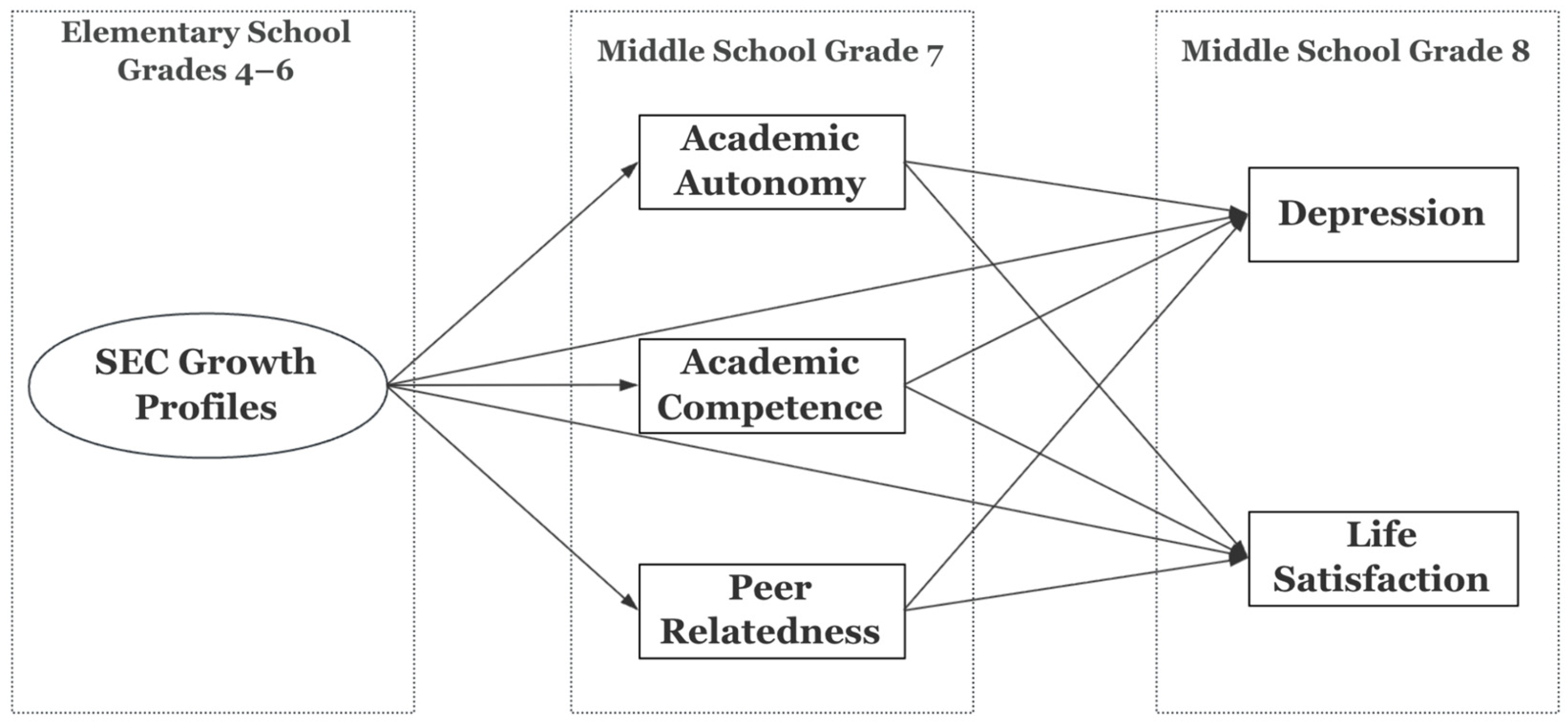
2.3.2. Mediation Analysis
3. Results
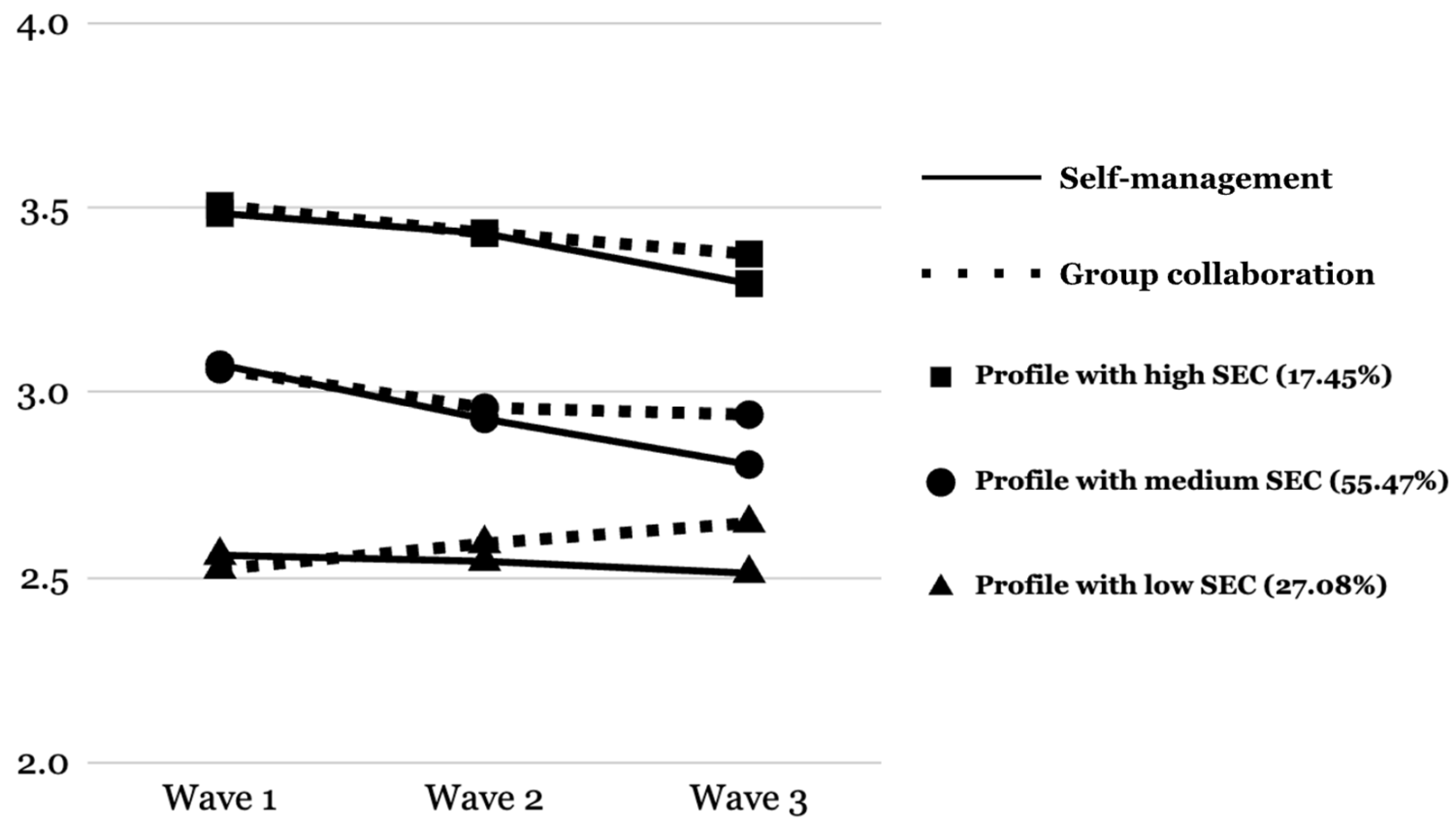
3.1. Latent Profiles of SEC Growth Trajectories
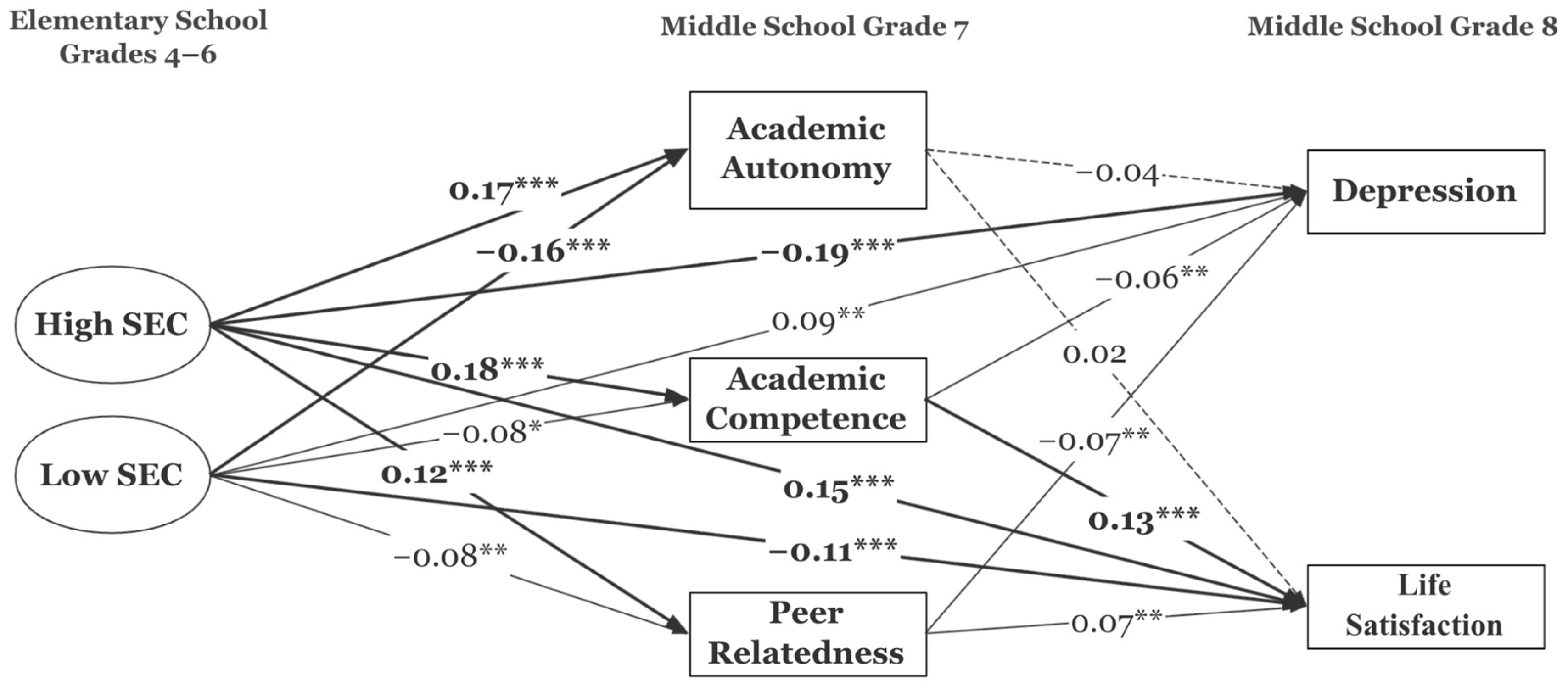
3.2. Mediation Model
4. Discussion
4.1. SEC Development in Upper Elementary School Years
4.2. Mediational Pathways from Early SEC to Adolescent Mental Health
4.3. Limitations and Recommendations for Future Research
5. Conclusions
Supplementary Materials
Author Contributions
Funding
Institutional Review Board Statement
Informed Consent Statement
Data Availability Statement
Acknowledgments
Conflicts of Interest
Abbreviations
| AIC | Akaike information criterion |
| aBIC | adjusted Bayesian information criteria |
| BLRT | Bootstrap likelihood ratio test |
| BIC | Bayesian information criteria |
| CFI | Comparative fit index |
| CI | Confidence interval |
| FIML | Full information maximum likelihood |
| LMRT | Lo–Mendell–Rubin likelihood ratio test |
| LPGM | Latent profile growth modeling |
| MCAR | Missing completely at random |
| MLR | Maximum likelihood with robust standard errors |
| RMSEA | Root-mean-square error of approximation |
| SDT | Self-determination theory |
| SEC | Social–emotional competence |
| SEL | Social–emotional learning |
| SRMR | Standardized root-mean-square residual |
| TLI | Tucker–Lewis index |
| KCYPS | Korean Children and Youth Panel Survey |
References
- Shorey, S.; Ng, E.D.; Wong, C.H.J. Global prevalence of depression and elevated depressive symptoms among adolescents: A systematic review and meta-analysis. Br. J. Clin. Psychol. 2022, 61, 287–305. [Google Scholar] [CrossRef] [PubMed]
- World Health Organization. Mental Health of Adolescents. 2021. Available online: https://www.who.int/news-room/fact-sheets/detail/adolescent-mental-health (accessed on 24 September 2025).
- Racine, N.; McArthur, B.A.; Cooke, J.E.; Eirich, R.; Zhu, J.; Madigan, S. Global Prevalence of Depressive and Anxiety Symptoms in Children and Adolescents During COVID-19: A Meta-analysis. JAMA Pediatr. 2021, 175, 1142–1150. [Google Scholar] [CrossRef] [PubMed]
- Mullins, E.R.; Irvin, J.L. Transition into Middle School. Middle Sch. J. 2000, 31, 57–60. [Google Scholar] [CrossRef]
- Yoo, S.H. Student expectations and perceptions of the transition from elementary to middle school. J. Elem. Educ. 2007, 20, 355–375. [Google Scholar]
- Kessler, R.C.; Berglund, P.; Demler, O.; Jin, R.; Merikangas, K.R.; Walters, E.E. Lifetime Prevalence and Age-of-Onset Distributions of DSM-IV Disorders in the National Comorbidity Survey Replication. Arch. Gen. Psychiatry 2005, 62, 593–602. [Google Scholar] [CrossRef]
- Goldstein, S.E.; Boxer, P.; Rudolph, E. Middle School Transition Stress: Links with Academic Performance, Motivation, and School Experiences. Contemp. Sch. Psychol. 2015, 19, 21–29. [Google Scholar] [CrossRef]
- Chatterjee Singh, N.; Duraiappah, A.K. Rethinking Learning: A Review of Social and Emotional Learning for Education Systems. 2020. Available online: https://unesdoc.unesco.org/ark:/48223/pf0000373890 (accessed on 24 September 2025).
- Chernyshenko, O.S.; Kankaraš, M.; Drasgow, F. Social and Emotional Skills for Student Success and Well-Being: Conceptual Framework for the OECD Study on Social and Emotional Skills; OECD: Paris, France, 2018. [Google Scholar] [CrossRef]
- Domitrovich, C.E.; Durlak, J.A.; Staley, K.C.; Weissberg, R.P. Social-Emotional Competence: An Essential Factor for Promoting Positive Adjustment and Reducing Risk in School Children. Child Dev. 2017, 88, 408–416. [Google Scholar] [CrossRef]
- Cipriano, C.; Strambler, M.J.; Naples, L.H.; Ha, C.; Kirk, M.; Wood, M.; Sehgal, K.; Zieher, A.K.; Eveleigh, A.; McCarthy, M.; et al. The state of evidence for social and emotional learning: A contemporary meta-analysis of universal school-based SEL interventions. Child Dev. 2023, 94, 1181–1204. [Google Scholar] [CrossRef]
- Durlak, J.A.; Mahoney, J.L.; Boyle, A.E. What we know, and what we need to find out about universal, school-based social and emotional learning programs for children and adolescents: A review of meta-analyses and directions for future research. Psychol. Bull. 2022, 148, 765–782. [Google Scholar] [CrossRef]
- World Health Organization. World Mental Health Report: Transforming Mental Health for All; World Health Organization: Geneva, Switzerland, 2022. [Google Scholar]
- Lee, J.; Wang, C.; Lui, I.D. Exploring gender differences in multidimensional social-emotional competence from developmental and cross-cultural perspectives. Soc. Emot. Learn. Res. Pract. Policy 2025, 6, 100137. [Google Scholar] [CrossRef]
- Lee, J.; Junus, A. Differences and Similarities in Youth Social-emotional Competence Measurement Between North American and East Asian Countries: Exploratory Graph Analysis using the OECD Survey on Social and Emotional Skills Data. Child Indic. Res. 2024, 17, 57–79. [Google Scholar] [CrossRef]
- Rose-Krasnor, L.; Denham, S. Social-Emotional Competence in Early Childhood. In Handbook of Peer Interactions, Relationships, and Groups. Social, Emotional, and Personality Development in Context; The Guilford Press: New York, NY, USA, 2009; pp. 162–179. [Google Scholar]
- CASEL’s SEL Framework: What Are the Core Competence Areas and Where are They Promoted? 2020. Available online: https://casel.org/casel-sel-framework-11-2020/?view=true (accessed on 24 September 2025).
- Walton, K.E.; Murano, D.; Burrus, J.; Casillas, A. Multimethod Support for Using the Big Five Framework to Organize Social and Emotional Skills. Assessment 2023, 30, 144–159. [Google Scholar] [CrossRef] [PubMed]
- Hay, D.F.; Paine, A.L.; Perra, O.; Cook, K.V.; Hashmi, S.; Robinson, C.; Kairis, V.; Slade, R. Prosocial and Aggressive Behavior: A Longitudinal Study. Monogr. Soc. Res. Child Dev. 2021, 86, 7–103. [Google Scholar] [CrossRef] [PubMed]
- Yates, T.; Ostrosky, M.M.; Cheatham, G.A.; Fettig, A.; Shaffer, L.; Santos, R.M. Research Synthesis on Screening and Assessing Social-Emotional Competence; The Center on the Social and Emotional Foundations for Early Learning: Nashville, TN, USA, 2008; pp. 1–19. [Google Scholar]
- Wolf, S.; McCoy, D.C. The role of executive function and social-emotional skills in the development of literacy and numeracy during preschool: A cross-lagged longitudinal study. Dev. Sci. 2019, 22, e12800. [Google Scholar] [CrossRef]
- Takahashi, Y.; Okada, K.; Hoshino, T.; Anme, T. Developmental Trajectories of Social Skills during Early Childhood and Links to Parenting Practices in a Japanese Sample. PLoS ONE 2015, 10, e0135357. [Google Scholar] [CrossRef]
- Eisenberg, N.; Fabes, R.A.; Spinrad, T.L. Prosocial Development. In Handbook of Child Psychology; John Wiley & Sons, Ltd: Hoboken, NJ, USA, 2007. [Google Scholar] [CrossRef]
- Spinrad, T.L.; Eisenberg, N. Empathy, Prosocial Behavior, and Positive Development in Schools. In Handbook of Positive Psychology in Schools, 2nd ed.; Routledge: London, UK, 2014; pp. 119–129. [Google Scholar]
- Zahn-Waxler, C.; Smith, K.D. The Development of Prosocial Behavior. In Handbook of Social Development: A Lifespan Perspective; Van Hasselt, V.B., Hersen, M., Eds.; Springer: New York, NY, USA, 1992; pp. 229–256. [Google Scholar] [CrossRef]
- Buckley, M.; Saarni, C. Emotion Regulation: Implications for Positive Youth Development. In Handbook of Positive Psychology in Schools, 2nd ed.; Routledge: London, UK, 2014; pp. 99–114. [Google Scholar]
- Kokko, K.; Tremblay, R.E.; Lacourse, E.; Nagin, D.S.; Vitaro, F. Trajectories of Prosocial Behavior and Physical Aggression in Middle Childhood: Links to Adolescent School Dropout and Physical Violence. J. Res. Adolesc. 2006, 16, 403–428. [Google Scholar] [CrossRef]
- Sallquist, J.V.; Eisenberg, N.; Spinrad, T.L.; Reiser, M.; Hofer, C.; Liew, J.; Zhou, Q.; Eggum, N. Positive and negative emotionality: Trajectories across six years and relations with social competence. Emotion 2009, 9, 15–28. [Google Scholar] [CrossRef]
- Ross, K.M.; Kim, H.; Tolan, P.H.; Jennings, P.A. An exploration of normative social and emotional skill growth trajectories during adolescence. J. Appl. Dev. Psychol. 2019, 62, 102–115. [Google Scholar] [CrossRef]
- Sørlie, M.A.; Hagen, K.A.; Nordahl, K.B. Development of social skills during middle childhood: Growth trajectories and school-related predictors. Int. J. Sch. Educ. Psychol. 2021, 9, S69–S87. [Google Scholar] [CrossRef]
- Yong, G.H.; Lin, M.H.; Toh, T.H.; Marsh, N.V. Social-Emotional Development of Children in Asia: A Systematic Review. Behav. Sci. 2023, 13, 123. [Google Scholar] [CrossRef]
- Chen, X.; French, D.C. Children’s Social Competence in Cultural Context. Annu. Rev. Psychol. 2008, 59, 591–616. [Google Scholar] [CrossRef]
- Garrett-Peters, P.T.; Fox, N.A. Cross-cultural differences in children’s emotional reactions to a disappointing situation. Int. J. Behav. Dev. 2007, 31, 161–169. [Google Scholar] [CrossRef]
- Fine, S.E.; Izard, C.E.; Mostow, A.J.; Trentacosta, C.J.; Ackerman, B.P. First grade emotion knowledge as a predictor of fifth grade self-reported internalizing behaviors in children from economically disadvantaged families. Dev. Psychopathol. 2003, 15, 331–342. [Google Scholar] [CrossRef] [PubMed]
- Guhn, M.; Gadermann, A.M.; Almas, A.; Schonert-Reichl, K.A.; Hertzman, C. Associations of teacher-rated social, emotional, and cognitive development in kindergarten to self-reported wellbeing, peer relations, and academic test scores in middle childhood. Early Child. Res. Q. 2016, 35, 76–84. [Google Scholar] [CrossRef]
- Jones, D.E.; Greenberg, M.; Crowley, M. Early Social-Emotional Functioning and Public Health: The Relationship Between Kindergarten Social Competence and Future Wellness. Am. J. Public Health 2015, 105, 2283–2290. [Google Scholar] [CrossRef] [PubMed]
- Shoshani, A.; Slone, M. Middle School Transition from the Strengths Perspective: Young Adolescents’ Character Strengths, Subjective Well-Being, and School Adjustment. J. Happiness Stud. 2013, 14, 1163–1181. [Google Scholar] [CrossRef]
- Rudolph, K.D.; Lambert, S.F.; Clark, A.G.; Kurlakowsky, K.D. Negotiating the Transition to Middle School: The Role of Self-Regulatory Processes. Child Dev. 2001, 72, 929–946. [Google Scholar] [CrossRef]
- Kang, Y.; Ha, J.; Ham, G.; Lee, E.; Jo, H. A structural equation model of the relationships between social-emotional competence, social support, depression, and aggression in early adolescents in South Korea. Child. Youth Serv. Rev. 2022, 138, 106498. [Google Scholar] [CrossRef]
- Vestad, L.; Bru, E.; Virtanen, T.E.; Stallard, P.N. Associations of social and emotional competencies, academic efficacy beliefs, and emotional distress among students in lower secondary school. Soc. Psychol. Educ. 2021, 24, 413–439. [Google Scholar] [CrossRef]
- Ryan, R.M.; Deci, E.L. Self-determination theory and the facilitation of intrinsic motivation, social development, and well-being. Am. Psychol. 2000, 55, 68–78. [Google Scholar] [CrossRef]
- Hagenauer, G.; Gläser-Zikuda, M.; Moschner, B. University students’ emotions, life-satisfaction and study commitment: A self-determination theoretical perspective. J. Furth. High. Educ. 2018, 42, 808–826. [Google Scholar] [CrossRef]
- Ruzek, E.A.; Hafen, C.A.; Allen, J.P.; Gregory, A.; Mikami, A.Y.; Pianta, R.C. How teacher emotional support motivates students: The mediating roles of perceived peer relatedness, autonomy support, and competence. Learn. Instr. 2016, 42, 95–103. [Google Scholar] [CrossRef]
- Li, N.; Hein, S. Parenting, Autonomy in Learning, and Development During Adolescence in China. New Dir. Child Adolesc. Dev. 2019, 163, 67–80. [Google Scholar] [CrossRef]
- Noom, M.J.; Deković, M.; Meeus, W.H.J. Autonomy, attachment and psychosocial adjustment during adolescence: A double-edged sword? J. Adolesc. 1999, 22, 771–783. [Google Scholar] [CrossRef]
- Deighton, J.; Humphrey, N.; Belsky, J.; Boehnke, J.; Vostanis, P.; Patalay, P. Longitudinal pathways between mental health difficulties and academic performance during middle childhood and early adolescence. Br. J. Dev. Psychol. 2018, 36, 110–126. [Google Scholar] [CrossRef]
- Zhang, W.; Zhang, L.; Chen, L.; Ji, L.; Deater-Deckard, K. Developmental changes in longitudinal associations between academic achievement and psychopathological symptoms from late childhood to middle adolescence. J. Child Psychol. Psychiatry 2019, 60, 178–188. [Google Scholar] [CrossRef]
- Moore, G.F.; Cox, R.; Evans, R.E.; Hallingberg, B.; Hawkins, J.; Littlecott, H.J.; Long, S.J.; Murphy, S. School, Peer and Family Relationships and Adolescent Substance Use, Subjective Wellbeing and Mental Health Symptoms in Wales: A Cross Sectional Study. Child Indic. Res. 2018, 11, 1951–1965. [Google Scholar] [CrossRef]
- Oberle, E.; Guhn, M.; Gadermann, A.M.; Thomson, K.; Schonert-Reichl, K.A. Positive mental health and supportive school environments: A population-level longitudinal study of dispositional optimism and school relationships in early adolescence. Soc. Sci. Med. 2018, 214, 154–161. [Google Scholar] [CrossRef]
- Shin, K.M.; Cho, S.M.; Shin, Y.M.; Park, K.S. Effects of Early Childhood Peer Relationships on Adolescent Mental Health: A 6- to 8-Year Follow-Up Study in South Korea. Psychiatry Investig. 2016, 13, 383–388. [Google Scholar] [CrossRef]
- Collie, R.J. Perceived social-emotional competence: A multidimensional examination and links with social-emotional motivation and behaviors. Learn. Instr. 2022, 82, 101656. [Google Scholar] [CrossRef]
- Zhang, C.; Mao, L.; Li, N.; Gu, X. Chinese EFL Students’ Social-Emotional Competence, Grit, and Academic Engagement. Front. Psychol. 2022, 13, 914759. [Google Scholar] [CrossRef]
- Rhoades, B.L.; Warren, H.K.; Domitrovich, C.E.; Greenberg, M.T. Examining the link between preschool social–emotional competence and first grade academic achievement: The role of attention skills. Early Child. Res. Q. 2011, 26, 182–191. [Google Scholar] [CrossRef]
- Jiménez-Rodríguez, T.; De la Barrera, U.; Schoeps, K.; Valero-Moreno, S.; Montoya-Castilla, I. Longitudinal Analysis of Adolescent Adjustment: The Role of Attachment and Emotional Competence. Children 2022, 9, 1711. [Google Scholar] [CrossRef]
- Nakamichi, K.; Nakamichi, N.; Nakazawa, J. Preschool social-emotional competencies predict school adjustment in Grade 1. Early Child Dev. Care 2021, 191, 159–172. [Google Scholar] [CrossRef]
- Wang, Y.; Yang, Z.; Zhang, Y.; Wang, F.; Liu, T.; Xin, T. The Effect of Social-Emotional Competency on Child Development in Western China. Front. Psychol. 2019, 10, 1282. [Google Scholar] [CrossRef]
- Kim, K.; Kim, J.; Won, H. Guidelines for Conducting Brief Psychiatric Diagnostic Tests; Central Psychological Publishing: Seoul, Republic of Korea, 1984. [Google Scholar]
- Kim, J.; Beak, H.; Lee, G. Korean Children and Youth Panel Survey 2010 I. 2010. Available online: https://www.nypi.re.kr/archive/board?menuId=MENU00220 (accessed on 24 September 2025).
- Diener, E.; Emmons, R.A.; Larsen, R.J.; Griffin, S. The Satisfaction With Life Scale. J. Pers. Assess. 1985, 49, 71–75. [Google Scholar] [CrossRef]
- Seo, E.H.; Kim, S.G.; Kim, S.H.; Kim, J.H.; Park, J.H.; Yoon, H.J. Life satisfaction and happiness associated with depressive symptoms among university students: A cross-sectional study in Korea. Ann. Gen. Psychiatry 2018, 17, 52. [Google Scholar] [CrossRef]
- Cho, B.; Lim, K. Development and validation of emotional or behavioral problems scale. Korean J. Couns. Psychother. 2003, 15, 729–746. [Google Scholar]
- Kim, H.; Hwang, M. Validation of the Korean grit scale for children. J. Educ. 2015, 35, 63–74. [Google Scholar] [CrossRef]
- Kim, T.; Oh, I.; Lee, Y.; Choi, K. Measurement and International Comparative Study of Youth Competencies II: IEA ICCS 2016—Development and Analysis Study of Measurement Tools for Youth Social Participation Competencies. 2015.
- Bak, B.; Roh, S.; Kim, J.; Hwang, J. Development and validation of the academic helplessness scale. Korean J. Child Educ. 2015, 24, 5–29. [Google Scholar] [CrossRef]
- Bae, S.; Hong, J.; Hyun, M. A validation study of the peer relationship quality scale for adolescents. Korean J. Youth Stud. 2015, 22, 325–344. Available online: https://www.researchgate.net/publication/319650583_A_Validation_Study_of_the_Peer_Relationship_Quality_Scale_for_Adolescents (accessed on 24 September 2025).
- Kim, T.; Lee, E. Validation of the Korean version of parents as social context questionnaire for adolescents: PSCQ_KA. Korean J. Youth Stud. 2017, 24, 313–333. [Google Scholar] [CrossRef]
- Shin, T. Comparison of three growth modeling techniques in the multilevel analysis of longitudinal academic achievement scores: Latent growth modeling, hierarchical linear modeling, and longitudinal profile analysis via multidimensional scaling. Asia Pac. Educ. Rev. 2007, 8, 262–275. [Google Scholar] [CrossRef]
- Mok, M.M.C.; McInerney, D.M.; Zhu, J.; Or, A. Growth trajectories of mathematics achievement: Longitudinal tracking of student academic progress. Br. J. Educ. Psychol. 2015, 85, 154–171. [Google Scholar] [CrossRef]
- Schwarz, G. Estimating the Dimension of a Model. Ann. Stat. 1978, 6, 461–464. [Google Scholar] [CrossRef]
- Sclove, S.L. Application of Model-Selection Criteria to Some Problems in Multivariate Analysis. Psychometrika 1987, 52, 333–343. [Google Scholar] [CrossRef]
- Lo, Y.; Mendell, N.R.; Rubin, D.B. Testing the number of components in a normal mixture. Biometrika 2001, 88, 767–778. [Google Scholar] [CrossRef]
- McLachlan, G.J.; Peel, D. Finite Mixture Models, 1st ed.; John Wiley & Sons: Hoboken, NJ, USA, 2000. [Google Scholar]
- Hu, L.; Bentler, P.M. Cutoff criteria for fit indexes in covariance structure analysis: Conventional criteria versus new alternatives. Struct. Equ. Model. Multidiscip. J. 1999, 6, 1–55. [Google Scholar] [CrossRef]
- Shrout, P.E.; Bolger, N. Mediation in experimental and nonexperimental studies: New procedures and recommendations. Psychol. Methods 2002, 7, 422–445. [Google Scholar] [CrossRef]
- Rosseel, Y. lavaan: An R Package for Structural Equation Modeling. J. Stat. Softw. 2012, 48, 1–36. [Google Scholar] [CrossRef]
- Flynn, E.; Ehrenreich, S.E.; Beron, K.J.; Underwood, M.K. Prosocial Behavior: Long-term Trajectories and Psychosocial Outcomes. Soc. Dev. 2015, 24, 462–482. [Google Scholar] [CrossRef]
- Lee, J.; Shapiro, V.B.; Kim, B.K.E. Universal school-based social and emotional learning (SEL) for diverse student subgroups: Implications for enhancing equity through SEL. Prev. Sci. 2023, 24, 1011–1022. [Google Scholar] [CrossRef]
- Shapiro, V.B.; Lee, J.; Kim, B.K.E. TOOLBOX effects on K-2 student growth in social-emotional competence: Evidence from a quasi-experimental study. Contemp. School Psychol. 2023, 27, 198–213. [Google Scholar] [CrossRef]
- Lee, J.; Shapiro, V.B.; Robitaille, J.L.; LeBuffe, P.A. Gender, racial-ethnic, and socioeconomic disparities in the development of social-emotional competence among elementary school students. J. Sch. Psychol. 2024, 104, 101311. [Google Scholar] [CrossRef] [PubMed]
- Ministry of Education. Ministry of Education’s Policy Priorities in 2024: Unveiling Comprehensive Educational Reforms: Introducing Neulbom School, Consolidation of Early Childhood Education and Childcare, and University Reform to Tackle Societal Challenges. 2024. Available online: https://english.moe.go.kr/boardCnts/viewRenewal.do?boardID=265&boardSeq=97840&lev=0&searchType=null&statusYN=W&page=1&s=english&m=0201&opType=N (accessed on 24 September 2025).
- Choi, C.; Lee, J.; Yoo, M.S.; Ko, E. South Korean children’s academic achievement and subjective well-being: The mediation of academic stress and the moderation of perceived fairness of parents and teachers. Child. Youth Serv. Rev. 2019, 100, 22–30. [Google Scholar] [CrossRef]
- Kingery, J.N.; Erdkey, C.A. Peer experiences as predictors of adjustment across the middle school transition. Educ. Treat. Child. 2007, 30, 73–88. [Google Scholar] [CrossRef]
- Shin, D.J.D.; Lee, H.J.; Ha, J.E.; Park, J.H.; Son, E.; Bong, M. Why Aren’t Korean Students Happy?: Tracing Back to the Sources of Their Academic Distress 1. In Asian Education Miracles; Routledge: London, UK, 2018; pp. 124–138. [Google Scholar]
- Rudolf, R.; Lee, J. School climate, academic performance, and adolescent well-being in Korea: The roles of competition and cooperation. Child Ind. Res. 2023, 16, 917–940. [Google Scholar] [CrossRef]
- Mahoney, J.L.; Weissberg, R.P.; Greenberg, M.T.; Dusenbury, L.; Jagers, R.J.; Niemi, K.; Schlinger, M.; Schlund, J.; Shriver, T.P.; VanAusdal, K.; et al. Systemic social and emotional learning: Promoting educational success for all preschool to high school students. Am. Psychol. 2021, 76, 1128–1142. [Google Scholar] [CrossRef]
- Lee, J.; Ko, Y.H.; Chi, S.; Lee, M.S.; Yoon, H.K. Impact of the COVID-19 pandemic on Korean adolescents’ mental health and lifestyle factors. J. Adolesc. Health 2022, 71, 270–276. [Google Scholar] [CrossRef]
- Lee, M.S.; Kim, D.J.; Lee, H. Trends in health behaviors and mental health among Korean adolescents in Korea over 5 years, 2017–2021: Focusing on the comparisons before and during the COVID-19 pandemic. Front. Public Health 2023, 11, 1139110. [Google Scholar] [CrossRef]
- Zhou, Q.; Wang, J.; Duan, W.; Ye, B. Assessing and evaluating the psychosocial impact of the COVID-19 pandemic on anxiety and stress: Perspectives from East Asia. Front. Psychiatry 2024, 14, 1353718. [Google Scholar] [CrossRef]
- Choi, J.; Park, Y.; Kim, H.E.; Song, J.; Lee, D.; Lee, E.; Kang, H.; Lee, J.; Park, J.; Lee, J.-W.; et al. Daily Life Changes and Life Satisfaction among Korean School-Aged Children in the COVID-19 Pandemic. Int. J. Environ. Res. Public Health 2021, 18, 3324. [Google Scholar] [CrossRef]
- Seoul National University Hospital. Prevalence and Risk Factors of Psychiatric Disorders in Child and Adolescent Population—School Based Research. 2018. Available online: https://doi.org/10.23000/TRKO201800042948 (accessed on 24 September 2025).
- Rees, G.; Main, G. Children’s Views on Their Lives and Well-Being in 15 Countries: An Initial Report on the Children’s Worlds Survey, 2013–2014. 2015. Available online: https://isciweb.org/wp-content/uploads/2019/12/ChildrensWorlds2015-FullReport-Final.pdf (accessed on 24 September 2025).
- UNICEF. Worlds of Influence: Understanding What Shapes Child Well-Being in Rich Countries; UNICEF Innocenti—Global Office of Research and Foresight: Florence, Italy, 2020; Available online: https://www.unicef.org/reports/worlds-influence-what-shapes-child-well-being-rich-countries-2020 (accessed on 24 September 2025).


Disclaimer/Publisher’s Note: The statements, opinions and data contained in all publications are solely those of the individual author(s) and contributor(s) and not of MDPI and/or the editor(s). MDPI and/or the editor(s) disclaim responsibility for any injury to people or property resulting from any ideas, methods, instructions or products referred to in the content. |
© 2025 by the authors. Licensee MDPI, Basel, Switzerland. This article is an open access article distributed under the terms and conditions of the Creative Commons Attribution (CC BY) license (https://creativecommons.org/licenses/by/4.0/).
Share and Cite
Lee, J.; Wang, C. Social–Emotional Competence Growth Profiles in Upper Elementary School Years and Pathways to Mental Health Outcomes in Middle School. Int. J. Environ. Res. Public Health 2025, 22, 1744. https://doi.org/10.3390/ijerph22111744
Lee J, Wang C. Social–Emotional Competence Growth Profiles in Upper Elementary School Years and Pathways to Mental Health Outcomes in Middle School. International Journal of Environmental Research and Public Health. 2025; 22(11):1744. https://doi.org/10.3390/ijerph22111744
Chicago/Turabian StyleLee, Juyeon, and Chenxiao Wang. 2025. "Social–Emotional Competence Growth Profiles in Upper Elementary School Years and Pathways to Mental Health Outcomes in Middle School" International Journal of Environmental Research and Public Health 22, no. 11: 1744. https://doi.org/10.3390/ijerph22111744
APA StyleLee, J., & Wang, C. (2025). Social–Emotional Competence Growth Profiles in Upper Elementary School Years and Pathways to Mental Health Outcomes in Middle School. International Journal of Environmental Research and Public Health, 22(11), 1744. https://doi.org/10.3390/ijerph22111744