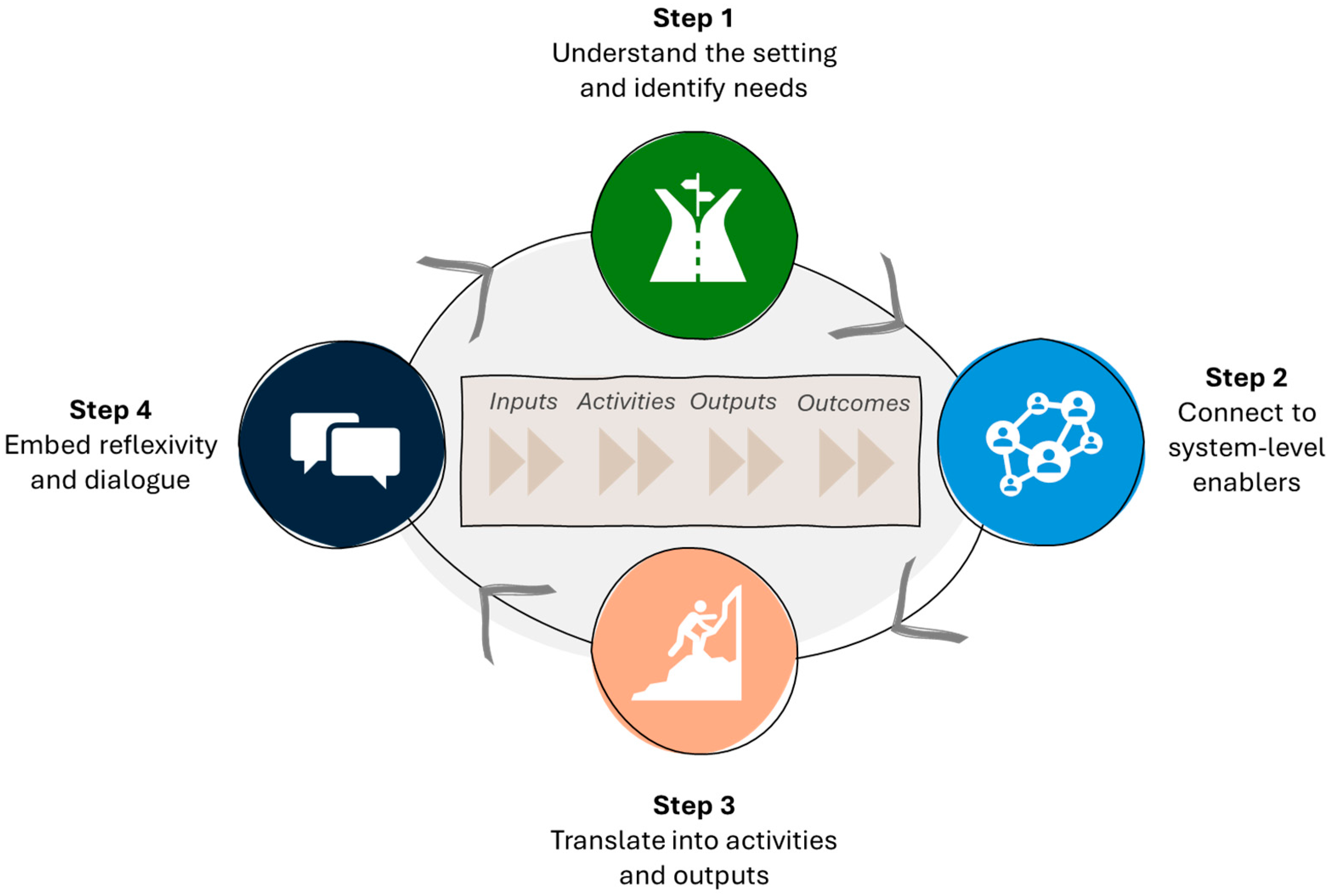

Digital Health Innovation by Design: A Logic Model Scaffold for Rural, Regional, and Remote Settings


Abstract
1. Introduction
2. Materials and Methods
- Establish a dedicated initiative for digital innovation and investment, fostering strong research–industry collaborations.
- Connect stakeholders across Northern Australia (industry partners, researchers, and local communities), through virtual technologies.
- Support collaborative projects via seed funding and strategic guidance to drive digital health solutions.
- Implement, evaluate, and disseminate innovations to promote the broad-scale adoption of effective digital health technologies.
- Deliver skills-based training for students and the health workforce to develop capabilities in using digital health applications.
2.1. Step 1: Understand the Setting and Identify Needs
2.2. Step 2: Connect to System-Level Enablers
2.3. Step 3: Translate into Activities and Outputs
2.4. Step 4: Embed Reflexivity and Dialogue
3. Results
3.1. Context Profile and Workforce Priorities
- Tailored, relevant, and context-sensitive digital health training.
- Opportunities for skills development, mentoring, and ongoing support.
- Align with local models of care, policy frameworks, and system priorities.
- Equip RRR health workforce with digital capabilities needed to integrate DHIs into routine practice.
- Enhance workforce confidence, engagement, and retention.
- Reduce regional digital inequities and improve service quality and accessibility.
3.2. Mapping Workforce Needs to System-Level Enablers
- Mapping workforce barriers and priorities identified in Step 1 against relevant behavioral determinants using the COM-B model and the TDF.
- Aligning each barrier with program responses (e.g., training modules, peer support, credentialing) and corresponding mechanisms of action.
- Validating the map with NARDHC stakeholders, including health services, policymakers, and educators, to ensure coherence with local governance arrangements and system priorities.
3.3. Designing Activities and Outputs
- Skills-based training modules reflecting real-world RRR care scenarios, aligned to national frameworks.
- Self-assessment tools, scenario-based learning, and credentialing mechanisms such as digital badges and CPD recognition.
- Virtual communities of practice, peer mentoring, and interactive learning sessions to support collaboration and continuous learning.
- Learning content tailored to the formal care workforce segments.
- Dashboards, feedback loops, and communication campaigns to monitor uptake, engagement, and learning outcomes.
3.4. Reflexivity and Iterative Refinement
- Updated versions of the logic model reflecting new learning and stakeholder feedback.
- Records of stakeholder dialogue (e.g., meeting summaries, reflective notes, or feedback reports) capturing evolving priorities, assumptions, and relational dynamics.
- Actionable refinements to intervention activities, evaluation measures, or governance processes emerging from reflexive reflection.
4. Discussion
4.1. Limitations and Future Directions
4.2. Implications for Practice
5. Conclusions
Author Contributions
Funding
Institutional Review Board Statement
Informed Consent Statement
Data Availability Statement
Acknowledgments
Conflicts of Interest
Abbreviations
| COM-B | Capability, Opportunity, Motivation and Behavior model |
| DHI | Digital Health Innovation |
| NARDHC | Northern Australian Regional Digital Health Collaborative |
| RRR | Rural, Regional, and Remote |
| TDF | Theoretical Domains Framework |
References
- Ramsden, R.; Pappas, S.J.; Rostas, J.; Islam, M.I.; Martiniuk, A.; Guisard, Y. Rural Health Pro-A Digital Platform Connecting Rural People, Organisations, and Communities. Aust. J. Rural Health 2025, 33, e70050. [Google Scholar] [CrossRef]
- Krahe, M.A.; Baker, S.; Woods, L.; Larkins, S.L. Factors That Influence Digital Health Implementation in Rural, Regional, and Remote Australia: An Overview of Reviews and Recommended Strategies. Aust. J. Rural Health 2025, 33, e70045. [Google Scholar] [CrossRef] [PubMed]
- Stewart, R.A. Building a rural and remote health workforce: An overview of effective interventions. Med. J. Aust. 2023, 219, S3–S4. [Google Scholar] [CrossRef] [PubMed]
- eHealth Queensland. Digital Strategy for Rural and Remote Healthcare: 10 Year Plan; Queensland Health: Brisbane, QLD, Australia, 2021.
- Greenhalgh, T.; Wherton, J.; Papoutsi, C.; Lynch, J.; Hughes, G.; A’Court, C.; Hinder, S.; Fahy, N.; Procter, R.; Shaw, S. Beyond Adoption: A New Framework for Theorizing and Evaluating Nonadoption, Abandonment, and Challenges to the Scale-Up, Spread, and Sustainability of Health and Care Technologies. J. Med. Internet Res. 2017, 19, e367. [Google Scholar] [CrossRef]
- Iqbal, F.M.; Aggarwal, R.; Joshi, M.; King, D.; Martin, G.; Khan, S.; Wright, M.; Ashrafian, H.; Darzi, A. Barriers to and Facilitators of Key Stakeholders Influencing Successful Digital Implementation of Remote Monitoring Solutions: Mixed Methods Analysis. JMIR Hum. Factors 2024, 11, e49769. [Google Scholar] [CrossRef]
- Nilsen, P. Making sense of implementation theories, models and frameworks. Implement. Sci. 2015, 10, 53. [Google Scholar] [CrossRef]
- Michie, S.; Atkins, L.; West, R. The Behaviour Change Wheel: A Guide to Designing Interventions; Silverback Publishing: Sutton, UK, 2017. [Google Scholar]
- Skivington, K.; Matthews, L.; Simpson, S.A.; Craig, P.; Baird, J.; Blazeby, J.M.; Boyd, K.A.; Craig, N.; French, D.P.; McIntosh, E.; et al. A new framework for developing and evaluating complex interventions: Update of Medical Research Council guidance. BMJ 2021, 374, n2061. [Google Scholar] [CrossRef] [PubMed]
- Astbury, B. Some reflections on Pawson’s Science of Evaluation: A Realist Manifesto. Evaluation 2013, 19, 383–401. [Google Scholar] [CrossRef]
- Jagosh, J.; Macaulay, A.C.; Pluye, P.; Salsberg, J.; Bush, P.L.; Henderson, J.; Sirett, E.; Wong, G.; Cargo, M.; Herbert, C.P.; et al. Uncovering the benefits of participatory research: Implications of a realist review for health research and practice. Milbank Q. 2012, 90, 311–346. [Google Scholar] [CrossRef]
- Pellegrini, G.; Lovati, C. Stakeholders’ engagement for improved health outcomes: A research brief to design a tool for better communication and participation. Front. Public Health 2025, 13, 1536753. [Google Scholar] [CrossRef]
- Thomas, T.W.; Hooker, S.A.; Schmittdiel, J.A. Principles for Stakeholder Engagement in Observational Health Research. JAMA Health Forum 2024, 5, e240114. [Google Scholar] [CrossRef]
- Hawe, P.; Shiell, A.; Riley, T. Theorising interventions as events in systems. Am. J. Community Psychol. 2009, 43, 267–276. [Google Scholar] [CrossRef] [PubMed]
- Moore, G.F.; Audrey, S.; Barker, M.; Bond, L.; Bonell, C.; Hardeman, W.; Moore, L.; O’Cathain, A.; Tinati, T.; Wight, D.; et al. Process evaluation of complex interventions: Medical Research Council guidance. BMJ 2015, 350, h1258. [Google Scholar] [CrossRef] [PubMed]
- Centre for Epidemiology and Evidence. Increasing the Scale of Population Health Interventions: A Guide; NSW Ministry of Health: Sydney, NSW, Australia, 2023.
- Thomas, J.; Barraket, J.; Parkinson, S.; Wilson, C.; Holcombe-James, I.; Kennedy, J.; Mannell, K.; Brydon, A. Australian Digital Inclusion Index; RMIT, Swinbourne University of Technology, Telstra: Melbourne, VIC, Australia, 2021. [Google Scholar]
- Huxley, C.J.; Atherton, H.; Watkins, J.A.; Griffiths, F. Digital communication between clinician and patient and the impact on marginalised groups: A realist review in general practice. Br. J. Gen. Pract. 2015, 65, e813–e821. [Google Scholar] [CrossRef] [PubMed]
- Kellogg Foundation. Logic Model Development Guide; W.K Kellogg Foundation: Battle Creek, MI, USA, 2004. [Google Scholar]
- Jordan, G.B. Logic modeling: A tool for designing program evaluations. In Handbook on the Theory and Practice of Program Evaluation; Edward Elgar Publishing: Cheltenham, UK, 2013; pp. 143–165. [Google Scholar]
- Carrion, A.J.; Miles, J.D.; Thompson, M.D.; Journee, B.; Nelson, E. Program evaluation through the use of logic models. Curr. Pharm. Teach. Learn. 2021, 13, 789–795. [Google Scholar] [CrossRef]
- Wholey, J. Evalutaion: Promise and Performance; Urban Institute: Washington, DC, USA, 1979. [Google Scholar]
- Voss, S.; Bauer, J.; Coenen, M.; Jung-Sievers, C.; Moore, G.; Rehfuess, E. Logic models for the evaluation of complex interventions in public health: Lessons learnt from a staged development process. BMC Public Health 2025, 25, 1923. [Google Scholar] [CrossRef]
- Hayes, H.; Parchman, M.L.; Howard, R. A logic model framework for evaluation and planning in a primary care practice-based research network (PBRN). J. Am. Board Fam. Med. 2011, 24, 576–582. [Google Scholar] [CrossRef]
- Haynes, A.; Rychetnik, L.; Finegood, D.; Irving, M.; Freebairn, L.; Hawe, P. Applying systems thinking to knowledge mobilisation in public health. Health Res. Policy Syst. 2020, 18, 134. [Google Scholar] [CrossRef] [PubMed]
- Nigatu, D.; Azage, M.; Misgan, E.; Enquobahrie, D.A.; Kebebaw, T.; Abate, E.; Alemneh, E.; Woldie, M.; Girma, T. Implementation research logic model in the design and execution of eHealth innovations for maternal and newborn healthcare in Ethiopia. Health Res. Policy Syst. 2025, 23, 4. [Google Scholar] [CrossRef]
- Smith, J.D.; Li, D.H.; Rafferty, M.R. The Implementation Research Logic Model: A method for planning, executing, reporting, and synthesizing implementation projects. Implement. Sci. 2020, 15, 84. [Google Scholar] [CrossRef]
- Rogers, P.J. Using programme theory to evaluate complicated and complex aspects of interventions. Evaluation 2008, 14, 29–48. [Google Scholar] [CrossRef]
- Taylor-Powell, E.; Henert, E. Developing a Logic Model: Teaching and Training Guide; University of Wisconsin: Madison, WI, USA, 2008. [Google Scholar]
- Smart, J. Planning and Evaluation: Step by Step; Australian Institute of Family Studies: Southbank, VIC, Australia, 2020.
- Australian Digital Health Agency. National Digital Health Workforce and Education Roadmap; Australian Digital Health Agency: Sydney, NSW, Australia, 2020.
- Digital Strategy Branch eHealth Queensland. Digital Health Strategic Vision for Queensland 2026; Queensland Health: Brisbane, QLD, Australia, 2017.
- Woods, L.; Martin, P.; Khor, J.; Guthrie, L.; Sullivan, C. The right care in the right place: A scoping review of digital health education and training for rural healthcare workers. BMC Health Serv. Res. 2024, 24, 1011. [Google Scholar] [CrossRef]
- AIHW. Rural and Remote Health. Available online: https://www.aihw.gov.au/reports/rural-remote-australians/rural-and-remote-health (accessed on 12 October 2025).
- Woolcock, K.; Gregg, J.; Groth, A. Perspectives Brief: Policy Alignment for Place-Based Solutions for Better Health Outcomes in Rural and Remote Communities; Deeble Institute for Health Policy Research: Deakin, ACT, Australia, 2025. [Google Scholar]
- Cornish, F.; Breton, N.; Moreno-Tabarez, U.; Delgado, J.; Rua, M.; de-Graft Aikins, A.; Hodgetts, D. Participatory action research. Nat. Rev. Methods Primer 2023, 3, 34. [Google Scholar] [CrossRef]
- Cane, J.; O’Connor, D.; Michie, S. Validation of the theoretical domains framework for use in behaviour change and implementation research. Implement. Sci. 2012, 7, 37. [Google Scholar] [CrossRef] [PubMed]
- Productivity Commission. Leveraging Digital Technology in Healthcare—Research Paper; Australian Government: Canberra, ACT, Australia, 2024.
- Moffatt, J.J.; Eley, D.S. The reported benefits of telehealth for rural Australians. Aust. Health Rev. 2010, 34, 276–281. [Google Scholar] [CrossRef]
- Armfield, N.R.; Bradford, M.; Bradford, N.K. The clinical use of Skype–For which patients, with which problems and in which settings? A snapshot review of the literature. Int. J. Med. Inform. 2015, 84, 737–742. [Google Scholar] [CrossRef]
- Humphreys, J.S.; Wakerman, J.; Wells, R.; Kuipers, P.; Jones, J.A.; Entwistle, P. Beyond workforce: A systemic solution for health service provision in small rural and remote communities. Med. J. Aust. 2008, 188, S77–S80. [Google Scholar] [CrossRef]
- Bourke, L.; Humphreys, J.S.; Wakerman, J.; Taylor, J. Understanding rural and remote health: A framework for analysis in Australia. Health Place 2012, 18, 496–503. [Google Scholar] [CrossRef] [PubMed]
- Australian Digital Health Agency. Safe, Seamless and Secure: Evolving Health and Care to Meet the Needs of Modern Australia; Australia’s National Digital Health Strategy: Sydney, NSW, Australia, 2023. Available online: https://www.digitalhealth.gov.au/sites/default/files/2020-11/Australia%27s%20National%20Digital%20Health%20Strategy%20-%20Safe%2C%20seamless%20and%20secure.pdf (accessed on 16 November 2025).
- Wakerman, J.; Humphreys, J.; Russell, D.; Guthridge, S.; Bourke, L.; Dunbar, T.; Zhao, Y.; Ramjan, M.; Murakami-Gold, L.; Jones, M.P. Remote health workforce turnover and retention: What are the policy and practice priorities? Hum. Resour. Health 2019, 17, 99. [Google Scholar] [CrossRef]
- Fixsen, D.L.; Blase, K.A.; Naoom, S.F.; Van Dyke, M.; Wallace, F. Implementation: The missing link between research and practice. NIRN Implement. Brief 2009, 1, 218–227. [Google Scholar]
- Greenhalgh, T.; Papoutsi, C. Studying complexity in health services research: Desperately seeking an overdue paradigm shift. BMC Med. 2018, 16, 95. [Google Scholar] [CrossRef] [PubMed]
- Willis, C.D.; Saul, J.; Bevan, H.; Scheirer, M.A.; Best, A.; Greenhalgh, T.; Mannion, R.; Cornelissen, E.; Howland, D.; Jenkins, E.; et al. Sustaining organizational culture change in health systems. J. Health Organ. Manag. 2016, 30, 2–30. [Google Scholar] [CrossRef] [PubMed]


| Feature | Logic Model Scaffold | Conventional Logic Model | Complementary Value |
|---|---|---|---|
| Primary purpose | Guides planning, implementation, and evaluation of DHIs in RRR settings | Supports program planning, implementation, and evaluation in a variety of settings | Enhances conventional logic models with RRR-specific relevance |
| Focus on context | Central to all steps in the scaffold: context shapes inputs, activities, and outcomes | Often treated as background or assumptions | Ensures that inputs, activities, and outcomes are aligned to the realities of RRR health systems |
| Structure | Wraps around a conventional logic model with iterative scaffolding, co-design, and system alignment | Typically linear and static | Captures adaptive, relational, and systems-informed aspects of complex health systems |
| Stakeholder engagement & reflexivity | Embedded in steps 1–4: includes continuous feedback, power dynamics, co-design, and relational considerations | May be included, but often optional and not structured | Embedding stakeholder input ensures the model reflects lived experiences and system realities, improving relevance and feasibility |
| Adaptivity & iteration | Designed for iterative refinement, responsive to changing context, workforce needs, and emerging challenges | Limited adaptation, static snapshot of planned activities and outcomes | Provides a mechanism to revise and refine the model as context, system, and workforce needs evolve |
| Barrier | Why It Matters? | Behavior a | Response | Mechanism of Action |
|---|---|---|---|---|
| Limited digital health capability [31,39] | Without foundational knowledge and skills, professionals, and consumers in RRR areas cannot effectively use digital tools, limiting quality and coordination of care | Knowledge, Skills → Capability | Type: Training and education; Mode: Online, embedded in curricula; Content: Skills-based modules using RRR scenarios; micro-credentials aligned to national frameworks | Builds core digital literacy; recognition through micro-credentials enhances motivation and value |
| Low confidence and engagement [5,40] | Even when training is available, many lack confidence or motivation to engage, particularly if content feels irrelevant or inaccessible | Beliefs about capabilities, Optimism, Reinforcement → Motivation | Type: Motivational and reflective learning; Mode: Online, credentialed learning; Content: Self-assessments, RRR-based scenarios, CPD recognition | Strengthens self-efficacy through relatable examples; rewards validated learning and sustains participation. |
| Workforce isolation [2,41] | Isolation limits peer learning, knowledge-sharing, and professional growth opportunities | Social influences, Role identity → Opportunity, Motivation | Type: Social learning and networking; Mode: Virtual peer groups, digital platforms; Content: Communities of practice, mentoring, local champions | Promotes shared learning, peer support, and identity as digital health leaders |
| Poor alignment with local practice [33,42] | Training that ignores RRR contexts disengages learners and risks poor adoption | Environmental context, Behavioral regulation → Opportunity, Capability | Type: Co-design and contextual learning; Mode: Stakeholder workshops, modular delivery; Content: Co-designed training, role-specific modules, culturally relevant case studies | Improves relevance and usability; co-design increases engagement and application in practice |
| Limited system support [43] | Weak infrastructure or promotion reduces training visibility, uptake, and sustainability | Memory, attention, Environmental context → Capability, Opportunity | Type: System-level support and evaluation; Mode: Dashboards, outreach strategies, embedded evaluation; Content: Progress tracking, regional communication, QA, and feedback loops | Enhances visibility, accountability, and alignment with system goals; supports continuous improvement |
| Inputs | Activities | Outputs | Outcomes |
|---|---|---|---|
| Funding and strategic leadership | Develop skills-based training grounded in RRR care contexts and aligned with national frameworks | Number of modules developed and delivered | Short-term: Increased awareness and understanding of digital health among RRR health workers and students; improved self-efficacy and foundational digital skills |
| Subject matter experts, educators, and program staff | Implement self-assessment tools, scenario-based learning, and microcredentials/CPD recognition | Participants by region and profession | |
| Technological infrastructure and platforms | Establish virtual communities of practice, mentoring networks, and peer learning sessions | Completion, credentialing, and engagement metrics | Medium-term: Consistent application of digital tools in practice, education, and service delivery; improved alignment with local care models; enhanced collaboration through shared platforms |
| Access to RRR health workforce and organizations | Content designed with end-users and modules tailored for workforce segments | Peer learning sessions or communities of practices established | |
| Purpose built tools and stakeholder engagement | Track uptake and learner progress via dashboards and feedback loops | Tailored resources produced and usage tracked | Long-term: A digitally confident, future-ready RRR workforce; improved service delivery and workforce satisfaction; reduced digital inequities; strengthened and more resilient health systems |
| Governance, evaluation, and quality assurance systems | Conduct regional communication campaigns and QA processes | Changes in confidence/capability pre/post training |
Disclaimer/Publisher’s Note: The statements, opinions and data contained in all publications are solely those of the individual author(s) and contributor(s) and not of MDPI and/or the editor(s). MDPI and/or the editor(s) disclaim responsibility for any injury to people or property resulting from any ideas, methods, instructions or products referred to in the content. |
© 2025 by the authors. Licensee MDPI, Basel, Switzerland. This article is an open access article distributed under the terms and conditions of the Creative Commons Attribution (CC BY) license (https://creativecommons.org/licenses/by/4.0/).
Share and Cite
Krahe, M.A.; Adams, N.; Larkins, S.L. Digital Health Innovation by Design: A Logic Model Scaffold for Rural, Regional, and Remote Settings. Int. J. Environ. Res. Public Health 2025, 22, 1743. https://doi.org/10.3390/ijerph22111743
Krahe MA, Adams N, Larkins SL. Digital Health Innovation by Design: A Logic Model Scaffold for Rural, Regional, and Remote Settings. International Journal of Environmental Research and Public Health. 2025; 22(11):1743. https://doi.org/10.3390/ijerph22111743
Chicago/Turabian StyleKrahe, Michelle A., Nico Adams, and Sarah L. Larkins. 2025. "Digital Health Innovation by Design: A Logic Model Scaffold for Rural, Regional, and Remote Settings" International Journal of Environmental Research and Public Health 22, no. 11: 1743. https://doi.org/10.3390/ijerph22111743
APA StyleKrahe, M. A., Adams, N., & Larkins, S. L. (2025). Digital Health Innovation by Design: A Logic Model Scaffold for Rural, Regional, and Remote Settings. International Journal of Environmental Research and Public Health, 22(11), 1743. https://doi.org/10.3390/ijerph22111743