Binding Multilateral Framework for South Asian Air Pollution Control: An Urgent Call for SAARC-UN Cooperation

Abstract

1. The Urgent Case for Binding Action
1.1. Health Crisis at Unprecedented Scale
1.2. Economic Imperative: Healthcare Costs Exceed Mitigation Investment
1.3. Transboundary Nature Demands Binding Cooperation
1.4. Current Policy Landscape and Gaps
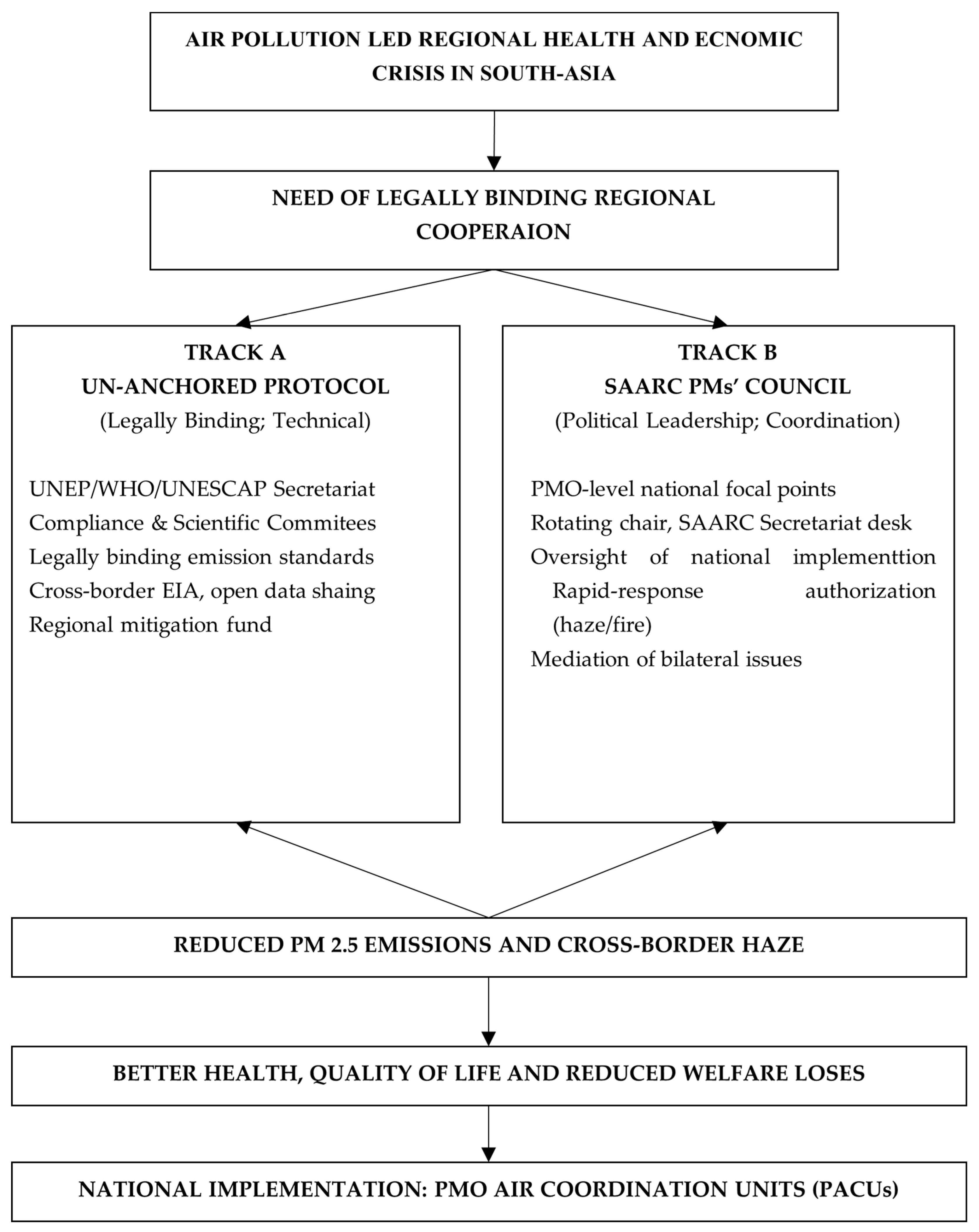
2. Proposed Binding Framework: Dual-Track Architecture
2.1. Track A: UN-Anchored Binding International Protocol
- PM 2.5 exposure reduction trajectory: An indicative 50% reduction by 2035 (relative to an agreed baseline), aligned with WHO guidelines and interim targets, to be country-differentiated via nationally determined implementation pathways and periodic scientific review.
- Sectoral emission standards: Harmonized, legally binding limits for power, industry (including brick kilns), transport, waste burning, agriculture/residue burning, and household energy, with time-bound adoption and phase-out schedules for high-emitting technologies.
- Cross-border EIA (Environmental Impact Assessment): Mandatory prior notification and assessment for projects with likely transboundary air quality impacts, including safeguards for vulnerable communities.
- Data infrastructure: Standardized monitoring protocols, calibration and QA/QC, open data sharing, and joint receptor/source apportionment studies to inform equitable burden-sharing.
- Compliance and remedies: A Compliance Committee empowered to assess non-compliance, recommend corrective action, and trigger financial consequences that recycle resources to a regional mitigation fund.
- Technical Secretariat: (hosted by UNEP, with WHO and UNESCAP participation) to manage reporting, develop technical guidance, and support capacity building.
- Compliance Committee: an independent body to review national reports, conduct expert assessments, and oversee graduated responses to non-compliance.
- Scientific Advisory Panel: to update exposure-response functions, source apportionment methods, and technology roadmaps, ensuring evidence-based target-setting.
- South Asia Air Quality Fund: to provide predictable financing for abatement, monitoring, and health adaptation, combining mandatory contributions and donor co-financing.
2.2. Track B: SAARC Prime Ministers’ Council on Air Quality (SPMCAQ)
- Membership: PMO-designated focal points (Director/Secretary level) from each SAARC member state.
- Rotating chair: Six-month rotation to mitigate dominance concerns and encourage shared ownership.
- Secretariat: A dedicated three-person desk at the SAARC Secretariat to convene meetings, track actions, and serve as the interface with Track A institutions.
- Technical partnership: Direct liaison with the UN-anchored Secretariat, enabling two-way translation between legal obligations and operational delivery.
- National implementation oversight of protocol obligations with quarterly PMO-level reviews.
- Cross-border emergency response authorization within a defined window (e.g., 48 h) for forest fires, industrial accidents, or extreme haze—the precise window to be finalized during negotiations for feasibility and fairness.
- Financing gateway: Endorse country proposals to the regional fund, prioritize high-impact, equity-centered investments, and de-risk donor participation.
- Dispute mitigation: Mediate emerging bilateral issues prior to formal compliance procedures, maintaining cooperation continuity.
2.3. National Implementation: PMO Air Coordination Units (PACU)
- To chair inter-ministerial technical committees (environment, energy, transport, agriculture, health, finance, industry, social welfare).
- To develop a National Implementation Roadmap with binding timelines, responsible agencies, and budget tags.
- To coordinate emergency measures during transboundary incidents (e.g., short-term emission curbs, traffic management, targeted advisories for vulnerable groups).
- To act as national focal point for regional fund access, ensuring proposals meet technical criteria, equity screens, and co-benefit accounting.
- To institutionalize accountability via public dashboards, performance contracts for agencies, and annual parliamentary reporting.
- National-Level Implementation Examples
- India (NCAP/PRANA): Integration of national city-level targets with binding regional standards; milestone: 25% reduction in PM 2.5 in non-attainment cities by 2030.
- Bangladesh (NAQMP 2024–2030): Alignment of action plans with regional emission ceilings; milestone: phase-out of uncontrolled brick kilns by 2027.
- Nepal (AQMAP 2021–2025): Expansion of monitoring networks to be fully interoperable with regional data platforms by 2025.
- Pakistan (Punjab Clean Air Plan): Adoption of harmonized vehicular emission standards by 2028.
3. Economic and Financial Architecture
4. Addressing Regional Political Dynamics: Conflict-Resilience Design
- Lessons from Regional Case Studies and Political Dynamics
5. Theory of Change Framework for Regional Airshed-Wide Air Quality Management
6. Conclusions: The Imperative for Immediate Action
Author Contributions
Funding
Institutional Review Board Statement
Informed Consent Statement
Data Availability Statement
Conflicts of Interest
References
- Abdul Jabbar, S.; Tul Qadar, L.; Ghafoor, S.; Rasheed, L.; Sarfraz, Z.; Sarfraz, A.; Sarfraz, M.; Felix, M.; Cherrez-Ojeda, I. Air quality, pollution and sustainability trends in South Asia: A population-based study. Int. J. Environ. Res. Public Health 2022, 19, 7534. [Google Scholar] [CrossRef] [PubMed]
- Herath Bandara, S.J.; Thilakarathne, N. Economic and Public Health Impacts of Transportation-Driven Air Pollution in South Asia. Sustainability 2025, 17, 2306. [Google Scholar] [CrossRef]
- Wang, Y.; Nemitz, E.; Tomlinson, S.J.; Carnell, E.J.; Yao, L.; Scheffler, J.; Liska, T.; Pearson, C.; Dragosits, U.; Venkataraman, C. Response of South Asia PM2. 5 pollution to ammonia emission changes and associated impacts on human health. Environ. Int. 2025, 195, 109207. [Google Scholar] [CrossRef] [PubMed]
- Thangavel, P.; Park, D.; Lee, Y.-C. Recent insights into particulate matter (PM2. 5)-mediated toxicity in humans: An overview. Int. J. Environ. Res. Public Health 2022, 19, 7511. [Google Scholar] [CrossRef] [PubMed]
- Xing, Y.-F.; Xu, Y.-H.; Shi, M.-H.; Lian, Y.-X. The impact of PM2. 5 on the human respiratory system. J. Thorac. Dis. 2016, 8, E69–E74. [Google Scholar] [PubMed]
- Lo, W.-C.; Hu, T.-H.; Hwang, J.-S. Lifetime exposure to PM2. 5 air pollution and disability-adjusted life years due to cardiopulmonary disease: A modeling study based on nationwide longitudinal data. Sci. Total Environ. 2023, 855, 158901. [Google Scholar] [CrossRef] [PubMed]
- Lv, Y.; Zhou, J.; Kraus, V.B.; Li, T.; Sarnat, J.A.; Wang, J.; Liu, Y.; Chen, H.; Brasher, M.S.; Mao, C. Long-term exposure to PM2. 5 and incidence of disability in activities of daily living among oldest old. Environ. Pollut. 2020, 259, 113910. [Google Scholar] [CrossRef] [PubMed]
- Li, S.; Cao, S.; Duan, X.; Zhang, Y.; Gong, J.; Xu, X.; Guo, Q.; Meng, X.; Bertrand, M.; Zhang, J.J. Long-term exposure to PM2. 5 and children’s lung function: A dose-based association analysis. J. Thorac. Dis. 2020, 12, 6379–6395. [Google Scholar] [CrossRef] [PubMed]
- Amer, A.; Mushtaq, N.; Albalawi, O.; Hanif, M.; Mahmoud, E.E.; Nabi, M. Forecasting mortality and DALYs from air pollution in SAARC nations. Sci. Rep. 2024, 14, 25898. [Google Scholar] [CrossRef] [PubMed]
- Owusu, P.A.; Sarkodie, S.A. Global estimation of mortality, disability-adjusted life years and welfare cost from exposure to ambient air pollution. Sci. Total Environ. 2020, 742, 140636. [Google Scholar] [CrossRef] [PubMed]
- World Bank. Striving for Clean Air: Air Pollution and Public Health in South Asia; World Bank: Washington, DC, USA, 2023; 52p, Report No.: 33615; Available online: https://openknowledge.worldbank.org/handle/10986/39336 (accessed on 9 October 2025).
- Lawrence, M.; Lelieveld, J. Atmospheric pollutant outflow from southern Asia: A review. Atmos. Chem. Phys. 2010, 10, 11017–11096. [Google Scholar] [CrossRef]
- Khanal, S.; Pokhrel, R.P.; Pokharel, B.; Becker, S.; Giri, B.; Adhikari, L.; LaPlante, M.D. An episode of transboundary air pollution in the central Himalayas during agricultural residue burning season in North India. Atmos. Pollut. Res. 2022, 13, 101270. [Google Scholar] [CrossRef]
- Singh, R. Environmental Cooperation within the SAARC Framework. Ph.D. Thesis, Sikkim University, Gangtok, India, February 2017. [Google Scholar]
- Guttikunda, S.K.; Dammalapati, S.K.; Pradhan, G. Assessing air quality during India’s National Clean Air Programme (NCAP): 2019–2023. Atmos. Environ. 2025, 343, 120974. [Google Scholar] [CrossRef]
- United Nations; Asian and Pacific Centre for Transfer of Technology; United Nations Economic and Social Commission for Asia and the Pacific. Comparative Analysis of Air Pollution Control Technologies and Policies in Three Asian Cities-Bangkok, Dhaka, and Gurugram; Asian and Pacific Centre for Transfer of Technology, UNESCAP: New Delhi, India, 2024. [Google Scholar]
- Chauhan, R.; Shrestha, A. Assessment of Environmental Policies and Institutions for Effective Air Quality Management in Nepal. Nepal Public Policy Rev. 2022, 2, 181–207. [Google Scholar] [CrossRef]
- World Bank. Air Pollution Knows No Borders in South Asia, Neither Do Solutions. World Bank News. 2024. Available online: https://www.worldbank.org/en/news/feature/2024/09/05/air-pollution-knows-no-borders-in-south-asia-neither-do-solutions (accessed on 9 October 2025).
- Sundram, P. Network governance in ASEAN: Fostering regional cooperation and integration. Front. Political Sci. 2025, 7, 1434595. [Google Scholar] [CrossRef]
- Turner, A.; Webb, A.; Jago, R.; Blackmore, S.; De Vocht, F.; Horwood, J. Integrated working in local authority decision-making about air quality: A qualitative study in Southwest England. J. Public Health 2023, 45, 654–662. [Google Scholar] [CrossRef] [PubMed]
- World Health Organization. WHO Global Air Quality Guidelines: Particulate Matter (PM2.5 and PM10), Ozone, Nitrogen Dioxide, Sulfur Dioxide and Carbon Monoxide; WHO: Geneva, Switzerland, 2021. [Google Scholar]
- South Asia Cooperative Environment Programme (SACEP). Malé Declaration on Control and Prevention of Air Pollution and Its Likely Transboundary Effects for South Asia; SACEP: Malé, Maldives, 1998; Available online: https://rrcap.ait.ac.th (accessed on 9 October 2025).
- United Nations Office of Legal Affairs (UN OLA). Trail Smelter Arbitration (United States v. Canada); 1938/1941. In Reports of International Arbitral Awards; United Nations: New York, NY, USA, 1950; Volume III, pp. 1905–1982. [Google Scholar]
- United Nations Conference on the Human Environment (UNCED). Declaration of the United Nations Conference on the Human Environment; UN: Stockholm, Sweden, 1972. [Google Scholar]
- Ministry of Environment, Forest and Climate Change (MoEFCC), Government of India. The Air (Prevention and Control of Pollution) Act; MoEFCC: New Delhi, India, 1981. [Google Scholar]
- Ministry of Environment, Forest and Climate Change (MoEF), Government of Bangladesh. National Air Quality Management Plan 2024–2030; MoEF: Dhaka, Bangladesh, 2024. [Google Scholar]
- Pakistan Environmental Protection Agency (Pak-EPA). National Environmental Quality Standards (NEQS); Pak-EPA: Islamabad, Pakistan, 2010. [Google Scholar]
- Ministry of Forests and Environment (MoFE), Government of Nepal. Environment Protection Act, 2019; MoFE: Kathmandu, Nepal, 2019. [Google Scholar]
- National Environment Commission (NEC), Royal Government of Bhutan. Environmental Protection Act; NEC: Thimphu, Bhutan, 2007. [Google Scholar]
- Central Environmental Authority (CEA), Government of Sri Lanka. National Environmental Act; CEA: Colombo, Sri Lanka, 1980; (amended). [Google Scholar]
- National Environmental Protection Agency (NEPA), Government of Afghanistan. Environment Act; NEPA: Kabul, Afghanistan, 2007. [Google Scholar]
- Association of Southeast Asian Nations (ASEAN). ASEAN Agreement on Transboundary Haze Pollution; ASEAN: Kuala Lumpur, Malaysia, 2002. [Google Scholar]
- Malmqvist, E. A Major Step Toward Cleaner Air in the EU. Acid News. June 2024. Available online: https://www.airclim.org/acidnews/major-step-toward-cleaner-air-eu (accessed on 9 October 2025).
- China-ROK-Japan Tripartite Environment Ministers Meeting Held to Discuss Environmental Issues [Internet]; State Council of the People’s Republic of China: Beijing, China, 2024. Available online: https://english.www.gov.cn/news/202410/01/content_WS66fb3234c6d0868f4e8eb740.html (accessed on 9 October 2025).
- Åström, S.; Tohka, A.; Bak, J.; Lindblad, M.; Arnell, J. Potential impact on air pollution from ambitious national CO2 emission abatement strategies in the Nordic countries–environmental links between the UNFCCC and the UNECE–CLRTAP. Energy Policy 2013, 53, 114–124. [Google Scholar] [CrossRef]
- Heilmann, D. After Indonesia’s ratification: The ASEAN agreement on Transboundary haze pollution and its effectiveness as a regional environmental governance tool. J. Curr. Southeast Asian Aff. 2015, 34, 95–121. [Google Scholar] [CrossRef]
- Dieperink, C. Successes in the international cooperation in the Rhine catchment area. Phys. Chem. Earth Part B Hydrol. Ocean. Atmos. 2000, 25, 341–347. [Google Scholar] [CrossRef]

| Instrument/Policy | Scope and Relevance | Source |
|---|---|---|
| WHO Global Air Quality Guidelines (2021) | International health-based guideline values for PM 2.5, PM10, NO2, SO2, O3. Provides evidence-based benchmarks for setting national and regional targets. | [21] |
| Malé Declaration on Control & Prevention of Air Pollution (1998, SACEP) | Voluntary regional declaration among South Asian countries to foster cooperation in monitoring and managing transboundary air pollution. Non-binding. | [22] |
| Trail Smelter Arbitration/No-Harm Principle | International law precedent affirming state responsibility to prevent transboundary environmental harm. | [23] |
| Stockholm Declaration (1972)/Rio Declaration (1992) | Global declarations establishing state responsibility to avoid cross-border environmental damage and cooperate in environmental protection. | [24] |
| India—Air (Prevention & Control) Act (1981); National Clean Air Programme (2019) | Statutory framework for air pollution control, city-specific targets, and PRANA monitoring portal. | [25] |
| Bangladesh—National Air Quality Management Plan (2024–2030) | National strategy for comprehensive air quality management with time-bound interventions. | [26] |
| Pakistan—National Environmental Quality Standards (NEQS, revised 2010); Punjab Clean Air Action Plan (2019) | Legally enforceable standards for industrial and vehicular emissions; provincial plan addressing smog and transboundary haze. | [27] |
| Nepal—Environment Protection Act (2019) and National Air Quality Management Action Plan (2021–2025) | Provides legal mandate and strategic plan for emission reduction, urban air quality management, and monitoring networks. | [28] |
| Bhutan—Environmental Protection Act (2007); Bhutan Air Quality Standards (2010) | Establishes national standards for ambient air quality and mandates pollution monitoring. | [29] |
| Sri Lanka—National Environmental Act (1980, amended); Vehicle Emission Testing Program (2008) | Legal framework for pollution control and regulatory programs targeting vehicular emissions. | [30] |
| Afghanistan—National Environmental Protection Act (2007) | Legal mandate for pollution control, though implementation capacity remains limited due to conflict and institutional weakness. | [31] |
| ASEAN Agreement on Transboundary Haze Pollution (2002) | While outside SAARC, provides a transferable model for binding regional cooperation on air pollution that can inform South Asian frameworks. | [32] |
| Level | Description |
|---|---|
| Inputs |
|
| Processes/Activities |
|
| Outputs |
|
| Outcomes (Medium-term) |
|
| Impacts (Long-term) |
|
Disclaimer/Publisher’s Note: The statements, opinions and data contained in all publications are solely those of the individual author(s) and contributor(s) and not of MDPI and/or the editor(s). MDPI and/or the editor(s) disclaim responsibility for any injury to people or property resulting from any ideas, methods, instructions or products referred to in the content. |
© 2025 by the authors. Licensee MDPI, Basel, Switzerland. This article is an open access article distributed under the terms and conditions of the Creative Commons Attribution (CC BY) license (https://creativecommons.org/licenses/by/4.0/).
Share and Cite
Sriram, S.; Adhikari, S. Binding Multilateral Framework for South Asian Air Pollution Control: An Urgent Call for SAARC-UN Cooperation. Int. J. Environ. Res. Public Health 2025, 22, 1628. https://doi.org/10.3390/ijerph22111628
Sriram S, Adhikari S. Binding Multilateral Framework for South Asian Air Pollution Control: An Urgent Call for SAARC-UN Cooperation. International Journal of Environmental Research and Public Health. 2025; 22(11):1628. https://doi.org/10.3390/ijerph22111628
Chicago/Turabian StyleSriram, Shyamkumar, and Saroj Adhikari. 2025. "Binding Multilateral Framework for South Asian Air Pollution Control: An Urgent Call for SAARC-UN Cooperation" International Journal of Environmental Research and Public Health 22, no. 11: 1628. https://doi.org/10.3390/ijerph22111628
APA StyleSriram, S., & Adhikari, S. (2025). Binding Multilateral Framework for South Asian Air Pollution Control: An Urgent Call for SAARC-UN Cooperation. International Journal of Environmental Research and Public Health, 22(11), 1628. https://doi.org/10.3390/ijerph22111628