


Parenting Stress Following a Neonatal Intensive Care Unit Hospitalization: A Longitudinal Study of Mothers and Fathers

Abstract
1. Introduction
2. Methods
2.1. Participants and Procedures
2.2. Measures
2.2.1. Medical and Demographic Data
2.2.2. Parenting Stress
2.2.3. Developmental Abilities
2.3. Data Analysis Plan
3. Results
3.1. Participant Demographics
3.2. Aim 1: Patterns of Stress Among NICU and Non-NICU Parents in the First Year of Life
3.3. Aim 2: Change in Parenting Stress from 6 to 12 Months
3.4. Aim 3: Explaining Variability in Parenting Stress Using Developmental and Medical Factors
3.5. Aim 4: Investigate Differences in Maternal and Paternal Parenting Stress
4. Discussion
4.1. Limitations and Future Directions
4.2. Conclusions
Author Contributions
Funding
Institutional Review Board Statement
Informed Consent Statement
Data Availability Statement
Acknowledgments
Conflicts of Interest
References
- Obeidat, H.M.; Bond, E.A.; Callister, L.C. The Parental Experience of Having an Infant in the Newborn Intensive Care Unit. J. Perinat. Educ. 2009, 18, 23. [Google Scholar] [CrossRef] [Scilit] [PubMed]
- Hynan, M.T.; Mounts, K.O.; Vanderbilt, D.L. Screening parents of high-risk infants for emotional distress: Rationale and recommendations. J. Perinatol. 2013, 33, 748–753. [Google Scholar] [CrossRef] [Scilit] [PubMed]
- Lotterman, J.H.; Lorenz, J.M.; Bonanno, G.A. You can’t take your baby home yet: A Longitudinal study of psychological symptoms in mothers of infants hospitalized in the NICU. J. Clin. Psychol. Med. Set. 2019, 26, 116–122. [Google Scholar] [CrossRef] [Scilit] [PubMed]
- Hendy, A.; El-sayed, S.; Bakry, S.; Mohammed, S.M.; Mohamed, H.; Abdelkawy, A.; Hassani, R.; Abouelela, M.A.; Sayed, S. The Stress Levels of Premature Infants’ Parents and Related Factors in NICU. SAGE Open Nurs. 2024, 10, 23779608241231172. [Google Scholar] [CrossRef] [Scilit] [PubMed]
- Granero-Molina, J.; Medina, I.M.F.; Fernández-Sola, C.; Hernández-Padilla, J.M.; Lasserrotte, M.D.M.J.; Rodríguez, M.D.M.L. Experiences of Mothers of Extremely Preterm Infants after Hospital Discharge. J. Pediatr. Nurs. 2019, 45, e2–e8. [Google Scholar] [CrossRef] [Scilit] [PubMed]
- Ionio, C.; Ciuffo, G.; Colombo, C.; Melani, O.; Figlino, M.F.; Landoni, M.; Castoldi, F.; Cavigioli, F.; Lista, G. Preterm Birth and Maternal Mood States: What Is the Impact on Bonding? Pediatr. Rep. 2024, 16, 35–45. [Google Scholar] [CrossRef] [Scilit] [PubMed]
- Bernardo, J.; Rent, S.; Arias-Shah, A.; Hoge, M.K.; Shaw, R.J. Parental stress and mental health symptoms in the NICU: Recognition and interventions. NeoReviews 2021, 22, e496–e505. [Google Scholar] [CrossRef] [Scilit] [PubMed]
- Singer, L.T.; Salvator, A.; Guo, S.; Collin, M.; Lilien, L.; Baley, J. Maternal Psychological Distress and Parenting Stress After the Birth of a Very Low-Birth-Weight Infant. JAMA 1999, 281, 799–805. [Google Scholar] [CrossRef] [Scilit] [PubMed]
- Ionio, C.; Mascheroni, E.; Colombo, C.; Castoldi, F.; Lista, G. Stress and feelings in mothers and fathers in NICU: Identifying risk factors for early interventions. Prim. Health Care Res. Dev. 2019, 20, e81. [Google Scholar] [CrossRef] [Scilit]
- Dudek-Shriber, L. Parent Stress in the Neonatal Intensive Care Unit and the Influence of Parent and Infant Characteristics. Am. J. Occup. Ther. 2004, 58, 509–520. [Google Scholar] [CrossRef] [Scilit]
- Turner, M.; Chur-Hansen, A.; Winefield, H.; Stanners, M. The assessment of parental stress and support in the neonatal intensive care unit using the Parent Stress Scale—Neonatal Intensive Care Unit. Women Birth 2015, 28, 252–258. [Google Scholar] [CrossRef] [Scilit] [PubMed]
- Schmöker, A.; Flacking, R.; Udo, C.; Eriksson, M.; Hellström-Westas, L.; Ericson, J. Longitudinal cohort study reveals different patterns of stress in parents of preterm infants during the first year after birth. Acta Paediatr. 2020, 109, 1778–1786. [Google Scholar] [CrossRef] [Scilit] [PubMed]
- Abidin, R.R. Parenting Stress Index; Psychological Assessment Resources (PAR): Lutz, FL, USA, 2012. [Google Scholar]
- Gray, P.H.; Edwards, D.M.; O’Callaghan, M.J.; Cuskelly, M. Parenting stress in mothers of preterm infants during early infancy. Early Hum. Dev. 2012, 88, 45–49. [Google Scholar] [CrossRef] [Scilit]
- Gray, P.H.; Edwards, D.M.; O’Callaghan, M.J.; Cuskelly, M.; Gibbons, K. Parenting stress in mothers of very preterm infants—Influence of development, temperament and maternal depression. Early Hum. Dev. 2013, 89, 625–629. [Google Scholar] [CrossRef] [Scilit]
- Barroso, N.E.; Hungerford, G.M.; Garcia, D.; Graziano, P.A.; Bagner, D.M. Psychometric Properties of the Parenting Stress Index-Short Form (PSI-SF) in a High-Risk Sample of Mothers and their Infants. Psych. Assess. 2016, 28, 1331. [Google Scholar] [CrossRef] [Scilit]
- Sparks, T.A.; Hunter, S.K.; Backman, T.L.; Morgan, G.A.; Ross, R.G. Maternal parenting stress and mothers’ reports of their infants’ mastery motivation. Infant Behav. Dev. 2012, 35, 167. [Google Scholar] [CrossRef] [Scilit] [PubMed]
- Lepage, C.; Gaudet, I.; Doussau, A.; Vinay, M.C.; Gagner, C.; von Siebenthal, Z.; Poirier, N.; Simard, M.N.; Paquette, N.; Gallagher, A. The role of parenting stress in anxiety and sleep outcomes in toddlers with congenital heart disease. Front. Pediatr. 2023, 10, 1055526. [Google Scholar] [CrossRef] [Scilit]
- Carter, J.D.; Mulder, R.T.; Darlow, B.A. Parental stress in the NICU: The influence of personality, psychological, pregnancy and family factors. Personal. Ment. Health 2007, 1, 40–50. [Google Scholar] [CrossRef] [Scilit]
- Griffith, T.; Singh, A.; Naber, M.; Hummel, P.; Bartholomew, C.; Amin, S.; White-Traut, R.; Garfield, L. Scoping review of interventions to support families with preterm infants post-NICU discharge. J. Pediatr. Nurs. 2022, 67, e135–e149. [Google Scholar] [CrossRef] [Scilit]
- Purdy, I.B.; Craig, J.W.; Zeanah, P. NICU discharge planning and beyond: Recommendations for parent psychosocial support. J. Perinatol. 2015, 35, S24–S28. [Google Scholar] [CrossRef] [Scilit]
- Høifødt, R.S.; Nordahl, D.; Landsem, I.P.; Csifcsák, G.; Bohne, A.; Pfuhl, G.; Rognmo, K.; Braarud, H.C.; Goksøyr, A.; Moe, V.; et al. Newborn Behavioral Observation, maternal stress, depressive symptoms and the mother-infant relationship: Results from the Northern Babies Longitudinal Study (NorBaby). BMC Psychiatry 2020, 20, 300. [Google Scholar] [CrossRef] [Scilit] [PubMed]
- Nugent, J.K.; Keefer, C.H.; Minear, S.; Johnson, L.C.; Blanchard, Y. Understanding Newborn Behavior & Early Relationships: The Newborn Behavioral Observations (NBO) System Handbook; Brookes Publishing Co.: Baltimore, MD, USA, 2007. [Google Scholar]
- Nugent, J.K.; Bartlett, J.D.; von Ende, A.; Valim, C. The Effects of the Newborn Behavioral Observations (NBO) System on Sensitivity in Mother-Infant Interactions. Infants Young Child. 2017, 30, 257–268. [Google Scholar] [CrossRef] [Scilit]

| NICU n = 51 | Non-NICU n = 38 | p-Value | |
|---|---|---|---|
| Gestational Age in weeks | 33.19 (5.26) | ||
| Infant birth weight (g) | 1892.06 (971.126) | ||
| Days in NICU | 57.31(44.69) | ||
| Number of older siblings | 1.08 (1.32) | 0.89 (1.07) | 0.214 |
| 12-Month Developmental Quotient (MSEL ELC) | 99.74 (17.98) | 98.37 (14.74) | 0.712 |
| Infant sex | 0.335 | ||
| Female | 24 (47.1%) | 14 (36.8%) | |
| Male | 27 (52.9%) | 24 (63.2%) | |
| Infant race | 0.060 | ||
| White | 29 (56.9%) | 27 (71.1%) | |
| Black/African American | 10 (19.6%) | 2 (5.3%) | |
| Multiracial | 4 (7.8%) | 7 (18.4%) | |
| Asian/Pacific Islander | 7 (13.7%) | 2 (5.3%) | |
| Infant ethnicity (Hispanic/Latinx) | 25 (49.0%) | 2 (5.3%) | <0.001 |
| Maternal Education | 0.014 | ||
| High School or less | 8(15.7%) | 5(13.2%) | |
| Some college | 15 (29.41%) | 5 (13.2%) | |
| College degree | 14 (27.45%) | 6 (15.8%) | |
| Graduate/professional degree | 12 (23.5%) | 22 (57.9%) | |
| Paternal Education | 0.013 | ||
| High School or less | 17 (33.3%) | 3 (7.9%) | |
| Some college | 8 (15.7%) | 5 (13.2%) | |
| College degree | 11 (21.6%) | 11 (28.9%) | |
| Graduate/professional degree | 11 (21.6%) | 17 (44.7%) | |
| Marital Status | 0.142 | ||
| Single Parent | 7 (13.7%) | 2 (5.3%) | |
| Other/Separated | 3 (5.9%) | 1 (2.6%) | |
| Married | 34 (66.7%) | 32 (84.2%) | |
| Living Together | 7 (13.7%) | 3 (7.9%) | |
| HRIF Primary Qualifying Condition | |||
| Preterm (<32 weeks) | 22 (43.14%) | ||
| Low Birthweight (≤1500 g, ≥32 weeks) | 8 (15.7%) | ||
| Major Neuro Injury (≥1500 g, ≥32 weeks) | 10 (19.6%) | ||
| Cardiac (No Neuro Injury, >1500 g, ≥32 weeks) | 6 (11.76%) | ||
| Other (No Neuro/Cardiac, >1500 g, ≥32 weeks) | 5 (9.8%) |
| Scale | Mean (SD) or % Above Cutoff | ||||
|---|---|---|---|---|---|
| NICU | Non-NICU | ||||
| 6 Months n = 50 | 9 Months n = 48 | 12 Months n = 45 | 6 Months n = 35 | 12 Months n = 30 | |
| Defensive Responding | 26% | 35.4% | 37.8% | 46% | 43% |
| Parental Distress | 25.14 (8.68) | 22.79 (8.17) | 23.38 (8.35) | 20.54 (4.80) | 20.87 (5.41) |
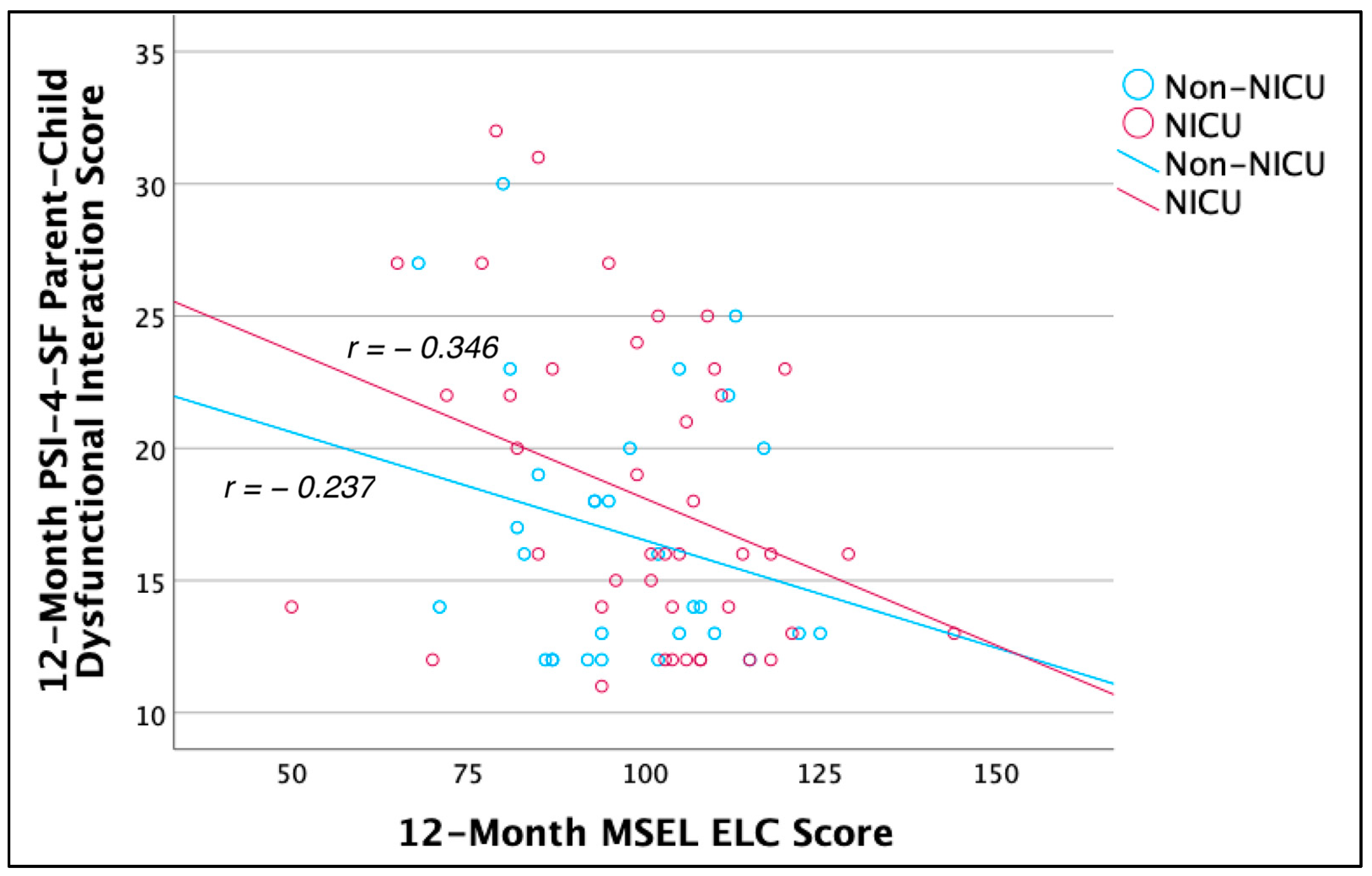
| Parent–Child Dysfunctional Interactions | 19.30 (6.05) | 18.50 (5.32) | 18.29 (5.83) | 16.02 (4.60) | 16.77 (5.04) |
| Difficult Child | 21.14 (6.55) | 20.94 (5.89) | 20.31 (5.44) | 18.20 (5.03) | 19.23 (4.20) |
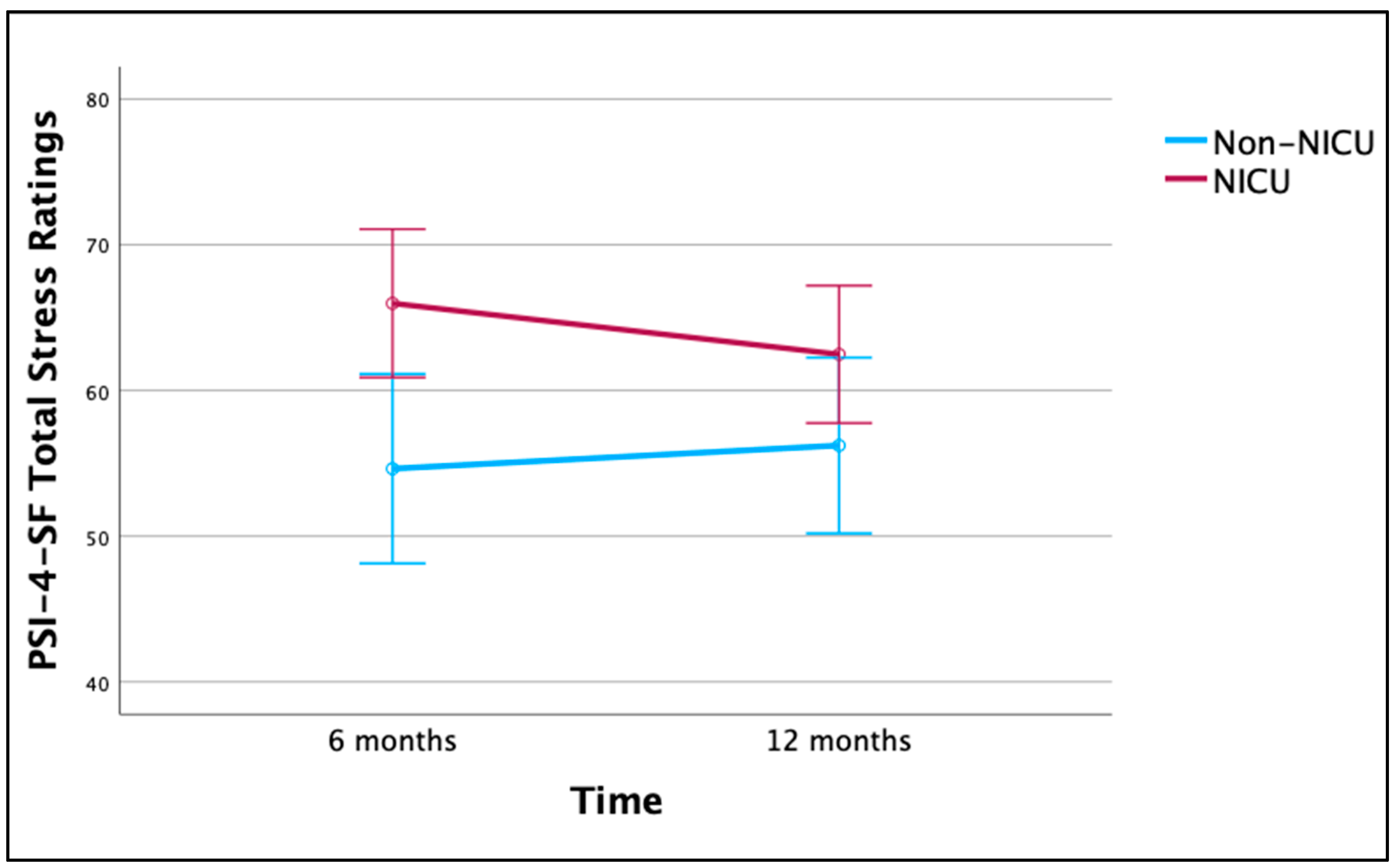
| Total Stress | 65.58 (19.04) | 62.23 (17.12) | 61.98 (17.75) | 54.77 (12.50) | 56.87 (12.67) |
| NICU n = 23 | Non-NICU n = 16 | |||
|---|---|---|---|---|
| Mothers | Fathers | Mothers | Fathers | |
| Parental Distress | 24.09 (8.04) | 23.04 (9.07) | 20.00 (6.76) | 20.81 (6.42) |
| Parent–Child Dysfunctional Interactions | 18.00 (5.31) | 17.96 (4.97) | 14.44 (3.18) | 16.00 (3.39) |
| Difficult Child | 21.74 (6.46) | 22.70 (7.80) | 16.81 (4.58) | 18.94 (5.12) |
| Total Stress | 63.83 (17.26) | 63.69 (19.83) | 51.25 (12.54) | 55.75 (12.53) |
| Parent Distress | Parent–Child Dysfunctional Interaction | Difficult Child | Total Stress | |
|---|---|---|---|---|
| Pearson’s Correlation | 0.424 ** | 0.396 * | 0.442 ** | 0.450 ** |
| 95% CI | 0.125–0.652 | 0.092–0.632 | 0.147–0.665 | 0.156–0.670 |
Disclaimer/Publisher’s Note: The statements, opinions and data contained in all publications are solely those of the individual author(s) and contributor(s) and not of MDPI and/or the editor(s). MDPI and/or the editor(s) disclaim responsibility for any injury to people or property resulting from any ideas, methods, instructions or products referred to in the content. |
© 2024 by the authors. Licensee MDPI, Basel, Switzerland. This article is an open access article distributed under the terms and conditions of the Creative Commons Attribution (CC BY) license (https://creativecommons.org/licenses/by/4.0/).
Share and Cite
Klein, C.C.; McDonald, N.M. Parenting Stress Following a Neonatal Intensive Care Unit Hospitalization: A Longitudinal Study of Mothers and Fathers. Int. J. Environ. Res. Public Health 2024, 21, 970. https://doi.org/10.3390/ijerph21080970
Klein CC, McDonald NM. Parenting Stress Following a Neonatal Intensive Care Unit Hospitalization: A Longitudinal Study of Mothers and Fathers. International Journal of Environmental Research and Public Health. 2024; 21(8):970. https://doi.org/10.3390/ijerph21080970
Chicago/Turabian StyleKlein, Corinna C., and Nicole M. McDonald. 2024. "Parenting Stress Following a Neonatal Intensive Care Unit Hospitalization: A Longitudinal Study of Mothers and Fathers" International Journal of Environmental Research and Public Health 21, no. 8: 970. https://doi.org/10.3390/ijerph21080970
APA StyleKlein, C. C., & McDonald, N. M. (2024). Parenting Stress Following a Neonatal Intensive Care Unit Hospitalization: A Longitudinal Study of Mothers and Fathers. International Journal of Environmental Research and Public Health, 21(8), 970. https://doi.org/10.3390/ijerph21080970

