Article

Adherence to the Mediterranean Diet Related to the Health Related and Well-Being Outcomes of European Mature Adults and Elderly, with an Additional Reference to Croatia


by
Manuela Maltarić
1,
Paula Ruščić
2,
Mirela Kolak
3,
Darija Vranešić Bender
4,
Branko Kolarić
1,
Tanja Ćorić
1,
Peter Sousa Hoejskov
5,
Jasna Bošnir
1 and
Jasenka Gajdoš Kljusurić
2,*
1
Andrija Štampar Teaching Institute of Public Health, Mirogojska 16, 10000 Zagreb, Croatia
2
Faculty of Food Technology and Biotechnology, University of Zagreb, Pierottijeva 6, 10000 Zagreb, Croatia
3
School of Medicine, University of Zagreb, Šalata 2, 10000 Zagreb, Croatia
4
Unit of Clinical Nutrition, Department of Internal Medicine, University Hospital Centre Zagreb, Kišpatićeva 12, 10000 Zagreb, Croatia
5
WHO Health Emergencies Programme, World Health Organization Regional Office for Europe, UN City, Marmorvej 51, DK-2100 Copenhagen, Denmark
*
Author to whom correspondence should be addressed.
Int. J. Environ. Res. Public Health 2023, 20(6), 4893; https://doi.org/10.3390/ijerph20064893

Submission received: 6 February 2023 / Revised: 27 February 2023 / Accepted: 4 March 2023 / Published: 10 March 2023

Abstract

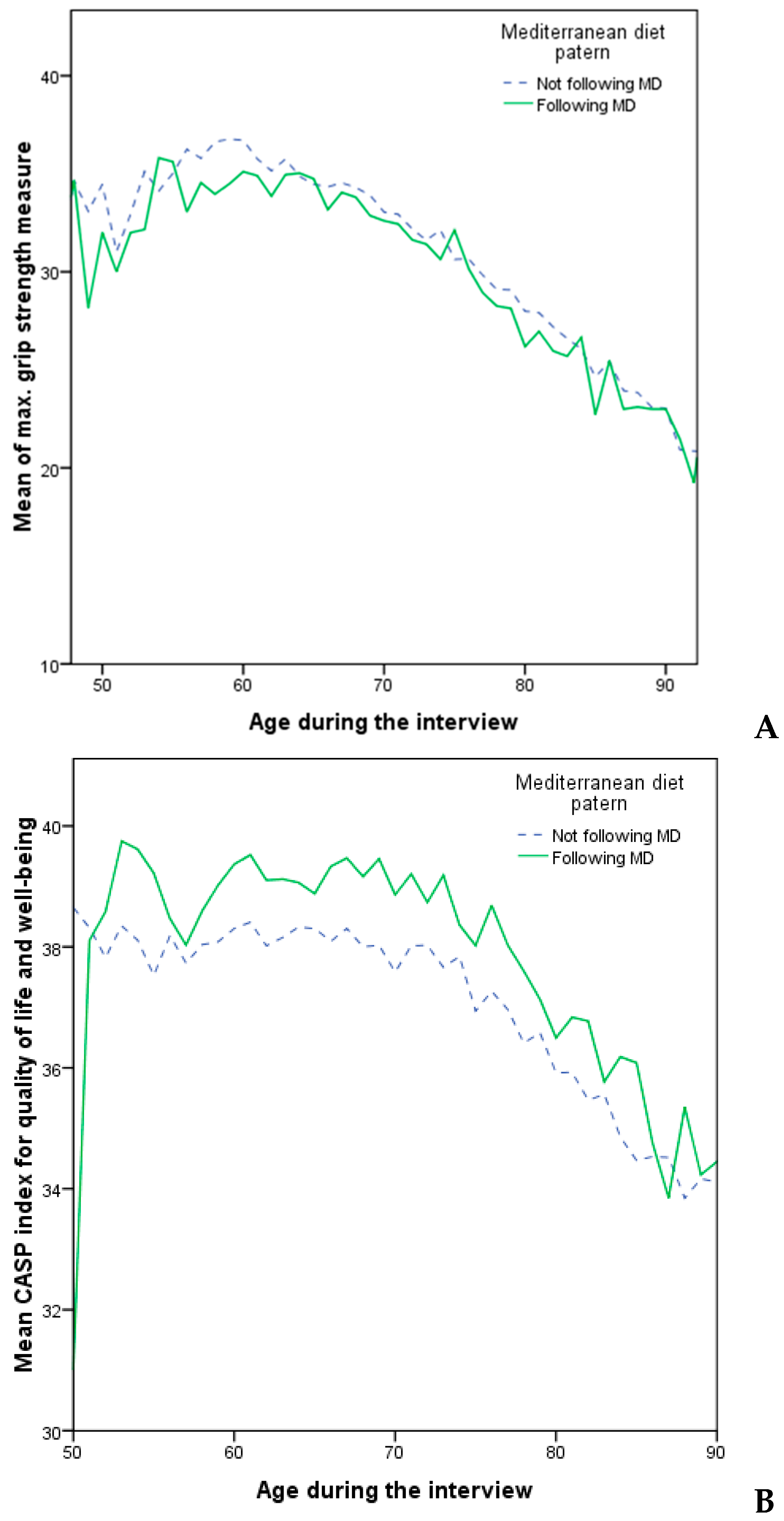
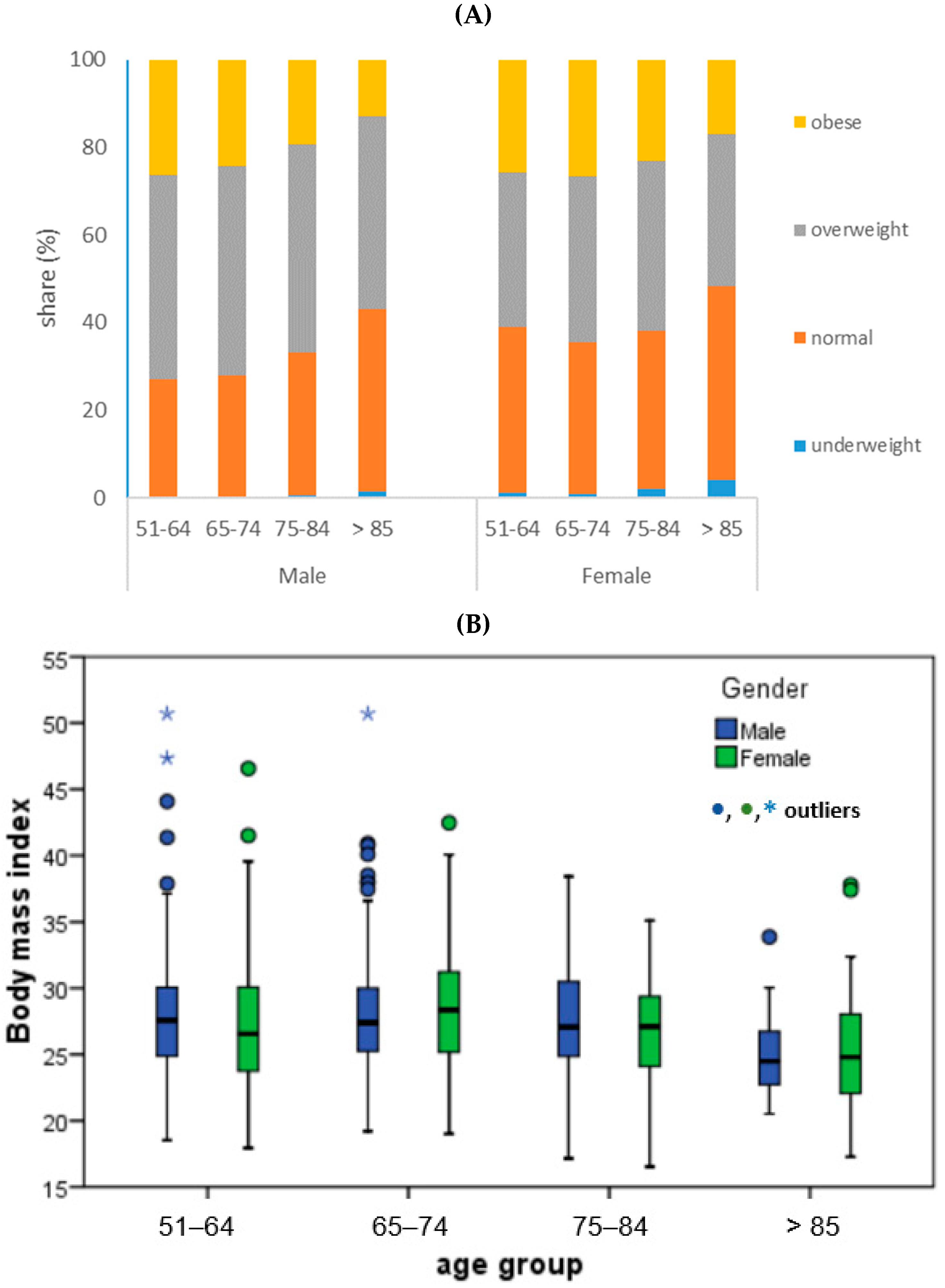
With the increase in life expectancy, expectation of a longer healthy life is also increasing. Importance of consumption of certain foods is confirmed to have a strong effect on quality of life. One of the healthiest dietary patterns consistently associated with a range of beneficial health outcomes is the Mediterranean diet (MD). The aim of this study was to assess MD adherence in the population over 50 years of age, in Europe, with special reference to Croatia, and to assess regional differences and investigate the association with health-related indicators (disease incidence, body mass index (BMI), grip strength measure, control, autonomy, self-realization, and pleasure scale (CASP-12)). This research uses data from the SHARE project for the population over 50 years of age. The frequency of individual responses was analyzed (frequencies, cross tables, and appropriate tests of significance, depending on the data set), and logistic regression was used to connect adherence to the Mediterranean diet with health indicators. The results of the study indicate a positive correlation between adherence to the principles of the Mediterranean diet with CASP and self-perception of health, which the followers of the MD pattern predominantly rate as “very good” or “excellent” (37.05%) what is significantly different (p < 0.05) from individuals which do not follow the patterns of MD (21.55%). The regression models indicate significant changes in the measure of maximum grip strength also among MD followers (ORMEDIUM = 1.449; ORHIGH = 1.293). Data for EU countries are also classified by regions (Central and Eastern; Northern, Southern and Western Europe), additionally allocating Croatia, and the trends in meat, fish and egg consumption showed the greatest differences for Croatian participants (39.6% twice a week) versus participants from four European regions. Data for Croatia deviates from the European average also in terms of the proportion of overweight and obese persons in all observed age groups, of which the largest proportion is in the 50–64 age group (normal BMI: only 30.3%). This study extended the currently available literature covering 27 European countries, placing the findings in a wider geographical context. The Mediterranean diet has once again proven to be an important factor related to health-related behavior. The presented results are extremely important for public health services, indicating possible critical factors in preserving the health of the population over 50 years old.
Keywords: health-related behaviors (HBR); food intake; well-being; elderly; Mediterranean diet health-related behaviors (HBR); food intake; well-being; elderly; Mediterranean diet