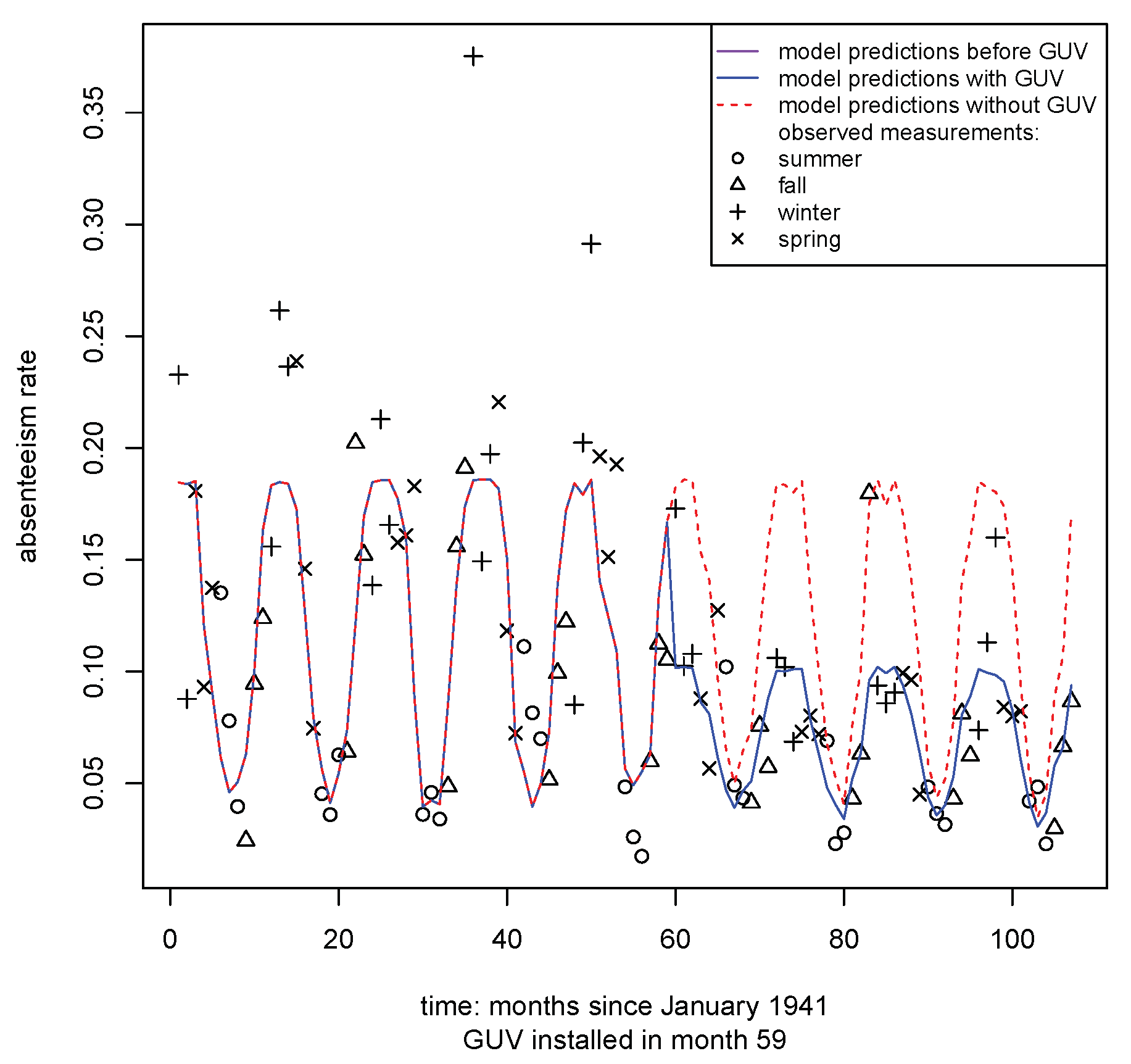
Decreased Respiratory-Related Absenteeism among Preschool Students after Installation of Upper Room Germicidal Ultraviolet Light: Analysis of Newly Discovered Historical Data


Abstract
Share and Cite
Ryan, C.W. Decreased Respiratory-Related Absenteeism among Preschool Students after Installation of Upper Room Germicidal Ultraviolet Light: Analysis of Newly Discovered Historical Data. Int. J. Environ. Res. Public Health 2023, 20, 2536. https://doi.org/10.3390/ijerph20032536
Ryan CW. Decreased Respiratory-Related Absenteeism among Preschool Students after Installation of Upper Room Germicidal Ultraviolet Light: Analysis of Newly Discovered Historical Data. International Journal of Environmental Research and Public Health. 2023; 20(3):2536. https://doi.org/10.3390/ijerph20032536
Chicago/Turabian StyleRyan, Christopher W. 2023. "Decreased Respiratory-Related Absenteeism among Preschool Students after Installation of Upper Room Germicidal Ultraviolet Light: Analysis of Newly Discovered Historical Data" International Journal of Environmental Research and Public Health 20, no. 3: 2536. https://doi.org/10.3390/ijerph20032536
APA StyleRyan, C. W. (2023). Decreased Respiratory-Related Absenteeism among Preschool Students after Installation of Upper Room Germicidal Ultraviolet Light: Analysis of Newly Discovered Historical Data. International Journal of Environmental Research and Public Health, 20(3), 2536. https://doi.org/10.3390/ijerph20032536