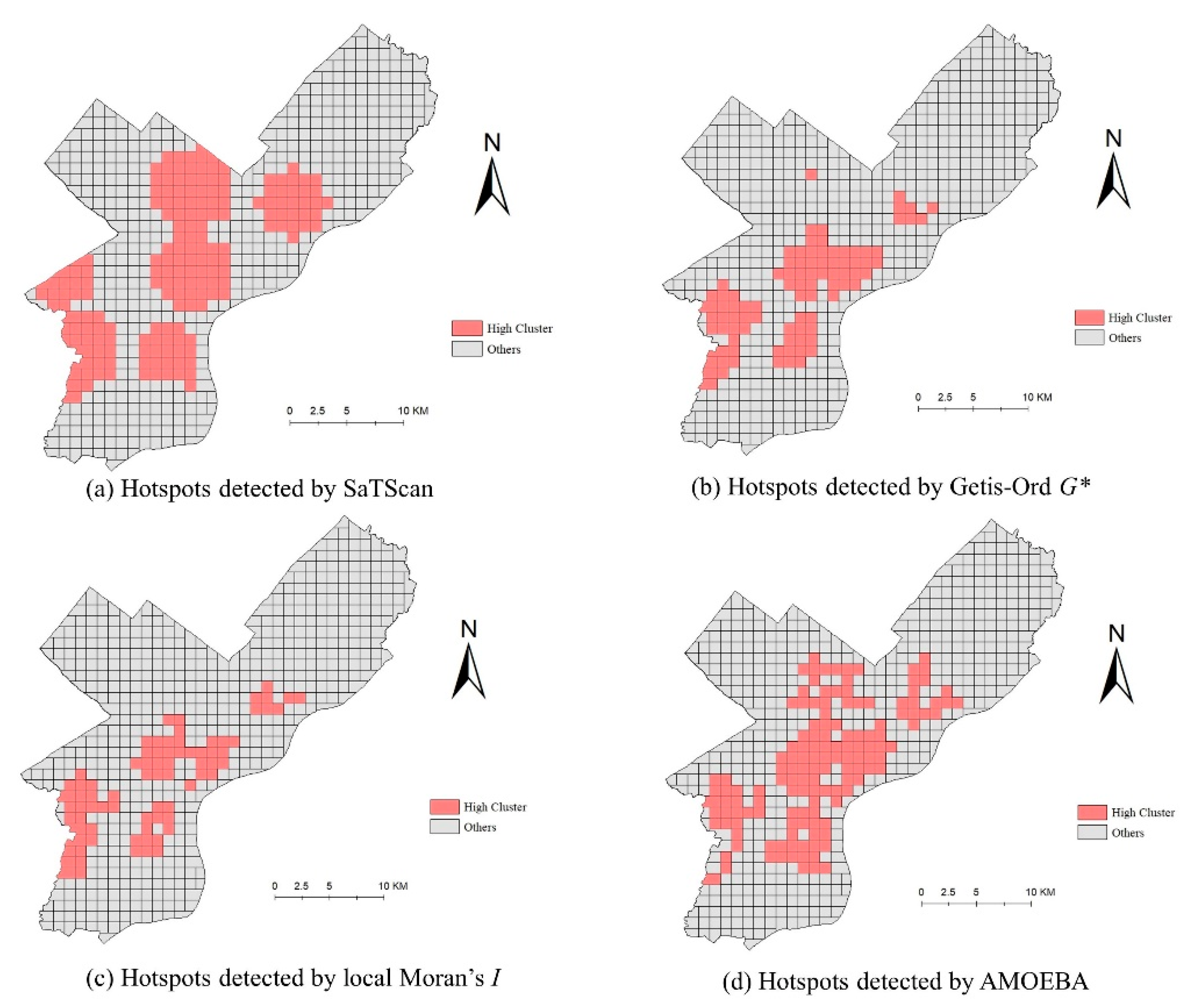
Comparative Study of Approaches for Detecting Crime Hotspots with Considering Concentration and Shape Characteristics


Abstract
Share and Cite
He, Z.; Lai, R.; Wang, Z.; Liu, H.; Deng, M. Comparative Study of Approaches for Detecting Crime Hotspots with Considering Concentration and Shape Characteristics. Int. J. Environ. Res. Public Health 2022, 19, 14350. https://doi.org/10.3390/ijerph192114350
He Z, Lai R, Wang Z, Liu H, Deng M. Comparative Study of Approaches for Detecting Crime Hotspots with Considering Concentration and Shape Characteristics. International Journal of Environmental Research and Public Health. 2022; 19(21):14350. https://doi.org/10.3390/ijerph192114350
Chicago/Turabian StyleHe, Zhanjun, Rongqi Lai, Zhipeng Wang, Huimin Liu, and Min Deng. 2022. "Comparative Study of Approaches for Detecting Crime Hotspots with Considering Concentration and Shape Characteristics" International Journal of Environmental Research and Public Health 19, no. 21: 14350. https://doi.org/10.3390/ijerph192114350
APA StyleHe, Z., Lai, R., Wang, Z., Liu, H., & Deng, M. (2022). Comparative Study of Approaches for Detecting Crime Hotspots with Considering Concentration and Shape Characteristics. International Journal of Environmental Research and Public Health, 19(21), 14350. https://doi.org/10.3390/ijerph192114350