


Health Risks Associated with Informal Electronic Waste Recycling in Africa: A Systematic Review

 , ,
, ,
Abstract
1. Introduction
2. Methods
2.1. Eligibility Criteria
2.2. Information Sources and Search Strategy
2.3. Selection Process
2.4. Data Collection Process
2.5. Study Risk of Bias Assessment
3. Results
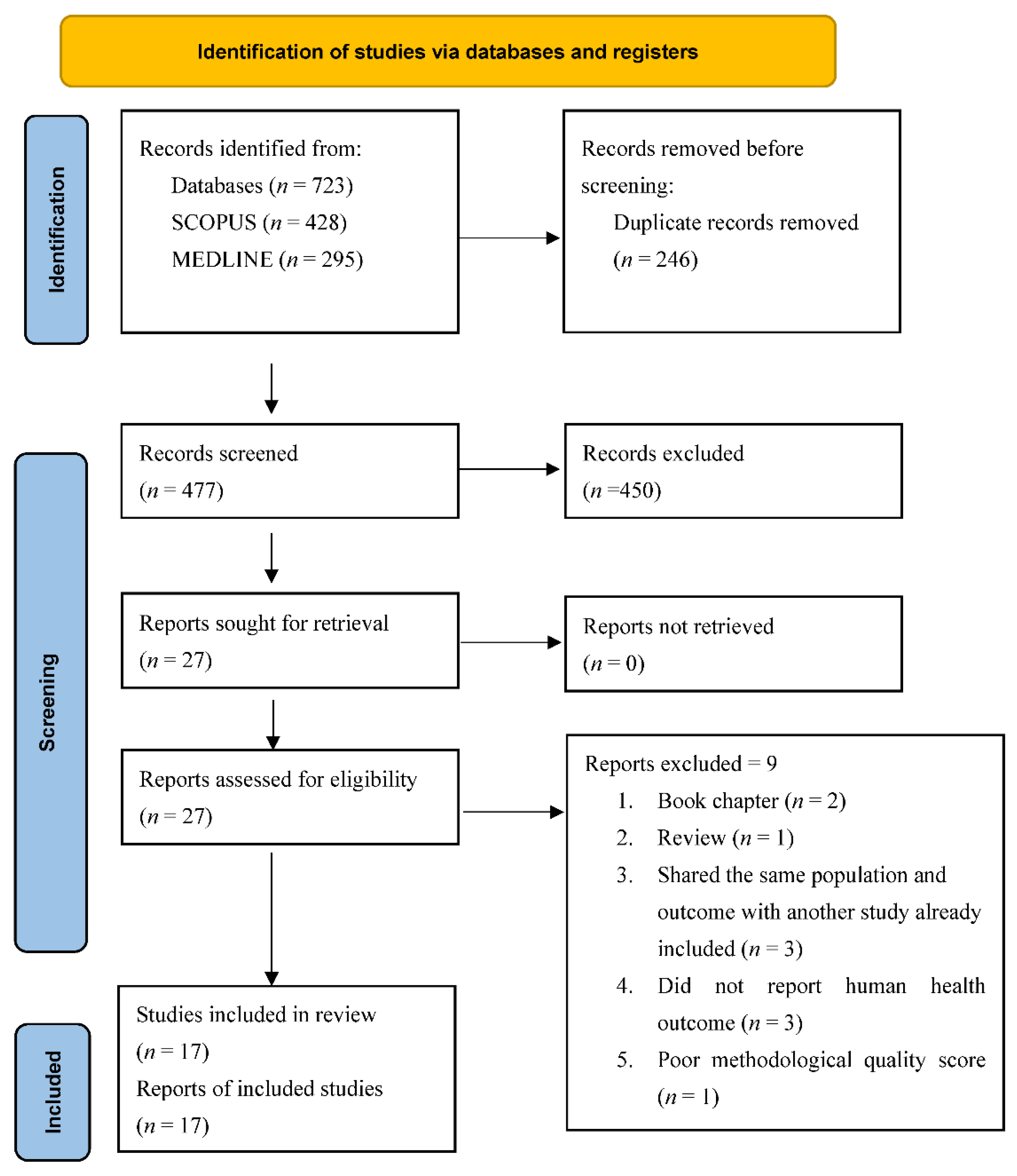
3.1. Study Selection
3.2. Study Characteristics
3.3. Quality of Evidence from the Included Studies
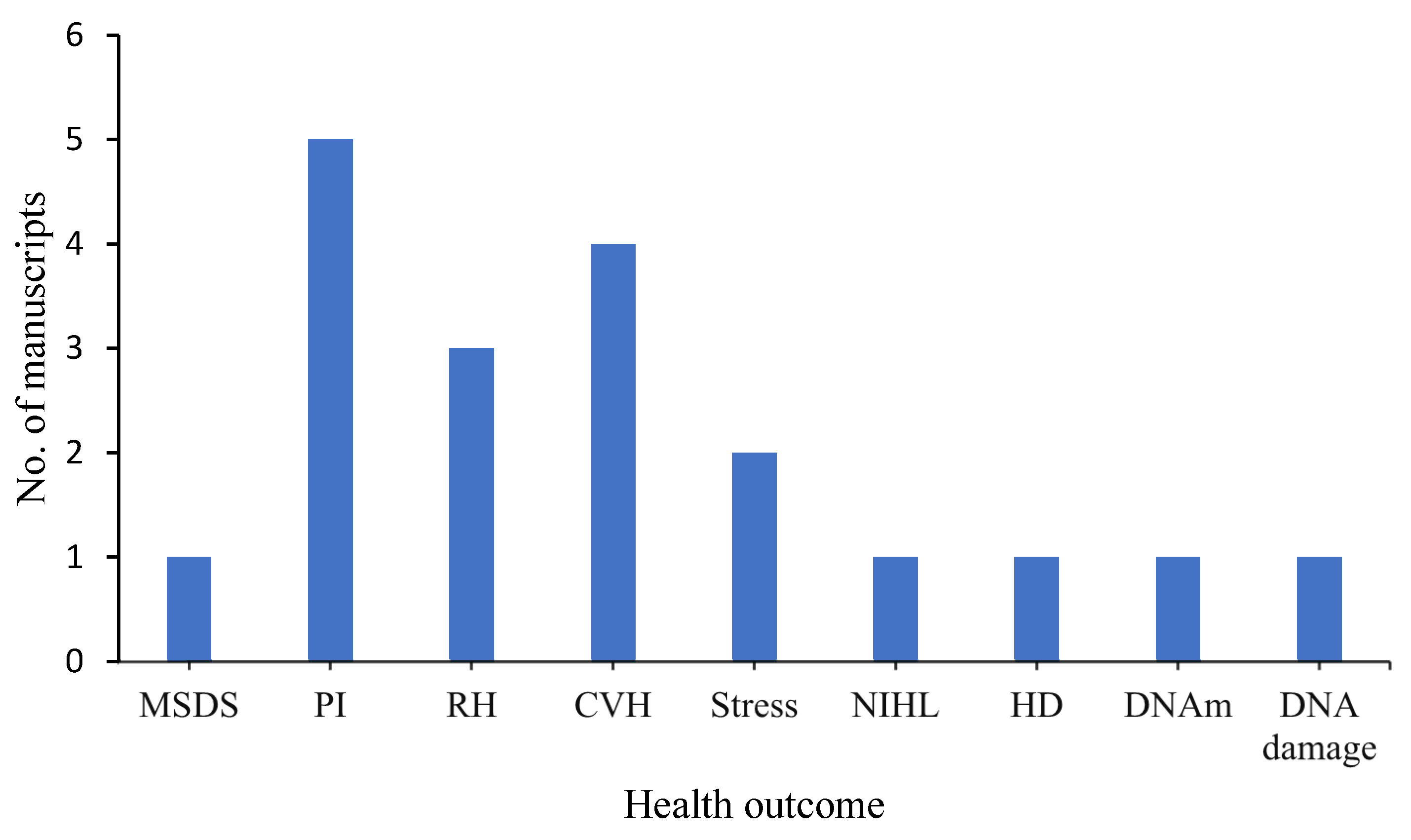
3.4. Narrative Synthesis of Study Outcomes
4. Discussion
5. Conclusions
Supplementary Materials
Author Contributions
Funding
Institutional Review Board Statement
Informed Consent Statement
Data Availability Statement
Conflicts of Interest
References
- Grant, K.; Goldizen, F.C.; Sly, P.D.; Brune, M.N.; Neira, M.; van den Berg, M.; Norman, R.E. Health consequences of exposure to e-waste: A systematic review. Lancet Glob. Health 2013, 1, e350–e361. [Google Scholar] [CrossRef]
- Lin, N.; Kwarteng, L.; Godwin, C.; Warner, S.; Robins, T.; Arko-Mensah, J.; Fobil, J.N.; Batterman, S. Airborne volatile organic compounds at an e-waste site in Ghana: Source apportionment, exposure and health risks. J. Hazard. Mater. 2021, 419, 126353. [Google Scholar] [CrossRef] [PubMed]
- Dai, Q.; Xu, X.; Eskenazi, B.; Asante, K.A.; Chen, A.; Fobil, J.; Bergman, Å.; Brennan, L.; Sly, P.D.; Nnorom, I.C.; et al. Severe Dioxin-Like Compound (Dlc) Contamination in E-Waste Recycling Areas: An under-Recognized Threat to Local Health. Environ. Int. 2020, 139, 105731. [Google Scholar] [CrossRef] [PubMed]
- Kwarteng, L.; Baiden, E.A.; Fobil, J.; Arko-Mensah, J.; Robins, T.; Batterman, S. Air Quality Impacts at an E-Waste Site in Ghana Using Flexible, Moderate-Cost and Quality-Assured Measurements. GeoHealth 2020, 4, e2020GH000247. [Google Scholar] [CrossRef]
- Song, Q.; Li, J. A Review on Human Health Consequences of Metals Exposure to E-Waste in China. Environ. Pollut. 2015, 196, 450–461. [Google Scholar] [CrossRef]
- Takyi, S.A.; Basu, N.; Arko-Mensah, J.; Dwomoh, D.; Houessionon, K.G.; Fobil, J.N. Biomonitoring of metals in blood and urine of electronic waste (E-waste) recyclers at Agbogbloshie, Ghana. Chemosphere 2021, 280, 130677. [Google Scholar] [CrossRef] [PubMed]
- Wittsiepe, J.; Feldt, T.; Till, H.; Burchard, G.; Wilhelm, M.; Fobil, J.N. Pilot study on the internal exposure to heavy metals of informal-level electronic waste workers in Agbogbloshie, Accra, Ghana. Environ. Sci. Pollut. Res. Int. 2017, 24, 3097–3107. [Google Scholar] [CrossRef] [PubMed]
- Yang, J.; Bertram, J.; Schettgen, T.; Heitland, P.; Fischer, D.; Seidu, F.; Felten, M.; Kraus, T.; Fobil, J.N.; Kaifie, A. Arsenic burden in e-waste recycling workers—A cross-sectional study at the Agbogbloshie e-waste recycling site, Ghana. Chemosphere 2020, 261, 127712. [Google Scholar] [CrossRef]
- Feldt, T.; Fobil, J.N.; Wittsiepe, J.; Wilhelm, M.; Till, H.; Zoufaly, A.; Burchard, G.; Goen, T. High levels of PAH-metabolites in urine of e-waste recycling workers from Agbogbloshie, Ghana. Sci. Total Environ. 2014, 466–467, 369–376. [Google Scholar] [CrossRef]
- Wittsiepe, J.; Fobil, J.N.; Till, H.; Burchard, G.-D.; Wilhelm, M.; Feldt, T. Levels of polychlorinated dibenzo-p-dioxins, dibenzofurans (PCDD/Fs) and biphenyls (PCBs) in blood of informal e-waste recycling workers from Agbogbloshie, Ghana, and controls. Environ. Int. 2015, 79, 65–73. [Google Scholar] [CrossRef]
- Tue, N.M.; Goto, A.; Takahashi, S.; Itai, T.; Asante, K.A.; Kunisue, T.; Tanabe, S. Release of chlorinated, brominated and mixed halogenated dioxin-related compounds to soils from open burning of e-waste in Agbogbloshie (Accra, Ghana). J. Hazard. Mater. 2016, 302, 151–157. [Google Scholar] [CrossRef] [PubMed]
- Kaifie, A.; Schettgen, T.; Bertram, J.; Löhndorf, K.; Waldschmidt, S.; Felten, M.K.; Kraus, T.; Fobil, J.N.; Küpper, T. Informal e-waste recycling and plasma levels of non-dioxin-like polychlorinated biphenyls (NDL-PCBs)—A cross-sectional study at Agbogbloshie, Ghana. Sci. Total Environ. 2020, 723, 138073. [Google Scholar] [CrossRef] [PubMed]
- Koomson, J.B. Massive Clean Up at Agbogbloshie. Graphic Online, 2 July 2021; p. 1. [Google Scholar]
- McElvaney, K. Agbogbloshie: The World’s Largest E Waste Dump—In Pictures. The Guardian, 27 February 2014; p. 1. [Google Scholar]
- Heacock, M.; Kelly, C.B.; Asante, K.A.; Birnbaum, L.S.; Bergman, Å.L.; Bruné, M.-N.; Buka, I.; Carpenter, D.O.; Chen, A.; Huo, X. E-waste and harm to vulnerable populations: A growing global problem. Environ. Health Perspect. 2016, 124, 550–555. [Google Scholar] [CrossRef] [PubMed]
- Alabi, O.A.; Adeoluwa, Y.M.; Bakare, A.A. Elevated Serum Pb, Ni, Cd, and Cr Levels and DNA Damage in Exfoliated Buccal Cells of Teenage Scavengers at a Major Electronic Waste Dumpsite in Lagos, Nigeria. Biol. Trace Elem. Res. 2020, 194, 24–33. [Google Scholar] [CrossRef]
- Mcintire, E. The international tribunal for E-waste: Ending the race towards lethal fallout. Seattle J. Environ. Law 2015, 5, 75–108. [Google Scholar]
- Laskaris, Z.; Milando, C.; Batterman, S.; Mukherjee, B.; Basu, N.; O’neill, M.S.; Robins, T.G.; Fobil, J.N. Derivation of Time-Activity Data Using Wearable Cameras and Measures of Personal Inhalation Exposure among Workers at an Informal Electronic-Waste Recovery Site in Ghana. Ann. Work. Expo. Health 2019, 63, 829–841. [Google Scholar] [CrossRef]
- Issah, I.; Arko-Mensah, J.; Agyekum, T.P.; Dwomoh, D.; Fobil, J.N. Electronic waste exposure and DNA damage: A systematic review and meta-analysis. Rev. Environ. Health 2021. [Google Scholar] [CrossRef]
- Grant, R.J.; Oteng-Ababio, M. The Global Transformation of Materials and the Emergence of Informal Urban Mining in Accra, Ghana. Afr. Today 2016, 62, 3–20. [Google Scholar] [CrossRef]
- Amoabeng Nti, A.A.; Arko-Mensah, J.; Botwe, P.K.; Dwomoh, D.; Kwarteng, L.; Takyi, S.A.; Acquah, A.A.; Tettey, P.; Basu, N.; Batterman, S.; et al. Effect of particulate matter exposure on respiratory health of e-waste workers at agbogbloshie, Accra, Ghana. Int. J. Environ. Res. Public Health 2020, 17, 3042. [Google Scholar] [CrossRef]
- Zheng, J.; Chen, K.-h.; Yan, X.; Chen, S.-J.; Hu, G.-C.; Peng, X.-W.; Yuan, J.-g.; Mai, B.-X.; Yang, Z.-Y. Heavy metals in food, house dust, and water from an e-waste recycling area in South China and the potential risk to human health. Ecotoxicol. Environ. Saf. 2013, 96, 205–212. [Google Scholar] [CrossRef]
- Zheng, X.; Xu, X.; Yekeen, T.A.; Zhang, Y.; Chen, A.; Kim, S.S.; Dietrich, K.N.; Ho, S.-M.; Lee, S.-A.; Reponen, T. Ambient air heavy metals in PM2. 5 and potential human health risk assessment in an informal electronic-waste recycling site of China. Aerosol Air Qual. Res. 2015, 16, 388–397. [Google Scholar] [CrossRef]
- Parvez, S.M.; Jahan, F.; Brune, M.-N.; Gorman, J.F.; Rahman, M.J.; Carpenter, D.; Islam, Z.; Rahman, M.; Aich, N.; Knibbs, L.D. Health consequences of exposure to e-waste: An updated systematic review. Lancet Planet. Health 2021, 5, e905–e920. [Google Scholar] [CrossRef]
- Burns, K.N.; Sun, K.; Fobil, J.N.; Neitzel, R.L. Heart rate, stress, and occupational noise exposure among electronic waste recycling workers. Int. J. Environ. Res. Public Health 2016, 13, 140. [Google Scholar] [CrossRef] [PubMed]
- Acquah, A.A.; D’souza, C.; Martin, B.J.; Arko-Mensah, J.; Dwomoh, D.; Nti, A.A.A.; Kwarteng, L.; Takyi, S.A.; Basu, N.; Quakyi, I.A.; et al. Musculoskeletal disorder symptoms among workers at an informal electronic-waste recycling site in agbogbloshie, ghana. Int. J. Environ. Res. Public Health 2021, 18, 2055. [Google Scholar] [CrossRef]
- Adusei, A.; Arko-Mensah, J.; Dzodzomenyo, M.; Stephens, J.; Amoabeng, A.; Waldschmidt, S.; Löhndorf, K.; Agbeko, K.; Takyi, S.; Kwarteng, L.; et al. Spatiality in health: The distribution of health conditions associated with electronic waste processing activities at agbogbloshie, accra. Ann. Glob. Health 2020, 86, 31. [Google Scholar] [CrossRef] [PubMed]
- Carlson, K.; Basu, N.; Fobil, J.N.; Neitzel, R.L. Metal exposures, noise exposures and audiometry from e-waste workers in agbogbloshie, ghana. Int. J. Environ. Res. Public Health 2021, 18, 9639. [Google Scholar] [CrossRef] [PubMed]
- Issah, I.; Arko-Mensah, J.; Rozek, L.S.; Rentschler, K.; Agyekum, T.P.; Dwumoh, D.; Batterman, S.; Robins, T.G.; Fobil, J.N. Association between global DNA methylation (LINE-1) and occupational particulate matter exposure among informal electronic-waste recyclers in Ghana. Int. J. Environ. Health Res. 2021, 1–19. [Google Scholar] [CrossRef]
- Ohajinwa, C.M.; Van Bodegom, P.M.; Vijver, M.G.; Olumide, A.O.; Osibanjo, O.; Peijnenburg, W.J.G.M. Prevalence and injury patterns among electronic waste workers in the informal sector in Nigeria. Inj. Prev. 2018, 24, 185–192. [Google Scholar] [CrossRef]
- Faomowe Foko, R.; Mbodji, M.; Kêdote, M.; Diaw, M.; Touré, M.; Bah, F.; Lam, A.; Diop, C.; Touré, A.; Sall, F.; et al. Chemical risk and respiratory health of waste electrical and electronic equipment (WEEE) handlers in Dakar (Senegal). Archives des Maladies Professionnelles et de l’Environnement 2021, 82, 438–448. [Google Scholar] [CrossRef]
- Kêdoté, N.M.; Sopoh, G.E.; Tobada, S.B.; Darboux, A.J.; Fonton, P.; Sanon Lompo, M.S.; Fobil, J. Perceived Stress at Work and Associated Factors among E-Waste Workers in French-Speaking West Africa. Int. J. Environ. Res. Public Health 2022, 19, 851. [Google Scholar] [CrossRef]
- Page, M.J.; McKenzie, J.E.; Bossuyt, P.M.; Boutron, I.; Hoffmann, T.C.; Mulrow, C.D.; Shamseer, L.; Tetzlaff, J.M.; Akl, E.A.; Brennan, S.E. The PRISMA 2020 statement: An updated guideline for reporting systematic reviews. Int. J. Surg. 2021, 88, 105906. [Google Scholar] [CrossRef] [PubMed]
- Moola, S.; Munn, Z.; Tufanaru, C.; Aromataris, E.; Sears, K.; Sfetcu, R.; Currie, M.; Qureshi, R.; Mattis, P.; Lisy, K. Chapter 7: Systematic reviews of etiology and risk. In Joanna Briggs Institute Reviewer’s Manual; The Joanna Briggs Institute: Adelaide, Australia, 2017; p. 5. [Google Scholar]
- Amoabeng Nti, A.A.; Robins, T.G.; Mensah, J.A.; Dwomoh, D.; Kwarteng, L.; Takyi, S.A.; Acquah, A.; Basu, N.; Batterman, S.; Fobil, J.N. Personal exposure to particulate matter and heart rate variability among informal electronic waste workers at Agbogbloshie: A longitudinal study. BMC Public Health 2021, 21, 2161. [Google Scholar] [CrossRef] [PubMed]
- Takyi, S.A.; Basu, N.; Arko-Mensah, J.; Botwe, P.; Amoabeng Nti, A.A.; Kwarteng, L.; Acquah, A.; Tettey, P.; Dwomoh, D.; Batterman, S.; et al. Micronutrient-rich dietary intake is associated with a reduction in the effects of particulate matter on blood pressure among electronic waste recyclers at Agbogbloshie, Ghana. BMC Public Health 2020, 20, 1067. [Google Scholar] [CrossRef] [PubMed]
- Armah, F.A.; Quansah, R.; Yawson, D.O.; Abdul Kadir, L. Assessment of Self-Reported Adverse Health Outcomes of Electronic Waste Workers Exposed to Xenobiotics in Ghana. Environ. Justice 2019, 12, 69–84. [Google Scholar] [CrossRef]
- Houessionon, M.K.; Basu, N.; Bouland, C.; Kedote, N.M.; Fayomi, B.; Fobil, N.J.; Ouendo, E.-M. Knowledge, Practices, and Environmental and Occupational Health Risks Associated with Electronic Waste Recycling in Cotonou, Benin. Occup. Dis. Environ. Med. 2021, 9, 33–48. [Google Scholar] [CrossRef]
- Burns, K.N.; Sayler, S.K.; Neitzel, R.L. Stress, health, noise exposures, and injuries among electronic waste recycling workers in Ghana. J. Occup. Med. Toxicol. 2019, 14, 1. [Google Scholar] [CrossRef]
- Igharo, O.G.; Akinfenwa, Y.; Isara, A.R.; Idomeh, F.A.; Nwobi, L.N.; Anetor, J.I.; Osibanjo, O. Lipid profile and Atherogenic Indices in Nigerians Occupationally Exposed to e-waste: A Cardiovascular Risk Assessment Study. Maedica J. Clin. Med. 2020, 15, 196–205. [Google Scholar] [CrossRef]
- Igaro, O.G.; Anetor, J.I.; Osibanjo, O.O.; Osadolor, H.B.; Idomeh, F.A.; Igiewe, W.O.; Kalikwu, O.U. Liver Damage Risk Assessment Study in Workers Occupationally Exposed to E-waste in Benin City, South-South Nigeria. J. Chem. Health Risks 2015, 5, 155–166. [Google Scholar]
- Issah, I.; Arko-Mensah, J.; Rozek, L.S.; Zarins, K.R.; Dwomoh, D.; Agyekum, T.P.; Basu, N.; Batterman, S.; Robins, T.G.; Fobil, J.N. Association between toxic and essential metals in blood and global DNA methylation among electronic waste workers in Agbogbloshie, Ghana. Environ. Sci. Pollut. Res. 2022, 1–11. [Google Scholar] [CrossRef]
- Yohannessen, K.; Pinto-Galleguillos, D.; Parra-Giordano, D.; Agost, A.; Valdés, M.; Smith, L.M.; Galen, K.; Arain, A.; Rojas, F.; Neitzel, R.L.; et al. Health Assessment of Electronic Waste Workers in Chile: Participant Characterization. Int. J. Environ. Res. Public Health 2019, 16, 386. [Google Scholar] [CrossRef]
- Decharat, S.; Kiddee, P. Assessment of knowledge, attitude, perceptions and risk assessment among workers in e-waste recycling shops, Thailand. Environ. Anal. Health Toxicol. 2022, 37, e2022003. [Google Scholar] [CrossRef] [PubMed]
- Acquah, A.A.; D’Souza, C.; Martin, B.; Arko-Mensah, J.; Nti, A.A.; Kwarteng, L.; Takyi, S.; Quakyi, I.A.; Robins, T.G.; Fobil, J.N. Processes and Challenges associated with informal electronic waste recycling at Agbogbloshie, a suburb of Accra, Ghana. In Proceedings of the Human Factors and Ergonomics Society Annual Meeting, Seattle, WA, USA, 28 October–1 November 2019; Volume 63, pp. 938–942. [Google Scholar] [CrossRef]
- Ohajinwa, C.M.; Van Bodegom, P.M.; Vijver, M.G.; Peijnenburg, W.J. Health risks awareness of electronic waste workers in the informal sector in Nigeria. Int. J. Environ. Res. Public Health 2017, 14, 911. [Google Scholar] [CrossRef] [PubMed]
- Black, M.; Karki, J.; Lee, A.; Makai, P.; Baral, Y.; Kritsotakis, E.; Bernier, A.; Heckmann, A.F. The health risks of informal waste workers in the Kathmandu Valley: A cross-sectional survey. Public Health 2019, 166, 10–18. [Google Scholar] [CrossRef] [PubMed]
- de Sousa, M.N.A.; de Oliveira Santos, B.M.; Bertoncello, D.; Feitosa, A.d.N.A.; de Assis, E.V.; Batista, H.M.T.; de Mello Monteiro, C.B.; Maia, P.C.G.G.S.; Bezerra, I.M.P.; de Abreu, L.C. Musculoskeletal disorders in informal mining workers. Int. Arch. Med. 2015, 8. [Google Scholar] [CrossRef]
- Fernandes, R.d.C.P.; Assunção, A.Á.; Silvany Neto, A.M.; Carvalho, F.M. Musculoskeletal disorders among workers in plastic manufacturing plants. Rev. Bras. Epidemiol. 2010, 13, 11–20. [Google Scholar] [CrossRef]
- Das, D.; Kumar, A.; Sharma, M. A systematic review of work-related musculoskeletal disorders among handicraft workers. Int. J. Occup. Saf. Ergon. 2018, 55–70. [Google Scholar] [CrossRef]
- Lu, X.; Xu, X.; Zhang, Y.; Zhang, Y.; Wang, C.; Huo, X. Elevated inflammatory Lp-PLA2 and IL-6 link e-waste Pb toxicity to cardiovascular risk factors in preschool children. Environ. Pollut. 2018, 234, 601–609. [Google Scholar] [CrossRef]
- Zheng, X.; Huo, X.; Zhang, Y.; Wang, Q.; Zhang, Y.; Xu, X. Cardiovascular endothelial inflammation by chronic coexposure to lead (Pb) and polycyclic aromatic hydrocarbons from preschool children in an e-waste recycling area. Environ. Pollut. 2019, 246, 587–596. [Google Scholar] [CrossRef]
- Cong, X.; Xu, X.; Xu, L.; Li, M.; Xu, C.; Qin, Q.; Huo, X. Elevated biomarkers of sympatho-adrenomedullary activity linked to e-waste air pollutant exposure in preschool children. Environ. Int. 2018, 115, 117–126. [Google Scholar] [CrossRef]
- Zeng, X.; Xu, X.; Zhang, Y.; Li, W.; Huo, X. Chest circumference and birth weight are good predictors of lung function in preschool children from an e-waste recycling area. Environ. Sci. Pollut. Res. 2017, 24, 22613–22621. [Google Scholar] [CrossRef]
- Zeng, X.; Xu, X.; Boezen, H.M.; Vonk, J.M.; Wu, W.; Huo, X. Decreased lung function with mediation of blood parameters linked to e-waste lead and cadmium exposure in preschool children. Environ. Pollut. 2017, 230, 838–848. [Google Scholar] [CrossRef] [PubMed]
- Zeng, X.; Xu, X.; Zheng, X.; Reponen, T.; Chen, A.; Huo, X. Heavy metals in PM2. 5 and in blood, and children’s respiratory symptoms and asthma from an e-waste recycling area. Environ. Pollut. 2016, 210, 346–353. [Google Scholar] [CrossRef] [PubMed]
- Rivero, D.H.R.F.; Soares, S.R.C.; Lorenzi-Filho, G.; Saiki, M.; Godleski, J.J.; Antonangelo, L.; Dolhnikoff, M.; Saldiva, P.H.N. Acute Cardiopulmonary Alterations Induced by Fine Particulate Matter of São Paulo, Brazil. Toxicol. Sci. 2005, 85, 898–905. [Google Scholar] [CrossRef]
- Fang, S.C.; Cassidy, A.; Christiani, D.C. A Systematic Review of Occupational Exposure to Particulate Matter and Cardiovascular Disease. Int. J. Environ. Res. Public Health 2010, 7, 1773–1806. [Google Scholar] [CrossRef]
- Lawin, H.; Ayi Fanou, L.; Hinson, A.V.; Stolbrink, M.; Houngbegnon, P.; Kedote, N.M.; Fayomi, B.; Kagima, J.; Katoto, P.; Ouendo, E.M.D. Health risks associated with occupational exposure to ambient air pollution in commercial drivers: A systematic review. Int. J. Environ. Res. Public Health 2018, 15, 2039. [Google Scholar] [CrossRef] [PubMed]
- Tchounwou, P.B.; Yedjou, C.G.; Patlolla, A.K.; Sutton, D.J. Heavy metal toxicity and the environment. In Molecular, Clinical and Environmental Toxicology; Springer: Basel, Switzerland, 2012; pp. 133–164. [Google Scholar]
- Koshan Al-Rikabi, Z.G.; Al-Saffar, M.A.; Abbas, A.H. The Accumulative Effect of Heavy Metals on Liver and Kidney Functions. Med.-Leg. Update 2021, 21, 1114–1119. [Google Scholar]
- Fischer, D.; Seidu, F.; Yang, J.; Felten, M.K.; Garus, C.; Kraus, T.; Fobil, J.N.; Kaifie, A. Health Consequences for E-Waste Workers and Bystanders—A Comparative Cross-Sectional Study. Int. J. Environ. Res. Public Health 2020, 17, 1534. [Google Scholar] [CrossRef]
- Acquah, A.A.; D’Souza, C.; Martin, B.; Arko-Mensah, J.; Quakyi, I.A.; Basu, N.; Robins, T.G.; Fobil, J.N. Work-Related Exposures and Musculoskeletal Disorder Symptoms among Informal E-Waste Recyclers at Agbogbloshie, Ghana. In Proceedings of the 21st Congress of the International Ergonomics Association (IEA 2021), Volume IV, Healthcare and Healthy Work, International Ergonomics Association, Congress, Vancouver, BC, Canada, 13–18 June 2021; Springer Nature: Cham, Switzerland, 2021; Volume 222, pp. 677–681. [Google Scholar]
- Acquah, A.A.; D’Souza, C.; Martin, B.J.; Arko-Mensah, J.; Basu, N.; Quakyi, I.A.; Robins, T.G.; Fobil, J.N. Comparison of Ergonomic Risk Factors and Work-Related Musculoskeletal Disorders among Dismantler and Burners of Electronic Waste in Agbogbloshie, Accra Ghana. In Proceedings of the Human Factors and Ergonomics Society Annual Meeting, Human Factors and Ergonomics Society, Annual Meeting, Baltimore, MD, USA, 3–8 October 2021; SAGE Publications: Los Angeles, CA, USA, 2021; Volume 65, pp. 715–719. [Google Scholar]
- Acquah, A.A.; D’Souza, C.; Martin, B.J.; Arko-Mensah, J.; Botwe, P.K.; Tettey, P.; Dwomoh, D.; Nti, A.A.; Kwarteng, L.; Takyi, S.; et al. A preliminary assessment of physical work exposures among electronic waste workers at Agbogbloshie, Accra Ghana. Int. J. Ind. Ergon. 2021, 82, 103096. [Google Scholar] [CrossRef]
- Fobil, J.; Abotsi, P.; Acquah, A.A.; Arko-Mensah, J.; D’Souza, C.; Martin, B. Occupational and Environmental Health Effects of Informal Electronic Waste Recycling—A Focus on Agbogbloshie, Ghana. In Congress of the International Ergonomics Association; Lecture Notes in Networks and Systems; Springer: Cham, Switzerland, 2021; pp. 746–752. [Google Scholar]
- Matovu, H.; Sillanpää, M.; Ssebugere, P. Polybrominated Diphenyl Ethers in Mothers’ Breast Milk and Associated Health Risk to Nursing Infants in Uganda. Sci. Total Environ. 2019, 692, 1106–1115. [Google Scholar] [CrossRef]
- Ohajinwa, C.M.; van Bodegom, P.M.; Osibanjo, O.; Xie, Q.; Chen, J.; Vijver, M.G.; Peijnenburg, W.J.G.M. Health Risks of Polybrominated Diphenyl Ethers (PBDEs) and Metals at Informal Electronic Waste Recycling Sites. Int. J. Environ. Res. Public Health 2019, 16, 906. [Google Scholar] [CrossRef]
- D’Souza, C.; Martin, B.; Fobil, J.N.; Todd, A.; Gomes, J.O. Musculoskeletal Disorders in Unstructured, Unregulated Work: Assessment Methods and Injuries. In Proceedings of the 21st Congress of the International Ergonomics Association (IEA 2021), Volume IV, Healthcare and Healthy Work, International Ergonomics Association Congress, Virtual 13–18 June 2021; Springer Nature: Cham, Switzerland, 2021; Volume 222, pp. 720–727. [Google Scholar]
- Issah, I.; Arko-Mensah, J.; Rozek, L.S.; Zarins, K.R.; Agyekum, T.P.; Dwomoh, D.; Basu, N.; Batterman, S.; Robins, T.G.; Fobil, J.N. Global DNA (LINE-1) methylation is associated with lead exposure and certain job tasks performed by electronic waste workers. Int. Arch. Occup. Environ. Health 2021, 94, 1931–1944. [Google Scholar] [CrossRef] [PubMed]

| Author (Year) | Citation Frequency | Study Design | Exposed Population | Control Population | Chemical Exposure | Health Outcome | Statistical Method | Key Findings |
|---|---|---|---|---|---|---|---|---|
| Acquah et al. (2021) [26] | 10 | Cross-sectional | 176 e-waste workers, Ghana | 41 non-e-waste workers | NA | Self-reported musculoskeletal disorder (MSD) symptoms | Poisson regression | Comparing across body parts, discomfort prevalence for (e-waste workers vs. the reference group) was highest in the lower back (65.9% vs. 51.2%), followed by the shoulders (37.5% vs. 31.7%), knees (37.5% vs. 19.5%), lower legs (26.7% vs. 14.6%), upper arms (28.4% vs. 2.4%), and neck (26.1% vs. 22.0%). |
| Adusei et al. (2020) [27] | 10 | Cross-sectional | 112 e-waste workers, Ghana | None | NA | Physical injuries | Pearson’s chi-square and ANOVA | 96.2% of all the study subjects had cuts, the dismantlers had a higher mix of scars, lacerations and abrasions. Abrasions were observed in 16.3% of the dismantlers. Scars were observed on the skins of 93.6% of the subjects. The prevalence of burns was 23.1%. |
| Armah et al. (2019) [37] | 10 | Cross-sectional | 140 resident e-waste workers and 60 resident non-e-waste workers, Ghana | 60 non-resident non-e-waste workers | NA | Self-reported physical injuries and respiratory symptoms | Generalized linear models (logit, complementary log-log, negative log-log regressions) | Non-e-waste exposed populations are 74% less likely to report eye problems compared with those exposed to e-waste. E-waste workers were 84% more likely to report skin burns compared with non-e-waste workers. Resident e-waste workers reported more breathing difficulty (odds ratio [OR] = 3.30, confidence interval [CI]: 1.733–6.267). |
| Burns et al. (2019) [39] | 48 | Cross-sectional | 46 e-waste workers, Ghana | None | NA | Injury experience, noise exposures, and stress risk factors | Multivariable Poisson regression | Average injuries per person = 9.9 ± 9.6 (range: 1–40). The majority of injuries were lacerations (65.2%), and the most common injury location was the hand (45.7%). Perceived stress level and perceived noise exposure were associated with a significantly greater number of injuries. |
| Ohajinwa et al. (2018) [30] | 34 | Cross-sectional | 279 e-waste workers, Nigeria | None | NA | Physical injury patterns | Logistic regression. | Injury prevalence of 38% in 1–2 weeks preceding the study and 68% in the 6-month preceding study. The most common injury type is cuts to the hands and fingers, mainly caused by sharp objects. |
| Houessionon et al. (2021) [38] | 1 | Cross-sectional | 45 e-waste recyclers, Benin | None | NA | Self-reported injuries | Chi-square test | High prevalence of injuries (88.9%), itchy skin (45.2%), blood in the stool (16.3%), and blood in the urine (14.2%). The number of hours worked per day is associated with blood in urine, itchy skin, and airway obstruction. |
| Burns et al. (2016) [25] | 71 | Cross-sectional | 57 e-waste workers, Ghana | None | NA | Noise exposures, heart rate, and perceived stress | Mixed effects linear regression model | 43.5% of workers had noise exposures that exceeded recommended occupational (85 dBA) and community (70 dBA) noise exposure limits. A 1 dB increase in noise exposure was associated with a 0.17 increase in heart rate (p = 0.01). |
| Carlson et al. (2021) [28] | 0 | Cross-sectional | 58 e-waste workers, Ghana | None | Pb, Cd, total Hg, Se, Mn, Cu, Fe, Zn, and As. | Noise-induced hearing loss (NIHL) | Linear regression models | Audiometric notches indicative of noise-induced hearing loss (NIHL) = 60%, high noise while working = 86%, daily average noise levels range = 74.4–90.0 dBA, and living at Agbogbloshie is associated with worse hearing thresholds at 4 and 6 kHz. |
| Kêdoté et al. (2022) [32] | 1 | Cross-sectional | 740 e-waste workers, 5 West African countries: Benin, Burkina Faso, Ivory Coast, Mali, and Senegal | None | NA | Perceived stress | Multivariate logistic regression | Prevalence of perceived = 76.76%. Factors associated with stress included insufficient income, number of working days per week, violence at work, and the interference of work with family responsibilities or leisure. |
| Amoabeng Nti et al. (2020) [21] | 41 | Longitudinal study | 142 e-waste workers, Ghana | 65 non-e-waste workers | PM (2.5, 2.5–10, and 10 µm) | Lung function parameters (FVC, FEV1, FEV1/FVC, PEF, and FEF 25–75) | Random effects models | Median PM concentrations (2.5, 2.5–10, and 10 µm) were all above the WHO ambient air standards across the 3 study waves. A 10 µg increase in PM (2.5, 2.5–10 and 10 µm) was associated with decreases in PEF and FEF 25–75 by 13.3% (β = −3.133; 95% CI: −0.243, −0.022) and 26.6% (β = −0.266; 95% CI: −0.437, 0.094), respectively. |
| Faomowe Foko et al. (2021) [31] | 0 | Cross-sectional | 178 e-waste workers, Senegal | None | NA | Respiratory health | Proportions | Spirometry examination revealed 37.11% cases of asthma, 21.65% cases of COPD-like syndrome, and 7.22% cases of restrictive syndromes. |
| Igharo et al. (2020) [40] | 3 | Cross-sectional | 63 e-waste workers, Nigeria | 41 non-e-waste workers | Pb and Cd | Cardiovascular health | Student’s t-test and Pearson’s correlation | Blood Pb µmol/L, mean ± SD = 0.05 ± 0.006 vs. 0.03 ± 0.03, and Cd nmol/L = 103.20 ± 11.98 vs. 54.65 ± 8.47 (Pall < 0.05). Total cholesterol, LDL cholesterol, AC, CRI-1, and CRI-11 significantly increased in the e-waste exposed participants compared to the unexposed group. |
| Amoabeng Nti et al. (2021) [35] | 2 | Longitudinal study | 142 e-waste workers, Ghana | 65 non-e-waste workers | PM (2.5, 2.5–10, and 10 µm) | Cardiovascular function (heart rate (HR), HRV and blood pressure) | Random effects models | A 10 μg/m3 increase in the concentrations of PM2.5, PM10–2.5, and PM10 in personal air was associated with reduced HRV indices and increased resting HR. A 10 μg/m3 per interquartile (IQR) increase in PM10–2.5 and PM10 decreased SDNN by 11% (95% CI: −0.002–0.000; p = 0.187) and 34% (95% CI: −0.002–0.001; p = 0.035), respectively. |
| Takyi et al. (2020) [36] | 10 | Longitudinal study | 142 e-waste workers, Ghana | 65 non-e-waste workers | Breathing zone PM2.5 | Cardiovascular indices: systolic BP (SBP), diastolic BP (DBP), and pulse pressure (PP) | Random effects models | Exposure to 1 μg/m3 of PM2.5 was associated with an increased heart rate (HR) among e-waste recyclers. |
| Igaro et al. (2015) [41] | 2 | Cross-sectional | 63 e-waste workers, Nigeria | 41 non-e-waste workers | NA | Liver damage | Student’s t-test | Significantly raised activities of enzymatic biomarkers of liver damage (ALT, AST, ALP, and GGT) in the e-waste group compared with the unexposed participants. |
| Alabi et al. (2020) [16] | 22 | Cross-sectional | 95 e-waste workers, Nigeria | 103 non-e-waste workers | Pb, Ni, Cd, and Cr | DNA damage (micronuclei, binucleated cells, pycnosis) | Spearman correlation | Blood Pb μg/L (median = 19.55, vs. 1.50; p = 0.01), Cd μg/L (median = 1.43, vs. 0.18; p = 0.05), Cr μg/L (median = 2.31, vs. 0.02; p = 0.01), and Ni μg/L (median = 1.05, vs. 0.01; p = 0.01). Micronuclei: mean (168.04 vs. 3.23; p < 0.01); binucleated cells: (42.20 vs. 0.08; p < 0.01); pycnosis: (26.02 vs. 0.00; p < 0.01). |
| Issah et al. (2022) [42] | 0 | Cross-sectional | 100 e-waste workers, Ghana | 51 non-e-waste workers | Pb, Cd, Mn, Se, and Zn | Global (LINE-1) DNA methylation | Multivariable linear regression with robust standard errors | Blood Pb, GM (95% CI) = 79.6 (71.9, 88.1) vs. 37.7 (33.8, 42.0), Cd = 147.7 (140.1, 155.8) vs. 190.6 (179.4, 200.7). Blood Zn was associated with a significant decrement in global DNA methylation levels (βZn = −0.912; 95% CI, −1.512, −0.306; p = 0.003). |
Publisher’s Note: MDPI stays neutral with regard to jurisdictional claims in published maps and institutional affiliations. |
© 2022 by the authors. Licensee MDPI, Basel, Switzerland. This article is an open access article distributed under the terms and conditions of the Creative Commons Attribution (CC BY) license (https://creativecommons.org/licenses/by/4.0/).
Share and Cite
Issah, I.; Arko-Mensah, J.; Agyekum, T.P.; Dwomoh, D.; Fobil, J.N. Health Risks Associated with Informal Electronic Waste Recycling in Africa: A Systematic Review. Int. J. Environ. Res. Public Health 2022, 19, 14278. https://doi.org/10.3390/ijerph192114278
Issah I, Arko-Mensah J, Agyekum TP, Dwomoh D, Fobil JN. Health Risks Associated with Informal Electronic Waste Recycling in Africa: A Systematic Review. International Journal of Environmental Research and Public Health. 2022; 19(21):14278. https://doi.org/10.3390/ijerph192114278
Chicago/Turabian StyleIssah, Ibrahim, John Arko-Mensah, Thomas P. Agyekum, Duah Dwomoh, and Julius N. Fobil. 2022. "Health Risks Associated with Informal Electronic Waste Recycling in Africa: A Systematic Review" International Journal of Environmental Research and Public Health 19, no. 21: 14278. https://doi.org/10.3390/ijerph192114278
APA StyleIssah, I., Arko-Mensah, J., Agyekum, T. P., Dwomoh, D., & Fobil, J. N. (2022). Health Risks Associated with Informal Electronic Waste Recycling in Africa: A Systematic Review. International Journal of Environmental Research and Public Health, 19(21), 14278. https://doi.org/10.3390/ijerph192114278

