

You are currently on the new version of our website. Access the old version .
  • Article
  • Open Access

29 September 2022

Healthcare Workers’ Resilience Toolkit for Disaster Management and Climate Change Adaptation

,
,
and
1
Cities Research Institute, Griffith University, Gold Coast, QLD 4215, Australia
2
School of Engineering and Built Environment, Griffith University, Gold Coast, QLD 4215, Australia
3
Department of Emergency Medicine, Griffith University, Gold Coast, QLD 4215, Australia
4
Menzies Health Institute Queensland, Griffith University, Gold Coast, QLD 4215, Australia
This article belongs to the Special Issue Climate Driven Health Impacts

Abstract

Climate change has been recognised as a multiplier of risk factors affecting public health. Disruptions caused by natural disasters and other climate-driven impacts are placing increasing demands on healthcare systems. These, in turn, impact the wellness and performance of healthcare workers (HCWs) and hinder the accessibility, functionality and safety of healthcare systems. This study explored factors influencing HCWs’ disaster management capabilities with the aim of improving their resilience and adaptive capacity in the face of climate change. In-depth, semi-structured interviews were conducted with thirteen HCWs who dealt with disasters within two hospitals in Queensland, Australia. Analysis of the results identified two significant themes, HCWs’ disaster education and HCWs’ wellness and needs. The latter comprised five subthemes: HCWs’ fear and vulnerability, doubts and uncertainty, competing priorities, resilience and adaptation, and needs assessment. This study developed an ‘HCWs Resilience Toolkit’, which encourages mindfulness amongst leaders, managers and policymakers about supporting four priority HCWs’ needs: ‘Wellness’, ‘Education’, ‘Resources’ and ‘Communication’. The authors focused on the ‘Education’ component to detail recommended training for each of the pre-disaster, mid-disaster and post-disaster phases. The authors conclude the significance of the toolkit, which provides a timely contribution to the healthcare sector amidst ongoing adversity.

1. Introduction

Climate change is recognized as a critical element of public health and signifies one of the most critical threats affecting global health [1,2]. Combatting climate change presents the greatest global health opportunity of the 21st century. Natural disasters and pandemics caused by emerging microbial pathogens have been witnessed worldwide and have focused greater attention on the complex relationships between our environment, our changing climate, and our health [3,4]. In the meantime, prioritising appropriate climate change mitigation and adaptation actions will improve health outcomes and avert disaster-related disturbances in health care delivery [5]. Specifically, enhanced planning, monitoring and assessment approaches are required to build the resilience of hospitals in the face of disasters, and other climate change impacts [6,7].
HCWs are suffering from climate change impacts on population health and healthcare services [8]. Hospitals are unique in having a wide range of healthcare workers constituting the hospitals’ human resources. HCWs are entirely responsible for health care delivery and patients’ safety, directly by doctors, nurses, and allied health professionals, and indirectly by medical assistants, technicians, and waste handlers [9,10,11]. HCWs are universally influenced by work-related stress in various healthcare settings [12,13,14]. Such stress is magnified during disasters (HCWs), owing to the increased workload, multitasks, roles and time constraints [15,16]. Moreover, the physical stress and emotional exhaustion faced by HCWs’ during disasters are exacerbated by having to deal with traumatic situations while experiencing their own fear, uncertainty, and concerns regarding the impact of such disasters on their homes, and families [17,18,19,20,21,22]. For example, nurses demonstrated exaggerated liability for Post-Traumatic Stress Disease, major depression, or severe psychological illness during disasters [20,23]. Equally important COVID-19 pandemic has resulted in the death of many HCWs and augmented their psychological stress and alcohol consumption [13,24,25,26,27].
Resilience has both physical and social dimensions in healthcare settings. A hospital’s resilience is defined as its ability to survive, absorb, acclimatise, adapt to, change and recover from the hazard effects in a timely and efficient manner [28]. It follows that resilience metrics used to capture a hospital’s performance during disasters then, would consider various factors in the hospitals’ performance during disasters as the physical factor, including “structural” and “non-structural” components, and the social “functional” one [29]. Human resources, communication and information management are crucial components of the latter [29,30,31,32,33]. Hence, regardless of physical resilience, human behaviour as HCWs’ resilience, preparedness, training, education, practice, and safety contribute to the hospital’s resilience during the disaster [16,34,35].
HCWs do not have a sufficient disaster preparedness and adequate competencies to ensure their safety and excel in their practices while facing the dreadful impacts of current and future disasters [7,36]. In addition, scarce experimental information was reported on HCWs’ resilience-enhancing strategies [17]. Considering that resilience implies learning from past failures and successes [37,38]. Thus, research should focus on HCWs’ resilience and explore their relevant capabilities, practices, safety, preparedness, and learning [7].
This paper considers the local context of disaster response in Australia. It explores how hospital managers and decision-makers can enhance their healthcare workers’ capabilities to improve business continuity and build personal and organisational resilience to future crises and climate change impacts. The researchers addressed the following research question: How can hospital managers and decision makers improve HCWs’ disaster resilience?

2. Methods

2.1. Design

A qualitative case-study design was adopted, including in-depth and semi-structured interviews. Interviews were designed to enable participants to reflect on what happened, anticipated, and responded to disasters [39,40]. Their perceptions were sought about issues related to staff awareness, training, education, and other capacity-building insights gained through experiences in dealing with disasters as HCWs.

2.2. Participant Recruitment

One hospital is located in the Gold Coast and the other in Brisbane, both very densely populated parts of Southeast Queensland, Australia. These hospitals were selected to ensure that both were exposed to similar challenges, had comparable opportunities, hierarchies and political regime management structures and followed the same policies.. Throughout this article, we will use (H1) and (H2) to report on these two hospitals.
The research team liaised with two hospital advisors (one for each hospital) to discuss the recruitment of participants, and to ensure the questions and logistics for the study were appropriate for the hospital workers.
The hospital advisor in one hospital was the disaster and emergency management coordinator, and in the other hospital was a Nurse Manager (Nursing Executive). The responsibility of each of the advisors was being the chief point of contact for the research team’s activities with their hospitals. The sampling methods were limited to the services and departments approved for the project by liaising with the hospitals’ management.
The two advisors then distributed information about the study to potential hospital staff participants via email, including managers who had experience in working through disasters (e.g., bushfires, floods, COVID-19, locally significant incidents). Once potential interviewees indicated their interest to the advisors, the researchers followed up with a meeting invitation email. Interviews were arranged to be face-to-face or virtual (using Microsoft Teams), based on the preference of the interviewee.

2.3. Data Collection and Analysis

The interviews were conducted confidentially by two researchers (the first author was the leader, and one of the co-authors was an observer) between June 2021 and April 2022. Each interview lasted approximately 45–60 min.
With each participant’s permission, their interview was audio-recorded using the recording function on Microsoft Teams and on the mobile phone of one of the researchers as a backup. Each interview recording was transcribed verbatim by the first author using Microsoft Word and saved in a file format compatible with NVivo. Participants’ details, interview transcripts, and recordings were coded with a participant number for discussion and publication purposes to maintain confidentiality. These were only accessible by the researchers named on the ethics approval.
Thematic analysis was used to analyse the interview transcripts using Braun and Clarke’s framework as a guide [41]. This was supported by the features within the NVivo software, enabling a detailed and nuanced account of the data to be produced. Moreover, reflections based on a synthesis of participants’ voices were constructed.

2.4. Quality Assurance

The validity and trustworthiness of the data analysis were addressed by ensuring transparency and consistency in the coding process [42]. An audit trail was provided of how and when any codes were created or renamed and how key themes were identified through coherence and exemplified appropriately. The research team discussed the meanings and interpretations of the codes and themes to minimise biased reporting and identify areas where information is likely to be missing.

3. Results

Out of 21 invited hospital staff members, 13 were available to be interviewed. All the participants were over 18 years of age, including 10 females (5 from each hospital) and 3 males (one from H1 and two from H2). The participants performed a range of duties in their workplace roles, including management, consultancy, directorship, and advisory roles.
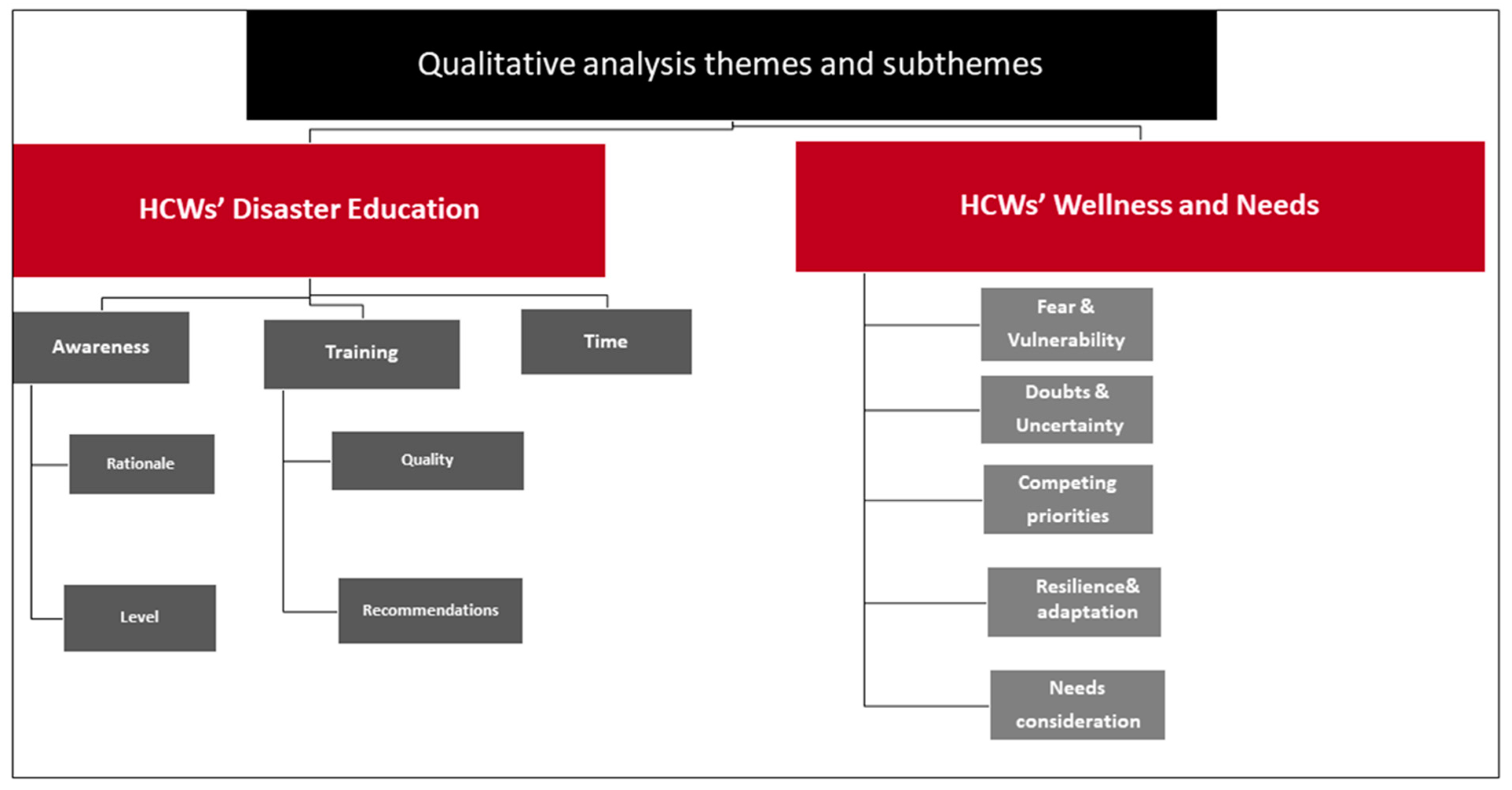
The current study has two significant themes (HCWs’ disaster education and HCWs’ wellness and needs), eight subthemes and four sub-sub themes. The first theme addressed the participants’ perceptions and descriptions of their disaster planning education, focusing on their awareness, training, and time factor. The second theme explored the participants’ perceptions of wellness and needs during various disasters (Figure 1). The results are presented to include the participants’ transcripts and the authors’ constructed reflections based on synthesised participants’ voices.
Figure 1. This is a figure showing the adopted themes and subthemes of the analysis of the results.

3.1. HCWs’ Disaster Education Regarding Disaster Planning and Preparedness (DPP)

This theme includes the participants’ perceptions regarding their DPP awareness, training, and time as three subthemes. The first subtheme illustrates the participants’ perceptions of their awareness of disaster planning and preparedness (DPP); including the reasons and methods that led them to be aware of their hospitals’ DPP documents and processes and the knowledge and competencies gained as because of this awareness (See Table 1). The second subtheme depicts the participants’ needs, expectations and thoughts regarding their DPP training and practice quality. It also includes the participants’ recommendations regarding the training and simulation (See Table 2). The third subtheme shows the participants’ perceptions regarding the significance of time and its effect on the quality and application of DPP training (See Table 3). Each table shows excerpts from participants’ transcripts and the constructed reflections based on synthesized participants’ voices.
Table 1. The awareness of disaster planning and preparedness (DPP): This is a table that shows excerpts from participants’ transcripts and the constructed reflections based on synthesized participants’ voices about the awareness of DPP.
Table 2. Disaster planning and preparedness (DPP) training: This is a table that shows excerpts from participants’ transcripts and the constructed reflections based on synthesized participants’ voices about DPP training.
Table 3. The significance of time with regard to disaster planning and preparedness (DPP): This is a table that shows excerpts from participants’ transcripts and the constructed reflections based on synthesized participants’ voices about the significance of time with regard to DPP.

3.2. HCWs’ Wellness and Needs

This theme includes the participants’ perceptions of their wellness and needs. This theme consists of the participants’ perceptions regarding the following subthemes: ‘Fear and Vulnerability’, ‘Doubts and uncertainty, ‘Competing priorities’, ‘Resilience and adaptation’ and ‘Needs considerations’ (See Table 4).
Table 4. Wellness and needs: This is a table that shows excerpts from participants’ transcripts and the constructed reflections based on synthesized participants’ voices about their wellness and needs.

4. Discussion

The resilience of a system is its competency to cope with catastrophes or disruptions by reacting in ways that preserve its core function, structure, and identity whereas keeping its ability to adapt, learn, and transform [43]. In addition, the individual’s resilience implies their adaptive responses to stress and their commitment to values and goals regardless of experiencing hardship [44]. The current study addressed how hospital decision-makers can improve HCWs’ resilience to disasters, including education and wellness situations.

4.1. Enhancing Education and Training

The participants indicated that DPP awareness might be mandatory for their job tasks, roles, and committees (H1.4 and 6 and H2.4 and 6). However, there were several considerations regarding the quality, effectiveness and mandatory level of such awareness, their gained competencies and the depth of knowledge. The participants had difficulties and challenges in applying what they had been taught in their DDP training. Thus, such activity does not ensure effectiveness and competency (H1.1, 5 and 6 and H2.5 and 6).
In addition, the participants’ recommendations included enhancing the level of DPP training and providing both junior and senior staff with mandatory, annual and sustainable training that helps them learn from past practices and think about various scenarios and possibilities. These recommendations highlighted the need for simulations based on authentic learning experiences and count the human factor during actual life application of lessons learnt. For instance, it should consider preparing the staff to work if electronics fail due to disasters. Monitoring and evaluating HCWs’ education and training should guarantee updated content (H1.1, 2 and 6 and H2.4 and 6).
Similar recommendations were described in the literature regarding the development of HCWs via awareness and training [2,7,38].
Such development should include disaster-specific contents. DPP training can develop HCWs’ knowledge and skills and improve their response to crises and emergencies [45,46].
Previous research studies showed that HCWs’ development should cover other relevant areas necessary to augment staff competencies [8,47,48,49,50,51]. For instance, in case of infectious diseases disasters, HCWs should be well educated and trained regarding proper infection control practices, quarantine processes, and how to treat, isolate, report, and track patients using electronic systems [47,50,51]. In addition, leadership training for hospital management and the development of emergency management operations plans are crucial for all types of disasters [52,53]. Moreover, HCWs should learn more about the climate change impacts on health, the environment and societies, and the climate change mitigation and adaptation strategies and approaches [8,54].
In the present study, the participants indicated that they were struggling with the time limitation. Moreover, it was evident that the HCWs’ limited time hinders their ability to understand the hospital disaster management plan deeply. Some consider education a time-consuming and exhausting process. Hence, time versus effort may be a consideration (H1.3 and 4 and H2.3 and 4). These findings conformed with a research study conducted by Besley, Dudo [55] and illustrated that the HCWs have high levels of commitment to keep training and education about climate change, and its impact on health. Yet, many participants indicated several barriers that obstruct them from pursuing such training. Among these barriers, time restraints were the most identified one [55].

4.2. Beyond Education and Training: The HCW’s Call for Action (SOS)

Climate-change–related hazards and adverse events with unfavourable impacts, such as disasters, affect the globally available vulnerable people and lead them to struggle with deep emotional traumas [56,57,58,59]. Such overwhelming situations significantly affect health professionals due to the nature of their routine work that predisposes them to high exposure levels [60].
In the current study, many stressful factors and concerns were raised in exploring the participants’ wellness and needs, including fear about their well-being, family safety, tiredness, and vulnerability. Some expressed uncertainty and doubts regarding their knowledge levels, coping with changes, resilience, and adaptations—moreover, the stress they encountered from competing priorities and time limitations. Several participants in the current study highlighted the significance of considering their needs by providing them with adequate resources, PPE and equipment, respecting their mental and psychological wellness, and most importantly, thinking of them as humans, not only as health professionals, and establishing a “well-being committee” (H1.1, 2, 3 and 5 and H2.2, 4, 5 and 7).
Similar stressful factors were identified in other studies due to lack of resources, lack of clarity in communications, deficient, excessive, rapidly changing information and competing priorities. [47,61]. Hence, during disasters and epidemics, more consideration should be given to the mental health of healthcare workers by enhancing their work experience and providing them with psychological, personal and family support [26].

4.3. A Conceptual Framework for Action—A Healthcare Workers’ Resilience Toolkit for Their Disaster Management and Climate Change Adaptation

Globally, several types of disasters, extreme weather, and climate events are expected to increase in frequency and intensity in the coming decades. Hence, these unfavourable situations will majorly impact health care systems and HCWs [56]. Climate change adaptation refers to activities that sustain or augment the adaptive capacity and resilience aiming to reduce the human or natural system’s vulnerabilities to climate change risks and impacts [54].
There are a few scenarios to acknowledge, creating a particular problem space to work into. Each of the training scenarios still requires consideration of the three domains cognitive (mental thinking), affective (attitudes), and psychomotor competencies (utilising motor skills and coordinating them) [62]. In the practitioner’s world, these competencies are perceived as applied practises for performance and change scoring and coordination [63].
Staff practices and safety, communication, equipment and resources were among the nine learning areas crucially highlighted in the Hybrid Resilience Learning Framework (HRLF) for both organisational resilience and learning components by Ali, Ranse [38]. Moreover, the current study conveyed an emergency ‘SOS’ call from the participating interviewees, including the key factors that affect their resilience in the face of disasters.
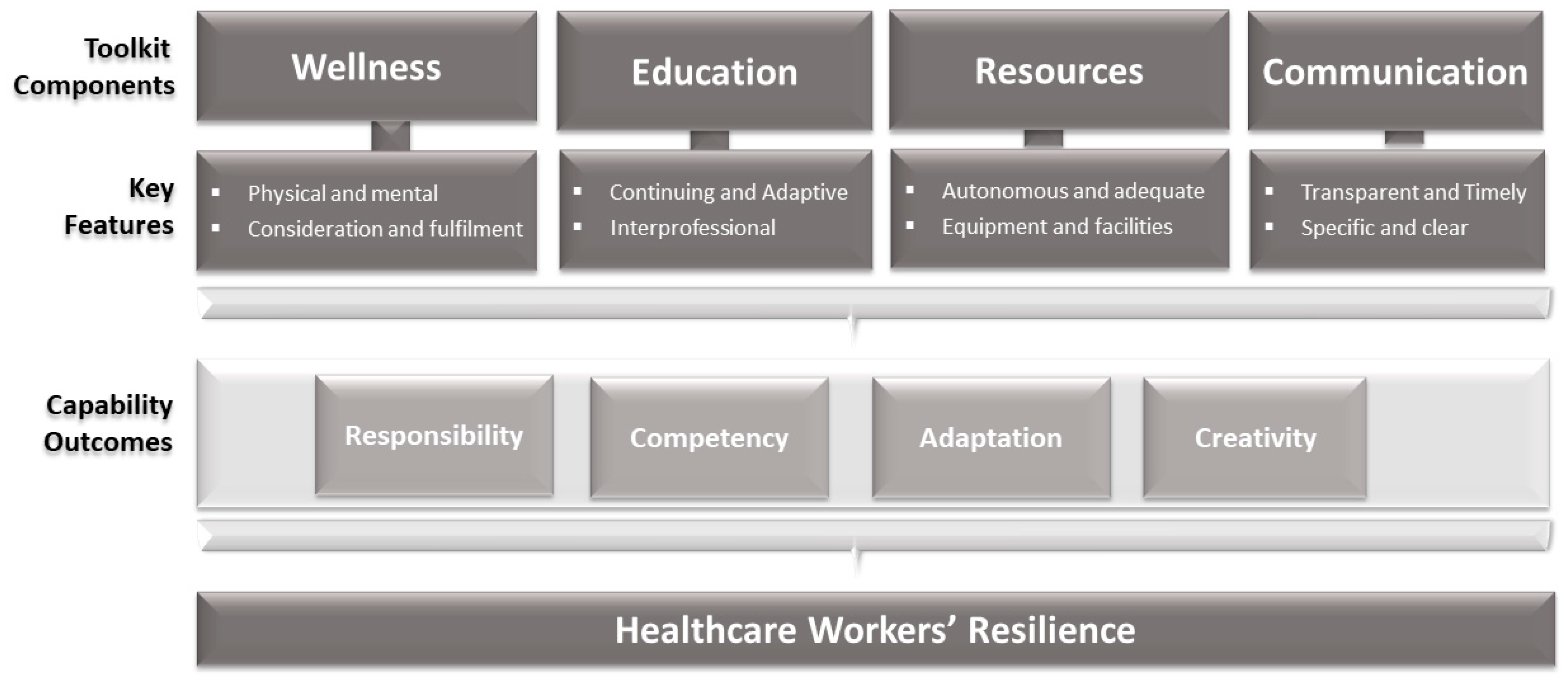
Hence, the authors in the current study responded to the HCWs expressed needs and their call for action by proposing an ‘HCWs Resilience Toolkit’, which encourages mindfulness amongst leaders, managers and policymakers about supporting four priority HCWs’ needs: ‘Wellness’, ‘Education’, ‘Resources’ and ‘Communication’. First, this framework shows the value of listening to the HCWs’ voices and concerns. Second, it emphasises the magnitude of having a culture of taking training seriously via mandatory and sustainable authentic inter-professional learning experiences. Third, it focuses on timely, clear, specific, and transparent communication with HCWs. Finally, it underscores providing HCWs with all the required resources and equipment (Figure 2).
Figure 2. A schematic of the ‘HCWs Resilience Toolkit’, highlighting key factors that can enhance disaster management and climate change adaptation.
The authors focused on the ‘Education’ component of the ‘HCWs Resilience Toolkit’ to detail recommended training for each of the pre-disaster, mid-disaster and post-disaster phases (Figure 3). The suggested topics are not sharply restricted for each phase, as many of them span the three phases, for instance, training related to climate change impacts, infection control measures, physical and mental wellness, inter-professionalism, innovation, and creativity. In post-disasters phases, Hospital managers should provide opportunities for HCWS to reflect in debriefing sessions and learn and apply what they have been taught while facing disasters to boost their performance in future ones.
Figure 3. The educational component of the Healthcare Workers’ Resilience Toolkit: education, training, and practice implications (pre-disaster, mid-disaster and post-disaster phases).

5. Limitations of the Study

Given the topic area of disaster resilience, there was a risk that the researchers may impact upon political or institutional sensitivities regarding classified information, public awareness campaigns, and past events. To minimise this potential, the researchers ensured that political and institutional sensitivities form part of the discussions with the project advisors prior to each round of interviews.
Moreover, there were the limitations of in-depth interviews being not generalisable, time-consuming, requiring a more prolonged verification process, and difficult to add context.

6. Conclusions

Hospital managers and decision makers should pay more attention to the HCWs’ awareness, training and wellness. Adopting the proposed ‘‘HCWs Resilience Toolkit’ by hospital leaders, managers and policymakers will potentiate and expand HCWs’ competencies and adaptation and decrease their stress and vulnerability. Moreover, it will help the HCWs be more adaptive, competent, creative, and responsible, hence ensuring their resilience. Such resilient, empowered, and supported HCWs can boost the hospitals’ resilience and business continuity while facing the current and future climate change impacts and diverse disasters. The authors conclude the significance of the toolkit, which provides a timely contribution to the healthcare sector amidst ongoing adversity. There are immediate opportunities for the toolkit to support hospitals in managing disruptions to hospital functions, through enhancing their HCWs’ adaptive capacity, competence, creativity and responsibility.

Author Contributions

Conceptualization, H.M.A. and C.D.; methodology, H.M.A., J.R., A.R. and C.D.; software (NVivo), H.M.A. and A.R.; validation, H.M.A., J.R., A.R. and C.D.; formal analysis, H.M.A., J.R., A.R. and C.D.; writing—original draft preparation, H.M.A.; writing—review and editing, H.M.A., J.R., A.R. and C.D.; visualization, H.M.A. and C.D.; supervision, J.R.; A.R. and C.D. All authors have read and agreed to the published version of the manuscript.

Funding

This research received no external funding.

Institutional Review Board Statement

The study was conducted in accordance with the Declaration of Helsinki and was granted Ethics approval to undertake interviews with staff from two major hospitals in Southeast Queensland by Griffith University Human Research Ethics Committee (Ref No: 2020/542- 09/09/2020), as well as from the hospital sector (Human Research Ethics Committee reference number: HREC/2020/QGC/66944-10/07/2020, SSA reference number: SSA/2020/QGC/66944-06/01/2021).

Data Availability Statement

The data supporting the results are in the form of interviews transcripts and can be made available by written request of the corresponding author.

Acknowledgments

The corresponding author is a recipient of the Griffith University PhD scholarship [Postgraduate Research scholarship, and a Griffith University International Postgraduate Research scholarship]. The authors acknowledge the hospital advisors and the interviewees for their contributions to this study.

Conflicts of Interest

The authors declare no conflict of interest.

References

  1. Benevolenza, M.A.; De Rigne, L. The impact of climate change and natural disasters on vulnerable populations: A systematic review of literature. J. Hum. Behav. Soc. Environ. 2019, 29, 266–281. [Google Scholar] [CrossRef]
  2. Kotcher, J.; Maibach, E.; Miller, J.; Campbell, E.; Alqodmani, L.; Maiero, M.; Wyns, A. Views of health professionals on climate change and health: A multinational survey study. Lancet Planet. Health 2021, 5, e316–e323. [Google Scholar] [CrossRef]
  3. Barouki, R.; Kogevinas, M.; Audouze, K.; Belesova, K.; Bergman, A.; Birnbaum, L.; Boekhold, S.; Denys, S.; Desseille, C.; Drakvik, E.; et al. The COVID-19 pandemic and global environmental change: Emerging research needs. Environ. Int. 2020, 146, 106272. [Google Scholar] [CrossRef]
  4. Gissing, A.; Timms, M.; Browning, S.; Crompton, R.; McAneney, J. Compound natural disasters in Australia: A historical analysis. Environ. Hazards 2021, 21, 1–15. [Google Scholar] [CrossRef]
  5. Vardoulakis, S. Reflections on climate change and the Australian health system. Aust. Health Rev. 2021, 45, 2–3. [Google Scholar] [CrossRef]
  6. Quitmann, C.; Sauerborn, R.; Danquah, I.; Herrmann, A. ‘Climate change mitigation is a hot topic, but not when it comes to hospitals’: A qualitative study on hospital stakeholders’ perception and sense of responsibility for greenhouse gas emissions. J. Med. Ethics 2022, 1–7. [Google Scholar] [CrossRef]
  7. Ali, H.M.; Desha, C.; Ranse, J.; Roiko, A. Planning and assessment approaches towards disaster resilient hospitals: A systematic literature review. Int. J. Disaster Risk Reduct. 2021, 61, 102319. [Google Scholar]
  8. Hathaway, J.; Maibach, E.W. Health Implications of Climate Change: A Review of the Literature About the Perception of the Public and Health Professionals. Curr. Environ. Health Rep. 2018, 5, 197–204. [Google Scholar] [CrossRef]
  9. Joseph, B.; Joseph, M. The health of the healthcare workers. Indian J. Occup. Environ. Med. 2016, 20, 71. [Google Scholar] [CrossRef]
  10. Ghanaatpisheh, E.; Khankeh, H.; Masoumi, G. Challenges for Hospital Resilience in Emergencies and Disasters: A Qualitative Study in Iran. J. Clin. Diagn. Res. 2019, 13, LC1–LC8. [Google Scholar] [CrossRef]
  11. Zhu, B.; Fan, H.; Xie, B.; Su, R.; Zhou, C.; He, J. Mapping the Scientific Research on Healthcare Workers’ Occupational Health: A Bibliometric and Social Network Analysis. Int. J. Environ. Res. Public Health 2020, 17, 2625. [Google Scholar] [CrossRef]
  12. Penwell-Waines, L.; Ward, W.; Kirkpatrick, H.; Smith, P.; Abouljoud, M. Perspectives on Healthcare Provider Well-Being: Looking Back, Moving Forward. J. Clin. Psychol. Med. Settings 2018, 25, 295–304. [Google Scholar] [CrossRef]
  13. Beiter, K.J.; Wiedemann, R.P.; Thomas, C.L.; Conrad, E.J. Alcohol Consumption and COVID-19–Related Stress Among Health Care Workers: The Need for Continued Stress-Management Interventions. Public Health Rep. 2022, 137, 326–335. [Google Scholar] [CrossRef]
  14. Achour, N.; Munokaran, S.; Barker, F.; Soetanto, R. Staff Stress: The Sleeping Cell of Healthcare Failure. Procedia Eng. 2018, 212, 459–466. [Google Scholar] [CrossRef]
  15. McCann, C.M.; Beddoe, E.; McCormick, K.; Huggard, P.; Kedge, S.; Adamson, C.; Huggard, J. Resilience in the health professions: A review of recent literature. Int. J. Wellbeing 2013, 3, 60–81. [Google Scholar] [CrossRef]
  16. Samsuddin, N.M.; Takim, R.; Nawawi, A.H. Human Behaviour and Resilience Hospital. Asian J. Behav. Stud. 2017, 2, 21–32. [Google Scholar] [CrossRef][Green Version]
  17. Baskin, R.G.; Bartlett, R. Healthcare worker resilience during the COVID-19 pandemic: An integrative review. J. Nurs. Manag. 2021, 29, 2329–2342. [Google Scholar] [CrossRef]
  18. Erdem, H.; Lucey, D.R. Healthcare worker infections and deaths due to COVID-19: A survey from 37 nations and a call for WHO to post national data on their website. Int. J. Infect. Dis. 2021, 102, 239–241. [Google Scholar] [CrossRef]
  19. Tovaranonte, P.; Cawood, T.J. Impact of the Christchurch Earthquakes on Hospital Staff. Prehospital Disaster Med. 2013, 28, 245–250. [Google Scholar] [CrossRef]
  20. Tseng, H.-M.; Shih, W.-M.; Shen, Y.-C.; Ho, L.-H.; Wu, C.-F. Work Stress, Resilience, and Professional Quality of Life Among Nurses Caring for Mass Burn Casualty Patients After Formosa Color Dust Explosion. J. Burn Care Res. 2017, 39, 798–804. [Google Scholar] [CrossRef]
  21. Park, Y.S.; Behrouz-Ghayebi, L.; Sury, J.J. Do Shared Barriers When Reporting to Work During an Influenza Pandemic Influence Hospital Workers’ Willingness to Work? A Multilevel Framework. Disaster Med. Public Health Prep. 2015, 9, 175–185. [Google Scholar] [CrossRef][Green Version]
  22. Jaimes, A.; Hassan, G.; Rousseau, C. Hurtful Gifts? Trauma and Growth Transmission Among Local Clinicians in Postearthquake Haiti. J. Trauma. Stress 2019, 32, 186–195. [Google Scholar] [CrossRef]
  23. Turner, S.B. Resilience of Nurses in the Face of Disaster. Disaster Med. Public Health Prep. 2015, 9, 601–604. [Google Scholar] [CrossRef]
  24. Casiraghi, A.; Domenicucci, M.; Cattaneo, S.; Maggini, E.; Albertini, F.; Avanzini, S.; Marini, M.P.; Galante, C.; Guizzi, P.; Milano, G. Operational strategies of a trauma hub in early coronavirus disease 2019 pandemic. Int. Orthop. 2020, 44, 1511–1518. [Google Scholar] [CrossRef]
  25. Raphael, T. Why Surgeons Don’t Want to Operate Right Now. Available online: https://www.bloomberg.com/opinion/articles/2020-03-24/the-coronavirus-crisis-is-putting-surgeons-at-risk-too (accessed on 24 September 2022).
  26. Wang, N.; Li, Y.; Wang, Q.; Lei, C.; Liu, Y.; Zhu, S. Psychological impact of COVID-19 pandemic on healthcare workers in China Xi’an central hospital. Brain Behav. 2021, 11, e02028. [Google Scholar] [CrossRef]
  27. Zahos, H.; Crilly, J.; Ranse, J. Psychosocial problems and support for disaster medical assistance team members in the preparedness, response and recovery phases of natural hazards resulting in disasters: A scoping review. Australas. Emerg. Care 2022, 25, 259–266. [Google Scholar] [CrossRef]
  28. World Health Organization. WHO Guidance on Research Methods for Health Emergency and Disaster Risk Management; World Health Organization: Geneva, Switzerland, 2021.
  29. Pan American Health Organization. Emergency Preparedness; Disaster Relief Coordination Program. Principles of Disaster Mitigation in Health Facilities; Pan American Health Organization: Washington, DC, USA, 2000.
  30. Nenkovic-Riznic, M.; Brankov, B.D.; Peirović, S.M.; Puca, M. Safe healthcare facilities Their Place and Role in Resilient Cities. Therm. Sci. 2018, 22, S1001–S1010. [Google Scholar] [CrossRef]
  31. Murshid, M.E.; Riaz, B.K.; Islam, Z.; Haque, M. Assessment of Safety Status and Response Capacity of Selected Primary Health Care Hospitals in Bangladesh. Eurasian J. Emerg. Med. 2019, 18, 137–141. [Google Scholar] [CrossRef]
  32. Sunindijo, R.Y.; Lestari, F.; Wijaya, O. Hospital safety index: Assessing the readiness and resiliency of hospitals in Indonesia. Facilities 2019, 38, 39–51. [Google Scholar] [CrossRef]
  33. Takim, R.; Samsuddin, N.M.; Nawawi, A.H. Assessing the content validity of hospital disaster resilience assessment instrument. J. Teknol. 2016, 78, 35–42. [Google Scholar] [CrossRef][Green Version]
  34. Zazali, A.K. Healthcare workers resilience from managing COVID-19 pandemic: A review. ITTPCOVID19 2021, 1, 1. [Google Scholar]
  35. Charney, R.; Rebmann, T.; Flood, R.G. Working After a Tornado: A Survey of Hospital Personnel in Joplin, Missouri. Biosecurity Bioterrorism Biodefense Strat. Pract. Sci. 2014, 12, 190–200. [Google Scholar] [CrossRef]
  36. Almukhlifi, Y.; Crowfoot, G.; Wilson, A.; Hutton, A. Emergency healthcare workers’ preparedness for disaster management: An integrative review. J. Clin. Nurs. 2021, 1–16. [Google Scholar] [CrossRef]
  37. Pariès, J.; Hollnagel, E.; Woods, D.D.; Wreathall, J. Resilience Engineering in Practice: A Guidebook; CRC Press LLC: Farnham, UK, 2010. [Google Scholar]
  38. Ali, H.M.; Ranse, J.; Roiko, A.; Desha, C. Investigating Organizational Learning and Adaptations for Improved Disaster Response Towards “Resilient Hospitals:” An Integrative Literature Review. Prehospital Disaster Med. 2022, 37, 1–9. [Google Scholar]
  39. Hegde, S.; Hettinger, A.Z.; Fairbanks, R.J.; Wreathall, J.; Wears, R.L.; Bisantz, A.M. Knowledge elicitation for resilience engineering in health care. In Proceedings of the Human Factors and Ergonomics Society Annual Meeting, Los Angeles, CA, USA, 26–30 October 2015; SAGE Publications: Los Angeles, CA, USA, 2015. [Google Scholar]
  40. Hollnagel, E.; Woods, D.D.; Leveson, N. Resilience Engineering: Concepts and Precepts; Ashgate Publishing, Ltd.: Farnham, UK, 2006. [Google Scholar]
  41. Braun, V.; Clarke, V. Using thematic analysis in psychology. Qual. Res. Psychol. 2006, 3, 77–101. [Google Scholar] [CrossRef]
  42. Lincoln, Y.S.; Guba, E.G. Naturalistic Inquiry; SAGE Publication: Los Angeles, CA, USA, 1985. [Google Scholar]
  43. Roostaie, S.; Nawari, N.; Kibert, C. Sustainability and resilience: A review of definitions, relationships, and their integration into a combined building assessment framework. Build. Environ. 2019, 154, 132–144. [Google Scholar] [CrossRef]
  44. Mistretta, E.G.; Davis, M.C.; Temkit, M.; Lorenz, C.; Darby, B.; Stonnington, C. Resilience Training for Work-Related Stress Among Health Care Workers: Results of a Randomized Clinical Trial Comparing In-Person and Smartphone-Delivered Interventions. J. Occup. Environ. Med. 2018, 60, 559–568. [Google Scholar] [CrossRef]
  45. Al Thobaity, A.; Plummer, V.; Innes, K.; Copnell, B. Perceptions of knowledge of disaster management among military and civilian nurses in Saudi Arabia. Australas. Emerg. Nurs. J. 2015, 18, 156–164. [Google Scholar] [CrossRef]
  46. Iryanidar, I.; Kadar, K.S.; Irwan, A.M. Readiness of nurses working in COVID-19 pandemic. Int. J. Health Sci. 2022, 1639–1649. [Google Scholar] [CrossRef]
  47. Aliyu, S.; Norful, A.A.; Schroeder, K.; Odlum, M.; Glica, B.; Travers, J.L. The powder keg: Lessons learned about clinical staff preparedness during the early phase of the COVID-19 pandemic. Am. J. Infect. Control 2020, 49, 478–483. [Google Scholar] [CrossRef]
  48. Balay-Odao, E.M.; Alquwez, N.; Inocian, E.P.; Alotaibi, R.S. Hospital Preparedness, Resilience, and Psychological Burden Among Clinical Nurses in Addressing the COVID-19 Crisis in Riyadh, Saudi Arabia. Front. Public Health 2021, 8, 573932. [Google Scholar] [CrossRef] [PubMed]
  49. Brandrud, A.S.; Bretthauer, M.; Brattebø, G.; Pedersen, M.J.; Håpnes, K.; Møller, K.; Bjorge, T.; Nyen, B.; Strauman, L.; Schreiner, A.; et al. Local emergency medical response after a terrorist attack in Norway: A qualitative study. BMJ Qual. Saf. 2017, 26, 806–816. [Google Scholar] [CrossRef] [PubMed]
  50. Meyer, D.; Bishai, D.; Ravi, S.J.; Rashid, H.; Mahmood, S.S.; Toner, E.; Nuzzo, J.B. A checklist to improve health system resilience to infectious disease outbreaks and natural hazards. BMJ Glob. Health 2020, 5, e002429. [Google Scholar] [CrossRef] [PubMed]
  51. Singh, S.R.; Coker, R.; Vrijhoef, H.J.-M.; Leo, Y.S.; Chow, A.; Lim, P.L.; Tan, Q.; Chen, M.I.-C.; Hildon, Z.J.-L. Mapping infectious disease hospital surge threats to lessons learnt in Singapore: A systems analysis and development of a framework to inform how to DECIDE on planning and response strategies. BMC Health Serv. Res. 2017, 17, 622. [Google Scholar] [CrossRef] [PubMed]
  52. Cariaso-Sugay, J.; Hultgren, M.; Browder, B.A.; Chen, J.-L. Nurse Leaders’ Knowledge and Confidence Managing Disasters in the Acute Care Setting. Nurs. Adm. Q. 2021, 45, 142–151. [Google Scholar] [CrossRef] [PubMed]
  53. Drevin, G.; Alvesson, H.M.; Van Duinen, A.; Bolkan, H.A.; Koroma, A.P.; Von Schreeb, J. “For this one, let me take the risk”: Why surgical staff continued to perform caesarean sections during the 2014–2016 Ebola epidemic in Sierra Leone. BMJ Glob. Health 2019, 4, 10. [Google Scholar] [CrossRef] [PubMed]
  54. Bikomeye, J.C.; Rublee, C.S.; Beyer, K.M.M. Positive Externalities of Climate Change Mitigation and Adaptation for Human Health: A Review and Conceptual Framework for Public Health Research. Int. J. Environ. Res. Public Health 2021, 18, 2481. [Google Scholar] [CrossRef]
  55. Besley, J.C.; Dudo, A.; Yuan, S.; Lawrence, F. Understanding Scientists’ Willingness to Engage. Sci. Commun. 2018, 40, 559–590. [Google Scholar] [CrossRef]
  56. Ebi, K.L.; Vanos, J.; Baldwin, J.W.; Bell, J.E.; Hondula, D.M.; Errett, N.A.; Hayes, K.; Reid, C.E.; Saha, S.; Spector, J.; et al. Extreme Weather and Climate Change: Population Health and Health System Implications. Annu. Rev. Public Health 2021, 42, 293. [Google Scholar] [CrossRef]
  57. Hayes, K.; Poland, B. Addressing Mental Health in a Changing Climate: Incorporating Mental Health Indicators into Climate Change and Health Vulnerability and Adaptation Assessments. Int. J. Environ. Res. Public Health 2018, 15, 1806. [Google Scholar] [CrossRef]
  58. Azzollini, S.C.; DePaula, P.D.; Cosentino, A.C.; Pupko, V.B. Applications of Psychological First Aid in Disaster and Emergency Situations: Its Relationship with Decision-Making. Athens J. Soc. Sci. 2018, 5, 201–214. [Google Scholar] [CrossRef]
  59. Ćosić, K.; Popović, S.; Šarlija, M.; Kesedžić, M. Impact of human disasters and COVID-19 pandemic on mental health: Potential of digital psychiatry. Psychiatr. Danub. 2020, 32, 25–31. [Google Scholar] [CrossRef] [PubMed]
  60. Huggard, P. Caring for the Carers: The emotional effects of disasters on health care professionals. Australas. J. Disaster Trauma Stud. 2011, 2, 60–62. [Google Scholar]
  61. Raven, J.; Wurie, H.; Witter, S. Health workers’ experiences of coping with the Ebola epidemic in Sierra Leone’s health system: A qualitative study. BMC Health Serv. Res. 2018, 18, 9. [Google Scholar] [CrossRef]
  62. Hoque, M.E. Three domains of learning: Cognitive, affective and psychomotor. J. EFL Educ. Res. 2016, 2, 45–52. [Google Scholar]
  63. Yphantides, N.; Escoboza, S.; Macchione, N. Leadership in Public Health: New Competencies for the Future. Front. Public Health 2015, 3, 24. [Google Scholar] [CrossRef]
Publisher’s Note: MDPI stays neutral with regard to jurisdictional claims in published maps and institutional affiliations.

Article Metrics

Citations

Article Access Statistics

Multiple requests from the same IP address are counted as one view.