


Abstract
Introduction: Disease-related stress is a common phenomenon. It also occurs in neoplastic diseases. Since physical and mental health are interrelated, it is important to make sure that treatment covers these two areas. Therefore, it is essential to learn how patients with neoplastic diseases can cope with stress. Materials and Methods: The respondents are 306 patients suffering from neoplastic diseases, associated in patient advocacy groups. The method is the Brief-COPE (Coping Orientation to Problems Experienced) questionnaire. Results: The following stress management strategies were most commonly adopted by the patients: acceptance (median 2.25; 25–75% IQR 2.0–3.0), active coping (median 2.0; 25–75% IQR (interquartile range) 1.5–2.0), planning (median 2.0; 25–75% IQR 2.0–2.0), emotional support (median 2.0; 25–75% IQR 1.5–2.0), instrumental support (median 2.0; 25–75% IQR 2.0–2.0), self-distraction (median 2.0; 25–75% IQR 1.5–3.0), and venting (median 2.0; 25–75% IQR 1.5–3.0). A decision to adopt a particular stress management strategy by patients with neoplastic diseases was highly affected by demographic factors (p < 0.05), such as sex, education, age, place of residence and employment. Conclusions: Teaching stress management strategies should be a part of the education process among patients with neoplastic diseases. Before or in the course of treatment, an oncology patient should be educated on the prevention of mental health disorders. The ability to cope with stress is one of the key competences for the course of neoplastic diseases and it can affect the treatment process. Stress management in chronic diseases, including neoplastic diseases, should be approached not only at the level of an individual person but also at the level of the health system as a whole.
1. Introduction
A diagnosis of a neoplastic disease often becomes a source of considerable stress for a patient and their family, which has been shown in many studies, e.g., by Sklar and Anisman [1]. Necessity to change one’s lifestyle and adapt to limitations imposed by the disease are just one of many after-effects and are frequently a heavy burden for one’s mental health, which has been investigated in many studies over the years, e.g., by Lissoni et al. [2]. Considering the above, it is essential to make education about stress management an integral part of the treatment process. Physical and mental health are interrelated, and, thus, better mental well-being might determine treatment effectiveness, e.g., through consequent participation in treatment procedures or maintaining an appropriate level of compliance or adherence. It has been shown that there is an interrelation between the location of cancer and the patient’s mental health condition [3].
It seems essential to monitor patient’s mental health condition in the course of treatment in order to promptly make an intervention, if necessary. An obvious recommendation on the treatment of patients with neoplastic diseases is to involve a psychologist or a psychiatrist in the therapeutic team. This solution allows for a more comprehensive patient care [3].
Currently, only few studies can be found in the global scientific literature on stress management in patients with neoplastic diseases. Patient guidebooks typically include information on external solutions (e.g., oncology rehabilitation, support groups, or psychological support). Certain studies have shown a positive influence of the task model on treatment and patient–doctor cooperation [3]. However, there is lack of studies concerning stress management strategies used by the patients with neoplastic diseases, especially during the COVID-19 pandemic.
The aim of the study was to identify the strategies of stress management used by cancer patients.
2. Materials and Methods
The study group consisted of 306 patients diagnosed with neoplastic diseases and associated in the patient advocacy groups, which are focused on advocacy for patients, survivors, and caregivers. Access to the study group was obtained from oncological organizations cooperating in the framework of national educational program for patients PACJENCI.PRO, the Academy of Patient Organization Development. The project was carried out by the Employers’ Union of Innovative Pharmaceutical Companies INFARMA and the Medical University of Warsaw, under the auspices of the Patients’ Rights Office. Inclusion criteria to the study were age ≥18 years old and cancer diagnosis.
In the study, the Brief-COPE standardized questionnaire was used [4]. It is a tool for examining adults, both healthy and ill. It consists of 28 statements that are assigned to 14 strategies (2 statements per strategy): active coping, planning, positive re-framing, acceptance, humor, religion, emotional support, instrumental support, self-distraction, denial, venting, substance use and behavioral disengagement. The respondent comments on each statement on a scale from 0 (I almost never do it) to 3 (I almost always do it). This method is typically used to measure one’s coping mechanisms, i.e., to assess typical ways of reacting to and experiencing highly stressful events.
The Polish version of the Brief-COPE questionnaire was validated by Juczyński and Ogińska-Bulik [4].
Reliability: Internal consistency reliability of the Polish version of Brief-COPE was established on the basis of a study conducted in 200 persons aged 25–60 years. Split-half reliability was 0.86 (Guttman’s coefficient of 0.87). Consistency is satisfactory for most scales.
Validity: Factor loadings of individual statements can be assumed as satisfactory. Diagnostic validity was assessed by correlating the results of Brief-COPE with the Mini-MAC scale, which is used to examine the strategy of coping with a neoplastic disease, and by forecasting the intensification of post-traumatic stress symptoms in mothers of children with leukemia.
Norms: Norms for university students and adults aged 20–65 years are expressed in means and standard deviations.
Use: The questionnaire is used to assess the ways of coping with stress. It was developed for scientific purposes but it can also be used for screenings and preventive tests, and to assess the effectiveness of therapeutic interactions.
The questionnaire was conducted using the CAWI method (computer-assisted web interview). It was published online as a Google Form. The results were collected automatically by the Form and then analyzed in a statistical program.
Consent of the Bioethics Committee of the Medical University of Warsaw was obtained for the research. Protocol number of the ethics is AKBE-161/2022. Patients were informed about the objective of the study. Each patient qualified for the studies received information that the collected results will be used only for scientific purposes. The participation in the study was voluntary.
Statistical Analysis
Characteristics of the study group were analyzed using descriptive statistics: n, percentage, mean, SD (standard deviation), median, 25–75% IQR (interquartile range). The differences between the subgroups were analyzed with the Mann–Whitney test. The Spearman correlation coefficient was estimated to evaluate the relationship between age and different strategies of coping with stress. A p-value of <0.05 was considered to be significant. The analysis was conducted using Statistica, version 13 (http://statistica.io, accessed on 7 May 2022). TIBCO Software Inc., Krakow, Poland (2017).
3. Results
306 patients participated in the study, the majority of whom were women (83.3%). The mean age was 39 years. Half of the respondents lived in cities with more than 100,000 residents. Most respondents had university education and worked full-time (66.7%). A total of 83.3% of respondents were in a formal/informal relationship (Table 1).
Table 1.
Target group characteristics.
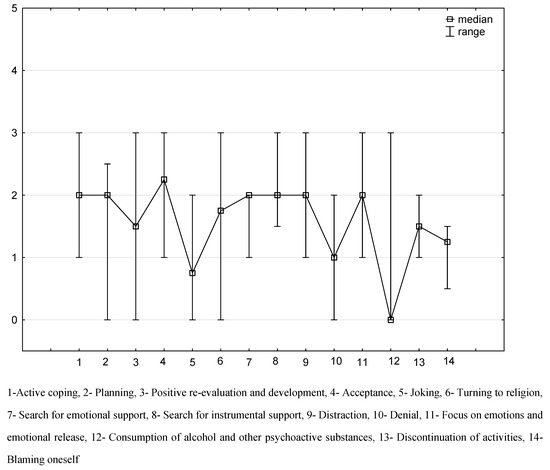
The most common stress management strategies that were adopted by patients with neoplastic diseases in the course of oncological treatment were as follows: acceptance (median 2.25; 25–75% IQR 2.0–3.0), active coping (median 2.0; 25–75% IQR 1.5–2.0), planning (median 2.0; 25–75% IQR 2.0–2.0), emotional support (median 2.0; 25–75% IQR 1.5–2.0), instrumental support (median 2.0; 25–75% IQR 2.0–2.0), self-distraction (median 2.0; 25–75% IQR 1.5–3.0), and venting (median 2.0; 25–75% IQR 1.5–3.0). The least commonly adopted stress management strategies were substance use (median 0.0; 25–75% IQR 0.0–0.0), humor (median 0.75; 25–75% IQR 0.5–2.0) and denial (median 1.0; 25–75% IQR 0.5–1.5) (Figure 1).
Figure 1.
Stress management strategies.
The following demographic factors significantly affected the strategies of coping with stress among patients with neoplastic diseases: sex, education, age, place of residence, and employment.
Women used the following stress management strategies significantly more than men (p < 0.05): planning, active coping, positive re-framing, religion, discontinuation of activity, and substance use. Compared to women, men more frequently (p < 0.05) chose acceptance, emotional and instrumental support, self-distraction, venting, humor and blaming oneself (Table 2).
Table 2.
Stress management strategies according to sex.
There is a positive correlation (p < 0.05) between the age of patients and the strategies of active coping, planning, shift to religion, emotional support, and blaming oneself. However, the older the patients get, the less frequently they choose the strategies of acceptance, humor, instrumental support, self-distraction, venting, substances use, and discontinuation of activity (p < 0.05) (Table 3).
Table 3.
Stress management strategies according to age.
Residents of cities with fewer than 100,000 residents statistically significantly more often choose emotional and instrumental support, and adopt the strategy of denial and blaming oneself (p < 0.05). Patients living in cities with more than 100,000 residents more frequently use the strategies of active coping, planning, positive re-framing, humor, religion, substance use and discontinuation of activity (p < 0.05) (Table 4).
Table 4.
Stress management strategies according to the place of residence.
Compared to respondents with secondary school education, patients with higher education significantly more often adopted the strategies of active coping, planning, positive re-framing, religion, and using alcohol or other psychoactive substances (p < 0.05). In turn, emotional and instrumental support, self-distraction, denial, venting, discontinuation of activity, and blaming oneself were more common in persons with secondary school education (p < 0.05) (Table 5).
Table 5.
Stress management strategies according to education.
Active coping, planning, positive re-framing, and substance use were more commonly adopted by the professionally active respondents, whereas the unemployed significantly more often sought emotional and instrumental support (p < 0.05) (Table 6).
Table 6.
Stress management strategies according to employment.
Limitation of the Study
The study was limited by the size of the sample and the selected group of respondents. The analysis included cancer patients associated in the patient advocacy groups.
4. Discussion
Cancer diagnosis is a traumatic event in patients’ life. Patients use different strategies to deal with distress, which could have impact on treatment compliance, psychological health and quality of cancer patients’ life. Psychological help is essential to identify stress management strategies and modify them. In our study, the most frequent strategy used by cancer patients was acceptance. Patients tend to focus on coping with stress through planning, active coping, self-distraction, venting and religion. Sabanciogullari and Yilmaz showed the positive relationship between positive religious-coping style and hope levels of cancer patients receiving chemotherapy [5]. Other authors also confirmed that turning to religion by patients could influence compliance to the disease, and treatment among cancer patients [6,7,8]. In our study, patients tended towards emotional and instrumental support. They should receive psychosocial help from health professionals. Only 21% of cancer patients in Poland received psychological support from psychologists and 4% from priests. Only 7% of cancer patients claimed that they received help from a social worker [9]. Rarely, patients tended to use stress management strategies such as humor, denial and blaming oneself. It is a positive phenomenon that destructive strategies, such as substance use, are rather uncommon in our study. This is a positive result considering other studies, e.g., a study by Esterbauer et al., which showed that chronically ill patients react to stress with the consumption of drugs and nicotine [10]. The results presented above indicate that a chronically ill person should be monitored and made secure against the use of psychoactive substances, as an irrational method of coping with the disease-related stress. This is also applicable to diseases other than neoplastic diseases. Importantly, many researchers, e.g., Alter, point out that focusing on pain, mood, mental stress and other problems related to quality of life can allow for effective treatment of symptoms and improvement in patient’s functioning, even in the case of late-stage neoplastic disease [11]. Currently, there are few studies available on the strategies of coping with stress in patients with neoplastic diseases. Patient guides typically contain information on external solutions (e.g., oncological rehabilitation, support groups, and psychological support). Certain studies show that there is a positive impact of the task model on treatment and patient–doctor cooperation. However, it is not known how many patients actually deal with stress in neoplastic diseases, or which stress management strategies are most commonly used by patients, especially during the COVID-19 epidemic [3].
Various demographic factors have a significant impact on the strategies of coping with stress in patients with neoplastic diseases, which has been confirmed by Esterbauer [10]. In this case, a multivariate analysis of covariance was used. Regarding age, men suffering from heart diseases showed higher values in the coping strategy tendency to flee. Women with heart complaints demonstrated significantly lower values in minimizing by comparison. In our study, patients with higher education, professionally active, women, younger and lived in bigger cities more often cope with stress using substances use. Identification of the risk group is important for introducing appropriate psychological support to improve their health, whereas lower education, unemployment, older age, living in smaller cities, and men are predisposing factors to seek emotional and/or instrumental support. This group should be monitored in the context of psychosocial support during oncological therapy. However, the quality of cancer patients’ life is very important.
The authors’ own study shows that compared to men, women significantly more often adopt the strategies of planning, active coping, positive re-framing, and religion. This is particularly important in light of the study by Ohaeri et al., who showed that women with breast cancer poorly adapt to the new situation [12]. One of the reasons behind slow adaptation is the lack of social acceptance for the disease, which is also emphasized by Tang et al. [13]. With regard to coping with stress, compared to women, men more often accept the situation, seek emotional and instrumental support, distract attention, vent, joke, and blame themselves. Considering the studies mentioned above, it is noticeable that most studies on stress in neoplastic diseases worldwide concern women, especially those with breast cancer.
The authors’ own study shows that age is a significant factor for stress management in illness: the older the patients get, the more frequently they adopt the strategies of active coping, planning, religion, searching for emotional support and blaming oneself. At the same time, the following strategies become less frequently applied: acceptance, humor, instrumental support, self-distraction, venting, substance use, and discontinuation of activity. Martins-Klein et al. noted that older adults less frequently reported cancer-related stress. [14] Whereas among women with breast cancer, older age was correlated with using maladaptive strategies, hopelessness and fatalism [15].
The authors’ own study shows that positive strategies, such as active coping, planning, positive re-framing, humor and religion are more frequently observed in patients living in cities with more than 100,000 residents. Unfortunately, patients in this group often adopt negative strategies, such as substance use and discontinuation of activity. These results are in line with the study by Amini-Tehrani et al., who directly presented the consequence of triggering the chain of identity changes (including distortion of body image), which ultimately result in full-scale psychological distress [16]. The thesis related to the distortion of body image was also confirmed in scientific studies, e.g., by Brandberg et al. [17]. Therefore, considering the conclusions of their own research, Schmid-Buchi et al. emphasized the importance of the needs of patients and their relatives, as well as psychological problems that require professional support even after the end of treatment. Continuous assessment of the disease symptoms and the needs of patients and their relatives constitutes the basis for targeted counseling and education [18]. In our study, patients living in smaller cities with fewer than 100,000 residents statistically significantly more often look for emotional and instrumental support and adopt the strategies of denial and blaming oneself. It is worth comparing the results presented above with the study by Tsaras et al., who indicated that considering a high risk of developing mental disorders, such as depression and anxiety, being a rural inhabitant or an unorthodox Christian with a high symptom burden may be a predictor of depression and anxiety in patients with breast cancer [19]. The role of cultural determinants of health are also emphasized by Onyedibe et al. or Herdman [20,21].
The authors’ own study shows that, compared with patients with secondary school education, patients with higher education significantly more often adopt the strategies of active coping, planning, positive re-framing, religion and substance use. In turn, acceptance, emotional and instrumental support, self-distraction, denial, venting, and disengagement prevail in respondents with secondary school education. Calderon et al. showed that breast cancer patients with lower educational level more often used hopelessness and cognitive avoidance [15]. These observations are in line with the studies by Onyedibe et al. or Herdman [20,21]. This allows for advancing a thesis that the quality of education can be a determinant of effectively coping with stress in neoplastic diseases. Therefore, it is clear that there is a need for an individual approach to the therapeutic process, also in terms of developing and implementing stress management strategies.
The authors’ own study shows that professionally active persons more often adopt not only the strategies of active coping, planning or positive re-framing, but also the strategy of substance use. Compared to the professionally active persons, the unemployed significantly more often sought emotional and instrumental support. There are few studies on this topic. Nevertheless, the available studies, e.g., by Taino et al., confirm the increase in the number of neoplastic diseases in the working population, which necessitates the creation of a therapeutic strategy for this group, including stress management strategies [22]. Pluta points out that professional work brings many benefits to the ill, but at the same time, it causes many difficulties. Both patients and employers are unaware of support options; intervention activities are rarely undertaken and the state’s aid is insufficient [23].
Distress related to cancer could lead to mental disorders. The prevalence of depression and anxiety was frequent among breast cancer women. From the meta-analysis, it was around 32% in the case of depression and around 42% of patients experienced anxiety [24,25]. Depression is one of the main health problems influencing lower survival rates [26,27]. A meta-analysis conducted by Wang et al. which included 282,203 breast cancer patients showed that depression was associated with higher risk of cancer recurrence (by 24%), and all-cause and cancer-specific mortality, respectively, by 30% and 29%. Anxiety as a second common psychiatric symptom was related to a 17% greater risk of cancer recurrence and 13% more risk of all-cause mortality [28]. Therefore, before or in the course of the treatment, each patient with a neoplastic disease should be taught how to prevent mental health disorders. The ability to cope with stress is one of the key competences for the treatment of neoplastic diseases. It has an impact on the effectiveness of the treatment, and, thus, it can improve the quality of life.
The issue of stress management in chronic diseases, e.g., neoplastic diseases, should be solved not only at the level of a “person”, but also at the level of a health system as a whole. The need for holistic patient care and the positive outcomes of holistic care have been known for a long time and they have been shown, e.g., by Becker, according to whom mental factors affect the immune system as a whole [29]. In addition, it has also been confirmed, e.g., by Popoola, that the course of a neoplastic disease predisposes depression [30]. This indicates anticipation of the occurrence of mental disorders in patients with neoplastic diseases and, thus, suggests the necessity of early preparation of effective solutions.
5. Conclusions
In our study, cancer patients mostly used stress management strategies: acceptance, active coping and planning. Although patients frequently accepted cancer disease, they needed emotional and instrumental support.
Each patient should be provided with appropriate psychological support at every stage of the disease, from diagnosis to the after-treatment period, because patient’s emotions and needs change at each stage. Different factors of sex, education, age, place of residence, and employment can influence stress-coping strategies used by cancer patients. The recognition and modification of destructive behaviors by psycho-oncologists can influence cancer patients’ well-being.
Author Contributions
Conceptualization, D.O. and P.M.-T.; Data curation, K.K. and A.K.; Formal analysis, K.O.; Funding acquisition, D.O. and P.M.-T.; Investigation, D.O. and A.K.; Methodology, D.O. and K.O.; Project administration, A.K. and A.S.; Resources, D.O. and A.K.; Software, K.K.; Supervision, P.M.-T. and A.S.; Validation, K.O.; Visualization, K.K. and K.O.; Writing—original draft, D.O. and A.O.; Writing—review and editing, P.M.-T., K.K. and A.O. All authors have read and agreed to the published version of the manuscript.
Funding
This research received no external funding.
Institutional Review Board Statement
Prior to the study the participants were informed that it was anonymous, and the data were confidential. No personal data or computer IPs were collected Consent of the Bioethics Committee of the Medical University of Warsaw was obtained for the research. Protocol number of the ethics is AKBE-161/2022.
Informed Consent Statement
Completing the questionnaire was tantamount to agreeing to participate in the study.
Data Availability Statement
Not applicable.
Conflicts of Interest
The authors declare no conflict of interest.
References
- Sklar, L.S.; Anisman, H. Stress and cancer. Psychol. Bull. 1981, 89, 369–406. [Google Scholar] [CrossRef]
- Lissoni, P.; Cangemi, P.; Pirato, D.; Roselli, M.G.; Rovelli, F.; Brivio, F.; Malugani, F.; Maestroni, G.J.M.; Conti, A.; Laudon, M.; et al. A review on cancer-psychospiritual status interactions. Neuro Endocrinol. Lett. 2001, 22, 175–180. [Google Scholar]
- Moussas, G.I.; Papadopoulou, A.G.; Christodoulaki, A.G.; Karkanias, A.P. Psychological and psychiatric problems in cancer patients: Relationship to the localization of the disease. Psychiatriki 2012, 23, 46–60. [Google Scholar]
- Juczyński, Z.; Ogińska-Bulik, N. NPSR—Narzędzia Pomiaru Stresu i Radzenia Sobie ze Stresem, 1st ed.; Pracownia Testów Psychologicznych Polskiego Towarzystwa Psychologicznego: Warszaw, Poland, 2009; pp. 5–20. [Google Scholar]
- Sabanciogullari, S.; Yilmaz, F.T. The Effect of Religious Coping on Hope Level of Cancer Patients Receiving Chemotherapy. J. Relig. Health 2021, 60, 2756–2769. [Google Scholar] [CrossRef] [Scilit]
- Bonomo, A.A.; Gragefe, C.K.; Gerbasi, A.R.V.; Carvalho, M.D.B.; Fontes, K.B. Religious/spiritual coping in cancer patients under treatment. J. Nurs. UFPE Line Recife 2015, 9, 7539–7546. [Google Scholar]
- Karekla, M.; Constantinou, M. Religious coping and cancer: Proposing an acceptance and commitment therapy approach. Cogn. Behav. Pract. 2010, 17, 371–381. [Google Scholar] [CrossRef] [Scilit]
- de Paiva Ribeiro Dantas Sousa, F.F.; Freitas, S.M.F.M.; Farias, A.G.S.; Cunha, M.C.S.O.; Araújo, M.F.M.; Veras, V.S. Religious/spiritual coping by people with cancer undergoing chemotherapy: Integrative literature review. SMAD Rev. Eletrônica Saúde Ment. Álcool E Drog. 2017, 13, 45–51. [Google Scholar]
- Osowiecka, K.; Sroda, R.; Saied, A.; Szwiec, M.; Mangold, S.; Osuch, D.; Nawrocki, S.; Rucinska, M. Patients’ Non-Medical and Organizational Needs during Cancer Diagnosis and Treatment. Int. J. Environ. Res. Public Health 2020, 17, 5841. [Google Scholar] [CrossRef] [Scilit]
- Esterbauer, E.; Anders, I.; Ladurner, G.; Huemer, M.; Wranek, U. Stress management in heart diseases, obesity, nicotine and alcohol use. Wien. Klin. Wochenschr. 2001, 17, 947–953. [Google Scholar]
- Alter, C.L. Palliative and supportive care of patients with pancreatic cancer. Semin. Oncol. 1996, 23, 229–240. [Google Scholar]
- Ohaeri, B.M.; Ofi, A.B.; Campbell, O.B. Relationship of knowledge of psychosocial issues about cancer with psychic distress and adjustment among breast cancer clinic attendees in a Nigerian teaching hospital. Psycho-Oncology 2012, 21, 419–426. [Google Scholar] [CrossRef] [Scilit] [PubMed]
- Tang, P.L.; Mayer, D.K.; Chou, F.H.; Hsiao, K.Y. The Experience of Cancer Stigma in Taiwan: A Qualitative Study of Female Cancer Patients. Arch. Psychiattic Nurs. 2016, 30, 204–209. [Google Scholar] [CrossRef] [Scilit] [PubMed]
- Martins-Klein, B.; Bamonti, P.M.; Owsiany, M.; Naik, A.; Moye, J. Age differences in cancer-related stress, spontaneous emotion regulation, and emotional distress. Aging Ment. Health 2021, 25, 250–259. [Google Scholar] [CrossRef] [Scilit] [PubMed]
- Calderon, C.; Gomez, D.; Carmona-Bayonas, A.; Hernandez, R.; Ghanem, I.; Gil Raga, M.; Garcia, L.O.; Carrasco, M.G.; de Ceballos, M.H.L.; Ferreira, E.; et al. Social support, coping strategies and sociodemographic factors in women with breast cancer. Clin. Transl. Oncol. 2012, 23, 1955–1960. [Google Scholar] [CrossRef] [Scilit]
- Amini-Tehrani, M.; Zamanian, H.; Daryaafzoon, M.; Andikolaei, S.; Mohebbi, M.; Imani, A.; Tahmasbi, B.; Foroozanfar, S.; Jalali, Z. Body image, internalized stigma and enacted stigma predict psychological distress in women with breast cancer: A serial mediation model. J. Adv. Nurs. 2012, 77, 3412–3423. [Google Scholar] [CrossRef] [Scilit]
- Brandberg, Y.; Sandelin, K.; Erikson, S.; Jurell, G.; Liljegren, A.; Lindblom, A.; Lindén, A.; Von Wachenfeldt, A.; Wickman, M.; Arver, B. Psychological reactions, quality of life, and body image after bilateral prophylactic mastectomy in women at high risk for breast cancer: A prospective one year follow up study. J. Clin. Oncol. 2008, 26, 3943–3949. [Google Scholar] [CrossRef] [Scilit]
- Schmid-Buchi, S.; Halfens, R.J.C.; Dassen, T.; Borne, B. Psychosocial problems and needs of post treatment patients with breast cancer and their relatives. Eur. J. Oncol. Nurs. 2009, 15, 260–266. [Google Scholar] [CrossRef] [Scilit]
- Tsaras, K.; Papathanasiou, I.V.; Mitsi, D.; Veneti, A.; Kelesi, M.; Zyga, S.; Fradelos, E.C. Assessment of Depression and Anxiety in Breast Cancer Patients: Prevalence and Associated Factors. Asian Pac. J. Cancer Prev. 2018, 19, 1661–1669. [Google Scholar]
- Onyedibe, M.C.; Ifeagwazi, M.C. Group Psychoeducation to Improve Cognitive Emotion Regulation in Nigerian Women with Breast Cancer. Int. J. Group Psychother. 2021, 71, 509–538. [Google Scholar] [CrossRef] [Scilit]
- Herdman, H.M.; Holland, J.R.; Hewitt, M. Meeting Psychosocial Needs of Women with Breast Cancer; National Academic Press: Washington, DC, USA, 2004. [Google Scholar]
- Taino, G.; Giroletti, E.; Delogu, A.; Malagò, G.; Corona, G.; Businaro, J.; Imbriani, M. Judgment of fitness for work in employees with a history of malignant neoplastic disease and exposed to ionizing radiations: Evaluation criteria and their application in a case-series study. La Med. Lav. 2014, 105, 445–472. [Google Scholar]
- Pluta, M. Professional work in the lives of people with cancer. Stud. Hum. AGH 2020, 3, 15–32. [Google Scholar]
- Pilevarzadeh, M.; Amirshahi, M.; Afsargharehbagh, R.; Rafiemanesh, H.; Hashemi, S.M.; Balouchi, A. Global prevalence of depression among breast cancer patients: A systematic review and meta-analysis. Breast Cancer Res. Treat. 2019, 176, 519–533. [Google Scholar] [CrossRef] [Scilit] [PubMed]
- Hashemi, S.M.; Rafiemanesh, H.; Aghamohammadi, T.; Badakhsh, M.; Amirshahi, M.; Sari, M.; Behnamfar, N.; Roudini, K. Prevalence of anxiety among breast cancer patients: A systematic review and meta-analysis. Breast Cancer 2020, 27, 166–178. [Google Scholar] [CrossRef] [Scilit] [PubMed]
- Rieke, K.; Schmid, K.K.; Lydiatt, W.; Houfek, J.; Boilesen, E.; Galloway, W.S. Depression and survival in head and neck cancer patients. Oral Oncol. 2017, 65, 76–82. [Google Scholar] [CrossRef] [Scilit]
- Sullivan, D.R.; Forsberg, C.W.; Ganzini, L.; Au, D.H.; Gould, M.K.; Provenzale, D.; Slatore, C.G. Longitudinal changes in depression symptoms and survival among patients with lung cancer: A national cohort assessment. J. Clin. Oncol. 2016, 34, 3984–3991. [Google Scholar] [CrossRef] [Scilit]
- Wang, X.; Wang, N.; Zhong, L.; Wang, S.; Zheng, Y.; Yang, B.; Zhang, J.; Lin, Y.; Wang, Z. Prognostic value of depression and anxiety on breast cancer recurrence and mortality: A systematic review and meta-analysis of 282, 203 patients. Mol. Psychiatry 2020, 25, 3186–3197. [Google Scholar] [CrossRef] [Scilit]
- Becker, H. Psychodynamic Aspects of Breast Cancer. Psychother. Psychosom. 1979, 32, 287–296. [Google Scholar] [CrossRef] [Scilit]
- Popoola, A.O.; Adewuya, A.O. Prevalence and correlates of depressive disorders in outpatients with breast cancer in Lagos, Nigeria. Psycho-Oncology 2011, 21, 675–679. [Google Scholar] [CrossRef] [Scilit]

Publisher’s Note: MDPI stays neutral with regard to jurisdictional claims in published maps and institutional affiliations. |
© 2022 by the authors. Licensee MDPI, Basel, Switzerland. This article is an open access article distributed under the terms and conditions of the Creative Commons Attribution (CC BY) license (https://creativecommons.org/licenses/by/4.0/).