


The Sport Training Process of Para-Athletes: A Systematic Review


Abstract
:1. Introduction
2. Materials and Methods
2.1. Eligibility Criteria
2.2. Search Strategy
2.3. Study Selection and Data Extraction Process
2.4. Quality Assessment
3. Results
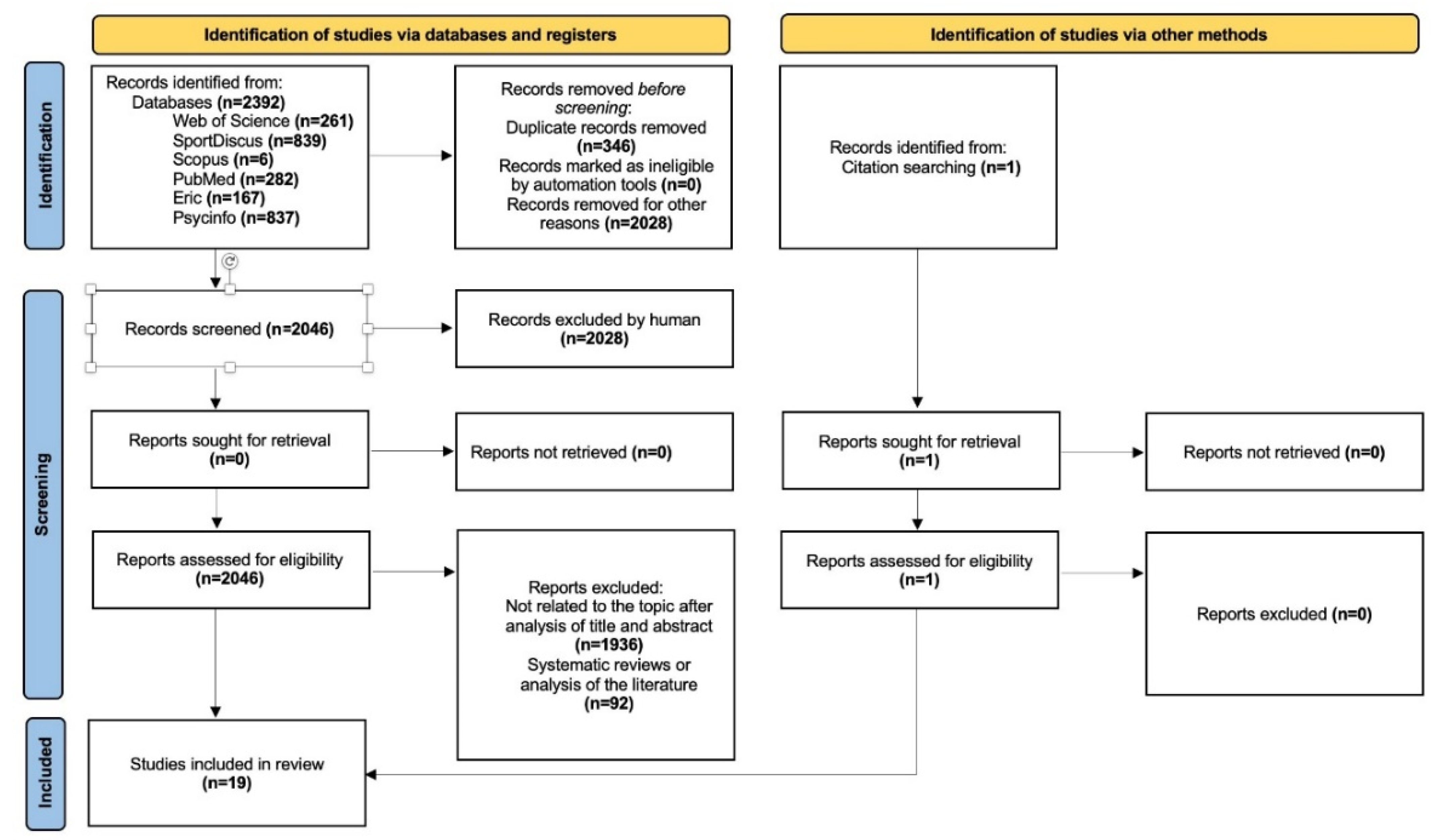
3.1. Selection of Studies
3.2. Quality of the Studies
3.3. Characteristics of the Studies
4. Discussion
5. Conclusions
Author Contributions
Funding
Institutional Review Board Statement
Informed Consent Statement
Conflicts of Interest
References
- Giménez, F.J. Fundamentos Básicos de la Iniciación Deportiva en la Escuela; Wanceulen: Seville, Spain, 2000. [Google Scholar]
- Castejón, F.J.; Giménez, F.J.; Jiménez, F.; López, V. (Eds.) Formación deportiva como eje central de la enseñanza del deporte. In Investigaciones en Formación Deportiva; Wanceulen: Seville, Spain, 2013; pp. 15–37. [Google Scholar]
- Kidman, L. Who reaps the benefits in coaching research? The case for an applied sociological approach. Sociol. Sport Online 1999, 1, 1. Available online: https://www.otago.ac.nz/sopeses/index.html (accessed on 20 March 2022).
- Martinent, G.; Decret, J.C. Motivational profiles among young table-tennis players in intensive training settings: A latent profile transition analysis. J. Appl. Sport Psychol. 2014, 27, 268–287. [Google Scholar] [CrossRef]
- Mujika, I. Intense training: The key to optimal performance before and during the taper. Scand. J. Med. Sci. Sports 2010, 20, 24–31. [Google Scholar] [CrossRef] [PubMed]
- Sosa, P.I.; Jaenes, J.C.; Godoy, D.; Oliver, J.F. Variables Psicológicas en el Deporte; Wanceulen: Seville, Spain, 2009. [Google Scholar]
- Williams, J.M.; Krane, V. Applied Sport Psychology: Personal Growth to Peak Performance; McGraw-Hill: Columbus, GA, USA, 2015. [Google Scholar]
- Willis, C.E.; Reid, S.; Elliott, C.; Rosenberg, M.; Nyquist, A.; Jahnsen, R.; Girdler, S. A realist evaluation of a physical activity participation intervention for children and youth with disabilities: What works, for whom, in what circumstances, and how? BMC Pediatr. 2018, 18, 113. [Google Scholar] [CrossRef] [PubMed]
- Williamson, J.A.; McDonald, F.W.; Galligan, E.A.; Baker, P.G. Selection and training of disabled persons for scuba-diving: Medical and psychological aspects. Med. J. Aust. 1984, 141, 414–418. [Google Scholar] [CrossRef] [PubMed]
- Durstine, J.L.; Painter, P.; Franklin, B.A.; Morgan, D.; Pitetti, K.H.; Roberts, S.O. Physical activity for the chronically Ill and disabled. Sports Med. 2000, 30, 207–219. [Google Scholar] [CrossRef]
- Martin, J.J. Athletes with physical disabilities. In Routledge Handbook of Applied Sport Psychology; Hanrahan, S., Andersen, M., Eds.; Routledge: London, UK, 2010; pp. 432–440. [Google Scholar]
- Sobiecka, J. Barriers hindering Paralympic sports of disabled competitors. Pol. J. Environ. Stud. 2007, 16, 684–690. [Google Scholar]
- DePauw, K.; Gavron, S.J. Disability and Sport; Human Kinetics: Champaign, IL, USA, 1995. [Google Scholar]
- Rimmer, J.H.; Riley, B.; Rauworth, A.; Jurkowski, J. Physical activity participation among persons with disabilities! Barriers and facilitators. Am. J. Prev. Med. 2004, 26, 419–425. [Google Scholar] [CrossRef]
- Shields, N.; Synnot, A.J.; Barr, M. Perceived barriers and facilitators to physical activity for children with disability: A systematic review. Br. J. Sports Med. 2012, 46, 989–997. [Google Scholar] [CrossRef]
- Sobiecka, J.; Plinta, R.; Kądziołka, M.; Gawroński, W.; Kruszelnicki, P.; Zwierzchowska, A. Polish paralympic sports in the opinion of athletes and coaches in retrospective studies. Int. J. Environ. Res. Public Health 2019, 16, 4927. [Google Scholar] [CrossRef] [Green Version]
- Alexander, D.; Bloom, G.A.; Taylor, S.L. Female paralympic athlete views of effective and ineffective coaching practices. J. Appl. Sport Psychol. 2019, 32, 48–63. [Google Scholar] [CrossRef]
- Murphy, N.A.; Carbone, P.S. Promoting the participation of children with disabilities in sports, recreation, and physical activities. Pediatrics 2008, 121, 1057–1061. [Google Scholar] [CrossRef] [PubMed] [Green Version]
- Bompa, T.O. Total Training for Young Champions; Human Kinetics: Champaign, IL, USA, 2000. [Google Scholar]
- Moher, D.; Shamseer, L.; Clarke, M.; Ghersi, D.; Liberati, A.; Petticrew, M.; Shekelle, P.; Stewart, L.A.; PRISMA-P Group. Preferred reporting items for systematic review and meta-analysis protocols (PRISMA-P) 2015 statement. Syst. Rev. 2015, 4, 224. [Google Scholar] [CrossRef] [PubMed] [Green Version]
- Page, M.J.; McKenzie, J.E.; Bossuyt, P.M.; Boutron, I.; Hoffmann, T.C.; Mulrow, C.D.; Shamseer, L.; Tetzlaff, J.M.; Akl, E.A.; Brennan, S.E.; et al. The PRISMA 2020 statement: An updated guideline for reporting systematic reviews. Br. Med. J. 2021, 88, 105906. [Google Scholar] [CrossRef]
- Urrútia, G.; Bonfill, X. PRISMA declaration: A proposal to improve the publication of systematic reviews and meta-analyses. Med. Clin. 2010, 135, 507–511. [Google Scholar] [CrossRef]
- Kmet, L.; Lee, R.; Cook, L. Standard Quality Assessment Criteria for Evaluating Primary Research Papers from a Variety of Fields; Alberta Heritage Foundation for Medical Research: Edmonton, AB, Canada, 2004. [Google Scholar]
- Landis, J.R.; Koch, G.G. The measurement of observer agreement for categorical data. Biometrics 1977, 33, 159–174. [Google Scholar] [CrossRef] [Green Version]
- Arnold, R.; Wagstaff, C.R.D.; Steadman, L.; Pratt, Y. The organizational stressors encountered by athletes with a disability. J. Sports Sci. 2017, 35, 1187–1196. [Google Scholar] [CrossRef] [Green Version]
- Eddy, K.A.; Mellalieu, S.D. Mental imagery in athletes with visual impairments. Adapt. Phys. Act. Q. 2003, 20, 347–368. [Google Scholar] [CrossRef] [Green Version]
- Page, S.; O’Connor, E.; Peterson, K. A qualitative study of factors underlying achievement motivation among athletes with disabilities. J. Sport Soc. Issues 2001, 25, 40–55. [Google Scholar] [CrossRef]
- Rodrigues, F.R.; Marivoet, S.; Almeida, M.A.B.D.; Gutierrez, G.L.; Menezes, R.P.; Nunomura, M. A abordagem mediática sobre o desporto paralímpico: Perspetivas de atletas portugueses. Motricidade 2015, 11, 123. [Google Scholar] [CrossRef]
- Vieira, Y.V.; Colere, J.; Souza, D.L.D. Facilitadores e barreiras para a prática esportiva por parte de atletas com comprometimentos no Brasil. Retos 2021, 41, 812–822. [Google Scholar] [CrossRef]
- Baĉanac, L.; Milićević-Marinković, B.; Kasum, G.; Marinković, M. Competitive anxiety, self-confidence and psychological skills in top athletes with and without disabilities: A pilot study. Phys. Educ. Sport 2014, 12, 59–70. [Google Scholar]
- Jaarsma, E.A.; Geertzen, J.H.B.; de Jong, R.; Dijkstra, P.U.; Dekker, R. Barriers and facilitators of sports in Dutch Paralympic athletes: An explorative study. Scand. J. Med. Sci. Sports 2014, 24, 830–836. [Google Scholar] [CrossRef]
- Kokun, O.; Shamych, O.M. Psychological Characteristics of Paralympic Athletes’ Self-Realisation. Soc. Welf. Interdiscip. Approach 2016, 2, 138. [Google Scholar] [CrossRef] [Green Version]
- Martin, J.J.; Malone, L.A.; Hilyer, J.C. Personality and mood in women’s paralympic basketball champions. J. Clin. Sport Psychol. 2011, 5, 197–210. [Google Scholar] [CrossRef]
- Marín-Urquiza, A.; Ferreira, J.P.; Van Biesen, D. Athletic identity and self-esteem among active and retired Paralympic athletes. Eur. J. Sport Sci. 2018, 18, 861–871. [Google Scholar] [CrossRef]
- Pereira, J.; Silva, A.; Rodrigues, D.F.; Menslin, R.; Araújo, L.T.; Vital, R.; Tufik, S.; Stieler, E.; de Mello, M.T. Association Between Hormonal Status, Stress, Recovery, and Motivation of Paralympic Swimmers. Res. Q. Exerc. Sport 2020, 91, 652–661. [Google Scholar] [CrossRef]
- Sánchez-Pay, A.; Sanz-Rivas, D. Evaluación de la condición física del jugador de tenis en silla de ruedas de alto nivel según nivel competitivo y tipo de lesión. RICYDE—Rev. Int. Cienc. Deport. 2019, 15, 235–248. [Google Scholar] [CrossRef]
- Sobiecka, J.; Plinta, R.; Drobniewicz, K.; Kłodecka-Różalska, J.; Cichoń, K. Conditions for preparations for the 2008 Beijing Paralympic Games in the opinion of the Polish national team. Biomed. Hum. Kinet. 2012, 4, 29–37. [Google Scholar] [CrossRef] [Green Version]
- Sobiecka, J.; Gawroński, W.; Kądziołka, M.; Kruszelnicki, P.; Kłodecka-Różalska, J.; Plinta, R. Standards of Conditions During Preparations for the Summer Paralympic Games Between 2004 and 2012 Assessed by Polish Athletes. J. Hum. Kinet. 2015, 48, 111–121. [Google Scholar] [CrossRef] [Green Version]
- Szájer, P.; Tóth, L.; Szemes, G.; Nagy, N.; Zala, B.; Köteles, F.; Szabo, A. A comparative analysis of national Olympic swimming team members’ and para-swimming team members’ psychological profiles. Cogn. Brain Behav. Interdiscip. J. 2019, 23, 299–311. [Google Scholar] [CrossRef]
- Van Biesen, D.; Mactavish, J.; Pattyn, N.; Vanlandewijck, Y. Technical proficiency among table tennis players with and without intellectual disabilities. Hum. Mov. Sci. 2012, 31, 1517–1528. [Google Scholar] [CrossRef] [PubMed]
- Wood, A.G.; Barker, J.B.; Turner, M.J.; Sheffield, D. Examining the effects of rational emotive behavior therapy on performance outcomes in elite paralympic athletes. Scand. J. Med. Sci. Sports 2017, 28, 329–339. [Google Scholar] [CrossRef] [PubMed] [Green Version]
- Rubin, H.J.; Rubin, I.S. Qualitative Interviewing: The Art of Hearing Data; Sage: London, UK, 2012. [Google Scholar] [CrossRef]
- Sparkes, A.C.; Smith, B. Qualitative Research Methods in Sport, Exercise and Health: From Process to Product; Routledge: London, UK, 2014. [Google Scholar] [CrossRef]
- Corbin, J.M.; Strauss, A.L. Basics of Qualitative Research: Techniques and Procedures for Developing Grounded Theory, 3rd ed.; Sage: London, UK, 2008. [Google Scholar] [CrossRef]
- Strauss, A.; Corbin, J. Basics of Qualitative Research: Techniques and Procedures for Developing Grounded Theory; Sage: London, UK, 1998. [Google Scholar]
- Rosenberg, M. Society and the Adolescent Self-Image; Princeton University Press: New Jersey, NJ, USA, 1965. [Google Scholar] [CrossRef]
- Vealey, R.S. Conceptualization of sport-confidence and competitive orientation: Preliminary investigation and instrument development. J. Sport Psychol. 1986, 8, 221–246. [Google Scholar] [CrossRef]
- Smith, R.E.; Schutz, R.W.; Smoll, F.L.; Ptacek, J. Development and validation of a multidimensional measure of sport-specific psychological skills: The athletic coping skills inventory-28. J. Sport Exerc. Psychol. 1995, 17, 379–398. [Google Scholar] [CrossRef]
- Baĉanac, L.; Kitanović, V.; Nikolić, M.; Ćirković, T.; Ilić, J. Psychometric Properties and Norms for the Tests: SCATr, SCI, ACSI-28 and GSE; Serbian Institute of Sport and Sports Medicine: Belgrade, Serbia, 2011. [Google Scholar]
- Mulier Instituut. Alternative Module Sports Performed by People with a Disability. 2010. Available online: https://www.mulierinstituut.nl/monitoring/rso/downloads (accessed on 15 December 2021).
- Schwarzer, R.; Jerusalem, M.; Romek, V. The russian version of general self-efficacy scale. Foreign Psychol. 1996, 7, 71–76. [Google Scholar] [CrossRef]
- Kokun, O.M. Optimization of Adaptive Human Capabilities: Psychophysiological Aspect of Providing the Activity; Millennium: Kyiv, Ukraine, 2004. [Google Scholar]
- Droppleman, L.F.; Lorr, M.; McNair, D.M. POMS Manual: Profile of Mood States; Educational and Industrial Testing Service: San Diego, CA, USA, 1992. [Google Scholar]
- Cattell, R.B.; Eber, H.W.; Tatsuoka, M.M. Handbook for the Sixteen Personality Factor Questionnaire; Institute for Personality and Ability Testing: Champaign, IL, USA, 1970. [Google Scholar]
- Cattell, R.B.; Cattell, A.K.; Cattell, H.E.P. 16PF Fifth Edition Questionnaire; Institute for Personality and Ability Testing: Champaign, IL, USA, 1993. [Google Scholar]
- Brewer, B.W.; Van Raalte, J.L.; Linder, D.E. Athletic identity: Hercules’ muscles or Achilles heel? Int. J. Sport Psychol. 1993, 24, 237–254. [Google Scholar] [CrossRef]
- Cohen, S.; Kamarck, T.; Mermelstein, R. A Global Measure of Perceived Stress. J. Health Soc. Behav. 1983, 24, 385–396. [Google Scholar] [CrossRef]
- Gill, D.L.; Deeter, T.E. Development of the Sport Orientation Questionnaire. Res. Q. Exerc. Sport 1988, 59, 191–202. [Google Scholar] [CrossRef]
- Bara Filho, M.; Andrade, D.; Miranda, R.; Núñez, J.L.; Martín-Albó, J.; Ribas, P.R. Preliminary validation of a brazilian version of the sport motivation scale. Univ. Psychol. 2011, 10, 557–566. [Google Scholar] [CrossRef] [Green Version]
- Kellmann, M.; Kallus, K.W. Recovery-Stress Questionnaire for Athletes: User Manual; Human Kinetics: Champaign, IL, USA, 2001. [Google Scholar] [CrossRef]
- Lefèvre, F.; Lefèvre, A.M.C. Pesquisa de Representação Social. Um Enfoque Qualiquantitativo: A Metodologia do Discurso do Sujeito Coletivo; Liber Livro: Brasilia, Brazil, 2012. [Google Scholar]
- De Groot, S.; Balvers, I.J.; Kouwenhoven, S.M.; Janssen, T.W. Validity and reliability of tests determining performance-related components of wheelchair basketball. J. Sports Sci. 2012, 30, 879–887. [Google Scholar] [CrossRef] [PubMed]
- Gil, S.M.; Yanci, J.; Otero, M.; Olasagasti, J.; Badiola, A.; Bidaurrazaga-Letona, I.; Iturricastillo, A.; Granados, C. The Functional Classification and Field Test Performance in Wheelchair Basketball Players. J. Hum. Kinet. 2015, 46, 219–230. [Google Scholar] [CrossRef] [PubMed] [Green Version]
- Granados, C.; Yanci, J.; Badiola, A.; Iturricastillo, A.; Otero, M.; Olasagasti, J.; Bidaurrazaga-Letona, I.; Gil, S.M. Anthropometry and Performance in Wheelchair Basketball. J. Strength Cond. Res. 2015, 29, 1812–1820. [Google Scholar] [CrossRef] [PubMed]
- Sánchez-Pay, A.; Torres-Luque, G.; Palao, J.M. Revisión y análisis de los test físicos empleados en tenis. Eur. J. Hum. Mov. 2011, 26, 105–122. [Google Scholar]
- Kłodecka-Różalska, J. Opinion of polish female athletes on preparation conditions for the Olympic games in Sydney 2000 and Salt Lake City 2002. Kob. Sport 2002, 3, 6–9. [Google Scholar]
- Sipos, K.; Kudar, K.; Bejek, K.; Tóth, L. Standardisation and validation of the Hungarian Competitive State Anxiety Inventory-2 (CSAI-2) of Martens et al. In Proceedings of the 20th International Conference of Stress and Anxiety Research Society (STAR), Cracow, Poland, 12–14 July 1999; p. 131. [Google Scholar]
- Martens, R.; Burton, D.; Vealey, R.S.; Bump, L.A.; Smith, D.E. Development and validation of the Competitive State Anxiety Inventory (CSAI-2). In Competitive Anxiety in Sport; Martens, R., Vealey, R.S., Burton, D., Eds.; Human Kinetics: Champaign, IL, USA, 1990; pp. 117–190. [Google Scholar]
- Jelinek, Z. The Personality Background of the Sport Physical Sensibility. Master’s Thesis, Eötvös Lorand University, Budapest, Hungary, 2000. [Google Scholar]
- Braun, V.; Clarke, V. Using thematic analysis in psychology. Qual. Res. Psychol. 2006, 3, 77–101. [Google Scholar] [CrossRef] [Green Version]
- Lindner, H.; Kirkby, R.; Wertheim, E.; Birch, P. A Brief Assessment of Irrational Thinking: The Shortened General Attitude and Belief Scale. Cogn. Ther. Res. 1999, 23, 651–663. [Google Scholar] [CrossRef]
- Spielberger, C.D.; Reheiser, E.C. Assessment of emotions: Anxiety, anger, depression, and curiosity. Appl. Psychol. Health Well-Being 2009, 1, 271–302. [Google Scholar] [CrossRef]
- Conroy, D.E.; Elliot, A.J.; Hofer, S.M. A 2 × 2 Achievement goals questionnaire for sport: Evidence for factorial invariance, temporal stability, and external validity. J. Sport Exerc. Psychol. 2003, 25, 456–476. [Google Scholar] [CrossRef]
- Martin, J.J. Determinants of elite disability sport performance. Kinesiol. Rev. 2015, 4, 91–98. [Google Scholar] [CrossRef]
- McMaster, S.; Culver, D.; Werthner, P. Coaches of athletes with a physical disability: A look at their learning experiences. Qual. Res. Sport Exerc. Health 2012, 4, 226–243. [Google Scholar] [CrossRef] [Green Version]
- Banack, H.R.; Sabiston, C.M.; Bloom, G.A. Coach autonomy support, basic need satisfaction, and intrinsic motivation of Paralympic athletes. Res. Q. Exerc. Sport 2011, 82, 722–730. [Google Scholar] [CrossRef] [PubMed]
- Vella, S.A.; Oades, L.G.; Crowe, T.P. Validation of the differentiated transformational leadership inventory as a measure of coach leadership in youth soccer. Sport Psychol. 2012, 26, 207–223. [Google Scholar] [CrossRef]
- Jowett, S.; Meek, G.A. The Coach-Athlete relationship in married couples: An exploratory content analysis. Sport Psychol. 2000, 14, 157–175. [Google Scholar] [CrossRef]
- Ellis, R.; Kosma, M.; Cardinal, B.J.; Bauer, J.J.; McCubbin, J.A. Physical activity beliefs and behaviour of adults with physical disabilities. Disabil. Rehabil. 2007, 29, 1221–1227. [Google Scholar] [CrossRef]
- Shirazipour, C.H.; Latimer-Cheung, A.E.; Arbour-Nicitopoulos, K.P. An exploratory qualitative investigation of psychosocial determinants of parental decisions to support sport participation for youth with a mobility impairment. Res. Dev. Disabil. 2015, 45–46, 400–410. [Google Scholar] [CrossRef]
- Díaz, R.; Miller, E.K.; Kraus, E.; Fredericson, M. Impact of adaptive sports participation on quality of life. Sports Med. Arthrosc. Rev. 2019, 27, 73–82. [Google Scholar] [CrossRef]
- Taub, D.E.; Greer, K.R. Physical activity as a normalizing experience for school-age children with physical disabilities. J. Sport Soc. Issues 2000, 24, 395–414. [Google Scholar] [CrossRef]
- Imms, C. Children with cerebral palsy participate: A review of the literature. Disabil. Rehabil. 2008, 30, 1867–1884. [Google Scholar] [CrossRef]
- Sherrill, C.; Rainbolt, W. Sociological perspectives of cerebral palsy sports. Palaestra 1986, 2, 20–26. [Google Scholar]
- Whidden, M. Socialization into Sport of Cerebral Palsied Persons. Master’s Thesis, Texas Woman’s University, Denton, TX, USA, 1986. [Google Scholar]
- Robinson, S.; Fraser-Thomas, J.L.; Balogh, R.; Lunsky, Y.; Weiss, J.A. Individual and contextual correlates of frequently involved special Olympics athletes. AJIDD—Am. J. Intellect. Dev. Disabil. 2018, 123, 164–175. [Google Scholar] [CrossRef]
- Penedo, F.J.; Dahn, J.R. Exercise and well-being: A review of mental and physical health benefits associated with physical activity. Curr. Opin. Psychiatr. 2005, 18, 189–193. [Google Scholar] [CrossRef] [PubMed]
- Fiorilli, G.; Iuliano, E.; Aquino, G.; Battaglia, C.; Giombini, A.; Calcagno, G.; di Cagno, A. Mental health and social participation skills of wheelchair basketball players: A controlled study. Res. Dev. Disabil. 2013, 34, 3679–3685. [Google Scholar] [CrossRef] [PubMed]
- Tasiemski, T.; Bergström, E.; Savic, G.; Gardner, B. Sports, recreation and employment following spinal cord injury—A pilot study. Spinal Cord 2000, 38, 173–184. [Google Scholar] [CrossRef] [PubMed] [Green Version]
- Puce, L.; Marinelli, L.; Girtler, N.G.; Pallecchi, I.; Mori, L.; Simonini, M.; Trompetto, C. Self-Perceived Psychophysical Well-Being of Young Competitive Swimmers with Physical or Intellectual Impairment. Percept. Mot. Ski. 2019, 126, 862–885. [Google Scholar] [CrossRef] [Green Version]
- Fletcher, D.; Hanton, S.; Mellalieu, S.D. An organizational stress review: Conceptual and theoretical issues in competitive sport. In Literature Reviews in Sport Psychology; Hanton, S., Mellalieu, S.D., Eds.; Nova Sciencer Publishers, Inc.: Hauppauge, NY, USA, 2006; pp. 321–374. [Google Scholar]
- Marsh, H.W.; Asci, F.H.; Tomas, I.M. Multitrait-Multimethod analyses of two physical self-concept instruments: A cross-cultural perspective. J. Sport Exer. Psychol. 2002, 24, 99–119. [Google Scholar] [CrossRef]
- Martin, J.J. A personal development model of sport psychology for athletes with disabilities. J. Appl. Sport Psychol. 1999, 11, 181–193. [Google Scholar] [CrossRef]
- Pensgaard, A.M.; Roberts, G.C.; Ursin, H. Motivational factors and coping strategies of Norwegian Paralympic and Olympic winter sport athletes. Adapt. Phys. Act. Q. 1999, 16, 238–250. [Google Scholar] [CrossRef]
- Heszen, I.; Sęk, H. Psychologia Zdrowia; Wydawnictwo Naukowe PWN: Warszawa, Poland, 2007. [Google Scholar]
- Gioia, M.C.; Cerasa, A.; Di Lucente, L.; Brunelli, S.; Castellano, V.; Traballesi, M. Psychological impact of sports activity in spinal cord injury patients. Scand. J. Med. Sci. Sports 2006, 16, 412–416. [Google Scholar] [CrossRef]
- Ferreira, J.P.; Fox, K.R. Physical self-perceptions and self-esteem in male basketball players with and without disability players with and without disability: A preliminary analysis using the physical self-perception profile. Eur. J. Adapt. Phys. Act. 2008, 1, 35–49. [Google Scholar] [CrossRef] [Green Version]
- Holt, N.L.; Hogg, J.M. Perceptions of Stress and Coping during Preparations for the 1999 Women’s Soccer World Cup Finals. Sport Psychol. 2002, 16, 251–271. [Google Scholar] [CrossRef]
- Wilson, G.S.; Raglin, J.S.; Pritchard, M.E. Optimism, Pessimism, and Precompetition Anxiety in College Athletes. Personal. Individ. Differ. 2002, 32, 893–902. [Google Scholar] [CrossRef]
- De Guast, V.D.; Golby, J.; Van Wersch, A.; d’Arripe-Longueville, F. Psychological Skills Training of an Elite Wheelchair Water-Skiing Athlete: A Single-Case Study. Adapt. Phys. Act. Q. 2013, 30, 351–372. [Google Scholar] [CrossRef] [Green Version]
- Shapiro, D.R.; Martin, J.J. Athletic identity, affect, and peer relations in youth athletes with physical disabilities. Disabil. Health J. 2010, 3, 79–85. [Google Scholar] [CrossRef] [PubMed]
- Marszalek, J.; Molik, B.; Gomez, M.A.; Skučas, K.; Lencse-Mucha, J.; Rekowski, W.; Pokvytyte, V.; Rutkowska, I.; Kaźmierska-Kowalewska, K. Relationships Between Anaerobic Performance, Field Tests and Game Performance of Sitting Volleyball Players. J. Hum. Kinet. 2015, 48, 25–32. [Google Scholar] [CrossRef] [PubMed] [Green Version]
- Paulson, T.; Goosey-Tolfrey, V. Current Perspectives on Profiling and Enhancing Wheelchair Court Sport Performance. Int. J. Sports Physiol. Perform. 2017, 12, 275–286. [Google Scholar] [CrossRef] [PubMed]
- Tawse, H.; Bloom, G.A.; Sabiston, C.M.; Reid, G. The role of coaches of wheelchair rugby in the development of athletes with a spinal cord injury. Qual. Res. Sport Exerc. Health 2012, 4, 206–225. [Google Scholar] [CrossRef]
- Jackson, A.S. The evolution and validity of health-related fitness. Quest 2006, 58, 160–175. [Google Scholar] [CrossRef]
- Rienzi, E.; Reilly, T.; Malkin, C. Investigation of anthropometric and work-rate profiles of rugby seven players. J. Sports Med. Phys. Fit. 1999, 39, 160–164. [Google Scholar]
- Fernhall, B.; Unnithan, V.B. Physical activity, metabolic issues, and assessment. Phys. Med. Rehabil. Clin. N. Am. 2002, 13, 925–947. [Google Scholar] [CrossRef]
- DePauw, K. Sport and Physical Activity in the Lifecycle of Girls and Women with Disabilities. Women Sport Phys. Act. J. 1997, 6, 225–237. [Google Scholar] [CrossRef]
- Meân, L.J.; Kassing, J.W. “I Would Just Like to be Known as an Athlete”: Managing Hegemony, Femininity, and Heterosexuality in Female Sport. West. J. Commun. 2008, 72, 126–144. [Google Scholar] [CrossRef]
- Bryson, L. Sport and the maintenance of masculine hegemony. Women’s Stud. Int. Forum 1987, 10, 349–360. [Google Scholar] [CrossRef]
- DePauw, K. The (In)Visibility of DisAbility: Cultural Contexts and “Sporting Bodies”. Quest 1997, 49, 416–430. [Google Scholar] [CrossRef]
- Dishman, R.K.; Heath, G.W.; Washburn, R.A. Physical Activity Epidemiology; Human Kinetics: Champaign, IL, USA, 2004. [Google Scholar]
- Seo, W.S.; Chen, R.K. Attitudes of College Students Toward People with Disabilities. J. Appl. Rehabil. Couns. 2009, 40, 3–8. [Google Scholar] [CrossRef]
- De Schipper, T.; Lieberman, L.J.; Moody, B. “Kids like me, we go lightly on the head”: Experiences of children with a visual impairment on the physical self-concept. Br. J. Vis. Impair. 2017, 35, 55–68. [Google Scholar] [CrossRef]
- Haegele, J.A.; Kirk, T.N. Experiences in Physical Education: Exploring the Intersection of Visual Impairment and Maleness. Adapt. Phys. Act. Q. 2018, 35, 196–213. [Google Scholar] [CrossRef]
- Haegele, J.A.; Zhu, X. Experiences of Individuals with Visual Impairments in Integrated Physical Education: A Retrospective Study. Res. Q. Exerc. Sport 2017, 88, 425–435. [Google Scholar] [CrossRef] [PubMed]
- Darcy, S.; Dowse, L. In search of a level playing field–the constraints and benefits of sport participation for people with intellectual disability. Disabil. Soc. 2013, 28, 393–407. [Google Scholar] [CrossRef]
- Cid, L. El deporte olímpico de las personas con discapacidad. Citius Altius 2008, 1, 133–145. [Google Scholar]
- Marín, J. Valores mediáticos del deportista profesional en la publicidad. Rev. Comun. 2010, 1, 26–40. [Google Scholar]
- Rimmer, J.H. The Conspicuous Absence of People with Disabilities in Public Fitness and Recreation Facilities: Lack of Interest or Lack of Access? Am. J. Health Promot. 2005, 19, 327–329. [Google Scholar] [CrossRef] [PubMed]

| Studies | Rater 1 (%) | Rater 2 (%) |
|---|---|---|
| Alexander et al. [17] | 90 | 90 |
| Arnold et al. [25] | 80 | 80 |
| Eddy and Mellalieu [26] | 85 | 100 |
| Page et al. [27] | 70 | 70 |
| Rodrigues et al. [28] | 80 | 70 |
| Vieira et al. [29] | 80 | 70 |
| Studies | Rater 1 (%) | Rater 2 (%) |
|---|---|---|
| Baĉanac et al. [30] | 75 | 75 |
| Jaarsma et al. [31] | 90 | 100 |
| Kokun and Shamych [32] | .86 | 88 |
| Martin et al. [33] | 95 | 100 |
| Marín-Urquiza et al. [34] | 100 | 100 |
| Pereira et al. [35] | 86 | 85 |
| Sánchez-Pay and Sanz-Rivas [36] | 90 | 85 |
| Sobiecka et al. [37] | 90 | 100 |
| Sobiecka et al. [38] | 95 | 100 |
| Sobiecka et al. [16] | 95 | 100 |
| Szájer et al. [39] | 95 | 100 |
| Van Biesen et al. [40] | 90 | 90 |
| Wood et al. [41] | 86 | 85 |
| Studies | Country | Subjects | Age (M ± SD) | Sports | Disability | Factors |
|---|---|---|---|---|---|---|
| Alexander et al. [17] | Canada | 8 women | NR | NR | NR | Sport context Barriers |
| Arnold et al. [25] | NR | 18 men | 25.44 ± 6.41 | Swimming, paratriathlon, athletics, cycling, golf, basketball, and cricket | Visual Amputation Cerebral palsy | Social context Sport context Barriers |
| Baĉanac et al. [30] | NR | 24 12 with disability (10 men) (2 women) 12 without disability (10 men) (2 women) | With disability (28.58 ± 5.71) Without disability (26.21 ± 6.36) | With disability (athletics, archery, table tennis, chess, and cycling) Without disability (athletics, table tennis, archery, and cycling) | Visual Hearing Physical | Psychological |
| Eddy and Mellalieu [26] | Great Britain | 6 (women) | 21.8 ± 8.0 | Goalball | Visual | Psychological |
| Jaarsma et al. [31] | The Netherlands | 76 (20 men) (46 women) | 30.5 ± 9.7 | Alpine skiing, athletics, archery, equestrian, rowing, tennis, table tennis, 7-a-side football, cycling, volleyball, and swimming | Visual Amputation Spinal cord injury Cerebral palsy Neurological | Social context Sport context Barriers and facilitators |
| Kokun and Shamych [32] | Ukraine | 36 men | NR | NR | Hearing impairment Cerebral palsy | Psychological |
| Martin et al. [33] | United States | 25 women | 25.80 ± 5.24 | Wheelchair basketball | Physical Spinal cord injury Spina Bifida | Psychological |
| Marín-Urquiza et al. [34] | Belgium, Ireland, United Kingdom, United States, Australia, Canada, Portugal, Spain, and Argentina | 84 (69 men) (15 women) | NR | Alpine skiing, athletics, pétanque, cycling, indoor football, goalball, judo, pentathlon, rowing, sailing, archery, sitting volleyball, swimming, table tennis, triathlon, wheelchair basketball, wheelchair rugby, and powerlifting | Visual Physical | Psychological |
| Page et al. [27] | United States | 6 (2 men) (6 women) | NR | wheelchair fencing, powerlifting, swimming, athletics, and wheelchair basketball | NR | Psychological Social context Physical condition |
| Pereira et al. [35] | Brazil | 11 men | 22.73 ± 5.00 | Swimming | Visual Physical Intellectual | Psychological |
| Rodrigues et al. [28] | Portugal | 9 (8 men) (1 woman) | NR | Swimming, boccia | Visual Physical | Social context Barriers |
| Sánchez-Pay and Sanz-Rivas [36] | NR | 9 men | 38.35 ± 11.28 | Wheelchair tennis | Amputation Spinal cord injury Osteogenesis | Physical condition |
| Sobiecka et al. [37] | Poland | 89 (58 men) (31 women) | Men 32 ± 9.7 Women 32 ± 9.32 | Horse riding, cycling, athletics, athletics, archery, swimming, fencing, tennis, table tennis, and rowing | Physical Visual | Psychological Social context Sport |
| Sobiecka et al. [38] | Poland | 91 (61 men) (30 women) | NR | NR | Physical Visual | Psychological Social context Sport context Barriers |
| Sobiecka et al. [16] | Poland | 470 Group 1 (324) (254 men) (70 women) Group 2 (146) (118 men) (28 women) | Group 1 Men (32 ± 11.0) Women 28 ± 8.20 Group 2 Men (32 ± 12.10) Women (33 ± 12.30) | NR | Physical Visual Physical | Psychological Social context Sport context Barriers |
| Szájer et al. [39] | Hungary | 18 with disability (9 men) (9 women) 35 without disability (23 men) (12 women) | With disability (26.33 ± 10.81) Without disability (23.26 ± 3.85) | Swimming | Physical Cerebral palsy | Psychological |
| Van Biesen et al. [40] | Czech Republic | 71 with disability (41 men) (30 women) 17 without disability (12 men) (5 women) | With disability Men 27.00 ± 8.00 Women 28.00 ± 8.00 Without disability Men 24.00 ± 12.00 Women 20.00 ± 9.00 | Table tennis | Intellectual | Technical-tactical |
| Vieria et al. [29] | Brazil | 9 (6 men) (3 women) | NR | Boccia, athletics, volleyball, goalball, swimming, and paracanoeing | Physical | Barriers and facilitators |
| Wood et al. [41] | NR | 8 (5 men) (6 women) | 40.12 ± 12.99 | NR | NR | Psychological Sport context Barriers |
| Studies | Methodology | Instrument | Objectives | Main Findings |
|---|---|---|---|---|
| Alexander et al. [17] | Qualitative | Semi-structured and one-to-one interviews [42,43] | Explore the perceptions and experiences of athletes competing in an individual or coercive sport | All athletes made significant sporting achievements and recognised the importance and value of their coaches in helping them reach high standards of success. In addition, participants highlighted that male coaches inappropriately address their disability and gender issues and how this influenced their psychological well-being. |
| Arnold et al. [25] | Qualitative | Semi-structured and one-to-one interviews [44,45] | Explore the different organisational stressors faced by athletes with a disability | A total of 316 organisational stressors were identified, which were summarised into 31 concepts and 4 pre-conceptualised exploratory schemes: leadership and staff issues, cultural and team issues, logistical and environmental issues, and performance and personal issues |
| Baĉanac et al. [30] | Quantitative | Self-Esteem Scale (RSES) [46] Sport Confidence Scale (SC) [47] Athletic Coping Skills Inventory-28 [48] Sport Competitive Anxiety Test (SCATr) [49] | Prove that participation in sport contributes to the psychological improvement of people with disabilities, as well as help them develop positive attitudes towards themselves and their general and sporting competence and become more able to cope with stress | The psychological profile of athletes with disabilities is very similar to the profile of athletes without them, which shows that sports positively contribute to their physical strength, making them equally prepared for the best results in sports as athletes without disabilities. The practice of sport has a positive impact not only on self-confidence in sports but also on the overall self-esteem of athletes with disabilities. Their anxiety about competing is optimised, and their psychological abilities to cope with stress are improved, making them no different from their non-disabled peers. |
| Eddy and Mellalieu [26] | Qualitative | Structured interview developed by the study’s authors | Research the imagery of experiences of visually impaired Paralympic athletes | Participants reported using imagery for cognitive and motivational purposes in both training and competition |
| Jaarsma et al. [31] | Quantitative | Questionnaire partially based on the questionnaire validated by the Mulier Instituut [50] | Understand the barriers and facilitators of sport for Paralympic athletes | This study indicated that barriers in sport were mainly environmental, while facilitators were generally personal factors. Attitude and subjective rules were considered to be the most important components of the intention to participate in sport. |
| Kokun and Shamych [32] | Quantitative | Questionnaire developed by the study authors Self-efficacy scale [51] Self-esteem scales [52] | Determine the characteristics and common factors of Paralympic athletes’ self-fulfilment | The results obtained suggest that the most significant incentive for Paralympic athletes to engage in sports is the moral satisfaction of winning a competition. Furthermore, there are other important incentives such as opportunities for personal self-fulfilment, socialising with friends, the ability to be a full member of society, gaining experience, meeting new people who could help later in life, opportunities or prospects for travel abroad, and the pleasure of training. |
| Martin et al. [33] | Quantitative | Profile of Mood State Questionnaire (POMS) [53] Sixteen-Factor Personality Questionnaire (16PF) [54], but the fifth edition was used [55] | Determine whether personality and mood differences existed between elite Paralympic athletes and elite athletes who did not qualify for the team | The results revealed that athletes who were part of the Paralympic team scored higher on toughness and lower on anxiety. In terms of mood, Paralympic athletes scored higher in vigour and lower in depressed mood. |
| Marín-Urquiza et al. [34] | Quantitative | Athletic Identity Measurement Scale (AIMS) [56] Rosenberg Self-Esteem Scale (RSES) [46] Perceived Stress Scale (PSS) [57] | Provide more information on Paralympic sport transition and its impact on athletes | No differences in self-esteem were found between the withdrawn group and the active group. However, within the withdrawn group, athletes who withdrew involuntarily had significantly lower self-esteem scores than those who withdrew voluntarily. |
| Page et al. [27] | Qualitative | Qualitative Sports Orientation Questionnaire [58] | Researching the reasons why six elite athletes with disabilities play sports | The results revealed a desire to abandon or at least temporarily escape from the social and physical conditions associated with disability. Specifically, participants discussed the desire to gain competence for oneself and with others through participation in sport and the desire to stay active to fight the combined effects of being inactive or being disabled. Additionally, there was the desire to participate in a social activity with other people with disabilities. |
| Pereira et al. [35] | Quantitative | Sport Motivation Scale [59] Recovery-Stress Questionnaire for Athletes (RESTQ76-Sport) [60] | Research the associations between the hormonal profile and the psycho-biological aspects of Paralympic athletes during a competition season | No significant differences were found between motivation levels, but significant differences were found in terms of pressure. |
| Rodrigues et al. [28] | Qualitative | Semi-structured individual interviews and methods in [61] | Identify the characteristics and trends of the media approach to the Paralympic Movement | The results showed that, in many cases, Paralympic athletes are unhappy with the limited media coverage, the stigma, and the supremacy of football, and there is an evident desire to occupy a more important space in the sporting arena, which confers greater legitimacy and the possibility of athletic-competitive development, as well as economic and social gains |
| Sánchez-Pay and Sanz-Rivas [36] | Quantitative | Field tests widely used in the assessment of tennis players and wheelchair players [62,63,64,65] | Measure the fitness levels of wheelchair tennis players and make comparisons according to ranking and type of injury | The results showed that higher-level players have better fitness levels in all tests, finding significant differences in almost all tests. Players with a higher functional limitation showed lower values, although no statistically significant differences were found. |
| Sobiecka et al. [37] | Quantitative | Interview for male and female athletes training for the Paralympic Games [66] | Evaluate the preparation process of Polish athletes with disabilities for the Beijing 2008 Paralympic Summer Games | The results revealed that the athletes were fully satisfied with the camps (food, accommodation, and sports equipment) and social relations (atmosphere of cooperation between athletes and cooperation between athletes and coaches of national teams of different disciplines). However, they require more attention in health (medical care and individual orthopaedic equipment) and contact with the media. |
| Sobiecka et al. [38] | Quantitative | Adjusted questionnaire for disabled sports [66] | Present the conditions during the preparations of Polish athletes for the Paralympic Summer Games (2004–2012) | The analysis showed that relationships between athletes were good at all times, but accommodations and food were poor. Cooperation with doctors, physiotherapists, and masseurs was satisfactory. Consultations with the dietician were sporadic and evaluated as poor. Consultations with sport psychologists were rare, but satisfactory. |
| Sobiecka et al. [16] | Quantitative | Form for male and female athletes of the national team [16] | Identify the limitations observed in Polish Paralympic sports in terms of the environment in which athletes train on a daily basis | Particularly outstanding difficulties were related to organisational and financial issues. At the same time, the environment was shown to be a differentiating factor. |
| Szájer et al. [39] | Quantitative | Adaptation of the Competitive State Anxiety Inventory-2 (CSAI-2) [67] from the original [68] Adaptation of the Athletic Coping Skills Inventory-28 (ACSI-28) [69] from the original [48] | Reveal possible differences in several psychological profiles between Paralympic swimmers and healthy swimmers. In addition, another objective was to explore possible gender differences and differences between successful and less successful swimmers. | Healthy swimmers scored lower on somatic anxiety and higher on self-confidence, absence of worry, and self-confidence or motivation for achievement than Paralympic swimmers. When the tests were repeated separately for men and women, the results remained unchanged for women, while healthy male athletes only scored significantly higher than male Paralympic swimmers in self-confidence and absence of worry. In addition, medal-winning athletes in the overall sample exhibited less cognitive and somatic anxiety. Para-swimmers with different levels of disability did not differ from each other in any of the measures. The findings show that para-swimmers experience significant psychological disadvantages. |
| Van Biesen et al. [40] | Quantitative | Ten different series of 10 identical strokes | Determine the technical competence of table tennis players with and without intellectual disabilities | Statistical analysis suggested that there were no gender differences in terms of proficiency. Table tennis players without a disability scored significantly better than those without a disability. |
| Vieria et al. [29] | Qualitative | Semi-structured interview [70] | Explore facilitators and barriers to the practice of sports by high-performance Brazilian athletes with disabilities actively involved in national or international competitions | The main facilitators mentioned were family support, socialisation, economic benefits of sport, incentives from rehabilitation centres and health professionals, the possibility of visiting new places, enjoyment of sport and competition, better perception of their abilities, development of autonomy, and access to places offering free adapted sports. The most frequently cited barriers were physical wear and tear, lack of appreciation and recognition of athletes as sports professionals, lack of sponsorship, accessibility difficulties, and the lack of media coverage. |
| Wood et al. [41] | Quantitative | Shortened General Attitudes and Beliefs Scale (SGABS) [71] State Trait Personality Inventory (STPI) [72] Achievement goals questionnaire (AGQ) [73] | Examine the immediate effects of rational emotive behavioural therapy on psychological, physiological, and performance outcomes with elite Paralympic athletes | Visual and statistical analyses of the data indicated that reductions in irrational beliefs were combined with reductions in systolic blood pressure, indicative of an adaptive physiological response, improved athletic performance during competition simulations, and reductions in goal avoidance. In addition, social validation data showed increased self-awareness, emotional control, and greater concentration during competition as a result of the rational emotive behavioural therapy intervention. |
| Sport Context | Social Context | Psychological Aspects | Technical-Tactical Aspects | Physical Condition |
|---|---|---|---|---|
| Importance of the figure of the coach [17] Relationship with coaches [16,17,32,37] Necessary training of coaches [16,31] Relevance of sport-specific facilities [25,37,41] Importance of having a medical team [35] Importance of competing and winning [31] Barriers: Need to adapt sports facilities and increase the number of sports facilities [16,31] Suitability of a medical team [16,38] Need for more financial support [16,25,28] | Significance of the relationship between athletes [25,27,31] Importance of the family [29,31] Barriers: By disability [16,31] By gender [17,28] Dependence on others [31] Lack of visibility in the media [28,29] Lack of sponsors [16] and lack of facilities, supervision, and transport [31] | Relevance of self-esteem [30,31,34,39] Importance of health [31] Reduction of stress [30,33,35,39] and depression [33] Significance of motivation [26,30,31,35] Barriers: Excessive stress [41] | Relevance of technical-tactical aspects [40] | Importance of physical condition [27,35,36] |
Publisher’s Note: MDPI stays neutral with regard to jurisdictional claims in published maps and institutional affiliations. |
© 2022 by the authors. Licensee MDPI, Basel, Switzerland. This article is an open access article distributed under the terms and conditions of the Creative Commons Attribution (CC BY) license (https://creativecommons.org/licenses/by/4.0/).
Share and Cite
Rodríguez Macías, M.; Giménez Fuentes-Guerra, F.J.; Abad Robles, M.T. The Sport Training Process of Para-Athletes: A Systematic Review. Int. J. Environ. Res. Public Health 2022, 19, 7242. https://doi.org/10.3390/ijerph19127242
Rodríguez Macías M, Giménez Fuentes-Guerra FJ, Abad Robles MT. The Sport Training Process of Para-Athletes: A Systematic Review. International Journal of Environmental Research and Public Health. 2022; 19(12):7242. https://doi.org/10.3390/ijerph19127242
Chicago/Turabian StyleRodríguez Macías, Manuel, Francisco Javier Giménez Fuentes-Guerra, and Manuel Tomás Abad Robles. 2022. "The Sport Training Process of Para-Athletes: A Systematic Review" International Journal of Environmental Research and Public Health 19, no. 12: 7242. https://doi.org/10.3390/ijerph19127242
APA StyleRodríguez Macías, M., Giménez Fuentes-Guerra, F. J., & Abad Robles, M. T. (2022). The Sport Training Process of Para-Athletes: A Systematic Review. International Journal of Environmental Research and Public Health, 19(12), 7242. https://doi.org/10.3390/ijerph19127242

