


A Multiscale Land Use Regression Approach for Estimating Intraurban Spatial Variability of PM2.5 Concentration by Integrating Multisource Datasets




Abstract
1. Introduction
2. Materials and Methods
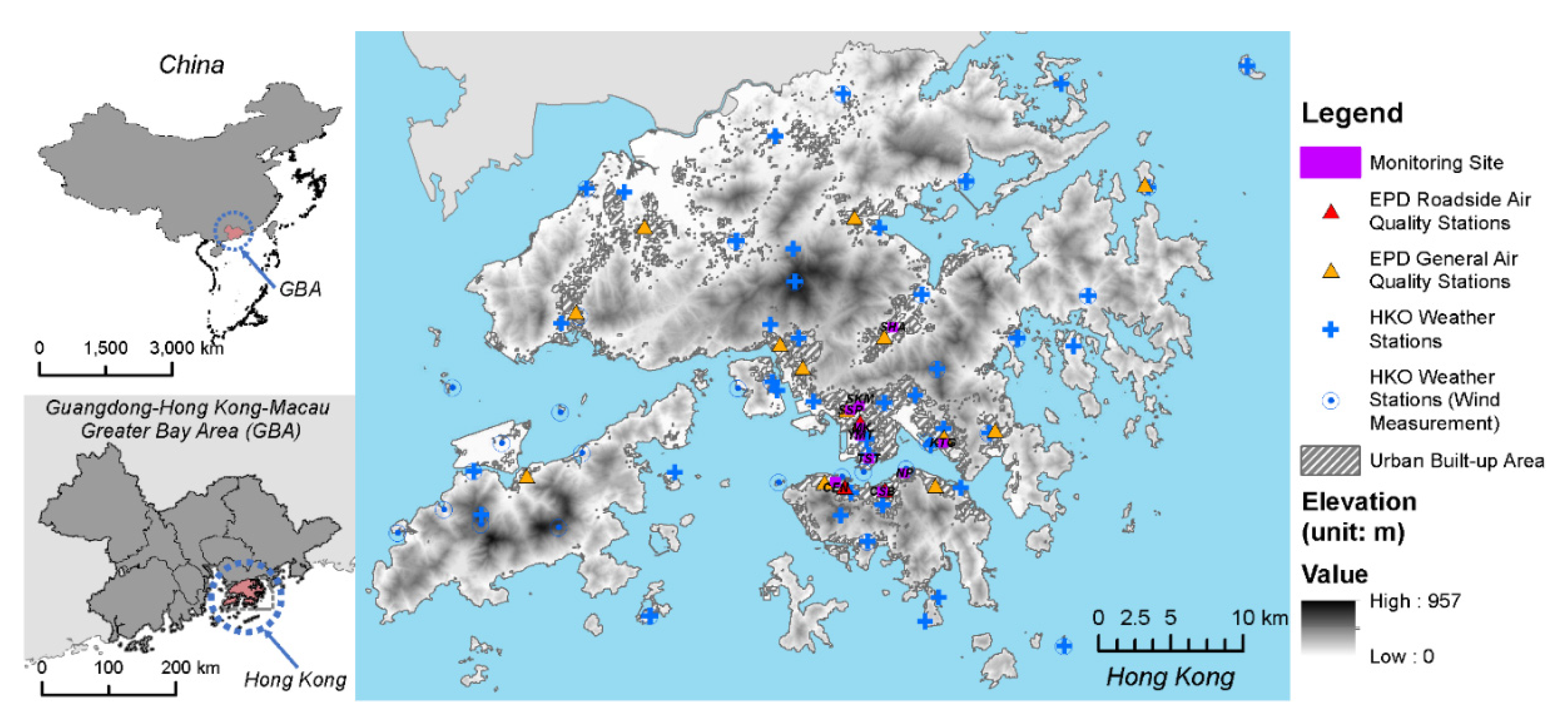
2.1. Study Area
2.2. PM2.5 and AOD Data
2.2.1. Satellite-Derived AOD Data at City Scale
2.2.2. Long-term PM2.5 Monitoring Data at City Scale
2.2.3. In-Situ PM2.5 Sampling at Neighborhood Scale
2.3. Spatial and Temporal Predictor Data
2.3.1. Weather Data and Sounding Data at City Scale
2.3.2. Land-Use, Population, Road Network at City Scale
2.3.3. Road Segment Centrality and Accessibility as Proxy of Traffic Distribution
2.3.4. Building Morphological Data at Neighborhood Scale
2.4. Multiscale Land Use Regression Modeling
2.4.1. City-Scale LUR Modeling and Mapping
2.4.2. Neighborhood-Scale LUR Modeling
3. Results
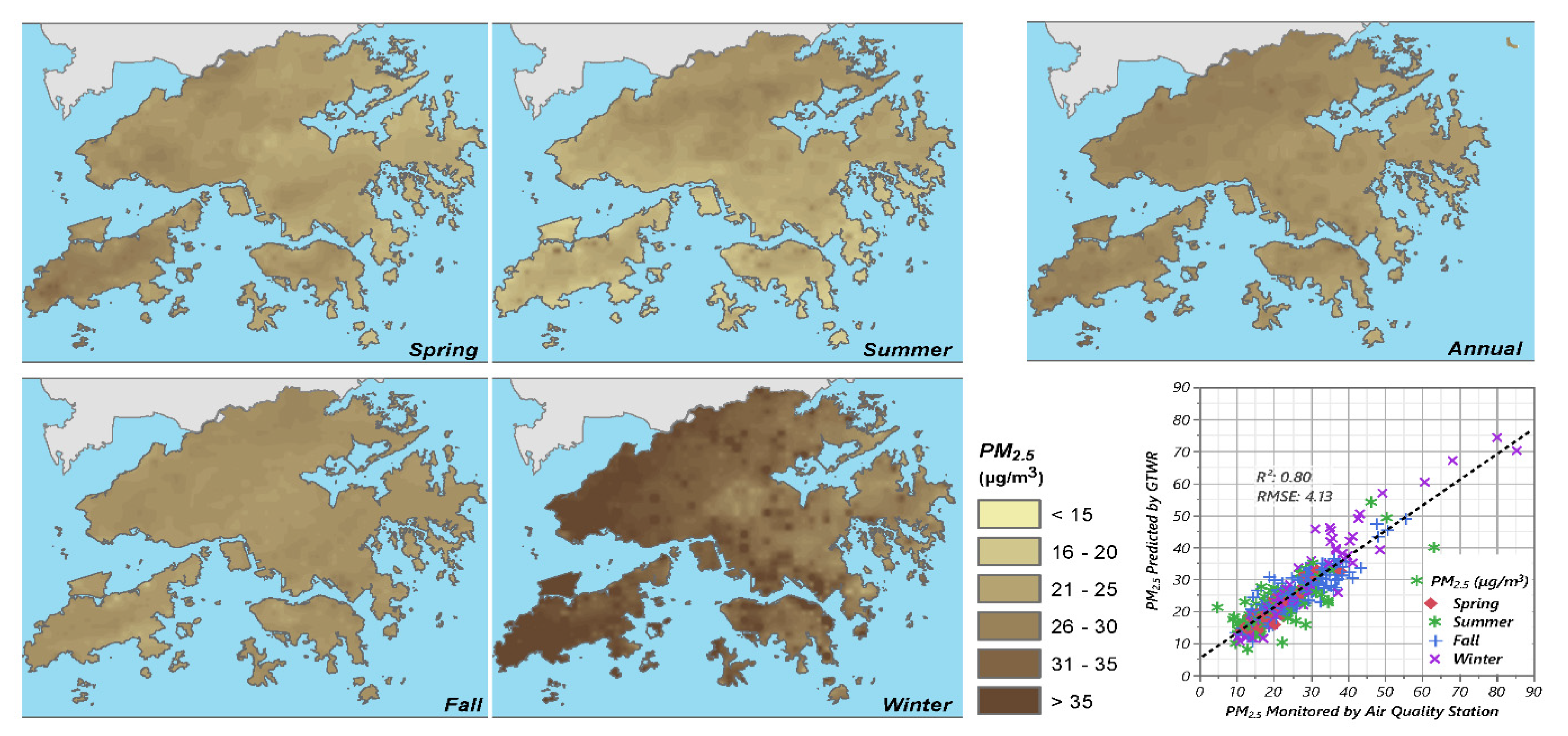
3.1. City-Scale LUR Modeling and Mapping Results
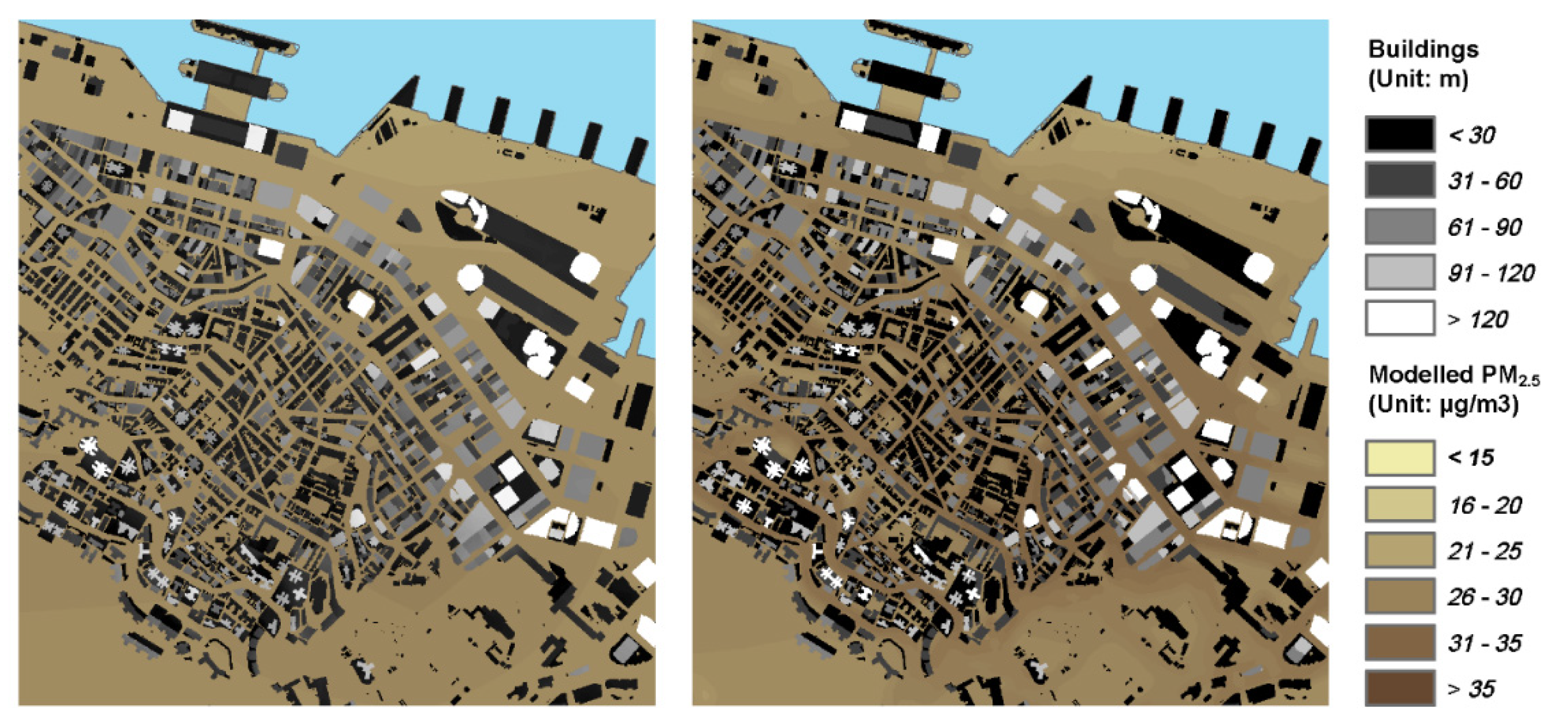
3.2. Neighborhood-Scale LUR Modeling Results
4. Discussion
4.1. At the City-Scale
4.2. At the Neighborhood-Scale
4.3. Limitations and Future Work
5. Conclusions
Supplementary Materials
Author Contributions
Funding
Institutional Review Board Statement
Informed Consent Statement
Data Availability Statement
Acknowledgments
Conflicts of Interest
References
- Coria, J.; Köhlin, G.; Xu, J. On the Use of Market-Based Instruments to Reduce Air Pollution in Asia. Sustainability 2019, 11, 4895. [Google Scholar] [CrossRef] [Scilit]
- Jandaghian, Z.; Akbari, H. The Effect of Increasing Surface Albedo on Urban Climate and Air Quality: A Detailed Study for Sacramento, Houston, and Chicago. Climate 2018, 6, 19. [Google Scholar] [CrossRef] [Scilit]
- Itahashi, S. Air Pollution Modeling: Local, Regional, and Global-Scale Applications. Atmosphere 2021, 12, 178. [Google Scholar] [CrossRef] [Scilit]
- Stern, A.C. Fundamentals of Air Pollution; Elsevier: Amsterdam, The Netherlands, 2014. [Google Scholar]
- Brown, M. Urban Parameterizations for Mesoscale Meteorological Models; Wit Press: Southampton, UK, 2000; pp. 193–255. [Google Scholar]
- Azarov, V.; Barikaeva, N.; Solovyeva, T. Monitoring of fine particulate air pollution as a factor in urban planning decisions. Procedia Eng. 2016, 150, 2001–2007. [Google Scholar] [CrossRef] [Scilit]
- Di Sabatino, S.; Buccolieri, R.; Pulvirenti, B.; Britter, R. Flow and pollutant dispersion in street canyons using fluent and adms-urban. Environ. Model. Assess. 2008, 13, 369–381. [Google Scholar] [CrossRef] [Scilit]
- Janhäll, S. Review on urban vegetation and particle air pollution—Deposition and dispersion. Atmos. Environ. 2015, 105, 130–137. [Google Scholar] [CrossRef] [Scilit]
- Zlatev, Z.; Dimov, I. Computational and Numerical Challenges in Environmental Modelling; Elsevier: Amsterdam, The Netherlands, 2006; Volume 13. [Google Scholar]
- Zannetti, P. Air Pollution Modeling: Theories, Computational Methods, and Available Software; Computational Mechanics Publications: New York, NY, USA, 1990; Volume 20. [Google Scholar]
- Zlatev, Z.; Brandt, J.; Builtjes, P.J.; Carmichael, G.; Dimov, I.; Dongarra, J.; Van Dop, H.; Georgiev, K.; Hass, H.; San José, R. Large Scale Computations in Air Pollution Modelling; Springer Science & Business Media: Berlin/Heidelberg, Germany, 2012; Volume 57. [Google Scholar]
- Holmes, N.S.; Morawska, L. A review of dispersion modelling and its application to the dispersion of particles: An overview of different dispersion models available. Atmos. Environ. 2006, 40, 5902–5928. [Google Scholar] [CrossRef] [Scilit]
- Knowlton, K.; Rosenthal, J.E.; Hogrefe, C.; Lynn, B.; Gaffin, S.; Goldberg, R.; Rosenzweig, C.; Civerolo, K.; Ku, J.-Y.; Kinney, P.L. Assessing ozone-related health impacts under a changing climate. Environ. Health Perspect. 2004, 112, 1557–1563. [Google Scholar] [CrossRef] [Scilit] [PubMed]
- Leelőssy, Á.; Molnár, F.; Izsák, F.; Havasi, Á.; Lagzi, I.; Mészáros, R. Dispersion modeling of air pollutants in the atmosphere: A review. Open Geosci. 2014, 6, 257. [Google Scholar] [CrossRef] [Scilit]
- Tominaga, Y.; Stathopoulos, T. Cfd modeling of pollution dispersion in a street canyon: Comparison between les and rans. J. Wind Eng. Ind. Aerodyn. 2011, 99, 340–348. [Google Scholar] [CrossRef] [Scilit]
- Kalampounias, A.G.; Stamatis, C.; Kaltsonoudis, C.; Bali, N.; Kalarakis, A.; Pandis, S.N. Mapping the Air Quality in the City of Patras by Combining Mobile Platform Measurements and Cfd Simulations; Springer International Publishing: Cham, Switzerland, 2017; pp. 1001–1006. [Google Scholar]
- Jones, A.; Thomson, D.; Hort, M.; Devenish, B. The U.K. Met Office’s Next-Generation Atmospheric Dispersion Model, Name III; Springer: Boston, MA, USA, 2007; pp. 580–589. [Google Scholar]
- Hatzopoulou, M.; Valois, M.F.; Levy, I.; Mihele, C.; Lu, G.; Bagg, S.; Minet, L.; Brook, J. Robustness of land-use regression models developed from mobile air pollutant measurements. Environ. Sci. Technol. 2017, 51, 3938–3947. [Google Scholar] [CrossRef] [Scilit]
- Shi, Y.; Xie, X.; Fung, J.C.-H.; Ng, E. Identifying critical building morphological design factors of street-level air pollution dispersion in high-density built environment using mobile monitoring. Build Environ. 2018, 128, 248–259. [Google Scholar] [CrossRef] [Scilit]
- Di Nicolantonio, W.; Cacciari, A.; Petritoli, A.; Carnevale, C.; Pisoni, E.; Volta, M.; Stocchi, P.; Curci, G.; Bolzacchini, E.; Ferrero, L.; et al. MODIS and OMI satellite observations supporting air quality monitoring. Radiat. Prot. Dosim. 2009, 137, 280–287. [Google Scholar] [CrossRef] [Scilit] [PubMed]
- Fan, Z.; Zhan, Q.; Yang, C.; Liu, H.; Bilal, M. Estimating PM2.5 Concentrations Using Spatially Local Xgboost Based on Full-Covered SARA AOD at the Urban Scale. Remote Sens. 2020, 12, 3368. [Google Scholar] [CrossRef] [Scilit]
- Chudnovsky, A.; Lyapustin, A.; Wang, Y.; Tang, C.; Schwartz, J.; Koutrakis, P. High resolution aerosol data from modis satellite for urban air quality studies. Open Geosci. 2014, 6, 17–26. [Google Scholar] [CrossRef] [Scilit]
- Knibbs, L.D.; Hewson, M.G.; Bechle, M.J.; Marshall, J.D.; Barnett, A.G. A national satellite-based land-use regression model for air pollution exposure assessment in Australia. Environ. Res. 2014, 135, 204–211. [Google Scholar] [CrossRef] [Scilit]
- Ryan, P.H.; LeMasters, G.K. A review of land-use regression models for characterizing intraurban air pollution exposure. Inhal. Toxicol. 2007, 19, 127–133. [Google Scholar] [CrossRef] [Scilit] [PubMed]
- Alvarez-Mendoza, C.I.; Teodoro, A.C.; Torres, N.; Vivanco, V. Assessment of Remote Sensing Data to Model PM10 Estimation in Cities with a Low Number of Air Quality Stations: A Case of Study in Quito, Ecuador. Environments 2019, 6, 85. [Google Scholar] [CrossRef] [Scilit]
- Yang, X.; Zheng, Y.; Geng, G.; Liu, H.; Man, H.; Lv, Z.; He, K.; de Hoogh, K. Development of PM2.5 and NO2 models in a LUR framework incorporating satellite remote sensing and air quality model data in Pearl River Delta region, China. Environ. Pollut. 2017, 226, 143–153. [Google Scholar] [CrossRef] [Scilit]
- Lee, H.J.; Chatfield, R.B.; Strawa, A.W. Enhancing the applicability of satellite remote sensing for pm2.5 estimation using modis deep blue aod and land use regression in california, united states. Environ. Sci. Technol. 2016, 50, 6546–6555. [Google Scholar] [CrossRef] [Scilit] [PubMed]
- Kloog, I.; Koutrakis, P.; Coull, B.A.; Lee, H.J.; Schwartz, J. Assessing temporally and spatially resolved pm2.5 exposures for epidemiological studies using satellite aerosol optical depth measurements. Atmos. Environ. 2011, 45, 6267–6275. [Google Scholar] [CrossRef] [Scilit]
- Ma, X.; Longley, I.; Gao, J.; Kachhara, A.; Salmond, J. A site-optimised multi-scale GIS based land use regression model for simulating local scale patterns in air pollution. Sci. Total Environ. 2019, 685, 134–149. [Google Scholar] [CrossRef] [Scilit] [PubMed]
- Remer, L.A.; Mattoo, S.; Levy, R.C.; Munchak, L.A. Modis 3 km aerosol product: Algorithm and global perspective. Atmos. Meas. Tech. 2013, 6, 1829–1844. [Google Scholar] [CrossRef] [Scilit]
- Lyapustin, A.; Wang, Y.; Korkin, S.; Huang, D. Modis collection 6 maiac algorithm. Atmos. Meas. Tech. 2018, 11, 5741–5765. [Google Scholar] [CrossRef] [Scilit]
- Just, A.C.; Wright, R.O.; Schwartz, J.; Coull, B.A.; Baccarelli, A.A.; Tellez-Rojo, M.M.; Moody, E.; Wang, Y.; Lyapustin, A.; Kloog, I. Using high-resolution satellite aerosol optical depth to estimate daily pm2.5 geographical distribution in Mexico City. Environ. Sci. Technol. 2015, 49, 8576–8584. [Google Scholar] [CrossRef] [Scilit] [PubMed]
- Lyapustin, A.; Wang, Y.; Xiong, X.; Meister, G.; Platnick, S.; Levy, R.; Franz, B.; Korkin, S.; Hilker, T.; Tucker, J. Scientific impact of modis c5 calibration degradation and c6+ improvements. Atmos. Meas. Tech. 2014, 7, 4353–4365. [Google Scholar] [CrossRef] [Scilit]
- Sherman, J.; Gupta, P.; Levy, R.; Sherman, P. An Evaluation of MODIS-Retrieved Aerosol Optical Depth over a Mountainous AERONET Site in the Southeastern US. Aerosol Air Qual. Res. 2017, 16, 3243–3255. [Google Scholar] [CrossRef] [Scilit]
- Lyapustin, A.; Wang, Y. Modis Multi-Angle Implementation of Atmospheric Correction (Maiac) Data User’s Guide; NASA: Greenbelt, MD, USA, 2018. [Google Scholar]
- HKEPD. Air Quality Monitoring Network of Hong Kong. Available online: http://www.aqhi.gov.hk/en/monitoring-network/air-quality-monitoring-network.html (accessed on 9 October 2021).
- Shi, Y.; Ng, E. Fine-scale spatial variability of pedestrian-level particulate matters in compact urban commercial districts in Hong Kong. Int. J. Environ. Res. Public Health 2017, 14, 1008. [Google Scholar] [CrossRef] [Scilit]
- Penwarden, A.D.; Wise, A.F.E. Wind Environment around Buildings; HMSO: Richmond, UK, 1975. [Google Scholar]
- Ramachandran, G.; Adgate, J.L.; Pratt, G.C.; Sexton, K. Characterizing indoor and outdoor 15 minute average pm 2.5 concentrations in urban neighborhoods. Aerosol Sci. Technol. 2003, 37, 33–45. [Google Scholar] [CrossRef] [Scilit]
- Lau, A.; Lo, A.; Gray, J.; Yuan, Z.; Loh, C. Relative Significance of Local vs. Regional Sources: Hong Kong’s Air Pollution; Civic Exchange: Hong Kong, China, 2007. [Google Scholar]
- Shi, Y.; Lau, K.K.-L.; Ng, E. Developing street-level pm2.5 and pm10 land use regression models in high-density hong kong with urban morphological factors. Environ. Sci. Technol. 2016, 50, 8178–8187. [Google Scholar] [CrossRef] [Scilit]
- Ren, C.; Cai, M.; Li, X.; Shi, Y.; See, L. Developing a rapid method for 3-dimensional urban morphology extraction using open-source data. Sustain. Cities Soc. 2020, 53, 101962. [Google Scholar] [CrossRef] [Scilit]
- Su, J.G.; Brauer, M.; Ainslie, B.; Steyn, D.; Larson, T.; Buzzelli, M. An innovative land use regression model incorporating meteorology for exposure analysis. Sci. Total Environ. 2008, 390, 520–529. [Google Scholar] [CrossRef] [Scilit]
- Arain, M.A.; Blair, R.; Finkelstein, N.; Brook, J.R.; Sahsuvaroglu, T.; Beckerman, B.; Zhang, L.; Jerrett, M. The use of wind fields in a land use regression model to predict air pollution concentrations for health exposure studies. Atmos. Environ. 2007, 41, 3453–3464. [Google Scholar] [CrossRef] [Scilit]
- Naughton, O.; Donnelly, A.; Nolan, P.; Pilla, F.; Misstear, B.D.; Broderick, B. A land use regression model for explaining spatial variation in air pollution levels using a wind sector based approach. Sci. Total Environ. 2018, 630, 1324–1334. [Google Scholar] [CrossRef] [Scilit]
- Waller, L.; Gotway, C. Applied Spatial Statistics for Public Health Data; John Wiley & Sons: Hoboken, NJ, USA, 2004. [Google Scholar]
- Tatem, A.J. Worldpop, open data for spatial demography. Sci. Data 2017, 4, 1–4. [Google Scholar] [CrossRef] [Scilit] [PubMed]
- Zhao, F.; Chung, S. Contributing factors of annual average daily traffic in a florida county: Exploration with geographic information system and regression models. Transp. Res. Rec. 2001, 1769, 113–122. [Google Scholar] [CrossRef] [Scilit]
- Selby, B.; Kockelman, K.M. Spatial prediction of traffic levels in unmeasured locations: Applications of universal kriging and geographically weighted regression. J. Transp. Geogr. 2013, 29, 24–32. [Google Scholar] [CrossRef] [Scilit]
- Crucitti, P.; Latora, V.; Porta, S. Centrality measures in spatial networks of urban streets. Phys. Rev. E 2006, 73, 036125. [Google Scholar] [CrossRef] [Scilit]
- Jayasinghe, A.; Sano, K.; Nishiuchi, H. Explaining traffic flow patterns using centrality measures. Int. J. Traffic Transp. Eng. 2015, 5, 134–149. [Google Scholar] [CrossRef] [Scilit]
- Jayasinghe, A.; Sano, K.; Abenayake, C.C.; Mahanama, P.K.S. A novel approach to model traffic on road segments of large-scale urban road networks. MethodsX 2019, 6, 1147–1163. [Google Scholar] [CrossRef] [Scilit]
- Zhang, X.; Ren, A.; Chen, L.; Zheng, X. Measurement and spatial difference analysis on the accessibility of road networks in major cities of china. Sustainability 2019, 11, 4209. [Google Scholar] [CrossRef] [Scilit]
- Giannopoulou, M.; Roukounis, Y.; Stefanis, V. Traffic network and the urban environment: An adapted space syntax approach. Procedia—Soc. Behav. Sci. 2012, 48, 1887–1896. [Google Scholar] [CrossRef] [Scilit]
- Patterson, J.L. Traffic modelling in cities—validation of space syntax at an urban scale. Indoor Built Environ. 2016, 25, 1163–1178. [Google Scholar] [CrossRef] [Scilit]
- Sevtsuk, A.; Mekonnen, M. Urban network analysis. A new toolbox for arcgis. Rev. Int. Géomatique 2012, 22, 287–305. [Google Scholar] [CrossRef] [Scilit]
- Jiang, B. Axwoman 6.3: An Arcgis Extension for Urban Morphological Analysis; University of Gävle: Gävle, Sweden, 2015. [Google Scholar]
- Yuan, C.; Ng, E.; Norford, L.K. Improving air quality in high-density cities by understanding the relationship between air pollutant dispersion and urban morphologies. Build. Environ. 2014, 71, 245–258. [Google Scholar] [CrossRef] [Scilit]
- Su, J.G.; Brauer, M.; Buzzelli, M. Estimating urban morphometry at the neighborhood scale for improvement in modeling long-term average air pollution concentrations. Atmos. Environ. 2008, 42, 7884–7893. [Google Scholar] [CrossRef] [Scilit]
- Watson, I.D.; Johnson, G.T. Graphical estimation of sky view-factors in urban environments. J. Climatol. 1987, 7, 193–197. [Google Scholar] [CrossRef] [Scilit]
- Yuan, C.; Norford, L.; Britter, R.; Ng, E. A modelling-mapping approach for fine-scale assessment of pedestrian-level wind in high-density cities. Build. Environ. 2016, 97, 152–165. [Google Scholar] [CrossRef] [Scilit]
- Krüger, E.L.; Minella, F.O.; Rasia, F. Impact of urban geometry on outdoor thermal comfort and air quality from field measurements in Curitiba, Brazil. Build. Environ. 2011, 46, 621–634. [Google Scholar] [CrossRef] [Scilit]
- Dozier, J.; Frew, J. Rapid calculation of terrain parameters for radiation modeling from digital elevation data. IEEE Trans. Geosci. Remote Sens. 1990, 28, 963–969. [Google Scholar] [CrossRef] [Scilit]
- Clougherty, J.E.; Wright, R.J.; Baxter, L.K.; Levy, J.I. Land use regression modeling of intra-urban residential variability in multiple traffic-related air pollutants. Environ. Health 2008, 7, 17. [Google Scholar] [CrossRef] [Scilit]
- Cheng, V.; Ng, E.; Chan, C.; Givoni, B. Outdoor thermal comfort study in a sub-tropical climate: A longitudinal study based in hong kong. Int. J. Biometeorol. 2012, 56, 43–56. [Google Scholar] [CrossRef] [Scilit]
- Vardoulakis, S.; Fisher, B.E.A.; Pericleous, K.; Gonzalez-Flesca, N. Modelling air quality in street canyons: A review. Atmos. Environ. 2003, 37, 155–182. [Google Scholar] [CrossRef] [Scilit]
- Belcher, S.; Jerram, N.; Hunt, J. Adjustment of a turbulent boundary layer to a canopy of roughness elements. J. Fluid Mech. 2003, 488, 369–398. [Google Scholar] [CrossRef] [Scilit]
- Shi, Y.; Ho, H.C.; Xu, Y.; Ng, E. Improving satellite aerosol optical depth-pm2. 5 correlations using land use regression with microscale geographic predictors in a high-density urban context. Atmos. Environ. 2018, 190, 23–34. [Google Scholar] [CrossRef] [Scilit]
- Song, W.; Jia, H.; Li, Z.; Tang, D.; Wang, C. Detecting urban land-use configuration effects on no2 and no variations using geographically weighted land use regression. Atmos. Environ. 2019, 197, 166–176. [Google Scholar] [CrossRef] [Scilit]
- Widya, L.K.; Hsu, C.-Y.; Lee, H.-Y.; Jaelani, L.M.; Lung, S.-C.C.; Su, H.-J.; Wu, C.-D. Comparison of spatial modelling approaches on pm10 and no2 concentration variations: A case study in surabaya city, indonesia. Int. J. Environ. Res. Public Health 2020, 17, 8883. [Google Scholar] [CrossRef] [Scilit]
- Su, J.G.; Jerrett, M.; Beckerman, B.; Wilhelm, M.; Ghosh, J.K.; Ritz, B. Predicting traffic-related air pollution in los angeles using a distance decay regression selection strategy. Environ. Res. 2009, 109, 657–670. [Google Scholar] [CrossRef] [Scilit]
- Basu, B.; Alam, M.S.; Ghosh, B.; Gill, L.; McNabola, A. Augmenting limited background monitoring data for improved performance in land use regression modelling: Using support vector regression and mobile monitoring. Atmos. Environ. 2019, 201, 310–322. [Google Scholar] [CrossRef] [Scilit]
- Liu, J.; Cai, P.; Dong, J.; Wang, J.; Li, R.; Song, X. Assessment of the dynamic exposure to pm2.5 based on hourly cell phone location and land use regression model in Beijing. Int. J. Environ. Res. Public Health 2021, 18, 5884. [Google Scholar] [CrossRef] [Scilit]
- Bartley, M.; Hanks, E.; Schliep, E.; Soranno, P.; Wagner, T. Identifying and characterizing extrapolation in multivariate response data. PLoS ONE 2019, 14, e0225715. [Google Scholar] [CrossRef] [Scilit] [PubMed]
- Hurvich, C.; Simonoff, J.; Tsai, C. Smoothing parameter selection in nonparametric regression using an improved Akaike information criterion. J. R. Stat. Soc. Ser. B (Stat. Methodol.) 1998, 60, 271–293. [Google Scholar] [CrossRef] [Scilit]
- Bowman, A. An alternative method of cross-validation for the smoothing of density estimates. Biometrika 1984, 71, 353–360. [Google Scholar] [CrossRef]
- Xie, R.; Wei, D.; Han, F.; Lu, Y.; Fang, J.; Liu, Y.; Wang, J. The effect of traffic density on smog pollution: Evidence from Chinese cities. Technol. Forecast. Soc. Change 2019, 144, 421–427. [Google Scholar] [CrossRef] [Scilit]
- Chen, J.; Wang, B.; Huang, S.; Song, M. The influence of increased population density in China on air pollution. Sci. Total Environ. 2020, 735, 139456. [Google Scholar] [CrossRef] [Scilit] [PubMed]
- Lou, C.-R.; Liu, H.-Y.; Li, Y.-F.; Li, Y.-L. Socioeconomic drivers of pm2.5 in the accumulation phase of air pollution episodes in the Yangtze River delta of China. Int. J. Environ. Res. Public Health 2016, 13, 928. [Google Scholar] [CrossRef] [Scilit] [PubMed]
- Ding, Y.; Zhang, M.; Qian, X.; Li, C.; Chen, S.; Wang, W. Using the geographical detector technique to explore the impact of socioeconomic factors on pm2.5 concentrations in China. J. Clean. Prod. 2019, 211, 1480–1490. [Google Scholar] [CrossRef] [Scilit]
- Fung, W.Y.; Wu, R. Relationship between intraseasonal variations of air pollution and meteorological variables in Hong Kong. Ann. GIS 2014, 20, 217–226. [Google Scholar] [CrossRef] [Scilit]
- Yang, J.; Shi, B.; Shi, Y.; Marvin, S.; Zheng, Y.; Xia, G. Air pollution dispersal in high density urban areas: Research on the triadic relation of wind, air pollution, and urban form. Sustain. Cities Soc. 2020, 54, 101941. [Google Scholar] [CrossRef] [Scilit]
- Chudnovsky, A.A.; Koutrakis, P.; Kloog, I.; Melly, S.; Nordio, F.; Lyapustin, A.; Wang, Y.; Schwartz, J. Fine particulate matter predictions using high resolution aerosol optical depth (aod) retrievals. Atmos. Environ. 2014, 89, 189–198. [Google Scholar] [CrossRef] [Scilit]
- Jiao, Y.; Su, M.; Ji, C.; Yang, S.; Zhang, P. How to design fully cooperative policies to abate transboundary air pollution between two highly asymmetric regions: An abnormal incrementalism analysis. J. Clean. Prod. 2021, 278, 124042. [Google Scholar] [CrossRef] [Scilit]
- Planning Department of Hong Kong. Hong Kong 2030+ Planning and Urban Design for a Liveable High-Density City; Planning Department of Hong Kong: Hong Kong, China, 2016. [Google Scholar]

| Data Type | Predictor Variables | Unit | Abbr. | Raw Data Source | Spatial Scale |
|---|---|---|---|---|---|
| Weather data | Air temperature | °C | TEMP | Historical records are publicly accessible from local authorities of weather monitoring—Hong Kong Observatory (HKO) | Temporal-resolved variable with city-scale spatial variability |
| Relative humidity | % | RH | |||
| Wind speed | m/s | WSPD | |||
| Rainfall | mm | RF | |||
| Mean sea level pressure | hPa | MSLP | |||
| Atmospheric soundings | Sounding indices examined in this study are listed in Table S3 of the Supplementary Material | Wyoming Weather Web | Temporal variable | ||
| Land use (Areal fraction of the land use type within certain circular buffer range 1) | Residential land | % | RES | Derived from the open data from the Planning Department of Hong Kong (PlanD) | City scale |
| Commercial land | % | COM | |||
| Industrial land | % | IND | |||
| Government land | % | GOV | |||
| Open space land | % | OPN | |||
| Greening cover ratio | % | GCR | Calculated based on above data | City scale | |
| Geolocation of air quality monitoring stations and weather stations | Longitude | degree | LONG | The GeoInfo Map of Hong Kong | City scale |
| Latitude | degree | LAT | |||
| Elevation above sea level | m | ELEV | |||
| Population | Population density 1 | People/km2 | POP | WorldPop Global Project Population Data | City scale |
| Road network density (For road: Line density of the land use type within certain circular buffer range 1; For bus station: the total number of stations within buffer) | Trunk road/expressways | km/km2 | RD0 | Spatial data layers extracted from Open Street Map (OSM) | City scale |
| Primary road | km/km2 | RD1 | |||
| Secondary road | km/km2 | RD2 | |||
| Tertiary road | km/km2 | RD3 | |||
| Ordinary road | km/km2 | RD4 | |||
| Bus stations | -- | BUS | |||
| Road segment attributes (a set of metrics commonly used as a proxy of the road usage and traffic distribution) | Normalized straightness | -- | STRAIGHT | Calculation based on network centrality analysis | Neighborhood scale (each road segment corresponds to a value) |
| Normalized betweenness | -- | BETWEEN | |||
| Normalized closeness | -- | CLOSE | |||
| Connectivity | -- | CONNECT | Calculation based on Spatial Syntax | ||
| Control value | -- | CONTROL | |||
| Mean depth | -- | MDEPTH | |||
| Global integration | -- | GINTEG | |||
| Local integration | -- | LINTEG | |||
| Building morphological data | Frontal area index 1 | -- | FAI | Calculated from the building dataset produced by Ren, et al. [42] | City scale |
| Point-based FAI | -- | FAIPoint | Neighborhood scale | ||
| Sky view factor | [0–1] | SVF | Neighborhood scale | ||
| Surface roughness length | m | ROUGHNESS | City scale | ||
| Season | Model Structure | AICc | |||
|---|---|---|---|---|---|
| Spring | PM2.5 ~ AOD − LONG + KINX − PWAT | 0.881 | 0.835 | 0.831 | 206.368 |
| Summer | PM2.5 ~ AOD + FAI250 + LAT − KINX − PWAT | 0.566 | 0.504 | 0.497 | 445.211 |
| Fall | PM2.5 ~ AOD + RES500 + BUS400 + TEMP − WSPD + KINX − PWAT | 0.772 | 0.694 | 0.673 | 1145.994 |
| Winter | PM2.5 ~ AOD − LONG + ROUGHNESS50 + CINV + LCLP + LFCV + VTOT | 0.898 | 0.853 | 0.846 | 579.051 |
| Annual | A piecewise linear function is the combination of four seasonal models. Only one of the four models will be selected based on the time. | 0.798 | 0.792 | N.A. | N.A. |
| Predictor Variables | Coefficients | Significant Level | VIF |
|---|---|---|---|
| Intercept | −2.925 × 10⁻¹ | <0.0001 | |
| Normalized betweenness | 1.431 × 10² | <0.0001 | 1.009 |
| Normalized closeness | 3.074 × 10⁵ | <0.0001 | 3.332 |
| Control value | −1.675 × 10⁻¹ | <0.0001 | 2.050 |
| Global integration | 3.749 | <0.0001 | 3.657 |
| Sky view factor | −1.263 × 101 | <0.0001 | 1.959 |
| Point-based FAI | 2.826 | <0.0001 | 1.716 |
Publisher’s Note: MDPI stays neutral with regard to jurisdictional claims in published maps and institutional affiliations. |
© 2021 by the authors. Licensee MDPI, Basel, Switzerland. This article is an open access article distributed under the terms and conditions of the Creative Commons Attribution (CC BY) license (https://creativecommons.org/licenses/by/4.0/).
Share and Cite
Shi, Y.; Lau, A.K.-H.; Ng, E.; Ho, H.-C.; Bilal, M. A Multiscale Land Use Regression Approach for Estimating Intraurban Spatial Variability of PM2.5 Concentration by Integrating Multisource Datasets. Int. J. Environ. Res. Public Health 2022, 19, 321. https://doi.org/10.3390/ijerph19010321
Shi Y, Lau AK-H, Ng E, Ho H-C, Bilal M. A Multiscale Land Use Regression Approach for Estimating Intraurban Spatial Variability of PM2.5 Concentration by Integrating Multisource Datasets. International Journal of Environmental Research and Public Health. 2022; 19(1):321. https://doi.org/10.3390/ijerph19010321
Chicago/Turabian StyleShi, Yuan, Alexis Kai-Hon Lau, Edward Ng, Hung-Chak Ho, and Muhammad Bilal. 2022. "A Multiscale Land Use Regression Approach for Estimating Intraurban Spatial Variability of PM2.5 Concentration by Integrating Multisource Datasets" International Journal of Environmental Research and Public Health 19, no. 1: 321. https://doi.org/10.3390/ijerph19010321
APA StyleShi, Y., Lau, A. K.-H., Ng, E., Ho, H.-C., & Bilal, M. (2022). A Multiscale Land Use Regression Approach for Estimating Intraurban Spatial Variability of PM2.5 Concentration by Integrating Multisource Datasets. International Journal of Environmental Research and Public Health, 19(1), 321. https://doi.org/10.3390/ijerph19010321

