Review

Management of a High-Performing Mental Health Recovery Research Group
School of Health Sciences, Institute of Mental Health, University of Nottingham, Triumph Road, Nottingham NG7 2TU, UK
Int. J. Environ. Res. Public Health 2021, 18(8), 4007; https://doi.org/10.3390/ijerph18084007

Submission received: 26 March 2021 / Revised: 8 April 2021 / Accepted: 9 April 2021 / Published: 11 April 2021

Abstract

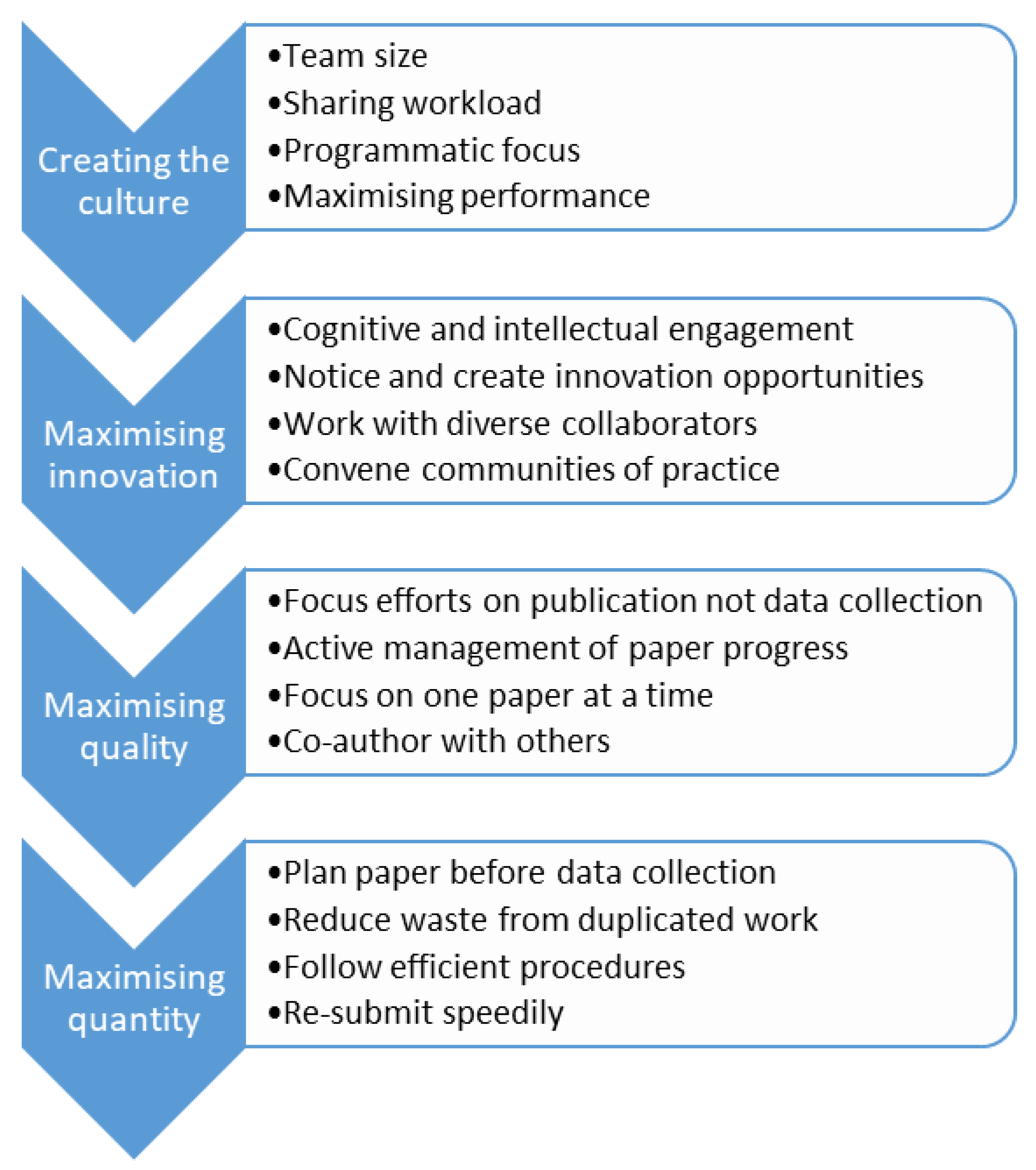
A personal perspective is given on the processes involved in managing and sustaining a high-performing mental health recovery research group. The broader context of scholarship in the United Kingdom is outlined, in which academic productivity is commodified specifically in relation to peer-reviewed journal papers. Four leadership choices in developing a high-performing research group are discussed: optimal group size; sharing the workload; maintaining a programmatic focus; and performance expectations. Approaches to maximising innovation are identified, including emotional and intellectual engagement of team members, working with diverse stakeholders and convening communities of practice. We use a highly managed approach to publications from inception to acceptance, which is described in detail. The use of these approaches is illustrated in relation to the Recovery Research Team which was formed in 2009. Specific recovery-related issues covered include demonstrating the ability to develop a significant recovery research portfolio (our four current large [>UK£2 m] studies relate to recovery narratives, global mental health peer support work, digital interventions and Recovery Colleges); the positive implications of actively recruiting researchers with mental health lived experience; how performance issues are managed; our approach to involving lived experience co-authors in papers; and our decision to conduct mixed-methods rather than solely qualitative studies.
Keywords: mental health; recovery; research management; productivity; lived experience mental health; recovery; research management; productivity; lived experience