


Planning the Future Oral Health Workforce: A Rapid Review of Supply, Demand and Need Models, Data Sources and Skill Mix Considerations

 ,
, 
Abstract
1. Introduction
2. Methods
2.1. Research Question
2.2. Search Strategy
2.3. Eligibility Criteria
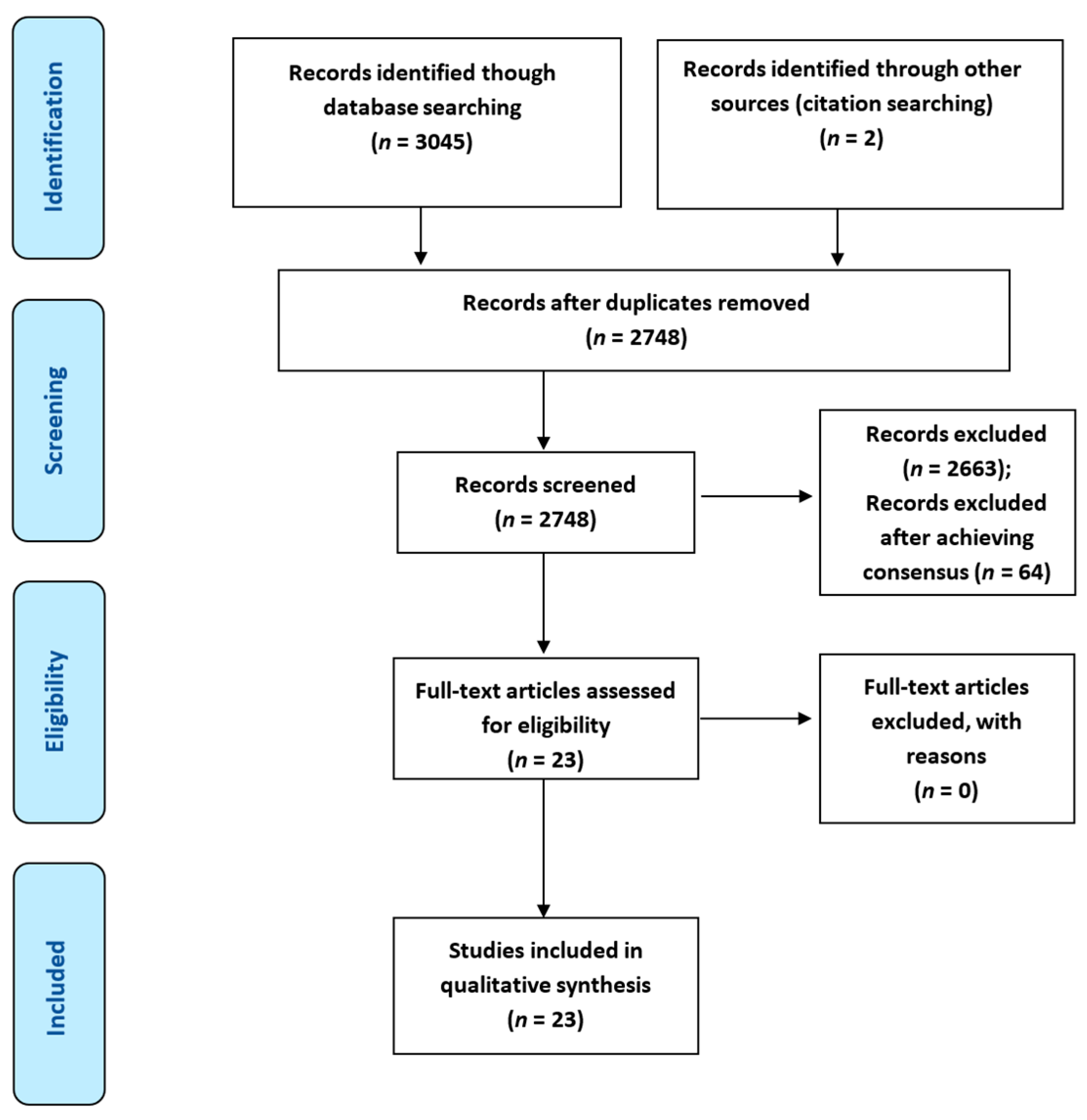
2.4. Study Selection
2.5. Data Extraction, Synthesis and Reporting
3. Results
3.1. Main Study Characteristics
3.2. Detailed Study Characteristics
3.2.1. Supply Models and Data Sources
3.2.2. Demand Models, Population Only Estimates and Data Sources
3.2.3. Needs Models and Data Sources
3.2.4. Skill Mix Considerations
4. Discussion
Limitations
5. Conclusions
Supplementary Materials
Author Contributions
Funding
Institutional Review Board Statement
Informed Consent Statement
Data Availability Statement
Conflicts of Interest
References
- World Health Organization. Framing the Health Workforce Agenda for the Sustainable Development Goals: Biennium Report 2016–2017—WHO Health Workforce. Available online: http://www.who.int/hrh/BienniumReportRevised2017.pdf?ua=1 (accessed on 30 December 2020).
- Campbell, J.; Buchan, J.; Cometto, G.; David, B.; Dussault, G.; Fogstad, H.; Fronteira, I.; Lozano, R.; Nyonator, F.; Pablos-Méndez, A.; et al. Human resources for health and universal health coverage: Fostering equity and effective coverage. Bull. World Health Organ. 2013, 91, 853–863. [Google Scholar] [CrossRef] [Scilit]
- Campbell, J.; Dussault, G.; Buchan, J.; Pozo-Martin, F.; Guerra Arias, M.; Leone, C.; Siyam, A.; Cometto, G.A. A Universal Truth: No Health without a Workforce; World Health Organization: Geneva, Switzerland, 2013. [Google Scholar]
- Hall, T.L.; Mejia, A. Health Manpower Planning: Principles, Methods and Issues; World Health Organisation: Geneva, Switzerland, 2010; pp. 1–146. [Google Scholar]
- Ono, T.; Lafortune, G.; Schoenstein, M. Health workforce planning in OECD countries: A review of 26 projection models from 18 countries. OECD Health Work. Pap. 2013, 62. [Google Scholar] [CrossRef]
- Dreesch, N.; Dolea, C.; Dal Poz, M.R.; Goubarev, A.; Adams, O.; Aregawi, M.; Bergstrom, K.; Fogstad, H.; Sheratt, D.; Linkins, J.; et al. An approach to estimating human resource requirements to achieve the Millennium Development Goals. Health Policy Plan. 2005, 20, 267–276. [Google Scholar] [CrossRef] [Scilit]
- Balasubramanian, M.; Brennan, D.S.; Short, S.D.; Gallagher, J.E. A strife of interests: A qualitative study on the challenges facing oral health workforce policy and planning. Health Policy 2019, 123, 1068–1075. [Google Scholar] [CrossRef] [Scilit] [PubMed]
- Balasubramanian, M.; Davda, L.; Short, S.D.; Gallagher, J.E. Moving from advocacy to activism? The fourth WHO global forum on human resources for health and implications for dentistry. Br. Dent. J. 2018, 225, 119–122. [Google Scholar] [CrossRef] [Scilit] [PubMed]
- Gallagher, J.E.; Wilson, N.H.F. The future dental workforce? Br. Dent. J. 2009, 206, 195–199. [Google Scholar] [CrossRef] [Scilit]
- FDI Word Dental Federation. Optimal Oral Health through Inter-Professional Education and Collaborative Practice. Geneva. 2015. Available online: https://www.fdiworlddental.org/sites/default/files/media/news/collaborative-practice_digital.pdf (accessed on 23 February 2018).
- Balasubramanian, M.; Teusner, D.; Brennan, D. Dental specialists in Australia. Aust. Dent. J. 2010, 55, 96–100. [Google Scholar]
- World Health Organization. Models and tools for health workforce planning and projections. Human Resources for Health Observer – Issue Number 3. Available online: https://www.who.int/hrh/resources/observer3/en/ (accessed on 30 December 2020).
- DeFriese, G.H.; Barker, B.D. Assessing Dental Manpower Requirements: Alternative Approaches for State and Local Planning; Ballinger Publishing Company: Cambridge, MA, USA; Harper & Row Publishers Inc.: New York, NY, USA, 1982; 15 p. [Google Scholar]
- World Health Organization. Dublin Declaration on Human Resources for Health [Internet]. Fourth Global Forum on Human Resources for Health. Dublin, Ireland. Available online: http://www.who.int/hrh/events/Dublin_Declaration-on-HumanResources-for-Health.pdf?ua=1%0Ahttp://www.who.int/hrh/news/2017/action-to-avert-an18-million-health-worker-shortfall/en/ (accessed on 30 December 2020).
- Birch, S.; Ahern, S.; Brocklehurst, P.; Chikte, U.; Gallagher, J.; Listl, S.; Lalloo, R.; O’Malley, L.; Rigby, J.; Tickle, M.; et al. Planning the oral health workforce: Time for innovation. Community Dent. Oral Epidemiol. 2021, 49, 17–22. [Google Scholar] [CrossRef] [Scilit]
- World Health Organization. Global Strategy on Human Resources for Health: Workforce; WHO: Geneva, Switzerland, 2016. [Google Scholar]
- Thomas, J.; Newman, M.; Oliver, S. Rapid evidence assessments of research to inform social policy: Taking stock and moving forward. Évid. Policy J. Res. Debate Pract. 2013, 9, 5–27. [Google Scholar] [CrossRef] [Scilit]
- Khangura, S.; Konnyu, K.; Cushman, R.; Grimshaw, J.; Moher, D. Evidence summaries: The evolution of a rapid review approach. Syst. Rev. 2012, 1, 10. [Google Scholar] [CrossRef] [Scilit] [PubMed]
- Tricco, A.C.; Antony, J.; Zarin, W.; Strifler, L.; Ghassemi, M.; Ivory, J.; Perrier, L.; Hutton, B.; Moher, D.; Straus, S.E. A scoping review of rapid review methods. BMC Med. 2015, 13, 1–15. [Google Scholar] [CrossRef] [Scilit]
- Langlois, E.V.; Straus, S.E.; Antony, J.; King, V.J.; Tricco, A.C. Using rapid reviews to strengthen health policy and systems and progress towards universal health coverage. BMJ Glob. Health 2019, 4, 1–4. [Google Scholar] [CrossRef] [Scilit]
- Haby, M.M.; Chapman, E.; Clark, R.; Barreto, J.; Reveiz, L.; Lavis, J.N. What are the best methodologies for rapid reviews of the research evidence for evidence-informed decision making in health policy and practice: A rapid review. Health Res. Policy Syst. 2016, 14, 1–12. [Google Scholar] [CrossRef] [Scilit] [PubMed]
- Ouzzani, M.; Hammady, H.; Fedorowicz, Z.; Elmagarmid, A. Rayyan—a web and mobile app for systematic reviews. Syst. Rev. 2016, 5, 1–10. [Google Scholar] [CrossRef] [Scilit] [PubMed]
- Ju, X.; Spencer, A.; Brennan, D. ARCPOH (Australian Research Centre for Population Oral Health) The University of Adelaide. Supply and demand for oral and maxillofacial surgeons and services in Australia. Aust. Dent. J. 2010, 55, 346. [Google Scholar]
- Shaw, J.L.; Farmer, J.W.; Coyte, P.C.; Lawrence, H.P. Comparing human resource planning models in dentistry: A case study using Canadian Armed Forces dental clinics. Community Dent. Oral Epidemiol. 2017, 45, 209–215. [Google Scholar] [CrossRef] [Scilit]
- Cartes-Velasquez, R.A. Exponential growth of dental schools in Chile: Effects on academic, economic and workforce issues. Braz. Oral Res. 2013, 27, 471–477. [Google Scholar] [CrossRef] [Scilit]
- Sun, X.; Bernabé, E.; Liu, X.; Zheng, S.; Gallagher, J.E. Meeting the oral health needs of 12-year-olds in China: Human resources for oral health. BMC Public Health 2017, 17, 1–12. [Google Scholar] [CrossRef] [Scilit] [PubMed]
- Zhang, Y.; Lu, Z.; Cheng, R.; Liu, L. Current state of allocation of oral health human resources in northern China and future needs. Int. J. Dent. Hyg. 2015, 13, 268–272. [Google Scholar] [CrossRef] [Scilit]
- Ishimaru, M.; Ono, S.; Yasunaga, H.; Matsui, H.; Koike, S. Projected future distribution of dentists in Japan. J. Public Health Dent. 2016, 76, 241–248. [Google Scholar] [CrossRef] [Scilit] [PubMed]
- Al-Jarallah, K.F.; Moussa, M.A.A.; Al-Duwairi, Y.; Zaatar, E.; Al-Khanfar, K.F. The dentist workforce in Kuwait to the year 2020. Community Dent. Health 2010, 27, 178–183. [Google Scholar] [PubMed]
- Jaiswal, A.K.; Srinivas, P.; Suresh, S. Dental manpower in India: Changing trends since 1920. Int. Dent. J. 2014, 64, 213–218. [Google Scholar] [CrossRef] [Scilit]
- Ahern, S.; Woods, N.; Kalmus, O.; Birch, S.; Listl, S. Needs-based planning for the oral health workforce—Development and ap-plication of a simulation model. Hum. Resour. Health 2019, 17, 1–9. [Google Scholar] [CrossRef] [Scilit]
- Ab-Murat, N.; Sheiham, A.; Tsakos, G.; Watt, R. Periodontal treatment needs and workforce requirements: Comparisons between the normative and sociodental approaches using different skill mix models. Community Dent. Oral Epidemiol. 2014, 43, 106–115. [Google Scholar] [CrossRef] [Scilit] [PubMed]
- Ab-Murat, N.; Sheiham, A.; Watt, R.; Tsakos, G. Treatment needs and skill mix workforce requirements for prosthodontic care: A comparison of estimates using normative and sociodental approaches. Bmc Oral Health 2015, 15, 1–7. [Google Scholar] [CrossRef] [Scilit]
- Gallagher, J.E.; Manickam, S.; Wilson, N.H.F. Sultanate of Oman: Building a dental workforce. Hum. Resour. Health 2015, 13, 50. [Google Scholar] [CrossRef] [Scilit]
- Brailsford, S.; De Silva, D. How many dentists does Sri Lanka need? Modelling to inform policy decisions. J. Oper. Res. Soc. 2015, 66, 1566–1577. [Google Scholar] [CrossRef] [Scilit]
- Huang, C.S.; Cher, T.-L.; Lin, C.-P.; Wu, K.-M. Projection of the dental workforce from 2011 to 2020, based on the actual workload of 6762 dentists in 2010 in Taiwan. J. Formos. Med. Assoc. 2013, 112, 527–536. [Google Scholar] [CrossRef] [Scilit]
- Bourne, C.O. Orthodontic manpower requirements of Trinidad and Tobago. West. Indian Med. J. 2012, 61, 631–634. [Google Scholar]
- Gallagher, J.E.; Kleinman, E.R.; Harper, P.R. Modelling workforce skill-mix: How can dental professionals meet the needs and demands of older people in England? Br. Dent. J. 2010, 208, E6. [Google Scholar] [CrossRef] [Scilit]
- Gallagher, J.E.; Lim, Z.; Harper, P.R. Workforce skill mix: Modelling the potential for dental therapists in state-funded primary dental care. Int. Dent. J. 2013, 63, 57–64. [Google Scholar] [CrossRef] [Scilit] [PubMed]
- Wanyonyi, K.L.; Radford, D.R.; Harper, P.R.; Gallagher, J.E. Alternative scenarios: Harnessing mid-level providers and evi-dence-based practice in primary dental care in England through operational research. Hum. Resour. Health 2015, 13, 1–12. [Google Scholar] [CrossRef] [Scilit] [PubMed]
- Mills, R.W. UK dental care for children—A specialist workforce analysis. Br. Dent. J. 2020, 1–5, 1–5. [Google Scholar] [CrossRef] [Scilit] [PubMed]
- Cao, S.; Gentili, M.; Griffin, P.M.; Griffin, S.O.; Harati, P.; Johnson, B.; Serban, N.; Tomar, S. Estimating Demand for and Supply of Pediatric Preventive Dental Care for Children and Identifying Dental Care Shortage Areas, Georgia. Public Health Rep. 2017, 132, 343–349. [Google Scholar] [CrossRef] [Scilit]
- Eklund, S.A.; Bailit, H.L. Estimating the Number of Dentists Needed in 2040. J. Dent. Educ. 2017, 81, eS146–eS152. [Google Scholar] [CrossRef] [Scilit]
- Saman, D.M.; Arevalo, O.; Johnson, A.O. The dental workforce in Kentucky: Current status and future needs. J. Public Health Dent. 2010, 70, 188–196. [Google Scholar] [CrossRef] [Scilit]
- Surdu, S.; Dall, T.M.; Langelier, M.; Forte, G.J.; Chakrabarti, R.; Reynolds, R.L. The pediatric dental workforce in 2016 and beyond. J. Am. Dent. Assoc. 2019, 150, 609–617.e5. [Google Scholar] [CrossRef] [Scilit]
- Federation, F.W.D. Oral health workforce planning for developed countries. Int. Dent. J. 2005, 55, 42–44. [Google Scholar] [CrossRef] [Scilit] [PubMed]
- Gallagher, J.E.; Hutchinson, L. Analysis of human resources for oral health globally: Inequitable distribution. Int. Dent. J. 2018, 68, 183–189. [Google Scholar] [CrossRef] [Scilit]
- Brennan, D.; Balasubramanian, M.; Spencer, A. Treatment of caries in relation to lesion severity: Implications for minimum intervention dentistry. J. Dent. 2015, 43, 58–65. [Google Scholar] [CrossRef] [Scilit]
- Brennan, D.; Balasubramanian, M.; Spencer, A. Diagnostic services in Australia: Service rates and characteristics of patients. Aust. Dent. J. 2016, 61, 298–303. [Google Scholar] [CrossRef] [Scilit]
- Brennan, D.; Balasubramanian, M.; Spencer, A. Restorative treatment for initial, cavitated and gross coronal carious lesions. Aust. Dent. J. 2016, 61, 350–356. [Google Scholar] [CrossRef] [Scilit]
- Brennan, D.S.; Balasubramanian, M.; Spencer, A.J. Trends in dental service provision in Australia: 1983–1984 to 2009–2010. Int. Dent. J. 2015, 65, 39–44. [Google Scholar] [CrossRef] [Scilit]
- Hillestad, R.; Bigelow, J.; Bower, A.; Girosi, F.; Meili, R.; Scoville, R.; Taylor, R. Can Electronic Medical Record Systems Transform Health Care? Potential Health Benefits, Savings, And Costs. Health Aff. 2005, 24, 1103–1117. [Google Scholar] [CrossRef] [Scilit]
- Baumann, L.A.; Baker, J.; Elshaug, A.G. The impact of electronic health record systems on clinical documentation times: A systematic review. Heal. Policy 2018, 122, 827–836. [Google Scholar] [CrossRef] [Scilit] [PubMed]
- Burton, L.C.; Anderson, G.F.; Kues, I.W. Using Electronic Health Records to Help Coordinate Care. Milbank Q. 2004, 82, 457–481. [Google Scholar] [CrossRef] [Scilit] [PubMed]
- Schleyer, T.K.; Thyvalikakath, T.P.; Spallek, H.; Dziabiak, M.P.; Johnson, L.A. From information technology to informatics: The in-formation revolution in dental education. J. Dent Educ. 2012, 76, 142–153. [Google Scholar] [CrossRef]
- Spallek, H.; Johnson, L.; Kerr, J.; Rankin, D. Costs of health IT: Beginning to understand the financial impact of a dental school EHR. J. Dent. Educ. 2014, 78, 1542–1551. [Google Scholar] [CrossRef] [Scilit] [PubMed]
- Johnson, L.; Callaghan, C.; Balasubramanian, M.; Haq, H.; Spallek, H. Cost Comparison of an On-Premise IT Solution with a Cloud-Based Solution for Electronic Health Records in a Dental School Clinic. J. Dent. Educ. 2019, 83, 895–903. [Google Scholar] [CrossRef] [Scilit]
- Balasubramanian, M.; IADR. International Association for Dental Research, Network for Practice Based Research. 2020. Available online: https://www.iadr.org/IADR/Join-Renew/Groups-Networks/Network-for-Practice-Based-Research (accessed on 10 January 2020).
- Bronkhorst, E.M.; Truin, G.J.; Batchelor, P.; Sheiham, A. Health Through Oral Health; Guidelines for Planning and Monitoring for Oral Health Care. J. Public Health Dent. 1991, 51, 223–227. [Google Scholar] [CrossRef] [Scilit] [PubMed]
- Brocklehurst, P.; Tickle, M. Planning a dental workforce for the future for the National Health Service in the United Kingdom: What factors should be accounted for? Health Educ. J. 2011, 71, 340–349. [Google Scholar] [CrossRef] [Scilit]
- O’Malley, L.; Macey, R.; Allen, T.; Brocklehurst, P.; Thomson, F.; Rigby, J.; Lalloo, R.; Murphy, G.T.; Birch, S.; Tickle, M. Workforce Planning Models for Oral Health Care: A Scoping Review. JDR Clin. Transl. Res. 2020. [Google Scholar] [CrossRef] [Scilit] [PubMed]

| Study No. | Author(s), Year | Aim of Study | Country; WHO Region; World Bank (WB) Group | Workforce Group Modelled | Population Modelled | Model Type |
|---|---|---|---|---|---|---|
| 1 | Ab-Murat N et al., 2015 | To compare estimates of periodontal dental treatment needs and workforce requirements for different skill mix models using normative and sociodental approaches | Malaysia; WHO South East Asian Region; WB Upper Middle Income Group | Dentists and Dental Therapists | Malaysian adults; 30–54 years old | Needs-based |
| 2 | Ab-Murat N et al., 2015 | To estimate and compare prosthodontic treatment needs and workforce requirements, using the normative and the sociodental approaches for different skill mix models | Malaysia; WHO South East Asian Region; WB Upper Middle Income Group | Dentists and Denturists | Malaysian adults; 30–54 years old | Needs-based |
| 3 | Ahern S et al., 2019 | To develop a practical oral health needs based workforce planning simulation tool and apply it in a hypothetical situation using publicly available data in Ireland. | Ireland; WHO European Region; WB High Income Country | Dentists | Irish adults; 15+ years | Needs-based |
| 4 | Al-Jarallah KF et al., 2020 | To describe the size of the dentist workforce in Kuwait between 1994 and 2006, and to project the future demand for dentists, and supply of Kuwaiti dentists for the years 2007–2020 | Kuwait; WHO Eastern Mediterranean Region; WB High Income Country | Dentists | All population in Kuwait | Workforce to population ratio |
| 5 | Bourne CO, 2012 | To estimate the current orthodontic manpower requirements of Trinidad and Tobago | Trinidad and Tobago; WHO American Region; WB High Income Country | Orthodontists | Children; 11 to 12 years | Workforce to population ratio |
| 6 | Brailsford S & De Silva D, 2015 | To develop an operational model for informing policy decisions on number of dentists required in Sri Lanka | Sri Lanka; WHO South Asian Region; WB Lower Middle Income Country | Dentists | All population in Sri Lanka | Needs based demand weighted |
| 7 | Cao S et al., 2017 | To determine the extent of paediatric dental care shortages in Georgia and to develop a general method for estimation that can be applied to other states | USA/Georgia; WHO American Region; WB High Income Country | Dentists; Paediatric dentists; Dental hygienists | Children aged under 18 years in Georgia, USA | Demand based |
| 8 | Cartes-Velásquez RA, 2013 | To review the changes in academic, economic and workforce issues resulting from the growth in the supply of undergraduate dental vacancies between 1997 to 2011 | Chile; WHO American Region; WB High Income Country | Dentists | All population in Chile | Workforce to population ratio |
| 9 | Eklund SA & Bailit HL, 2017 | To examine factors that are linkely to affect the number of US dentists needed in 2040 and compare estimated number of dentists needed in 2040 to current trends. | USA; WHO American Region; WB High Income Country | Dentists | All population in USA | Demand based |
| 10 | Gallagher JE, Kleinman ER & Harper PR, 2010 | To explore the required skill mix of the dental team to meet the future need and demand of older people in England. | UK/England; WHO European Region; WB High Income Country | Dentists; Hygienist; Therapist; Hygienist/Therapist; Clinical Dental Technicians | Older people (65 years) | Needs based, demand weighted |
| 11 | Gallagher JE, Lim Z & Harper PR, 2013 | To explore future scenarios for the use of the skill mix within the dental team to inform the commissioning of dental therapy training. | UK/England/South Central SHA WHO European Region; WB High Income Country | Dentists; Dental therapists | All population based at South Central Strategic Health Authority (SHA), one of the 10 National Health Service (NHS) administrative zones in England. | Needs based, demand weighted |
| 12 | Gallagher JE, Manickam S & Wilson NHF, 2015 | To describe trends in the dental workforce in Oman from 1990 to date; compare the dental workforce with its medical counterparts in Oman and with other countries; to consider future dental workforce in the Sultanate. | Oman; WHO Eastern Mediterranean Region; WB High Income Country | Dentists | All population in Oman | Workforce to population ratio |
| 13 | Huang CS et al., 2013 | To make projections of the dental workforce from 2011 to 2020, based on a survey of the actual workload of 6762 dentists in 2010. | Taiwan; WHO Western Pacific Region; WB High Income Country | Dentists | All population in Taiwan | Workforce to population ratio |
| 14 | Ishimaru M et al., 2016 | To estimate the future distribution of dentists with different working statuses in Japan and to discuss policy implications about the supply of dentists in any country. | Japan; WHO Western Pacific Region; WB High Income Country | Dentists | All population in Japan | Workforce to population ratio |
| 15 | Jaiswal AK et al., 2014 | To analyse the changing trends in dental manpower production in India since 1920 and its development to date, including the number of dental colleges and distribution of trained professionals nationwide. | India; WHO South Asian Region; WB Upper Middle Income Country | Dentists | All population in India, broken by States/Territories. | Workforce to population ratio |
| 16 | Ju X et al., 2010 | To estimate the supply and demand of oral and maxillofacial surgeons and services in Australia | Australia; WHO Western Pacific Region; WB High Income Country | Oral and Maxillo facial surgeons | Overall Australian population | Needs based, demand weighted |
| 17 | Mills RW, 2020 | To gather data and help contribute towards assessing the need for future specialist training places by mapping General Dental Council (GDC)-listed specialists registered in UK postal areas and plotting specialists’ first GDC registration dates. | UK; WHO European Region; WB High Income Country | Dental Specialists | Not available (NA) | Workforce to population ratio |
| 18 | Saman DM, Arevalo O & Johnson AO, 2010 | To assess geographic distribution of dentists in Kentucky; to estimate the future availability of dental providers and provide policy recommendations so as to improve access to oral health care in Kentucky and other rural states | USA/Kentucky; WHO American Region; WB High Income Country | Dentists | All population in Kentucky, USA | Workforce to population ratio |
| 19 | Shaw JL et al., 2017 | To compare two methods of allocating general dentists to Canadian Armed Forces (CAF) dental detachments: a dentist-to-population ratio model and a needs-based model. | Canada; WHO American Region; WB High Income Country | Dentists | Canadian Armed Forces population in catchment areas | Workforce to population ratio |
| 20 | Sun X et al., 2017 | To estimate the required human resources to meet the oral health needs of the WHO reference group of 12-year-olds in China and consider the implications for education, practice, policy and Human Resources for Oral Health nationally | China; WHO Western Pacific Region; WB Upper Middle Income Country | Dentists | Children; 12 year olds | Needs based |
| 21 | Surdu S et al., 2016 | To evaluate the adequacy of the supply of paediatric dentists | USA; WHO American Region; WB High Income Country | Paediatric dentists | Children, all ages | Needs based demand weighted |
| 22 | Wanyonyi KL et al., 2015 | To investigate the potential for skill mix use in primary dental care in England based on the undergraduate training experience in a primary care team training centre for dentists and mid-level dental providers | UK/England; WHO European Region; WB High Income Country | Dentists; Dental therapists | All population (adults and children) in England, who avail NHS public dental care. | Demand based |
| 23 | Zhang Y et al., 2015 | To describe the distribution, structure and allocation of oral health services personnel, evaluate oral health service capacity and predict the future needs for oral health services in northern China. | China; WHO Western Pacific Region; WB Upper Middle Income Country | Dentists | All population based at Liaoning Province, China | Workforce to population ratio |
| Study No. | Author(s), Year | Supply Model | Demand|Needs Model | Modelling Technique | |||
|---|---|---|---|---|---|---|---|
| Existing Stock; Flows; Newly trained; Workforce participation/Full Time Equivalent (FTE) | Data source(s) | Population; Demand|Needs Workforce requirement | Data source(s) | Approach Skill mix | |||
| 1 | Ab-Murat N et al., 2015 | NA | NA | Population: 30–54 year old adults; employees at a public university in Kuala Lumpur, Malaysia (n = 732) Needs: Periodontal treatment needs assessed using Normative and Social Dental Approaches.
| Oral health clinical examination of sample to assess oral health status and periodontal conditions. Face to face questionnaire survey to assess impacts on oral health related quality of life, frequency/severity of impacts, and oral health behaviours. Expert committee consisting of 6 dentists reviewed periodontal procedures and determined minimum and maximum times for periodontal treatments. The annual working hours of 1760 was used to highlight the differences in workforce estimates between the different scenarios | Approach: Dental personnel requirements for both NN and SDA estimated and compared using statistical tests. Comparisons made accounting for minimum and maximum treatment times, and dental personnel required for 100,000 Malaysian adults. Skill mix: Treatment timings for dentists and therapists were taken to be similar. Three scenarios modelled to meet periodontal care under the NN and SDA approaches:
| |
| 2 | Ab-Murat N et al., 2015 | NA | NA | Population: 30–54 year old adults; employees at a public university in Kuala Lumpur, Malaysia (n = 732) Needs: Prosthodontic treatment needs assessed using Normative and Social Dental Approaches.
| Oral health clinical examination of sample to assess oral health status including missing teeth, requirement of dentures or any prosthodontic treatment Face to face questionnaire survey to assess impacts on oral health related quality of life, frequency/severity of impacts, and oral health behaviours. Expert committee consisting of 6 dentists reviewed prosthodontic treatments for dentures and bridges, determined minimum and maximum times for periodontal treatments, 1760 annual working hours. | Approach: Dental personnel requirements for both NN and SDA estimated and compared using statistical tests. Comparisons made accounting for minimum and maximum treatment times, and dental personnel required for 100,000 Malaysian adults. Skill mix: Treatment timings for dentists and denturists were taken to be similar. Three scenarios modelled to meet prosthodontic care under the NN and SDA approaches:
| |
| 3 | Ahern S et al., 2019 | Existing stock: Stock of dentists in Ireland was estimated using registration statistics, which included information such as date of registration, year of qualification and primary qualification. Flows: Inflows were based on three types:
entering employment. Workforce participation/FTE: Participation rate assumed at 95% of all dentists registered, to account for dentists working in non-clinical activity. Further, activity rate was assumed to be at 85% accounting for part time work. All supply, inflow and outflow estimates were adjusted to reflect this activity rate. | Registration data of dentists from Dental Council of Ireland Registration data of dentists from Dental Council of Ireland Dental Schools Data | Population: Adult population of Ireland (15+ years). Age and gender distributions available. Needs: Oral health status mainly identified from four questions used in the population survey:
| Special Eurobarometer 330 Oral Health Survey dataset Special Eurobarometer 330 Oral Health Survey dataset Special Eurobarometer 330 Oral Health Survey dataset | Approach: Provider supply to requirement ratio estimated under four circumstances:
Skill mix: Not identified in the study/approach | |
| 4 | Al-Jarallah KF et al. 2020 | Existing stock Dentist estimates based on registrations data. Workforce participation/FTE: Dentist numbers (Kuwaiti and Non Kuwaiti) were used as proxy for workforce participation. | Dental Licensing Department; Ministry of Health Kuwait; Ministry of Planning Kuwait; Faculty of Dentistry, Kuwait | Population: Overall population of Kuwait was considered, including projections. | Ministry of Health Kuwait; Ministry of Planning Kuwait; Department of Statistics and Medical Records, Kuwait | Approach: Dentist supply numbers available from 1994 to 2006, and were projected for years 2007 to 2020. Similarly, population estimates were also available/projected for the given years. Projected supply estimates and dentist to population ratios accounted for growth in previous years. Shortfall in Kuwaiti dentists (based on annual increase estimates) to overall dentists (based on dentist to population ratio estimates) was projected for the years 2007 to 2020. Skill mix: Not identified in the study/approach | |
| 5 | Bourne CO, 2012 | NA | NA | Population: 11–12 year old childrenDemand: Orthodontic treatment preferences and visits of children were estimated through a population survey. Unclear how total children requiring orthodontic treatment were estimated. Workforce requirement: 9 orthodontists from 11 practices, who have been in practice for 10+ years and practice established 5 years ago were surveyed using a workforce questionnaire. Number of patients treated per year was estimated. Unclear how workforce requirements were limited to the specific age group 11–12 years. | Cross sectional study on orthodontic treatment needs of 11–12 years old children. Questionnaire survey administered to all orthodontists | Approach: Gap in total number of orthodontics required and currently available was identified though a survey based approach. Modelling aspects from the survey findings and how it applies to the specific age group is unclear in the description. A broad orthodontists to children/population approach seems to have applied for modelling. Skill mix: Not identified in the study/approach | |
| 6 | Brailsford S & De Silva D, 2015 | Existing stock: A national register of practising dentists natively prepared using dental registrations from medical council, record matching and panel interviews. Practice activity of dentists Flows: Attrition, Retirement and migration were accounted for in the model. Newly trained: Newly trained dentist practices based on outputs of the single dental school in Sri Lanka. Students were also surveyed on motivations and career expectations. Workforce participation/FTE: Practice activity of dentists surveyed via postal questionnaire, collecting information on socio-demographics, working patterns, hours worked, practice location, and main practice type. Total available clinical hours was estimated. | Sri Lankan Medical Council Registrations; Panel interviews; Dental practice activity survey Student survey | Population: All people in Sri Lanka Demand: FDI/WHO method for estimating services needed for a person, expressed in minutes, is used. Dental disease burden is accounted for in three main categories: caries, periodontal disease, and prosthodontic treatment needs. Local advice sought to identity percentage of people who need care, and who actively express demand for care. Workforce requirement: Timings for dental treatment were estimated via a survey, and treatment times were scaled up for each age groups, and at national level to identify the number of overall treatment hours required. | Sri Lankan Department of Census and Statistics 2003 National Oral Health Survey, Sri Lankan Ministry of Health | Approach: Supply and demands models separately created with the outputs of both models being number of hours available or required. Both these models were superimposed to identify gap in provision of services in treatment hours and number of dentists. A range of supply and demand scenarios were modelled for the years 2010 to 2024. Demand was considered in three main scenarios: low, moderate and high (in hours), and supply estimates were varied based on student intakes, retirements, practice activity restrictions, private sector participation and increased employment opportunities. Skill mix: Not identified in the study/approach | |
| 7 | Cao S et al., 2017 | Existing stock: Number of dental registrations available from local/state government sources. Flows: Not identified in the study/approach Newly trained: Not identified in the study/approach Workforce participation/FTE: Average work hours of 35.2 and 35.6 h accounted for male and female dentists per week. Time spend for the provision of paediatric dental care was estimated for both general dentists at 22% and paediatric dentists at 84%. This provided overall clinical hours available for treating children. | 2015 National Plan and Provider Enumeration System Georgia Board of Dentistry roster for licenses expiring 2010 Survey of Dental Practice | Population: All children in Georgia, USA Demand: Caries risk estimated for children using survey data and prevalence of high risk and low risk children estimated across each census tract (geographic areas). Workforce requirement: Dental care demand per child by age group (0–3, 4–5, 6–7 and 8–18 years) estimated in minutes, and stratified by caries risk. Published data on procedure timings (including MEPS and expert opinions) were used to estimate paediatric treatment need. The timings were estimated for state and each geographic area/county. | 2010 US Census data National Health and Nutrition Examination Survey data Medical Expenditure Panel Survey Expert opinion for treatment timings | Approach: Paediatric work hours were estimated both on supply side and demand side, and superimposed at the geographic level (country) to understand shortage areas. Skill mix: Dental hygienists, general dentists accounted for in the calculation of work hours along with paediatric dentists. | |
| 8 | Cartes-Velásquez RA, 2013 | Existing stock: Current workforce (baseline: 2012) estimated at n = 17,000 dentists. Historical data on number of dentists and graduates available from 1997 to 2011. Flows: Dentist migration and attrition rates were not included in the model. Newly trained: Current number of dental schools and graduates accounted for. Assumptions made that 80% of students in school graduate. Opening of new dental schools not accounted for. Workforce participation/FTE: Number of dentists available in the workforce was estimated based on the available assumptions at 2012, mainly accounting for student graduations. Unclear if any historical data from previous years were used to inform the supply projection model. | Indicadores de Instituciones y Carreras de Edu- cación Superior database of the Consejo Nacional de Educación (Education database from the Ministry of Education, Chile) | Population: Total population in Chile. | Instituto Nacional de Es- tadísticas de Chile (National Statistics Department of Chile) | Approach: Workforce to population ratios were estimated, and gap in dentist numbers and dentist to population ratios were visually described. Historical trends on dental school enrolments and dentist numbers also provided on the supply model.Skill mix: Not identified in the study/approach | |
| 9 | Eklund SA & Bailit HL, 2017 | Existing stock: Number of dentists (n = 195,722) in USA working across private practices, armed forces, hospitals, resident students or others were identified from a survey. Flows: Not identified in the study/approach Newly trained: Not identified in the study/approach Workforce participation/FTE: 70% of all dentists assumed to provide full time care (n = 136,905) at 30 or more hours per week. | American Dental Association Survey Centre | Population: Overall population for current year (2015) and projections for 2040 available. Demand: Previous publications suggest about 42 to 62% of people visit dentist once every year, estimated at 135 to 215 million single dental visits. Workforce requirement: Based on the number of dental visits, dentist requirements are estimated. | National Centre for Health Statistics Previous publications (Manski et al. 2009, 2016) | Approach: Number of FTE dentists available under the supply model and number of FTE dentists required under the demand model were estimated and compared. A range of theoretical assumptions and policy approaches were discussed, but without a modelling exercise. Skill mix: Not identified in the study/approach | |
| 10 | Gallagher JE, Kleinman ER & Harper PR, 2010 | Existing Stock: Supply of dentists, hygienists and therapists (2006: baseline) determined from registrations, survey and NHS data. The shift to dual qualified hygienists and therapists included, with a gradual increase in hygienist numbers. Flows: Short term recruitment drive (n = 1000 dentists) included; Unclear to what extent migration, attrition and return to work is incorporated. Newly trained: Current student completions, as well as increases in student intake for dentists (n = 170) and dental hygienists/therapists training (n = 150) accommodated. Workforce participation/FTE: Percentage of care provided for older people at NHS was estimated at 14% of all activity data. NHS FTE% for dentists was based on 69% of registrations, converting GDC register headcount to practising FTE dentists. NHS FTE for therapists/hygienists was assumed to be at 80% of NHS FTE of dentists. | Dental Practice Board of NHS England and Wales for old General Dental Services (GDS) and old Personal Dental Services (PDS); Primary Care Health Workforce Survey; General Dental Council Registrations | Population: Older people in England UK, aged 65 to 99 years. Demand: Population demographics (age, sex), oral health status (edentate rates), participation and attendance in NHS, and treatments provided included to estimate demand in terms of dentate and edentate treatments. Treatment rates, treatment times and costs were also accommodated for the services provided. Workforce requirement: Total demand was estimated in terms of treatment time (and cost)—also used in determining the FTE dentists and therapists/hygienists required. | UK Adult Dental Survey; The Information Centre UK; UK Government Actuary’s Department Treatment times from the British Dental Association | Approach: Workforce/FTE estimates were calculated using both the supply and demand models, and superimposition of both models identified shortage or surplus. Sensitivity analysis was done via Monte Carlo simulation and linear programming models. Estimates were projected from 2006 (baseline) to 2028. Skill mix: Various skill mix scenarios included that took into account the type of treatments provided by dentists and therapists/hygienists and FTE contribution (and costs). Five scenarios used:
| |
| 11 | Gallagher JE, Lim Z & Harper PR, 2013 | Existing Stock: Dentist and dental therapist numbers were estimated for 1 NHS Administrative Zone: South Central Strategic Health Authority (SHA). Dentist numbers were available for baseline (2007) and past trend was accommodated for future years (2008 and 2013). Therapist numbers based on national dentist to therapist ratio (1:19). Flows: Migration, return to work and attrition were not identified in the model. Newly trained: New dental therapist training places (n = 34) accommodated for projection years 2008 and 2013. Workforce participation/FTE: NHS FTE considered for dentists and therapists; Final estimates are presented in workforce numbers i.e., number of dentists and therapists. | Information Centre UK; NHS South Central SHA; Local survey of skill mix from Buchinghamshire and Milton Keys Dental Workforce Survey | Population: All people at NHS South Central SHA Demand: Oral health trend, and proportion of treatment provided by NHS under 4 bands were available:
Three ages groups (0 to 19 years, 20–64 years and 65+ years) were used to estimate future dental demand. The model was developed with key parameters that affect the changes in needs and demand: demographic changes, oral health trends, dental attendance and proportion of treatments attended by each age group. Workforce requirement: NHS FTE potentially estimated to arrived at workforce numbers to meet demand. | The Information Centre UK; NHS South Central SHA | Approach: Supply and Demand models workforce outputs compared. Linear programming developed to obtain optimal makeup of workforce and project the future requirements of workforce supply. The model took various inputs estimates: treatments, cost/volume of activity, staff type or skill mix. Skill mix: A range of future scenarios were accounted in the models, which took into account use of therapists along with dentists. | |
| 12 | Gallagher JE, Manickam S & Wilson NHF, 2015 | Existing stock: Historical data from registrations/practice of dentists from 1990 to 2012 including stratification by Omani and Expatriate dentists identified. Projects from 2013 to 2020 estimated based on previous years. Flows: Migrant and Omani trained dentists accounted for in the estimates based on previous years. Migration and attrition maintained at constant levels for all years. Newly trained: Addition of new graduates to workforce form Oman Dental College maintained constant (n = 50) Workforce participation/FTE: Number of Oman and expatriate dentists | Ministry of Health Oman; World Health Organization | Population: Overall population of Oman and projections for years 1990 to 2020 available in the study. Population growth continues in an upward trajectory. 1990 to 2012 historical data. Projections 2013 onwards. | Ministry of Health, Oman | Approach: Dentist density or Dentist to population ratios calculated. Ratios—both for Omani dentists and Expatriate dentists. Three projection models were made for dentist to population ratios considered appropriate to meet:
| |
| 13 | Huang CS et al., 2013 | Existing stock: Number of total dentists (n = 11,449) and basic information on each dentist registered in Taiwan retrieved from the database of health personnel. Proportion of female dentists were also taken into account Flows: Attrition, retirement and migration were taken into account, and rate determined based on historical data. Newly trained: Yearly pass rates of dental licensing exam for 2006 to 2010 accounted for and average numbers included in the supply model. This pass rate also took into considerate number of foreign trained dentists. Workforce participation/FTE: Survey to dentists accounts for practice type and work hours, but clinical hours and FTE usage is unclear in the study. Workforce participation is represented as number of dentists available. | Department of Health database on health personnel, Executive Yuan (Taipei, Taiwan) Dentist practice activity survey | Population: All people in Taiwan. Both baseline and projections available from published government reports. Demand: A list of factors identified in the demand model including population change, increase in aged people, economic growth, new technology etc. But unclear on how they were used. Dentist to population ratios are presented as the means of comparing supply and demand | Official government reports of Council for Economic Planning and Development, Executive Yuan (Taipei, Taiwan) | Approach: Dentist to population ratios are estimated across 2010 to 2020. Supply and demand estimates are compared. Skill mix: Not identified in the study/approach | |
| 14 | Ishimaru M et al., 2016 | Existing stock: Number of dentists in Japan was estimated via a survey. Dentists registration number, year of registration, year of birth, sex, main working status, speciality and geographic postcodes of practice location were available from longitudinal survey data (1972 to 2012). Survey data is collected every 2 years. Flows: Retirees were identified as those who did not report to the for two consecutive surveys. Median age of retirees calculated at 65 years, and when dentists reach the retirement age they were considered as retirees. Newly trained: New entrants were identified via the matched cohort at 2012 from NSPDP. Workforce participation/FTE: Work status is identified as 6 main categories: ownership of practice; employed in dental clinic, hospital practice, academic work, and not reported. Workforce participation was represented via dentist numbers based on active registrations and work status. | National Survey of Physicians, Dentists and Pharmacists (NSPDP) for 1972–2012. | Population: Population numbers for Japan for years 1990 to 2012, and 2014 to 2042 used. Both historical estimates and population projections. | National Institute of Population and Social Security Research. | Approach: Dentists to population ratio (involving work status, and male/female dentists differentiators). Dentists work status across the six categories were identified for male and female dentists. Changes in distribution of work status accommodated for selected dentists at 0.5 and 10 years after registration for years 1982, 1992, 2002 and 2012. Probabilities for change in dentists work status were calculate for a wide range of patterns (78 patterns) for age and years of experience. Transition matrix models were developed using Markov chains to estimate future dentists. Skill mix: Not identified in the study/approach | |
| 15 | Jaiswal AK et al., 2014 | Existing stock: Based on dentists registrations across various states/territories. Number of dental institutions in India, undergraduate and postgraduate student positions obtained from the Dental Council of India. Flows: Not identified in the study Newly trained: Undergraduate placements in schools/colleges identified, but separately and not incorporated in the supply model. Workforce participation/FTE: Number of dentists used to identify workforce participation. | Central Bureau of Health Intelligence; Dental Council of India | Population: Population numbers for India, and individually for the States in India identified. | Ministry of Health and Family Welfare; Previous studies via literature | Approach: Dentist to population ratios were estimated using dentist registrations and population numbers, both for India, and individually for each of the States of India. This was determined for one year only (i.e., 2014). Growth in dental college numbers were provided from 1947 to 2014. Trends in increase in number of registered dentists from 1994 to 2012 was also provided separately, but not included as a main component of the modelling. Skill mix: Not identified in the study/approach | |
| 16 | Ju X et al., 2010 | Existing stock: Oral and maxillo facial surgeons (OMFS) estimates were available through from a survey, with information collected from speciality of practice question from a survey. OMFS estimates were available by age, sex and which state/territory they practised in Australia. Flows: Retirement, migration, cessation of practice or death accounted in the model. Attrition rates calculated based on male general dental practitioner wastage rates. Newly trained: Recruitment of OMFS was determined as the average number of completions between the years 2001 and 2005. This estimate was validated by the number trainees currently enrolled in OMFS training programs in Australia. Workforce participation/FTE: Participation was represented by the number of practising oral and maxillo facial surgeons; work status was obtained from the survey to determine practising oral and maxillo facial surgeons. | National Dental Labour Force Survey, 2006 Previous publication on all dentists in Australia for male general practitioner wastage rates; Source unclear for overseas entrants and returned to practice OMFS. Australasian Council of Dental Schools for recruitment vector; | Population: Population data for all Australians. Age specific information was included for 6 age groups. Demand: Six types of oral and maxillo facial services provided were identified: dentoalveolar, trauma, pathology, orthognathic, reconstructive surgery and other. Population estimates for people with oral and maxillo facial conditions were extrapolated based on service provision identified from the survey. Workforce requirement: Estimates on number of oral and maxillo facial surgeons required to meet the number of services estimated were calculated, and applied under different demand growth scenarios. It is unclear if FTE was used, or what is the ratio of surgeons to services utilised for demand. | Australian Bureau of Statistics for population data and projections Previous published reports on practice patterns and oral and maxillo facial services provided to patients. | Approach: Supply and demand models were developed separately and superimposed to identify gap in OMFS services. Both supply and demand projections were estimated from 2007 to 2037. Seven different types of supply scenarios and five different demand scenarios were used in the projection models. These models were later reconciled into three broad types:
| |
| 17 | Mills RW, 2020 | Existing stock: Number of dental specialists across all specialities in the UK were obtained from registrations data for 20 years (1999 to 2019). Postcode of practice location of these specialists were also obtained from the GDC registrations website information. | General Dental Council Specialist Registrations | NA | NA | Approach: Supply data of dental specialists were matched by postcode of practice location. Differences in practice location of specialities and lack of specialists in certain postcode areas were identified. Geographic information system approaches were used. Skill mix: Not identified in the study/approach | |
| 18 | Saman DM, Arevalo O & Johnson AO, 2010 | Existing stock: Dentist numbers were available from registrations, and location of practice mapped. Flows: Incoming and retiring dentists identified (change in results section). Newly trained: Not identified in the study/approach. Workforce participation/FTE: Number of dentists used for workforce participation. | Kentucky Board of Dentistry | Population: All population of Kentucky. | Kentucky State Data Centre | Approach: Dentist to population ratios were projected for each geographic area in Kentucky from 2007 up to 2016. The simulation model includes aspects of geospatial modelling to identify and map the dentist to population ratios. Skill mix: Not identified in the study/approach | |
| 19 | Shaw JL et al., 2017 | Existing stock: Number of dentists, specialists and allied dental practitioners available in the human resources management system. Flows: Not identified in the approach/study Newly trained: Not identified in the approach/study Workforce participation/FTE: FTE was calculated based on standard hours worked by a full time dentist (n = 1229.5 h). The number of clinical hours were adjusted to reflect clinical FTE, and variations in clinical provision adjusted across army ranks. | Human Resource Management System of Canadian Armed Forces (CAF) Canadian Forces Dental Services (CFDS) RESTORE & CFDS Position Charter (Policy documents) | Population: All people living in catchment areas served by the CAF clinics. Demand: Oral health status information of CAF personnel in catchment areas surveyed, along with treatment plan data. Workforce requirement: FTE requirement were estimated based on hours required to meet the demand. | Dental Information System (DentIS) Oral health surveillance data from a cross sectional sample of CAF personnel | Approach: FTE dentist requirements under both workforce to population ratio, and demand models were estimated. This calculation was extended to all geographic areas served under the CAF catchments. Level of FTE dentists agreement between the dentist to population model and demand model were assessed using Intraclass Correlation Coefficient and Bland-Altman plots. Skill mix: Though Skill mix in CAF is identified, only general dentists FTE seen in models presented. | |
| 20 | Sun X et al., 2017 | NA | NA | Population: Children; 12 year olds from 31 provinces of Mainland China, except Tibet. Needs: A representative sample of n = 23,508 children (12 years) clinically examined, and questionnaire survey for n = 12,392. Oral health status measured included dental caries experience and periodontal assessment. Oral health behaviours assessed via questionnaire. Four risk groups identified based on caries and behavioural assessment:
Percentage of care provided for 12 year olds estimated at 1.27 percent. Similar workforce requirement was made for full population in China, based on 12 year olds. | 3rd National Oral Health Survey Panel of nine experts from Peking University for data on timings for dental professionals Previous study (No 22) Wanyonyi et al., 2015 for data on percentage of care for 12 year olds. | Approach: Dental workforce requirements estimated based on a needs informed approach from a national population survey of 12 year olds in China. Percentage of time spent on 12 year olds was estimated, and workforce requirements both for 12 years olds and for all population in China was calculated. Skill mix: Not identified in the study/approach | |
| 21 | Surdu S et al., 2016 | Existing stock: Active paediatric dentists in the United States estimated using the membership data, and a 6% adjustment for non members. Overall n = 6530 paediatric dentists. Flows: Intended retirement age collected via online survey. All dentists were assumed to retire at 75 years. Age dependent attrition rates calculated either based on US mortality rates (for less than 50 years of age) or using survey responses. Annual cross state migration estimated via a logistic regression model using survey data on all dentists younger than 50 years. Unclear if overseas migration, and long term migration has been accounted for. Newly trained: Number of new graduates entering the paediatric dental workforce assumed based on previous publication/data (n = 448; 63.5% female). Age distribution of new graduates calculated based on new members data. Workforce participation/FTE: Information on patient care hours per week collected from an online survey of all paediatric dentists, who were association members with a US postal address. Ordinary least squares regression analysis used to model total weekly patient hours across various practice setting. FTE defined at 32.6 h per week in patient care activities. | American Association for Paediatric dentists membership data; Online survey of paediatric dentistry practice in 2016; Previous publication from American Dental Association (ADA), Health Policy Institute; | Population: Representative sample of child population for each state collected from US Census and Behavioural Risk Factor surveys (n = 656,400). This sample was weighted to represent the population in each state in the US (at national level summed up to 73.6 million children under 17 years of age). The population data contained information on age, sex, race, ethnicity, income, medical insurance and residence. Population projections 2015 to 2030 were made represent these sample characteristics, by scaling up the weights for the individual people in the sample. Demand: Patterns of care from MEPS survey were modelled to understand annual encounters to dental visits, considering age, sex, ethnicity, insurance, and geographic area as explanatory variables. Poisson regression was used to model patterns of annual care. All visits excluding prophylaxis and visits related to orthodontic procedures considered. Workforce requirement: Number of paediatric dentists required to meet supply were estimated to meet the demand, using various scenarios. | American Community Survey; Centre for Disease Control and Prevention 2014 and 2015 Behavioural Risk Factor Surveillance Data; US Mortality Register; Medical Expenditure Panel Survey (MEPS) 2010 to 2014 data. | Approach: Supply model based on a microsimulation approach to model future supply under a range of assumptions. Demand model for services based on patterns of care and visits using a range of population and oral health data. Sensitivity analysis was used for supply estimates; Weighting for both supply and demand estimates; least squares regression to model total weekly patient care hours; logistic regression to model interstate migration; Poisson regression to model annual care; Scenarios to model derived demand for dentists/paediatric dentists. Derived demand for dentists modelled using scenarios based on how workforce requirement will vary based on services and removal of barriers to access. Scenario 1: Continuation of care Scenario 2: Hypothetical—pediatric dentists provide care for all children under 4 years; 80% care for childre 5–12 years, and 20% care for children 13 to 17 years;
| |
| 22 | Wanyonyi KL et al., 2015 | Dentists and mid level providers (dental therapists) are identified as components of the overall model presented, but not accounted in the analysis or study results which focusses on alternative scenarios based on workforce requirements (based on demand but not compared with supply) | General Dental Council | Population: All population in England (both adults and children), who avail public dental care Demand: NHS dental services and treatment provided at a single site at South England were used to estimate age specific treatment rates across all NHS services for England. Timings for treatments were accounted using British Dental Association timings, and verified with expert panel. Total demand was expressed in age specific clinical hours. Workforce requirement: Workforce estimates were calculated based on the basis that dentists spend 0.4 FTE and hygienists/therapists spend 0.3 FTE of clinical hours for NHS work. Overall number of dentists and therapists required was expressed as alternative scenarios accounting for skill mix, and costs. | NHS Electronic Health Records Treatment data (single site at South England) British Dental Association timings for services Expert panel to validate treatment timings Salaries from National Career Service Advice | Approach: Treatment provision or utilisation data used in determining age specific treatment rates and timings of service. The later used to account for dentist/therapist FTE and costs based on skill mix alternative scenarios. Skill mix: Four NHS activity scenarios were used that accounted for delegation of tasks to dental hygienists/therapists:
| |
| 23 | Zhang Y et al., 2015 | Existing stock: Survey of all practices in a single Province in China, including n = 2155 dental practices and n = 8611 oral health personnel (including dentists, nurses and technicians). Education, professional level, area of practice captured in the survey. Flows: Not identified in the study. Newly trained: Not identified in the study. Workforce participation/FTE: Hours worked collected in the survey, but its application towards the supply model is unclear. | Questionnaire survey sent to all dental facilities by Sanitation Bureau and Health Supervision station | Population: All population from a single Province (Liaoning) in China | Survey; Unclear | Approach: Number of dentists per population for the Province estimated (at current levels). Population projection for 2020 and workforce requirements to meet the population at 2020 was determined by using WHO recommended ratios. The gap in dental workforce for future identified, accounting a list of scenarios based on needs, amounts of time worked by dentists and dentist to population ratios Skill mix: Not identified in the study/approach | |
Publisher’s Note: MDPI stays neutral with regard to jurisdictional claims in published maps and institutional affiliations. |
© 2021 by the authors. Licensee MDPI, Basel, Switzerland. This article is an open access article distributed under the terms and conditions of the Creative Commons Attribution (CC BY) license (http://creativecommons.org/licenses/by/4.0/).
Share and Cite
Balasubramanian, M.; Hasan, A.; Ganbavale, S.; Alolayah, A.; Gallagher, J. Planning the Future Oral Health Workforce: A Rapid Review of Supply, Demand and Need Models, Data Sources and Skill Mix Considerations. Int. J. Environ. Res. Public Health 2021, 18, 2891. https://doi.org/10.3390/ijerph18062891
Balasubramanian M, Hasan A, Ganbavale S, Alolayah A, Gallagher J. Planning the Future Oral Health Workforce: A Rapid Review of Supply, Demand and Need Models, Data Sources and Skill Mix Considerations. International Journal of Environmental Research and Public Health. 2021; 18(6):2891. https://doi.org/10.3390/ijerph18062891
Chicago/Turabian StyleBalasubramanian, Madhan, Aliya Hasan, Suruchi Ganbavale, Anfal Alolayah, and Jennifer Gallagher. 2021. "Planning the Future Oral Health Workforce: A Rapid Review of Supply, Demand and Need Models, Data Sources and Skill Mix Considerations" International Journal of Environmental Research and Public Health 18, no. 6: 2891. https://doi.org/10.3390/ijerph18062891
APA StyleBalasubramanian, M., Hasan, A., Ganbavale, S., Alolayah, A., & Gallagher, J. (2021). Planning the Future Oral Health Workforce: A Rapid Review of Supply, Demand and Need Models, Data Sources and Skill Mix Considerations. International Journal of Environmental Research and Public Health, 18(6), 2891. https://doi.org/10.3390/ijerph18062891

