

Quality of Life and Its Correlates in People Serving Prison Sentences in Penitentiary Institutions

Abstract
1. Introduction
2. Materials and Methods
3. Results
3.1. Direct Effects
3.2. Indirect Effects
4. Discussion
Author Contributions
Funding
Institutional Review Board Statement
Informed Consent Statement
Data Availability Statement
Acknowledgments
Conflicts of Interest
References
- World Health Organization (WHO). WHOQOL: Measuring Quality-of-Life; WHO: Geneva, Sitzerland, 1997. [Google Scholar]
- Straś-Romanowska, M. Jakość Życia w Świetle Założeń Psychologii Zorientowanej na Osobę. In Jakość Życia w Badaniach Empirycznych i Refleksji Teoretycznej; Straś-Romanowska, M., Lachowicz-Tabaczek, K., Szmajke, A., Eds.; Wydawnictwo Instytutu Psychologii PAN: Warsaw, Poland, 2005. [Google Scholar]
- Straś-Romanowska, M.; Frąckowiak, T. Rola Relacji Międzyludzkich w Budowaniu Jakości Życia Osób Niepełnosprawnych (Perspektywa Personalistyczno-Egzystencjalna). In Rola Więzi w Rozwoju Dzieci i Młodzieży Niepełnosprawnej; Patkiewicz, J., Ed.; Wydawnictwo TWK: Wroclaw, Poland, 2007. [Google Scholar]
- Coid, J.W. Quality of life for patients detained in hospital. Br. J. Psychiatry 1993, 162, 611–620. [Google Scholar] [CrossRef] [Scilit]
- Williams, D. “Quality of life” as perceived by sex offenders on early release in a halfway house: Implications for treatment. J. Offender Rehabil. 2003, 38, 77–93. [Google Scholar] [CrossRef] [Scilit]
- Dolińska-Zygmunt, G.; Mokrzyńska, K. Personal quality of life factors among imprisoned repeat offenders. Pol. J. Appl. Psychol. 2013, 11, 109–122. [Google Scholar]
- Alzúa, M.L.; Rodríguez, C.; Villa, E. The Quality of Life in Prisons: Do Educational Programs Reduce In-Prison Conflicts? In The Economics of Crime: Lessons for and from Latin America; University of Chicago Press: Chicago, IL, USA, 2010; pp. 239–264. [Google Scholar]
- Van Ginneken, E.F.; Palmen, J.M.H.; Bosma, A.Q.; Nieuwbeerta, P.; Berghuis, M.L. The Life in Custody Study: The quality of prison life in Dutch prison regimes. J. Criminol. Res. Policy Pract. 2018, 4, 253–268. [Google Scholar] [CrossRef] [Scilit]
- Andersen, H. Mental Health in Prison Populations. A review—With special emphasis on a study of Danish prisoners on remand. Acta Psychiatr. Scand. 2004, 110, 5–59. [Google Scholar] [CrossRef] [Scilit] [PubMed]
- Chmielewska-Hampel, A.; Wawrzyniak, M. Depresja, lęk i nadzieja podstawowa u osób odbywających karę więzienia. Psychol. Jakości Życia 2009, 8, 45–58. [Google Scholar]
- Fazel, S.; Seewald, K. Severe mental illness in 33,588 prisoners worldwide: Systematic review and meta-regression analysis. Br. J. Psychiatry 2012, 200, 364–373. [Google Scholar] [CrossRef] [Scilit] [PubMed]
- Brugha, T.; Singleton, N.; Meltzer, H.; Bebbington, P.; Farrell, M.; Jenkins, R.; Coid, J.; Fryers, T.; Melzer, D.; Lewis, G. Psychosis in the Community and in Prisons: A Report from the British National Survey of Psychiatric Morbidity. Am. J. Psychiatry 2005, 162, 774–780. [Google Scholar] [CrossRef] [Scilit] [PubMed]
- Petrila, J.; Ridgely, M.; Borum, R. Debating Outpatient Commitment: Controversy, Trends, and Empirical Data. Crime Delinq. 2003, 49, 157–172. [Google Scholar] [CrossRef] [Scilit]
- Zwemstra, J.; Masthoff, E.D.; Trompenaars, F.J.; De Vries, J. Quality of Life in a Population of Dutch Prisoners with Mental Disorders: Relations with Psychopathological, Social, Demographical, Judicial and Penitentiary Factors. Int. J. Forensic Ment. Health 2009, 8, 186–197. [Google Scholar] [CrossRef] [Scilit]
- Mooney, M.; Hannon, F.; Barry, M.; Friel, S.; Seller, C. Perceived QoL and mental health status of Irish female prisoners. Ir. Med. J. 2002, 95, 241–243. [Google Scholar] [PubMed]
- Black, D.W.; Gunter, T.; Loveless, P.; Allen, J.; Sieleni, B. Antisocial personality disorder in incarcerated offenders: Psychiatric comorbidity and quality of life. Ann. Clin. Psychiatry 2010, 22, 113–120. [Google Scholar]
- Black, D.W.; Gunter, T.; Allen, J.; Blum, N.; Arndt, S.; Wenman, G.; Sieleni, B. Borderline personality disorder in male and female offenders newly committed to prison. Compr. Psychiatry 2007, 48, 400–405. [Google Scholar] [CrossRef] [Scilit]
- Marzano, L.; Hawton, K.; Rivlin, A.; Smith, E.N.; Piper, N.; Fazel, S. Prevention of Suicidal Behavior in Prisons. An Overview of Initiatives Based on a Systematic Review of Research on Near-Lethal Suicide Attempts. Crisis 2016, 37, 323–334. [Google Scholar] [CrossRef] [Scilit]
- Rivlin, A.; Hawton, K.; Marzano, L.; Fazel, S. Psychiatric disorders in male prisoners who made near-lethal suicide attempts: Case-control study. Br. J. Psychiatry 2010, 197, 313–319. [Google Scholar] [CrossRef] [Scilit] [PubMed]
- Marzano, L.; Hawton, K.; Rivlin, A.; Fazel, S. Psychosocial influences on prisoner suicide: A case-control study of near-lethal self-harm in women prisoners. Soc. Sci. Med. 2011, 72, 874–883. [Google Scholar] [CrossRef] [Scilit]
- Rivlin, A.; Hawton, K.; Marzano, L.; Fazel, S. Psychosocial characteristics and social networks of suicidal prisoners: Towards a model of suicidal behaviour in detention. PLoS ONE 2013, 8. [Google Scholar] [CrossRef] [Scilit]
- Liebling, A. Vulnerability and Prison Suicide. Br. J. Criminol. 1995, 35, 173–187. [Google Scholar] [CrossRef] [Scilit]
- Ministerstwo Sprawiedliwości CZSW. Roczna Informacja Statystyczna. 2019; pp. 1–66. Available online: https://www.sw.gov.pl/strona/statystyka-roczna (accessed on 5 February 2021).
- Jacoby, J.E.; Kozie-Peak, B. The benefits of social support for mentally ill offenders: Prison to community transitions. Behav. Sci. Law 1997, 15, 483–501. [Google Scholar] [CrossRef] [Scilit]
- Perez, I.R.; Blanco, J.M.; Lima, A.O.d.L.; Recio, J.C.; Lopez, E.G.; Basanta, J.A.; Castano, J.P. Factors that affect quality of life of prison inmates on antiretroviral treatment. AIDS Care 2006, 18, 433–440. [Google Scholar] [CrossRef] [Scilit]
- Bandura, A. Perceived self-efficacy in cognitive development and functioning. Educ. Psychol. 1993, 28, 117–148. [Google Scholar] [CrossRef] [Scilit]
- Guillamón, N.; Nieto, R.; Pousada, M.; Redolar, D.; Muñoz, E.; Hernández, E.; Boixadós, M.; Gómez-Zúñiga, B. Quality of life and mental health among parents of children with cerebral palsy: The influence of self-efficacy and coping strategies. J. Clin. Nurs. 2013, 22, 1579–1590. [Google Scholar] [CrossRef] [Scilit]
- Motl, R.W.; McAuley, E.; Wynn, D.; Sandroff, B.; Suh, Y. Physical activity, self-efficacy, and health-related quality of life in persons with multiple sclerosis: Analysis of associations between individual-level changes over one year. Qual. Life Res. 2013, 22, 253–261. [Google Scholar] [CrossRef] [Scilit]
- Yazdi-Ravandi, S.; Taslimi, Z.; Jamshidian, N.; Saberi, H.; Shams, J.; Haghparast, A. Prediction of quality of life by self-efficacy, pain intensity and pain duration in patient with pain disorders. Basic Clin. Neurosci. 2013, 4, 11–18. [Google Scholar]
- Quiceno, J.M.; Mateus, J.; Cardenas, M.; Villareal, D.; Vinaccia, S. Quality of life, resilience and suicidal ideation in adolescent victims of sexual abuse. J. Psicopatol. Psicol. Clin. 2013, 18, 107–117. [Google Scholar]
- Boyle, M.P. Relationships between psychosocial factors and quality of life for adults who stutter. Am. J. Speech Lang. Pathol. 2015, 24, 1–12. [Google Scholar] [CrossRef] [Scilit]
- Chung, M.L.; Moser, D.K.; Lennie, T.A.; Frazier, S.K. Perceived social support predicted quality of life in patients with heart failure, but the effect is mediated by depressive symptoms. Qual. Life Res. 2013, 22, 1555–1563. [Google Scholar] [CrossRef] [Scilit]
- Salonen, P.; Rantanen, A.; Kellokumpu-Lehtinen, P.L.; Huhtala, H.; Kaunonen, M. The quality of life and social support in significant others of patients with breast cancer—A longitudinal study. Eur. J. Cancer Care 2014, 23, 274–283. [Google Scholar] [CrossRef] [Scilit]
- Prężyna, W. Funkcja Postawy Religijnej w Osobowości Człowieka; RW KUL: Lublin, Poland, 1981. [Google Scholar]
- Stringer, E.C. “Keeping the faith”: How incarcerated African American mothers use religion and spirituality to cope with imprisonment. J. Afr. Am. Stud. 2009, 13, 325–347. [Google Scholar] [CrossRef] [Scilit]
- Clear, T.R.; Sumter, M.T. Prisoners, prison, and religion. J. Offender Rehabil. 2002, 35, 125–156. [Google Scholar] [CrossRef] [Scilit]
- Maruna, S.; Wilson, L.; Curran, K. Why God is often found behind bars: Prison conversions and the crisis of self-narrative. Res. Hum. Dev. 2006, 3, 161–184. [Google Scholar] [CrossRef] [Scilit]
- Allen, R.S.; Harris, G.M.; Crowther, M.R.; Oliver, J.S.; Cavanaugh, R.; Phillips, L. Does religiousness and spirituality moderate the relations between physical and mental health among aging prisoners? Int. J. Geriatr. Psychiatry 2013, 28, 710–717. [Google Scholar] [CrossRef] [Scilit]
- Lee, M.; Nezu, A.M.; Nezu, C.M. Positive and negative religious coping, depressive symptoms, and quality of life in people with HIV. J. Behav. Med. 2014, 37, 921–930. [Google Scholar] [CrossRef] [Scilit]
- Stroppa, A.; Moreira-Almeida, A. Religiosity, mood symptoms, and quality of life in bipolar disorder. Bipolar Disord. 2013, 15, 385–393. [Google Scholar] [CrossRef] [Scilit] [PubMed]
- Talik, E.; Skowroński, B. The Sense of Quality of Life and Religious Strategies of Coping with Stress in Prison Inmates. J. Relig. Health 2018, 57, 915–937. [Google Scholar] [CrossRef] [Scilit]
- Spielberger, C.D.; Reheiser, E.C. Assessment of emotions: Anxiety, anger, depression, and curiosity. Appl. Psychol. Health Well Being 2009, 1, 271–302. [Google Scholar] [CrossRef] [Scilit]
- Dubayova, T.; Krokavcova, M.; Nagyova, I.; Rosenberger, J.; Gdovinova, Z.; Middel, B.; Groothoff, J.W.; van Dijk, J.P. Type D, anxiety and depression in association with quality of life in patients with Parkinson’s disease and patients with multiple sclerosis. Qual. Life Res. 2013, 22, 1353–1360. [Google Scholar] [CrossRef] [Scilit]
- Oleś, M. Jakość Życia Młodzieży w Zdrowiu i Chorobie; Wydawnictwo KUL: Lublin, Poland, 2010. [Google Scholar]
- Yıkılkan, H.; Aypak, C.; Görpelioğlu, S. Depression, anxiety and quality of life in caregivers of long-term home care patients. Arch. Psychiatr. Nurs. 2014, 28, 193–196. [Google Scholar] [CrossRef] [Scilit]
- Mandzuk, L.L.; McMillan, D.E. A concept analysis of quality of life. J. Orthop. Nurs. 2005, 9, 12–18. [Google Scholar] [CrossRef] [Scilit]
- Pinto, S.; Fumincellic, L.; Mazzoc, A.; Caldeirad, S.; Martinse, J.C. Comfort, well-being and quality of life: Discussion of the differences and similarities among the concepts. Porto Biomed. J. 2017, 2, 6–12. [Google Scholar] [CrossRef] [Scilit]
- Gullone, E.; Jones, T.; Cummins, R. Coping styles and prison experience as predictors of psychological well-being in male prisoners. Psychiatry Psychol. Law 2000, 7, 170–181. [Google Scholar] [CrossRef] [Scilit]
- Machel, H. Wybrane Problemy i Zadania Więziennictwa Polskiego. In Przegląd Więziennictwa Polskiego; Wydawnictwo Centralnego Zarzadu Sluzby Wieziennej Ministerstwa Spawiedliwosci: Warsaw, Poland, 2009; pp. 103–120. [Google Scholar]
- Juczyński, Z. Narzędzia Pomiaru w Promocji i Psychologii Zdrowia; PTP: Warsaw, Poland, 2001. [Google Scholar]
- Ogińska-Bulik, N.; Juczyński, Z. Skala Pomiaru Prężności (SPP-25). Now. Psychol. 2008, 3, 39–56. [Google Scholar]
- Kmiecik-Baran, K. Skala wsparcia społecznego. Teoria i właściwości psychometryczne. Przegląd Psychol. 1995, 38, 201–214. [Google Scholar]
- Tardy, C.H. Social Support Measurement. Am. J. Community Psychol. 1985, 13, 187–202. [Google Scholar] [CrossRef] [Scilit]
- Śliwak, J.; Bartczuk, R.P. Skala Intensywności Postawy Religijnej W. Prężyny. In Psychologiczny Pomiar Religijności; Jarosz, M., Ed.; TN KUL: Lublin, Poland, 2011; pp. 45–72. [Google Scholar]
- Carver, C.S.; Scheier, M.F.; Weintraub, J.K. Assessing coping strategies: A theoretically based approach. J. Pers. Soc. Psychol. 1989, 56, 267–283. [Google Scholar] [CrossRef]
- Juczyński, Z.; Ogińska-Bulik, N. NPSR—Narzędzia Pomiaru Stresu i Radzenia Sobie ze Stresem; Pracownia Testów Psychologicznych: Warsaw, Poland, 2009. [Google Scholar]
- Frąckowiak, T. Personalistyczno-Egzystencjalna Koncepcja Poczucia Jakości Życia. Próba Operacjonalizacji; University of Wrocław: Worclaw, Poland, 2004. [Google Scholar]
- Hu, L.T.; Bentler, P.M. Cutoff criteria for fit indexes in covariance structure analysis: Conventional criteria versus new alternatives. Struct. Equ. Model. Multidiscip. J. 1999, 6, 1–55. [Google Scholar] [CrossRef] [Scilit]
- Pargament, K.I. The Psychology of Religion and Coping: Theory, Research, Practice; The Guilford Press: New York, NY, USA; London, UK, 1997. [Google Scholar]
- Park, C.L. Religion as a meaning- making framework in coping with life stress. J. Soc. Issues 2005, 61, 707–729. [Google Scholar] [CrossRef] [Scilit]
- Ashkar, P.J.; Kenny, D.T. Views from the inside: Young offenders’ subjective experiences of incarceration. Int. J. Offender Ther. Comp. Criminol. 2008, 5, 584–597. [Google Scholar] [CrossRef] [Scilit]
- Van der Kaap-Deeder, J.; Audenaert, E.; Vandevelde, S.; Soenens, B.; Van Mastrigt, S.; Mabbe, E.; Vansteenkiste, M. Choosing when Choices are Limited: The Role of Perceived Afforded Choice and Autonomy in Prisoners’ Well-being. Law Hum. Behav. 2017, 41, 567–578. [Google Scholar] [CrossRef] [Scilit]
- Jaworski, R. Psychologiczna analiza religijności w perspektywie komunikacji interpersonalnej. Stud. Psychol. 2002, 3, 143–166. [Google Scholar]
- Silarova, B.; Nagyova, I.; Rosenberger, J.; Studencan, M.; Ondusova, D.; Reijneveld, S.A.; van Dijk, J.P. Sense of coherence as an independent predictor of health-related quality of life among coronary heart disease patients. Qual. Life Res. 2012, 21, 1863–1871. [Google Scholar] [CrossRef] [Scilit]
- Niewiadomska, I. Zakorzenianie Społeczne Więźniów; Wydawnictwo KUL: Lublin, Poland, 2011. [Google Scholar]
- Niewiadomska, I.; Chwaszcz, J. Jak Skutecznie Zapobiegać Karierze Przestępczej? Drukarnia TEKS: Lublin, Poland, 2010. [Google Scholar]
- Beijersbergen, K.A.; Dirkzwager, A.J.E.; Molleman, T.; van der Laan, P.H.; Nieuwbeerta, P. Procedural justice in prison: The importance of staff characteristics. Int. J. Offender Ther. Comp. Criminol. 2015, 59, 337–358. [Google Scholar] [CrossRef] [Scilit] [PubMed]
- Newberry, M. A synthesis of outcome research at Grendon therapeutic community prison. Ther. Communities 2010, 31, 356–371. [Google Scholar]
- Nolan, J.A.; McEvoy, J.P.; Koenig, H.G.; Hooten, E.G.; Whetten, K.; Pieper, C.F. Religious coping and quality of life among individuals living with schizophrenia. Psychiatr. Serv. 2012, 63, 1051–1054. [Google Scholar] [CrossRef] [Scilit] [PubMed]
- Talik, E. The adolescent religious coping questionnaire. Translation and cultural adaptation of pargament’s RCOPE scale for polish adolescents. J. Relig. Health 2013, 52, 143–158. [Google Scholar] [CrossRef] [Scilit]
- Mandhouj, O.; Aubin, H.; Amirouche, A.; Perroud, N.; Huguelet, P. Spirituality and religion among French prisoners: An effective coping resource? Int. J. Offender Ther. Comp. Criminol. 2014, 58, 821–834. [Google Scholar] [CrossRef] [Scilit] [PubMed]
- Shinkfield, A.J.; Graffam, J. Experience and expression of anger among Australian prisoners and the relationship between anger and reintegration variables. Int. J. Offender Ther. Comp. Criminol. 2014, 58, 435–453. [Google Scholar] [CrossRef] [Scilit]
- Pennington, C.R.; Cramer, R.J.; Miller, H.A.; Anastasi, J.S. Psychopathy, depression, and anxiety as predictors of suicidal ideation in offenders. Death Stud. 2015, 39, 288–295. [Google Scholar] [CrossRef] [Scilit] [PubMed]
- Martin, M.S.; Dorken, S.K.; Simpson, A.I.; McKenzie, K.; Colman, I. The predictive validity of the depression hopelessness suicide screening form for self-injurious or suicidal behaviour among prisoners. J. Forensic Psychiatry Psychol. 2014, 25, 733–747. [Google Scholar] [CrossRef] [Scilit]
- Skowroński, B.; Talik, E. Coping with stress and the sense of quality of life in inmates of correctional facilities. Psychiatr. Pol. 2018, 52, 525–542. [Google Scholar] [CrossRef] [Scilit] [PubMed]
- De Smet, S.; De Donder, L.; Ryan, D.; Van Regenmortel, S.; Brosens, D.; Vandevelde, S. Factors related to the quality of life of older prisoners. Qual. Life Res. 2017, 26, 1571–1585. [Google Scholar] [CrossRef] [Scilit]
- Taiwo, J. A Commentary on the Relationship between self-efficacy, problem-focused coping and performance. Behav. Sci. Undergrad. J. 2015, 2, 37–41. [Google Scholar] [CrossRef] [Scilit]
- Hsieh, P.; Sullivan, J.R.; Sass, D.A.; Guerra, N.S. Undergraduate engineering students’ beliefs, coping strategies, and academic performance: An evaluation of the theoretical models. J. Exp. Educ. 2012, 80, 196–218. [Google Scholar] [CrossRef] [Scilit]
- Shen, Y.E. Relationships between self-efficacy, social support and stress coping strategies in Chinese primary and secondary school teachers. Stress Health J. Int. Soc. Investig. Stress 2009, 25, 129–138. [Google Scholar] [CrossRef] [Scilit]
- Secades, X.G.; Molinero, O.; Salguero, A.; Barquín, R.R.; de la Vega, R.; Márquez, S. Relationship Between Resilience and Coping Strategies in Competitive Sport. Percept. Mot. Skills 2016, 122, 336–349. [Google Scholar] [CrossRef] [Scilit]
- Ano, G.G.; Vasconcelles, E.B. Religious coping and psychological adjustment to stress: A meta-analysis. J. Clin. Psychol. 2005, 61, 461–480. [Google Scholar] [CrossRef] [Scilit]
- Harrison, M.O.; Koenig, H.G.; Hays, J.C. The epidemiology of religious coping: A review of recent literature. Special issue: Religion and psychiatry. Int. Rev. Psychiatry 2001, 13, 86–93. [Google Scholar] [CrossRef] [Scilit]
- Zeenah, A.; Ward, C. Stress, Religious Coping and Wellbeing in Acculturating Muslims. J. Muslim Ment. Health 2016, 10, 3–26. [Google Scholar]
- Fredrickson, B.; Joiner, T. Positive emotions trigger upward spirals toward emotional well-being. Psychol. Sci. 2002, 13, 172–175. [Google Scholar] [CrossRef] [Scilit]
- Borkovec, T.D.; Ray, W.J.; Stöber, J. Worry: A cognitive phenomenon intimately linked to affective, physiological, and interpersonal behavioral processes. Cogn. Ther. Res. 1998, 22, 561–576. [Google Scholar] [CrossRef] [Scilit]
- Eshuys, D.; Smallbone, S. Religious affiliations among adult sexual offenders. Sex. Abus. J. Res. Treat. 2006, 18, 279–288. [Google Scholar] [CrossRef] [Scilit]
- O’Connor, T. Prison Religion in Action and Its Influence on Offender Rehabilitation. J. Offender Rehabil. 2002, 35, 11–33. [Google Scholar] [CrossRef] [Scilit]

| M | SD | Min. | Max. | |||
|---|---|---|---|---|---|---|
| Global QoL | 2.99 | 0.37 | 1.55 | 3.85 | ||
| Positive correlates | self-efficacy | 30.7 | 5.55 | 10 | 40 | |
| social support | 84 | 14.87 | 31 | 116 | ||
| general level of resilience | 68.7 | 18.67 | 0 | 100 | ||
| intensity of religious attitude | 88 | 24.48 | 20 | 140 | ||
| Negative correlates | states | SPI anxiety | 21.1 | 5.58 | 10 | 40 |
| SPI anger | 20.2 | 7.12 | 10 | 40 | ||
| SPI depression | 20.6 | 5.85 | 10 | 40 | ||
| traits | TPI anxiety | 21.5 | 4.53 | 10 | 37 | |
| TPI anger | 21.4 | 6.43 | 10 | 40 | ||
| TPI depression | 20.2 | 5.28 | 10 | 40 | ||
| M | SD | Min. | Max. | |
|---|---|---|---|---|
| Active coping | 10.7 | 2.62 | 4 | 16 |
| Planning | 11.1 | 2.88 | 4 | 16 |
| Seeking social support for instrumental reasons | 10.5 | 2.83 | 4 | 16 |
| Seeking social support for emotional reasons | 9.8 | 2.83 | 4 | 16 |
| Suppression of competing activities | 10.4 | 2.56 | 4 | 16 |
| Turning to religion | 8.2 | 3.34 | 4 | 16 |
| Positive reinterpretation and growth | 10.5 | 2.70 | 4 | 16 |
| Restraint | 9.9 | 2.42 | 4 | 16 |
| Acceptance | 9.7 | 2.69 | 4 | 16 |
| Focus on and venting of emotions | 9.8 | 2.59 | 4 | 16 |
| Denial | 7.9 | 2.83 | 4 | 16 |
| Mental disengagement (Self-distraction) | 8.6 | 2.45 | 4 | 16 |
| Behavioral disengagement | 7.6 | 2.68 | 4 | 16 |
| Substance use | 7.8 | 3.47 | 4 | 16 |
| Humor | 7.9 | 2.82 | 4 | 16 |
| Social Support | Resilience | Intensity of Religious Attitude | SPI Anxiety | SPI Anger | SPI Depression | TPI Anxiety | TPI Anger | TPI Depression | Self-Efficacy | |
|---|---|---|---|---|---|---|---|---|---|---|
| QoL | 0.565 ** | 0.585 ** | 0.385 ** | −0.524 ** | −0.521 ** | −0.605 ** | −0.508 ** | −0.344 ** | −0.621 ** | 0.489 ** |
| Social support | 1 | 0.398 ** | 0.261 ** | −0.498 ** | −0.471 ** | −0.482 ** | −0.496 ** | −0.369 ** | −0.501 ** | 0.283 ** |
| Resilience | 1 | 0.223 ** | −0.493 ** | −0.392 ** | −0.532 ** | −0.425 ** | −0.231 ** | −0.566 ** | 0.463 ** | |
| Intensity of Religious Attitude | 1 | −0.180 ** | −0.172 ** | −0.181 ** | −0.081 | −0.135 ** | −0.168 ** | 0.174 ** | ||
| SPI Anxiety | 1 | 0.743 ** | 0.863 ** | 0.757 ** | 0.517 ** | 0.771 ** | −0.272 ** | |||
| SPI Anger | 1 | 0.666 ** | 0.586 ** | 0.651 ** | 0.604 ** | −0.225 ** | ||||
| SPI Depression | 1 | 0.740 ** | 0.467 ** | 0.808 ** | −0.317 ** | |||||
| TPI Anxiety | 1 | 0.590 ** | 0.771 ** | −0.277 ** | ||||||
| TPI Anger | 1 | 0.476 ** | −0.118 * | |||||||
| TPI Depression | 1 | −0.286 ** | ||||||||
| Self-efficacy | 1 |
| QoL | |
|---|---|
| Active coping | 0.417 ** |
| Planning | 0.498 ** |
| Seeking social support for instrumental reasons | 0.262 ** |
| Seeking social support for emotional reasons | 0.328 ** |
| Suppression of competing activities | 0.310 ** |
| Turning to religion | ns. |
| Positive reinterpretation and growth | 0.425 ** |
| Restraint | 0.172 ** |
| Acceptance | 0.135 ** |
| Focus on and venting of emotions | ns. |
| Denial | −0.327 ** |
| Mental disengagement (Self-distraction) | −0.181 ** |
| Behavioral disengagement | −0.379 ** |
| Substance use | −0.395 ** |
| Humor | −0.242 ** |
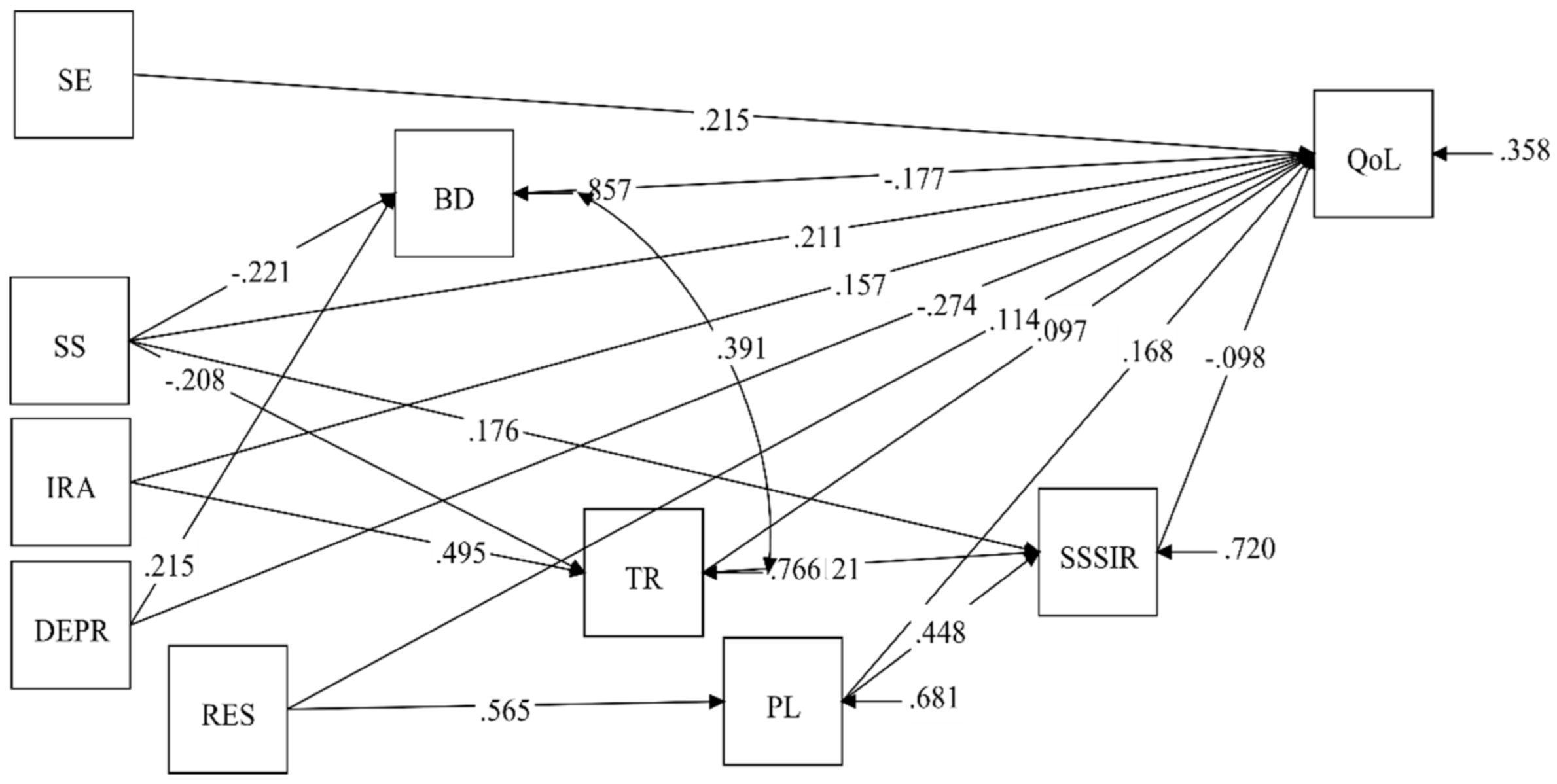
| Estimate | SE | Est./SE | R2 | |
|---|---|---|---|---|
| Quality of life | 0.642 | |||
| Self-efficacy | 0.215 *** | 0.035 | 6.165 | |
| Social support | 0.211 *** | 0.038 | 5.563 | |
| Depression (trait) | −0.274 *** | 0.040 | −6.786 | |
| Resiliency | 0.114 ** | 0.043 | 2.626 | |
| Behavioral disengagement | −0.177 *** | 0.036 | −4.922 | |
| Turning to religion | 0.097 * | 0.038 | 2.531 | |
| Planning | 0.168 *** | 0.042 | 3.980 | |
| Intensity of religious attitude | 0.157 *** | 0.037 | 4.237 | |
| Seeking social support for instrumental reasons | −0.098 ** | 0.036 | −2.702 | |
| Turning to religion | 0.234 | |||
| Intensity of religious attitude | 0.495 *** | 0.038 | 12.868 | |
| Social support | −0.208 *** | 0.045 | −4.610 | |
| Behavioral disengagement | 0.143 | |||
| Social support | −0.221 *** | 0.052 | −4.266 | |
| Depression (trait) | 0.215 *** | 0.049 | 4.352 | |
| Planning | 0.319 | |||
| Resiliency | 0.565 *** | 0.034 | 16.396 | |
| Seeking social support for instrumental reasons | 0.280 | |||
| Turning to religion | 0.121 ** | 0.044 | 2.770 | |
| Planning | 0.448 *** | 0.043 | 10.521 | |
| Social support | 0.176 *** | 0.046 | 3.831 | |
Publisher’s Note: MDPI stays neutral with regard to jurisdictional claims in published maps and institutional affiliations. |
© 2021 by the authors. Licensee MDPI, Basel, Switzerland. This article is an open access article distributed under the terms and conditions of the Creative Commons Attribution (CC BY) license (http://creativecommons.org/licenses/by/4.0/).
Share and Cite
Skowroński, B.; Talik, E. Quality of Life and Its Correlates in People Serving Prison Sentences in Penitentiary Institutions. Int. J. Environ. Res. Public Health 2021, 18, 1655. https://doi.org/10.3390/ijerph18041655
Skowroński B, Talik E. Quality of Life and Its Correlates in People Serving Prison Sentences in Penitentiary Institutions. International Journal of Environmental Research and Public Health. 2021; 18(4):1655. https://doi.org/10.3390/ijerph18041655
Chicago/Turabian StyleSkowroński, Bartłomiej, and Elżbieta Talik. 2021. "Quality of Life and Its Correlates in People Serving Prison Sentences in Penitentiary Institutions" International Journal of Environmental Research and Public Health 18, no. 4: 1655. https://doi.org/10.3390/ijerph18041655
APA StyleSkowroński, B., & Talik, E. (2021). Quality of Life and Its Correlates in People Serving Prison Sentences in Penitentiary Institutions. International Journal of Environmental Research and Public Health, 18(4), 1655. https://doi.org/10.3390/ijerph18041655

