Effects of COVID-19 on Urban Population Flow in China


Abstract
1. Introduction
2. Materials and Methods
2.1. Data Sources
2.2. Research Framework and Methods
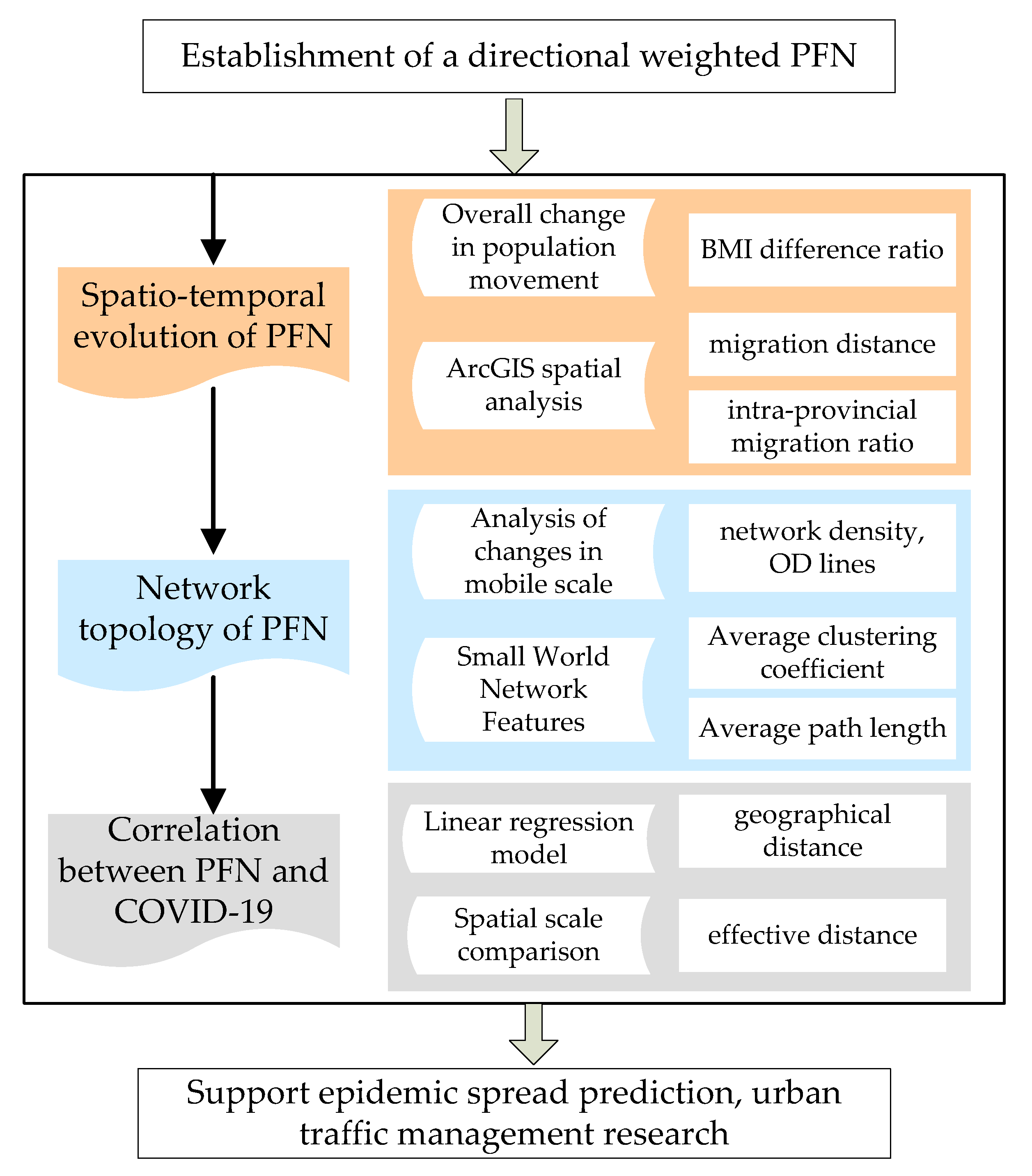
2.2.1. Overall Methodological Framework
2.2.2. Social Network Analysis
2.2.3. Effective Distance
3. Evolution Pattern of PFN
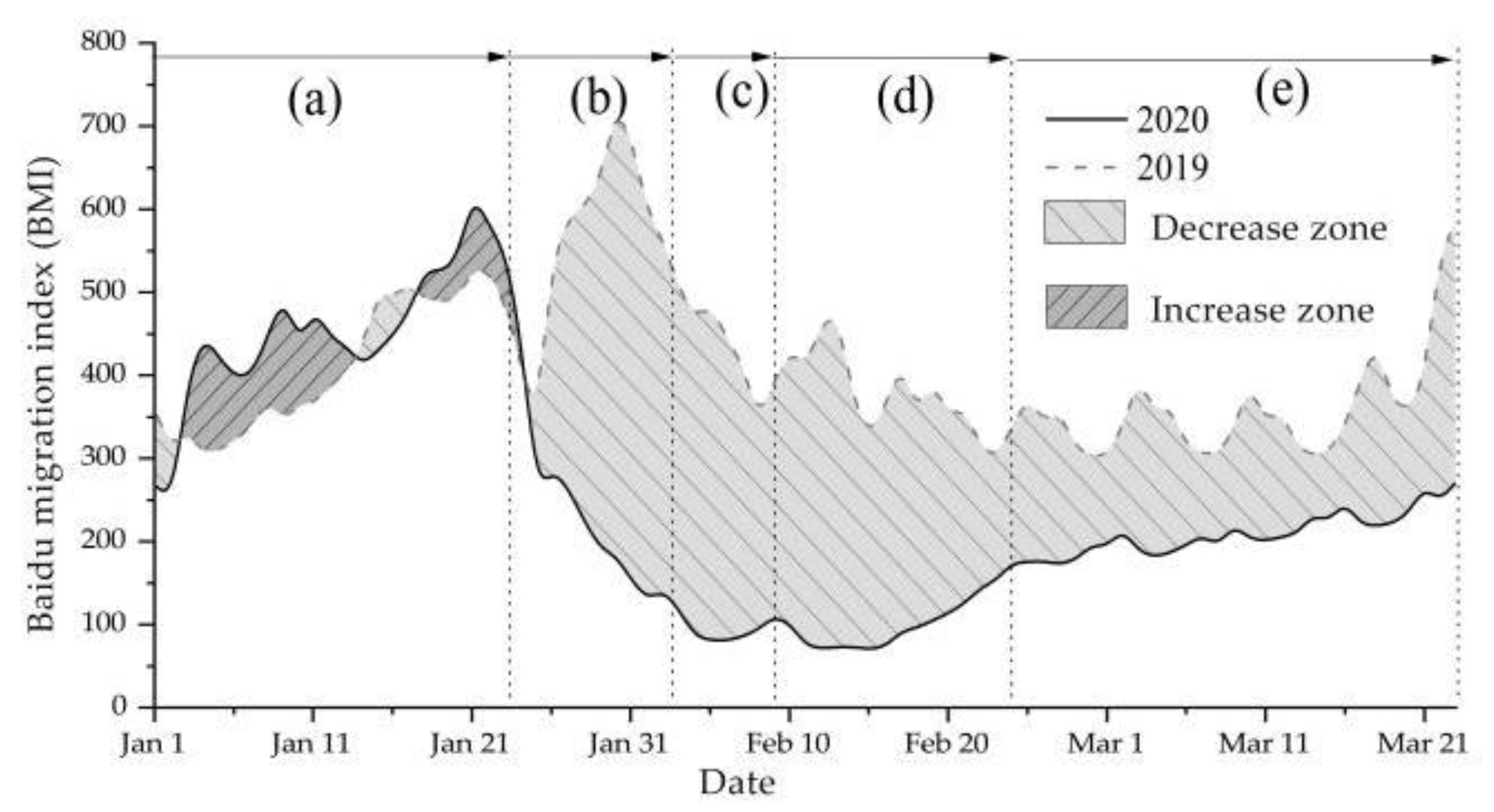
3.1. Changes in the Scale of Population Mobility
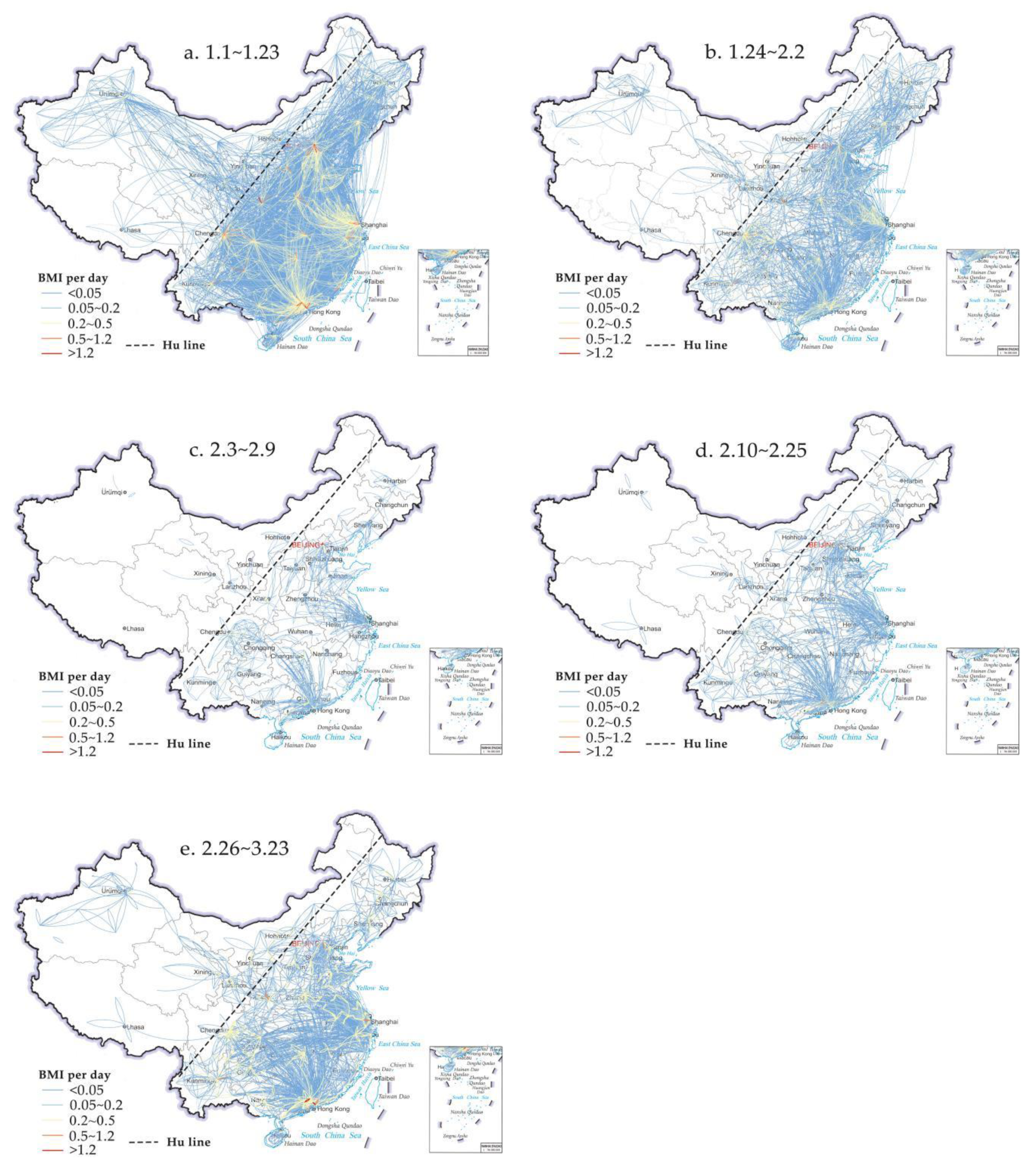
3.2. Spatial Pattern Changes of PFN
3.3. Network Topology Analysis
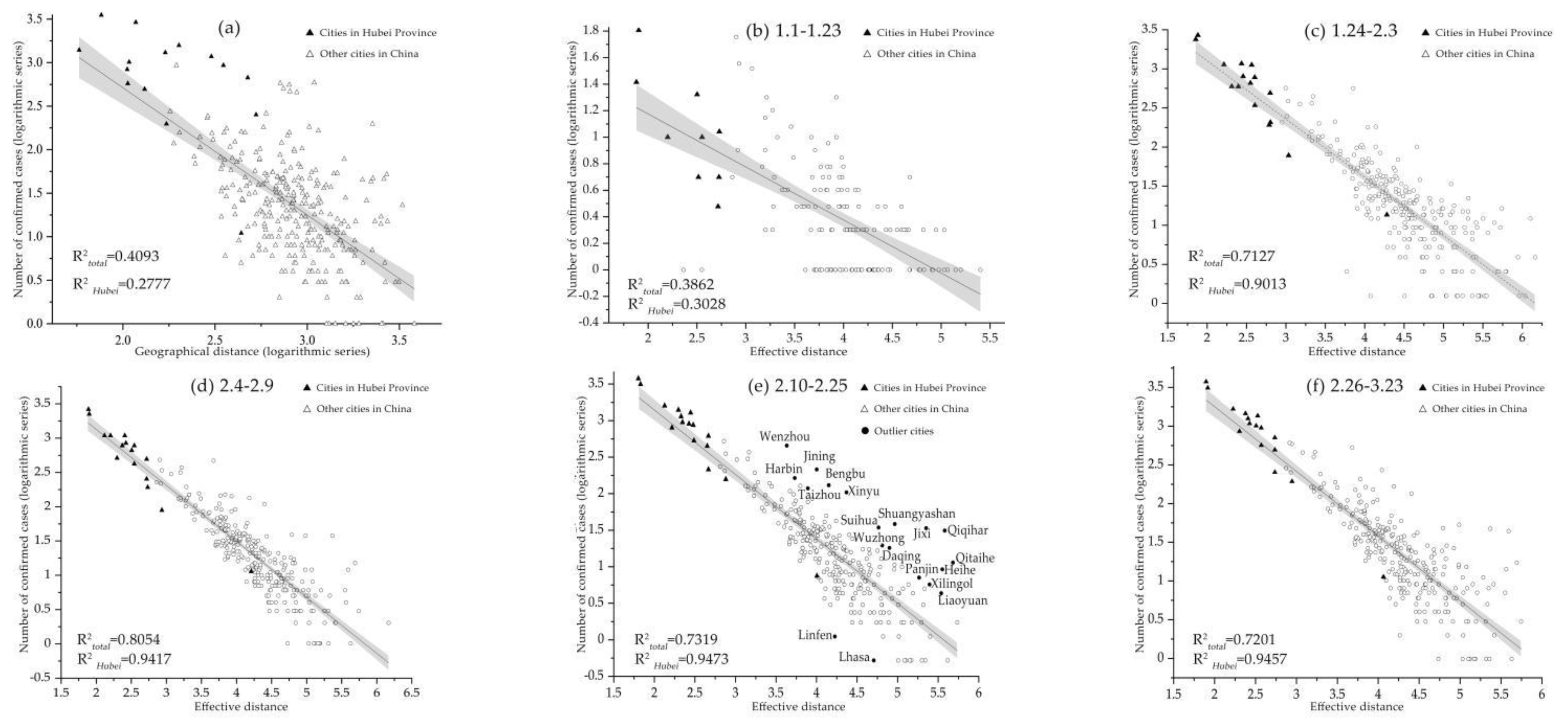
4. An Explanation of Correlation between PFN and COVID-19: Effective Distance
5. Discussion
6. Conclusions
Author Contributions
Funding
Institutional Review Board Statement
Informed Consent Statement
Data Availability Statement
Conflicts of Interest
References
- Manawadu, L.; Gunathilaka, K.L.; Wijeratne, V.P. Urban Agglomeration and COVID-19 Clusters: Strategies for Pandemic Free City Management. Int. J. Ent. Res. Publ. 2020, 10, 769–775. [Google Scholar] [CrossRef]
- Kraemer, M.U.; Yang, C.H.; Gutierrez, B.; Wu, C.H.; Klein, B.; Pigott, D.M.; Plessis, L.; Faria, N.R.; Li, R.R.; Hanage, W.P. The effect of human mobility and control measures on the COVID-19 epidemic in China. Science 2020, 368, 493–497. [Google Scholar] [CrossRef] [PubMed]
- Wei, Y.; Song, W.; Xiu, C.L.; Zhao, Z.Y. The rich-club phenomenon of China’s population flow network during the country’s spring festival. Appl. Geogr. 2018, 96, 77–85. [Google Scholar] [CrossRef]
- Li, R.; Pei, S.; Chen, B.; Song, Y.; Zhang, T.; Yang, W.; Shaman, J. Substantial undocumented infection facilitates the rapid dissemination of novel coronavirus (SARS-CoV-2). Science 2020, 368, 489–493. [Google Scholar] [CrossRef]
- Zhu, Y.; Lin, L.Y. Continuity and change in the transition from the first to the second generation of migrants in China: Insights from a survey in Fujian. Habitat Int. 2014, 42, 147–154. [Google Scholar] [CrossRef]
- Lin, Y.; Li, Y.; Ma, Z. Exploring the Interactive Development between Population Urbanization and Land Urbanization: Evidence from Chongqing, China (1998–2016). Sustainability 2018, 10, 1741. [Google Scholar] [CrossRef]
- Yang, H.R.; Guillaume, B.; Wang, J.E.; Thijs, B.; Martin, D. The implications of high-speed railways on air passenger flows in China. Appl. Geogr. 2018, 97, 1–9. [Google Scholar] [CrossRef] [PubMed]
- Wu, W.; Wang, J.; Dai, T. The Geography of Cultural Ties and Human Mobility: Big Data in Urban Contexts. Ann. Am. Assoc. Geogr. 2016, 106, 1–19. [Google Scholar] [CrossRef]
- Arribas, B.D.; Bakens, J. Use and validation of location-based services in urban research: An example with Dutch restaurants. Urban Stud. 2019, 56, 868–884. [Google Scholar] [CrossRef]
- Kitchin, R. The real-time city? Big data and smart urbanism. Geojournal 2014, 79, 1–14. [Google Scholar] [CrossRef]
- Lynch, C. Big data: How do your data grow? Nature 2008, 455, 28–29. [Google Scholar] [CrossRef] [PubMed]
- Finch, K.C.; Snook, K.R.; Duke, C.H.; Fu, K.W.; Tse, Z.T.H.; Adhikari, A.; Fung, I.C.H. Public health implications of social media use during natural disasters, environmental disasters, and other environmental concerns. Nat. Hazards 2016, 83, 729–760. [Google Scholar] [CrossRef]
- Can, U.; Alatas, B. Big social network data and sustainable economic development. Sustainability 2017, 9, 2027. [Google Scholar] [CrossRef]
- Zhang, X.; Li, W.; Zhang, F.; Liu, R.; Du, Z. Identifying urban functional zones using public bicycle rental records and point-of-interest data. ISPRS Int. J. Geo Inf. 2018, 7, 459. [Google Scholar] [CrossRef]
- Zhao, Z.Y.; Wei, Y.; Pang, R.Q.; Wang, S.; Feng, Z. Alter-based centrality and power of Chinese city network using inter-provincial population flow. Acta Geogr. Sin. 2017, 72, 1032–1048. (In Chinese) [Google Scholar]
- Jiang, X.R.; Wang, S.L. Research on China’s Urban Population Mobility Network: Based on Baidu Migration Big Data. Chin. J. Popul. Sci. 2017, 2, 35–46. (In Chinese) [Google Scholar]
- Jin, Y.; Wei, Y.; Xiu, C.; Song, W.; Yang, K. Study on Structural Characteristics of China’s Passenger Airline Network Based on Network Motifs Analysis. Sustainability 2019, 11, 2484. [Google Scholar] [CrossRef]
- Bradley, B.; Daniel, S. How Might the COVID-19 Pandemic Affect 21st Century Urban Design, Planning, and Development? Urban Sci. 2020, 4, 56. [Google Scholar]
- Wang, J.E.; Du, D.L.; Wei, Y.; Yang, H.R. The development of COVID-19 in China: Spatial diffusion and geographical pattern. Geogr. Res. 2020, 39, 1450–1462. (In Chinese) [Google Scholar]
- Barnett, E.D.; Walker, P.F. Role of Immigrants and Migrants in Emerging Infectious Diseases. Med. Clin. N. Am. 2008, 92, 1447–1458. [Google Scholar] [CrossRef]
- Colizza, V.; Barrat, A.; Barthélemy, M.; Vespignani, A. The role of the airline transportation network in the prediction and predictability of global epidemics. Proc. Natl. Acad. Sci. USA 2006, 103, 2015–2020. [Google Scholar] [CrossRef]
- Balcan, D.; Colizza, V.; Goncalves, D.; Hu, H.; Ramasco, J.J.; Vespignani, A. Multiscale mobility networks and the spatial spreading of infectious diseases. Proc. Natl. Acad. Sci. USA 2009, 106, 21484–21489. [Google Scholar] [CrossRef]
- Brockmann, D.; Helbing, D. The Hidden Geometry of Complex, Network-Driven Contagion Phenomena. Science 2013, 342, 1337–1342. [Google Scholar] [CrossRef] [PubMed]
- Jia, J.S.; Lu, X.; Yuan, Y.; XU, G.; Jia, J.M.; Christakis, N.A. Population flow drives spatio-temporal distribution of COVID-19 in China. Nature 2020, 582, 389–394. [Google Scholar] [CrossRef]
- Chinazzi, M.; Davis, J.T.; Ajelli, M.; Gioannini, C.; Litvinova, M.; Merler, S.; Piontti, A.P.; Mu, K.; Rossi, L.; Sun, K.; et al. The effect of travel restrictions on the spread of the 2019 novel coronavirus (COVID-19) outbreak. Science 2020, 368, 395–400. [Google Scholar] [CrossRef] [PubMed]
- Badr, H.S.; Du, H.R.; Marshal, M.; Dong, E.S.; Gardner, L.M. Association between mobility patterns and COVID-19 transmission in the USA: A mathematical modelling study. Lancet Infect. Dis. 2020, 20, 1247–1254. [Google Scholar] [CrossRef]
- Tian, H.; Liu, Y.; Li, Y.; Wu, C.; Chen, B.; Kraemer, M.U.G.; Li, B.; Cai, J.; Xu, B.; Yang, Q.; et al. An investigation of transmission control measures during the first 50 days of the COVID-19 epidemic in China. Science 2020, 368, 638–642. [Google Scholar] [CrossRef] [PubMed]
- Zhou, C.H.; Pei, T.; Du, Y.Y. Big Data Analysis on COVID-19 Epidemic and Suggestions on Regional Prevention and Control Policy. Bull. Chin. Acad. Sci. 2020, 35, 200–203. (In Chinese) [Google Scholar]
- Liu, Y.; Yang, D.Y.; Dong, G.P.; Zhang, H.; Miao, C.H. The Spatio-Temporal Spread Characteristics of 2019 Novel Coronavirus Pneumonia and Risk Assessment Based on Population Movement in Henan Province: Analysis of 1 243 Individual Case Reports. Econ. Geogr. 2020, 40, 24–32. (In Chinese) [Google Scholar]
- Arino, J.; Jordan, R.; Van, D.D.P. Quarantine in a multi-species epidemic model with spatial dynamics. Math. Biosci. 2007, 206, 46–60. [Google Scholar] [CrossRef]
- Watts, D.J.; Strogatz, S. Collective dynamics of ‘small-world’ networks. Nature 1998, 393, 440–442. [Google Scholar] [CrossRef] [PubMed]
- Guan, W.J.; Ni, Z.Y.; Hu, Y.; Liang, W.-H.; Ou, C.-Q.; He, J.-X.; Liu, L.; Shan, H.; Lei, C.-L.; Hui, D.S.C.; et al. Clinical characteristics of 2019 novel coronavirus infection in China. N. Engl. J. Med. 2020, 382, 1708–1720. [Google Scholar] [CrossRef] [PubMed]


| Statistical Indicators | 1.1–1.23 | 1.24–2.2 | 2.3–2.9 | 2.10–2.25 | 2.26–3.23 |
|---|---|---|---|---|---|
| Stage 1 | Stage 2 | Stage 3 | Stage 4 | Stage 5 | |
| Total number of OD lines (BMI > 0.003) | 10472 | 7002 | 2466 | 3813 | 6579 |
| Average migratory distance (km) | 615.58 | 470.71 | 308.61 | 373.17 | 454.33 |
| Weighted migratory distance (km) | 363.13 | 270.32 | 246.64 | 251.88 | 251.24 |
| Proportion of OD lines within provinces | 30.53% | 40.95% | 57.58% | 48.59% | 39.05% |
| Proportion of flow within provinces | 49.94% | 66.03% | 66.52% | 65.07% | 66.86% |
| Statistical Indicators | 1.1–1.23 | 1.24–2.2 | 2.3–2.9 | 2.10–2.25 | 2.26–3.23 |
|---|---|---|---|---|---|
| Stage 1 | Stage 2 | Stage 3 | Stage 4 | Stage 5 | |
| Emigration from Hubei/Total emigration | 3.9% | 1.37% | 1.62% | 1.71% | 1.36% |
| Immigration to Hubei/Total immigration | 4.34% | 1.28% | 1.63% | 1.72% | 1.04% |
| Percentage of emigration from Hubei Province | 78.71% | 74.29% | 85.22% | 84.96% | 80.89% |
| Percentage of immigration to Hubei Province | 61.47% | 79.71% | 84.90% | 85.03% | 92.27% |
| Network Indicators | 1.1–1.23 | 1.24–2.2 | 2.3–2.9 | 2.10–2.25 | 2.26–3.23 |
|---|---|---|---|---|---|
| Stage 1 | Stage 2 | Stage 3 | Stage 4 | Stage 5 | |
| Network density | 0.188 | 0.125 | 0.065 | 0.101 | 0.117 |
| Average clustering coefficient | 0.74 | 0.698 | 0.632 | 0.639 | 0.678 |
| Average path length | 1.881 | 2.171 | 2.546 | 2.36 | 2.295 |
| Total OD lines | 17,508 | 13,485 | 6840 | 10,480 | 12,630 |
| Model | Spatial Scale | Phases | 95%CI | t-Value | Prob > F | R-Square |
|---|---|---|---|---|---|---|
| Geographical distance | National China | 1.1–3.23 | −1.464 (±0.101) | −14.445 | 0.000 | 0.4093 |
| Hubei Province | 1.1–3.23 | −1.049 (±0.452) | −2.320 | 0.036 | 0.2777 | |
| Effective distance | National China | 1.1–1.23 | −0.399 (±0.041) | −9.682 | 0.000 | 0.3862 |
| 1.24–2.2 | −0.802 (±0.030) | −26.305 | 0.000 | 0.7127 | ||
| 2.3–2.9 | −0.820 (±0.025) | −32.908 | 0.000 | 0.8054 | ||
| 2.10–2.25 | −0.824 (±0.029) | −27.749 | 0.000 | 0.7319 | ||
| 2.26–3.23 | −0.825 (±0.030) | −27.645 | 0.000 | 0.7201 | ||
| Hubei Province | 1.1–1.23 | −1.012 (±0.512) | −1.977 | 0.079 | 0.3028 | |
| 1.24–2.2 | −1.060 (±0.100) | −10.561 | 0.000 | 0.9013 | ||
| 2.3–2.9 | −1.137 (±0.093) | −12.231 | 0.000 | 0.9417 | ||
| 2.10–2.25 | −1.147 (±0.072) | −15.862 | 0.000 | 0.9473 | ||
| 2.26–3.23 | 1.151 (±0.074) | −15.615 | 0.000 | 0.9457 |
Publisher’s Note: MDPI stays neutral with regard to jurisdictional claims in published maps and institutional affiliations. |
© 2021 by the authors. Licensee MDPI, Basel, Switzerland. This article is an open access article distributed under the terms and conditions of the Creative Commons Attribution (CC BY) license (http://creativecommons.org/licenses/by/4.0/).
Share and Cite
Jiang, X.; Wei, W.; Wang, S.; Zhang, T.; Lu, C. Effects of COVID-19 on Urban Population Flow in China. Int. J. Environ. Res. Public Health 2021, 18, 1617. https://doi.org/10.3390/ijerph18041617
Jiang X, Wei W, Wang S, Zhang T, Lu C. Effects of COVID-19 on Urban Population Flow in China. International Journal of Environmental Research and Public Health. 2021; 18(4):1617. https://doi.org/10.3390/ijerph18041617
Chicago/Turabian StyleJiang, Xiaorong, Wei Wei, Shenglan Wang, Tao Zhang, and Chengpeng Lu. 2021. "Effects of COVID-19 on Urban Population Flow in China" International Journal of Environmental Research and Public Health 18, no. 4: 1617. https://doi.org/10.3390/ijerph18041617
APA StyleJiang, X., Wei, W., Wang, S., Zhang, T., & Lu, C. (2021). Effects of COVID-19 on Urban Population Flow in China. International Journal of Environmental Research and Public Health, 18(4), 1617. https://doi.org/10.3390/ijerph18041617