


The Achilles Heel of Technology: How Does Technostress Affect University Students’ Wellbeing and Technology-Enhanced Learning

Abstract
1. Introduction
- (1)
- How does technostress affect students’ learning in TEL via burnout?
- (2)
- How do factors such as gender, disciplines, and willingness to join TEL moderate the relationships among technostress, burnout, and students’ learning in TEL?
2. Theoretical Framework
2.1. Literature on Technostress
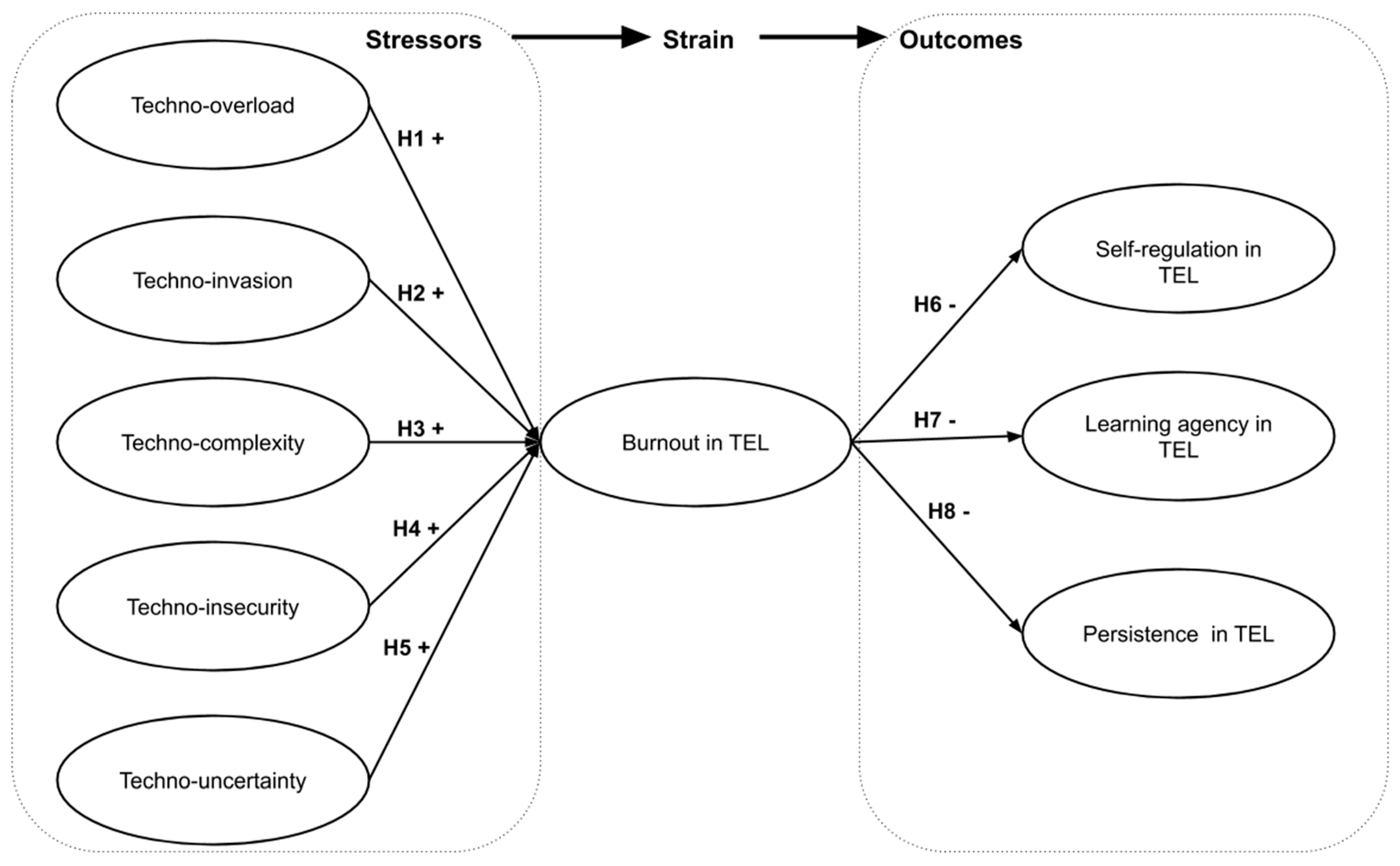
2.2. Stressor-Strain-Outcome (SSO) Model
3. Methodology
3.1. Participants and Research Context
3.2. Focus Group Interviews
3.3. Instrumentation
3.4. Analysis of Survey Data
4. Results
4.1. Validating the Measures
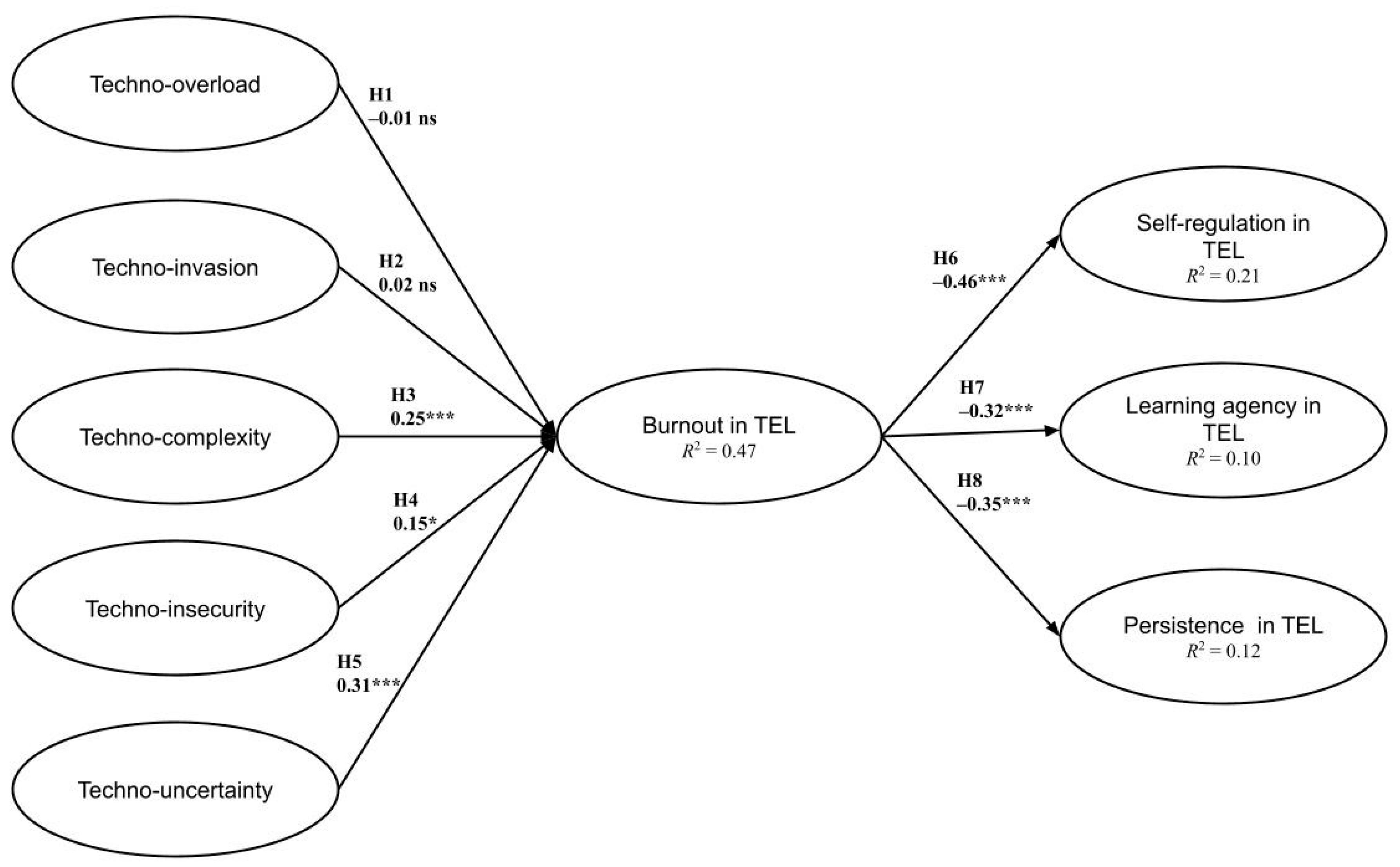
4.2. Structural Model
4.3. Group Comparisons in Terms of Genders, Academic Disciplines, and Willingness to Join TELL
4.3.1. Gender Differences in the Technostress Model
4.3.2. Differences Based on Students’ Academic Disciplines
4.3.3. Differences Based on Willingness to Join TEL
4.4. Relating Qualitative Findings to Statistical Modelling
5. Discussion
5.1. Contributions
5.2. Implications
5.3. Limitations and Future Research
6. Conclusions
Author Contributions
Funding
Institutional Review Board Statement
Informed Consent Statement
Data Availability Statement
Conflicts of Interest
References
- Al-Abdullatif, A.M.; Alsubaie, M.A.; Aldoughan, E.A. Exploring the effects of excessive texting through mobile applications on students’ technostress and academic writing skills in the Arabic language. IEEE Access 2020, 8, 166940–166950. [Google Scholar] [CrossRef] [Scilit]
- Selwyn, N. Digital downsides: Exploring university students’ negative engagements with digital technology. Teach. High. Educ. 2016, 21, 1006–1021. [Google Scholar] [CrossRef] [Scilit]
- Wang, X.; Li, B. Technostress among teachers in higher education: An investigation from multidimensional person-environment misfit. Front. Psychol. 2019, 10, 1791. [Google Scholar] [CrossRef] [Scilit]
- Dunn, T.; Kennedy, M. Technology enhanced learning in higher education; motivations, engagement and academic achievement. Comput. Educ. 2019, 137, 104–113. [Google Scholar] [CrossRef] [Scilit]
- Schmid, R.F.; Bernard, R.M.; Borokhovski, E.; Tamim, R.M.; Abrami, P.C.; Surkes, M.A.; Wade, C.A.; Woods, J. The effects of technology use in postsecondary education: A meta-analysis of classroom applications. Comput. Educ. 2014, 72, 271–291. [Google Scholar] [CrossRef] [Scilit]
- Teo, T.; Huang, F. Investigating the influence of individually espoused cultural values on teachers’ intentions to use educational technologies in Chinese universities. Interact. Learn. Environ. 2018, 27, 813–829. [Google Scholar] [CrossRef] [Scilit]
- Brod, C. Technostress: The Human Cost of the Computer Revolution; Addison Wesley Publishing Company: Boston, MA, USA, 1984. [Google Scholar]
- Wang, X.; Tan, S.C.; Li, L. Measuring university students’ technostress in technology-enhanced learning: Scale development and validation. Australas. J. Educ. Technol. 2020, 36, 96–112. [Google Scholar] [CrossRef] [Scilit]
- Al-Fudail, M.; Mellar, H. Investigating teacher stress when using technology. Comput. Educ. 2008, 51, 1103–1110. [Google Scholar] [CrossRef] [Scilit]
- Jena, R. Technostress in ICT enabled collaborative learning environment: An empirical study among Indian academician. Comput. Hum. Behav. 2015, 51, 1116–1123. [Google Scholar] [CrossRef] [Scilit]
- Estrada-Muñoz, C.; Castillo, D.; Vega-Muñoz, A.; Boada-Grau, J. Teacher technostress in the Chilean school system. Int. J. Environ. Res. Public Health 2020, 17, 5280. [Google Scholar] [CrossRef] [Scilit]
- Tarafdar, M.; Tu, Q.; Ragu-Nathan, T. Impact of technostress on end-user satisfaction and performance. Manag. Inf. Syst. 2014, 27, 303–334. [Google Scholar] [CrossRef] [Scilit]
- Verkijika, S.F. Digital textbooks are useful but not everyone wants them: The role of technostress. Comput. Educ. 2019, 140, 103591. [Google Scholar] [CrossRef] [Scilit]
- Ayyagari, R.; Grover, V.; Purvis, R. Technostress: Technological antecedents and implications. MIS Quart. 2011, 35, 831–858. [Google Scholar] [CrossRef] [Scilit]
- Borle, P.; Reichel, K.; Niebuhr, F.; Voelter-Mahlknecht, S. How are techno-stressors associated with mental health and work outcomes? A systematic review of occupational exposure to information and communication technologies within the technostress model. Int. J. Environ. Res. Public Health 2021, 18, 8673. [Google Scholar] [CrossRef] [Scilit]
- Hsiao, K.L.; Shu, Y.; Huang, T.C. Exploring the effect of compulsive social app usage on technostress and academic performance: Perspectives from personality traits. Telemat. Inform. 2017, 34, 679–690. [Google Scholar] [CrossRef] [Scilit]
- Ragu-Nathan, T.; Tarafdar, M.; Ragu-Nathan, B.S.; Tu, Q. The consequences of technostress for end users in organizations: Conceptual development and empirical validation. Inf. Syst. Res. 2008, 19, 417–433. [Google Scholar] [CrossRef] [Scilit]
- Sumiyana, S.; Sriwidharmanely, S. Mitigating the harmful effects of technostress: Inducing chaos theory in an experimental setting. Behav. Inf. Technol. 2019, 39, 1079–1093. [Google Scholar] [CrossRef] [Scilit]
- Brooks, S.; Califf, C. Social media-induced technostress: Its impact on the job performance of it professionals and the moderating role of job characteristics. Comput. Netw. 2017, 114, 143–153. [Google Scholar] [CrossRef] [Scilit]
- Marchiori, D.M.; Mainardes, E.W.; Rodrigues, R.G. Do individual characteristics influence the types of technostress reported by workers? Int. J. Hum. Comput. Interact. 2018, 35, 218–230. [Google Scholar] [CrossRef] [Scilit]
- Hung, W.-H.; Chen, K.; Lin, C.-P. Does the proactive personality mitigate the adverse effect of technostress on productivity in the mobile environment? Telemat. Inform. 2015, 32, 143–157. [Google Scholar] [CrossRef] [Scilit]
- Qi, C. A double-edged sword? Exploring the impact of students’ academic usage of mobile devices on technostress and academic performance. Behav. Inf. Technol. 2019, 38, 1337–1354. [Google Scholar] [CrossRef] [Scilit]
- Barnard, L.; Lan, W.Y.; To, Y.M.; Paton, V.O.; Lai, S.L. Measuring self-regulation in online and blended learning environments. Internet High. Educ. 2009, 12, 1–6. [Google Scholar] [CrossRef] [Scilit]
- Koeske, G.F.; Koeske, R.D. A preliminary test of a stress-strain-outcome model for reconceptualizing the burnout phenomenon. J. Soc. Serv. Res. 2010, 17, 107–135. [Google Scholar] [CrossRef] [Scilit]
- Lazarus, R.S.; Folkman, S. Stress, Appraisal, and Coping; Springer Publishing Company: Berlin, Germany, 1984. [Google Scholar]
- Cheung, F.Y.-L.; Cheung, R.Y.-H. Effect of emotional dissonance on organizational citizenship behavior: Testing the stressor-strain-outcome model. J. Psychol. 2013, 147, 89–103. [Google Scholar] [CrossRef] [Scilit]
- Hur, W.M.; Kim, B.S.; Park, S.J. The relationship between coworker incivility, emotional exhaustion, and organizational outcomes: The mediating role of emotional exhaustion. Hum. Factors Ergon. Manuf. 2014, 25, 701–712. [Google Scholar] [CrossRef] [Scilit]
- Cao, X.; Masood, A.; Luqman, A.; Ali, A. Excessive use of mobile social networking sites and poor academic performance: Antecedents and consequences from stressor-strain-outcome perspective. Comput. Hum. Behav. 2018, 85, 163–174. [Google Scholar] [CrossRef] [Scilit]
- Fuglseth, A.M.; Sørebø, Ø. The effects of technostress within the context of employee use of ICT. Comput. Hum. Behav. 2014, 40, 161–170. [Google Scholar] [CrossRef] [Scilit]
- Kristensen, T.S.; Borritz, M.; Villadsen, E.; Christensen, K.B. The Copenhagen burnout inventory: A new tool for the assessment of burnout. Work Stress 2007, 19, 192–207. [Google Scholar] [CrossRef] [Scilit]
- Kljajic, K.; Gaudreau, P.; Franche, V. An investigation of the 2 × 2 model of perfectionism with burnout, engagement, self-regulation, and academic achievement. Learn. Individ. Differ. 2017, 57, 103–113. [Google Scholar] [CrossRef] [Scilit]
- Kearney, M.; Burden, K.; Rai, T. Investigating teachers’ adoption of signature mobile pedagogies. Comput. Educ. 2015, 80, 48–57. [Google Scholar] [CrossRef] [Scilit]
- Lai, K.-W.; Campbell, M. Developing secondary students’ epistemic agency in a knowledge-building community. Technol. Pedagog. Educ. 2017, 27, 69–83. [Google Scholar] [CrossRef] [Scilit]
- Yang, Y. Reflective assessment for epistemic agency of academically low-achieving students. J. Comput. Assist. Learn. 2019, 35, 459–475. [Google Scholar] [CrossRef] [Scilit]
- Wu, B.; Chen, X. Continuance intention to use MOOCs: Integrating the technology acceptance model (TAM) and task technology fit (TTF) model. Comput. Hum. Behav. 2017, 67, 221–232. [Google Scholar] [CrossRef] [Scilit]
- Maslach, C.; Schaufeli, W.B.; Leiter, M.P. Job burnout. Annu. Rev. Psychol. 2001, 52, 397–422. [Google Scholar] [CrossRef] [Scilit]
- Kidd, P.S.; Parshall, M.B. Getting the focus and the group: Enhancing analytical rigor in focus group research. Qual. Health Res. 2000, 10, 293–308. [Google Scholar] [CrossRef] [Scilit] [PubMed]
- Tarafdar, M.; Pullins, E.B.; Ragu-Nathan, T. Technostress: Negative effect on performance and possible mitigations. Inf. Syst. J. 2014, 25, 103–132. [Google Scholar] [CrossRef] [Scilit]
- Creswell, J.W. Qualitative Research Design: An Interactive Approach, 2nd ed.; Sage: Thousand Oaks, CA, USA, 2005. [Google Scholar]
- Zhang, S.; Zhao, L.; Lu, Y.; Yang, J. Do you get tired of socializing? An empirical explanation of discontinuous usage behaviour in social network services. Inf. Manag. 2016, 53, 904–914. [Google Scholar] [CrossRef] [Scilit]
- Fornell, C.; Bookstein, F.L. Two structural equation models: LISREL and PLS applied to consumer exit-voice theory. J. Mark. Res. 1982, 19, 440–452. [Google Scholar] [CrossRef] [Scilit]
- Willaby, H.W.; Costa, D.S.; Burns, B.D.; MacCann, C.; Roberts, R.D. Testing complex models with small sample sizes: A historical overview and empirical demonstration of what Partial Least Squares (PLS) can offer differential psychology. Pers. Individ. Differ. 2015, 84, 73–78. [Google Scholar] [CrossRef] [Scilit]
- Hair, J.F.; Anderson, R.E.; Tatham, R.L.; Black, W.C. Multivariate Data Analysis, 5th ed.; Prentice Hall: Upper Saddle River, NJ, USA, 1998. [Google Scholar]
- Sanchez, G. PLS Path Modeling with R; Trowchez Editions: Berkeley, CA, USA, 2013. [Google Scholar]
- Cangur, S.; Ercan, I. Comparison of model fit indices used in structural equation modeling under multivariate normality. J. Mod. Appl. Stat. Methods 2015, 14, 152–167. [Google Scholar] [CrossRef] [Scilit]
- Hooper, D.; Coughlan, J.; Mullen, M.R. Structural equation modelling: Guidelines for determining model fit. Electron. J. Bus. Res. Methods 2008, 6, 53–60. [Google Scholar] [CrossRef]
- Podsakoff, P.M.; MacKenzie, S.B.; Podsakoff, N.P. Sources of method bias in social science research and recommendations on how to control it. Annu. Rev. Psychol. 2012, 63, 539–569. [Google Scholar] [CrossRef] [Scilit] [PubMed]
- Hair, J.F.; Hult, G.T.M.; Ringle, C.; Sarstedt, M. A Primer on Partial Least Squares Structural Equation Modeling (PLS-SEM); Sage: Thousand Oaks, CA, USA, 2014. [Google Scholar]
- Henseler, J.; Ringle, C.M.; Sinkovics, R.R. The use of partial least squares path modeling in international marketing. Adv. Int. Mark. 2009, 20, 277–319. [Google Scholar] [CrossRef]
- Cohen, J. Statistical Power Analysis for the Behavioral Sciences, 2nd ed.; Lawrence Earlbaum Associates: Hillsdale, NJ, USA, 1988. [Google Scholar]
- Tenenhaus, M.; Amato, S.; Vinzi, V.E. A global goodness-of-fit. Index for PLS structural equation modelling. In Proceedings of the XLII SIS Scientific Meeting, Padova, Italy, 9–11 June 2004. [Google Scholar]
- Wang, X.; Fan, H.X. Report of present situation of study adaptability of university students. Theory Pract. Educ. 2009, 29, 62–64. Available online: http://en.cnki.com.cn/Article_en/CJFDTotal-JYL200927025.htm (accessed on 23 May 2021).
- Dahlgren, M.A.; Dahlgren, L.O. Portraits of PBL: Students’ experiences of the characteristics of problem-based learning in physiotherapy, computer engineering and psychology. Instr. Sci. 2002, 30, 111–127. [Google Scholar] [CrossRef] [Scilit]
- Hill, F.; Tomkinson, B.; Hiley, A.; Dobson, H. Learning style preferences: An examination of differences amongst students with different disciplinary backgrounds. Innov. Educ. Teach. Int. 2016, 53, 122–134. [Google Scholar] [CrossRef] [Scilit]

| Constructs/Items | Factor Loadings | M (SD) | Cronbach’s Alpha | Composite Reliability | AVE |
|---|---|---|---|---|---|
| Techno-overload | 0.91 | 0.94 | 0.78 | ||
| TO1 | 0.86 | 2.25 (0.89) | |||
| TO2 | 0.88 | 2.22 (0.89) | |||
| TO3 | 0.91 | 2.22 (0.90) | |||
| TO4 | 0.90 | 2.21 (0.88) | |||
| Techno-invasion | 0.91 | 0.94 | 0.79 | ||
| TIV1 | 0.90 | 2.24 (0.92) | |||
| TIV2 | 0.89 | 2.24 (0.90) | |||
| TIV3 | 0.89 | 2.19 (0.92) | |||
| TIV4 | 0.88 | 2.15 (0.94) | |||
| Techno-complexity | 0.87 | 0.92 | 0.79 | ||
| TC1 | 0.90 | 2.19 (0.89) | |||
| TC2 | 0.88 | 2.26 (0.92) | |||
| TC3 | 0.88 | 2.08 (0.94) | |||
| Techno-insecurity | 0.85 | 0.91 | 0.76 | ||
| TIS1 | 0.90 | 2.15 (0.91) | |||
| TIS2 | 0.85 | 2.27 (0.89) | |||
| TIS3 | 0.87 | 2.15 (0.94) | |||
| Techno-uncertainty | 0.94 | 0.95 | 0.80 | ||
| TU1 | 0.90 | 2.13 (0.93) | |||
| TU2 | 0.89 | 2.12 (0.94) | |||
| TU3 | 0.89 | 2.09 (0.92) | |||
| TU4 | 0.91 | 2.11 (0.93) | |||
| TU5 | 0.87 | 2.15 (0.93) | |||
| Burnout in TEL | 0.95 | 0.96 | 0.79 | ||
| BN1 | 0.86 | 2.17 (0.89) | |||
| BN2 | 0.90 | 2.09 (0.91) | |||
| BN3 | 0.91 | 1.98 (0.93) | |||
| BN4 | 0.88 | 2.11 (0.93) | |||
| BN5 | 0.91 | 2.01 (0.93) | |||
| BN6 | 0.88 | 2.03 (0.94) | |||
| Self-regulation in TEL (reversed) | 0.93 | 0.95 | 0.75 | ||
| SR1 | 0.86 | 1.77 (0.84) | |||
| SR2 | 0.87 | 1.81 (0.86) | |||
| SR3 | 0.88 | 1.80 (0.86) | |||
| SR4 | 0.84 | 1.72 (0.87) | |||
| SR5 | 0.87 | 1.79 (0.85) | |||
| SR6 | 0.86 | 1.73 (0.87) | |||
| Learning agency in TEL (reversed) | 0.92 | 0.95 | 0.82 | ||
| LA1 | 0.91 | 1.66 (0.84) | |||
| LA2 | 0.92 | 1.67 (0.85) | |||
| LA3 | 0.90 | 1.64 (0.86) | |||
| LA4 | 0.89 | 1.65 (0.83) | |||
| Persistence in TEL (reversed) | 0.93 | 0.95 | 0.78 | ||
| PER1 | 0.88 | 1.62 (0.86) | |||
| PER2 | 0.88 | 1.64 (0.87) | |||
| PER3 | 0.89 | 1.64 (0.88) | |||
| PER4 | 0.88 | 1.66 (0.86) | |||
| PER5 | 0.89 | 1.64 (0.84) |
| Constructs | 1 | 2 | 3 | 4 | 5 | 6 | 7 | 8 | 9 |
|---|---|---|---|---|---|---|---|---|---|
| 1. Techno-overload | 0.88 | ||||||||
| 2. Techno-invasion | 0.84 | 0.89 | |||||||
| 3. Techno-complexity | 0.77 | 0.85 | 0.89 | ||||||
| 4. Techno-insecurity | 0.79 | 0.83 | 0.87 | 0.87 | |||||
| 5. Techno-uncertainty | 0.69 | 0.74 | 0.82 | 0.84 | 0.89 | ||||
| 6. Burnout | 0.53 | 0.58 | 0.65 | 0.64 | 0.65 | 0.89 | |||
| 7. Self-regulation in TEL | −0.45 | −0.45 | −0.39 | −0.43 | −0.38 | −0.46 | 0.86 | ||
| 8. Learning agency in TEL | −0.43 | −0.38 | −0.33 | −0.37 | −0.33 | −0.32 | 0.73 | 0.90 | |
| 9. Persistence in TEL | −0.41 | −0.38 | −0.33 | −0.35 | −0.28 | −0.35 | 0.74 | 0.85 | 0.88 |
| Hypotheses | Path Coefficients | Standard Error | Percentile 0.025 | Percentile 0.975 | Results | |
|---|---|---|---|---|---|---|
| H1 | Techno-overload -> Burnout | −0.01 ns | 0.06 | −0.10 | 0.14 | Not support |
| H2 | Techno-invasion -> Burnout | 0.02 ns | 0.08 | −0.15 | 0.14 | Not support |
| H3 | Techno-complexity -> Burnout | 0.25 *** | 0.05 | 0.14 | 0.34 | Support |
| H4 | Techno-insecurity -> Burnout | 0.15 * | 0.07 | 0.05 | 0.30 | Support |
| H5 | Techno-uncertainty -> Burnout | 0.31 *** | 0.06 | 0.18 | 0.40 | Support |
| H6 | Burnout -> Self-regulation | −0.46 *** | 0.05 | −0.57 | −0.38 | Support |
| H7 | Burnout -> Learning agency | −0.32 *** | 0.06 | −0.44 | −0.21 | Support |
| H8 | Burnout-> Persistence | −0.35 *** | 0.06 | −0.47 | −0.24 | Support |
| Hypotheses | Global | Group: Females | Group: Males | diff.abs | t | df | p | |
|---|---|---|---|---|---|---|---|---|
| H1 | Techno-overload -> Burnout | −0.01 | −0.02 | −0.003 | 0.02 | 0.22 | 794 | 0.41 |
| H2 | Techno-invasion -> Burnout | 0.02 | −0.02 | 0.09 | 0.11 | 0.69 | 794 | 0.25 |
| H3 | Techno-complexity -> Burnout | 0.25 | 0.30 | 0.18 | 0.12 | 0.86 | 794 | 0.20 |
| H4 | Techno-insecurity -> Burnout | 0.15 | 0.15 | 0.14 | 0.01 | 0.02 | 794 | 0.49 |
| H5 | Techno-uncertainty -> Burnout | 0.31 | 0.28 | 0.36 | 0.08 | 0.65 | 794 | 0.26 |
| H6 | Burnout -> Self-regulation | −0.46 | −0.31 | −0.60 | 0.29 | 2.59 | 794 | 0.01 |
| H7 | Burnout -> Learning agency | −0.32 | −0.18 | −0.45 | 0.27 | 2.45 | 794 | 0.01 |
| H8 | Burnout-> Persistence | −0.35 | −0.20 | −0.48 | 0.28 | 2.50 | 794 | 0.01 |
| Hypotheses | Global | Group: SS | Group: EN | diff.abs | t | df | p | |
|---|---|---|---|---|---|---|---|---|
| H1 | Techno-overload -> Burnout | −0.01 | 0.07 | −0.06 | 0.13 | 1.02 | 794 | 0.16 |
| H2 | Techno-invasion -> Burnout | 0.02 | −0.02 | 0.08 | 0.11 | 0.66 | 794 | 0.25 |
| H3 | Techno-complexity -> Burnout | 0.25 | 0.37 | 0.13 | 0.24 | 1.94 | 794 | 0.03 |
| H4 | Techno-insecurity -> Burnout | 0.15 | 0.12 | 0.19 | 0.07 | 0.55 | 794 | 0.29 |
| H5 | Techno-uncertainty -> Burnout | 0.31 | 0.22 | 0.38 | 0.16 | 1.27 | 794 | 0.10 |
| H6 | Burnout -> Self-regulation | −0.46 | −0.41 | −0.50 | 0.09 | 0.91 | 794 | 0.18 |
| H7 | Burnout -> Learning agency | −0.32 | −0.24 | −0.36 | 0.12 | 1.13 | 794 | 0.13 |
| H8 | Burnout-> Persistence | −0.35 | −0.25 | −0.41 | 0.16 | 1.46 | 794 | 0.07 |
| Hypotheses | Global | Group: Willingly | Group: Unwillingly | diff.abs | t | df | p | |
|---|---|---|---|---|---|---|---|---|
| H1 # | Techno-overload -> Burnout | −0.01 | 0.18 | −0.08 | 0.26 | 1.83 | 794 | 0.03 |
| H2 | Techno-invasion -> Burnout | 0.02 | 0.07 | 0.02 | 0.05 | 0.27 | 794 | 0.39 |
| H3 | Techno-complexity -> Burnout | 0.25 | 0.29 | 0.23 | 0.06 | 0.49 | 794 | 0.31 |
| H4 | Techno-insecurity -> Burnout | 0.15 | 0.10 | 0.17 | 0.07 | 0.47 | 794 | 0.32 |
| H5 | Techno-uncertainty -> Burnout | 0.31 | 0.19 | 0.33 | 0.14 | 0.96 | 794 | 0.17 |
| H6 | Burnout -> Self-regulation | −0.46 | −0.69 | −0.36 | 0.33 | 2.94 | 794 | 0.00 |
| H7 | Burnout -> Learning agency | −0.32 | −0.64 | −0.18 | 0.46 | 3.75 | 794 | 0.00 |
| H8 | Burnout -> Persistence | −0.35 | −0.67 | −0.22 | 0.45 | 4.12 | 794 | 0.00 |
Publisher’s Note: MDPI stays neutral with regard to jurisdictional claims in published maps and institutional affiliations. |
© 2021 by the authors. Licensee MDPI, Basel, Switzerland. This article is an open access article distributed under the terms and conditions of the Creative Commons Attribution (CC BY) license (https://creativecommons.org/licenses/by/4.0/).
Share and Cite
Wang, X.; Li, Z.; Ouyang, Z.; Xu, Y. The Achilles Heel of Technology: How Does Technostress Affect University Students’ Wellbeing and Technology-Enhanced Learning. Int. J. Environ. Res. Public Health 2021, 18, 12322. https://doi.org/10.3390/ijerph182312322
Wang X, Li Z, Ouyang Z, Xu Y. The Achilles Heel of Technology: How Does Technostress Affect University Students’ Wellbeing and Technology-Enhanced Learning. International Journal of Environmental Research and Public Health. 2021; 18(23):12322. https://doi.org/10.3390/ijerph182312322
Chicago/Turabian StyleWang, Xinghua, Zhenyu Li, Zhangdong Ouyang, and Yanping Xu. 2021. "The Achilles Heel of Technology: How Does Technostress Affect University Students’ Wellbeing and Technology-Enhanced Learning" International Journal of Environmental Research and Public Health 18, no. 23: 12322. https://doi.org/10.3390/ijerph182312322
APA StyleWang, X., Li, Z., Ouyang, Z., & Xu, Y. (2021). The Achilles Heel of Technology: How Does Technostress Affect University Students’ Wellbeing and Technology-Enhanced Learning. International Journal of Environmental Research and Public Health, 18(23), 12322. https://doi.org/10.3390/ijerph182312322

