Review of Workplace Based Aerosol Sampler Comparison Studies, 2004–2020

Abstract
1. Introduction
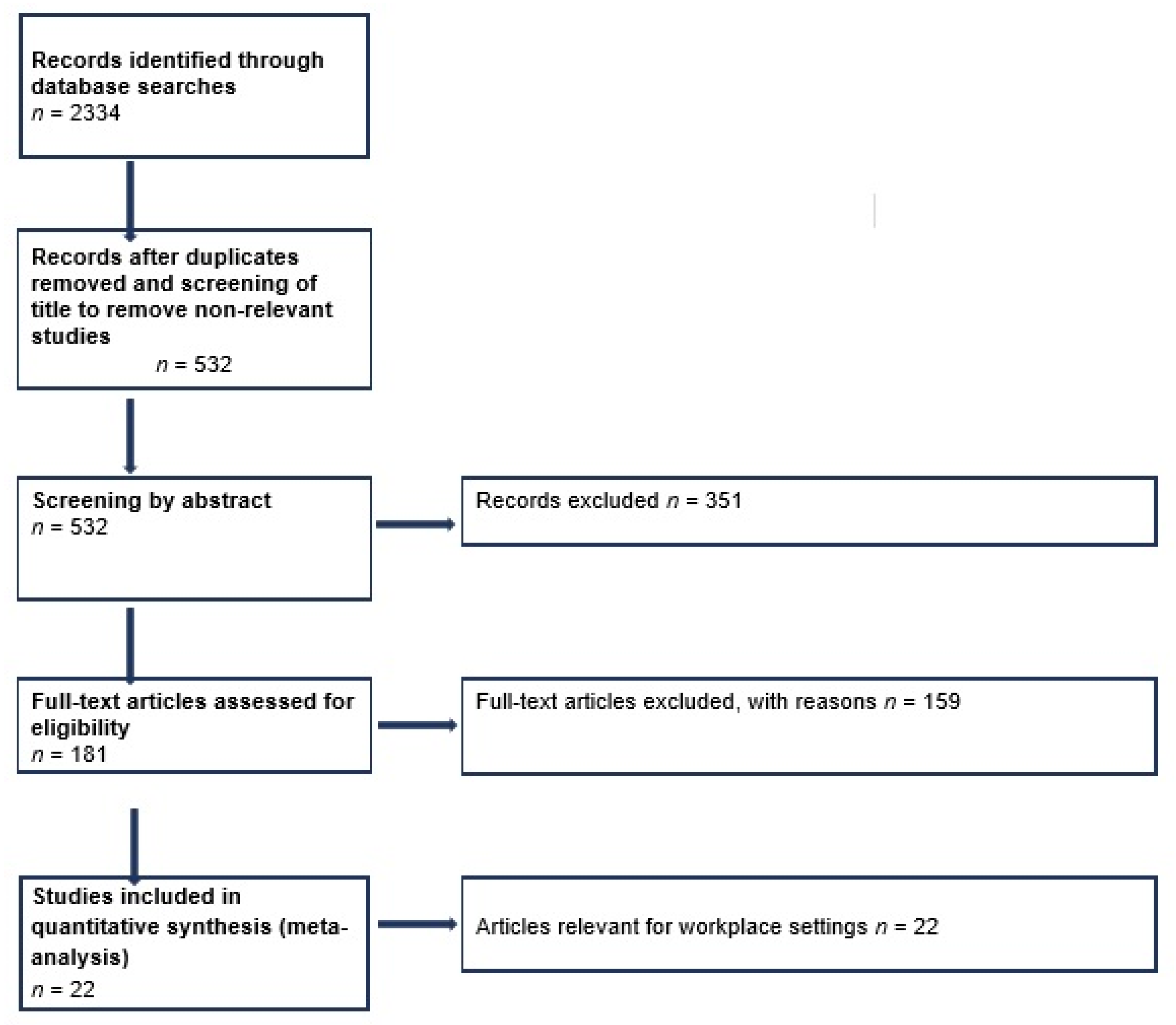
2. Methods
2.1. Search Strategies
2.2. Data Extraction and Collection Process
3. Results
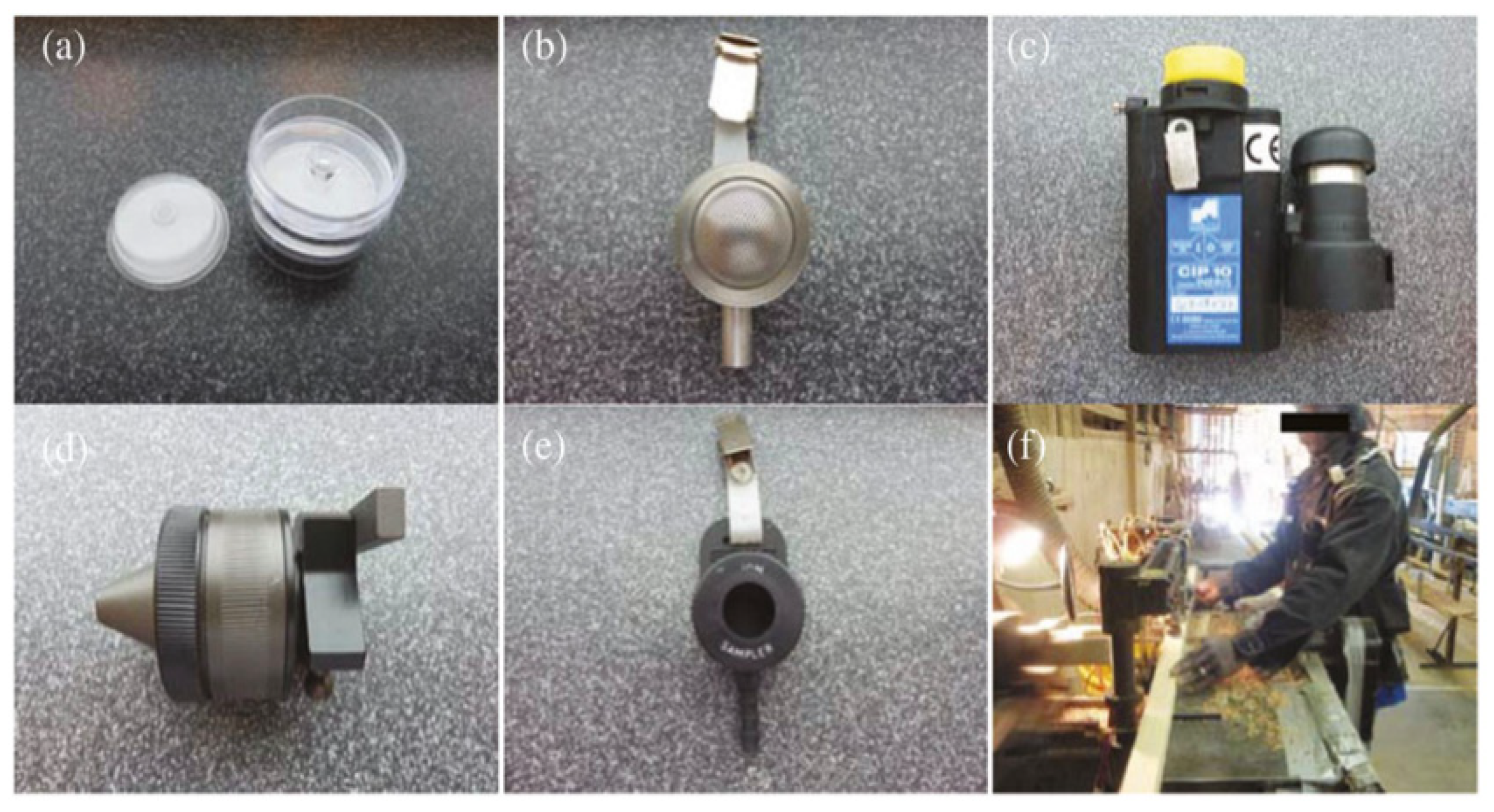
3.1. Samplers and Size Fractions Studied

| Aerosol Fraction | Sampler | Articles (n = 22) | References |
|---|---|---|---|
| Inhalable | IOM Sampler | 15 | [28,29,30,31,32,33,34,35,38,39,40,42,43,44,45] |
| Disposable inhalable aerosol sampler (DIAS) | 1 | [45] | |
| Button sampler | 5 | [28,32,33,35,43] | |
| Millipore (25 mm and 37 mm) open-faced cassette | 1 | [46] | |
| 37-mm closed-face cassette (CFC) with ACCU-CAP | 2 | [33,35] | |
| GSP sampler | 2 | [35,36] | |
| Italian Cone Sampler (Zambelli s.r.l) | 1 | [34] | |
| Seven hole sampler | 1 | [46] | |
| Polish sampler | 1 | [46] | |
| CIP 10-l | 1 | [33,35] | |
| Prototype sampler (no name supplied) | 2 | [30] | |
| Respirable | GK2.69 cyclone | 1 | [37] |
| Higgins-Dewell cyclone | 2 | [38] | |
| Aluminium SKC cyclone | 3 | [39,40,43] | |
| IOSH cyclone | 1 | [41] | |
| Thoracic | GK2.69 cyclone | 2 | [38,40] |
| Total | Closed face 37-mm cassette (37-mm CFC) | 12 | [31,32,33,36,38,39,42,43,44,47,48,49] |
| Dual IOM sampler | 4 | [23,28,29,37] | |
| Multi-fraction | Respicon | 4 | [40,41,42,46] |
| Novel three stage sampler | 1 | [41] | |
| 8-stage Sierra cascade impactor | 1 | [39] | |
| 10-stage MOUDI impactor (compared to personal samplers) | 1 | [39] | |
| Two stage cascade impactor model PM 10/4, Dekati Ltd. | 1 | [28] |
3.2. Workplace Sampler Comparison Settings
3.2.1. Metal/Metalloids Settings
3.2.2. Agriculture
3.2.3. Brick Manufacturing
3.2.4. Cement Plants
3.2.5. Road Paving
3.2.6. Rubber Manufacturing
3.2.7. Shipbuilding
3.2.8. Talc Production and Peat Production
3.2.9. Wood Manufacturing
3.3. Correction Factors
| Setting | Aerosol Fraction Assessed/Compared | Samplers | Dust Assessed | Summary of Results | Correction Factors | Reference |
|---|---|---|---|---|---|---|
| Metals | ||||||
| Aluminium smelters | Total, inhalable and respirable | IOM inhalable sampler (inhalable) | Beryllium | The median of median dust concentration ratios computed from the sampling heads at the fixed station decreased as follows: IOM (1.00) > Sierra (0.76) > 37-mm cassette (0.61) > MOUDI (0.48) > respirable (0.12). The median of median ratios of dust were: IOM (1.00) > Sierra (0.56) > 37-mm cassette (0.35) > respirable (0.06)) and Be (IOM (1.00) > Sierra (0.66) > 37-mm cassette (0.48) > respirable (0.11). | N/A | [39] |
| SKC Aluminium cyclone (respirable) | ||||||
| 37-mm CFC (‘total’) | ||||||
| 8-stage Sierra cascade impactor | ||||||
| 10-stage MOUDI impactors | ||||||
| Total and inhalable | Respicon (‘total’) | Aluminium | The Respicon under sampled the aerosol mass for the inhalable fraction compared to the IOM sampler at concentrations higher than 1.35 mg/m3 and oversamples at lower concentrations. The overall ratio between aerosol mass collected with IOM and CFC was 4.19 (95% CI = 3.79–4.64). | CFC/IOM inhalable aerosol mass: 4.2. CFC/IOM to inhalable aerosol mass for water-soluble: 1.6. | [42] | |
| 25-mm CFC (‘total’) | ||||||
| IOM sampler (inhalable) | ||||||
| Bronze foundry, copper ore smelter, lead-acid battery recycling, lead ore concentrate mill, solder manufacturing | Total and inhalable | IOM sampler (inhalable) | Lead | Bronze foundry: The filter sample size distributions did not differ significantly for IOM and CFC samplers (p < 0.05); Copper ore smelter: Only 1/7 pairs of IOM and CFC filters had a difference in mass-weighted size distributions; Lead acid battery recycling: Difference in one filter and wall distribution and one difference between IOM and CFC filter deposits; Lead ore concentrate mill: No filter sample differed significantly from wall deposit samples; Solder manufacturing: One IOM filter sample differed significantly from the corresponding CFC filter sample. | N/A | [31] |
| 37-mm plastic CFC (‘total’) | ||||||
| Casting factory | Inhalable, respirable, thoracic | Novel three-stage sampler | Lead | Inhalable fraction: Three-stage sampler sampled lower corrections than the Respicon; Respirable fraction: The three-stage sampler and the IOSH cyclones collected similar respirable dust concentrations (less than 10% difference); Thoracic fraction: the three-stage sampler sampled lower concentrations than the Respicon (~22%). | 1.5 for extra thoracic from inhalable Respicon (defined from other studies). | [41] |
| IOSH cyclone | ||||||
| Respicon | ||||||
| Copper electrorefinary | Inhalable | Disposable inhalable aerosol sampler | Copper | GM ratio of exposure measurements (DIAS/IOM) was 1.1 for the personal exposures, 1.6 for the area exposures, and 1.4 for the combined personal and area exposures. The DIAS sampled higher concentrations than the IOM sampler. | DIOS/IOM: 1.4 | [45] |
| IOM sampler | ||||||
| Manufacture of indium-tin oxide | Inhalable and respirable | IOM sampler (inhalable) | Indium and dust | Inhalable: High agreement between dual IOM sampler and IOM sampler but lower agreement for dust (concordance correlation coefficient 0.997 vs. 0.886) Respirable: Better agreement for respirable indium compared to respirable dust (concordance correlation coefficient 0.932 vs. 0.777). Dual IOM sampler sampled higher respirable indium levels than the GK2.69 cyclone (1.61 mg/m3 mean ratio for IOM:Cyclone). | N/A | [29] |
| Dual IOM sampler (inhalable and respirable) | ||||||
| GK2.69 cyclone (respirable) | ||||||
| Manufacture of solder | Inhalable | IOM sampler | Lead | Only one filter sample from a corresponding wall deposit sample and one IOM filter sample significantly differed from the corresponding CFC filter sample. | N/A | [31] |
| 37-mm CFC | ||||||
| Total | 37-mm CFC (filter only and wiping internal surfaces of cassette) | Lead and tin | No statistically significant differences for log transformed metal concentrations between filter/interior wipe (FW) samples and CI (p = 0.3009 for leas, p = 0.800 for tin). Significant differences between FO and CI results (p < 0.05). | N/A | [49] | |
| CFC which also includes a customised insert sample | ||||||
| Magnesium foundry | Total, inhalable and respirable | IOM sampler (inhalable) | Beryllium | The median of median dust concentration ratios (no further discussion of median of median in the article) computed from the sampling heads at the fixed station decreased as follows: IOM (1.00) > Sierra (0.76) > 37-mm cassette (0.61) > MOUDI (0.48) > respirable (0.12). The median of median ratios of dust were as follows: (IOM (1.00) > Sierra (0.56) > 37-mm cassette (0.35) > respirable (0.06)) and Be (IOM (1.00) > Sierra (0.66) > 37-mm cassette (0.48) > respirable (0.11). | N/A | [39] |
| 37-mm CFC (‘total’) | ||||||
| SKC Aluminium cyclone (respirable) | ||||||
| 8-stage Sierra cascade impactor | ||||||
| 10-stage MOUDI impactors | ||||||
| Manufacture of lead (lead powder factory and lead acid battery plant) | Inhalable, respirable, thoracic | Novel three-stage sampler | Lead | Inhalable fraction: Three-stage sample sampled lower corrections than the Respicon; Respirable fraction: The three-stage sampler and the IOSH cyclones collected similar respirable dust concentrations (less than 10% difference) Thoracic fraction: The three-stage sampler sampled lower concentrations than the Respicon (~22%). | 1.5 for extra thoracic from inhalable Respicon (defined from other studies). | [41] |
| IOSH cyclone | ||||||
| Respicon | ||||||
| Metal smelter and metal foundry | Inhalable and respirable | IOM dual sampler | Metal | Inhalable mean concentrations: No statistically significant differences between samplers for inhalable fractions. Respirable concentrations: No statistically significant differences between samplers. IOM dual sampler sampled the highest concentrations (114–115%). | Not considered for field tests. | [28] |
| Button sampler (inhalable) | ||||||
| Two-stage cascade impactor (inhalable and respirable) | ||||||
| Processing of copper-beryllium | Total and inhalable | 37-mm CFC (‘total’ and inhalable) | Beryllium | Personal samples GMs: CFC (5.88 ng m−3) and GSP (18.55 ng m−3) Static samplers GMs: CFC (7.41 ng m−3), GSP (18.55 ng m−3) and Respicon (respirable: 2.81 ng m−3, thoracic (5.44 ng m−3 and inhalable 8.03 ng m−3) | GSP/CFC: 2.88 for personal samples; 1.99 for static samples. | [36] |
| GSP (‘total’ and inhalable) | ||||||
| Respicon | ||||||
| Other Sectors | ||||||
| Agriculture | Inhalable and respirable | Prototype sampler (inhalable) | General | The inhalable dust concentrations were approximately five times than that for respirable (p < 0.001, paired t-test). High correlation between IOM sampler and prototype sampler for inhalable mass concentrations (Spearman correlation coefficient = 0.85) with a mean difference of 0.03 mg/m3. | IOM/prototype ratio: 0.87. | [30] |
| IOM sampler (inhalable) | ||||||
| GK2.69 cyclone (respirable) | ||||||
| Inhalable and respirable | IOM sampler (inhalable) | Agriculture | CFC/IOM GM (GSD) sampler ratios: Swine: 0.50 (1.2), chicken: 0.67 (1.5), turkey: 0.60 (1.3) and dairy: 0.49 (2.7); Button/IOM GM (GSD) ratios: Swine: 0.57 (1.6), chicken: 0.80 (1.4), turkey: 0.53 (1.3) and dairy: 0.69 (1.3); Cyclone/IOM GM (GSD) ratios: Swine: 0.05 (2.0), chicken: 0.08 (2.3), turkey 0.12 (1.7) and dairy 0.22 (3.8). | Button/IOM: Swine (0.57), chicken (0.80), turkey (0.53) and dairy (0.67). Conversion factor not recommended between cyclone and inhalable samplers. | [43] | |
| Button sampler (inhalable) | ||||||
| 37-mm CFC (inhalable) | ||||||
| SKC Aluminium cyclone (respirable) | ||||||
| Brick manufacturing | Inhalable and respirable | Higgins-Dewell cyclone (respirable) | Brick | For clay particulates: GM (GSD) of 0.75 (2.94) for Higgins-Dewell and 0.39 (2.60) for IOM; For mixed: GM (GSD) of 0.75 (2.63) for Higgins-Dewell and 0.36 (2.43) for IOM; For sand particles: GM (GSD) of 0.73 (4.29) for Higgins-Dewell and 0.46 (2.52) for IOM. | IOM dual fraction/cyclone: 0.50 clay particulates, 0.61 mixed and 0.96 for sand particles. | [37] |
| IOM dual-fraction sampler (inhalable and respirable) | ||||||
| Cement plants | Total, inhalable, thoracic, respirable | Higgins-Dewell cyclone (respirable) | Cement | Median ratio between thoracic aerosol and ‘total’ dust to be 0.41. The median ratios between observed results of the respirable, ‘total’ dust, and inhalable fractions relative to the thoracic aerosol fractions were 0.51, 2.4, and 5.9, respectively. | N/A | [38] |
| GK2.69 cyclone (thoracic) | ||||||
| IOM sampler (inhalable) | ||||||
| 37-mm CFC (‘total’) | ||||||
| Road paving | Total and inhalable | 37-mm CFC (‘total’) | Asphalt fumes | 1:1 ratio between the two samplers when only limited to asphalt fumes. When there are confounders (dust or old asphalt fumes), significant differences were seen between the two samplers. | IOM/CFC: 1.37 for milling asphalt, 1.41 for asphalt paving over granular base, 1.02 for asphalt over asphalt pavements. | [44] |
| IOM sampler (inhalable) | ||||||
| Total and inhalable | 37-mm CFC | Fume sampling | The 37-mm CFC and the IOM sampler provided similar results with no statistical differences for collecting field organic aerosols from bitumen fumes. | IOM/CFC GM ratios: Mineral fraction: 1.82 Benzene-Soluble fraction: 1.02 Vapor fraction: 0.96. | [47] | |
| IOM sampler | ||||||
| Rubber manufacturing | Inhalable | Seven hole sampler | Rubber dust | All the samplers apart from the IOM sampler under sampled the inhalable fraction. | GM (GSD) of samplers relative to CALTOOL: Seven hole sampler: 0.68 (1.41) IOM: 1.04 (1.41) 25-mm Millipore: 0.65 (1.66) 37-mm Millipore: 0.67 (1.50) PAS6-left: 0.73 (1.52) Polish sampler: 0.54 (1.69). | [46] |
| PAS-6 | ||||||
| 25-mm Millipore | ||||||
| 37-mm Millipore | ||||||
| IOM sampler | ||||||
| ‘Polish’ sampler | ||||||
| Respicon (PSD) | ||||||
| Shipbuilding | Total | 37-mm CFC | Manganese | Significant correlations for measured concentrations between the two samplers (r = 0.964, p < 0.001). | N/A | [48] |
| 8-stage cascade impactor samplers | ||||||
| Talc production plant, and a peat-fired power plant (mineral, metal, peat) | Inhalable and respirable | IOM dual sampler (inhalable and respirable) | Mineral, metal, peat | Inhalable: Mean concentration of inhalable dust of 2.5 mg/m3 (0.5–5.1 mg/m3) for the talc production plant and 42 mg/m3 (18–96 mg/m3) for the power plant. Respirable: Mean concentration of 0.2 mg/m3 (<0.1–0.3 mg/m3) for the talc production plant and 1.0 mg/m3 (<0.1–3.7 mg/m3) for the power plant. | N/A | [28] |
| Button sampler (inhalable) | ||||||
| Two-stage cascade impactor (inhalable and respirable) | ||||||
| Wood industry | Inhalable | IOM sampler | Wood | No statistically differences between the samplers for the measured woodworking processes. The Italian cone samplers and IOM sampler were exchangeable (p > 0.05). | Italian cone/IOM: 0.68 (not passive); 0.74 (when IOM sampler operated as a passive sampler). | [34] |
| Italian cone sampler | ||||||
| Total and inhalable | 37-mm CFC (‘total’) | Wood | For particles > 100 µm AED: Button versus IOM (p = 0.1781), CFC versus IOM (p = 0.1241) and Button versus CFC contrast is not significant (p = 0.999). For samples without particles of 100 µm or larger: Button versus CFC contrast is significant (p = 0.04). Button versus IOM contrast is significant (p = 0.005). | Discussed in the article but are not applied to the results. | [32] | |
| IOM sampler (inhalable) | ||||||
| Button sampler (inhalable) | ||||||
| Total and inhalable | 37-mm CFC (‘total’) | Wood | The samplers were not significantly different for measured concentrations compared to CALTOOL. The CFC sampler collected the least dust compared to the other samplers with the IOM sampler collecting two times more dust than the CFC. | Ratio R: sampler concentration/CALTOOL mouth mean concentrations: IOM 1.12, CIP 0.94, ACCU-CAP 0.8, Button 0.86, CFC 0.62. | [33] | |
| IOM sampler (inhalable) | ||||||
| CIP 10-l (inhalable) | ||||||
| ACCUCAP (inhalable) | ||||||
| Button sampler (inhalable) | ||||||
| Inhalable | 37-mm CFC with ACCU-CAP | Wood | Median dust concentrations of 0.90 for ACCU-CAP, 0.87 for the Button sampler, 1.08 for CIP-10l, 0.95 for the GSP and 1.06 mg/m3 for the IOM sampler. | ACCU—CAP/ACCU-CAP: 0.16 ± 0.50; ACCU-CAP/Button: 0.91 ± 0.46; ACCU-CAP/CIP10-l: 0.60 ± 1.52; ACCU-CAP/GSP: 0.77 ± 0.75; ACCU-CAP/IOM: 0.64 ± 0.38; Button/Button: 0.97 ± 0.34; Button/CIP10-l: 0.82 ± 1.18; Button/GSP: 0.79 ± 0.57; Button/IOM: 0.95 ± 0.52; CIP-10l/CIP10-l: 1.13 ± 1.02; CIP10-l/GSP: 1.08 ± 0.35; CIP10-l/IOM: 1.08 ± 0.39; GSP-GSP: 0.88 ± 0.26 GSP/IOM: 0.99 ± 0.39; IOM/IOM: 0.74 ± 0.74. | [35] | |
| Button | ||||||
| CIP-10l | ||||||
| GSP | ||||||
| IOM sampler | ||||||
| Inhalable, respirable and thoracic | Respicon (inhalable, respirable, thoracic) | Wood | Inhalable: No significant difference between IOM sampler and Respicon when a correction factor for the Respicon was applied. The Respicon under sampled by 23% when no correction factor was applied. Respirable: Significant difference between the Respicon and the SKC cyclone. Thoracic: Respicon oversampled the extrathoracic dust fraction resulting in an overall error of 48%. | Respicon correction factor of 1.5 for extrathoracic (from previous studies). | [40] | |
| IOM plastic sampler (inhalable) | ||||||
| SKC Aluminum cyclone (respirable) | ||||||
| GK 2.69 cyclone (thoracic) | ||||||
3.4. EN Standard 13205:5 for Workplace Comparison Studies
- Number of experiments. The standard requires that four sets of experiments (consisting of five runs and parallel sampling) are performed. From the studies, it is unclear if this is being followed.
- Candidate sampler bias. For the standard a minimum of five different experimental runs for validated sampler/candidate sampler are required to be used. From the studies, it is unclear if this is being followed.
- Sampler bias and expanded uncertainty. In the table, those studies which have reported the correction factors (either calculated or stated) have been assigned as partially meeting the standard. However, no studies clearly meet this requirement of the standard.
4. Discussion
4.1. Samplers Assessed
| Reference | Reference to EN 13205 Standard | Number of Experiments (as Stated in the Standard) | Candidate Sampler Bias | Candidate Sampler Variability | Exclusion from the Nominal Flow Rate | Collected Mass or Internally Separated Mass | Sampler Bias and Expanded Uncertainty |
|---|---|---|---|---|---|---|---|
| [28] | x | U | U | N/A (inhalable) x (respirable) | x | x | |
| [29] | x | U | U | x | N/A (inhalable) x (respirable) | x | x |
| [30] | x | U | U | x | N/A (inhalable) x (respirable) | x | P |
| [31] | x | U | U | N/A | N/A | x | P |
| [32] | x | U | U | x | N/A (inhalable) x (total) | x | x |
| [33] | x | U | U | N/A | N/A | x | x |
| [34] | x | U | U | N/A | N/A | x | P |
| [35] | x | U | U | N/A | N/A | x | P |
| [36] | x | U | U | x | N/A (inhalable) x (total) | x | P |
| [37] | x | U | U | x | N/A (inhalable) x (respirable) | x | P |
| [38] | x | U | U | x | N/A (inhalable) x (total, thoracic, respirable) | x | x |
| [39] | x | U | U | x | N/A (inhalable) x (respirable, total) | x | x |
| [40] | x | U | U | x | N/A (inhalable) x (respirable, thoracic) | x | P |
| [41] | x | U | U | x | N/A (inhalable) x (respirable, thoracic) | x | P |
| [42] | x | U | U | x | N/A (inhalable) x (total) | x | P |
| [43] | x | U | U | x | N/A (inhalable) x (respirable) | x | P |
| [44] | x | U | U | x | N/A (inhalable) x (total) | x | P |
| [45] | x | U | U | N/A | N/A | x | P |
| [46] | √ | U | U | N/A | N/A | x | x |
| [47] | x | U | U | x | N/A (inhalable) x (total) | x | P |
| [48] | x | U | U | x | x (total) | x | x |
| [49] | x | U | U | x | x | x | x |
4.2. Comparison of Samplers Reported in the Literature and Those Used by Industry
- Inhalable samplers: Open face cassette (OFC) 25 mm, Zefon inhalable sampler, HSE 7H sampler, and the 37 mm conical inhalable sampler (CIS);
- Respirable samplers: FSP2, SKC conductive plastic cyclone, Zefon cyclones. GS-1 and GS-3 respirable cyclones, SKC disposable, and aluminium respirable PPI samplers, and the 10 mm Dorr-Oliver Nylon Cyclone;
- Multifraction samplers: EA sampling system;
- PM fractions: SKC personal environment monitors for PM2.5 and PM10, SKC PM2.5, and PM10 IMPACT samplers, SKC PM coarse IMPACT sampler and SKC personal modular impactor (PMI) samplers for PM2.5 and PM10.
4.3. EN Standard 13025:5 for Workplace Sampler Comparison Studies
4.4. Workplace Settings
4.5. Limitations Identified by Article Authors
4.6. Potential Improvements
5. Conclusions
Author Contributions
Funding
Institutional Review Board Statement
Informed Consent Statement
Data Availability Statement
Acknowledgments
Conflicts of Interest
Appendix A
| Inhalable | Thoracic | Respirable | Multi-Fraction | Other Fraction Samplers |
|---|---|---|---|---|
| Open face cassette (OFC) 25 mm | SKC Disposable Thoracic Parallel Particle Impactors (PPI®) (blue) 2 L min−1 | FSP 2 | EA sampling system | SKC Personal Environmental Monitor (PEM) (blue) for Particulate Matter (PM) 2.5 (2.5 µm) 2 L min−1 |
| Closed face cassette (OFC) 37 mm | SKC Aluminium Thoracic PPI (blue) 2 L min−1 | FSP 10 | RESPICON | SKC PEM (black) for PM2.5 (2.5 µm) 4 L min−1 |
| Closed face cassette (CFC) 25 mm | SKC conductive plastic cyclone | SKC PEM (red) for PM2.5 (2.5 µm) 10 L min−1 | ||
| Closed face cassette (CFC) 37 mm | 10 mm Dorr-Oliver Nylon Cyclone | SKC PEM (green) for PM10 (10 µm) 2 L min−1 | ||
| GSP 3.5 | Zefon 37 mm Aluminium Cyclone | SKC PEM (gold) for PM10 (10 µm) 4 L min−1 | ||
| GSP 10 | Zefon 25 mm Aluminium Cyclone | SKC PEM (bronze) for PM10 (10 µm) 10 L min−1 | ||
| Zefon inhalable dust sampler, reusable, plastic | Zefon 10 mm Conductive Nylon Cyclone | SKC PM2.5 IMPACT Sampler | ||
| Zefon Disposable Inhalable Sampler (DIS) with Cellulose Filter Capsule | GS-1 Respirable Cyclone | SKC PM10 IMPACT Sampler | ||
| Zefon DIS with Polyvinyl chloride (PVC) Filter Capsule | GS-3 Respirable Dust Cyclone | SKC PM Coarse IMPACT Sampler | ||
| Button Aerosol Sampler | SKC Aluminium Cyclone | SKC Personal Modular Impactor (PMI) (gold) PM2.5 | ||
| IOM Sampler and Cassette, Plastic | SKC Disposable PPI® (gold) 2 L min−1 | SKC PMI (silver) PM10 | ||
| IOM Inhalable Sampler and Cassette, Stainless Steel | SKC Disposable Respirable PPI® (orange) 4 L min−1 | SKC PMI (gold/silver) PM Coarse | ||
| Health and Safety Executive (HSE) 7H sampler | SKC Disposable Respirable PPI® (red) 8 L min−1 | SKC PEM (blue) for PM2.5 (2.5 µm) 2 L min−1 | ||
| PAS-6 | SKC Aluminium Respirable PPI (gold) 2 L min−1 | SKC PEM (black) for PM2.5 (2.5 µm) 4 L min−1 | ||
| 37 mm Conical Inhalable Sampler (CIS) | SKC Aluminium Respirable PPI (orange) 4 L min−1 | SKC PEM (red) for PM2.5 (2.5 µm) 10 L min−1 | ||
| Swinnex sampling head (13 mm) | SKC Aluminium Respirable PPI (red) 8 L min−1 |
Appendix B
| Setting | Aerosol Fraction Assessed/Compared | Samplers | Cassette Materials | Sampling Substrate Material | Type of Sampling | Flow Rate (L/min) | Particle Size Distribution (PSD) Considered? | Reference |
|---|---|---|---|---|---|---|---|---|
| Metals Sector | ||||||||
| Aluminium smelters | Total, inhalable, respirable and PSD | IOM inhalable sampler | Not stated | 25-mm MCE; pore size 0.8 µm | Personal and area | 2 | Yes | [39] |
| SKC Aluminium cyclone | Aluminium | 37-mm MCE; pore size 0.8 µm | 2.5 | |||||
| 37-mm CFC | Plastic | MCE; pore size 0.8 µm | 2.5 | |||||
| 8-stage Sierra cascade impactor | Not stated | 34-mm MCE (pore size 0.52 µm–21.3 µm fractions) | Not stated | |||||
| 10-stage MOUDI impactors | Not stated | 37-mm MCE (pore size 0.056 µm–21.3 µm) | 30 | |||||
| Total and inhalable | Respicon | Not stated | PVC (pore size 5 µm) | Personal | 3.1 | No | [42] | |
| 25-mm CFC | Not stated | PVC (pore size 5 µm) | 2 | |||||
| IOM sampler | Not stated | Cellulose ester (pore size 5 µm) | 2 | |||||
| Bronze foundry, copper smelter, lead-acid battery recycling, solder manufacturing | Total and inhalable | IOM sampler | Stainless steel | MCE (pore size 0.8 µm) | Area | 2 | No | [31] |
| 37-mm plastic CFC | Plastic | 2 | ||||||
| Casting factory | Inhalable, respirable, thoracic | Novel three-stage sampler | Not stated | Glass; pore size not discussed | Area | 3.2 | No | [41] |
| IOSH cyclone | Not stated | Not discussed | Not stated | |||||
| Respicon | Not stated | Not discussed | Not stated | |||||
| Copper electrorefinary | Inhalable | Disposable inhalable aerosol sampler (DIAS) | Not stated | 37-mm MCE; pore size 0.8 µm | Personal and area | 2 | No | [45] |
| IOM sampler | Not stated | 25-mm MCE; pore size 0.8 µm | 2 | |||||
| Manufacture of indium-tin oxide | Inhalable and respirable | IOM sampler | Plastic | PVC; pore size 5-mm | Area | 2 | No | [29] |
| Dual IOM sampler | Plastic | PVC; pore size 5-mm | 2 | |||||
| GK2.69 cyclone | Not stated | PVC; pore size 5-mm | 4.2 | |||||
| Manufacture of solder | Inhalable | IOM sampler | Stainless steel | Standard MCE; pore size 0.8 µm | Area | 2 | No | [31] |
| 37-mm CFC | Plastic | 2 | ||||||
| Total | 37-mm CFC (filter only and wiping internal surfaces of cassette) | Not stated | 37-mm MCE; pore size 0.8 µm | Personal and area | 2 | No | [49] | |
| CFC which also includes a customised insert sample | Not stated | 2 | ||||||
| Magnesium foundry | Total, inhalable, and respirable and PSD | IOM sampler | Not stated | 25-mm MCE; pore size 0.8 µm | Personal and area | 2 | Yes | [39] |
| 37-mm CFC | Aluminium | MCE; pore size 0.8 µm | 2.5 | |||||
| SKC Aluminium cyclone | Plastic | MCE; pore size 0.8 µm | 2.5 | |||||
| 8-stage Sierra cascade impactor | Not stated | 34-mm MCE; pore size 0.52 µm–21.3 µm fractions) | Not stated | |||||
| 10-stage MOUDI impactors | Not stated | 37-mm MCE; pore size 0.056 µm–18 µm fractions) | 30 | |||||
| Manufacture of lead (lead powder factory and lead acid battery plant) | Inhalable, respirable, thoracic | Novel three-stage sampler | Not stated | Glass; pore size not discussed | Area | 3.2 | No | [41] |
| IOSH cyclone | Not stated | Not discussed | Not stated | |||||
| Respicon | Not stated | Not discussed | Not stated | |||||
| Metal smelter and metal foundry | Inhalable and respirable | IOM head with porous plastic foam insert | Stainless steel (dual IOM) | 25 mm cellulose acetate; pore size not discussed | Area | 2 | No | [28] |
| Button sampler | Not stated | 2 | ||||||
| Two-stage cascade impactor | Not stated | 47-mm Teflon; pore size not discussed | 10 | |||||
| Processing of copper-beryllium | Total and inhalable | 37-mm CFC | Not stated | MCE; pore size 5 µm | Personal and area | 2 | No | [36] |
| GSP | Not stated | 3.5 | ||||||
| Respicon | Not stated | 3.1 | ||||||
| Other Sectors | ||||||||
| Agriculture | Inhalable and respirable | Prototype sampler | Not stated | PTFE; pore size 2 µm | Area | 2 | No | [30] |
| IOM sampler | Not stated | PVC; pore size 5 µm | 2 | |||||
| GK2.69 cyclone | Not stated | PVC; pore size 5 µm | 2 | |||||
| Inhalable and respirable | IOM sampler | Plastic | PVC; pore size 5 µm | Area | 2 | No | [43] | |
| Button sampler | Not stated | 4 | ||||||
| 37-mm CFC | Not stated | 2 | ||||||
| SKC Aluminium cyclone | Aluminium | 2.5 | ||||||
| Brick manufacturing | Inhalable and respirable | Higgins-Dewell cyclone | Plastic | 37-mm PVC membrane; pore size 5.0 mm | Area | 2.2 | No | [37] |
| IOM dual-fraction sampler | Plastic | 25-mm PVC membrane; pore size 5.0 mm | 2 | |||||
| Cement plants | Total, inhalable, thoracic, respirable | Higgins-Dewell cyclone | Not stated | 37-mm PVC; pore size not discussed | Personal | 2.2 | No | [38] |
| GK2.69 cyclone | Cellulose support | 37-mm PVC; pore size not discussed | 1.6 | |||||
| IOM sampler | Plastic | 25-mm PVC; pore size not discussed | 2 | |||||
| 37-mm CFC | Not stated | 37-mm PVC; pore size not discussed | 2 | |||||
| Road paving | Total and inhalable | 37-mm CFC | Not stated | Glass fibre; pore size not discussed | Personal | Not given | No | [44] |
| IOM sampler | Stainless steel | 25-mm glass fibre; pore size not discussed | Not given | |||||
| Total and inhalable | 37-mm CFC | Not stated | PTFE; pore size not discussed | Personal | Not given | No | [47] | |
| IOM sampler | Stainless steel | Fiberglass membrane; pore size not discussed | Not given | |||||
| Rubber manufacturing | Inhalable | Seven hole sampler | Not stated | Whatmann glass fibre filters, diameter depending on type of sampler (25 mm, 37 mm, 47 mm or 50 mm); pore size not discussed | Area | 2 | Yes | [46] |
| PAS-6 | 2 | |||||||
| 25-mm Millipore | Not stated | 2 | ||||||
| 37-mm Millipore | Not stated | 2 | ||||||
| IOM sampler | Not stated | 2 | ||||||
| ‘Polish’ sampler | Plastic | 2 | ||||||
| Respicon (PSD) | Not stated | 2 | ||||||
| Shipbuilding | Total and PSD | 37-mm CFC | Not stated | MCE; pore size not discussed | Personal | 2 | Yes | [48] |
| 8-stage cascade impactor samplers | Not stated | 2 | ||||||
| Talc production plant, and a peat-fired power plant (mineral, metal, peat) | Inhalable and respirable | IOM dual sampler | Stainless steel | 25-mm cellulose acetate; pore size not discussed | Area | 2 | No | [28] |
| Button sampler | Not stated | 2 | ||||||
| Two-stage cascade impactor | Not stated | 47-mm Teflon; pore size not discussed | 10 | |||||
| Wood industry | Inhalable | IOM sampler | Not stated | 25-mm PVC; pore size 5 µm | Personal | 2 | No | [34] |
| Italian cone sampler | Not stated | 3.5 | ||||||
| Total and inhalable | 37-mm CFC | Not stated | MCE; pore size not discussed | Personal | Not given | No | [32] | |
| IOM sampler | Not stated | Not given | ||||||
| Button sampler | Not stated | Not given | ||||||
| Total and inhalable | 37-mm CFC | Not stated | 37-mm PVC; pore size 5 µm | Personal and area | 1 | No | [33] | |
| IOM sampler | Not stated | 25-mm PVC; pore size 5 µm | 2 | |||||
| CIP 10-l | Not stated | Foams housed in cups | 10 | |||||
| ACCUCAP | Not stated | MCE; pore size 0.8 µm | 2 | |||||
| Button sampler | Not stated | 25-mm PVC; pore size 5 µm | 1 | |||||
| Inhalable | 37-mm CFC with ACCU-CAP | ACCU-CAP: PVC CFC: not stated | 37-mm PVC; pore size 5 µm | Personal | 2 | No | [35] | |
| Button | Not stated | 25-mm glass fibre; pore size not discussed | 4 | |||||
| CIP-10l | Not stated | Polyurethane foam; pore size not discussed | 10 | |||||
| GSP | Polyurethane | PVC; pore size not discussed | 3.5 | |||||
| IOM sampler | Not stated | 25-mm PVC; pore size not discussed | 2 | |||||
| Inhalable, respirable and thoracic | Respicon | 37-mm glass fibre | Area | 3.1 | No | [40] | ||
| IOM plastic sampler | Plastic | 25-mm Teflon; pore size 1 µm | 2 | |||||
| SKC Aluminium cyclone | Aluminium | 37-mm Teflon pore size; 1 µm | 2.5 | |||||
| GK 2.69 cyclone | Aluminium | 47-mm Teflon; pore size 1 µm | 1.7 | |||||
Appendix C
| Setting | Aerosol Fraction Assessed/Compared | Samplers | Dust Assessed | Number of Measurements | Analysis Undertaken | Analysis Details | Wall Loses and Deposits | Reference |
|---|---|---|---|---|---|---|---|---|
| Metals Sector | ||||||||
| Aluminium smelters | Total, inhalable, respirable | IOM inhalable sampler | Beryllium | 68 dust samples (64 analysed for Be) | Gravimetric and chemical | Only the filter catch was analysed. No further explanation of catch in the article | Total mass (dust) not corrected for inside wall loses | [39] |
| SKC Aluminium cyclone | 57 dust samples (56 analysed for Be) | |||||||
| 37-mm CFC | 61 dust samples analysed for Be | |||||||
| 8-stage Sierra cascade impactor | 64 dust samples (54 analysed for Be) | |||||||
| 10-stage MOUDI impactors | 25 dust samples (19 analysed for Be) | |||||||
| Total and inhalable | Respicon | Aluminium | Total of 2275 full-shift air samples | Gravimetric and chemical | IOM cassettes and all filters weighed | Wall deposits collected for CFC and Respicon | [42] | |
| 25-mm CFC | ||||||||
| IOM sampler | ||||||||
| Bronze foundry, copper smelter, lead-acid battery recycling, solder manufacturing | Total and inhalable | IOM sampler | Lead | Bronze foundry: seven pairs; Solder manufacturing: five pairs; Lead ore concentrate mill: eight pairs and additional non-paired IOM and CFC sample | SEM and chemical | Filter used for ICP-MS analysis | Wall deposits analysed by SEM/EDX | [31] |
| 37-mm plastic CFC | ||||||||
| Casting factory | Inhalable, respirable, thoracic | Novel three-stage sampler | Lead | At least six effective samples for each workplace | Gravimetric | Not mentioned for field sampling | Not mentioned for field sampling | [41] |
| IOSH cyclone | ||||||||
| Respicon | ||||||||
| Copper electrorefinary | Inhalable | Disposable inhalable aerosol sampler (DIAS) | Copper | 48 paired measurements (23 personal and 25 area) | Chemical | Internal walls wiped for analysis. Filter, internal wall wipe and cap wipe mases combined | Internal walls wiped for analysis | [45] |
| IOM sampler | Not stated | 25-mm MCE; pore size 0.8 µm | ||||||
| Manufacture of indium-tin oxide | Inhalable and respirable | IOM sampler | Indium and dust | 17 pairs of IOM (dual) and respirable cyclone samples; 18 pairs of IOM (dual) and IOM samples | Gravimetric and chemical; Inhalable: entire sampler and filter weighed; Respirable: bottom plastic support and filter weighed | IOM cassette wiped with wetted PVC filter | Not discussed | [29] |
| Dual IOM sampler | ||||||||
| GK2.69 cyclone | ||||||||
| Manufacture of solder | Inhalable | IOM sampler | Lead | Five pairs | SEM and chemical | Filter used for ICP-MS analysis | Wall deposits analysed by SEM/EDX | [31] |
| 37-mm CFC | ||||||||
| Total | 37-mm CFC (filter only and wiping internal surfaces of cassette) | Lead and tin | Personal samples: smelting—8 samples, casting—9 samples, powder handling—16 samples, others—6 samples Area samples: Smelting—8 samples, powder- 5 samples | Chemical | Complete dissolution of insert with acid and filter plus internal wipe for mass concentrations | Wall deposits were measured | [49] | |
| CFC which also includes a customised insert sample | ||||||||
| Magnesium foundry | Total, inhalable, and respirable and PSD | IOM sampler | Beryllium | 68 dust samples (64 analysed for Be) | Gravimetric and chemical | Only the filter catch was analysed | Total mass (dust) not corrected for inside wall loses | [39] |
| 37-mm CFC | 57 dust samples (56 analysed for Be) | |||||||
| SKC Aluminium cyclone | 61 dust samples analysed for Be | |||||||
| 8-stage Sierra cascade impactor | 64 dust samples (54 analysed for Be) | |||||||
| 10-stage MOUDI impactors | 25 dust samples (19 analysed for Be) | |||||||
| Manufacture of lead (lead powder factory and lead acid battery plant) | Inhalable, respirable, thoracic | Novel three-stage sampler | Lead | At least six effective samples for each workplace | Gravimetric | Not mentioned for field sampling | Not mentioned for field sampling | [41] |
| IOSH cyclone | ||||||||
| Respicon | ||||||||
| Metal smelter and metal foundry | Inhalable and respirable | IOM head with porous plastic foam insert | Metal | 15 for metal smelter and foundry | Gravimetric | Whole cassettes weighed for IOM; only filter weighed for Button | Not discussed | [28] |
| Button sampler | ||||||||
| Two-stage cascade impactor | ||||||||
| Processing of copper-Beryllium | Total and inhalable | 37-mm CFC | Beryllium | 39 personal samples and 21 static samples taken | Chemical only | Only filters used for analysis | Wall loses were not considered for exposure concentrations | [36] |
| GSP | ||||||||
| Respicon | ||||||||
| Other Sectors | ||||||||
| Agriculture | Inhalable and respirable | Prototype sampler | Agriculture | 36 paired samples for gravimetric analysis | Gravimetric | All sample media was weighed (×3 times) | Internal capsule to collect wall deposits | [30] |
| Discussed sampler includes wall deposits | ||||||||
| IOM sampler | Not discussed | Not included | ||||||
| GK2.69 cyclone | ||||||||
| Inhalable and respirable | IOM sampler | Agriculture | 20 pairs for field sampling | Gravimetric | Filters weighed | Not discussed | [43] | |
| Button sampler | ||||||||
| 37-mm CFC | ||||||||
| SKC Aluminium cyclone | ||||||||
| Brick manufacturing | Inhalable and respirable | Higgins-Dewell cyclone | Brick | 72 pairs | Gravimetric | Filters weighed | Not discussed | [37] |
| IOM dual-fraction sampler | ||||||||
| Cement plants | Total, inhalable, thoracic, respirable | Higgins-Dewell cyclone | Cement | 112 pairs for respirable/thoracic, 112 pairs for thoracic/inhalable and 122 pairs for respirable/inhalable; 72 sets available for all fractions | Gravimetric | Filters weighed | Not discussed | [38] |
| GK2.69 cyclone | ||||||||
| IOM sampler | ||||||||
| 37-mm CFC | ||||||||
| Road paving | Total and inhalable | 37-mm CFC | Not stated Asphalt fumes | 54 worker samples | Gravimetric and chemical | Cassette and filters weighed | Discussed that inner cassette wall deposits should be included in BEIP fraction | [44] |
| IOM sampler | ||||||||
| Total and inhalable | 37-mm CFC | Fume sampling | Unclear- possibly 46 paired samples | Chemical | Extraction from filters | Not discussed | [47] | |
| IOM sampler | ||||||||
| Rubber manufacturing | Inhalable | Seven hole sampler | Rubber dust | 281 measurements in total | Gravimetric | Filters only weighed | Not discussed | [46] |
| PAS-6 | ||||||||
| 25-mm Millipore | ||||||||
| 37-mm Millipore | ||||||||
| IOM sampler | ||||||||
| ‘Polish’ sampler | ||||||||
| Respicon (PSD) | ||||||||
| Shipbuilding | Total and PSD | 37-mm CFC | Manganese | 86 for each sampler | Gravimetric | Filter only | Not discussed | [48] |
| 8-stage cascade impactor samplers | ||||||||
| Talc production plant, and a peat-fired power plant (mineral, metal, peat) | Inhalable and respirable | IOM dual sampler | Mineral, metal, peat | 21 for talc production plant, 15 for metal smelter and foundry and 10 for the power plant | Gravimetric | Foams and filter weighed | Not considered | [28] |
| Button sampler | ||||||||
| Two-stage cascade impactor | ||||||||
| Wood industry | Inhalable | IOM sampler | Wood | 136 IOM/Italian cone samples and 136 passive IOM samples. 114 valid sample pairs | Gravimetric and SEM | Only filter weights used for analysis | Results does not include wall deposits from IOM cassette | [34] |
| Italian cone sampler | ||||||||
| Total and inhalable | 37-mm CFC | Wood | 62 for CFC, 59 for Button and 65 for IOM | Microscopy | Filter analysed | Inner wall deposits included for CFC | [32] | |
| IOM sampler | ||||||||
| Button sampler | ||||||||
| Total and inhalable | 37-mm CFC | Wood | 235 sample pairs | Gravimetric | Filters, IOM and ACCUCAP cassettes and CIP10-l cups weighed | Not discussed | [33] | |
| IOM sampler | ||||||||
| CIP 10-l | ||||||||
| ACCUCAP | ||||||||
| Button sampler | ||||||||
| Inhalable | 37-mm CFC with ACCU-CAP | Wood | 444 pairs | Gravimetric | Filters and foams weighed | Considers internal wall deposits | [35] | |
| Button | Not discussed | |||||||
| CIP-10l | ||||||||
| GSP | ||||||||
| IOM sampler | Filter and cassette considered | |||||||
| Inhalable, respirable and thoracic | Respicon | Wood | 64 inhalable dust pairs, 53 thoracic dust pairs, 66 thoracic dust pairs | Gravimetric | Filter weights only considered | Not discussed | [40] | |
| IOM plastic sampler | ||||||||
| SKC Aluminium cyclone | ||||||||
| GK 2.69 cyclone | ||||||||
References
- Orenstein, A.J. Proceedings of Pneumoconiosis Conference, Johannesburg 1959; J. & A. Churchill Ltd.: London, UK, 1960; pp. 610–621. [Google Scholar]
- Soderholm, S.C. Proposed international conventions for particle size-selective sampling. Ann. Occup. Hyg. 1989, 33, 301–320. [Google Scholar] [CrossRef]
- ISO. ISO 7708:1995 Air Quality: Particle Size Fraction Definitions for Health-Related Sampling; International Standards Organization: Geneva, Switzerland, 1995. [Google Scholar]
- Bevan, R.; Ashdown, L.; McGough, D.; Huici-Montagud, A.; Levy, L. Setting evidence-based occupational exposure limits for manganese. Neurotoxicology 2017, 58, 238–248. [Google Scholar] [CrossRef] [PubMed]
- OSHA. Final Rule to Protect Workers from Beryllium Exposure. 2018. Available online: https://www.osha.gov/berylliumrule/ (accessed on 24 June 2021).
- Committee for Risk. Assessment Opinion on Scientific Evaluation of Occupational Exposure Limits for Nickel and Its Compounds. 2018. Available online: https://echa.europa.eu/documents/10162/13641/nickel_opinion_en.pdf/9e050da5-b45c-c8e5-9e5e-a1a2ce908335 (accessed on 24 June 2021).
- Waters, M.; McKernan, L.; Maier, A.; Jayjock, M.; Schaeffer, V.; Brosseau, L. Exposure Estimation and Interpretation of Occupational Risk: Enhanced Information for the Occupational Risk Manager. J. Occup. Environ. Hyg. 2015, 12 (Suppl. 1), S99–S111. [Google Scholar] [CrossRef] [PubMed][Green Version]
- Kuempel, E.D.; Geraci, C.L.; Schulte, P.A. Risk Assessment and Risk Management of Nanomaterials in the Workplace: Translating Research to Practice. Ann. Occup. Hyg. 2012, 56, 491–505. [Google Scholar] [CrossRef]
- Verpaele, S. Impact of the Detection and Quantitation Limits on the Analytical Feasibility of Measuring the European Chemicals Agency Risk Assessment Committee’s Recommendations for Occupational Exposure Limit Values for Nickel and Its Compounds in the Workplace. In Detection Limits in Air Quality and Environmental Measurements; Brisson, M., Ed.; ASTM International: West Conshohocken, PA, USA, 2019; pp. 88–104. ISBN 978-0-8031-7683-6. [Google Scholar]
- Verpaele, S.; Butler, O. Measurements of Trace Metals and Metalloids. Deliberations from an ASTM Workshop. Available online: https://synergist.aiha.org/202008-trace-metals-metalloids (accessed on 24 June 2021).
- Vaughan, N.P.; Chalmers, C.P.; Botham, R.A. Field comparison of personal samplers for inhalable dust. Ann. Occup. Hyg. 1990, 34, 553–573. [Google Scholar] [CrossRef] [PubMed]
- Vincent, J.H.; Tsai, P.-J.; Warner, J.S. Sampling of inhalable aerosol with special reference to speciation. Analyst 1995, 120, 675–679. [Google Scholar] [CrossRef]
- Vinzents, P.S.; Thomassen, Y.; Hetland, S. A method for establishing tentative occupational exposure limits for inhalable dust. Ann. Occup. Hyg. 1995, 39, 795–800. [Google Scholar] [CrossRef]
- Aitken, R.; Donaldson, R. Large Particle and in Wall Deposition Effects Inhalable Samplers; HSE Contract Research Report No. 117/19996; HSE Health and Safety Executive: Bootle, UK, 1996. [Google Scholar]
- Tsai, P.J.; Vincent, J.H.; Wahl, G.A.; Maldonado, G. Worker exposures to inhalable and total aerosol during nickel alloy production. Ann. Occup. Hyg. 1996, 40, 651–659. [Google Scholar] [CrossRef]
- Wilsey, P.W.; Vincent, J.H.; Bishop, M.J.; Brosseau, L.M.; Greaves, I.A. Exposures to Inhalable and “Total” Oil Mist Aerosol by Metal Machining Shop Workers. Am. Ind. Hyg. Assoc. J. 1996, 57, 1149–1153. [Google Scholar] [CrossRef]
- Kenny, L.C.; Aitken, R.; Chalmers, C.; Fabriès, J.F.; Gonzalez-Fernandez, E.; Kromhout, H.; Lidén, G.; Mark, D.; Riediger, G.; Prodi, V. A collaborative European study of personal inhalable aerosol sampler performance. Ann. Occup. Hyg. 1997, 41, 135–153. [Google Scholar] [CrossRef]
- Kenny, L.C.; Bowry, A.; Crook, B.; Stancliffe, J.D. Field testing of a personal size-selective bioaerosol sampler. Ann. Occup. Hyg. 1999, 43, 393–404. [Google Scholar] [CrossRef]
- Ogden, T.; Birkett, J. The Human Head as a Dust Sampler. In Inhaled Particles IV; Walton, W., Ed.; Pergamon Press: Oxford, UK, 1997; pp. 93–105. [Google Scholar]
- Demange, M.; Görner, P.; Elcabache, J.-M.; Wrobel, R. Field comparison of 37-mm closed-face cassettes and IOM samplers. Appl. Occup. Environ. Hyg. 2002, 17, 200–208. [Google Scholar] [CrossRef]
- Lidén, G.; Melin, B.; Lidblom, A.; Lindberg, K.; Norén, J.O. Personal sampling in parallel with open-face filter cassettes and IOM samplers for inhalable dust-implications for occupational exposure limits. Appl. Occup. Environ. Hyg. 2000, 15, 263–276. [Google Scholar] [CrossRef] [PubMed]
- Görner, P.; Wrobel, R.; Micka, V.; Skoda, V.; Denis, J.; Fabriès, J.F. Study of fifteen respirable aerosol samplers used in occupational hygiene. Ann. Occup. Hyg. 2001, 45, 43–54. [Google Scholar] [CrossRef]
- Teikari, M.; Linnainmaa, M.; Laitinen, J.; Kalliokoski, P.; Vincent, J.; Tiitta, P.; Raunemaa, T. Laboratory and field testing of particle size-selective sampling methods for mineral dusts. AIHA J. Sci. Occup. Environ. Health Saf. 2003, 64, 312–318. [Google Scholar] [CrossRef]
- Aizenberg, V.; Choe, K.; Grinshpun, S.A.; Willeke, K.; Baron, P.A. Evaluation of personal aerosol samplers challenged with large particles. J. Aerosol Sci. 2001, 32, 779–793. [Google Scholar] [CrossRef]
- BSI. BS EN 481:1993 Workplace Atmospheres: Size Fraction Definitions for Measurement of Airborne Particles; British Standards Institution (BSI): London, UK, 1993. [Google Scholar]
- EN 482. 2012 Workplace Exposure—General Requirements for the Performance of Procedures for the Measurement of Chemical Agents; European Committee for Standardization: Brussels, Belgium, 2012. [Google Scholar]
- EN 13205-5. Workplace Exposure—Assessment of Sampler Performance for Measurement of Airborne Particle Concentrations—Part 5: Aerosol Sampler Performance Test and Sampler Comparison Carried out at Workplaces; European Committee for Standardization: Brussels, Belgium, 2014. [Google Scholar]
- Linnainmaa, M.; Laitinen, J.; Leskinen, A.; Sippula, O.; Kalliokoski, P. Laboratory and field testing of sampling methods for inhalable and respirable dust. J. Occup. Environ. Hyg. 2008, 5, 28–35. [Google Scholar] [CrossRef] [PubMed]
- Hawley Blackley, B.; Gibbs, J.L.; Cummings, K.J.; Stefaniak, A.B.; Park, J.Y.; Stanton, M.; Virji, M.A. A field evaluation of a single sampler for respirable and inhalable indium and dust measurements at an indium-tin oxide manufacturing facility. J. Occup. Environ. Hyg. 2019, 16, 66–77. [Google Scholar] [CrossRef]
- Anthony, T.R.; Cai, C.; Mehaffy, J.; Sleeth, D.; Volckens, J. Performance of prototype high-flow inhalable dust sampler in a livestock production facility. J. Occup. Environ. Hyg. 2017, 14, 313–322. [Google Scholar] [CrossRef][Green Version]
- Chisholm, W.P.; Lee, T.; Slaven, J.E.; Nelson, J.; Harper, M. Comparison of Filter and Wall Deposits from Samplers Used to Collect Airborne Lead-Containing Dusts at Field Sites. Aerosol Sci. Technol. 2012, 46, 411–418. [Google Scholar] [CrossRef]
- Harper, M.; Akbar, M.Z.; Andrew, M.E. Comparison of wood-dust aerosol size-distributions collected by air samplers. J. Environ. Monit. 2004, 6, 18–22. [Google Scholar] [CrossRef] [PubMed]
- Kauffer, E.; Wrobel, R.; Görner, P.; Rott, C.; Grzebyk, M.; Simon, X.; Witschger, O. Site Comparison of Selected Aerosol Samplers in the Wood Industry. Ann. Occup. Hyg. 2010, 54, 188–203. [Google Scholar] [CrossRef]
- Campopiano, A.; Basili, F.; Angelosanto, F.; Cannizzaro, A.; Olori, A.; Ramires, D.; Iannò, A.; Angelici, L. Field comparison of two inhalable samplers used in Italy to measure the wood dust exposure. Int. J. Occup. Environ. Health 2016, 22, 159–166. [Google Scholar] [CrossRef]
- Lee, T.; Harper, M.; Slaven, J.E.; Lee, K.; Rando, R.J.; Maples, E.H. Wood dust sampling: Field evaluation of personal samplers when large particles are present. Ann. Occup. Hyg. 2011, 55, 180–191. [Google Scholar] [CrossRef] [PubMed]
- Kock, H.; Civic, T.; Koch, W. Beryllium Concentrations at European Workplaces: Comparison of “Total” and Inhalable Particulate Measurements. Ann. Occup. Hyg. 2015, 59, 788–796. [Google Scholar] [CrossRef]
- De Vocht, F.; Hirst, A.; Gardner, A. Application of PUF Foam Inserts for Respirable Dust Measurements in the Brick-Manufacturing Industry. Ann. Occup. Hyg. 2009, 53, 19–25. [Google Scholar] [CrossRef][Green Version]
- Notø, H.P.; Nordby, K.-C.; Eduard, W. Relationships between Personal Measurements of “Total” Dust, Respirable, Thoracic, and Inhalable Aerosol Fractions in the Cement Production Industry. Ann. Occup. Hyg. 2016, 60, 453–466. [Google Scholar] [CrossRef] [PubMed]
- Dufresne, A.; Dion, C.; Viau, S.; Cloutier, Y.; Perrault, G. Beryllium aerosol characteristics in the magnesium and aluminum transformation industry in Quebec: A comparison of four different sampling methodologies. J. Occup. Environ. Hyg. 2009, 6, 687–697. [Google Scholar] [CrossRef]
- Rando, R.; Poovey, H.; Mokadam, D.; Brisolara, J.; Glindmeyer, H. Field performance of the RespiCon for size-selective sampling of industrial wood processing dust. J. Occup. Environ. Hyg. 2005, 2, 219–226. [Google Scholar] [CrossRef]
- Tsai, C.-J.; Chang, C.-S.; Chen, S.-C.; Chen, P.; Shih, T.-S.; Pui, D.Y.H.; Karasev, V.V.; Onischuk, A.A.; Li, S.-N. Laboratory and Field Tests of a Novel Three-Stage Personal Dust Sampler for Sampling Three Dust Fractions Simultaneously. Aerosol Sci. Technol. 2008, 42, 86–95. [Google Scholar] [CrossRef]
- Skaugset, N.P.; Ellingsen, D.G.; Notø, H.; Jordbekken, L.; Thomassen, Y. Intersampler Field Comparison of Respicon®, IOM, and Closed-Face 25-mm Personal Aerosol Samplers During Primary Production of Aluminium. Ann. Occup. Hyg. 2013, 57, 1054–1064. [Google Scholar] [CrossRef]
- Reynolds, S.J.; Nakatsu, J.; Tillery, M.; Keefe, T.; Mehaffy, J.; Thorne, P.S.; Donham, K.; Nonnenmann, M.; Golla, V.; O’shaughnessy, P. Field and Wind Tunnel Comparison of Four Aerosol Samplers Using Agricultural Dusts. Ann. Occup. Hyg. 2009, 53, 585–594. [Google Scholar] [CrossRef]
- Kriech, A.J.; Osborn, L.V.; Wissel, H.L.; Kurek, J.T.; Sweeney, B.J.; Peregrine, C.J.G. Total versus inhalable sampler comparison study for the determination of asphalt fume exposures within the road paving industry. J. Environ. Monit. 2004, 6, 827–833. [Google Scholar] [CrossRef]
- Lee, E.G.; Grimson, P.J.; Chisholm, W.P.; Kashon, M.L.; He, X.; L’Orange, C.; Volckens, J. Performance evaluation of disposable inhalable aerosol sampler at a copper electrorefinery. J. Occup. Environ. Hyg. 2019, 16, 250–257. [Google Scholar] [CrossRef] [PubMed]
- de Vocht, F.; Huizer, D.; Prause, M.; Jakobsson, K.; Peplonska, B.; Straif, K.; Kromhout, H. Field comparison of inhalable aerosol samplers applied in the european rubber manufacturing industry. Int. Arch. Occup. Environ. Health 2006, 79, 621–629. [Google Scholar] [CrossRef]
- Deygout, F.; Le Coutaller, P. Field sampling investigations within the road paving industry. J. Occup. Environ. Hyg. 2010, 7, 103–108. [Google Scholar] [CrossRef] [PubMed]
- Jeong, J.Y.; Park, J.S.; Kim, P.G. Characterization of Total and Size-Fractionated Manganese Exposure by Work Area in a Shipbuilding Yard. Saf. Health Work 2016, 7, 150–155. [Google Scholar] [CrossRef][Green Version]
- Lee, E.G.; Chisholm, W.P.; Burns, D.A.; Nelson, J.H.; Kashon, M.L.; Harper, M. Comparison of lead and tin concentrations in air at a solder manufacturer from the closed-face 37-mm cassette with and without a custom cellulose-acetate cassette insert. J. Occup. Environ. Hyg. 2014, 11, 819–825. [Google Scholar] [CrossRef] [PubMed]
- L’Orange, C.; Anderson, K.; Sleeth, D.; Anthony, T.R.; Volckens, J. A Simple and Disposable Sampler for Inhalable Aerosol. Ann. Occup. Hyg. 2016, 60, 150–160. [Google Scholar] [CrossRef] [PubMed]
- Borsh, F.B.; Sleeth, D.K.; Handy, R.G.; Pahler, L.F.; Andrews, R.; Ashley, K. Evaluation of a 25-mm disposable sampler relative to the inhalable aerosol convention. J. Occup. Environ. Hyg. 2019, 16, 634–642. [Google Scholar] [CrossRef]
- Committee for Risk Assessment. Annex XV Restriction Report for Five Cobalt Salts; ECHA/RAC/A77 O-0000001412-86-189/F; ECHA: Helsinki, Finland, 2018; Available online: https://echa.europa.eu/documents/10162/13641/nickel_opinion_en.pdf/9e050da5-b45c-c8e5-9e5e-a1a2ce908335 (accessed on 24 June 2021).
- AGS and BAuA. Ausschuss für Gefahrstoffe—AGS, BAuA Begründung zu Antimontrioxid und Antimontrisulfid (A-Staub) in TRGS 900. 2018. Available online: https://www.baua.de/DE/Angebote/Rechtstexte-und-Technische-Regeln/Regelwerk/TRGS/pdf/900/900-antimontrioxid-antimontrisulfid.pdf?__blob=publicationFile&v=2 (accessed on 24 June 2021).
- European Committee for Standardization. Workplace Atmospheres—Guidance for Sampling of Inhalable, Thoracic and Respirable Aerosol Fractions, CEN TR 15230; European Committee for Standardization: Brussels, Belgium, 2005. [Google Scholar]


| Parameter | Description |
|---|---|
| Number of experiments | The standard requires that four sets of experiments (consisting of five runs and parallel sampling) are performed. The parallel runs set out in the standard to be performed are between the candidate and validated samplers, for a least six candidate specimens for the personal sampler, the determination of the effect of flow rate excursions on the mass fraction samples, and the determination of internally separated mass or the collected mass effect. It is also required, under the standard that a validated sampler is needed to be used for two of the experiments. |
| Candidate sampler bias | For complying with the standard, the exclusion of outliers is allowed. However, a minimum of five different experimental runs for validated sampler/candidate sampler are required to be used. |
| Candidate sampler variability (not applicable for inhalable fraction and large static samplers) | The standard discusses that this test is not necessary if the candidate sampler is for personal inhalable sampling or if the candidate sampler is a large static sampler. |
| Exclusion from the nominal flow rate (not applicable for inhalable fractions) | The standard sets out the requirements for sampling the respirable and thoracic fraction. This involves calculating the corresponding uncertainty component. This requirement of the standard is not applicable for sampling the personal inhalable fraction. |
| Collected mass or internally separated mass | The standard discusses that the tests required for collecting the mass and internally separated mass can be performed simultaneously. If the inhalable fraction is being sampled, it is stated that the second test is not required. The components to be calculated are the maximum collected mass and the maximum internally separated mass. |
| Sampler bias and expanded uncertainty | The criterion for applying a correction factor is stated in the standard for a candidate sampler to be validated. The correction factor from the manufacturer can be used or a correction factor obtained from a relevant measuring procedure. In cases of no correction factor being stated, the standard stated a value of 1.00 should be used. |
Publisher’s Note: MDPI stays neutral with regard to jurisdictional claims in published maps and institutional affiliations. |
© 2021 by the authors. Licensee MDPI, Basel, Switzerland. This article is an open access article distributed under the terms and conditions of the Creative Commons Attribution (CC BY) license (https://creativecommons.org/licenses/by/4.0/).
Share and Cite
Hanlon, J.; Galea, K.S.; Verpaele, S. Review of Workplace Based Aerosol Sampler Comparison Studies, 2004–2020. Int. J. Environ. Res. Public Health 2021, 18, 6819. https://doi.org/10.3390/ijerph18136819
Hanlon J, Galea KS, Verpaele S. Review of Workplace Based Aerosol Sampler Comparison Studies, 2004–2020. International Journal of Environmental Research and Public Health. 2021; 18(13):6819. https://doi.org/10.3390/ijerph18136819
Chicago/Turabian StyleHanlon, James, Karen S. Galea, and Steven Verpaele. 2021. "Review of Workplace Based Aerosol Sampler Comparison Studies, 2004–2020" International Journal of Environmental Research and Public Health 18, no. 13: 6819. https://doi.org/10.3390/ijerph18136819
APA StyleHanlon, J., Galea, K. S., & Verpaele, S. (2021). Review of Workplace Based Aerosol Sampler Comparison Studies, 2004–2020. International Journal of Environmental Research and Public Health, 18(13), 6819. https://doi.org/10.3390/ijerph18136819