Article

Perinatal Anxiety Symptoms: Rates and Risk Factors in Mexican Women


by
Janeth Juarez Padilla
1,
Sandraluz Lara-Cinisomo
1,
Laura Navarrete
2 and
Ma. Asunción Lara
2,*
1
Department of Kinesiology and Community Health, College of Applied Health Sciences, University of Illinois at Urbana-Champaign, Champaign, IL 61820, USA
2
Innovation and Global Health Department, Ramon de la Fuente Muñiz National Institute of Psychiatry, Tlalpan, Mexico City 14370, Mexico
*
Author to whom correspondence should be addressed.
Int. J. Environ. Res. Public Health 2021, 18(1), 82; https://doi.org/10.3390/ijerph18010082

Submission received: 14 December 2020 / Accepted: 18 December 2020 / Published: 24 December 2020
(This article belongs to the Special Issue Maternal Perinatal Mental Health)

Abstract

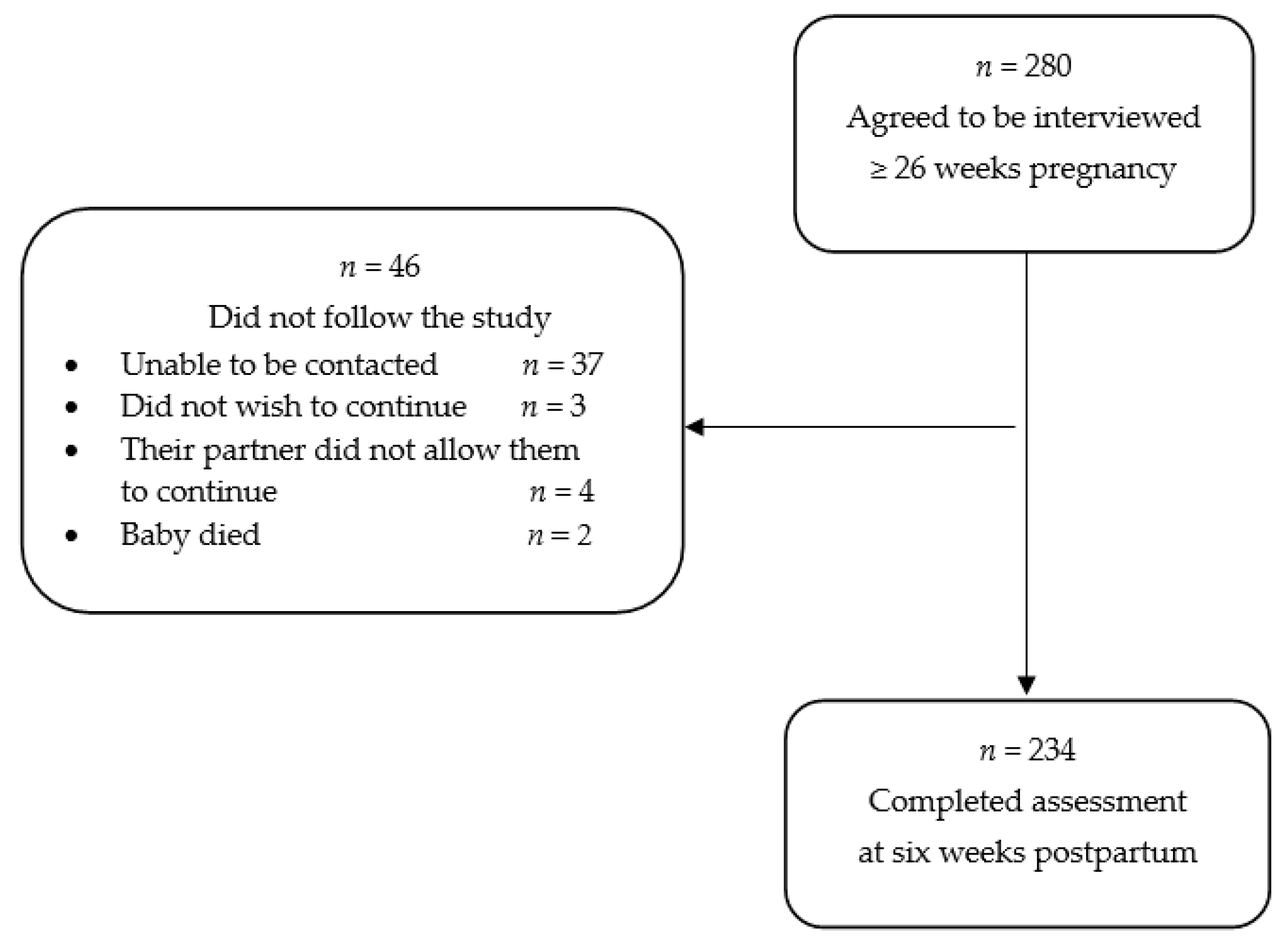
Anxiety during pregnancy and after childbirth can have negative consequences for a woman and her baby. Despite growing interest in the perinatal mental health of Mexican women living in the U.S., perinatal anxiety symptom (PAS) rates and risk factors have yet to be established for women in Mexico. We sought to determine PAS rates and identify risk factors, including the traditional female role (TFR) in a sample of Mexican women. This secondary data analysis is based on 234 Mexican women who participated in a longitudinal study on perinatal depression in Mexico. Anxiety symptoms were assessed in pregnancy and at six weeks postpartum. Rates were determined through frequencies, and multiple logistics regressions were conducted to identify risk factors in the sample. The PAS rate was 21% in pregnancy and 18% postpartum. Stressful life events and depressive symptoms were associated with a higher probability of PAS. Adherence to TFR increased the probability of prenatal anxiety; lower educational attainment and low social support during pregnancy increased the probability of postpartum anxiety. The PAS rates were within the range reported in the literature. The TFR was only associated with anxiety in gestation, highlighting the role of this culturally relevant risk factor. Culturally responsive early interventions are therefore required.
Keywords: perinatal anxiety symptoms; traditional female role; risk factors perinatal anxiety symptoms; traditional female role; risk factors