

Geoacumulation of Heavy Metals in Sediment of the Fluvial–Lagoon–Deltaic System of the Palizada River, Campeche, Mexico



Abstract
1. Introduction
2. Materials and Methods
2.1. Study Area
2.2. Laboratory Analysis
2.3. Acid Digestion in Microwave
2.4. Heavy Metal Enrichment: Pollution Load Index (PLI) for Heavy Metals and Geoaccumulation Index (Igeo)
3. Results and Discusion
3.1. Sources of Heavy Metals in the Palizada River System
3.1.1. Lead Concentration (Pb)
3.1.2. Cadmium Concentration (Cd)
3.2. Geoaccumulation Index (Igeo) in the Palizada Rriver
3.3. Heavy Metal Pollution Load Index (PLI)
3.4. Permissible Limits in Sediments
4. Conclusions
Author Contributions
Funding
Acknowledgments
Conflicts of Interest
References
- Rashed, M.N. Monitoring of environmental heavy metals in fish from Nasser Lake. Environ. Int. 2011, 27, 27–33. [Google Scholar] [CrossRef] [Scilit]
- Montalvo, C.; Aguilar, C.; Argaes, J.; Cerón, R.M.; Cerón, J.G.; Amador, L.E.; Ramírez, M.A. Cuantificación de los niveles de metales pesados en el río Palizada. In Análisis del Espacio Urbano y sus Consecuencias Ambientales en la Región de la Laguna de Términos; Villegas-Sierra, J., Cerón Bretón, R.M., Eds.; Universidad Autónoma de Campeche: Campeche, Mexico, 2018; pp. 181–213. [Google Scholar]
- Yilmaz, F.; Özdemir, N.; Demirak, A.; Tuna, A.L. Heavy metal levels in two fish species Leuciscus cephalus and Lepomis gibbosus. Food Chem. 2007, 100, 830–835. [Google Scholar] [CrossRef] [Scilit]
- Vargas-González, H.H.; Arreola-Lizárraga, J.A.; García-Hernández, J.; Mendoza-Salgado, R.A.; Zenteno Savín, T.; Méndez-Rodríguez, L.C. Calidad de sedimentos asociada a actividades antrópicas en lagunas costeras semiáridas subtropicales de la costa central este del Golfo de California. Rev. Int. Contam. Ambie 2017, 33, 7–22. [Google Scholar] [CrossRef] [Scilit]
- Abdel-Ghani, S.A. Trace metals in seawater, sediments and some fish species from Marsa Matruh Beaches in north-western Mediterranean coast, Egypt. Egyptian J. Aqua. Res 2015, 41, 145–154. [Google Scholar] [CrossRef] [Scilit]
- Montalvo, C.; Aguilar, C.A.; Amador, L.E.; Cerón, J.G.; Cerón, R.M.; Anguebes, F.; Cordova, A.V. Metal Contents in Sediments (Cd, Cu, Mg, Fe, Mn) as Indicators of Pollution of Palizada River, Mexico. Environ. Pollut. 2014, 3, 89–98. [Google Scholar] [CrossRef] [Scilit]
- Lu, C.-X.; Cheng, J.-M. Speciation of Heavy Metals in the Sediments from Different Eutrophic Lakes of China. Procedia Eng. 2011, 18, 318–323. [Google Scholar]
- Zhang, L.; Shi, Z.; Zhang, J.; Jiang, Z.; Wang, F.; Huang, X. Spatial and seasonal characteristics of dissolved heavy metals in the east and west Guangdong coastal waters, South China. Mar. Pollut. Bull. 2015, 95, 419–426. [Google Scholar] [CrossRef] [Scilit]
- Milanov, Đ.R.; Krstić, P.M.; Marković, V.R.; Jovanović, A.D.; Baltić, M.B.; Ivanović, S.J.; Jovetić, M.; Baltić, Ž.M. Analysis of heavy metals concentration in tissues of three different fish speciesincluded in human diet from Danube River, in the Belgrade region, Serbia. Act. Veterinaria-Beograd 2016, 66, 89–102. [Google Scholar] [CrossRef] [Scilit]
- Nogueirol, R.C.; Alleoni, L.R.F. Sequential extraction and speciation of Ba, Cu, Ni, Pb and Zn in soil contaminated with automotive industry waste. Chem. Speciat. Bioavailab 2013, 25, 34–42. [Google Scholar] [CrossRef] [Scilit]
- ATSDR. Cobre. Resumen de Salud Pública Cobre CAS: 7440-50-8. Agencia para Sustancias Tóxicas y el Registro de Enfermedades. Departamento de Salud y Servicios Humanos de EE. UU., Servicio de Salud Pública. 2018. Available online: https://www.atsdr.cdc.gov/es/phs/es_phs132.html (accessed on 18 December 2019).
- Wang, W.X. Interactions of trace metals and different marine food chains. Mar. Ecol. Prog. Ser. 2002, 243, 295–309. [Google Scholar] [CrossRef] [Scilit]
- Ansari, T.M.; Marr, I.L.; Tariq, N. Heavy metals in marine pollution perspective: A mini review. J. Appl. Sci 2004, 4, 1–20. [Google Scholar]
- Magesh, N.S.; Chandrasekar, N.; Krishna-Kumar, S.; Glory, M. Trace element contamination in the estuarine sediments along Tuticorin coast-Gulf of Mannar, southeast coast of India. Mar. Pollut. Bull. 2013, 73, 355–361. [Google Scholar] [CrossRef] [Scilit] [PubMed]
- Magallanes-Ordóñez, V.R.; Marmolejo-Rodríguez, A.J.; Rodríguez-Figueroa, G.M.; Sánchez-González, A.; Aguíñiga-García, S.; Arreguín-Sánchez, F.; Zetina-Rejón, M.; Tripp-Valdez, A.; Romo-Ríos, J.A. Characterization of lithogenic and biogenic zones and natural enrichment of nickel in sediments of the Terminos Lagoon, Campeche, Mexico. Estuar Shelf Sci. 2014, 156, 116–123. [Google Scholar] [CrossRef] [Scilit]
- Mendoza-Vega, J.; Kú-Quej, V.; Pool-Novelo, L.; Aguirre-Cortés, E. El impacto de prácticas agropecuarias en los recursos naturales del Área de Protección de Flora y Fauna Laguna de Términos, Campeche. El caso de Palizada y Sabancuy. In Aspectos socioambientales de la región de la laguna de Términos, Campeche; Ramos-Miranda, J., Villalobos-Zapata, G.J., Eds.; Universidad Autónoma de Campeche: Campeche, Mexico, 2015; pp. 65–73. [Google Scholar]
- Botello, A.V.; Páez-Osuna, F. El problema Crucial: La Contaminación; Serie de medio ambiente en Coatzacoalcos; Centro de Eco desarrollo: Mexico City, Mexico, 1986; pp. 62–85. [Google Scholar]
- Gantús-Inurreta, F.; Alcalá, C.; Villanueva, L. Historia Breve, 3rd ed.; Fondo de Cultura Económica, COLMEX: Campeche, Mexico, 2011; p. 295. [Google Scholar]
- Fuentes-Yaco, C.; Salas-Leon, D.A.; Monreal-Gomez, M.A.; Vera-Herrera, F. Environmental forcing in a tropical estuarine ecosystem: The Palizada River in the southern Gulf of Mexico. Mar. Freshwater Res. 2001, 52, 735–744. [Google Scholar] [CrossRef] [Scilit]
- Contreras-Ruiz, E.A.; Douillet, P.; Zavala-Hidalgo, J. Tidal dynamics of the Términos Lagoon, Mexico: Observations and 3D numerical modelling. Ocean Dyn. 2014, 64, 1349–1371. [Google Scholar] [CrossRef] [Scilit]
- Diario Oficial. Norma oficial Mexicana. NOM-117-SSA1-1994. Bienes y Servicios. Método de Prueba para la Determinación de Cadmio, Arsénico, Plomo, Estaño, Cobre, Fierro, Zinc y Mercurio en Alimentos, Agua Potable y Agua Purificada por Espectrometría de Absorción Atómica. Pubicado en el Diario Oficial de la Federación el 16 de Agosto de 1995. México, D.F. 2019. Available online: https://www.sinec.gob.mx/SINEC/Vista/Normalizacion/DetalleNorma.xhtml?pidn=ZlhiVk5TeVEzNEE1RVVPci96Y3I4Zz09 (accessed on 3 July 2019).
- Hakanson, L. An ecological risk index for aquatic pollution control. A sedimentological approach. Water Res. 1980, 14, 975–1001. [Google Scholar] [CrossRef] [Scilit]
- Martin, G.D.; George, R.; Shaiju, P.; Muraleedharan, K.R.; Nair, S.M.; Chandramohanakumar, N. Toxic Metals Enrichment in the Surficial Sediments of a Eutrophic Tropical Estuary (Cochin Backwaters, Southwest Coast of India). Sci. World J. 2012. [Google Scholar] [CrossRef] [Scilit]
- Rezaie-Boroon, M.H.; Toress, V.; Diaz, S.; Lazzaretto, T.; Tsang, M.; Deheyn, D.D. The Geochemistry of Heavy Metals in the Mudflat of Salinas de San Pedro Lagoon, California, USA. J. Environ. Protect. 2013, 4, 12–25. [Google Scholar] [CrossRef]
- Tomlinson, D.C.; Wilson, J.G.; Harris, C.R.; Jeffrey, D.W. Problems in the assessment of heavy-metal levels in estuaries and the formation of a pollution index. Helgoland Mar. Res. 1980, 33, 566–575. [Google Scholar] [CrossRef] [Scilit]
- Suresh, G.; Ramasamy, V.; Meenakshisundaram, V.; Venkatachalapathy, R.; Ponnusamy, V. Influence of mineralogical and heavy metal composition on natural radionuclide contents in the river sediments. Appl. Radiat. Isot. 2011, 69, 1466–1474. [Google Scholar] [CrossRef] [Scilit]
- Müller, G. Index of geoaccumulation in sediments of the Rhine River. GeoJournal 1969, 2, 108–118. [Google Scholar]
- Müller, G. Chemical Decontamination of Dredged Mate-rials, Combustion Residues, Soil and Other In: Materials Contaminated with Heavy Metals. In Proceedings of the 2nd International TNO/ BMFT Conference on Contaminated Soil, Hamburg, Germany, 11–15 April 1988; Wolf, W., Van-DeBrink, J., Colon, F.J., Eds.; 1988; Volume 2, pp. 1439–1442. [Google Scholar]
- Taylor, S.R.; McLennan, S.M. The Geochemical Evolution of the Continental Crust. Rev. Geophys. 1995, 33, 241–265. [Google Scholar] [CrossRef] [Scilit]
- Förstner, U.A.; Wolfgang, C.; Kersten, M. Sediment Criteria, Development. In Sediments and Environmental Geochemistry; Heling, D., Rothe, P., Förstner, U., Eds.; Springer: Berlin/Heidelberg, Germany, 1990; Volume 1, pp. 311–338. [Google Scholar] [CrossRef] [Scilit]
- Earthref. Referencia Values. 2018. Available online: https://earthref.org/GERMRD/11/ (accessed on 28 January 2019).
- Huheey, J.E. Inorganic Chemistry: Principles of Structure and Reactivity; Longman Higher Education: New York, NY, USA, 1983; p. 760. [Google Scholar]
- Muller, G. Die Schwermetallbelstung der sedimente des Neckars und seiner Nebenflusse: Eine estandsaufnahme. Chem. Zeitung 1981, 105, 157–164. [Google Scholar]
- Duncan, A.E.; De-Vries, N.; Nyarko, K. Assessment of Heavy Metal Pollution in the Sediments of the River Pra and Its Tributaries. Water Air Soil Pollut. 2018, 229, 272. [Google Scholar] [CrossRef] [Scilit]
- Grenz, C.; Fichez, R.; Álvarez-Silva, C.; Calva-Benítez, L.; Conan, P.; Contreras-Ruiz, E.A.; Denis, L.; Díaz-Ruiz, S.; Douillet, P.; Gallegos-Martinez, M.E.; et al. Benthic ecology of tropical coastal lagoons: Environmental changes over the last decades in the Términos Lagoon, Mexico. Geoscience 2017, 349, 319–329. [Google Scholar] [CrossRef] [Scilit]
- Aguilar, C.A.; Montalvo, C.; Rodríguez, L.; Cerón, J.G.; Cerón, R.M. American oyster (Crassostrea virginica) and sediments as a coastal zone pollution monitor by heavy metals. Int. J. Environ. Sci. Technol. 2012, 9, 579–586. [Google Scholar] [CrossRef] [Scilit]
- Cuevas-Madrid, H.; Rosales-Hoz, L.; Márquez-García, A.Z.; Carranza-Edwards, A. Environmental assessment of a mangrove protected area in the southeast Gulf of Mexico through sediment core analysis. Environ. Earth Sci. 2018, 77, 73. [Google Scholar] [CrossRef] [Scilit]
- Laino-Guanes, R.M.; Bello-Mendoza, R.; González-Espinosa, M.; Ramírez-Marcial, N.; Jiménez-Otárola, F.; Musálem-Castillejos, K. Metal Concentrations in Water and Sediments in the Upper Grijalva River Basin, Mexico-Guatemala border. Water Technol. Sci. 2015, 6, 61–74. [Google Scholar]
- Morales-García, S.S.; Rodríguez-Espinosa, P.F.; Shruti, V.C.; Jonathan, M.P.; Martínez-Tavera, E. Metal concentrations in aquatic environments of Puebla River basin, Mexico: Natural and industrial influences. Environ. Sci. Pollut. Res. 2016. [Google Scholar] [CrossRef] [Scilit]
- Shruti, V.C.; Rodríguez-Espinosa, P.F.; Escobedo-Urías, D.C.; Martinez-Tavera, E.; Jonathan, M.P. Environmental Consequences of Metal Concentrations in Stream Sediments of Atoyac River Basin, Central Mexico: Natural and Industrial Influences. Int. J. Environ. Ecol. Eng. 2017, 11, 44–51. [Google Scholar]
- Pérez-Castresana, G.; Tamariz-Flores, V.; López-Reyes, L.; Hernández-Aldana, F.; Castelán-Vega, R.; Morán-Perales, J.L.; García-Suastegui, W.A.; Díaz-Fonseca, A.; Handal-Silva, A. Atoyac River Pollution in the Metropolitan Area of Puebla, México. Water 2018, 10, 267. [Google Scholar] [CrossRef] [Scilit]
- Wakida, F.T.; Lara-Ruiz, D.; Temores-Peña, J.; Rodriguez-Ventura, J.G.; Diaz, C.; Garcia-Flores, E. Heavy metals in sediments of the Tecate River, Mexico. Environ. Geol. 2008, 54, 637–642. [Google Scholar] [CrossRef] [Scilit]
- Páez-Osuna, F.; Valdez-Lozano, D.S.; Alexander, H.M.; Fernandez-Perez, H. Trace metals in the fluvial system of Términos lagoon, Mexico. Mar. Pollut. Bull. 1987, 18, 294–297. [Google Scholar] [CrossRef] [Scilit]
- Conan, P.; Agab, M.; Calva-Benítez, L.G.; Chifflet, S.; Douillet, P.; Dussud, C.; Fichez, R.; Grenz, C.; Gutierrez Mendieta, F.; Origel-Moreno, M.; et al. Combining biogeochemical char-acterisation and microbial biomass and activities to assess pelagic cycling in a large and shallow tropical lagoon Términos Lagoon, Mexico. Biogeosciences 2017, 14, 959–975. [Google Scholar] [CrossRef] [Scilit]
- Grenz, C.; Moreno, M.; Soetaert, K.; Denis, L.; Douillet, P.; Fichez, R. Spatio-temporal variability in benthic exchanges at the sediment-water interface of a shallow tropical coastal lagoon south coast of Gulf of Mexico. Estuarine Coast. Shelf Sci. 2019, 218, 368–380. [Google Scholar] [CrossRef] [Scilit]
- ATSDR. Plomo. Resumen de Salud Pública Plomo CAS: 7439-92-1. Agencia para Sustancias Tóxicas y el Registro de Enfermedades. Departamento de Salud y Servicios Humanos de EE. UU., Servicio de Salud Pública. 2007. Available online: https://www.atsdr.cdc.gov/es/phs/es_phs13.pdf (accessed on 7 February 2019).
- Ciszewski, D.; Matys-Grygar, T. A Review of Flood-Related Storage and Remobilization of Heavy Metal Pollutants in River Systems. Water Air Soil Pollut. 2016, 227, 239. [Google Scholar] [CrossRef] [Scilit]
- Balakrishnan, T.; Sundaramanickam, A.; Shekhar, S.; Balasubramanian, T. Distribution and seasonal variation of heavy metals in sediments of Muthupet lagoon, southeast coast of India. J. Ecol. Eng. 2017, 16, 49–60. [Google Scholar] [CrossRef] [Scilit]
- Ajima, M.N.; Nnodi, P.C.; Ogo, O.A.; Adaka, G.S.; Osuigwe, D.I.; Njoku, D.C. Bioaccumulation of heavy metals in Mbaa River and the impact on aquatic ecosystem. Environ. Monit. Assess 2015, 187, 768. [Google Scholar] [CrossRef] [Scilit]
- Muciño-Márquez, R.E.; Figueroa-Torres, M.G.; Aguirre-León, A. Composición fitoplanctónica en los sistemas fluvio-lagunares Pom-Atasta y Palizada del este, adyacentes a la laguna de Términos Campeche, México. Acta Biol. Colomb. 2014, 19, 63–84. [Google Scholar] [CrossRef] [Scilit]
- Shil, S.C.; Islam, M.S.; Irin, A.; Tusher, T.R.; Hoq, M.E. Heavy Metal Contamination in Water and Sediments of Passur River near the Sundarbans Mangrove of Bangladesh. J. Environ. Sci. Nat. Resour. 2017, 10, 15–19. [Google Scholar] [CrossRef] [Scilit]
- Salem, Z.B.; Capelli, N.; Laffray, X.; Elise, G.; Ayadi, H.; Aleya, L. Seasonal variation of heavy metals in water, sediment and roachtissues in a landfill draining system pond (Etueffont, France). Ecol. Eng. 2014, 69, 25–37. [Google Scholar] [CrossRef] [Scilit]
- Cardoso, I.; Granadeiro, J.P.; Cabral, H. Cantidad y calidad de las presas bénticas en las principales zonas de alimentación de las planicies lodosas del estuario del Tajo: Implicaciones para las poblaciones de aves y peces. Ciencias Marinas 2008, 34, 283–296. [Google Scholar] [CrossRef] [Scilit]
- Ghorbanzadeh-Zaferani, S.; Machinchian-Moradi, A.; Mousavi-Nadushan, R.; Sari, A.R.; Fatemi, S.M.R. Distribution pattern of heavy metals in the surficial sediment of Gorgan Bay (South Caspian Sea, Iran). Iran. J. Fish. Sci. 2016, 15, 1144–1166. [Google Scholar]
- Gati, G.; Pop, C.; Brudașcă, F.; Gurzău, A.E.; Spînu, M. Assessment of the Heavy Metal Contamination in the Danube Delta from the Bioaccumulation Perspective. Glob. J. Hum. Soc. Sci. (B) 2013, 13, 11–16. [Google Scholar]
- ATSDR. Cadmio. Resumen de Salud Pública Cadmio CAS: 1306-19-0. Agencia para Sustancias Tóxicas y el Registro de Enfermedades. Departamento de Salud y Servicios Humanos de EE. UU., Servicio de Salud Pública. 2018. Available online: https://www.atsdr.cdc.gov/es/phs/es_phs5.html (accessed on 2 March 2019).
- Hounkpè, J.B.; Kélomè, N.C.; Adèchina, R.; Lawani, R.N. Assessment of heavy metals contamination in sediments at the lake of Ahémé in southern of Benin (West Africa). J. Mater. Environ. Sci. 2017, 8, 4369–4377. [Google Scholar] [CrossRef] [Scilit]
- López-Pérez, M.E.; Del Rincón-Castro, M.C.; Muñoz-Torres, C.; Ruiz-Aguilar, G.M.L.; Solís-Valdez, S.; Zanor, G.A. Evaluación de la contaminación por elementos traza en suelos agrícolas del suroeste de Guanajuato, México. Acta Universitaria 2017, 27, 10–21. [Google Scholar] [CrossRef] [Scilit]
- Hasan, A.B.; Kabir, S.; Selim-Reza, A.H.M.; Nazim-Zaman, M.; Ahsan, A.; Rashid, M. Enrichment factor and geo-accumulation index of trace metals in sediments of the ship breaking area of Sitakund Upazilla (Bhatiary–Kumira), Chittagong, Bangladesh. J. Geochem. Explor. 2013, 125, 130–137. [Google Scholar] [CrossRef] [Scilit]
- Mohiuddin, K.M.; Zakir, H.M.; Otomo, K.; Sharmin, S.; Shikazono, N. Geochemical distribution of trace metal pollutants in water andsediments of downstream of an urban river. Int. J. Environ. Sci. Tech 2010, 7, 17–28. [Google Scholar] [CrossRef] [Scilit]
- Genc, O.T.; Yilmaz, F. Risk Assessment and Accumulation of Metals in Sediment of Köyceğiz Lagoon System, Turkey. J. Adv. Agric. 2016, 6, 804–811. [Google Scholar]
- Suresh, G.; Sutharsan, P.; Ramasamy, V.; Venkatachalapathy, R. Assessment of spatial distribution and potential ecological risk of the heavy metals in relation to granulqometric contents of Veeranam lake sediments, India. Ecotoxicol. Environ. Saf. 2012, 84, 117–124. [Google Scholar] [CrossRef] [Scilit]
- Nfon, E.; Cousins, I.T.; Järvinen, O.; Mukherjee, A.B.; Verta, M.; Broman, D. Trophodynamics of mercury and other trace elements in a pelagic food chain from the Baltic Sea. Sci. Total Environ. 2009, 407, 6267–6274. [Google Scholar] [CrossRef] [Scilit]
- Botello, V.A.; Villanueva, S.; Martínez, E. Metales y metaloides en praderas de pastos marinos de la laguna de Términos, Campeche. In Aspectos Socioambientales de la Región de la Laguna de Términos, Campeche; Ramos-Miranda, J., Villalobos-Zapata, G.J., Eds.; Universidad Autónoma de Campeche: Campeche, Mexico, 2015; pp. 133–143. [Google Scholar]
- Long, E.R.; Macdonald, D.D.; Smith, S.L.; Calder, F.D. Incidence of adverse biological effects within ranges of chemical concentrations in marine and estuarine sediments. Environ. Manag. 1995, 19, 81–97. [Google Scholar] [CrossRef] [Scilit]
- Xu, Y.; Wu, Y.; Han, J.; Li, P. The current status of heavy metal in lake sediments from China: Pollution and ecological risk assessment. Ecol. Evol. 2017, 7, 5454–5466. [Google Scholar] [CrossRef] [Scilit]
- FEPA/WHO. Guidelines and Standards for Environmental Pollution Control in Nigeria; Federal Government Protection Agency: Washington, DC, USA; WHO: Geneva, Switzerland, 2003; p. 238.
- CCME. Canadian Sediment Quality Guidelines for the Protection of Aquatic Life. Cadmium. Canadian Council of Ministers of the Environment: Winnipeg, MB, Canada, 1999. Available online: http://ceqg-rcqe.ccme.ca/download/en/231 (accessed on 30 April 2019).
- US EPA (U.S. Environmental Protection Agency). Screening Level Ecological Risk Assessment Protocol for Hazardous Waste Combustion Facilities. Vol. 3, Appendix E: Toxicity Reference Values. EPA530-D99-001C. 1999. Available online: https://www.csu.edu/cerc/researchreports/documents/ScreeningLevelEcologicalRiskAssessmentProtocolHazardousWasteCombustionFacilitiesVolume3.pdf (accessed on 15 November 2019).
- Buchman, M.F. NOAA Screening Quick Reference Tables; NOAA, OR&R Report 08-1; Office of Response and Restoration: Seattle, WA, USA, 2008; p. 12. [Google Scholar]
- MacDonald, D.D.; Ingersoll, C.G.; Berger, T.A. Development and evaluation of consensus-based sediment quality guidelines for freshwater ecosystems. Arch. Environ. Contam. Toxicol. 2000, 39, 20–31. [Google Scholar] [CrossRef] [Scilit]

| Site | Pb | Cd |
|---|---|---|
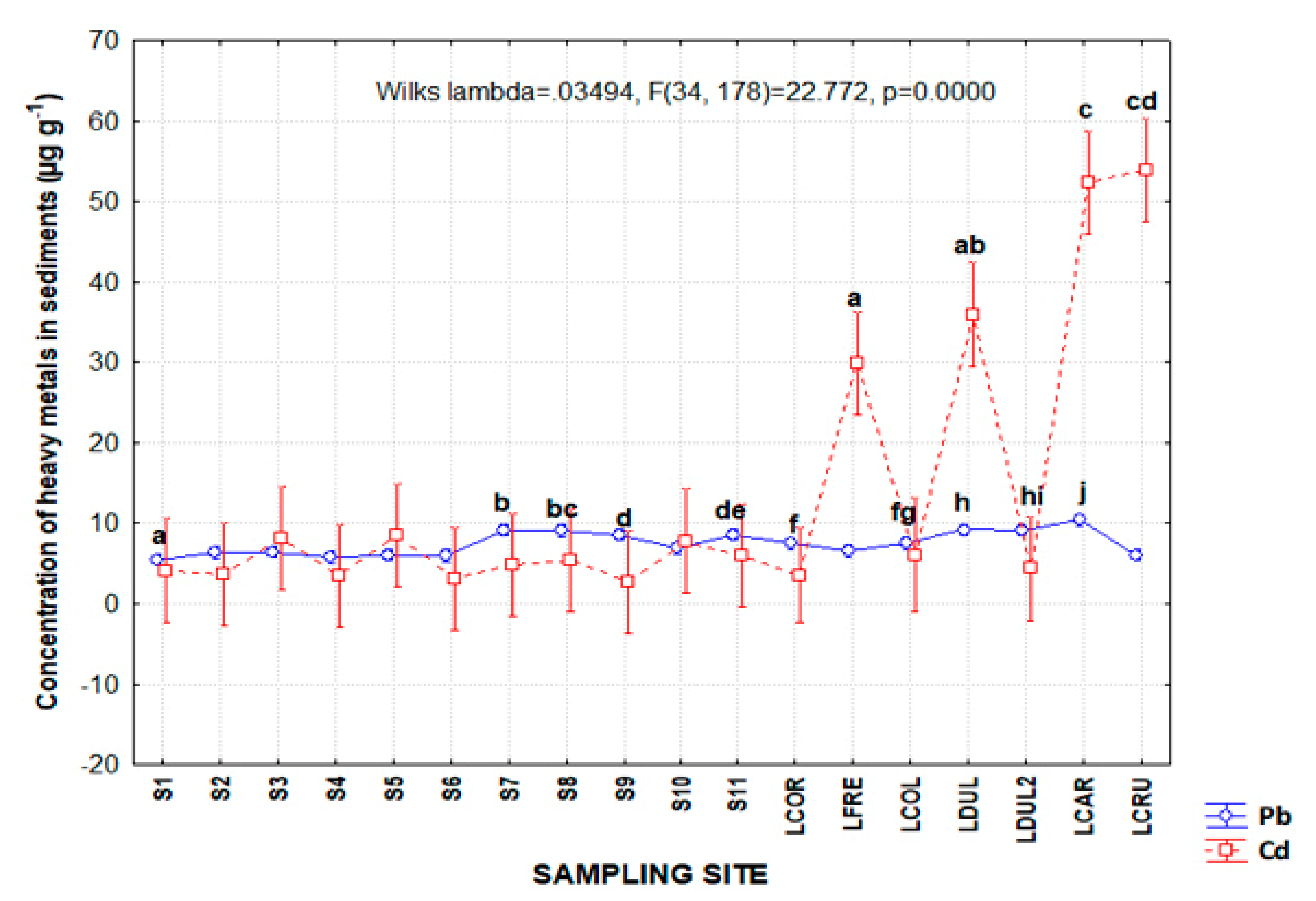
| S1 | 5.5 ± 1.0 | 4.1 ± 0.5 |
| S2 | 6.4 ± 0.9 | 3.6± 0.6 |
| S3 | 6.4 ± 0.9 | 8.0 ± 1.6 |
| S4 | 5.7 ± 0.8 | 3.4 ± 0.8 |
| S5 | 6.0 ± 0.9 | 8.5 ± 1.6 |
| S6 | 6.0 ± 1.6 | 3.1 ± 1.4 |
| S7 | 9.1 ± 0.6 | 4.8± 1.3 |
| S8 | 9.1 ± 0.5 | 5.4 ± 0.9 |
| S9 | 8.6 ± 0.9 | 2.7 ± 0.4 |
| S10 | 6.9 ± 0.6 | 7.8 ± 1.0 |
| S11 | 8.5 ± 0.8 | 6.0 ± 2.1 |
| LCOR | 7.4 ± 0.8 | 3.5 ± 0.9 |
| LFRE | 6.5 ± 1.1 | 29.8 ± 19.8 |
| LCOL | 7.5 ± 1.0 | 6.0 ± 1.3 |
| LDUL | 9.2 ± 0.6 | 35.9 ± 25.3 |
| LDUL2 | 9.1 ± 0.8 | 4.3 ± 0.6 |
| LCAR | 10.4 ± 0.2 | 52.4 ± 6.5 |
| LCRU | 6.0 ± 0.6 | 53.9 ± 5.0 |
| Total | 7.5 ± 1.6 | 13.5 ± 18.1 |
| Season | Pb | Cd |
|---|---|---|
| R | 7.6 ± 1.5 | 14.8 ± 19.0 |
| NW | 6.6 ± 1.7 | 9.0 ± 13.3 |
| D | 8.2 ± 1.3 | 16.7 ± 20.8 |
| Total | 7.5 ± 1.6 | 13.5 ± 18.1 |
| Sampling Site | CF Pb | CF Cd | PLI | I-geo Pb | I-geo Cd |
|---|---|---|---|---|---|
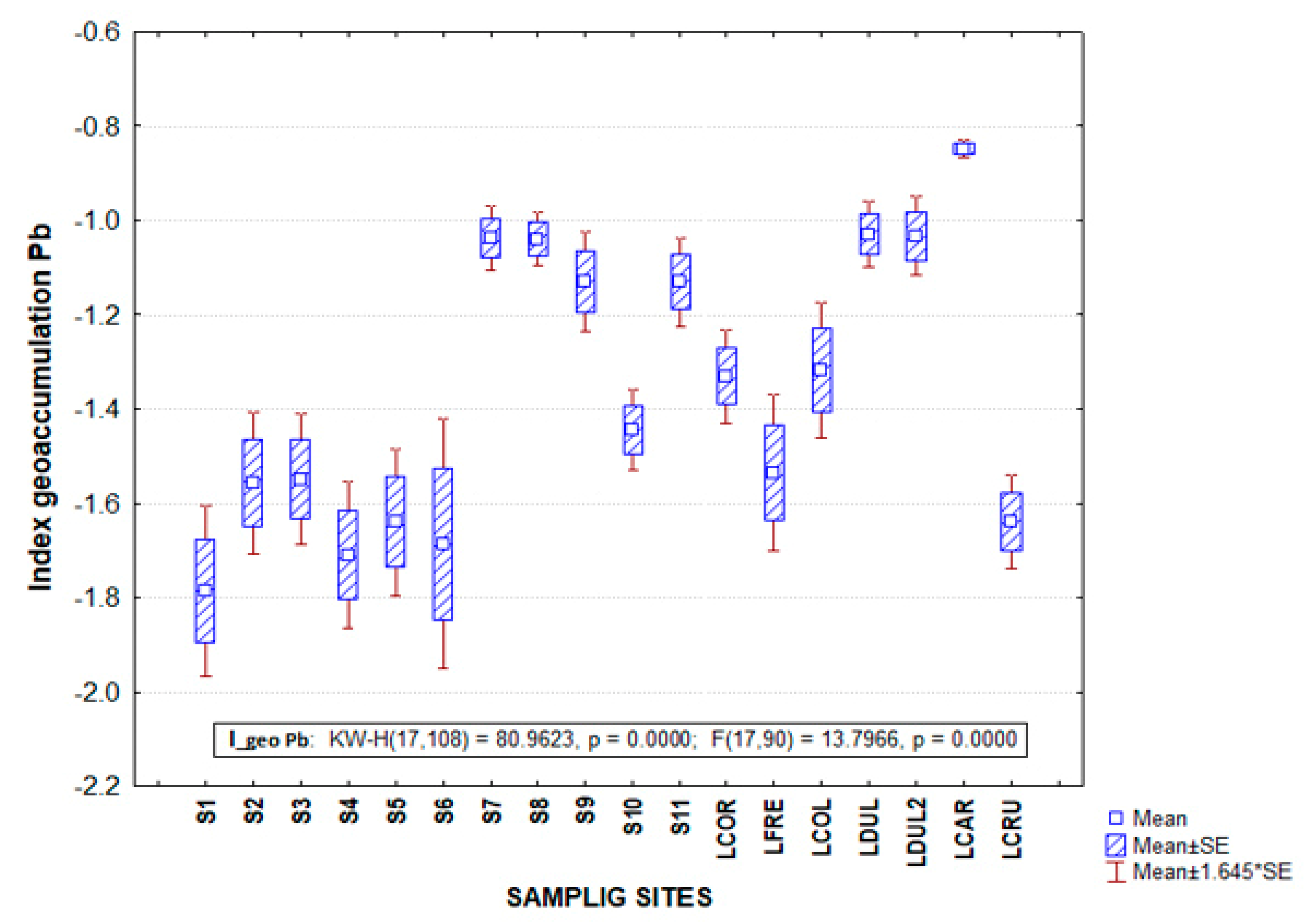
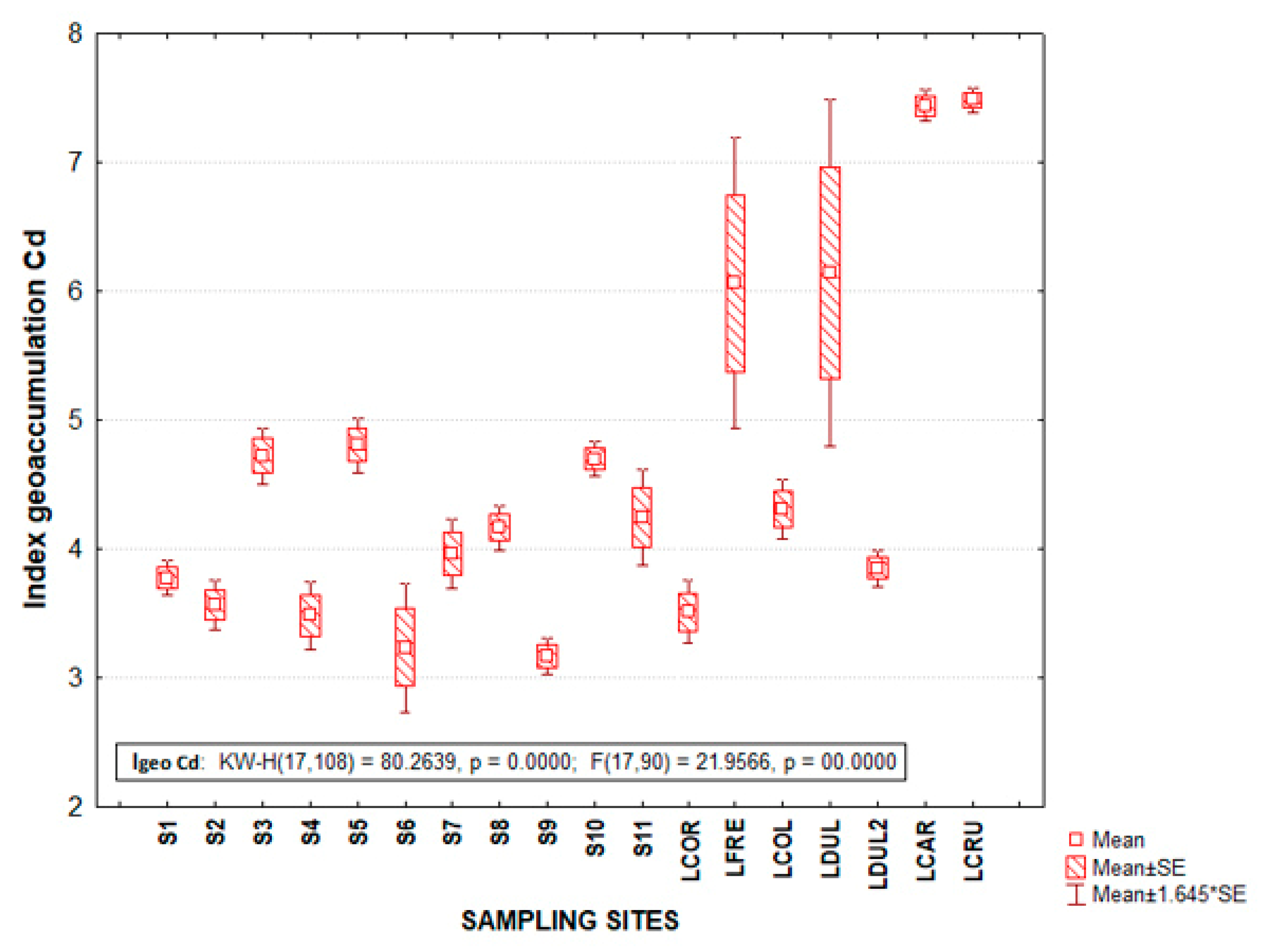
| Total | 0.6 | 67.6 | 71.6 | −1.3 | 4.5 |
| S1 | 0.4 | 20.7 | 15.0 | −1.7 | 3.7 |
| S2 | 0.5 | 18.0 | 15.6 | −1.5 | 3.5 |
| S3 | 0.5 | 40.3 | 35.0 | −1.5 | 4.7 |
| S4 | 0.4 | 17.2 | 13.0 | −1.7 | 3.4 |
| S5 | 0.4 | 42.6 | 34.6 | −1.6 | 4.8 |
| S6 | 0.4 | 15.6 | 11.5 | −1.6 | 3.2 |
| S7 | 0.7 | 24.1 | 28.8 | −1.0 | 3.9 |
| S8 | 0.7 | 27.2 | 32.9 | −1.0 | 4.1 |
| S9 | 0.6 | 13.6 | 15.2 | −1.1 | 3.1 |
| S10 | 0.5 | 39.1 | 35.7 | −1.4 | 4.6 |
| S11 | 0.6 | 30.1 | 35.1 | −1.1 | 4.2 |
| LCOR | 0.5 | 17.6 | 17.4 | −1.3 | 3.5 |
| LFRE | 0.5 | 149.0 | 138.7 | −1.5 | 6.0 |
| LCOL | 0.6 | 30.3 | 30.9 | −1.3 | 4.3 |
| LDUL | 0.7 | 179.8 | 227.5 | −1.0 | 6.1 |
| LDUL2 | 0.7 | 21.8 | 26.7 | −1.0 | 3.8 |
| LCAR | 0.8 | 262.1 | 360.9 | −0.8 | 7.4 |
| LCRU | 0.4 | 269.6 | 216.6 | −1.6 | 7.4 |
| Permissible Limits | Pb | Cd | Source |
|---|---|---|---|
| Maximum permissible limit (MPL) | 0.040 | 0.006 | FEPA [67] |
| Probable effect concentrations (PEC) | 91.3 | 3.5 | CCME [68] |
| Interim Sediment Quality Guidelines (ISQG) | 35 | 0.6 | |
| Toxicity reference values (TRVs) | 31 | 0.60 | US EPA [69] |
| Minimum threshold concentration Effects Range–Low (ERL) | 46.7 | 1.2 | Long [65] |
| Maximum threshold concentration Effects Range–Median (ERM) | 218 | 9.6 | |
| Threshold effects level (TEL) | 30.2 | 0.69 | Buchman [70] |
| Probable effects level (PEL) Threshold effects level (TEL) | 112.2 30.2 | 4.21 0.68 | MacDonald et al. [71] |
© 2020 by the authors. Licensee MDPI, Basel, Switzerland. This article is an open access article distributed under the terms and conditions of the Creative Commons Attribution (CC BY) license (http://creativecommons.org/licenses/by/4.0/).
Share and Cite
Navarrete-Rodríguez, G.; Castañeda-Chávez, M.d.R.; Lango-Reynoso, F. Geoacumulation of Heavy Metals in Sediment of the Fluvial–Lagoon–Deltaic System of the Palizada River, Campeche, Mexico. Int. J. Environ. Res. Public Health 2020, 17, 969. https://doi.org/10.3390/ijerph17030969
Navarrete-Rodríguez G, Castañeda-Chávez MdR, Lango-Reynoso F. Geoacumulation of Heavy Metals in Sediment of the Fluvial–Lagoon–Deltaic System of the Palizada River, Campeche, Mexico. International Journal of Environmental Research and Public Health. 2020; 17(3):969. https://doi.org/10.3390/ijerph17030969
Chicago/Turabian StyleNavarrete-Rodríguez, Gabycarmen, María del Refugio Castañeda-Chávez, and Fabiola Lango-Reynoso. 2020. "Geoacumulation of Heavy Metals in Sediment of the Fluvial–Lagoon–Deltaic System of the Palizada River, Campeche, Mexico" International Journal of Environmental Research and Public Health 17, no. 3: 969. https://doi.org/10.3390/ijerph17030969
APA StyleNavarrete-Rodríguez, G., Castañeda-Chávez, M. d. R., & Lango-Reynoso, F. (2020). Geoacumulation of Heavy Metals in Sediment of the Fluvial–Lagoon–Deltaic System of the Palizada River, Campeche, Mexico. International Journal of Environmental Research and Public Health, 17(3), 969. https://doi.org/10.3390/ijerph17030969

