The Influence of South East Asia Forest Fires on Ambient Particulate Matter Concentrations in Singapore: An Ecological Study Using Random Forest and Vector Autoregressive Models


Abstract
1. Introduction
2. Methods
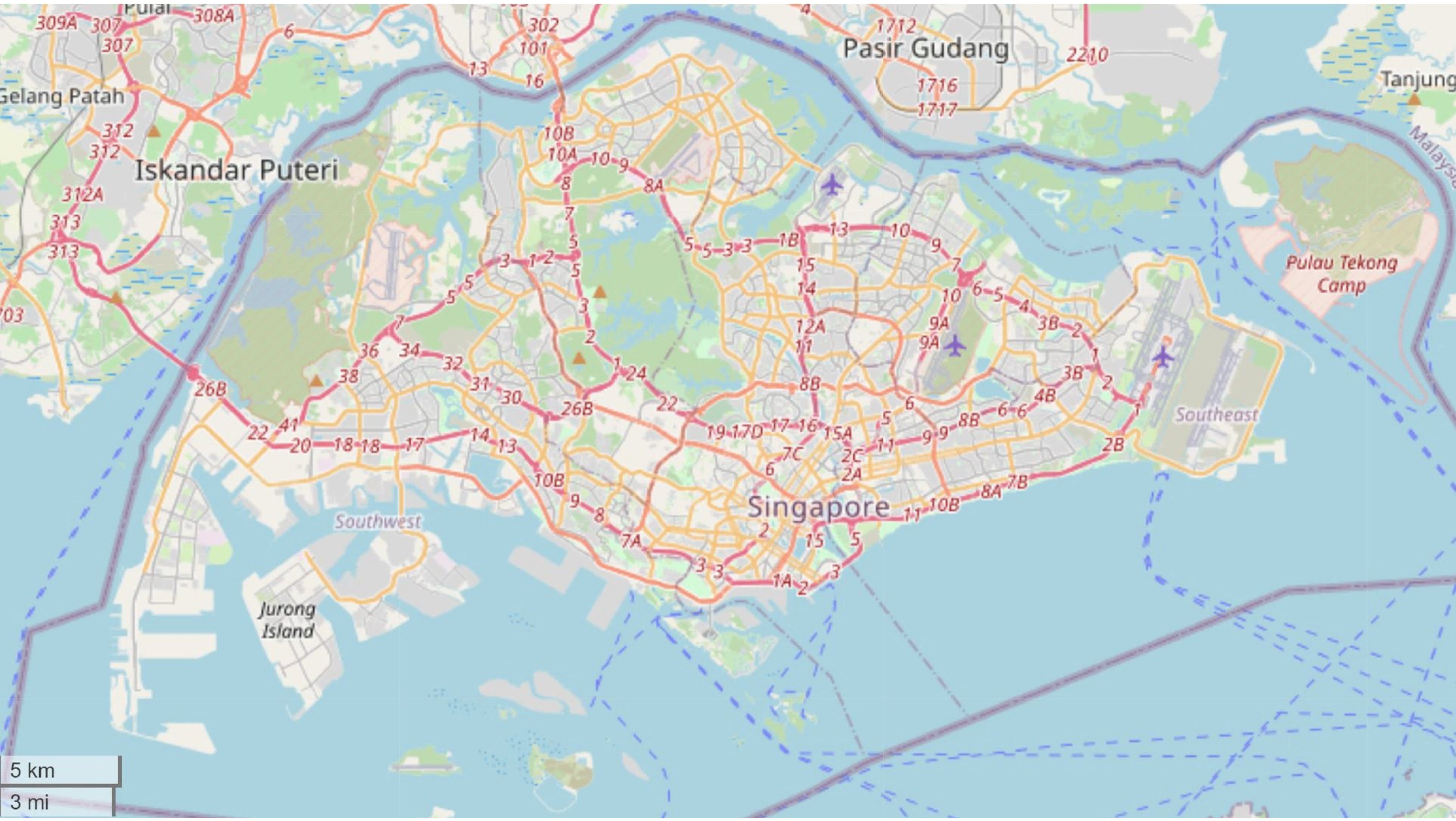
2.1. Study Setting
2.2. Climate Data
2.3. Air Quality Data
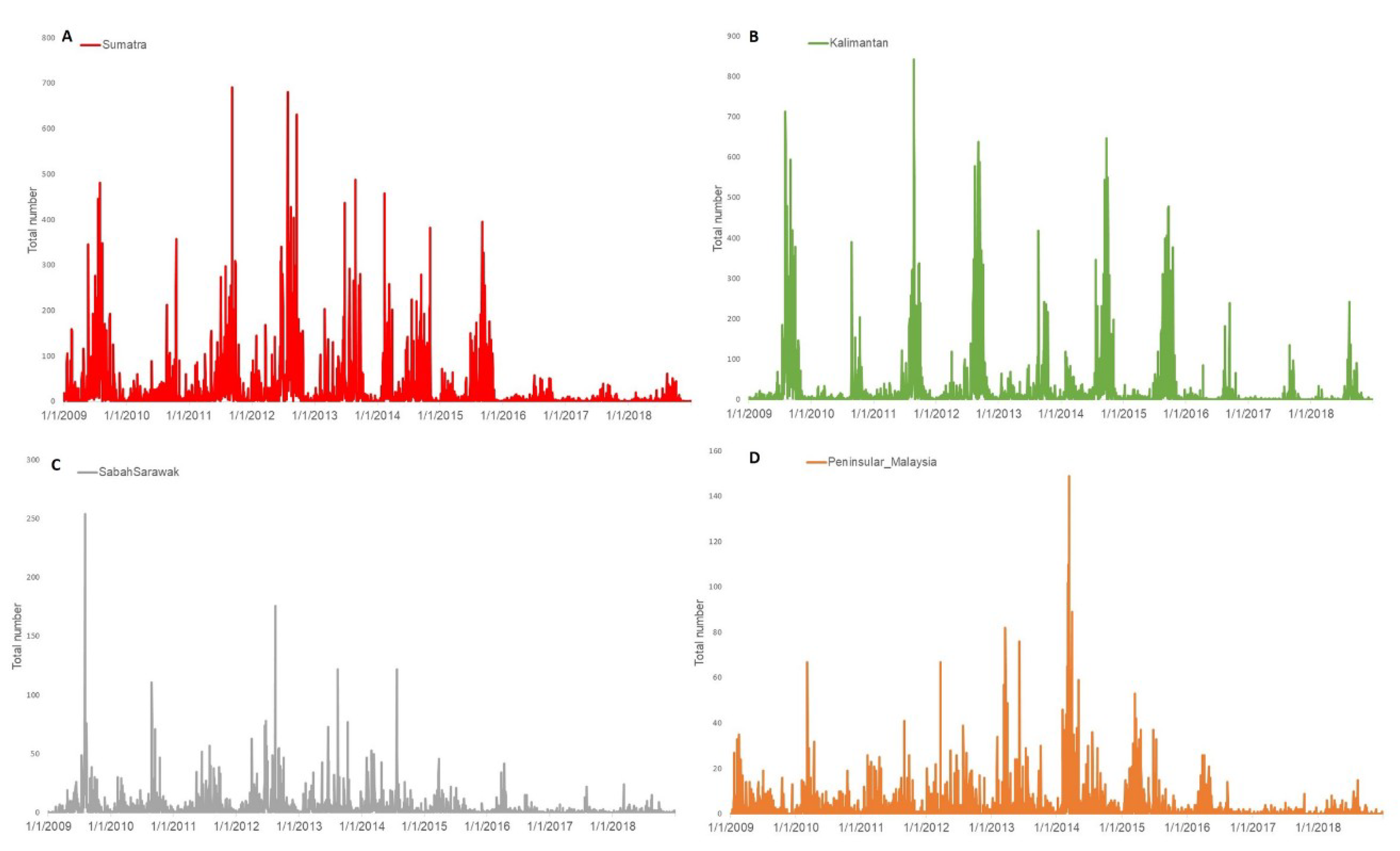
2.4. Forest Fire Data
2.5. Statistical Analyses
2.6. Model Parameters and Evaluation
2.7. RF Model
2.8. VAR Model
3. Results
3.1. Association between PM2.5 and PM10 with Climate and Hotspots Variables
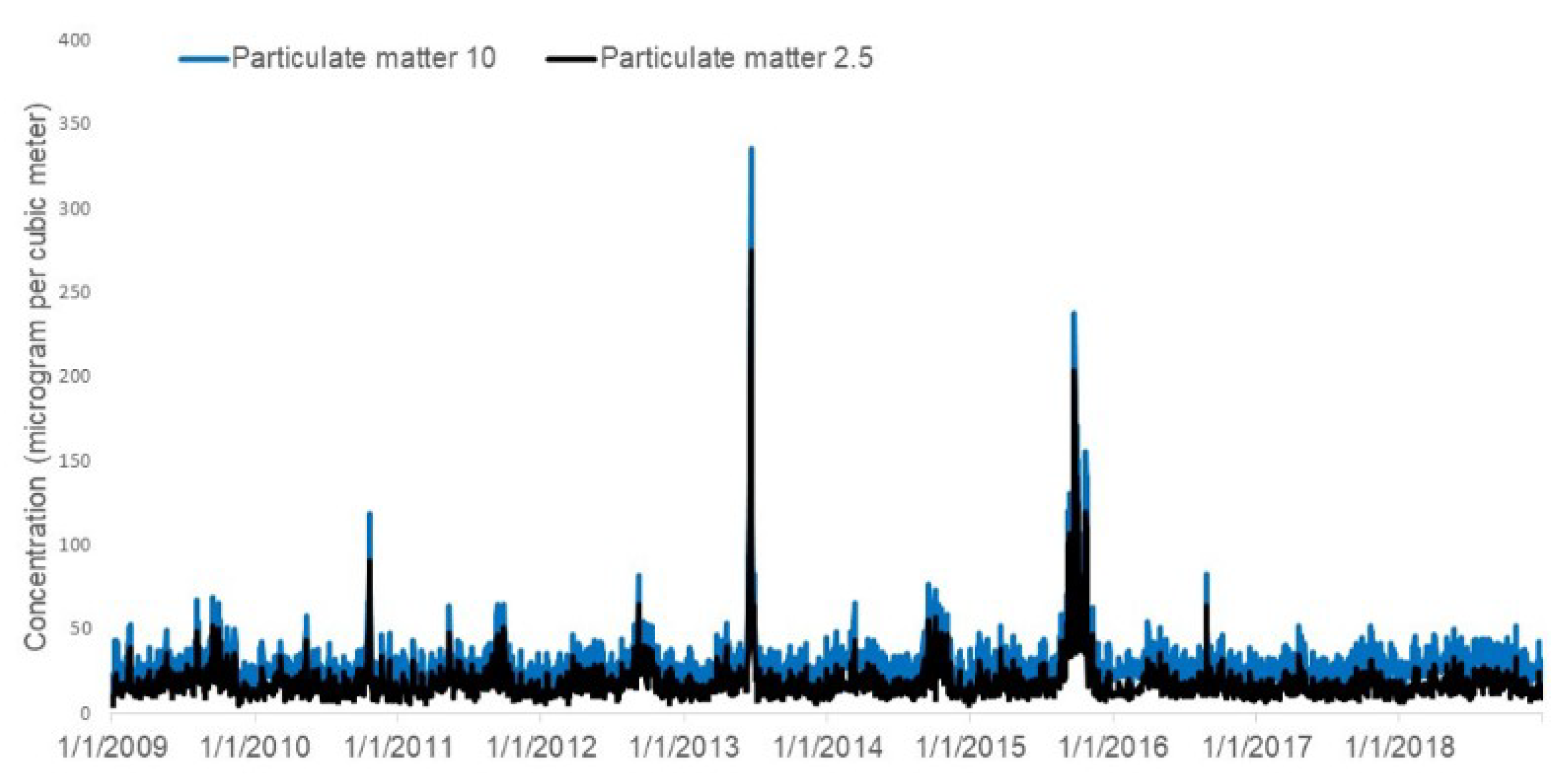
3.2. Time-Series Analyses of Daily 24-h Average of PM2.5 and PM10
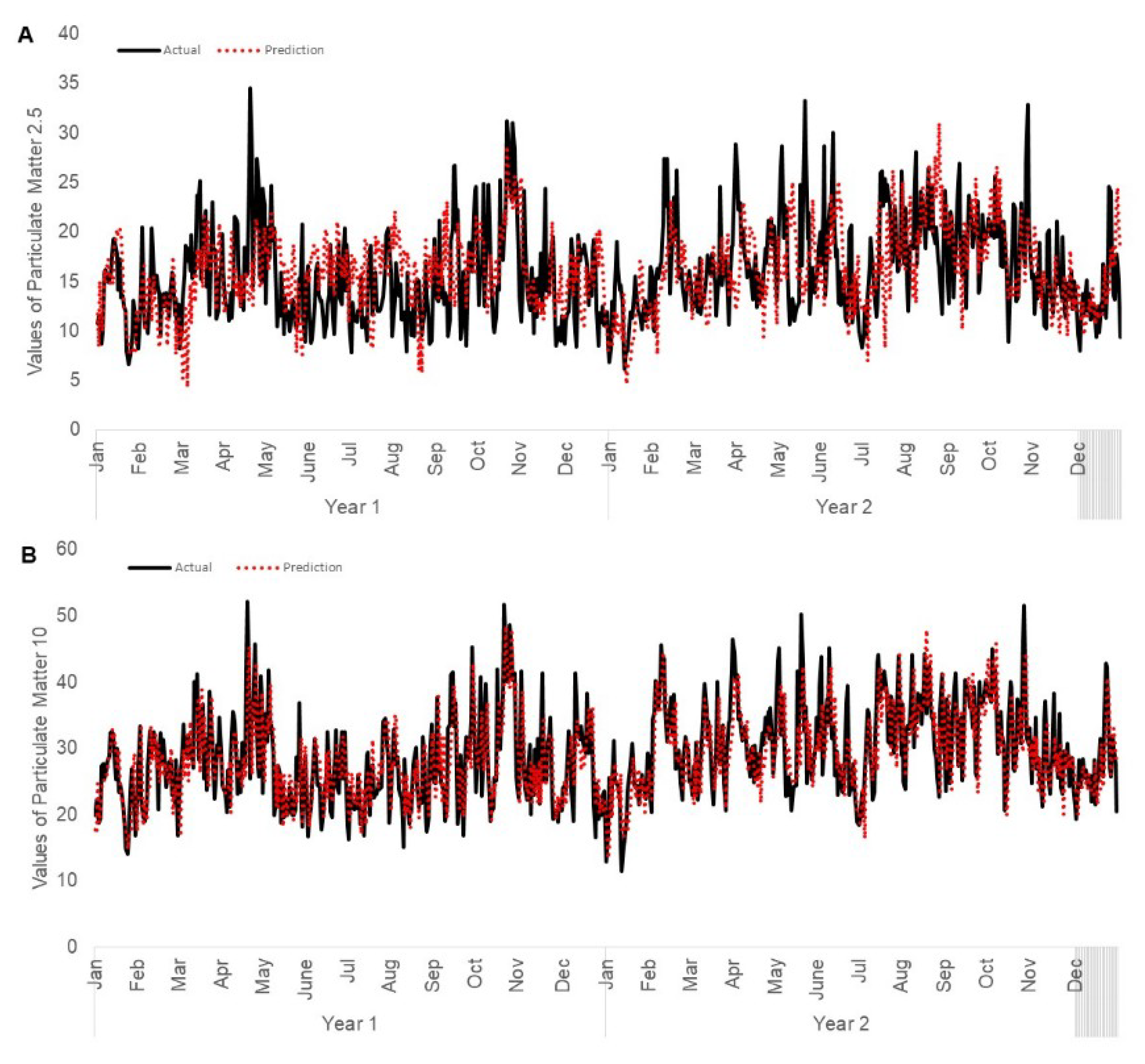
3.3. RF Model
3.4. VAR Model
3.5. Comparison of Models
4. Discussion
- In contrast, the VAR models picked up mean temperature lagging PM2.5 and PM10 by one and two days having significant negative effect on the concentration of PM2.5 and PM10 in the air. The effect of mean temperature on air quality has, however, been inconsistent, with several studies showing conflicting findings. Some studies have observed a negative correlation between mean temperature and concentrations of PM2.5 and PM10 [50,51]. However, there are other studies that have shown that there is a combined effect of climatic factors on the concentration of PM2.5 and PM10. For example, a study in Nagasaki, Japan concluded that temperature is positively correlated with PM2.5 and PM10 during monsoons and negatively correlated during other seasons [52]. Another study in Dhaka also showed variable response of relative humidity with air pollutants according to seasonal variation [53]. Hence, machine learning methods are relevant for the predictions of air quality, due to the mixed effects of climatic factors.
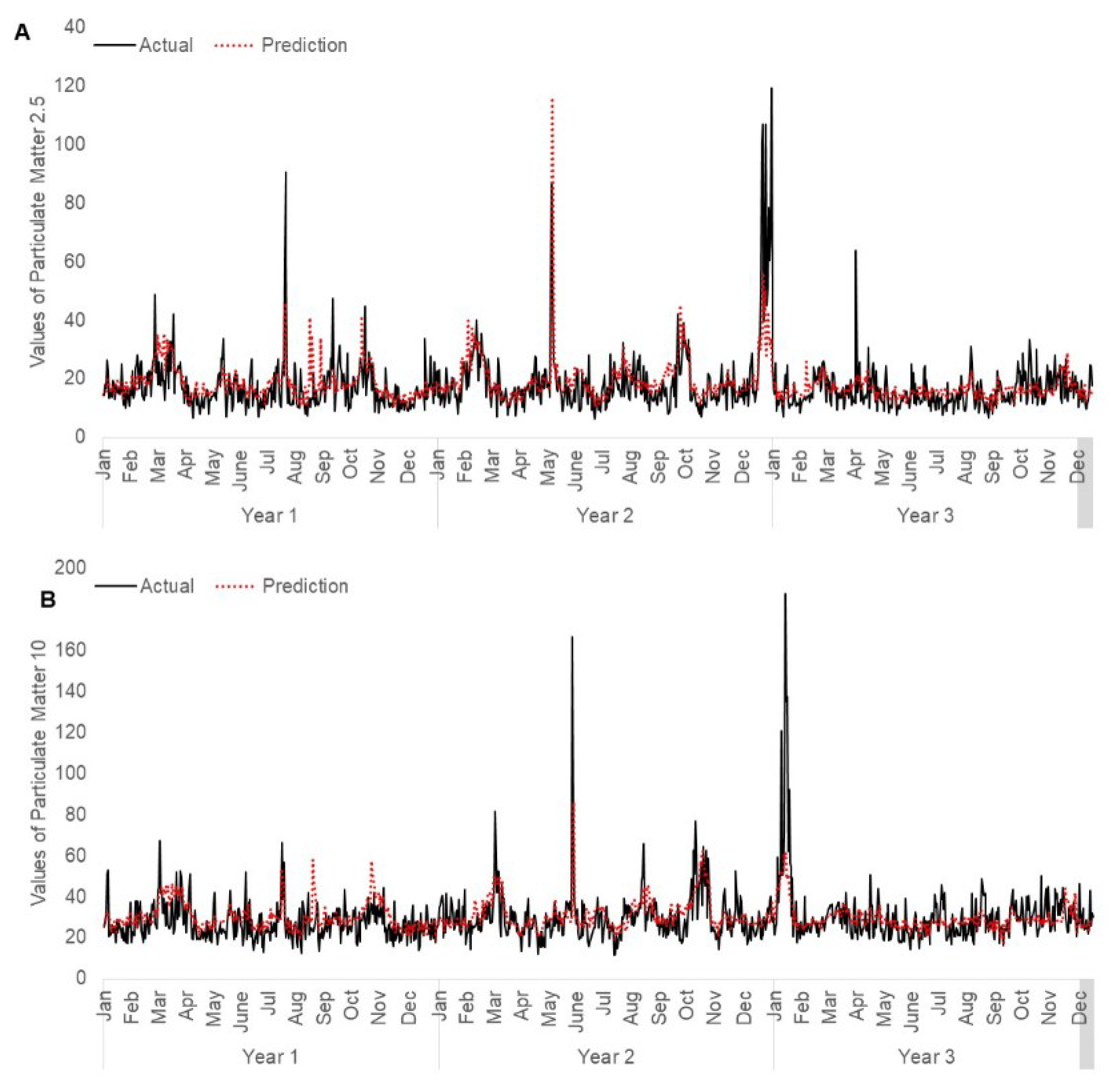
- Comparing RF and VAR models, the VAR models performs slightly better with MAPE values being 0.8% and 6.1% lower for PM2.5 and PM10, respectively. Hence, the VAR model can be reliably used for future predictions of the concentration of PM2.5 and PM10 in urban atmosphere in Singapore. To improve the communication of predictions to the community, we can categorize the predicted values according to the Table 4 [54]. Singapore uses this category to show the levels of pollutants in the air. It will be useful to release a daily prediction of PM2.5 and PM10 for community preparedness.
5. Conclusions
Supplementary Materials
Author Contributions
Funding
Acknowledgments
Conflicts of Interest
List of Abbreviations
References
- Crutzen, P.J.; Heidt, L.E.; Krasnec, J.P.; Pollock, W.H.; Seiler, W. Biomass burning as a source of atmospheric gases CO, H2, N2O, NO, CH3Cl and COS. Nat. Cell Biol. 1979, 282, 253–256. [Google Scholar] [CrossRef] [Scilit]
- Seiler, W.; Crutzen, P.J. Estimates of gross and net fluxes of carbon between the biosphere and the atmosphere from biomass burning. Clim. Chang. 1980, 2, 207–247. [Google Scholar] [CrossRef] [Scilit]
- Crutzen, P.J.; Andreae, M.O. Biomass Burning in the Tropics: Impact on Atmospheric Chemistry and Biogeochemical Cycles. Science 1990, 250, 1669–1678. [Google Scholar] [CrossRef] [Scilit] [PubMed]
- Crippa, P.; Castruccio, S.; Archer-Nicholls, S.; Lebron, G.B.; Kuwata, M.; Thota, A.; Sumin, S.; Butt, E.; Wiedinmyer, C.; Spracklen, D.V. Population exposure to hazardous air quality due to the 2015 fires in Equatorial Asia. Sci. Rep. 2016, 6, 37074. [Google Scholar] [CrossRef] [Scilit]
- Sigsgaard, T.; Bertil, F.; Isabella, A.-M.; Anders, B.; Anette, B.; Christoffer, B.; Jakob, B. Health impacts of anthropogenic biomass burning in the developed world. Eur. Respir. J. 2015, 46, 1577–1588. [Google Scholar] [CrossRef] [Scilit]
- Youssouf, H.; Liousse, C.; Roblou, L.; Assamoi, E.-M.; Salonen, R.O.; Maesano, C.; Banerjee, S.; Annesi-Maesano, I. Non-Accidental Health Impacts of Wildfire Smoke. Int. J. Environ. Res. Public Health 2014, 11, 11772–11804. [Google Scholar] [CrossRef] [Scilit]
- Reddington, C.L.; Butt, E.W.; Ridley, D.A.; Artaxo, P.; Morgan, W.T.; Coe, H.; Spracklen, D.V. Air quality and human health improvements from reductions in deforestation-related fire in Brazil. Nat. Geosci. 2015, 8, 768–771. [Google Scholar] [CrossRef] [Scilit]
- Aik, J.; Chua, R.; Jamali, N.; Chee, E. The burden of acute conjunctivitis attributable to ambient particulate matter pollution in Singapore and its exacerbation during South-East Asian haze episodes. Sci. Total. Environ. 2020, 740, 140129. [Google Scholar] [CrossRef] [Scilit]
- Jones, D.S. ASEAN and transboundary haze pollution in Southeast Asia. Asia Eur. J. 2006, 4, 431–446. [Google Scholar] [CrossRef] [Scilit]
- Hansen, A.B.; Witham, C.S.; Chong, W.M.; Kendall, E.; Chew, B.N.; Gan, C.; Hort, M.C.; Lee, S.-Y. Haze in Singapore–source attribution of biomass burning PM10 from Southeast Asia. Atmos. Chem. Phys. Discuss. 2019, 19, 5363–5385. [Google Scholar] [CrossRef] [Scilit]
- Gellert, P.K. A brief history and analysis of Indonesia’s forest fire crisis. Indonesia 1998, 65, 63–85. [Google Scholar] [CrossRef] [Scilit]
- Langner, A.; Miettinen, J.; Siegert, F. Land cover change 2002–2005 in Borneo and the role of fire derived from MODIS imagery. Glob. Chang. Biol. 2007, 13, 2329–2340. [Google Scholar] [CrossRef] [Scilit]
- Carlson, K.M.; Curran, L.M.; Ratnasari, D.; Pittman, A.M.; Soares-Filho, B.S.; Asner, G.P.; Trigg, S.N.; Gaveau, D.A.; Lawrence, D.; Rodrigues, H.O. Committed carbon emissions, deforestation, and community land conversion from oil palm plantation expansion in West Kalimantan, Indonesia. Proc. Natl. Acad. Sci. USA 2012, 109, 7559–7564. [Google Scholar] [CrossRef] [Scilit] [PubMed]
- Van Der Werf, G.R.; Randerson, J.T.; Giglio, L.; Collatz, G.J.; Mu, M.; Kasibhatla, P.S.; Morton, D.C.; DeFries, R.S.; Jin, Y.; Van Leeuwen, T.T. Global fire emissions and the contribution of deforestation, savanna, forest, agricultural, and peat fires (1997–2009). Atmos. Chem. Phys. Discuss. 2010, 10, 11707–11735. [Google Scholar] [CrossRef] [Scilit]
- Marlier, M.; DeFries, R.S.; Kim, P.S.; Koplitz, S.N.; Jacob, D.J.; Mickley, L.J.; Myers, S.S. Fire emissions and regional air quality impacts from fires in oil palm, timber, and logging concessions in Indonesia. Environ. Res. Lett. 2015, 10, 085005. [Google Scholar] [CrossRef] [Scilit]
- Lee, H.-H.; Bar, O.R.Z.; Wang, C. Biomass burning aerosols and the low-visibility events in Southeast Asia. Atmos. Chem. Phys. Discuss. 2017, 17, 965–980. [Google Scholar] [CrossRef] [Scilit]
- Nichol, J. Bioclimatic impacts of the 1994 smoke haze event in Southeast Asia. Atmos. Environ. 1997, 31, 1209–1219. [Google Scholar] [CrossRef] [Scilit]
- Heil, A.; Langmann, B.; Aldrian, E. Indonesian peat and vegetation fire emissions: Study on factors influencing large-scale smoke haze pollution using a regional atmospheric chemistry model. Mitig. Adapt. Strat. Glob. Chang. 2006, 12, 113–133. [Google Scholar] [CrossRef] [Scilit]
- Flocas, H.; Kelessis, A.; Helmis, C.; Petrakakis, M.; Zoumakis, M.; Pappas, K. Synoptic and local scale atmospheric circulation associated with air pollution episodes in an urban Mediterranean area. Theor. Appl. Clim. 2009, 95, 265–277. [Google Scholar] [CrossRef] [Scilit]
- Wang, L.; Zhang, N.; Liu, Z.; Sun, Y.; Ji, D.; Wang, Y. The Influence of Climate Factors, Meteorological Conditions, and Boundary-Layer Structure on Severe Haze Pollution in the Beijing-Tianjin-Hebei Region during January 2013. Adv. Meteorol. 2014, 2014, 685971. [Google Scholar] [CrossRef] [Scilit]
- Zhao, X.J.; Zhao, P.S.; Xu, J.; Meng, W.; Pu, W.W.; Dong, F.; He, D.; Shi, Q.F. Analysis of a winter regional haze event and its formation mechanism in the North China Plain. Atmos. Chem. Phys. Discuss. 2013, 13, 5685–5696. [Google Scholar] [CrossRef] [Scilit]
- Song, L.-C.; Rong, G.; Ying, L.; Guo-Fu, W. Analysis of China’s Haze Days in the Winter Half-Year and the Climatic Background during 1961–2012. Adv. Clim. Chang. Res. 2014, 5, 6. [Google Scholar] [CrossRef] [Scilit]
- Zhang, R.; Li, Q.; Zhang, R. Meteorological conditions for the persistent severe fog and haze event over eastern China in January 2013. Sci. China Earth Sci. 2014, 57, 26–35. [Google Scholar] [CrossRef] [Scilit]
- Fu, G.Q.; Xu, W.Y.; Yang, R.F.; Li, J.B.; Zhao, C.S. The distribution and trends of fog and haze in the North China Plain over the past 30 years. Atmos. Chem. Phys. Discuss. 2014, 14, 11949–11958. [Google Scholar] [CrossRef] [Scilit]
- Reid, J.S.; Xian, P.; Hyer, E.J.; Flatau, M.K.; Ramirez, E.M.; Turk, F.J.; Sampson, C.R.; Zhang, C.; Fukada, E.M.; Maloney, E.D. Multi-scale meteorological conceptual analysis of observed active fire hotspot activity and smoke optical depth in the Maritime Continent. Atmos. Chem. Phys. Discuss. 2012, 12, 2117–2147. [Google Scholar] [CrossRef] [Scilit]
- Marlier, M.E.; DeFries, R.S.; Voulgarakis, A.; Kinney, P.L.; Randerson, J.T.; Shindell, D.T.; Chen, Y.; Faluvegi, G. El Niño and health risks from landscape fire emissions in southeast Asia. Nat. Clim. Chang. 2013, 3, 131–136. [Google Scholar] [CrossRef] [Scilit]
- Roswintiarti, O.; Raman, S. Three-dimensional Simulations of the Mean Air Transport During the 1997 Forest Fires in Kalimantan, Indonesia Using a Mesoscale Numerical Model. Pure Appl. Geophys. Pageoph 2003, 160, 429–438. [Google Scholar] [CrossRef] [Scilit]
- Hertwig, D.; Burgin, L.; Gan, C.; Hort, M.; Jones, A.; Shaw, F.; Witham, C.S.; Zhang, K. Development and demonstration of a Lagrangian dispersion modeling system for real-time prediction of smoke haze pollution from biomass burning in Southeast Asia. J. Geophys. Res. Atmos. 2015, 120, 12605–12630. [Google Scholar] [CrossRef] [Scilit]
- Li, X.; Peng, L.; Hu, Y.; Shao, J.; Chi, T. Deep learning architecture for air quality predictions. Environ. Sci. Pollut. Res. 2016, 23, 22408–22417. [Google Scholar] [CrossRef] [Scilit]
- Shaban, K.B.; Kadri, A.; Rezk, E. Urban Air Pollution Monitoring System with Forecasting Models. IEEE Sens. J. 2016, 16, 2598–2606. [Google Scholar] [CrossRef] [Scilit]
- Population and Population Structure. Department of Statistics Singapore. 27 September 2018. Available online: https://www.singstat.gov.sg/find-data/search-by-theme/population/population-and-population-structure/latest-data (accessed on 13 July 2020).
- Climate of Singapore. Meteorological Service Singapore. 2019. Available online: http://www.weather.gov.sg/climate-climate-of-singapore/ (accessed on 13 July 2020).
- Our Organization. Meteorological Service Singapore. 2019. Available online: http://www.weather.gov.sg/about-our-organisation/ (accessed on 17 November 2020).
- Air Pollution. National Environment Agency. 2020. Available online: https://www.nea.gov.sg/our-services/pollution-control/air-pollution/faqs (accessed on 17 November 2020).
- Obtaining AQS Data. United States Environmental Protection Agency. 2018. Available online: https://www.epa.gov/aqs/obtaining-aqs-data (accessed on 17 November 2020).
- Transboundary Haze. Hotspot Information. 2019. Available online: http://asmc.asean.org/asmc-haze-hotspot-daily#Hotspot (accessed on 13 July 2020).
- Team, R.C. A Language and Environment for Statistical Computing; R Foundation for Statistical Computing: Vienna, Austria, 2012. [Google Scholar]
- Breiman, L. Random forests. Mach. Learn. 2001, 45, 5–32. [Google Scholar] [CrossRef] [Scilit]
- Breiman, L. Out-of-Bag Estimation; Statistics Department, University of California: Berkerley, CA, USA, 1996. [Google Scholar]
- Wild, B.; Eichler, M.; Friederich, H.-C.; Hartmann, M.; Zipfel, S.; Herzog, W. A graphical vector autoregressive modelling approach to the analysis of electronic diary data. BMC Med. Res. Methodol. 2010, 10, 28. [Google Scholar] [CrossRef] [Scilit] [PubMed]
- Zivot, E.; Jiahui, W. Vector autoregressive models for multivariate time series. In Modeling Financial Time Series with S-PLUS®; Springer Science and Businiess Media: Berlin, Germany, 2006; pp. 385–429. [Google Scholar]
- Engling, G.; Yi-Nan, Z.; Chuen-Yu, C.; Xue-Fang, S.; Mang, L.; Kin-Fai, H.; Yok-Sheung, L.; Chuan-Yao, L.; James, J.L. Characterization and sources of aerosol particles over the southeastern Tibetan Plateau during the Southeast Asia biomass-burning season. Chem. Phys. Meteorol. 2011, 63, 117–128. [Google Scholar]
- Lee, K.-H.; Kim, J.; Kim, Y.J.; Von Hoyningen-Huene, W. Impact of the smoke aerosol from Russian forest fires on the atmospheric environment over Korea during May 2003. Atmos. Environ. 2005, 39, 85–99. [Google Scholar] [CrossRef] [Scilit]
- Lazaridis, M.; Latos, M.; Aleksandropoulou, V.; Hov, Ø.; Papayannis, A.; Tørseth, K. Contribution of forest fire emissions to atmospheric pollution in Greece. Air Qual. Atmos. Health 2008, 1, 143–158. [Google Scholar] [CrossRef] [Scilit]
- Koe, L.C.C.; Avelino, F.; John, L. Investigating the haze transport from 1997 biomass burning in Southeast Asia: Its impact upon Singapore. Atmos. Environ. 2001, 35, 2723–2734. [Google Scholar] [CrossRef] [Scilit]
- Distance between Cities and Places. Available online: https://www.distancefromto.net/ (accessed on 13 July 2020).
- BBC World News. Indonesia Haze: Why Do Forests Keep Burning? Available online: https://www.bbc.com/news/world-asia-34265922 (accessed on 13 July 2020).
- Zhao, C.-X.; Wang, Y.; Wang, Y.; Zhang, H.; Zhao, B.-Q. Temporal and spatial distribution of PM2.5 and PM10 pollution status and the correlation of particulate matters and meteorological factors during winter and spring in Beijing. Huan jing Ke Xue 2014, 35, 418–427. [Google Scholar]
- Lou, C.; Liu, H.; Li, Y.; Peng, Y.; Wang, J.; Dai, L. Relationships of relative humidity with PM2.5 and PM10 in the Yangtze River Delta, China. Environ. Monit. Assess. 2017, 189, 582. [Google Scholar] [CrossRef] [Scilit]
- Hernandez, G.; Terri-Ann, B.; Shannon, W.; David, P. Temperature and Humidity Effects on Particulate Matter Concentrations in a Sub-Tropical Climate during Winter; Unitec Institute of Technology: Auckland, Australia, 2017. [Google Scholar]
- Akyüz, M.; Çabuk, H. Meteorological variations of PM2.5/PM10 concentrations and particle-associated polycyclic aromatic hydrocarbons in the atmospheric environment of Zonguldak, Turkey. J. Hazard. Mater. 2009, 170, 13–21. [Google Scholar] [CrossRef] [Scilit]
- Wang, J.; Ogawa, S. Effects of Meteorological Conditions on PM2.5 Concentrations in Nagasaki, Japan. Int. J. Environ. Res. Public Health 2015, 12, 9089–9101. [Google Scholar] [CrossRef] [Scilit]
- Kayes, I.S.A.; Shahriar, K.; Hasan, M.; Akhter, M.M.; Salam, M.A. The relationships between meteorological parameters and air pollutants in an urban environment. Glob. J. Environ. Sci. Manag. 2019, 5, 265–278. [Google Scholar]
- Computation of the Pollutants Standard Index (PSI) 2014. Available online: https://www.haze.gov.sg/docs/default-source/faq/computation-of-the-pollutant-standards-index-(psi).pdf (accessed on 13 July 2020).
- National Environment Agency. Resources. Pollutants Concentrations. 2019. Available online: https://www.haze.gov.sg/resources/pollutant-concentrations (accessed on 13 July 2020).



| Variables | Estimate (CI) |
|---|---|
| Mean temp with 2 days lag | −2.77 (−1.58 to −3.94) |
| PM2.5 with 1 day lag | 0.76 (0.56 to 0.95) |
| Mean wind speed with 2 days lag | 0.56 (0.10 to 1.01) |
| PM2.5 with 5 days lag | 0.12 (−0.10 to 0.33) |
| Relative humidity with 1 day lag | −0.36 (−0.75 to 0.03) |
| Mean wind speed with 1 day lag | −0.44 (−0.87 to −0.01) |
| Mean temp with 1 day lag | −2.81 (−3.91 to −1.72) |
| Count of hotspots in Kalimantan with 3 days lag | 0.01 (−0.08 to 0.11) |
| Max temp with 2 days lag | −0.63 (−1.3 to 0.04) |
| Count of hotspots in Kalimantan with 8 days lag | 0.01 (−0.08 to 0.09) |
| Rainfall with 1 day lag | −0.0008 (−0.03 to 0.02) |
| PM2.5 with 6 days lag | −0.06 (−0.28 to 0.16) |
| Min temp with 1 day lag | 0.69 (−0.05 to 1.44) |
| Mean wind speed with 5 days lag | 0.24 (−0.21 to 0.7) |
| Mean wind speed with 4 days lag | −0.24 (−0.69 to 0.22) |
| Count of hotspots in Sabah/Sarawak with 8 days lag | −0.04 (−0.21 to 0.14) |
| Count of hotspots in Kalimantan with 6 days lag | 0.01 (−0.08 to 0.10) |
| Count of hotspots in Kalimantan with 1 day lag | 0.01 (−0.08 to 0.09) |
| Max wind speed with 2 days lag | −0.05 (−0.28 to 0.17) |
| Count of hotspots in Sabah/Sarawak with 6 days lag | −0.04 (−0.22 to 0.15) |
| Variables | Estimate (CI) |
|---|---|
| PM10 with 1 day lag | 0.75 (0.59 to 0.91) |
| Mean temp with 1 day lag | −3.53 (−2.49 to −4.56) |
| PM10 with 5 days lag | 0.08 (−0.08 to 0.24) |
| Relative humidity with 1 day lag | −0.52 (−0.93 to −0.10) |
| Mean wind speed with 2 days lag | 0.68 (0.19 to 1.16) |
| Mean temp with 2 days lag | −3.72 (−2.58 to −4.87) |
| Relative humidity with 2 days lag | 0.31 (−0.09 to 0.72) |
| Mean wind speed with 1 day lag | −0.35 (−0.79 to 0.09) |
| Counts of hotspots in Kalimantan with 8 days lag | 0.01 (−0.07 to 0.09) |
| Counts of hotspots in Sabah/Sarawak with 8 days lag | −0.05 (−0.24 to 0.13) |
| Min temp with 4 days lag | 0.61 (−0.01 to 1.23) |
| Mean wind speed with 4 days lag | −0.33 (−0.78 to 0.13) |
| Rainfall with 1 day lag | −0.001 (−0.03 to 0.03) |
| Min temp with 1 day lag | 0.84 (0.06 to 1.62) |
| Min temp with 2 days lag | −0.85 (−1.65 to −0.05) |
| Mean wind speed with 5 days lag | 0.23 (−0.19 to 0.65) |
| Max temp with 2 days lag | −0.57 (−1.23 to 0.10) |
| Mean wind speed with 3 days lag | −0.23 (−0.68 to 0.22) |
| Counts of hotspots in Sumatra with 3 days lag | 0.001 (−0.08 to 0.09) |
| Counts of hotspots in Sabah/Sarawak with 6 days lag | −0.04 (−0.21 to 0.14) |
| Rainfall with 7 days lag | 0.0007 (−0.03 to 0.03) |
| Min temp with 9 days lag | −0.44 (−1.09 to 0.21) |
| Max wind speed with 2 days lag | −0.06 (−0.29 to 0.18) |
| Counts of hotspots in Kalimantan with 1 day lag | 0.006 (−0.07 to 0.09) |
| MAPE (%) | ||
|---|---|---|
| Outcome Variable | Random Forest | VAR |
| PM2.5 | 26.8 | 26.0 |
| PM10 | 21.3 | 15.2 |
| Index Category | 24-h PM2.5 (µg/m3) | 24-h PM10 (µg/m3) |
|---|---|---|
| Good | 0–12 | 0–50 |
| Moderate | 13–55 | 51–150 |
| Unhealthy | 56–150 | 151–350 |
| Very unhealthy | 151–250 | 351–420 |
| Hazardous | 251–350 | 421–500 |
| 351–500 | 501–600 |
Publisher’s Note: MDPI stays neutral with regard to jurisdictional claims in published maps and institutional affiliations. |
© 2020 by the authors. Licensee MDPI, Basel, Switzerland. This article is an open access article distributed under the terms and conditions of the Creative Commons Attribution (CC BY) license (http://creativecommons.org/licenses/by/4.0/).
Share and Cite
Rajarethinam, J.; Aik, J.; Tian, J. The Influence of South East Asia Forest Fires on Ambient Particulate Matter Concentrations in Singapore: An Ecological Study Using Random Forest and Vector Autoregressive Models. Int. J. Environ. Res. Public Health 2020, 17, 9345. https://doi.org/10.3390/ijerph17249345
Rajarethinam J, Aik J, Tian J. The Influence of South East Asia Forest Fires on Ambient Particulate Matter Concentrations in Singapore: An Ecological Study Using Random Forest and Vector Autoregressive Models. International Journal of Environmental Research and Public Health. 2020; 17(24):9345. https://doi.org/10.3390/ijerph17249345
Chicago/Turabian StyleRajarethinam, Jayanthi, Joel Aik, and Jing Tian. 2020. "The Influence of South East Asia Forest Fires on Ambient Particulate Matter Concentrations in Singapore: An Ecological Study Using Random Forest and Vector Autoregressive Models" International Journal of Environmental Research and Public Health 17, no. 24: 9345. https://doi.org/10.3390/ijerph17249345
APA StyleRajarethinam, J., Aik, J., & Tian, J. (2020). The Influence of South East Asia Forest Fires on Ambient Particulate Matter Concentrations in Singapore: An Ecological Study Using Random Forest and Vector Autoregressive Models. International Journal of Environmental Research and Public Health, 17(24), 9345. https://doi.org/10.3390/ijerph17249345