Review

From Midwife-Dominated to Midwifery-Led Antenatal Care: A Meta-Ethnography


by
Bente Dahl
1,*,
Kristiina Heinonen
2,3 and
Terese Elisabet Bondas
4
1
Centre for Women’s, Family and Child Health, Faculty of Health and Social Sciences, University of South Eastern Norway, P.O. Box 235, N-3603 Kongsberg, Norway
2
Metropolia University of Applied Sciences, Health Promotion, P.O. Box 4000, FI-00079 Metropolia, Helsinki, Finland
3
Department of Nursing Science, University of Eastern Finland, Finland, Yliopistonranta 1, 70210 Kuopio, Finland
4
Faculty of Health Sciences, University of Stavanger, P.O. Box 8600, N-4036 Stavanger, Norway
*
Author to whom correspondence should be addressed.
Int. J. Environ. Res. Public Health 2020, 17(23), 8946; https://doi.org/10.3390/ijerph17238946

Submission received: 12 October 2020 / Revised: 22 November 2020 / Accepted: 27 November 2020 / Published: 1 December 2020
(This article belongs to the Section Reproductive Health)

Abstract

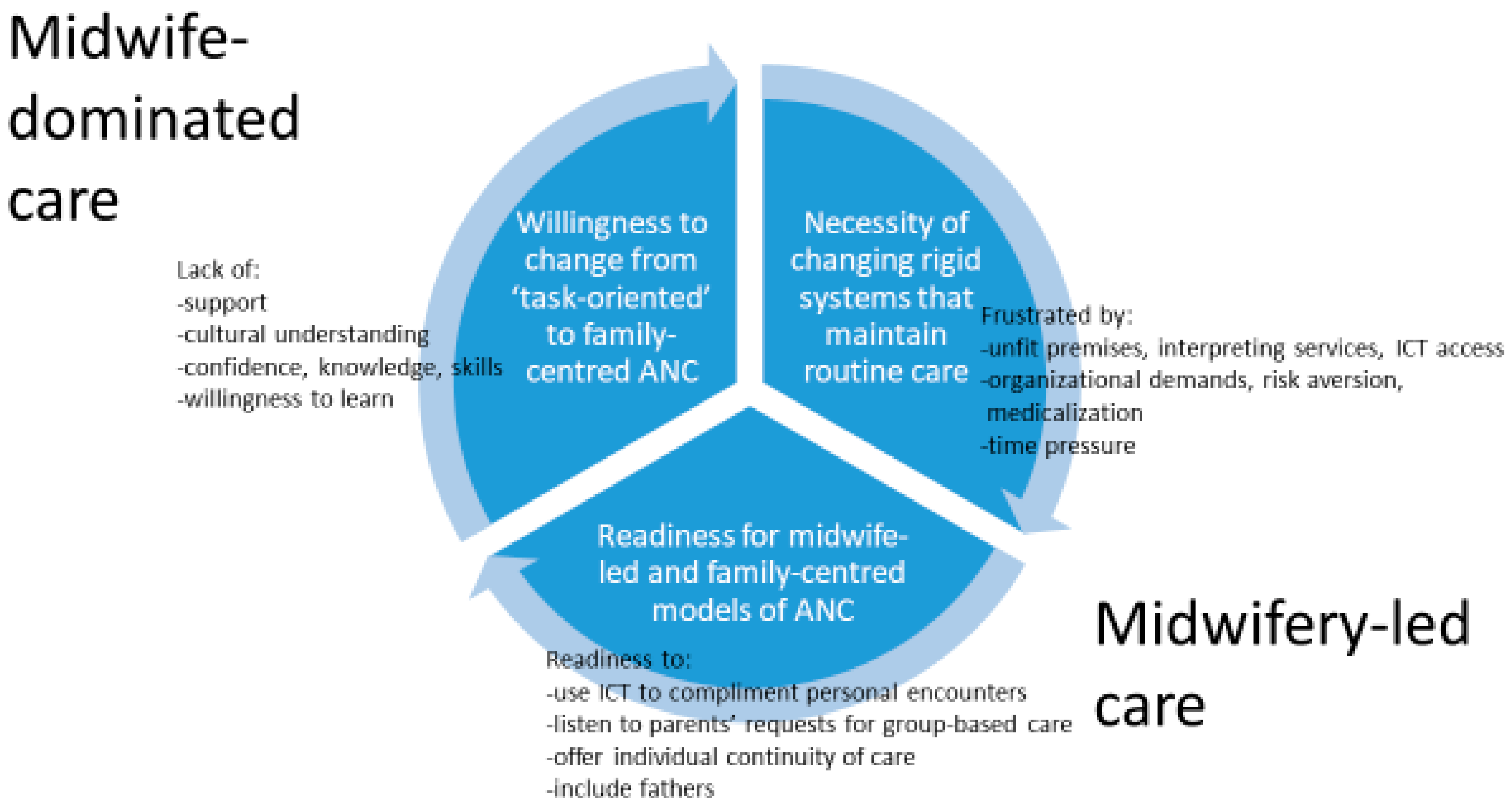
Provision of antenatal care includes risk identification, prevention and management of pregnancy-related diseases, but also health education, health promotion, support and guidance to smooth the transition to parenthood. To ensure good perinatal health, high-quality, free and easily accessed antenatal care is essential. The aim of this study was to identify, integrate and synthesize knowledge of midwives’ experiences of providing antenatal care, attending to clients’ individual needs whilst facing multiple challenges. We conducted a meta-ethnography, which is a seven-step grounded, comparative and interpretative methodology for qualitative evidence synthesis. A lines-of-argument synthesis based on two metaphors was developed, based on refutational themes emerging from an analogous translation of findings in the included 14 papers. The model reflects midwives’ wished-for transition from a midwife-dominated caring model toward a midwifery-led model of antenatal care. Structural, societal and personal challenges seemingly influenced midwives’ provision of antenatal care. However, it emerged that midwives had the willingness to change rigid systems that maintain routine care. The midwifery-led model of care should be firmly based in midwifery science and evidence-based antenatal care that emphasize reflective practices and listening to each woman and her family. The change from traditional models of antenatal care towards increased use of digitalization no longer seems to be a choice, but a necessity given the ongoing 2020 pandemic.
Keywords: antenatal care; midwife; meta-ethnography; meta-synthesis; prenatal care; qualitative research antenatal care; midwife; meta-ethnography; meta-synthesis; prenatal care; qualitative research