

Barriers and Facilitators in the Strengthening Families Program (SFP 10–14) Implementation Process in Northeast Brazil: A Retrospective Qualitative Study

 ,
,  ,
,
Abstract
1. Introduction
2. Materials and Methods
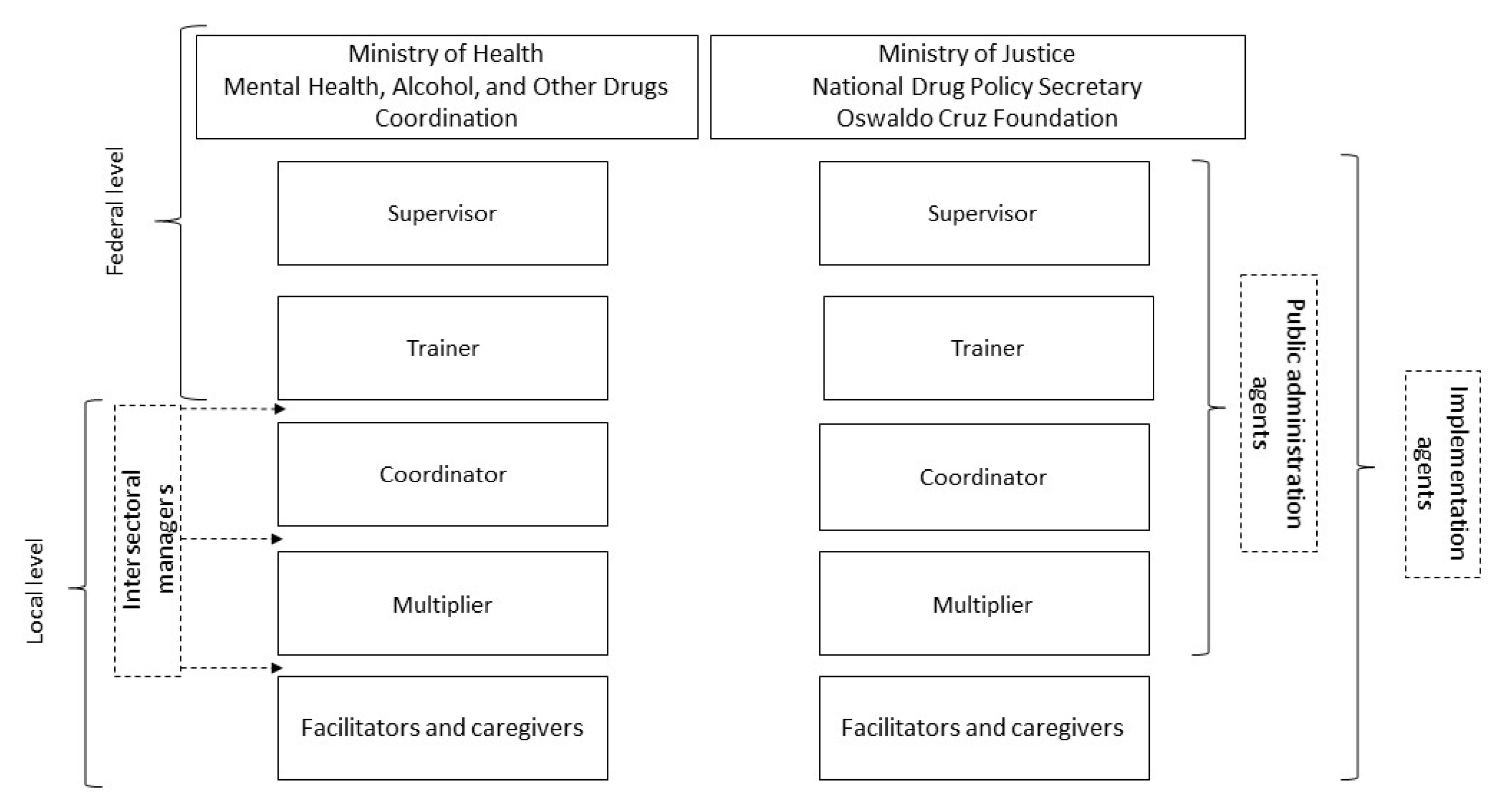
2.1. Brazilian SFP 10–14 Implementation Context
2.2. Design and Participants
2.3. Instrument
2.4. Strengthening Families Program (10–14)
2.5. Data Collection Procedures
2.6. Data Analysis Procedures
3. Results
3.1. Negotiation for Local Adoption of SFP 10–14
3.1.1. Barriers in Negotiation
“(…) there were other managers who had never participated in the process. “Oh, I agree”, but you agree and that is not the point. Perhaps some managers lacked commitment. As if it were “let the technicians take care of that”. And that doesn’t fulfill our needs, like a providing snacks, which depends on authorization from the top manager, that is hard to get. Since, we don’t often get it, everyone just do what they can.”
3.1.2. Facilitators in Negotiation
“Receive support from top managements helps a lot. From the secretary, from the mayor, (…) if they are not at the forefront, they should endorse and designate people to take care of it. If technicians have this endorsement from higher managers, the program happens, if it doesn’t, it doesn’t happen. So, in departments where the manager was more committed, we managed to do everything more easily. In our case, it was easy, because the staff was really involved, both the manager and the local coordinator.”
3.2. Local Coordination
3.2.1. Barriers in Local Coordination
“For the SFP 10–14 to enter the services, there was a great resistance from the equipment professionals themselves, because it was something new and people thought they were getting more work, a demand for more work. Even the staff from the Ministry (of Health) and National Drug Policy Secretary came to provide explanations about the program. We were called for meetings to understand a little more about this program and how it would be executed. So, it would have been nice if there were always conversations and dialogues between us and the secretariat regarding how the program would be executed.”
3.2.2. Facilitators in Local Coordination
“In the municipalities that ran (the program) (...) we managed to set up good relationships with the secretaries that endorsed the local coordinator to execute and deliberate on the issue. So, it was not necessary to have to take all the information through the municipal secretary to do something, (...) received carte blanche to deliberate. (...) We believe that this was remarkably good.”
3.3. Service Mobilization
3.3.1. Barriers in Service Mobilization
“(…) because of the simultaneous activities we did not always have physical space available for the activities. We had to disturb the service dynamics to carry out the program, which we did, but we knew we were holding up routine activities. That is the reason why service providers are resistant to the program, and we understand it.”
3.3.2. Facilitators in Service Mobilization
“In fact, the secretariat of health could not provide enough material necessary for executing the SFP 10–14, such as cardboards, to everyone. There is a list, from the three departments (Health, Education, Social Assistance), that was shared to check what each department could provide. When they contributed, we put everything together and distributed it to the regions.”
3.4. Team Training
3.4.1. Barriers in Team Training
“It could be expanded (the training hours). It is because there are many activities to be developed and we do not see all the activities during training”.
3.4.2. Facilitators in Team Training
“There was no way for her (federal trainer) to apply all the activities in the training. What was applied served us as starting point. I think that what was explained in the training was extremely important to guide us in adapting it in different scenarios.”
3.5. Family Recruitment
3.5.1. Barriers in Family Recruitment
“(…) we knew teenagers and children that we believed should be part of the SFP 10–14, but the program was really strict with the age limit. Leaving out a nine-year-old child or a fifteen-year-old teenager who wanted to participate was a problem, however they were technically ineligible and we couldn’t take them in.”
3.5.2. Facilitators in Family Recruitment
“(...) in our group there were several mothers who couldn’t read or write. We were afraid that when we handed up the brochures, they would feel embarrassed. So, since the first meeting, we welcomed them warmly so that they would not feel that way for not being able to read.”
3.6. Planning of Implementation Logistics
3.6.1. Barriers in Planning of Implementation Logistics
“(...) we initially thought and still think that there is a big issue with making workers’ schedules compatible with the families’ schedules for the program’s activities. We do not want to overwork our professionals. This remains a considerable barrier.”
3.6.2. Facilitators in Planning of Implementation Logistics
“(…) the team’s engagement was the main facilitator. No worker has ever been absent nor delayed. Besides, we talked about everything, if we identified a problem, we talked about it and got it solved.”
3.7. SFP 10–14 Delivery
3.7.1. Barriers in the Delivery of SFP 10–14
“It is too much (...) from a single sector (not intersectoral). The program is too heavy for the service. This year we had a lot of work on trying to make the health department and the social assistance department work together. We hoped joining forces would make the implementation not so burdening. And it was not easy task, but we got more material and more human resources by bringing all departments together.”
3.7.2. Facilitators in the Delivery of SFP 10–14
“(...) speaking of my team, what convinced us during the meetings was really what the families were bringing to us as a result, strengthening their bonds, and we clearly saw that little by little it was happening. We saw that it was really working for the group. That is what convinced us. I speak for myself that I was very resistant after the first meeting, I was not very fond of the idea. I didn’t like being pushed to do this, but after the second and third meetings when we heard feedback from the families, and we started to get excited.”
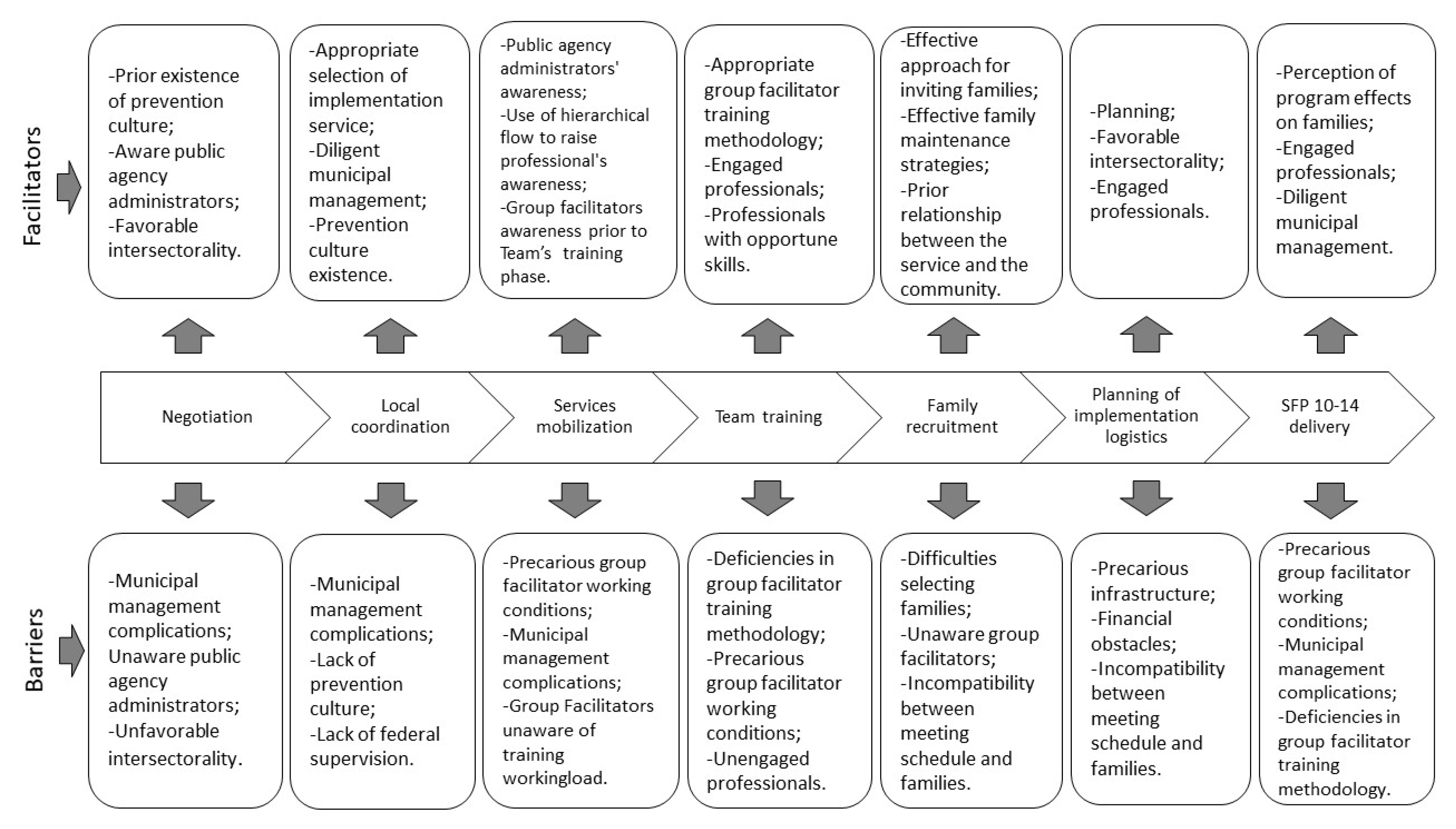
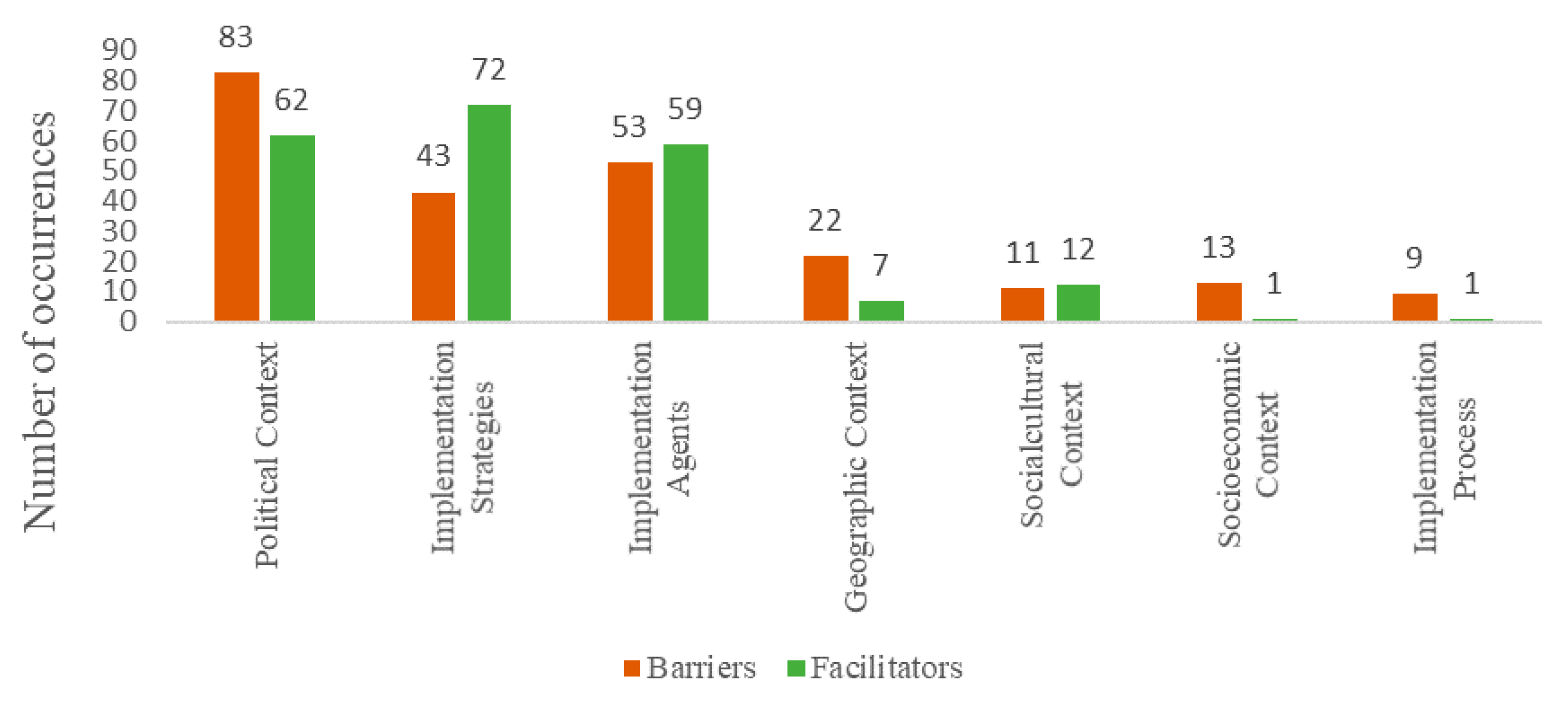
3.8. Barriers and Facilitators in the Implementation of SFP 10–14 in Brazil: A Synthesis
4. Discussion
5. Conclusions
Author Contributions
Funding
Conflicts of Interest
References
- Reis, A.A.C.D.; Malta, D.C.; Furtado, L.A.C. Challenges for public policies aimed at adolescence and youth based on the National Scholar Health Survey (PeNSE). Ciênc. Saúde Coletiva 2018, 23, 2879–2890. [Google Scholar] [CrossRef] [Scilit] [PubMed]
- Pedroso, R.T.; Hamann, E.M. Adequações do piloto do programa Unplugged#Tamojunto para promoção à saúde e prevenção de drogas em escolas brasileiras. Ciênc. Saúde Coletiva 2019, 24, 371–381. [Google Scholar] [CrossRef] [Scilit]
- Sanchez, Z.M.; Valente, J.Y.; Sanudo, A.; Pereira, A.P.D.; Schneider, D.R.; Andreoni, S. Effectiveness evaluation of the school-based drug prevention program #Tamojunto in Brazil: 21-month follow-up of a randomized controlled trial. Int. J. Drug Policy 2018, 60, 10–17. [Google Scholar] [CrossRef] [Scilit] [PubMed]
- Schneider, D.R.; Pereira, A.P.D.; Cruz, J.I.; Strelow, M.; Chan, G.; Kurki, A.; Sanchez, Z.M. Evaluation of the Implementation of a Preventive Program for Children in Brazilian Schools. Psicol. Ciênc. E Prof. 2016, 36, 508–519. [Google Scholar] [CrossRef] [Scilit]
- Murta, S.G.; Nobre-Sandoval, L.A.; Pedralho, T.N.G.; Ramos, C.E.P.L.; Allen, D.; Coombes, L. Needs assessment for cultural adaptation of Strengthening Families Program (SFP 10–14-UK) in Brazil. Psychol. Res. Rev. 2018. [Google Scholar] [CrossRef] [Scilit]
- Abreu, S.; Murta, S.G. O estado da arte da pesquisa em prevenção em saúde mental no Brasil: Uma revisão sistemática. Interação Em Psicol. 2016, 20, 101–111. [Google Scholar] [CrossRef] [Scilit]
- Kumpfer, K.L.; DeMarsh, J.P.; Child, W. Strengthening families program: Children’s Skill Curriculum Manual, Parent Training Manual, Children’s Skill Tranining Manual, and Family Skills Training Manual. Prevention Services to Children of Substance-Abusing Parents; Department of Health, Alcohol and Drug Research Center: Salt Lake City, UT, USA, 1989. [Google Scholar]
- Spoth, R.L.; Redmond, C.; Trudeau, L.; Shin, C. Longitudinal substance initiation outcomes for a universal preventive intervention combining family and school programs. Psychol. Addict. Behav. 2002, 16, 129–134. [Google Scholar] [CrossRef]
- Spoth, R.; Redmond, C.; Shin, C.; Greenberg, M.; Feinberg, M.; Schainker, L. PROSPER community–university partnership delivery system effects on substance misuse through 6 1/2years past baseline from a cluster randomized controlled intervention trial. Prev. Med. 2013, 56, 190–196. [Google Scholar] [CrossRef] [Scilit]
- Bröning, S.; Kumpfer, K.; Kruse, K.; Sack, P.-M.; Schaunig-Busch, I.; Ruths, S.; Moesgen, D.; Pflug, E.; Klein, M.; Thomasius, R. Selective prevention programs for children from substance-affected families: A comprehensive systematic review. Subst. Abuse Treat. Prev. Policy 2012, 7, 23. [Google Scholar] [CrossRef] [Scilit]
- Foxcroft, D.; Ireland, D.; Lister-Sharp, D.; Lowe, G.; Breen, R. Longer-term primary prevention for alcohol misuse in young people: A systematic review. Addict. Abingdon Engl. 2003, 98, 397–411. [Google Scholar] [CrossRef] [Scilit]
- Foxcroft, D.R.; Tsertsvadze, A. Universal alcohol misuse prevention programmes for children and adolescents: Cochrane systematic reviews. Perspect. Public Health 2012, 132, 128–134. [Google Scholar] [CrossRef] [Scilit] [PubMed]
- Gates, S.; McCambridge, J.; Smith, L.A.; Foxcroft, D.R. Interventions for prevention of drug use by young people delivered in non-school settings. Cochrane Database Syst. Rev. 2006, CD005030. [Google Scholar] [CrossRef] [Scilit] [PubMed]
- Bohn, S.; Veiga, L.F.; Dalt, S.D.; Brandão, A.A.P.; de Carvalho Gouvêa, V.H. Can conditional cash transfer programs generate equality of opportunity in highly unequal societies? Evidence from Brazil. Rev. Sociol. E Política 2014, 22, 111–133. [Google Scholar] [CrossRef] [Scilit]
- de Oliveira, F.P.; Vanni, T.; Pinto, H.A.; dos Santos, J.T.R.; de Figueiredo, A.M.; de Araújo, S.Q.; Matos, M.F.M.; Cyrino, E.G. “Mais Médicos”: A Brazilian program in an international perspective. Interface Comun. Saúde Educ. 2015, 19, 623–634. [Google Scholar] [CrossRef] [Scilit]
- Gardner, F.; Montgomery, P.; Knerr, W. Transporting Evidence-Based Parenting Programs for Child Problem Behavior (Age 3–10) Between Countries: Systematic Review and Meta-Analysis. J. Clin. Child Adolesc. Psychol. 2016, 45, 749–762. [Google Scholar] [CrossRef] [Scilit]
- Moore, G.F.; Audrey, S.; Barker, M.; Bond, L.; Bonell, C.; Hardeman, W.; Moore, L.; O’Cathain, A.; Tinati, T.; Wight, D.; et al. Process evaluation of complex interventions: Medical Research Council guidance. BMJ 2015, 350, h1258. [Google Scholar] [CrossRef] [Scilit]
- Pfadenhauer, L.M.; Gerhardus, A.; Mozygemba, K.; Lysdahl, K.B.; Booth, A.; Hofmann, B.; Wahlster, P.; Polus, S.; Burns, J.; Brereton, L.; et al. Making sense of complexity in context and implementation: The Context and Implementation of Complex Interventions (CICI) framework. Implement. Sci. 2017, 12, 21. [Google Scholar] [CrossRef] [Scilit]
- Burkhart, G. Is the Strengthening Families Programme feasible in Europe? J. Child. Serv. 2015. [Google Scholar] [CrossRef] [Scilit]
- Mejia, A.; Bertello, L.; Gil, J.; Griffith, J.; Isabel López, A.; Moreno, M.; Calam, R. Evaluation of Family Skills Training Programs to Prevent Alcohol and Drug Use: A Critical Review of the Field in Latin America. Int. J. Ment. Health Addict. 2019. [Google Scholar] [CrossRef] [Scilit]
- Maalouf, W.; Campello, G. The influence of family skills programmes on violence indicators: Experience from a multi-site project of the United Nations Office on Drugs and Crime in low- and middle-income countries. Aggress. Violent Behav. 2014, 19, 616–624. [Google Scholar] [CrossRef] [Scilit]
- Pinheiro-Carozzo, N.P.; Murta, S.G.; Vinha, L.G.; Silva, I.M.; Fontaine, A.M. Beyond effectiveness of the Strengthening Families Program (10–14): An integrative REAIM-based review. New Dir. Child Adolesc. Dev. under review.
- Orpinas, P.; Reidy, M.C.; Lacy, M.E.; Kogan, S.M.; Londoño-McConnell, A.; Powell, G. Familias Fuertes: A feasibility study with Mexican immigrants living in low-income conditions in the southeastern United States. Health Promot. Pract. 2014, 15, 915–923. [Google Scholar] [CrossRef] [Scilit] [PubMed]
- Segrott, J. Recruitment and group composition strategies for family-based substance misuse prevention interventions: An exploratory evaluation. J. Child. Serv. 2013. [Google Scholar] [CrossRef] [Scilit]
- Spoth, R.; Redmond, C.; Hockaday, C.; Shin, C.Y. Barriers to Participation in Family Skills Preventive Interventions and Their Evaluations: A Replication and Extension. Fam. Relat. 1996, 45, 247–254. [Google Scholar] [CrossRef] [Scilit]
- Aarons, G.A.; Hurlburt, M.; Horwitz, S.M. Advancing a conceptual model of evidence-based practice implementation in public service sectors. Adm. Policy Ment. Health 2011, 38, 4–23. [Google Scholar] [CrossRef] [Scilit]
- Moullin, J.C.; Dickson, K.S.; Stadnick, N.A.; Rabin, B.; Aarons, G.A. Systematic review of the Exploration, Preparation, Implementation, Sustainment (EPIS) framework. Implement. Sci. IS 2019, 14, 1. [Google Scholar] [CrossRef] [Scilit]
- Kislov, R.; Pope, C.; Martin, G.P.; Wilson, P.M. Harnessing the power of theorising in implementation science. Implement. Sci. 2019, 14, 103. [Google Scholar] [CrossRef] [Scilit]
- Kumpfer, K.L.; Alvarado, R. Family-strengthening approaches for the prevention of youth problem behaviors. Am. Psychol. 2003, 58, 457–465. [Google Scholar] [CrossRef] [Scilit]
- Da Brasil, M.S. Programa Famílias Fortes: Versão Brasileira Adaptada do “Strengthening Families Programme” – SFP 10–14 UK. In Coordenação de Saúde Mental, Álcool e Drogas; Ministério da Saúde: Brasília, Brazil, 2014. [Google Scholar]
- Miranda, A.A.V.; Murta, S.G. Programa Famílias Fortes: Barreiras e facilitadores da difusão de uma intervenção preventiva ao abuso de drogas para famílias em desvantagem econômica no Brasil. In A Experiência Brasileira de Prevenção Escolar e Comunitária do uso de álcool e Outras Drogas; Abreu, S., Murta, S.G., Rocha, V.P., Eds.; Observatório do Cuidado: Rio de Janeiro, Brazil, in press; Volume 1.
- Yoon, Y.; Newkirk, K.; Perry-Jenkins, M. Parenting Stress, Dinnertime Rituals, and Child Well-Being in Working-Class Families. Fam. Relat. 2015, 64, 93. [Google Scholar] [CrossRef] [Scilit]
- Segrott, J.; Murphy, S.; Rothwell, H.; Scourfield, J.; Foxcroft, D.; Gillespie, D.; Holliday, J.; Hood, K.; Hurlow, C.; Morgan-Trimmer, S.; et al. An application of Extended Normalisation Process Theory in a randomised controlled trial of a complex social intervention: Process evaluation of the Strengthening Families Programme (10–14) in Wales, UK. SSM Popul. Health 2017, 3, 255–265. [Google Scholar] [CrossRef] [Scilit] [PubMed]
- Salminen, S.; Lee, J. A Concept of “Culture of Prevention”: A Review of Literature. Occup. Med. Health Aff. 2014, 2, 1–5. [Google Scholar] [CrossRef]
- Zdunek, K.; Blair, M.; Alexander, D. National and Public Cultures as Determinants of Health Policy and Production. In Issues and Opportunities in Primary Health Care for Children in Europe; Blair, M., Rigby, M., Alexander, D., Eds.; Emerald Publishing Limited: Bingley, UK, 2019; pp. 345–357. ISBN 978-1-78973-354-9. [Google Scholar]
- Movsisyan, A.; Arnold, L.; Evans, R.; Hallingberg, B.; Moore, G.; O’Cathain, A.; Pfadenhauer, L.M.; Segrott, J.; Rehfuess, E. Adapting evidence-informed complex population health interventions for new contexts: A systematic review of guidance. Implement. Sci. 2019, 14, 105. [Google Scholar] [CrossRef] [Scilit] [PubMed]
- Ubbink, D.T.; Guyatt, G.H.; Vermeulen, H. Framework of policy recommendations for implementation of evidence-based practice: A systematic scoping review. BMJ Open 2013, 3, e001881. [Google Scholar] [CrossRef] [Scilit] [PubMed]
- Warren, J.I.; McLaughlin, M.; Bardsley, J.; Eich, J.; Esche, C.A.; Kropkowski, L.; Risch, S. The Strengths and Challenges of Implementing EBP in Healthcare Systems. Worldviews Evid. Based Nurs. 2016, 13, 15–24. [Google Scholar] [CrossRef] [Scilit] [PubMed]
- Patterson, P.D.; Ghen, J.D.; Antoon, S.F.; Martin-Gill, C.; Guyette, F.X.; Weiss, P.M.; Turner, R.L.; Buysse, D.J. Does evidence support “banking/extending sleep” by shift workers to mitigate fatigue, and/or to improve health, safety, or performance? A systematic review. Sleep Health 2019, 5, 359–369. [Google Scholar] [CrossRef] [Scilit] [PubMed]
- McPherson, K.E.; Kerr, S.; Casey, B.; Marshall, J. Barriers and Facilitators to Implementing Functional Family Therapy in a Community Setting: Client and Practitioner Perspectives. J. Marital Fam. Ther. 2017, 43, 717–732. [Google Scholar] [CrossRef] [Scilit] [PubMed]
- Berkel, C.; Gallo, C.G.; Sandler, I.N.; Mauricio, A.M.; Smith, J.D.; Brown, C.H. Redesigning Implementation Measurement for Monitoring and Quality Improvement in Community Delivery Settings. J. Prim. Prev. 2019, 40, 111–127. [Google Scholar] [CrossRef] [Scilit]
- Kostadinov, I.; Daniel, M.; Stanley, L.; Gancia, A.; Cargo, M. A systematic review of community readiness tool applications: Implications for reporting. Int. J. Environ. Res. Public. Health 2015, 12, 3453–3468. [Google Scholar] [CrossRef] [Scilit]
- Salter, K.L.; Kothari, A. Using realist evaluation to open the black box of knowledge translation: A state-of-the-art review. Implement. Sci. IS 2014, 9, 115. [Google Scholar] [CrossRef] [Scilit]


| Action Theory Stages | Expected Outcomes |
|---|---|
| Negotiation for local adoption of SFP 10–14 | Negotiation between federal and municipal spheres for the coming of SFP 10–14 to the states. A technical-operational agreement seals an initial implementation. The recommendation of a local coordinator and intersectoral adoption is expected, with consensus of tasks from each sector involved. |
| Local coordination | Hiring and instruction of federal trainers. Federal trainer integration with local team. Elaboration of a training schedule to program articulator and multiplier to operationalize the implementation. |
| Services mobilization | Adoption of SFP 10–14 by professionals and services that will effectively deliver the program and strengthen the support the SFP 10–14 implementation. Building of organizational and community support by the municipal articulator. |
| Team training | Implementation agents trained in the paradigm governing the National Drug Policy and the SFP 10–14 objectives, bases, and methodology. |
| Family recruitment | Advertisement to, invitation of, and selection of SFP 10–14 participant families. It includes strategies to gather groups of seven to ten families to start the program as well as their initial engagement. |
| Planning of implementation logistics | Planning and organization of infrastructure, materials, and procedures required for implementation. |
| SFP 10–14 delivery | Implementation of the seven meetings with parents/legal guardians, youths, and families. Weekly session planning and monitoring in order to correct implementation problems. |
| Categories | Definitions |
|---|---|
| Infrastructure | Material and resources needed for implementation. |
| Prevention culture | Identification by public agency administrators, the professionals and institutions that shares values, objectives, and methodologies of SFP 10–14, which may be the result of experience with previous iterations or another experience in prevention. |
| Financial resources | The capital needed to implement SFP 10–14. |
| Municipal management | Management actions related to the management of people in their activities, financial resources, and the intersectoral policy. |
| Group facilitators’ working conditions | Aspects of workload, time availability, number of people available to perform required activities, work accumulation, sensation of job instability, and employment precarity. |
| Institutional disruption | Refers to the period of political instability in 2015 that culminated in 2016 with the impeachment of President Dilma Rousseff and her removal from the Presidency of the Republic. |
| Intersectorality | Coordination via agreement among various social public policies aiming to implement the program. |
| Corruption | Diversion of funds. |
| Elections | Political agreements and campaign support during the election period, August through October, every even numbered year in the municipalities. |
| Awareness of hierarchical flow | Understanding that awareness occurs according to hierarchical flows of power, in which a higher-level manager is responsible for raising awareness of lower-level managers. |
| Federal supervision | Decisions concerning SFP 10–14 implementation logistics in the municipality together with federal and municipal service leaders, including the provision of implementation kits and the hiring of federal trainers. |
| Aggregate value of SFP 10–14 | Benefits gained from experience in program implementation. |
| Local peculiarities | Strikes and holidays occurring during the implementation. |
| Selection of public service | Strategies used by federal trainers in selecting where to implement SFP 10–14. |
| Selection of families | The criteria established for selecting families to participate in the program. |
| Group facilitator training methodology | Strategies and methodologies used to train program facilitators. |
| Approach for inviting families | Strategies used to disseminate the program and information offered to families invited to participate in SFP 10–14. |
| Family maintenance strategies | Strategies used in the awareness-raising and recruitment meetings and weekly sessions to boost family adherence. |
| Federal support and monitoring in the implementation | Operational support by federal trainers for group facilitators during the SFP implementation |
| Planning | Holding weekly planning meetings during the SFP 10–14 implementation, where activities to be carried out with families are discussed, materials for implementation organized, and the best session management strategies verified. |
| Compatibility of meeting and family schedules | Reconciliation of session times between professionals and families according to availability of both groups. |
| Perception of effects on families | The perception of positive effects on the families as an essential element for motivation of the program facilitator. |
| Prior relationship between service and community | The closeness of the relationship between the service implementing the program and the individuals from the community who constitute the SFP 10–14 target audience. |
| Awareness-raising of public agency administrator | Information provided by federal trainers to public agency administrators about the program and strategies used by trainers to mobilize them in favor of implementing SFP 10–14. |
| Awareness-raising of group facilitators | Information provided by federal trainers, public agency administrators, or program multipliers to group facilitators aiming to mobilize them in favor of implementing SFP 10–14. |
| Team training awareness-raising | The understanding that professionals need to receive information about the real complexity of implementing SFP 10–14 before going through the facilitator team training. |
| Adherence of professionals | Engagement of public agency administrators, as well as health care, education, and social service professionals in the SFP 10–14 implementation and the quality of their participation in program delivery. |
| Adherence of institutions | Engagement by institutions as a whole, not the individuals comprising them, whether departments of education or health care, or other government agencies. |
| Professionals’ skills | Professionals with attitudes and actions that exceed expectations regarding the exercise of their function and that favor the implementation. |
| Relationships between professionals | Relationship and communication quality between professionals involved in the SFP 10–14 implementation process. |
| Elements | Definitions |
|---|---|
| Geographic context | The physical and resource aspects of the environment, both natural and human-transformed (e.g., infrastructure), which are available in a given space. |
| Epidemiological context | The disease network as well as the determinants of the population’s needs, including demography. |
| Sociocultural context | Comprises explicit and implicit behavior patterns, including their incorporation in the form of symbols. The essential culture core consists of ideas and values historically derived and selected that are shared by the members of a group. It refers not only to the conditions under which people are born, grow, live, and work or their ages, but also the social roles a human being assumes as a member of a family, of a community, or as a citizen, as well as the relationships inherent in these roles. Constructs such as knowledge, beliefs, concepts, customs, institutions and any other capacities and habits acquired by a group are included in this context. |
| Socioeconomic context | The social and economic resources of a community and its access by the population. |
| Ethical context | Moral reflections that encompass the norms, rules, patterns of conduct, and principles that guide the decision-making and behavior of individuals and institutions. The ethical, sociocultural, and legal aspects are strongly interrelated. |
| Legal context | The rules and regulations established to protect the rights of the population and the interests of society. Formally, these should be approved by a competent legislative body, such as a congress. The legal norms may be applied by order and coercion, which distinguishes them from ethical and social ones. |
| Political context | The distribution of power, resources, and interests among the population as a whole, as well as among organizations according to formal rules or information from the interactions between them. Also, the accessibility to the location offering the service, such as service delivery, leadership and governance, health information, human resources, and financing. Strongly related to the socioeconomic and sociocultural elements of the population in question. |
| Implementation theory | The implementation of a program theory seeks to explain the causal mechanisms of the implementation; it is, thus, analogous to a program theory, which explains the causal mechanisms that connect an intervention to its results. An implementation theory formalizes how a change needs to be executed so that the implementation effort is successful. Additionally, it serves as the basis for the implementation process and strategies. |
| Implementation process | The whole social process by which the implementation is operationalized. It relies on the tactics and methods used by change-promoting leaders. It is a multistage process that does not necessarily take place linearly. At some points, it is expected that the implementation agents will capture corrections, refinements, or expansions. The steps range from the evaluation of needs and community resources to agent awareness, program adoption, preparation, and changes necessary for implementation. The team should be well-informed about the program and information should be disseminated. This follows a pilot or initial implementation in which the intervention may be readjusted to accommodate the community’s daily routine, thus making it more sustainable. |
| Implementation strategy | The set of activities chosen and customized to fit the program theory in its delivery context. These strategies may change over time and they ensure the adoption of the program and future sustainability. This takes place prior to the actual implementation and refers to planning strategies and awareness of the implementation process. |
| Implementation agents | These are individuals who possess a combination of attributes, knowledge, skills, beliefs, positions, and attitudes that exercise significant influence on the implementation. Implementation agents could be either local public agency administrators or frontline professionals aware of and skilled in the implementation. The agents may also be recipients of the implementation or institutions when these entities play a primary role in the implementation. |
| SFP 10–14 Action Theory Stages | |||||||
|---|---|---|---|---|---|---|---|
| Categories | Negotiation for Local Adoption of SFP 10–14 | Local Coordination | Services Mobilization | Team Training | Family Recruitment | Planning of Implementation Logistics | SFP 10–14 Delivery |
| Approach for inviting families | 14 | ||||||
| Adherence of professionals | 4 | 4 | 2 | 3 | 6 | ||
| Adherence of Institution | 1 | 1 | 1 | ||||
| Compatibility of meeting and family schedules | 1 | ||||||
| Group facilitator working conditions | 1 | 1 | 1 | ||||
| Prevention culture | 9 | 1 | 1 | 1 | |||
| Selection of public service | 5 | 1 | 2 | ||||
| Family maintenance strategies | 7 | 3 | |||||
| Awareness of hierarchical flow | 2 | 5 | |||||
| Municipal management | 2 | 2 | 4 | 2 | 4 | ||
| Professionals’ skills | 2 | 2 | |||||
| Infrastructure | 2 | 1 | 2 | 2 | |||
| Intersectorality | 7 | 3 | 1 | 4 | 7 | 1 | |
| Group facilitator training methodology | 11 | ||||||
| Perception of effects on families | 8 | ||||||
| Planning | 8 | 3 | |||||
| Financial resources | 1 | ||||||
| Relationships between professionals | 1 | 4 | |||||
| Prior relationship between the service and the community | 6 | 2 | |||||
| Public agency administrator awareness | 8 | 1 | 6 | 1 | |||
| Group facilitator awareness | 1 | 4 | 4 | ||||
| Team training awareness-raising | 1 | 5 | |||||
| Federal supervision | 1 | 3 | |||||
| Federal support and monitoring in implementing the SFP 10–14 | 2 | 4 | |||||
| SFP 10–14 aggregate value | 1 | ||||||
| Total | 36 | 10 | 39 | 20 | 38 | 23 | 48 |
| SFP 10–14 Action Theory Stages | |||||||
|---|---|---|---|---|---|---|---|
| Categories | Negotiation for Local Adoption of SFP 10–14 | Local Coordination | Services Mobilization | Team Training | Family Recruitment | Planning Implementation Logistics | SFP 10–14 Delivery |
| Adherence of professionals | 2 | 5 | 3 | 3 | |||
| Adherence of Institutions | 1 | 5 | 1 | ||||
| Compatibility of meeting and family schedules | 2 | 5 | |||||
| Group facilitator working conditions | 1 | 1 | 12 | 4 | 13 | ||
| Corruption | 1 | ||||||
| Prevention culture | 1 | 2 | 2 | 1 | 1 | 1 | 3 |
| Elections | 1 | 1 | |||||
| Selection of families | 4 | 6 | |||||
| Selection of public service | 1 | 1 | |||||
| Awareness of hierarchical flow | 1 | ||||||
| Municipal management | 5 | 3 | 11 | 3 | 10 | ||
| Infrastructure | 1 | 15 | 6 | ||||
| Intersectorality | 3 | 3 | 1 | 3 | |||
| Group facilitator training methodology | 10 | 7 | |||||
| Location peculiarities | 1 | 3 | 1 | 3 | |||
| Planning | 2 | 4 | |||||
| Financial resources | 1 | 2 | 5 | 5 | |||
| Relationships between professionals | 2 | 2 | 1 | 1 | 2 | ||
| Institutional rupture | 1 | 2 | 1 | ||||
| Public agency administrator awareness | 3 | ||||||
| Group facilitator awareness | 1 | 1 | 2 | 4 | 1 | ||
| Team training awareness-raising | 1 | 7 | |||||
| Federal supervision | 2 | ||||||
| Federal support and monitoring in implementing the SFP 10–14 | 1 | ||||||
| SFP 10–14 aggregate value | 1 | ||||||
| Total | 25 | 13 | 56 | 24 | 13 | 34 | 69 |
| Elements | Categories |
|---|---|
| Geographic context | Infrastructure |
| Epidemiological context | N/A |
| Sociocultural context | Prevention culture |
| Socioeconomic context | Financial resources |
| Ethical context | N/A |
| Legal context | N/A |
| Political context | Municipal management Group facilitators’ working conditions Institutional disruption Intersectorality Corruption Elections Awareness of hierarchical flow Prior relationship between service and community Federal supervision |
| Implementation theory | N/A |
| Implementation process | Aggregate value of SFP 10–14 Local peculiarities |
| Implementation strategy | Group facilitator training methodology Approach for inviting families Family maintenance strategies Federal support and monitoring in the implementation Planning Selection of public service Selection of families Perception of effects on families Compatibility of meeting and family schedules |
| Implementation agents | Awareness-raising of public agency administrator Awareness-raising of group facilitators Professionals’ skills Adherence of professionals Adherence of institutions Team training awareness-raising Relationships between professionals |
© 2020 by the authors. Licensee MDPI, Basel, Switzerland. This article is an open access article distributed under the terms and conditions of the Creative Commons Attribution (CC BY) license (http://creativecommons.org/licenses/by/4.0/).
Share and Cite
Abdala, I.G.; Murta, S.G.; Menezes, J.C.L.d.; Nobre-Sandoval, L.d.A.; Gomes, M.d.S.M.; Duailibe, K.D.; Farias, D.A. Barriers and Facilitators in the Strengthening Families Program (SFP 10–14) Implementation Process in Northeast Brazil: A Retrospective Qualitative Study. Int. J. Environ. Res. Public Health 2020, 17, 6979. https://doi.org/10.3390/ijerph17196979
Abdala IG, Murta SG, Menezes JCLd, Nobre-Sandoval LdA, Gomes MdSM, Duailibe KD, Farias DA. Barriers and Facilitators in the Strengthening Families Program (SFP 10–14) Implementation Process in Northeast Brazil: A Retrospective Qualitative Study. International Journal of Environmental Research and Public Health. 2020; 17(19):6979. https://doi.org/10.3390/ijerph17196979
Chicago/Turabian StyleAbdala, Ingrid Gomes, Sheila Giardini Murta, Jordana Calil Lopes de Menezes, Larissa de Almeida Nobre-Sandoval, Maria do Socorro Mendes Gomes, Karina Damous Duailibe, and Danielle Aranha Farias. 2020. "Barriers and Facilitators in the Strengthening Families Program (SFP 10–14) Implementation Process in Northeast Brazil: A Retrospective Qualitative Study" International Journal of Environmental Research and Public Health 17, no. 19: 6979. https://doi.org/10.3390/ijerph17196979
APA StyleAbdala, I. G., Murta, S. G., Menezes, J. C. L. d., Nobre-Sandoval, L. d. A., Gomes, M. d. S. M., Duailibe, K. D., & Farias, D. A. (2020). Barriers and Facilitators in the Strengthening Families Program (SFP 10–14) Implementation Process in Northeast Brazil: A Retrospective Qualitative Study. International Journal of Environmental Research and Public Health, 17(19), 6979. https://doi.org/10.3390/ijerph17196979


