


Abstract
The Australian Asthma Handbook does not recommend use of fixed dose combination (FDC) controller medicines for asthma in children aged ≤5 years. FDCs are only recommended in children and adolescents (aged 6–18 years) not responding to initial inhaled corticosteroid (ICS) therapy. Using Pharmaceutical Benefits Scheme dispensing claims from 2013–2018, we examined the annual incident FDC dispensing and the incident FDC dispensing without prior ICS up to 365 days. We also determined cost of FDCs to government and patients. During 2013–2018, there were 35,635 FDC initiations and 31,368 (88%) did not have a preceding ICS dispensing. The annual incidence of FDC dispensing declined from 14.7 to 7.2/1000 children. Incidence of FDC dispensing/1000 children without a preceding ICS declined from 2.1 to 0.5 in children aged 1–2 years, 7.2 to 1.7 in 3–5 years, 14.8 to 5.1 in 6–11 years, and 18.6 to 11.9 in ≥12years. The cost of FDCs was 7.8 million Australian dollars (AUD); of which 4.4 million AUD was to government and 3.3 million AUD was to patient. Despite inappropriate dispensing of FDCs in children aged ≤5 years, incidence of FDC dispensing and more importantly incidence without a preceding ICS is declining in Australia.
1. Introduction
Asthma is the most common chronic childhood disease. In Australia, the prevalence of childhood asthma is higher than many other high-income countries [1,2,3]. It is estimated that 20.8% of Australian children aged 0–15 years have ever been diagnosed with asthma, while 11.3% of children have a current diagnosis [4]. The annual national hospitalisation rate for this disease is 495/100,000 children aged 0–14 years [5], costing the Australian health care system ~$200 million [6]. This high burden of asthma is in part due to variation in the clinical management of asthma resulting in low value care [7]. The appropriate management of asthma includes correct diagnosis, asthma self-management education, removal of modifiable triggers, and appropriate medication.
Several national and international guidelines for the management of paediatric asthma have been created in an attempt to reduce variability, standardise clinical care across different health care providers, and to improve health outcomes for patients. Physicians across Australia are encouraged to use the freely available Australian Asthma Handbook developed by National Asthma Council, Australia [8]. The Australian Asthma Handbook (AAH version 1 and 2) does not recommend the use of inhaled fixed dose combination (FDC) controller medicines, which include a combination of inhaled corticosteroids and a long acting β2-agonists (LABAs), in children aged ≤5 years [8]. Additionally, AAH recommends use of FDCs in children ≥6 years only as a step-up controller therapy if the initial use of daily inhaled corticosteroid (ICS, anti-inflammatory) fails to control symptoms. Prior to 2019, the international Global Initiative for Asthma (GINA) guidelines recommended increasing daily dose of ICS as a step-up controller therapy in children aged 6–11 years and use of FDCs as a step-up controller therapy after an initial trial with ICS only in adolescents (≥12 years) [9].
Data from the USA [10,11] and UK [12] suggest that, despite these established guidelines, the inappropriate use of FDC is actually increasing in children. A similar trend was also observed in the Australian Capital Territory [13] and in the 2014 Pharmaceutical Benefits Scheme (PBS) post-market review of medicines used to treat asthma in children [14]. However, there have been no national studies examining the dispensing pattern of FDCs since the 2014 post-market review and our understanding of how these medicines are dispensed in contemporary practice remains limited. Therefore, the objectives of our study were to assess the patterns of asthma FDC controller medicines dispensed to Australian children using a national, 10% sample of PBS dispensing data. As FDCs are the most expensive asthma controller medicines and are not recommended for children aged ≤5 years, we also aimed to calculate the cost of these medicines to the health system. We further investigated the sequence of dispensing of FDCs with the aim of determining whether or not their use adhered to the AAH step-up recommendations. These data are helpful to quantify the extent of appropriateness in asthma controller dispensing in children, with the goal of improving asthma management for children and reducing burden (including cost) on the health care services.
2. Methods
2.1. Study Design and Population
Australia has universal healthcare arrangements for all Australian citizens and eligible residents. The PBS is a program of the Australian Government that provides subsidised prescription drugs to all residents of Australia, as well as certain foreign visitors covered by a Reciprocal Health Care Agreement [15]. We conducted a population-based, retrospective cohort study using the 10% PBS sample dataset—a standardised dataset provided by Services Australia (servicesaustralia.gov.au). This 10% sample PBS dataset is a longitudinal nationally representative random sample of the PBS-eligible, Australian population. The PBS data has records of 23 million Australian citizens. The patient population for the dataset is selected for the sample based on their unique, randomly assigned Medicare ID. The data collection includes all dispensing records of prescription medicines for the sample [15].
Our study population consisted of all children and adolescents aged 1–18 years of age who were dispensed at least one FDC between January 2013 and December 2018.The PBS data set does not include details about how the diagnosis of a specific condition was made. However, FDCs are only prescribed to children with asthma. The names of FDCs that are available in Australia and were included in the analysis are listed in Table 1.
Table 1.
Annual fixed dose combination product specific incidence/1000 children per year dispensed in 10% PBS sample of Australian children aged 1–18 years, 2013–2018.
2.2. Statistical Methods
We calculated annual age-stratified (1–2 years, 3–5 years, 6–12 years, and >12 years age groups) incidence/1000 children per year of FDC dispensing. We estimated incident (new) use by identifying children with a dispensing record for an FDC within a given calendar year and without any dispensing of an FDC in the preceding 12 months. We further estimated incident use of FDC without any dispensing of ICS in the preceding 12 months. We used the Australian Bureau Statistics (ABS) midyear population estimates [16] for each age group, divided by 10 to correspond to our 10% sample, as the denominator for all incidence estimates.
The total cost of FDC, including cost to government and patients based on the dispensed price and patient co-payment, over the entire study period as well as for each calendar year was estimated.
2.3. Ethics Approval
The New South Wales Population and Health Services Research Ethics Committee granted ethics approval for this study (approval number 2013/11/494).
2.4. Patient and Public Involvement
The study involved analyses of routinely collected data and did not involve any direct patient participation or recruitment.
3. Results
Cohort Characteristics
During 2013–2018, 31,149 children and adolescents aged 1–18 years were dispensed at least one FDC. There were 35,635 FDC initiations and 31,368 (88%) did not have a preceding ICS dispensing. The median annual number of FDC dispensing/patient (interquartile range (IQR)) was 1 [1,2,3]. For children with two or more FDC dispensing in a year, the median time between dispensing was 70 days (IQR 37–151 days). The most commonly dispensed FDC was fluticasone and salmeterol preparation (Table 1).
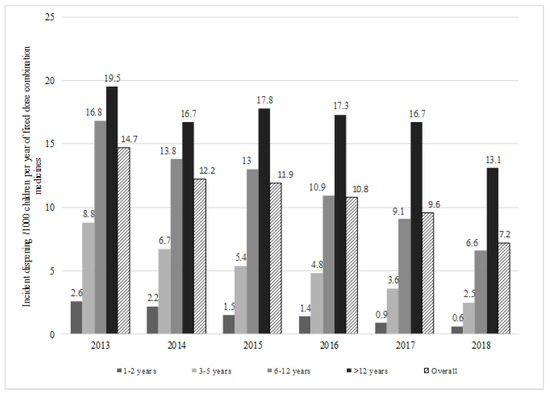
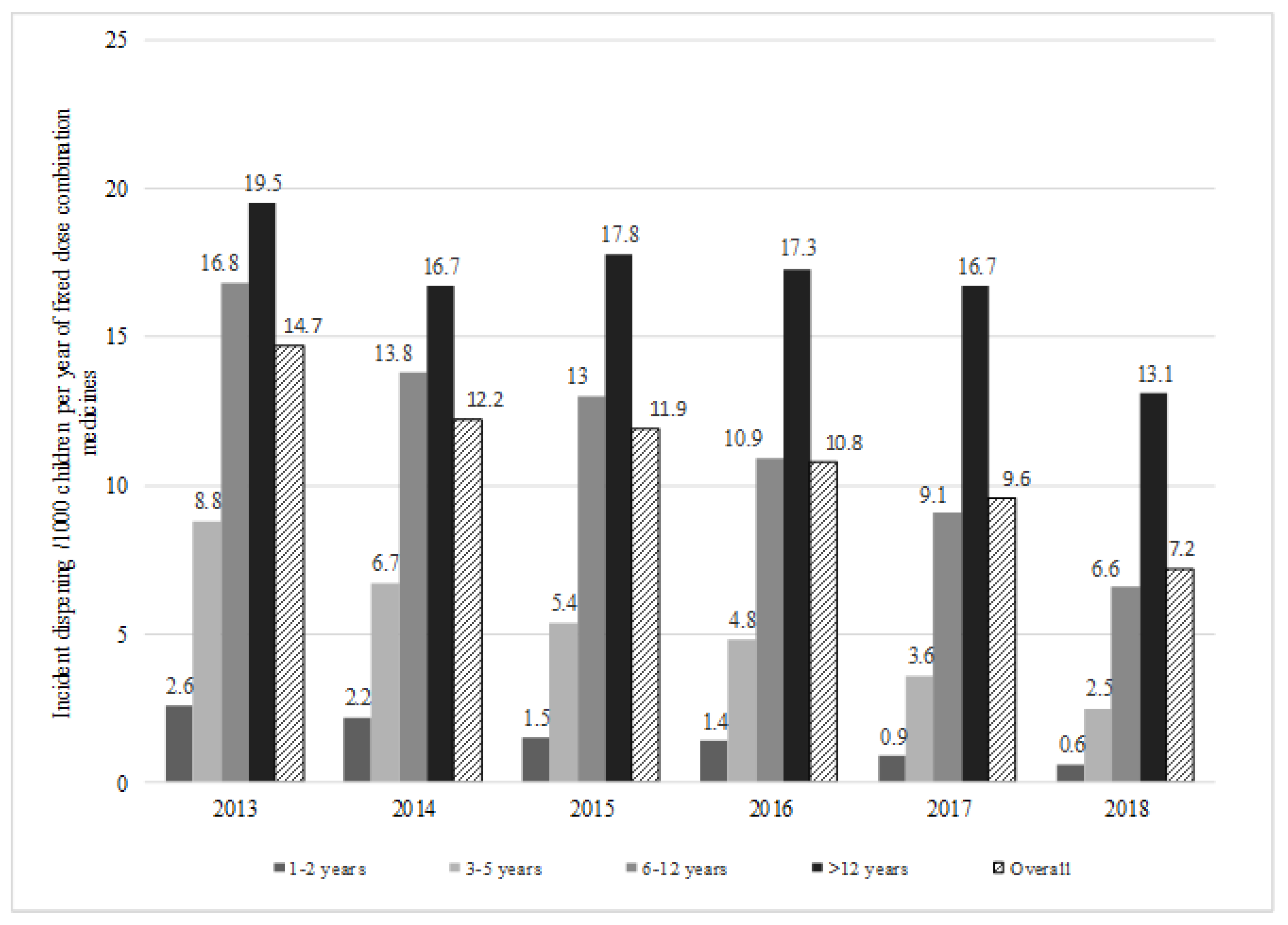
During 2013–2018, the overall incidence of FDC dispensing in children and adolescents declined from 14.7–7.2/1000 children (Figure 1). The incidence of FDC dispensing /1000 in children aged 1–2 years ranged between 2.6–0.6; 8.8–2.5 in children aged 3–5 years; 16.8–6.6 in children aged 6–12 years; and 19.5–13.1 in adolescents aged >12 years (Figure 1).
Figure 1.
Year and age specific incident dispensing of any fixed dose combination medicines in 10% PBS sample of Australian children aged 1–18 years, 2013–2018.
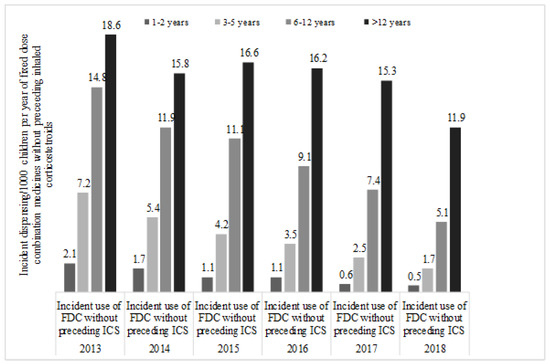
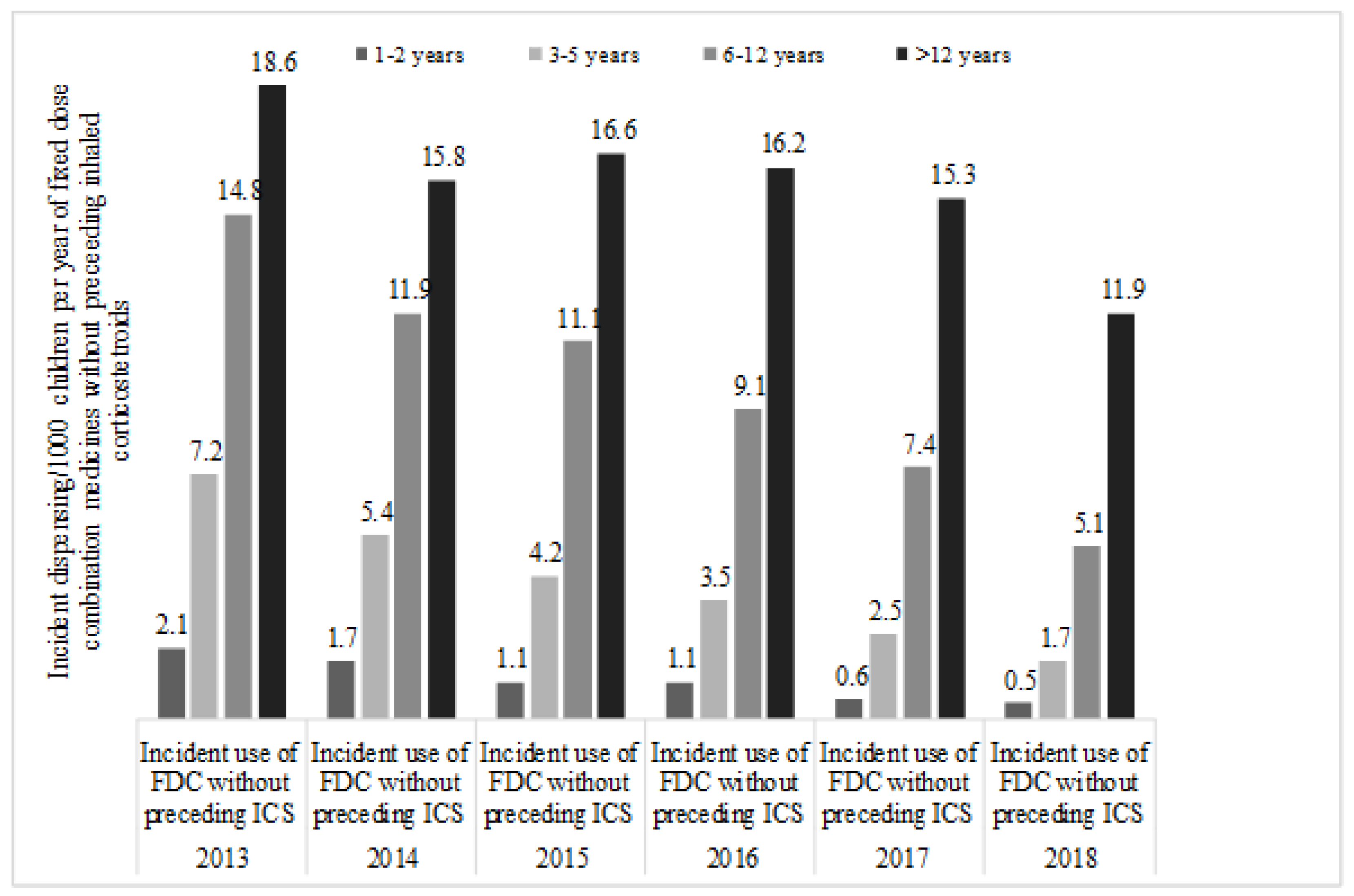
Incidence of FDC dispensing/1000 children without a preceding ICS dispensing was between 2.1–0.5 in children aged 1–2 years; 7.2–1.7 in children aged 3–5 years; 14.8–5.1 in children aged 6–12 years and 18.6–11.9 in adolescents aged >12 years (Figure 2).
Figure 2.
Year and age specific incident dispensing of any fixed dose combination medicine without a preceding dispensing of inhaled corticosteroid in 10% PBS sample of Australian children aged 1–18 years, 2013–2018.
The overall cost of FDC for 2013–2018 in our cohort was AUD 7.8 million; of which AUD 4.5 million was to the government and AUD 3.3 million was to the patient (Table 2).
Table 2.
Costs of fixed dose combination medicines by year in 10% PBS sample; 2013–2018, Australia.
4. Discussion
This nationally representative, population-based study suggests that while there is inappropriate dispensing of FDC in pre-school children there is a steady declining trend in the annual dispensing of FDCs across all age groups. The observed declining trend in FDC initiations for children contrasted findings from a previous study conducted in the Australian Capital Territory over a different timeframe. That study found a 12% increase in use of FDC between 2002 and 2005 [13]. Despite the observed declining trend across more recent years, if we extrapolate our estimates to the wider Australian population, a large number of children (>50,000) were initiated on FDC therapy without a prior trial of ICS. Although there is some evidence that maintenance and reliever therapy in children with budesonide and formoterol may be beneficial [17], at the time of the study there was insufficient evidence to recommend FDC before a trial of ICS in children ≥6 years [18]. Such practice was also not supported by national and international clinical practice guidelines [8]. However, in 2019 the GINA guidelines updated their recommendations and suggested use of daily low dose of ICS or FDC (budesonide-formoterol) as needed as the first line of controller therapy in adolescents [19]. It is expected that the national guidelines will also be updated to reflect this change and thus our study will provide baseline data in terms of evaluating the change in the dispensing pattern of FDCs following this change.
In our cohort, 3500 children aged ≤5 years across Australia were inappropriately [8] initiated on FDC annually which amounted to a cost of ~AUD 500,000 to the government and patients. Such inappropriate use represents wastage of health funds. Additionally, the high cost of these medicines is a significant barrier to compliance with asthma medications [20]. The most commonly dispensed FDC was the combination of fluticasone and salmeterol. This is likely because only the combination of fluticasone and salmeterol is listed on the PBS for use and reimbursed in children aged 4 years and over.
It is pleasing to note the trend in reduced dispensing of FDC during the period of the study. Whilst we could not look into the reasons for this, this time period coincides with a significant increase in education to the prescribing community about the appropriate use of FDCs by the Australian asthma peak bodies and the Australian Paediatric Respiratory Medical Group [21] following concerns of tachyphylaxis caused by long acting beta agonists [22].
In March 2018, the Pharmaceutical Benefits Advisory Committee (PBAC), an independent expert body of doctors, health professionals, health economists, and consumer representatives appointed by the Australian Government to recommend new medicines for listing on the PBS, considered a three-year evaluation report conducted following the 2014 post market review of asthma medicines in children. Following the meeting PBAC concluded that the proportion of use of FDC outside clinical guidelines remained “unacceptably” high and recommended that listing of all FDC for asthma should be streamlined authority [23]. When prescribing a streamlined authority item, a doctor needs to ensure that the prescribing of the medication is in line with the PBS restrictions criteria for the medication and is required to add the respective streamlined authority code on the prescription [24]. This recommendation was made to promote prescribing ICS as the first line of controller therapy [23]. The data from our study will help monitor the effectiveness of this policy change over time.
There are several limitations of our study. The 10% PBS sample includes the year of birth for all patients based on dates of birth that have been perturbed by up to six months to protect individual privacy. As such, some children in our cohort would have been less than one year and greater than 18 years of age. Our data contain records of asthma prevention medicine dispensing, but lack information on adherence to medicine. While non-compliance is associated with sub-optimal management of asthma symptoms [2] we cannot assess this aspect of asthma management. Our data also lack information regarding the type of prescriber, however studies suggest that >90% of asthma preventers are initiated by primary care providers [14]. Finally, our data did not include information on treatment indication and we were unable to investigate why prescribing was not in keeping with the national guidelines.
5. Conclusions
In conclusion, we have demonstrated that both FDC dispensing and initiation are decreasing in Australian children, which is a promising trend. However, children aged <12 years are often prescribed FDCs without an initial therapy with ICS which is inconsistent with National and International Guidelines. Clinical practice guidelines standardize clinical care, reduce wastage of health resources, and improve the value of healthcare. There is a need to understand factors associated with guidelines adherence in order to develop appropriate interventions to improve health care professionals’ awareness of guidelines and appropriate prescribing practices.
Author Contributions
N.H., A.J., S.P. and B.D. conceived and designed the study; N.H. was responsible for drafting the manuscript; B.D. performed the statistical analyses for the study; A.J., S.P. and B.D. provided technical feedback with drafting of the manuscript. All authors have read and agreed to the published version of the manuscript.
Funding
The study was funded by Rotary Club of Sydney Cove.
Acknowledgments
The authors would like to thank Sydney Children’s Hospital Foundation and Rotary Club of Sydney Cove for their continued support in our research endeavours. The authors thank the Services Australia for providing the data. This work was supported by The Rotary Club of Sydney Cove. The funding organization had no role in the study design, analyses, or drafting of the manuscript. NH is funded through NHMRC research fellowship (APP1158646), B.D. is funded by a NHMRC postgraduate award (ID: 1094325) and Centre for Research Excellence in Medicines and Ageing (CREMA) PhD top-up award.
Conflicts of Interest
The authors declare no conflict of interest.
Data Sharing Statement
Access to the dataset analysed during the current study is not permitted without the express permission of the approving human research ethics committees and data custodians. There is no additional data available.
References
- The Global Asthma Report 2014; Global Asthma Network: Auckland, New Zealand, 2014; Available online: http://www.globalasthmareport.org/resources/Global_Asthma_Report_2014.pdf (accessed on 23 January 2018).
- Australian Bureau of Statistics. Australian Health Survey: First Results, 2011–12; Australian Bureau of Statistics: Canberra, Australia, 2012. Available online: http://www.ausstats.abs.gov.au/ausstats/subscriber.nsf/0/1680ECA402368CCFCA257AC90015AA4E/$File/4364.0.55.001.pdf (accessed on 7 August 2017).
- Goeman, D.P.; Abramson, M.J.; McCarthy, E.A.; Zubrinich, C.M.; Douglass, J.A. Asthma mortality in Australia in the 21st century: A case series analysis. BMJ Open 2013, 3, e002539. [Google Scholar] [CrossRef] [Scilit] [PubMed]
- Poulos, L.M.; Toelle, B.G.; Marks, G.B. The burden of asthma in children: An Australian perspective. Paediatr. Respir. Rev. 2005, 6, 20–27. [Google Scholar] [CrossRef] [Scilit] [PubMed]
- Australian Institute of Health and Welfare 2013, Asthma Hospitalisations in Australia 2010–11. Available online: https://www.aihw.gov.au/getmedia/ (accessed on 23 February 2018).
- Australian Institute of Health and Welfare 2015, How Much Is Spent on Asthma? Available online: http://www.aihw.gov.au/asthma/expenditure/ (accessed on 23 February 2018).
- Braithwaite, J.; Hibbert, P.D.; Jaffe, A.; White, L.; Cowell, C.T.; Harris, M.F. Quality of Health Care for Children in Australia, 2012–2013. JAMA 2018, 319, 1113–1124. [Google Scholar] [CrossRef] [Scilit] [PubMed]
- National Asthma Council, Australia 2016. Australian Asthma Handbook, Version 1.2. Available online: http://www.asthmahandbook.org.au (accessed on 4 May 2018).
- Global Initative for Asthma. Gobal Strategy for Asthma Management and Prevention. 2018. Available online: https://ginasthma.org/wp-content/uploads/2019/01/2018-GINA.pdf (accessed on 6 May 2018).
- Adams, R.J.; Fuhlbrigge, A.; Fink elstein, J.A.; Lozano, P.; Livingston, J.M.; Weiss, K.B. Use of inhaled anti-inflammatory medication in children with asthma in managed care settings. Arch. Pediatr. Adolesc. Med. 2001, 155, 501–507. [Google Scholar] [CrossRef] [Scilit] [PubMed]
- Andrews, A.L.; Teufel, R.J., II; Basco, W.T., Jr. Low rates of controller medication initiation and outpatient follow-up after emergency department visits for asthma. J. Pediatr. 2012, 160, 325–330. [Google Scholar] [CrossRef] [Scilit] [PubMed]
- Cohen, S.; Taitz, J.; Jaffe, A. Paediatric prescribing of asthma drugs in the UK: Are we sticking to the guideline? Arch. Dis. Child. 2007, 92, 847–849. [Google Scholar] [CrossRef] [Scilit] [PubMed]
- Phillips, C.B.; Toyne, H.; Ciszek, K.; Attewell, R.G.; Kljakovic, M. Trends in medication use for asthma in school-entry children in the Australian capital territory, 2000–2005. Med. J. Aust. 2007, 187, 10–13. [Google Scholar] [CrossRef] [Scilit] [PubMed]
- Post-Market Review of Pharmaceutical Benefits Scheme Medicines Used to Treat Asthma in Children; The Pharmaceutical Benefit Scheme, Department of Health, Australian Government: Canberra, Australia, 2015. Available online: http://www.pbs.gov.au/info/reviews/asthma-children-reviews (accessed on 8 May 2015).
- Mellish, L.; Karanges, E.A.; Litchfield, M.J.; Schaffer, A.L.; Blanch, B.; Daniels, B.J. The Australian Pharmaceutical Benefits Scheme data collection: A practical guide for researchers. BMC Res. Notes 2015, 8, 634. [Google Scholar] [CrossRef] [Scilit] [PubMed]
- Australian Bureau of Statistics. ABS.Stat. Available online: http://stat.data.abs.gov.au/# (accessed on 15 March 2020).
- Bisgaard, H.; Le Roux, P.; Bjamer, D.; Dymek, A.; Vermeulen, J.H.; Hultquist, C. Budesonide/formoterol maintenance plus reliever therapy: A new strategy in pediatric asthma. Chest 2006, 130, 1733–1743. [Google Scholar] [CrossRef] [Scilit] [PubMed]
- Ducharme, F.M.; Ni Chroinin, M.; Greenstone, I.; Lasserson, T.J. Addition of long-acting beta2-agonists to inhaled steroids versus higher dose inhaled steroids in adults and children with persistent asthma. Cochrane Database Syst. Rev. 2010. [Google Scholar] [CrossRef] [Scilit] [PubMed]
- Global Initative for Asthma. Gobal Strategy for Asthma Management and Prevention. 2019. Available online: https://ginasthma.org/wp-content/uploads/2019/06/GINA-2019-main-report-June-2019-wms.pdf (accessed on 1 January 2020).
- Chuang, S.; Jaffe, A. Cost considerations of therapeutic options for children with asthma. Paediatr. Drugs 2012, 14, 211–220. [Google Scholar] [CrossRef] [Scilit] [PubMed]
- van Asperen, P.P. Long-acting beta2 agonists for childhood asthma. Aust. Prescr. 2012, 35, 111–113. [Google Scholar] [CrossRef] [Scilit]
- Nelson, H.S.; Weiss, S.T.; Bleecker, E.R.; Yancey, S.W.; Dorinsky, P.M.; Group, S.S. The salmeterol multicenter asthma research trial: A comparison of usual pharmacotherapy for asthma or usual pharmacotherapy plus salmeterol. Chest 2006, 129, 15–26. [Google Scholar] [CrossRef] [Scilit] [PubMed]
- Department of Health (Ed.) Pharmaceutical Benefits Advisory Committee. In March 2018 PBAC Outcome-Other Materials; Australian Government: Canberra, Australia, 2018. Available online: http://www.pbs.gov.au/industry/listing/elements/pbac-meetings/pbac-outcomes/2018-03/other-matters-03-2018.pdf (accessed on 8 May 2018).
- Desai, M.; Oppenheimer, J.J. Medication adherence in the asthmatic child and adolescent. Curr. Allergy Asthma Rep. 2011, 11, 454. [Google Scholar] [CrossRef] [Scilit]

© 2020 by the authors. Licensee MDPI, Basel, Switzerland. This article is an open access article distributed under the terms and conditions of the Creative Commons Attribution (CC BY) license (http://creativecommons.org/licenses/by/4.0/).