Can the New Subway Line Openings Mitigate PM10 Concentration? Evidence from Chinese Cities Based on the PSM-DID Method




Abstract
1. Introduction
2. Literature Review
2.1. The Impact of Air Pollution on Human Health
2.2. The Sources of Air Pollution
2.3. The Effect of Driving Restriction Policy on Air Pollution
2.4. The Influence Mechanism of the Effect of Subway Supply on Air Pollution
2.5. The Contributions of This Paper
3. Methods, Data and Sample
3.1. Empirical Strategy
3.1.1. Difference-In-Differences (DID) Method
3.1.2. Propensity Score Matching (PSM) Method
3.2. Data and Sample
4. Empirical Results
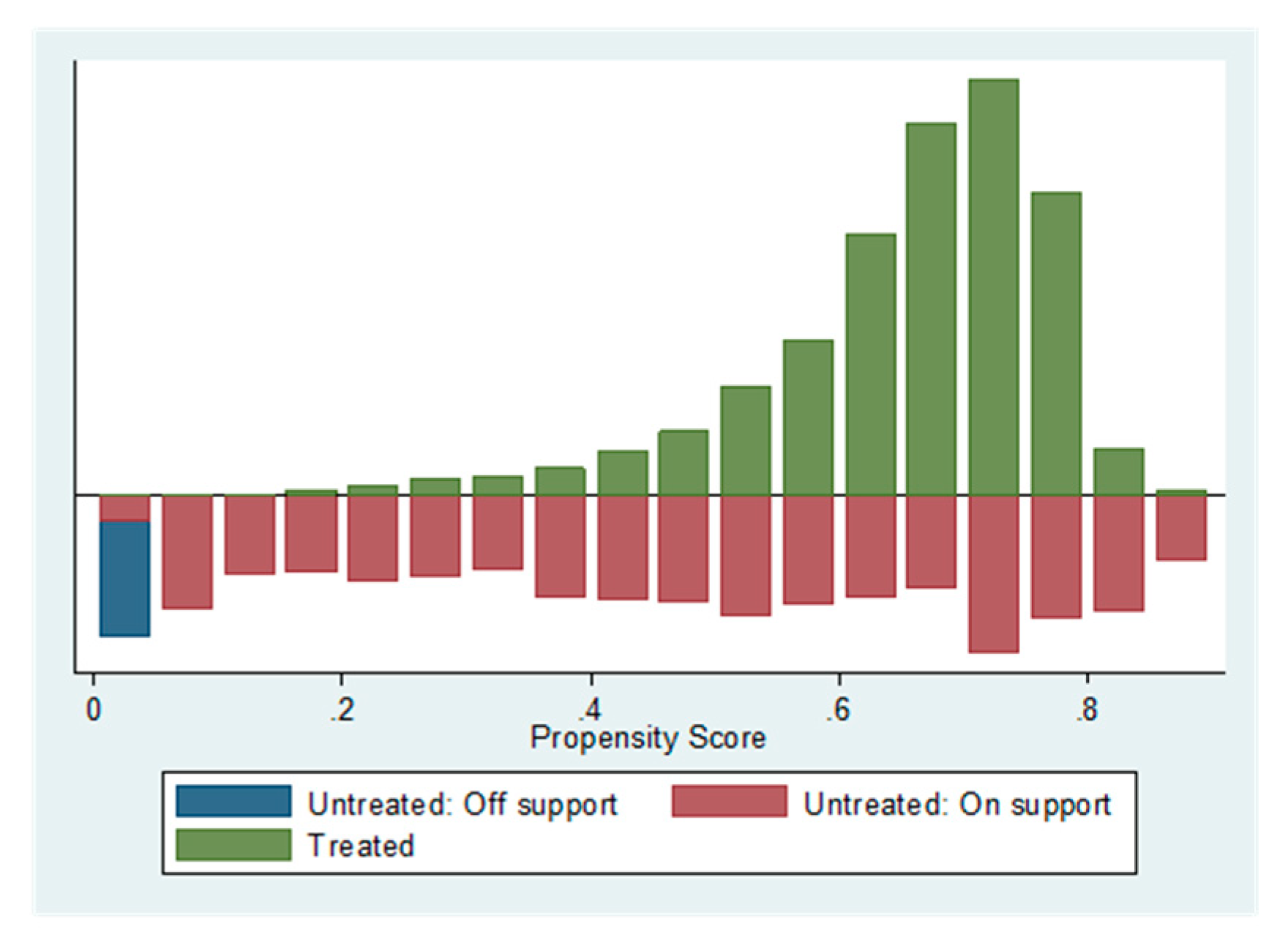
4.1. PSM Results
4.2. Regression Results
4.2.1. Heterogeneity of Time Windows
4.2.2. Heterogeneity of Population Sizes
4.2.3. Heterogeneity of the Level of Economic Development
4.3. Robustness Check
4.4. Mechanism Analysis
5. Discussion
6. Conclusions
Author Contributions
Funding
Conflicts of Interest
References
- Zhou, H.; He, J.; Zhao, B.; Zhang, L.; Fan, Q.; Lü, C.; Yuan, Y. The distribution of PM10 and PM2.5 carbonaceous aerosol in Baotou, China. Atmos. Res. 2016, 178, 102–113. [Google Scholar] [CrossRef] [Scilit]
- Cui, M.; Lu, H.; Etyemezian, V.; Su, Q. Quantifying the emission potentials of fugitive dust sources in Nanjing, East China. Atmos. Environ. 2019, 207, 129–135. [Google Scholar] [CrossRef] [Scilit]
- Guan, Q.; Yang, Y.; Luo, H.; Zhao, R.; Pan, N.; Lin, J.; Yang, L. Transport pathways of PM10 during the spring in northwest China and its characteristics of potential dust sources. J. Clean. Prod. 2019, 237, 117746. [Google Scholar] [CrossRef] [Scilit]
- Ho, H.C.; Wong, M.S.; Yang, L.; Chan, T.C.; Bilal, M. Influences of socioeconomic vulnerability and intra-urban air pollution exposure on short-term mortality during extreme dust events. Environ. Pollut. 2018, 235, 155–162. [Google Scholar] [CrossRef] [Scilit]
- Zhou, N.Y.; Jiang, C.T.; Chen, Q.; Yang, H.; Wang, X.G.; Zou, P.; Sun, L.; Liu, J.J.; Li, L.; Li, L.B.; et al. Exposures to atmospheric PM10 and PM10-2.5 affect male semen quality: Results of MARHCS study. Environ. Sci. Technol. 2018, 52, 1571–1581. [Google Scholar] [CrossRef] [PubMed]
- Enders, C.; Pearson, D.; Harley, K.; Ebisu, K. Exposure to coarse particulate matter during gestation and term low birthweight in California: Variation in exposure and risk across region and socioeconomic subgroup. Sci. Total Environ. 2018, 653, 1435–1444. [Google Scholar] [CrossRef] [Scilit] [PubMed]
- Ebisu, K.; Jesse, D.B.; Michelle, L.B. Exposure to coarse particulate matter during gestation and birth weight in the U.S. Environ. Int. 2016, 94, 519–524. [Google Scholar] [CrossRef] [Scilit] [PubMed]
- Lee, S.; Han, C.; Shin, D.; Do Hur, S.; Jun, S.J.; Kim, Y.T.; Hong, S. Characteristics of elemental and Pb isotopic compositions in aerosols (PM10-2.5) at the Ieodo Ocean Research Station in the East China Sea. Environ. Pollut. 2017, 231, 154–164. [Google Scholar] [CrossRef] [Scilit]
- Bigi, A.; Ghermandi, G. Trends and variability of atmospheric PM2.5 and PM10-2.5 concentration in the Po Valley, Italy. Atmos. Chem. Phys. 2016, 16, 15777–15788. [Google Scholar] [CrossRef] [Scilit]
- Li, S.; Liu, Y.; Purevjav, A.O.; Yang, L. Does subway expansion improve air quality? J. Environ. Econ. Manag. 2019, 96, 213–235. [Google Scholar] [CrossRef] [Scilit]
- Zheng, S.; Zhang, X.; Sun, W.; Wang, J. The effect of a new subway line on local air quality: A case study in Changsha. Transp. Res. Part D Transp. Environ. 2017, 68, 26–38. [Google Scholar] [CrossRef] [Scilit]
- Moreno, T.; Kelly, F.J.; Dunster, C.; Oliete, A.; Martins, V.; Reche, C.; Querol, X. Oxidative potential of subway PM2. Atmos. Environ. 2017, 148, 230–238. [Google Scholar] [CrossRef] [Scilit]
- Park, D.; Oh, M.; Yoon, Y.; Park, E.; Lee, K. Source identification of PM10 pollution in subway passenger cabins using positive matrix factorization. Atmos. Environ. 2012, 49, 180–185. [Google Scholar] [CrossRef] [Scilit]
- Kim, G.S.; Son, Y.S.; Lee, J.H.; Kim, I.W.; Kim, J.C.; Oh, J.T.; Kim, H. Air pollution monitoring and control system for subway stations using environmental sensors. J. Sens. 2016, 2016, 1865614. [Google Scholar] [CrossRef] [Scilit]
- Jamison, D.T.; Breman, J.G.; Measham, A.R.; Alleyne, G.; Claeson, M.; Evans, D.B.; Musgrove, P. Disease Control Priorities in Developing Countries; The International Bank for Reconstruction and Development/The World Bank: Washington, DC, USA, 2006. [Google Scholar]
- Wang, H.; Chen, Z.; Wu, X.; Nie, X. Can a carbon trading system promote the transformation of a low-carbon economy under the framework of the porter hypothesis?-Empirical analysis based on the PSM-DID method. Energy Policy 2019, 129, 930–938. [Google Scholar] [CrossRef] [Scilit]
- Zang, J.; Wan, L.; Li, Z.; Wang, C.; Wang, S. Does emission trading scheme have spillover effect on industrial structure upgrading? Evidence from the EU based on a PSM-DID approach. Environ. Sci. Pollut. Res. 2020, 27, 12345–12357. [Google Scholar] [CrossRef] [Scilit]
- World Health Organization. Available online: https://www.who.int/en/newsroom/fact-sheets/detail/ambient-(outdoor)-air-quality-and-health (accessed on 3 January 2019).
- GBD 2016; Risk Factors Collaborators. Global, regional, and national comparative risk assessment of 84 behavioural, environmental and occupational, and metabolic risks or clusters of risks, 1990–2016: A systematic analysis for the Global Burden of Disease Study. Lancet 2017, 390, 1345–1422. [Google Scholar] [CrossRef] [Scilit]
- Feng, W.; Li, H.; Wang, S.; Van Halm-Lutterodt, N.; An, J.; Liu, Y.; Liu, M.; Wang, X.; Guo, X. Short-term PM10 and emergency department admissions for selective cardiovascular and respiratory diseases in Beijing, China. Sci. Total Environ. 2019, 657, 213–221. [Google Scholar] [CrossRef] [Scilit]
- Zheng, Q.; Liu, H.; Zhang, J.; Chen, D. The effect of ambient particle matters on hospital admissions for cardiac arrhythmia: A multi-city case-crossover study in China. Environ. Health 2018, 17, 60. [Google Scholar] [CrossRef] [Scilit]
- Yoon, H.J.; Xu, S.; Tourassi, G. Predicting lung cancer incidence from air pollution exposures using shapelet-based time series analysis. In Proceedings of the 3rd IEEE EMBS International Conference on Biomedical and Health Informatics, BHI, Las Vegas, NV, USA, 24–27 February 2016. [Google Scholar]
- Kim, K.H.; Kabir, E.; Kabir, S. A review on the human health impact of airborne particulate matter. Environ. Int. 2015, 74, 136–143. [Google Scholar] [CrossRef] [Scilit]
- Zhang, X.Y.; Wang, J.Z.; Wang, Y.Q.; Liu, H.L.; Sun, J.Y.; Zhang, Y.M. Changes in chemical components of aerosol particles in different haze regions in China from 2006 to 2013 and contribution of meteorological factors. Atmos. Chem. Phys. 2015, 15, 12935–12952. [Google Scholar] [CrossRef] [Scilit]
- Liu, Q.; Liu, Y.; Yin, J.; Zhang, M.; Zhang, T. Chemical characteristics and source apportionment of PM10 during Asian dust storm and non-dust storm days in Beijing. Atmos. Environ. 2014, 91, 85–94. [Google Scholar] [CrossRef] [Scilit]
- Potier, E.; Waked, A.; Bourin, A.; Minvielle, F.; Pere, J.C.; Perdrix, E.; Michoud, V.; Riffault, V.; Alleman, L.Y.; Sauvage, S. Characterizing the regional contribution to PM10 pollution over northern France using two complementary approaches: Chemistry transport and trajectory-based receptor models. Atmos. Res. 2019, 223, 1–14. [Google Scholar] [CrossRef] [Scilit]
- Currie, J.; Walker, R. Traffic congestion and infant health: Evidence from E-ZPass. Am. Econ. J. Appl. Econ. 2011, 3, 65–90. [Google Scholar] [CrossRef] [Scilit]
- Levy, J.I.; Buonocore, J.J.; Von Stackelberg, K. Evaluation of the public health impacts of traffic congestion: A health risk assessment. Environ. Health 2010, 9, 65. [Google Scholar] [CrossRef] [Scilit] [PubMed]
- Li, M.; Zhang, Q.; Kurokawa, J.I.; Woo, J.H.; He, K.; Lu, Z.; Ohara, T.; Song, Y.; Streets, D.G.; Carmichael, G.R.; et al. MIX: A mosaic Asian anthropogenic emission inventory under the international collaboration framework of the MICS-Asia and HTAP. Atmos. Chem. Phys. 2017, 17, 935–963. [Google Scholar] [CrossRef] [Scilit]
- Viard, V.B.; Fu, S.H. The effect of Beijing’s driving restrictions on pollution and economic activity. J. Public Econ. 2015, 125, 98–115. [Google Scholar] [CrossRef] [Scilit]
- Chen, Y.Y.; Jin, G.Z.; Kumar, N.; Guang, S. The promise of Beijing: Evaluating the impact of the 2008 Olympic Games on air quality. J. Environ. Econ. Manag. 2013, 66, 424–443. [Google Scholar] [CrossRef] [Scilit]
- Davis, L.W. The effect of driving restrictions on air quality in Mexico City. J. Political Econ. 2008, 116, 38–81. [Google Scholar] [CrossRef] [Scilit]
- Zhang, W.; Lawell, C.Y.; Umanskaya, V.I. The effects of license plate-based driving restrictions on air quality: Theory and empirical evidence. J. Environ. Econ. Manag. 2017, 82, 181–220. [Google Scholar] [CrossRef] [Scilit]
- Lalive, R.; Luechinger, S.; Schmutzler, A. Does Supporting Passenger Railways Reduce Road Traffic Externalities? CEPR Discussion Paper. 2013, p. 9335. Available online: http://citeseerx.ist.psu.edu/viewdoc/download?doi=10.1.1.828.5923&rep=rep1&type=pdf (accessed on 3 January 2019).
- Liang, R.; Xi, P. Heterogeneous effects of rail transit on air pollution: An empirical study with RDID. China Ind. Econ. 2016, 3, 83–98. [Google Scholar]
- Chen, Y.; Whalley, A. Green infrastructure: The effects of urban rail transit on air quality. Am. Econ. J. Econ. Policy 2012, 4, 58–97. [Google Scholar] [CrossRef] [Scilit]
- Gendron-Carrier, N.; Gonzalez-Navarro, M.; Polloni, S.; Turner, M.A. Subways and Urban Air Pollution; National Bureau of Economic Research: Cambridge, MA, USA, 2018. [Google Scholar]
- Beaudoin, J.; Lin Lawell, C.Y.C. Is Public Transit’s “Green” Reputation Deserved? Evaluating the Effects of Transit Supply on Air Quality. TREC Friday Seminar Series. 2018, p. 162. Available online: https://pdxscholar.library.pdx.edu/trec_seminar/162 (accessed on 3 January 2019).
- Bauernschuster, S.; Hener, T.; Rainer, H. When labor disputes bring cities to a standstill: The impact of public transit strikes on traffic, accidents, air pollution, and health. Am. Econ. J. 2017, 9, 1–37. [Google Scholar] [CrossRef] [Scilit]
- Mohring, H. Optimization and scale economies in urban bus transportation. Am. Econ. Rev. 1972, 62, 591–604. [Google Scholar]
- Reche, C.; Moreno, T.; Martins, V.; Minguillón, M.C.; Jones, T.; de Miguel, E.; Querol, X. Factors controlling particle number concentration and size at metro stations. Atmos. Environ. 2017, 156, 169–181. [Google Scholar] [CrossRef] [Scilit]
- Wang, J.; Zhao, L.; Zhu, D.; Gao, H.O.; Xie, Y.; Li, H.; Xu, X.; Wang, H. Characteristics of particulate matter (PM) concentrations influenced by piston wind and train door opening in the Shanghai subway system. Transp. Res. Part D Transp. Environ. 2016, 47, 77–88. [Google Scholar] [CrossRef] [Scilit]
- Xu, B.; Hao, J. Air quality inside subway metro indoor environment worldwide: A review. Environ. Int. 2017, 107, 33–46. [Google Scholar] [CrossRef] [Scilit]
- Son, Y.S.; Jeon, J.S.; Lee, H.J.; Ryu, I.C.; Kim, J.C. Installation of platform screen doors and their impact on indoor air quality: Seoul subway trains. J. Air Waste Manag. Assoc. 2014, 64, 1054–1061. [Google Scholar] [CrossRef] [Scilit]
- Zhao, L.; Wang, J.; Gao, H.O.; Xie, Y.; Jiang, R.; Hu, Q.; Sun, Y. Evaluation of particulate matter concentration in Shanghai’s metro system and strategy for improvement. Transp. Res. Part D Transp. Environ. 2017, 53, 115–127. [Google Scholar] [CrossRef] [Scilit]
- Midander, K.; Elihn, K.; Wallén, A.; Belova, L.; Karlsson, A.K.B.; Wallinder, I.O. Characterisation of nano- and micron-sized airborne and collected subway particles, a multi-analytical approach. Sci. Total Environ. 2012, 427, 390–400. [Google Scholar] [CrossRef] [Scilit]
- Beaudoin, J.; Farzin, Y.H.; Lawell, C.Y.C.L. Public transit investment and sustainable transportation: A review of studies of transit’s impact on traffic congestion and air quality. Res. Transp. Econ. 2015, 52, 15–22. [Google Scholar] [CrossRef] [Scilit]
- Caliendo, M.; Kopeinig, S. Some practical guidance for the implementation of propensity score matching. J. Econ. Surv. 2008, 22, 31–72. [Google Scholar] [CrossRef] [Scilit]
- Zhang, L.; Long, R.; Chen, H. Do car restriction policies effectively promote the development of public transport? World Dev. 2019, 119, 100–110. [Google Scholar] [CrossRef] [Scilit]
- Zhang, Y.L. Dynamic effect analysis of meteorological conditions on air pollution: A case study from Beijing. Sci. Total Environ. 2019, 684, 178–185. [Google Scholar] [CrossRef] [Scilit] [PubMed]
- American Lung Association (ALA). Available online: https://www.lung.org/clean-air/climate-change/climate-change-air-pollution (accessed on 14 March 2020).
- Chang, Y.S.; Lee, Y.J.; Choi, S.S.B. Is there more traffic congestion in larger cities?-Scaling analysis of the 101 largest US urban centers. Transport Policy 2017, 59, 54–63. [Google Scholar] [CrossRef] [Scilit]
- Lu, H.Y.; Zhu, Y.C.; Qi, Y.; Yu, J.L. Do Urban Subway Openings Reduce PM 2.5 Concentrations? Evidence from China. Sustainability 2018, 10, 4147. [Google Scholar] [CrossRef] [Scilit]
- Querol, X.; Moreno, T.; Karanasiou, A.; Reche, C.; Alastuey, A.; Viana, M.; Capdevila, M. Variability of levels and composition of PM 10 and PM 2.5 in the Barcelona metro system. Atmos. Chem. Phys. 2012, 12, 10767–10768. [Google Scholar] [CrossRef] [Scilit]
- Colombi, C.; Angius, S.; Gianelle, V.; Lazzarini, M. Particulate matter concentrations, physical characteristics and elemental composition in the Milan underground transport system. Atmos. Environ. 2013, 70, 166–178. [Google Scholar] [CrossRef] [Scilit]
- China Urban Traffic Analysis Report. Available online: https://report.amap.com/download.do (accessed on 10 January 2017).
- Huang, X.; Cao, X.J.; Yin, J.; Cao, X. Can metro transit reduce driving? Evidence from Xi’an, China. Transport Policy 2019, 81, 350–359. [Google Scholar] [CrossRef] [Scilit]
- Yang, J.; Shi, B.; Shi, Y.; Marvin, S.; Zheng, Y.; Xia, G. Air pollution dispersal in high density urban areas: Research on the triadic relation of wind, air pollution, and urban form. Sustain. Cities Soc. 2020, 54, 101941. [Google Scholar] [CrossRef] [Scilit]
- Yang, L.; Zhang, Y.; Xia, J. Case study of train-induced airflow inside underground subway stations with simplified field test methods. Sustain. Cities Soc. 2018, 37, 275–287. [Google Scholar] [CrossRef] [Scilit]


| Variable. | Obs | Mean | Std. Dev. | Min | Max | Unit | Definition |
|---|---|---|---|---|---|---|---|
| ln(PM2.5) | 12,090 | 3.711 | 0.683 | 1.386 | 6.084 | mg/m3 | Daily PM2.5 concentration |
| ln(PM10) | 12,034 | 4.302 | 0.611 | 0 | 7.489 | mg/m3 | Daily PM10 concentration |
| ln(CO) | 12,068 | 0.872 | 1.597 | −1.609 | 4.771 | mg/m3 | Daily CO concentration |
| treated | 12,170 | 0.551 | 0.497 | 0 | 1 | - | - |
| T | 12,170 | 0.501 | 0.500 | 0 | 1 | - | - |
| ifrain | 12,133 | 0.378 | 0.485 | 0 | 1 | - | Rain/snow/storm dummy: 1 if there was rain/snow/storm, 0 otherwise |
| ln(qw) | 12,138 | 6.800 | 0.706 | 0 | 7.569 | °C | Mean temperature |
| ln(xdsd) | 12,138 | 6.491 | 0.684 | 0 | 7.122 | % | Relative humidity |
| ln(fs) | 12,138 | 2.224 | 1.311 | 0 | 18.624 | m/s | Mean wind speed |
| Variable | ln(PM2.5) | ln(PM10) | ln(CO) | treated | T | ifrain | ln(qw) | ln(xdsd) | ln(fs) |
|---|---|---|---|---|---|---|---|---|---|
| ln(PM2.5) | 1.000 | ||||||||
| ln(PM10) | 0.886 | 1.000 | |||||||
| ln(CO) | 0.308 | 0.288 | 1.000 | ||||||
| treated | −0.273 | −0.260 | −0.705 | 1.000 | |||||
| T | −0.209 | −0.157 | 0.009 | −0.120 | 1.000 | ||||
| ifrain | −0.260 | −0.346 | −0.006 | −0.022 | 0.087 | 1.000 | |||
| ln(qw) | −0.142 | −0.121 | −0.146 | 0.092 | 0.187 | 0.048 | 1.000 | ||
| ln(xdsd) | −0.157 | −0.298 | −0.212 | 0.171 | 0.139 | 0.378 | 0.180 | 1.000 | |
| ln(fs) | −0.129 | −0.077 | −0.100 | 0.092 | −0.019 | −0.067 | −0.089 | −0.235 | 1.000 |
| City | Province | Annual Populations (Ten Thousand People) | Gross Domestic Production (a Hundred Million Yuan) | Opening Date of the Opening Date of the First Subway Line | Opening Date of the Second Subway Line |
|---|---|---|---|---|---|
| Changsha | Hunan | 304 | 7825 | 29 April 2014 | 21 March 2016 |
| Ningbo | Zhejiang | 230 | 7610 | 30 May 2014 | 26 September 2015 |
| Wuxi | Jiangsu | 246 | 8205 | 1 July 2014 | 28 December 2014 |
| Qingdao | Shandong | 480 | 9300 | 16 December 2015 | 10 December 2017 |
| Nanchang | Jiangxi | 178 | 4000 | 26 December 2015 | 30 June 2019 |
| Fuzhou | Fujian | 203 | 6197 | 18 June 2016 | 26 April 2019 |
| Nanning | Guangxi | 370 | 3703 | 28 July 2016 | 6 June 2019 |
| Variable | Unmatched/Matched | Mean | %Bias | %Reduct |Bias| | t Test | ||
|---|---|---|---|---|---|---|---|
| Treated | Control | t | p > |t| | ||||
| ifrain | U | 0.448 | 0.399 | 9.9 | 4.74 | 0.000 | |
| M | 0.445 | 0.447 | −0.3 | 96.9 | −0.14 | 0.892 | |
| ln(fs) | U | 0.604 | 0.564 | 8.3 | 4.01 | 0.138 | |
| M | 0.567 | 0.644 | −16.0 | −93.2 | −7.36 | 0.000 | |
| ln(xdsd) | U | 4.306 | 4.281 | 11.6 | 5.59 | 0.000 | |
| M | 4.302 | 4.302 | 0.0 | 99.9 | 0.00 | 0.997 | |
| ln(qw) | U | 3.062 | 2.556 | 83.4 | 40.95 | 0.000 | |
| M | 3.006 | 2.932 | 12.1 | 85.5 | 8.07 | 0.687 | |
| ln(PM10) | ln(PM2.5) | |||
|---|---|---|---|---|
| (1) OLS | (2) OLS | (3) PSM-DID | (4) PSM-DID | |
| treated×T | 0.23 (10.42) *** | 0.15 (7.17) *** | 0.175 (8.03) *** | 0.344 (14.79) *** |
| ln(qw) | −0.03 (−3.06) ** | 0.59 (15.72) *** | 0.59 (15.66) *** | |
| ln(xdsd) | −0.14 (−14.71) *** | 0.87 (17.40) *** | 0.85 (17.08) *** | |
| ln(fs) | −0.18 (−17.40) *** | 0.56 (9.80) *** | 0.54 (9.59) *** | |
| ifrain | −0.36 (−32.84) *** | −0.23 (−3.54) *** | −0.24 (−3.58) *** | |
| constant | 4.69 (351.16) *** | 5.94 (77.50) *** | −9.31 (−23.45) *** | −9.14 (−23.21) *** |
| Time window (days) | τ ± 90 | τ ± 90 | τ ± 90 | |
| N | 12,034 | 11,990 | 5964 | 5997 |
| R2 | 0.11 | 0.25 | 0.11 | 0.16 |
| ln(PM10) | ln(PM2.5) | |||||
|---|---|---|---|---|---|---|
| (1) PSM-DID | (2) PSM-DID | (3) PSM-DID | (4) PSM-DID | (5) PSM-DID | (6) PSM-DID | |
| treated×T | 0.21 (6.97) *** | 0.05 (3.34) ** | −0.09 (6.25) *** | 0.15 (5.01) *** | 0.08 (4.06) ** | −0.05 (3.09) *** |
| ln(qw) | 0.41 (5.80) *** | 0.15 (3.90) *** | 1.12 (18.71) *** | 0.41 (5.74) *** | 0.16 (3.96) *** | 1.13 (18.76) *** |
| ln(xdsd) | 3.63 (12.70) *** | 0.14 (3.24) *** | 2.39 (14.63) *** | 3.56 (12.55) *** | 0.14 (3.16) *** | 2.38 (14.58) *** |
| ln(fs) | 0.88 (7.95) *** | 0.63 (10.87) *** | 0.16 (3.15) ** | 0.88 (7.91) *** | 0.63 (10.84) *** | 0.16 (3.07) *** |
| ifrain | −1.28 (−9.48) *** | −0.61 (−8.93) *** | −0.14 (−2.47) ** | −1.28 (−9.55) *** | −0.62 (−8.98) *** | −0.14 (−2.50) *** |
| constant | −19.97 (−15.73) *** | −3.68 (−12.40) *** | −15.48 (−21.42) *** | −19.69 (−15.60) *** | −3.67 (−12.36) *** | −15.45 (−21.39) *** |
| time window (days) | τ ± 90 | τ ± 350 | τ ± 500 | τ ± 90 | τ ± 350 | τ ± 500 |
| N | 3384 | 12,902 | 15,411 | 3428 | 12,959 | 15,468 |
| ln(PM10) | ln(PM2.5) | |||||
|---|---|---|---|---|---|---|
| (1) PSM-DID | (2) PSM-DID | (3) PSM-DID | (4) PSM-DID | (5) PSM-DID | (6) PSM-DID | |
| treated×T | 0.24 (15.07) *** | −0.02 (1.78) * | −0.03 (2.04) ** | 0.15 (8.05) *** | −0.02 (1.53) * | −0.01 (0.46) * |
| ln(qw) | 0.45 (6.37) *** | 0.30 (6.49) *** | 0.41 (9.96) *** | 0.46 (6.77) *** | 0.30 (6.49) *** | 0.41 (10.01) *** |
| ln(xdsd) | 3.20 (12.11) *** | 1.67 (10.91) *** | 0.39 (8.59) *** | 3.19 (12.07) *** | 1.66 (10.85) *** | 0.38 (8.52) *** |
| ln(fs) | −0.29 (−4.10) *** | 0.65 (11.30) *** | 0.43 (−18.75) *** | −0.29 (−4.16) *** | 0.65 (11.26) *** | 0.43 (8.37) *** |
| ifrain | −0.58 (−6.70) *** | −0.17 (−2.57) ** | −0.59 (−9.83) *** | −0.58 (−6.70) *** | −0.17 (−2.58) ** | −0.59 (−9.87) *** |
| constant | −17.57 (−15.27) *** | −12.04 (−16.93) *** | −5.73 (−18.75) *** | −17.52 (−15.24) *** | −12.00 (−16.88) *** | −5.71 (−18.71) *** |
| Time window (days) | τ ± 350 | τ ± 90 | τ ± 350 | τ ± 350 | τ ± 90 | τ ± 350 |
| population(million) | 1–2 | 2–3 | 3–5 | 1–2 | 2–3 | 3–5 |
| N | 14,331 | 16,254 | 15,290 | 14,388 | 16,311 | 15,347 |
| ln(PM10) | ln(PM2.5) | |||
|---|---|---|---|---|
| (1) PSM-DID | (2) PSM-DID | (3) PSM-DID | (4) PSM-DID | |
| treated×T | −0.102 (7.32) *** | −0.216 (15.66) *** | −0.100 (6.60) *** | −0.178 (11.80) *** |
| ln(qw) | 0.310 (7.53) *** | −0.388 (−4.86) *** | 0.310 (7.54) *** | −0.386 (−4.84) *** |
| ln(xdsd) | 2.460 (16.62) *** | 1.247 (3.13) *** | 2.448 (16.56) *** | 1.230 (3.09) *** |
| ln(fs) | 0.154 (3.52) *** | 0.010 (0.11) | 0.150 (3.44) *** | 0.008 (0.09) |
| ifrain | −0.156 (−2.90) *** | −1.478 (−6.04) *** | −0.156 (−2.91) *** | −1.478 (−6.04) *** |
| constant | −14.503 (−21.11) *** | −8.357 (−4.62) *** | −14.456 (−21.06) *** | −8.284 (−4.59) *** |
| Time window (days) | τ ± 90 | τ ± 90 | τ ± 90 | τ ± 90 |
| GDP (a hundred million) | 3000–8000 | 8000–10,000 | 3000–8000 | 8000–10,000 |
| N | 14,622 | 11,679 | 14,679 | 11,754 |
| ln(PM2.5) | ln(PM10) | |||
|---|---|---|---|---|
| (1) OLS | (2) DID | (3) OLS | (4) DID | |
| treated×T | 0.17 (6.29) *** | 0.10 (4.77) *** | 0.16 (6.31) *** | 0.04 (2.03) ** |
| ln(qw) | −0.18 (−13.18) *** | −0.03 (−2.23) ** | ||
| ln(xdsd) | −0.002 (−0.07) | −0.41 (−12.42) *** | ||
| ln(fs) | −0.26 (−19.75) *** | −0.22 (−17.97) *** | ||
| ifrain | −0.32 (−24.48) *** | −0.34 (−28.04) *** | ||
| constant | 4.87 (34.31) *** | 6.73 (48.69) *** | ||
| time window(days) | τ ± 90 | τ ± 500 | τ ± 90 | τ ± 500 |
| population(million) | ||||
| N | 9337 | 26,811 | 9281 | 26,755 |
| R2 | 0.29 | 0.19 | 0.30 | 0.20 |
| ln(CO) | ||||||||
|---|---|---|---|---|---|---|---|---|
| (1) PSM-DID | (2) PSM-DID | (3) PSM-DID | (4) PSM-DID | (5) PSM-DID | (6) PSM-DID | (7) PSM-DID | (8) PSM-DID | |
| treated×T | −0.10 (2.02) ** | −0.26 (10.41) *** | −0.62 (20.63) *** | −0.28 (8.81) *** | −0.38 (13.33) *** | −0.42 (14.63) *** | −0.593 (20.98) *** | −0.578 (19.19) *** |
| ln(qw) | 2.25 (28.01) *** | 0.15 (3.82) *** | 1.12 (18.72) *** | 0.45 (6.74) *** | 0.30 (6.46) *** | 0.41 (9.97) *** | 0.308 (7.49) *** | −0.388 (−4.86) *** |
| ln(xdsd) | 3.76 (15.26) *** | 0.18 (3.54) *** | 2.37 (14.54) *** | 3.18 (12.04) *** | 1.65 (6.46) *** | 0.38 (8.47) *** | 2.438 (16.48) *** | 1.219 (3.06) *** |
| ln(fs) | 0.19 (2.51) ** | 0.64 (10.96) *** | 0.16 (3.09) ** | −0.29 (−4.14) *** | 0.65 (11.27) *** | 0.43 (8.39) *** | 0.151 (3.46) *** | 0.009 (0.10) |
| ifrain | −0.36 (−4.02) *** | −0.63 (−9.18) *** | −0.14 (−2.54) ** | −0.58 (−6.73) *** | −0.18 (−2.61) *** | −0.59 (−9.91) *** | −0.158 (−2.94) *** | −1.480 (−6.05) *** |
| constant | −21.66 (−19.97) *** | −3.87 (−11.81) *** | −15.41 (−21.33) *** | −17.49 (−15.20) *** | −11.97 (−16.83) *** | −5.69 (−18.64) *** | −14.395 (−20.96) *** | −8.234 (−4.56) *** |
| time window(days) | τ ± 90 | τ ± 350 | τ ± 500 | τ ± 350 | τ ± 90 | τ ± 90 | τ ± 90 | τ ± 90 |
| population | 1–2 | 2–3 | 3–5 | |||||
| GDP | 3000–8000 | 8000–10,000 | ||||||
| N | 4370 | 28,335 | 15,422 | 14,342 | 16,257 | 15,301 | 14,625 | 11,708 |
| R2 | 0.56 | 0.50 | 0.52 | 0.49 | 0.53 | 0.51 | 0.51 | 0.50 |
© 2020 by the authors. Licensee MDPI, Basel, Switzerland. This article is an open access article distributed under the terms and conditions of the Creative Commons Attribution (CC BY) license (http://creativecommons.org/licenses/by/4.0/).
Share and Cite
Wang, Y.; Tao, J.; Wang, R.; Mi, C. Can the New Subway Line Openings Mitigate PM10 Concentration? Evidence from Chinese Cities Based on the PSM-DID Method. Int. J. Environ. Res. Public Health 2020, 17, 4638. https://doi.org/10.3390/ijerph17134638
Wang Y, Tao J, Wang R, Mi C. Can the New Subway Line Openings Mitigate PM10 Concentration? Evidence from Chinese Cities Based on the PSM-DID Method. International Journal of Environmental Research and Public Health. 2020; 17(13):4638. https://doi.org/10.3390/ijerph17134638
Chicago/Turabian StyleWang, Ying, Jing Tao, Rong Wang, and Chuanmin Mi. 2020. "Can the New Subway Line Openings Mitigate PM10 Concentration? Evidence from Chinese Cities Based on the PSM-DID Method" International Journal of Environmental Research and Public Health 17, no. 13: 4638. https://doi.org/10.3390/ijerph17134638
APA StyleWang, Y., Tao, J., Wang, R., & Mi, C. (2020). Can the New Subway Line Openings Mitigate PM10 Concentration? Evidence from Chinese Cities Based on the PSM-DID Method. International Journal of Environmental Research and Public Health, 17(13), 4638. https://doi.org/10.3390/ijerph17134638