Measuring and Understanding Food Insecurity in Australia: A Systematic Review



Abstract
:1. Introduction
2. Methods
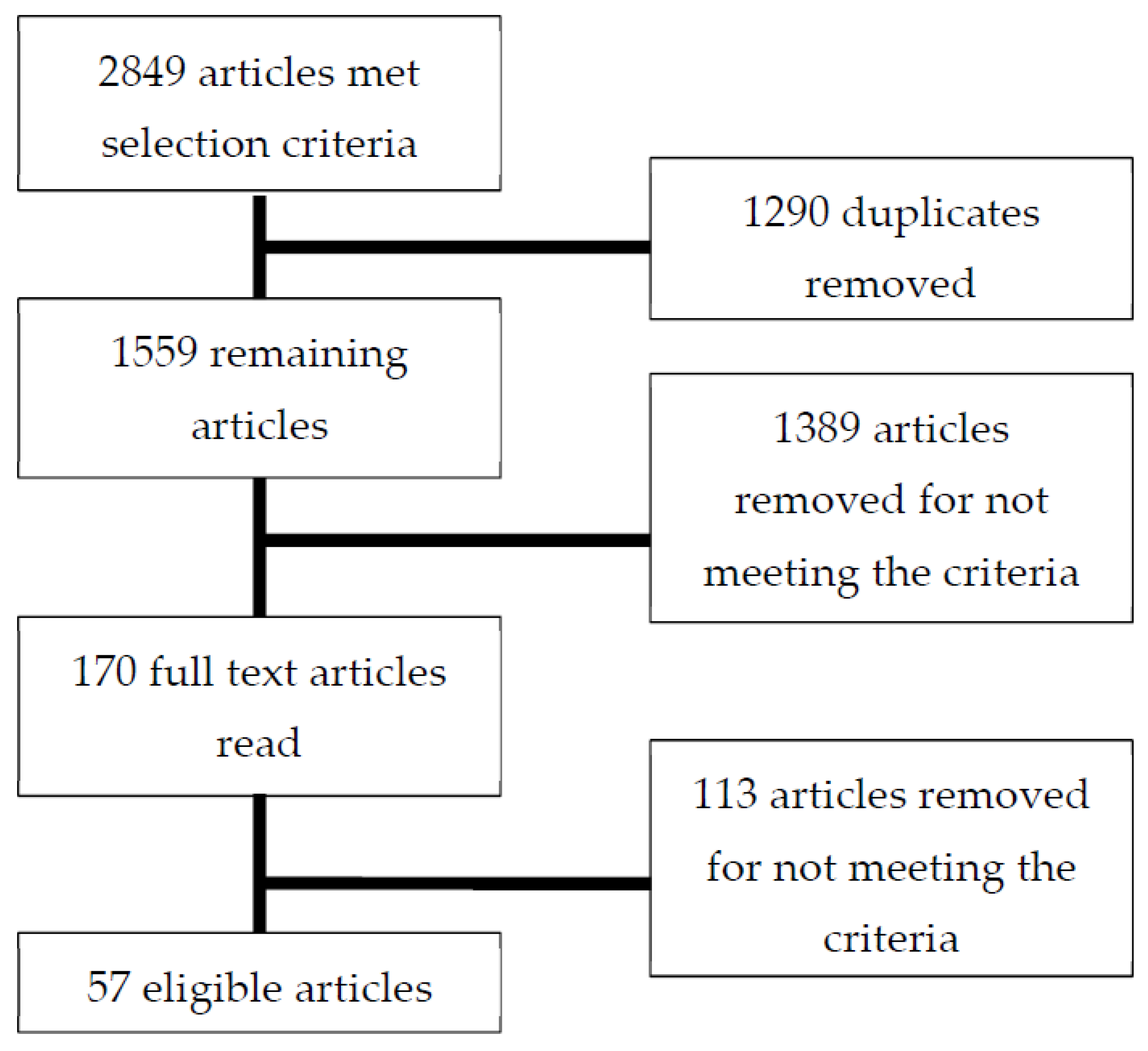
3. Results
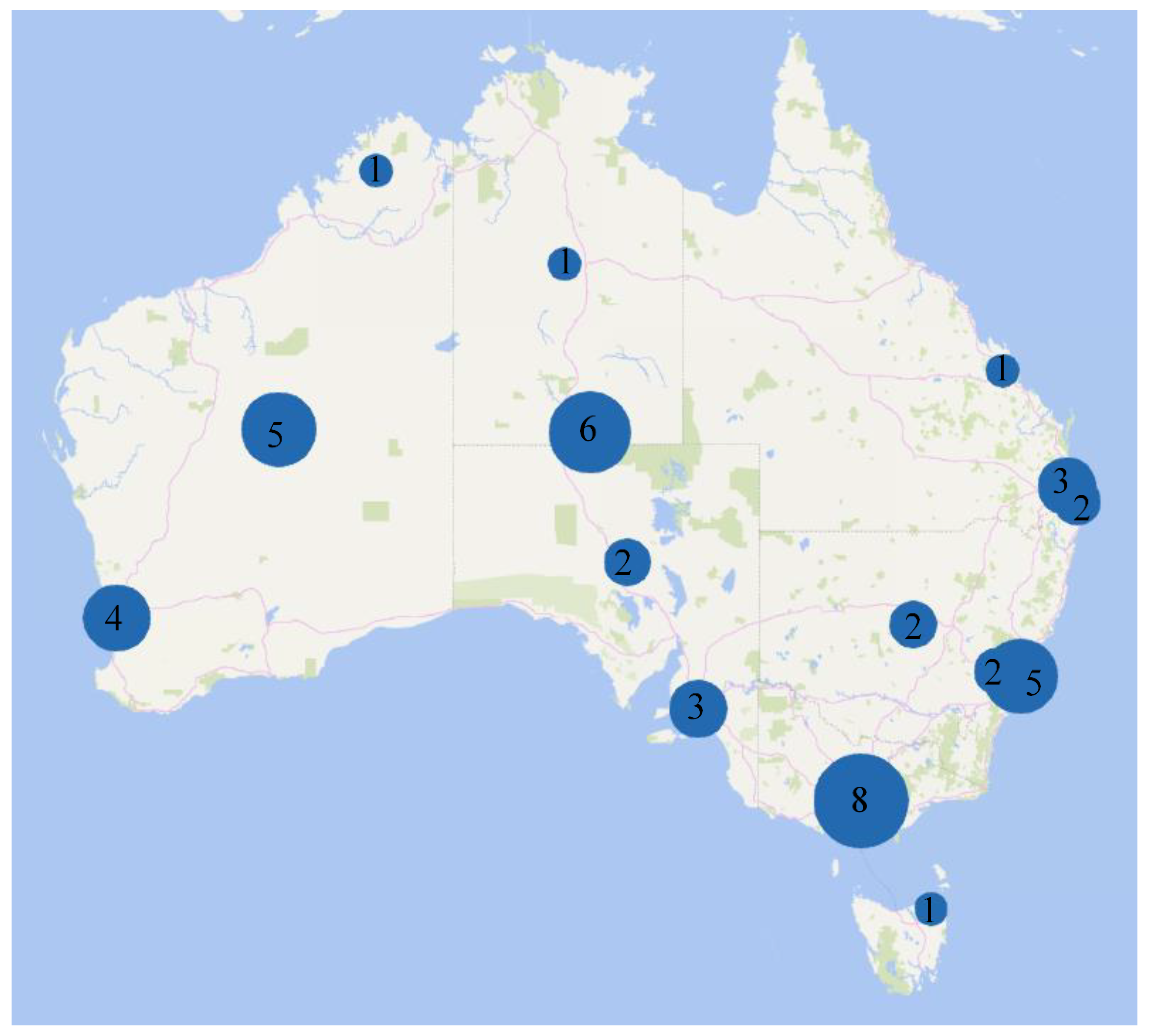
3.1. General Characteristics
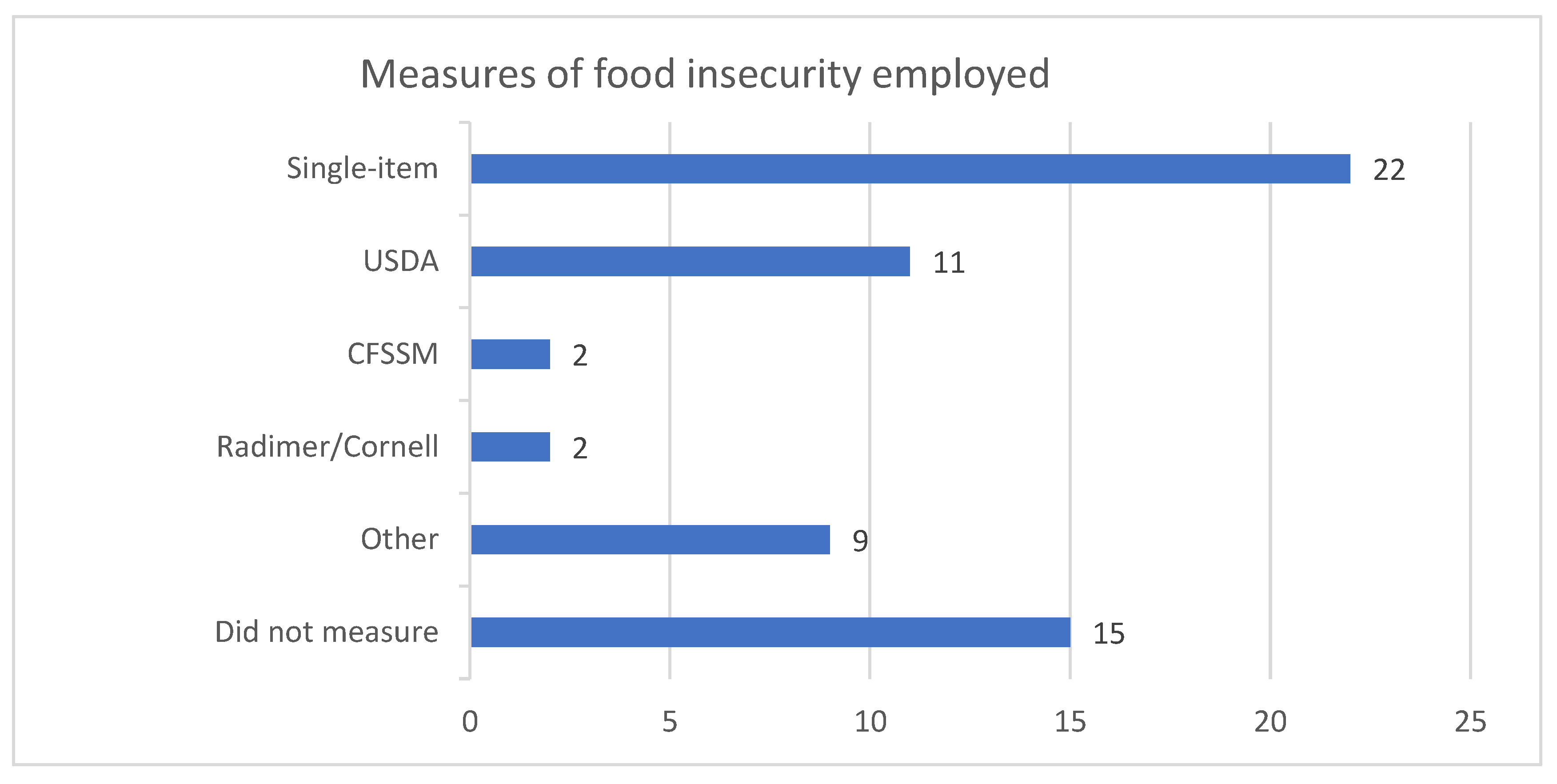
3.2. Food Insecurity Measurement
3.3. Investigation of Food Insecurity in Different Population Groups
3.4. Interventions to Mitigate Food Insecurity
4. Discussion
Limitations
5. Conclusions
Author Contributions
Funding
Conflicts of Interest
References
- Gallegos, D.; Ellies, P.; Wright, J. Still there’s no food! Food insecurity in a refugee population in Perth, Western Australia. Nutr. Dietet. 2008, 65, 78–83. [Google Scholar] [CrossRef]
- McKay, F.H.; Dunn, M. Food security among asylum seekers in Melbourne. Aust. N. Z. J. Public Health 2015, 39, 344–349. [Google Scholar] [CrossRef] [PubMed]
- FAO. Rome declaration on the world food security and world food summit plan of action. In Proceedings of the World Food Summit 1996, Rome, Italy, 13–17 November 1996. [Google Scholar]
- Gross, R.; Schoeneberger, H.; Pfeifer, H.; Preuss, H.-J. The four dimensions of food and nutrition security: Definitions and concepts. SCN News 2000, 20, 20–25. [Google Scholar]
- Kendall, A.; Olson, C.M.; Frongillo, E.A., Jr. Validation of the Radimer/Cornell measures of hunger and food insecurity. J. Nutr. 1995, 125, 2793–2801. [Google Scholar] [PubMed]
- Webb, P.; Coates, J.; Frongillo, E.A.; Rogers, B.L.; Swindale, A.; Bilinsky, P. Measuring household food insecurity: Why it’s so important and yet so difficult to do. J. Nutr. 2006, 136, 1404S–1408S. [Google Scholar] [CrossRef] [PubMed]
- Nolan, M.; Rikard-Bell, G.; Mohsin, M.; Williams, M. Food insecurity in three socially disadvantaged localities in Sydney, Australia. Health Promot. J. Aust. 2006, 17, 247–254. [Google Scholar] [CrossRef]
- McKenzie, H.; McKay, F.H. Food as a discretionary item: The impact of welfare payment changes on low-income single mother’s food choices and strategies. J. Poverty Soc. Justice 2017, 25, 35–48. [Google Scholar] [CrossRef]
- Seligman, H.K.; Laraia, B.A.; Kushel, M.B. Food insecurity is associated with chronic disease among low-income NHANES participants. J. Nutr. 2010, 140, 304–310. [Google Scholar] [CrossRef]
- Whitaker, R.C.; Phillips, S.M.; Orzol, S.M. Food insecurity and the risks of depression and anxiety in mothers and behavior problems in their preschool-aged children. Pediatrics 2006, 118, e859–e868. [Google Scholar] [CrossRef]
- Cook, J.T.; Frank, D.A.; Levenson, S.M.; Neault, N.B.; Heeren, T.C.; Black, M.M.; Berkowitz, C.; Casey, P.H.; Meyers, A.F.; Cutts, D.B. Child food insecurity increases risks posed by household food insecurity to young children’s health. J. Nutr. 2006, 136, 1073–1076. [Google Scholar] [CrossRef]
- Rose-Jacobs, R.; Black, M.M.; Casey, P.H.; Cook, J.T.; Cutts, D.B.; Chilton, M.; Heeren, T.; Levenson, S.M.; Meyers, A.F.; Frank, D.A. Household food insecurity: Associations with at-risk infant and toddler development. Pediatrics 2008, 121, 65–72. [Google Scholar] [CrossRef]
- Kirkpatrick, S.I.; Tarasuk, V. Food Insecurity Is Associated with Nutrient Inadequacies among Canadian Adults and Adolescents. J. Nutr. 2008, 138, 604–612. [Google Scholar] [CrossRef] [PubMed]
- Martin, M.A.; Lippert, A.M. Feeding her children, but risking her health: The intersection of gender, household food insecurity and obesity. Soc. Sci. Med. 2012, 74, 1754–1764. [Google Scholar] [CrossRef]
- Daponte, B.O.; Lewis, G.H.; Sanders, S.; Taylor, L. Food pantry use among low-income households in Allegheny County, Pennsylvania. J. Nutr. Educ. 1998, 30, 50–57. [Google Scholar] [CrossRef]
- Ramsey, R.; Giskes, K.; Turrell, G.; Gallegos, D. Food insecurity among adults residing in disadvantaged urban areas: Potential health and dietary consequences. Public Health Nutr. 2012, 15, 227–237. [Google Scholar] [CrossRef] [PubMed]
- Bazerghi, C.; McKay, F.H.; Dunn, M. The role of food banks in addressing food insecurity: A systematic review. J. Community Health 2016, 41, 732–740. [Google Scholar] [CrossRef] [PubMed]
- McKay, F.H.; McKenzie, H. Food Aid Provision in Metropolitan Melbourne: A Mixed Methods Study. J. Hunger Environ. Nutr. 2017, 12, 11–25. [Google Scholar] [CrossRef]
- Foodbank Australia. Foodbank Hunger Report; Foodbank Australia: Sydney, Australia, 2017. [Google Scholar]
- Ashby, S.; Kleve, S.; McKechnie, R.; Palermo, C. Measurement of the dimensions of food insecurity in developed countries: A systematic literature review. Public Health Nutr. 2016, 19, 2887–2896. [Google Scholar] [CrossRef] [PubMed]
- Hamilton, W.L.; Cook, J.T. Household food security in the United States in 1995: Technical Report of the Food Security Measurement Project; United States Department of Agriculture: Washington, DC, USA, 1997.
- Melgar-Quinonez, H.; Nord, M.; Perez-Escamilla, R.; Segall-Correa, A. Psychometric properties of a modified US-household food security survey module in Campinas, Brazil. Eur. J. Clin. Nutr. 2008, 62, 665–673. [Google Scholar] [CrossRef]
- Melgar-Quinonez, H.; Hackett, M. Measuring household food security: The global experience. Revista de Nutrição 2008, 21, 27s–37s. [Google Scholar] [CrossRef]
- Hackett, M.; Zubieta, A.C.; Hernandez, K.; Melgar-Quiñonez, H. Food insecurity and household food supplies in rural Ecuado. Archivos Latinoamericanos de Nutricion 2007, 57, 10. [Google Scholar] [PubMed]
- Frongillo, E.A.; Chowdhury, N.; Ekström, E.-C.; Naved, R.T. Understanding the experience of household food insecurity in rural Bangladesh leads to a measure different from that used in other countries. J. Nutr. 2003, 133, 4158–4162. [Google Scholar] [CrossRef] [PubMed]
- Frongillo, E.A.; Nanama, S. Development and validation of an experience-based measure of household food insecurity within and across seasons in northern Burkina Faso. J. Nutr. 2006, 136, 1409S–1419S. [Google Scholar] [CrossRef] [PubMed]
- Ballard, T.J.; Kepple, A.W.; Cafiero, C. The Food Insecurity Experience Scale: Development of a Global Standard for Monitoring Hunger Worldwide; FAO: Rome, Italy, 2013. [Google Scholar]
- Cafiero, C.; Nord, M.; Viviani, S. Methods for Estimating Comparable Prevalence Rates of Food Insecurity Experienced by Adults Throughout the World; VoH Technical Reprt No 1/2016; UN FAO: Rome, Italy, 2016. [Google Scholar]
- Frongillo, E.A.; Nguyen, H.T.; Smith, M.D.; Coleman-Jensen, A. Food Insecurity Is Associated with Subjective Well-Being among Individuals from 138 Countries in the 2014 Gallup World Poll. J. Nutr. 2017, 147, 680–687. [Google Scholar] [CrossRef] [PubMed]
- Jones, A.D. Food insecurity and mental health status: A global analysis of 149 countries. Am. J. Prev. Med. 2017, 53, 264–273. [Google Scholar] [CrossRef] [PubMed]
- Smith, M.D.; Rabbitt, M.P.; Coleman-Jensen, A. Who are the world’s food insecure? New evidence from the Food and Agriculture Organization’s food insecurity experience scale. World Dev. 2017, 93, 402–412. [Google Scholar] [CrossRef]
- ABS. National Health Survey 2014–2015. Available online: http://www.abs.gov.au/AUSSTATS/abs@.nsf/DetailsPage/4364.0.55.0092011-12?OpenDocument (accessed on 26 January 2019).
- Kleve, S.; Gallegos, D.; Ashby, S.; Palermo, C.; McKechnie, R. Preliminary validation and piloting of a comprehensive measure of household food security in Australia. Public Health Nutr. 2018, 21, 526–534. [Google Scholar] [CrossRef]
- McKechnie, R.; Turrell, G.; Giskes, K.; Gallegos, D. Single-item measure of food insecurity used in the National Health Survey may underestimate prevalence in Australia. Aust. N. Z. J. Public Health 2018, 42, 389–395. [Google Scholar] [CrossRef]
- Radimer, K.L.; Radimer, K.L. Measurement of household food security in the USA and other industrialised countries. Public Health Nutr. 2002, 5, 859–864. [Google Scholar] [CrossRef]
- Radimer, K.L.; Olson, C.M.; Greene, J.C.; Campbell, C.C.; Habicht, J.-P. Understanding hunger and developing indicators to assess it in women and children. J. Nutr. Educ. 1992, 24, 36S–44S. [Google Scholar] [CrossRef]
- Weaver, L.J.; Hadley, C. Moving beyond hunger and nutrition: A systematic review of the evidence linking food insecurity and mental health in developing countries. Ecol. Food Nutr. 2009, 48, 263–284. [Google Scholar] [CrossRef] [PubMed]
- Bruening, M.; Argo, K.; Payne-Sturges, D.; Laska, M.N. The struggle is real: A systematic review of food insecurity on postsecondary education campuses. J. Acad. Nutr. Dietet. 2017, 117, 1767–1791. [Google Scholar] [CrossRef] [PubMed]
- Marques, E.S.; Reichenheim, M.E.; de Moraes, C.L.; Antunes, M.M.; Salles-Costa, R. Household food insecurity: A systematic review of the measuring instruments used in epidemiological studies. Public Health Nutr. 2015, 18, 877–892. [Google Scholar] [CrossRef] [PubMed]
- Lindberg, R.; Lawrence, M.; Caraher, M. Kitchens and Pantries—Helping or Hindering? The Perspectives of Emergency Food Users in Victoria, Australia. J. Hunger Environ. Nutr. 2017, 12, 26. [Google Scholar] [CrossRef]
- Butcher, L.M.; Chester, M.R.; Aberle, L.M.; Bobongie, V.J.A.; Davies, C.; Godrich, S.L.; Milligan, R.A.K.; Tartaglia, J.; Thorne, L.M.; Begley, A. Foodbank of Western Australia’s healthy food for all. Br. Food J. 2014, 116, 1490–1505. [Google Scholar] [CrossRef]
- Furber, S.; Quine, S.; Jackson, J.; Laws, R.; Kirkwood, D. The role of a community kitchen for clients in a socio-economically disadvantaged neighbourhood. Health Promot. J. Aust. 2010, 21, 143–145. [Google Scholar] [CrossRef]
- Iacovou, M.; Pattieson, D.C.; Truby, H.; Palermo, C. Social health and nutrition impacts of community kitchens: A systematic review. Public Health Nutr. 2013, 16, 535–543. [Google Scholar] [CrossRef]
- McKay, F.H.; Lippi, K.; Dunn, M. Investigating Responses to Food Insecurity Among HIV Positive People in Resource Rich Settings: A Systematic Review. J. Community Health 2017, 42, 1062–1068. [Google Scholar] [CrossRef] [PubMed]
- Lindberg, R.; Whelan, J.; Lawrence, M.; Gold, L.; Friel, S. Still serving hot soup? Two hundred years of a charitable food sector in Australia: A narrative review. Aust. N. Z. J. Public Health 2015, 39, 358–365. [Google Scholar] [CrossRef] [PubMed]
- SecondBite. SecondBite 2015–16 Annual Report; SecondBite: Kensington, VIC, Australia, 2016. [Google Scholar]
- Bassett, H.; Lloyd, C.; King, R. Food Cent$: Educating Mothers with a Mental Illness about Nutrition. Br. J. Occup. Ther. 2003, 66. [Google Scholar] [CrossRef]
- Kleve, S.; Davidson, Z.; Gearon, E.; Booth, S.; Palermo, C. Are low-to-middle-income households experiencing food insecurity in Victoria, Australia? An examination of the Victorian Population Health Survey, 2006–2009. Aust. J. Prim. Health 2017, 23, 249–256. [Google Scholar] [CrossRef] [PubMed]
- Booth, S. Eating rough: Food sources and acquisition practices of homeless young people in Adelaide, South Australia. Public Health Nutr. 2006, 9, 212–218. [Google Scholar] [CrossRef]
- Foley, W.; Ward, P.R.; Carter, P.; Coveney, J.; Tsourtos, G.; Taylor, A. An ecological analysis of factors associated with food insecurity in South Australia, 2002–7. Public Health Nutr. 2010, 13, 215–221. [Google Scholar] [CrossRef] [PubMed]
- Friel, S.; Berry, H.; Dinh, H.; O’Brien, L.; Walls, H.L. The impact of drought on the association between food security and mental health in a nationally representative Australian sample. BMC Public Health 2014, 14, 1102. [Google Scholar] [CrossRef] [PubMed]
- Quine, S.; Morrell, S. Food insecurity in community-dwelling older Australians. Public Health Nutr. 2006, 9, 219–224. [Google Scholar] [CrossRef] [PubMed]
- Ramsey, R.; Giskes, K.; Turrell, G.; Gallegos, D. Food insecurity among Australian children: Potential determinants, health and developmental consequences. J. Child Health Care 2011, 15, 401–416. [Google Scholar] [CrossRef] [PubMed]
- Allen, M.W.; Wilson, M. Materialism and food security. Appetite 2005, 45, 314–323. [Google Scholar] [CrossRef]
- Barbour, L.; Ho, M.Y.L.; Davidson, Z.E.; Palermo, C. Challenges and opportunities for measuring the impact of a nutrition programme amongst young people at risk of food insecurity: A pilot study. Nutr. Bull. 2016, 41, 122–129. [Google Scholar] [CrossRef]
- Burns, C.; Bentley, R.; Thornton, L.; Kavanagh, A. Associations between the purchase of healthy and fast foods and restrictions to food access: A cross-sectional study in Melbourne, Australia. Public Health Nutr. 2015, 18, 143–150. [Google Scholar] [CrossRef]
- Crawford, B.; Yamazaki, R.; Franke, E.; Amanatidis, S.; Ravulo, J.; Steinbeck, K.; Ritchie, J.; Torvaldsen, S. Sustaining dignity? Food insecurity in homeless young people in urban Australia. Health Promot. J. Aust. 2014, 25, 71–78. [Google Scholar] [CrossRef]
- Ferguson, M.; Brown, C.; Georga, C.; Miles, E.; Wilson, A.; Brimblecombe, J. Traditional food availability and consumption in remote Aboriginal communities in the Northern Territory, Australia. Aust. N. Z. J. Public Health 2017, 41, 294–298. [Google Scholar] [CrossRef] [PubMed]
- Gallegos, D.; Ramsey, R.; Ong, K.W. Food insecurity: Is it an issue among tertiary students? Higher Educ. 2014, 67, 497–510. [Google Scholar] [CrossRef]
- Gichunge, C.; Harris, N.; Tubei, S.; Somerset, S.; Lee, P. Relationship between food insecurity, social support, and vegetable intake among resettled African refugees in Queensland, Australia. J. Hunger Environ. Nutr. 2015, 10, 379–389. [Google Scholar] [CrossRef]
- Hughes, R.; Serebryanikova, I.; Donaldson, K.; Leveritt, M. Student food insecurity: The skeleton in the university closet. Nutr. Dietet. 2011, 68, 27–32. [Google Scholar] [CrossRef]
- Li Ming, W.; Flood, V.M.; Simpson, J.M.; Rissel, C.; Baur, L.A. Dietary behaviours during pregnancy: Findings from first-time mothers in southwest Sydney, Australia. Int. J. Behav. Nutr. Phys. Act. 2010, 7, 1–7. [Google Scholar] [CrossRef]
- Markwick, A.; Ansari, Z.; Sullivan, M.; McNeil, J. Social determinants and lifestyle risk factors only partially explain the higher prevalence of food insecurity among Aboriginal and Torres Strait Islanders in the Australian state of Victoria: A cross-sectional study. BMC Public Health 2014, 14. [Google Scholar] [CrossRef] [PubMed]
- Markwick, A.; Ansari, Z.; Sullivan, M.; Parsons, L.; McNeil, J. Inequalities in the social determinants of health of Aboriginal and Torres Strait Islander people: A cross-sectional population-based study in the Australian state of Victoria. Int. J. Equity Health 2014, 13. [Google Scholar] [CrossRef]
- Micevski, D.; Thornton, L.; Brockington, S. Food insecurity among university students in Victoria: A pilot study. Nutr. Dietet. 2014, 71, 258–264. [Google Scholar] [CrossRef]
- Mucheru, D.; Hanlon, M.C.; Campbell, L.E.; McEvoy, M.; MacDonald-Wicks, L. Social dysfunction and diet outcomes in people with psychosis. Nutrients 2017, 9, 80. [Google Scholar] [CrossRef]
- Pollard, C.M.; Nyaradi, A.; Lester, M.; Sauer, K. Understanding food security issues in remote Western Australian Indigenous communities. Health Promot. J. Aust. 2014, 25, 83–89. [Google Scholar] [CrossRef]
- Russell, J.; Flood, V.; Yeatman, H.; Mitchell, P. Prevalence and risk factors of food insecurity among a cohort of older Australians. J. Nutr. Health Aging 2014, 18, 3–8. [Google Scholar] [CrossRef] [PubMed]
- Russell, J.; Flood, V.; Yeatman, H.; Wang, J.J.; Mitchell, P. Food insecurity and poor diet quality are associated with reduced quality of life in older adults. Nutr. Dietet. 2016, 73, 50–58. [Google Scholar] [CrossRef]
- Temple, J.B. Food insecurity among older Australians: Prevalence, correlates and well-being. Australas. J. Ageing 2006, 25, 158–163. [Google Scholar] [CrossRef]
- Temple, J.B. Severe and moderate forms of food insecurity in Australia: Are they distinguishable? Aust. J. Soc. Issues (Aust. Counc. Soc. Serv.) 2008, 43, 649–668. [Google Scholar] [CrossRef]
- Burns, C.; Bentley, R.; Thornton, L.; Kavanagh, A. Reduced food access due to a lack of money, inability to lift and lack of access to a car for food shopping: A multilevel study in Melbourne, Victoria. Public Health Nutr. 2010, 14, 1017–1023. [Google Scholar] [CrossRef]
- Cunningham, J.; Paradies, Y.C. Socio-demographic factors and psychological distress in Indigenous and non-Indigenous Australian adults aged 18-64 years: Analysis of national survey data. BMC Public Health 2012, 12, 95. [Google Scholar] [CrossRef] [PubMed]
- Edmond, K.M.; McAuley, K.; McAullay, D.; Matthews, V.; Strobel, N.; Marriott, R.; Bailie, R. Quality of social and emotional wellbeing services for families of young Indigenous children attending primary care centers; a cross sectional analysis. BMC Health Serv. Res. 2018, 18, 100. [Google Scholar] [CrossRef] [PubMed]
- Evers, A.; Hodgson, N.L. Food choices and local food access among Perth’s community gardeners. Local Environ. 2011, 16, 585–602. [Google Scholar] [CrossRef]
- Godrich, S.; Lo, J.; Davies, C.; Darby, J.; Devine, A. Prevalence and socio-demographic predictors of food insecurity among regional and remote Western Australian children. Aust. N. Z. J. Public Health 2017, 41, 585–590. [Google Scholar] [CrossRef]
- Lê, Q.; Auckland, S.; Nguyen, H.B.; Murray, S.; Long, G.; Terry, D.R. The socio-economic and physical contributors to food insecurity in a rural community. SAGE Open 2015, 5. [Google Scholar] [CrossRef]
- McManus, A.; Brown, G.; Maycock, B. Western Australian food security project. BMC Public Health 2007, 7. [Google Scholar] [CrossRef] [PubMed]
- Radermacher, H.; Feldman, S.; Bird, S. Food Security in Older Australians from Different Cultural Backgrounds. J. Nutr. Educ. Behav. 2010, 42, 328–336. [Google Scholar] [CrossRef] [PubMed]
- Thornton, L.E.; Pearce, J.R.; Ball, K. Sociodemographic factors associated with healthy eating and food security in socio-economically disadvantaged groups in the UK and Victoria, Australia. Public Health Nutr. 2014, 17, 20–30. [Google Scholar] [CrossRef] [PubMed]
- Godrich, S.L.; Lo, J.; Davies, C.R.; Darby, J.; Devine, A. Which food security determinants predict adequate vegetable consumption among rural Western Australian children? Int. J. Environ. Res. Public Health 2017, 14, 40. [Google Scholar] [CrossRef] [PubMed]
- Murray, M.; Bonnell, E.; Thorpe, S.; Browne, J.; Barbour, L.; MacDonald, C.; Palermo, C. Sharing the tracks to good tucker: Identifying the benefits and challenges of implementing community food programs for Aboriginal communities in Victoria. Aust. J. Prim. Health 2014, 20, 373–378. [Google Scholar] [CrossRef]
- Wicks, R.; Trevena, L.J.; Quine, S. Experiences of food insecurity among urban soup kitchen consumers: Insights for improving nutrition and well-being. J. Am. Dietet. Assoc. 2006, 106, 921–924. [Google Scholar] [CrossRef]
- Slade, C.; Baldwin, C. Critiquing Food Security Inter-governmental Partnership Approaches in Victoria, Australia. Aust. J. Public Adm. 2017, 76, 204–220. [Google Scholar] [CrossRef]
- Spurway, K.; Soldatic, K. “Life just keeps throwing lemons”: The lived experience of food insecurity among Aboriginal people with disabilities in the West Kimberley. Local Environ. 2016, 21, 1118–1131. [Google Scholar] [CrossRef]
- Booth, S.; Coveney, J. Survival on the Streets: Prosocial and Moral Behaviors Among Food Insecure Homeless Youth in Adelaide, South Australia. J. Hunger Environ. Nutr. 2007, 2, 41–53. [Google Scholar] [CrossRef]
- Allen, L.; O’Connor, J.; Amezdroz, E.; Bucello, P.; Mitchell, H.; Thomas, A.; Kleve, S.; Bernardi, A.; Wallis, L.; Palermo, C. Impact of the Social Café meals program: A qualitative investigation. Aust. J. Prim. Health 2014, 20, 79–84. [Google Scholar] [CrossRef]
- Smith, K.; Lawrence, G. Flooding and food security: A case study of community resilience in Rockhampton. Rural Soc. 2014, 23, 216–228. [Google Scholar] [CrossRef]
- Law, I.R.; Ward, P.R.; Coveney, J. Food insecurity in South Australian single parents: An assessment of the livelihoods framework approach. Crit. Public Health 2011, 21, 455–469. [Google Scholar] [CrossRef]
- Meiklejohn, S.J.; Barbour, L.; Palermo, C.E. An impact evaluation of the FoodMate programme: Perspectives of homeless young people and staff. Health Educ. J. 2017, 76, 829–841. [Google Scholar] [CrossRef]
- Godrich, S.L.; Davies, C.R.; Darby, J.; Devine, A. What are the determinants of food security among regional and remote Western Australian children? Aust. N. Z. J. Public Health 2017, 41, 172–177. [Google Scholar] [CrossRef] [PubMed]
- Crawford, B.; Yamazaki, R.; Franke, E.; Amanatidis, S.; Ravulo, J.; Torvaldsen, S. Is something better than nothing? Food insecurity and eating patterns of young people experiencing homelessness. Aust. N. Z. J. Public Health 2015, 39, 350–354. [Google Scholar] [CrossRef] [PubMed]
- Gunson, J.S.; Warin, M.; Moore, V. Visceral politics: Obesity and children’s embodied experiences of food and hunger. Crit. Public Health 2017, 27, 407–418. [Google Scholar] [CrossRef]
- Cuesta-Briand, B.; Saggers, S.; McManus, A. ‘You get the quickest and the cheapest stuff you can’: Food security issues among low-income earners living with diabetes. Australas. Med. J. 2011, 4, 683–691. [Google Scholar] [CrossRef]
- Adams, K.; Burns, C.; Liebzeit, A.; Ryschka, J.; Thorpe, S.; Browne, J. Use of participatory research and photo-voice to support urban Aboriginal healthy eating. Health Soc. Care Community 2012, 20, 497–505. [Google Scholar] [CrossRef]
- Myers, J.; Gibbons, K.; Arnup, S.; Volders, E.; Naughton, G. Early childhood nutrition, active outdoor play and sources of information for families living in highly socially disadvantaged locations. J. Paediatr. Child Health 2015, 51, 287–293. [Google Scholar] [CrossRef]
- Bickel, G.; Nord, M.; Price, C.; Hamilton, W.; Cook, J. Guide to Measuring Household Food Security; Department of Agriculture Food and Nutrition Service: Alexandria, Egypt, 2000.
- Jones, A.D.; Ngure, F.M.; Pelto, G.; Young, S.L. What are we assessing when we measure food security? A compendium and review of current metrics. Adv. Nutr. Int. Rev. J. 2013, 4, 481–505. [Google Scholar] [CrossRef]
- Coveney, J.; O’dwyer, L.A. Effects of mobility and location on food access. Health Place 2009, 15, 45–55. [Google Scholar] [CrossRef] [PubMed]
- Scelza, B.A. Food scarcity, not economic constraint limits consumption in a rural Aboriginal community. Aust. J. Rural Health 2012, 20, 108–112. [Google Scholar] [CrossRef] [PubMed]
- Pollard, C.M.; Landrigan, T.; Ellies, P.; Kerr, D.A.; Lester, M.; Goodchild, S. Geographic factors as determinants of food security: A Western Australian food pricing and quality study. Asia Pac. J. Clin. Nutr. 2014, 23, 703–713. [Google Scholar] [PubMed]


| Ref. | Location | Population Group | Study Aim | Findings | Testing an Intervention? | Primary Method | Measured Food Security | Method for Determining Food Insecurity | Prevalence of Food Insecurity | Participants |
|---|---|---|---|---|---|---|---|---|---|---|
| [95] | Geelong, Victoria | Aboriginal (urban) | To work with an urban aboriginal community to understand meaning of food and food insecurity. | Participants were concerned about hungry children and were filling up to satiate hunger with high energy foods. Vegetable content was low, and some people found cooking a socially isolating and boring experience. Food was associated with family harmony (keeping children happy through food). Family recipes were viewed with pride. | No | Photo voice | No | N/A | N/A | 10; mostly female aged 20–30 |
| [54] | Australia | General public and university students | To examine if materialists have an elevated concern about food availability. | Those who can be described as materialists are not experiencing food insecurity. Materialists have food stored at home and tend to be obese. | No | Survey | Yes | Modified USDA—4 items, 12-month reference, single item | 24% “food bought didn’t last, no money for more”, 16% “couldn’t afford balanced meals”, 17% “cut or skipped meals”, 12% “ate less than felt I should” | 334; general public (210) and university students (124). |
| [87] | Melbourne, Victoria | Socially isolated and food insecure | To explore the ability of a café meals program to address social exclusion and food insecurity. | An evaluation of a social meals program found that participants had improved access to food, with the setting of the café identified as important in promoting community cohesion. | Yes (Social Café Meals Program) | Interviews | No | N/A | N/A | 18; Café owners/workers and program members. |
| [55] | Melbourne, Victoria | Young people at risk | To access the impact of the FoodMate program by SecondBite in at risk young people on their dietary intake and quality, cooking confidence and food independence. | Difficult to get people at risk to be involved in a long-term program. Some positives around improved nutrition. Confidence in basic meal preparation returned to baseline at 4–6-week follow-up, some improvements to confidence in the ability to “buy, store, prepare and enjoy nutritious food at all times from non-emergency sources” over the course of the intervention (high attrition may negate useful findings). | Yes (FoodMate) | Survey | No | N/A | N/A | 9; Young people, median age 20 (half homeless, half experiencing food insecurity at program start). |
| [46] | Western Australia | Mothers with poor mental health | To investigate if the Food$ents program influenced behaviours and attitudes toward food and food selection and perpetration. | Food$ents might be a good way to increase knowledge about nutrition. | Yes (Food$ents) | Focus groups and supermarket receipts (pre and post program) | No | N/A | N/A | 6; female who had experienced poor mental health and had children under 5. |
| [96] | Adelaide, South Australia | Young people experiencing homelessness | To determine the food sources and acquisition practices used by homeless youth in Adelaide. | Homeless young people use a range of sources to procure food including theft, visiting welfare agencies, begging, and deliberate incarceration. | No | Survey and interviews | No | N/A | N/A | 150; 15–24 years, 54% male. |
| [86] | Adelaide, South Australia | Young people experiencing homelessness | To report on street life and the extent to which homeless youth justify their behaviours. | Homeless young people exhibit prosocial behaviours of sharing food with other people, begging together, and protecting each other. Moral stance influenced how young people sourced food. | No | Interviews | No | N/A | N/A | 15; 15–23 years, 9 female and 6 male. |
| [72] | Melbourne, Victoria | Main food shopper in each house | To describe the associations between demographic and individual and area level Socioeconomic variables and household access to food due to a lack of money, ability to lift and transport foods. | Difficulty lifting groceries is a factor in food insecurity for low-income people and those with no access to a car. The elderly and those born overseas were more likely to report difficulty lifting groceries. Single individuals with or without children were more likely to report having no money for food. Those experiencing disadvantage were 12 times more likely to report having no money for food. | No | Survey | Yes | Single Item | 8.10% | 2564; stratified population to include a gradient of socio-economic status. |
| [56] | Melbourne, Victoria | General public | To examine the associations between financial, physical and transport conditions that may restrict food access and the purchase of foods. | No evidence found between financial food insecurity and the purchase of fruit and veg, or nutritionally recommended foods. No evidence that difficulty lifting is associated with purchasing healthy foods. | No | Survey | Yes | Single item | 8.1% | 2564 |
| [92] | Sydney, New South Wales | Young people experiencing homelessness | To investigate issues associated with food insecurity and nutrition in young people experiencing or at risk of homelessness. | Young people living independently had higher food insecurity than young people living in supported accommodation services. Participants reported skipping meals and low consumption of fruit and vegetables. | No | Survey | Yes | 9-item USDA: 30-day reference, CFSSM, and single item measure: 12-month reference. | 70% (USDA), 58% (single item), CFSSM not reported | 50; 14–26 years, 29 female |
| [57] | Sydney, New South Wales | Young people experiencing homelessness | To examine the extent of food insecurity and the eating patterns of young people accessing support from a homeless service. | Participants described daily experiences of food shortages and hunger and associated anxiety. More severe food insecurity is said to be experienced by the more disadvantaged participants; however, food insecurity not measured. | No | Focus groups | No | N/A | N/A | 48; 15–24 years, 29 female, 18 male, 1 transgender |
| [94] | Perth, Western Australia | Low income, diabetes patients, half Aboriginal | To explore food security issues faced by low-income earners living with type 2 diabetes to explore the effect of socio-economic disadvantage. | Participants were aware of what consisted of a “healthy diet” was but were not always able to attain it. Indigenous participants compared to non-Indigenous participants were more likely to rely on others for supply of foods. The perceived high cost of diabetes-appropriate foods was problematic for participants. Social networks helped low-income participants to access food. | No | Interviews and focus groups and | Proxy | Access to food | Not reported | 38; mostly female, aged over 65. |
| [73] | Australia | Aboriginal | To examine the prevalence and patterning of psychological distress among Aboriginal Australians adults and compare these with corresponding non- Aboriginal data. | Running out of food was associated with very high psychological stress. | No | Survey | Yes | Single item | 24.6% | 5417; 18–64 years |
| [74] | Australia (all states except Victoria and Tasmania) | Aboriginal | To assess delivery of social and emotional wellbeing services to the families of Aboriginal children. | Audits of data collected during visits to primary health care centres suggests child food insecurity is an issue for Indigenous communities (11%), however rates of follow-up for these children is low (30%). | No | Client audit | Proxy | Advice about food security | 10.60% | 2466 children aged between 3 and 59 months. Mostly from remote areas |
| [75] | Perth, Western Australia | Community gardeners and coordinators | To report on the attitudes of community gardeners toward local food, and how these attitudes fit into the context of Alternative Food Networks as a response to food security. | Community gardens can be used to produce food to address food insecurity at the same time they can be useful in education about the food system. | No | Interviews | No | N/A | N/A | 35 |
| [58] | Northern Territory | Aboriginal (very remote) | To explore the availability, variety, and frequency of consumption of traditional foods and their role in alleviating food insecurity in remote Aboriginal Australia. | Traditional foods are an important component of the diet of Aboriginal people. | No—conducting research in an intervention context, SHOP@RIC, did not report on intervention. | Survey | Yes | Single item | 76% | 73 Aboriginal primary household shoppers, 97% female |
| [50] | South Australia | General public | To estimate the extent of food insecurity in South Australia and its relationship with a variety of socio-economic variables. | Those with lower education, the unemployed (only significant in bivariate analysis, not multi) lower incomes, people in households that were unable to save, Aboriginal households, and households with three or more children were more likely to be food insecure. | No | Survey | Yes | Single item | 7% | 19,037 |
| [51] | Australia | General public | To investigate the associations between food insecurity and drought and mental health. | Psychological stress is associated with food insecurity. No relationship between drought exposure and food insecurity. | No | Survey | Yes | Single item | 1.6% | 5012 |
| [1] | Perth, Western Australia | Refugees | To identify food insecurity and examine its association with socio-demographic factors in a group of newly arrived refugees. | Refugees experience food insecurity for a variety of reasons related to income. Many described feelings of shame in accessing food aid. | No | Survey | Yes | Single item | 71% | 51 refugees in Australia for less than 12 months, over 18 years |
| [59] | Brisbane, Queensland | University students | To investigate the food insecurity status of university students. | Food insecurity more common in those living out of home and on low income. Food insecure less likely to have adequate diets, more likely to report fair/poor health, more likely to report deferral of studies. | No | Survey | Yes | 18-item USDA, 12-month reference | 25.5% | 810; mostly young females |
| [60] | South East Queensland | Refugees | To assess the interaction of food insecurity, social support, and vegetable intake among refugees. | Higher than population level food insecurity, but lower than other studies of refugees. Those with low education and no social support more likely to experience food insecurity. No difference in vegetable intake between food secure and insecure. | No | Survey | Yes | 18-item USDA, 6-month reference | 18% | 383 participants from 71 households. Many children (67%), mostly female (88.7%) |
| [91] | Western Australia | Key informants | To determine whether there is a relationship between food security determinants and adequate vegetable consumption among children in regional and remote Western Australia. | Food insecurity is influenced by inequalities in availability, price, promotion and quality of healthy food. | No | Interviews | Proxy | Food situation | Not reported | 20 mostly female from regional areas |
| [76] | Western Australia | School children and their care givers | To ascertain the prevalence of food insecurity among regional and remote Western Australian children and to determine which socio-demographic factors predicted food insecurity. | Receipt of government benefit and relative disadvantage are predictors of child food insecurity. | No—conducting research in an intervention context, but did not report on intervention. | Survey | Yes | CFSSM | 20.1% | 438 mostly female children and female care givers. |
| [81] | Western Australia | Care givers | To explore how determinants of food security affect children in regional and remote Western Australia across food availability, access and utilization. | Determinants that predicted vegetable consumption included food availability, promotion and access to foods. | No | Survey | Proxy | Food security determinants | Not reported | 187 mostly female, with a medium age of 41 years. |
| [93] | Adelaide, South Australia | Children, low SES | To explore how children negotiate food practices in community environments that were the target of a public health obesity and healthy lifestyle initiative. | Food insecurity suggested present. Hunger and obesity were stigmatized. | No—conducting research in an intervention context but did not report on intervention. | Observation and focus group | No | N/A | N/A | Unspecified; Children 10–14 years, involved with charitable food relief organizations |
| [61] | Gold Coast, Queensland | University students | To identify and describe prevalence, distribution and severity of food insecurity, and related behavioural adaptions, among a sample of Australian university students. | Food insecurity significantly associated with renting, boarding, or sharing accommodation. Students on low incomes and government assistance more likely to be food insecure. Those who reported food insecurity more likely to report overall lower health status. | No | Survey | Yes | 8-item USDA (current year at university) and single item | 46% (USDA),12.7% (singe item) | 399; representative of student body |
| [32] | Victoria | General population | To investigate the prevalence and frequency of food insecurity in low- to middle-income households over time and identify factors associated with food insecurity. | Low- and middle-income households more likely to experience food insecurity. Inability to get help from friends, and dependent children were strongly correlated with FI. | No | Survey | Yes | Single item | 4.9–5.5% | 57,056 |
| [34] | Victoria | General public | To investigate the psychometric properties, validity and reliability of a newly developed measure of food insecurity. | The HFNSS reported higher food insecurity than the USDA | No | Survey | Yes | 18-item USDA and HFNSS | 29% USDA; 57% HFNSS | 134 mostly female, aged 26–45 |
| [89] | South Australia | Low-income single parents | To apply a livelihoods framework approach as an analytical lens and organizational structure to explore strategies single parents use to maintain food security. | Food acquisition is constrained by finances. | No | Interviews | No | N/A | N/A | 8 low-income single parents |
| [77] | Dorset, Tasmania | General public | To investigate the impact of socio-economic factors on food security and the coping strategies used when food shortages occur. | Food choice was influenced by availability, supply, and access (particularly cost of transport to shops). Most participants felt nothing could be done to improve their physical and financial access to healthy foods. | No | Survey and focus groups | Yes | Single item + how often have you run out of nutritious food? | 5% (single item), ran out of nutritious food 10.5% weekly or fortnightly, 15.8% during the previous 12 months | 364 (survey) 45 (focus group participants); mostly female, more than half over 55 |
| [62] | Sydney, New South Wales | First-time mothers | To assess dietary behaviours during pregnancy among first time mothers, and to investigate the relationship between these behaviours and demographic characteristics. | Low levels of fruit and vegetable consumption and low levels of food insecurity. Mothers in households with lower incomes were more likely to consume fewer vegetables. High levels of fast food and soft drink intake were reported. | No—conducting research in an intervention context but did not report on intervention. | Survey | Yes | Single item | 5% | 409 first time mothers at 26–36 weeks. Average age 26 years |
| [41] | Melbourne, Victoria | Previous or current users of food charities | To understand food aid users’ experience of food insecurity and gain evidence for effective responses. | Alternatives to “cap in hand” food aid and more respectful services needed. Users of services need to be included in any solutions. | No | Interviews | Proxy | Going without, budgeting, use of food charities | N/A | 12 users of emergency food aid |
| [63] | Victoria | Aboriginal | To explain the relationship between food insecurity and Aboriginal and Torres Strait Islanders. | Aboriginal and Torres Strait Islanders more likely to experience food insecurity. Food insecurity in this study can be explained by age, household income, smoking, obesity and ability to get help from friends. | No | Survey | Yes | Single item | 20.3% | 339; 51.4% male, over 18 years |
| [64] | Victoria | Aboriginal | To identify determinants of health for Aboriginal adults compared to non-Aboriginal adults. | Authors state that food insecurity is a psychosocial risk factor, Aboriginal and Torres Strait Islanders experience food insecurity at a higher rate. | No | Survey | Yes | Single item | 20.3% | 339 |
| [2] | Melbourne, Victoria | Asylum seekers | To explore the food insecurity status of asylum seekers. | High rates of food insecurity in asylum seekers, related to lack of income and lack of cooking facilities. | No | Survey | Yes | 7-item USDA—30-day reference | 91% | 56 food bank users |
| [78] | Perth, Western Australia | Food outlet owners | To investigate issues relating to food insecurity. | Food outlets did not provide a range of healthy food choices. | No | Survey | No | N/A | N/A | 99 |
| [90] | Melbourne, Victoria | Young people experiencing homelessness | To investigate the impact of Secondbites’s FoodMate program for young people experiencing homelessness. | The program may have positive impacts of dietary behaviours both immediately after the program and at the 2-year mark. Homeless young people may misunderstand what is meant by food security (classifying themselves as food secure, when still accessing food relief). | Yes (FoodMate) | Interviews and focus groups | No | N/A | N/A | 11 |
| [65] | Melbourne, Victoria | University students | To assess the prevalence of food insecurity in university students. | More likely to be food insecure if living out of home. | No | Survey | Yes | 7-item USDA—current university year | 48% | 124 university students |
| [66] | New South Wales | People with psychosis | To examine the association of social dysfunction with food security status, fruit intake, vegetable intake, meal frequency and breakfast consumption in people with psychosis. | Rates of social dysfunction, significant food insecurity, and intakes of fruits and vegetables below recommendations in people with psychosis. | No | Survey | Yes | Single item | 25.30% | 221; 60% male |
| [82] | Victoria | Community food program staff | To explore the role of community food programs operating for Aboriginal people and their perceived influence on food access and nutrition. | Community food programs may offer access to safe, affordable, nutritious, culturally and socially acceptable food. | Yes (Community Food Program) | Interviews | No | N/A | N/A | 23 staff from a range of community food programs. 20 women, 3 men. Majority Aboriginal. |
| [96] | Victoria | Play group parents | To compare nutrition and active play of children aged 0–4 years attending Supported Playgroups and mainstream services and to compare access, understanding and application of health information within these families. | Supported play groups (those for disadvantaged families) demonstrated more vulnerability, with families experiencing difficulties accessing, understanding and applying positive health advice. | No | Survey | Yes | Unspecified | 13% (Supported play group), 5% (mainstream play group). | 412 parents from mainstream, and supported play groups. |
| [7] | Sydney, New South Wales | General public (in socially disadvantaged areas) | To determine the prevalence of food insecurity within an urban population of social disadvantage in readiness for a local health promotion response. | Three food insecurity coping strategies identified: cutting variety of food, delaying bill payment, carer skipping meals or eating less. Renting, capacity to save, health status and having children within the household were strongly associated with food insecurity. | No | Survey | Yes | 16-item USDA single item tool—past 12 months | 15.8% (single item), 21.9% (USDA) | 1719; 76% male, 54% not completed high school |
| [67] | Western Australia | Store managers in Aboriginal communities | To explored remote community store managers’ views on issues related to improving food security to inform health policy. | Freight costs and irregular deliveries contribute to high prices and limited range of foods. Store managers described a practice where community members would deposit money with the store manager to ensure money for store goods at a later date. | No | Interviews | Proxy | Perceptions of customer food insecurity | 63% said no FI, 52% said hunger because people did not have enough money to buy food. | 33 |
| [52] | New South Wales | Older | To identify the extent of food insecurity amongst older Australians, and the characteristics of those who experience this condition. | Those experiencing food insecurity have poorer health, limited financial resources, non-home ownership, are more likely to live alone, and to need assistance at home. As females aged, they reported lower food insecurity. | No | Survey | Yes | Single item | 2% | 8881 aged over 65 years and living independently |
| [79] | Melton, Victoria | Older | To investigate the experiences and barriers to food security of community-dwelling older people. | The single item question may under report food insecurity in older Australians. Although low incidence of food insecurity, many reported previous use of a food bank and a range of other indicators of food insecurity. Social networks were an important mechanism of acquiring culturally appropriate food. | No | Survey and focus groups | Yes | Single item | 3% | 37 mostly female, between 58–85 years, mostly on a pension (83%) |
| [53] | Brisbane, Queensland | Children | To investigate associations between food insecurity, sociodemographic and health factors and dietary intakes among adults residing in disadvantaged urban areas. | Children with a parent born outside of Australia were less likely to experience food insecurity. Children in food insecure households were more likely to miss days at school and were more likely to have emotional and/or behavioural problems. | No | Survey | Yes | 16-item USDA | 34% | 185; aged 25–45 |
| [16] | Brisbane, Queensland | Low SES | To investigate associations between food insecurity, sociodemographic, and health factors and dietary intake among adults residing in disadvantaged areas. | Food insecurity was associated with lower income households, poor mental health, poor general health, and increase hospital visits. | No | Survey | Yes | 18-item USDA | 25% | 505; half female, mostly aged 30–50. |
| [68] | Blue Mountains, New South Wales | Older | To estimate the prevalence of food insecurity and to identify associated characteristics in a cohort of older Australians. | High rate of food insecurity in older Australians. Women and younger respondents (less than 70) were more likely to be FI. Those living on a welfare payment, living alone, and renting were more likely to be food insecure. Being a current smoker was also a strong predictor. | No | Survey | Yes | Radimer/Cornell | 13% | 3068; over 45 years. |
| [69] | Blue Mountains, New South Wales | Older | To examine the relationships of food security and diet quality with health-related quality of life in a cohort of older Australians. | Food insecure respondents had poorer quality of health. Those with poor food insecurity were more likely to have poor mental and physical health. | No | Survey | Yes | Radimer/Cornell | Not included (reported elsewhere) | 2642; over 45 years |
| [84] | Victoria | Government | To analyse inter-governmental partnership approaches facilitating local government’s response to food insecurity. | Good government partnerships can build the capacity of local government to act on food security initiatives and help to legitimize food security work within local governments. Local government staffing arrangements were a limiting factor. | No | Interviews | No | N/A | N/A | 27 government staff and program evaluators. |
| [88] | Rockhampton, Queensland | Supply chain actors governing food security | To consider the ways that different actors within the community mobilized resources, information and relationships to ensure food security for the city during the flooding crisis of 2011. | Poor formal decision making and communication among supply chain actors in time of crisis can lead to food insecure communities. | No | Interviews and secondary data analysis | No | N/A | N/A | 13 government, community groups, industry, emergency services |
| [85] | Kimberley region, West Australia | Aboriginal (remote) | To investigate the impact of chronic food insecurity on the daily lives of remote Aboriginal Australians. | Participants use alternative methods to obtain food when food insecure. Poor access to transport, economic insecurity, and inadequate government social assistance compounded food insecurity. Social support networks were important to obtain traditional foods. | No | Interviews | Proxy | Alternative food access (fishing and crabbing) | N/A | 16 people with disabilities and Aboriginal family members who were carers |
| [70] | Australia | Older | To examine the prevalence of food insecurity among older persons, the characteristics of the food insecure and the association between food insecurity and well-being. | People living alone are more likely to be food insecure, as are those on a low income. Food insecurity were more likely to report poorer health and quality of life. | No | Survey | Yes | Single item | 2.80% | 4650; over 55 years |
| [71] | Australia | General public | To examine the prevalence and correlates of the severity of food insecurity, and to uncover potential health and nutrition outcomes. | Food insecurity is a result of financial constraint and insufficient access to food. Those who are food insecure also have poor health. | No | Survey | Yes | Single item | 5.1% | 19,501 |
| [80] | Victoria | Low-income women | To investigate the associations between sociodemographic factors and both diet indicators and food security among socio-economically disadvantaged populations in two different (national) contextual settings. | Food insecurity was more likely in unmarried, unemployed, and low-income women. | No | Survey | Yes | Single item | 14.70% | 1340, mostly aged 18–45 |
| [83] | Sydney, New South Wales | Soup kitchen users | To describe the experiences of food insecurity among participants who participated in interviews at a charity-run soup kitchen in urban Sydney, Australia. | People who attend soup kitchens are reliant on these charities for a large proportion of food. These participants had good dietary knowledge, and so did not require cooking classes or the like but were hungry because of low income and lack of cooking facilities. | No | Interviews | Proxy | Frequency and severity of hunger | Over half reported eating less than 3 meals per day, most reported meal skipping. | 22; mostly single middle-aged and male. |
© 2019 by the authors. Licensee MDPI, Basel, Switzerland. This article is an open access article distributed under the terms and conditions of the Creative Commons Attribution (CC BY) license (http://creativecommons.org/licenses/by/4.0/).
Share and Cite
McKay, F.H.; Haines, B.C.; Dunn, M. Measuring and Understanding Food Insecurity in Australia: A Systematic Review. Int. J. Environ. Res. Public Health 2019, 16, 476. https://doi.org/10.3390/ijerph16030476
McKay FH, Haines BC, Dunn M. Measuring and Understanding Food Insecurity in Australia: A Systematic Review. International Journal of Environmental Research and Public Health. 2019; 16(3):476. https://doi.org/10.3390/ijerph16030476
Chicago/Turabian StyleMcKay, Fiona H., Bronte C. Haines, and Matthew Dunn. 2019. "Measuring and Understanding Food Insecurity in Australia: A Systematic Review" International Journal of Environmental Research and Public Health 16, no. 3: 476. https://doi.org/10.3390/ijerph16030476
APA StyleMcKay, F. H., Haines, B. C., & Dunn, M. (2019). Measuring and Understanding Food Insecurity in Australia: A Systematic Review. International Journal of Environmental Research and Public Health, 16(3), 476. https://doi.org/10.3390/ijerph16030476