

Classic Bioelectrical Impedance Vector Reference Values for Assessing Body Composition in Male and Female Athletes

 ,
, 
 ,
,  ,
,
Abstract
1. Introduction
2. Materials and Methods
2.1. Subjects
2.2. Procedures
2.3. Statistical Analysis
3. Results
4. Discussion
5. Conclusions
Author Contributions
Funding
Acknowledgments
Conflicts of Interest
References
- Silva, A.M. Structural and functional body components in athletic health and performance phenotypes. Eur. J. Clin. Nutr. 2019, 73, 215–224. [Google Scholar] [CrossRef] [PubMed]
- Castizo-Olier, J.; Irurtia, A.; Jemni, M.; Carrasco-Marginet, M.; Fernández-García, R.; Rodríguez, F.A. Bioelectrical impedance vector analysis (BIVA) in sport and exercise: Systematic review and future perspectives. PLoS ONE 2018, 13, e0197957. [Google Scholar] [CrossRef] [PubMed]
- Piccoli, A.; Rossi, B.; Pillon, L.; Bucciante, G. A new method for monitoring body fluid variation by bioimpedance analysis: The RXc graph. Kidney Int. 1994, 46, 534–539. [Google Scholar] [CrossRef] [PubMed]
- Lukaski, H.C.; Piccoli, A. Bioelectrical impedance vector analysis for assessment of hydration in physiological states and clinical conditions. In Handbook of Anthropometry; Preedy, V., Ed.; Springer: Berlin, Germany, 2012; pp. 287–305. [Google Scholar]
- Marini, E.; Campa, F.; Buffa, R.; Stagi, S.; Matias, C.N.; Toselli, S.; Sardinha, L.B.; Silva, A.M. Phase angle and bioelectrical impedance vector analysis in the evaluation of body composition in athletes. Clin. Nutr. 2019. [Google Scholar] [CrossRef]
- Campa, F.; Matias, C.N.; Marini, E.; Heymsfield, S.B.; Toselli, S.; Sardinha, L.B.; Silva, A.M. Identifying athlete body-fluid changes during a competitive season with bioelectrical impedance vector analysis. Int. J. Sports Physiol. Perform. 2019. [Google Scholar] [CrossRef]
- Gonzalez, M.C.; Barbosa-Silva, T.G.; Bielemann, R.M.; Gallagher, D.; Heymsfield, S.B. Phase angle and its determinants in healthy subjects: Influence of body composition. Am. J. Clin. Nutr. 2016, 103, 712–716. [Google Scholar] [CrossRef]
- Campa, F.; Silva, A.M.; Toselli, S. Changes in phase angle and handgrip strength induced by suspension training in older women. Int. J. Sports Med. 2018, 39, 442–449. [Google Scholar] [CrossRef]
- Ribeiro, A.S.; Avelar, A.; Dos Santos, L.; Silva, A.M.; Gobbo, L.A.; Schoenfeld, B.J.; Sardinha, L.B.; Cyrino, E.S. Hypertrophy-type resistance training improves phase angle in young adult men and women. Int. J. Sports Med. 2017, 38, 35–40. [Google Scholar] [CrossRef]
- Souza, M.F.; Tomeleri, C.M.; Ribeiro, A.S.; Schoenfeld, B.J.; Silva, A.M.; Sardinha, L.B.; Cyrino, E.S. Effect of resistance training on phase angle in older women: A randomized controlled trial. Scand. J. Med. Sci. Sports 2017, 27, 1308–1316. [Google Scholar] [CrossRef]
- Mundstock, E.; Amaral, M.A.; Baptista, R.R.; Sarria, E.E.; Dos Santos, R.R.G.; Filho, A.D.; Rodrigues, C.A.S.; Forte, G.C.; Castro, L.; Padoin, A.V.; et al. Association between phase angle from bioelectrical impedance analysis and level of physical activity: Systematic review and meta-analysis. Clin. Nutr. 2019, 38, 1504–1510. [Google Scholar] [CrossRef]
- Micheli, M.L.; Pagani, L.; Marella, M.; Gulisano, M.; Piccoli, A.; Angelini, F.; Burtscher, M.; Gatterer, H. Bioimpedance and impedance vector patterns as predictors of league level in male soccer players. Int. J. Sports Physiol. Perform. 2014, 9, 532–539. [Google Scholar] [CrossRef] [PubMed]
- Giorgi, A.; Vicini, M.; Pollastri, L.; Lombardi, E.; Magni, E.; Andreazzoli, A.; Orsini, M.; Bonifazi, M.; Lukaski, H.; Gatterer, H. Bioimpedance patterns and bioelectrical impedance vector analysis (BIVA) of road cyclists. J. Sports Sci. 2018, 36, 2608–2613. [Google Scholar] [CrossRef] [PubMed]
- Campa, F.; Toselli, S. Bioimpedance vector analysis of elite, subelite, and low-level male volleyball players. Int. J. Sports Physiol. Perform. 2018, 13, 1250–1253. [Google Scholar] [CrossRef] [PubMed]
- Pollastri, L.; Lanfranconi, F.; Tredici, G.; Schenk, K.; Burtscher, M.; Gatterer, H. Body fluid status and physical demand during the Giro d’Italia. Res. Sports Med. 2016, 24, 30–38. [Google Scholar] [CrossRef]
- Carrasco-Marginet, M.; Castizo-Olier, J.; Rodríguez-Zamora, L.; Iglesias, X.; Rodríguez, F.A.; Chaverri, D.; Brotons, D.; Irurtia, A. Bioelectrical impedance vector analysis (BIVA) for measuring the hydration status in young elite synchronized swimmers. PLoS ONE 2017, 12, e0178819. [Google Scholar] [CrossRef]
- Piras, A.; Campa, F.; Toselli, S.; Di Michele, R.; Raffi, M. Physiological responses to partial-body cryotherapy performed during a concurrent strength and endurance session. Appl. Physiol. Nutr. Metab. 2019, 44, 59–65. [Google Scholar] [CrossRef]
- Campa, F.; Gatterer, H.; Lukaski, H.; Toselli, S. Stabilizing bioimpedance-vector-analysis measures with a 10-minute cold shower after running exercise to enable assessment of body hydration. Int. J. Sports Physiol. Perform. 2019, 14, 1006–1009. [Google Scholar] [CrossRef]
- Campa, F.; Silva, A.M.; Iannuzzi, V.; Mascherini, G.; Benedetti, L.; Toselli, S. The role of somatic maturation on bioimpedance patterns and body composition in male elite youth soccer players. Int. J. Environ. Res. Public Health 2019, 16, 4711. [Google Scholar] [CrossRef]
- Piccoli, A.; Nigrelli, S.; Caberlotto, A.; Bottazzo, S.; Rossi, B.; Pillon, L.; Maggiore, Q. Bivariate normal values of the bioelectrical impedance vector in adult and elderly populations. Am. J. Clin. Nutr. 1995, 61, 269–270. [Google Scholar] [CrossRef]
- Khalil, S.F.; Mohktar, M.S.; Ibrahim, F. The theory and fundamentals of bioimpedance analysis in clinical status monitoring and diagnosis of diseases. Sensors 2014, 14, 10895–10928. [Google Scholar] [CrossRef]
- Kotler, D.P.; Burastero, S.; Wang, J.; Pierson, R.N. Prediction of body cell mass, fat-free mass, and total body water with bioelectrical impedance analysis: Effects of race, sex, and disease. Am. J. Clin. Nutr. 1996, 64, 489S–497S. [Google Scholar] [CrossRef] [PubMed]
- Picocli, A.; Pastori, G. BIVA Software; University of Padova: Padua, Italy, 2002. [Google Scholar]
- Koury, J.C.; Trugo, N.M.F.; Torres, A.G. Phase angle and bioelectrical impedance vectors in adolescent and adult male athletes. Int. J. Sports Physiol. Perform. 2014, 9, 798–804. [Google Scholar] [CrossRef] [PubMed]
- Meleleo, D.; Bartolomeo, N.; Cassano, L.; Nitti, A.; Susca, G.; Mastrototaro, G.; Armenise, U.; Zito, A.; Devito, F.; Scicchitano, P. Evaluation of body composition with bioimpedence. A comparison between athletic and non-athletic children. Eur. J. Sport Sci. 2017, 17, 710–719. [Google Scholar] [CrossRef] [PubMed]
- Campa, F.; Piras, A.; Raffi, M.; Toselli, S. functional movement patterns and body composition of high-level volleyball, soccer, and rugby players. J. Sport Rehabil. 2019, 28, 740–745. [Google Scholar] [CrossRef]
- Nakagawa, Y.; Hattori, M. Intramyocellular lipids of muscle type in athletes of different sport disciplines. Open Access J. Sports Med. 2017, 8, 161–166. [Google Scholar] [CrossRef]
- Mala, L.; Maly, T.; Zahalka, F.; Bunc, V.; Kaplan, A.; Jebavy, R.; Tuma, M. Body composition of elite female players in five different sports games. J. Hum. Kinet. 2015, 45, 207–215. [Google Scholar] [CrossRef]
- Di Vincenzo, O.; Marra, M.; Scalfi, L. Bioelectrical impedance phase angle in sport: A systematic review. J. Int. Soc. Sports Nutr. 2019, 16, 49. [Google Scholar] [CrossRef]
- Mattiello, R.; Amaral, M.A.; Mundstock, E.; Ziegelmann, P.K. Reference values for the phase angle of the electrical bioimpedance: Systematic review and meta-analysis involving more than 250,000 subjects. Clin. Nutr. 2019, 19, 30286–30289. [Google Scholar] [CrossRef]
- Campa, F.; Semprini, G.; Judice, P.B.; Messina, G.; Toselli, S. Anthropometry, physical and movement features, and repeated-sprint ability in soccer players. Int. J. Sports Med. 2019, 40, 100–109. [Google Scholar] [CrossRef]
- Toselli, S.; Campa, F. Anthropometry and functional movement patterns in elite male volleyball players of different competitive levels. J. Strength Cond. Res. 2018, 32, 2601–2611. [Google Scholar] [CrossRef]
- Mascherini, G.; Gatterer, H.; Lukaski, H.; Burtscher, M.; Galanti, G. Changes in hydration, body-cell mass and endurance performance of professional soccer players through a competitive season. J. Sports Med. Phys. Fit. 2015, 55, 749–755. [Google Scholar]
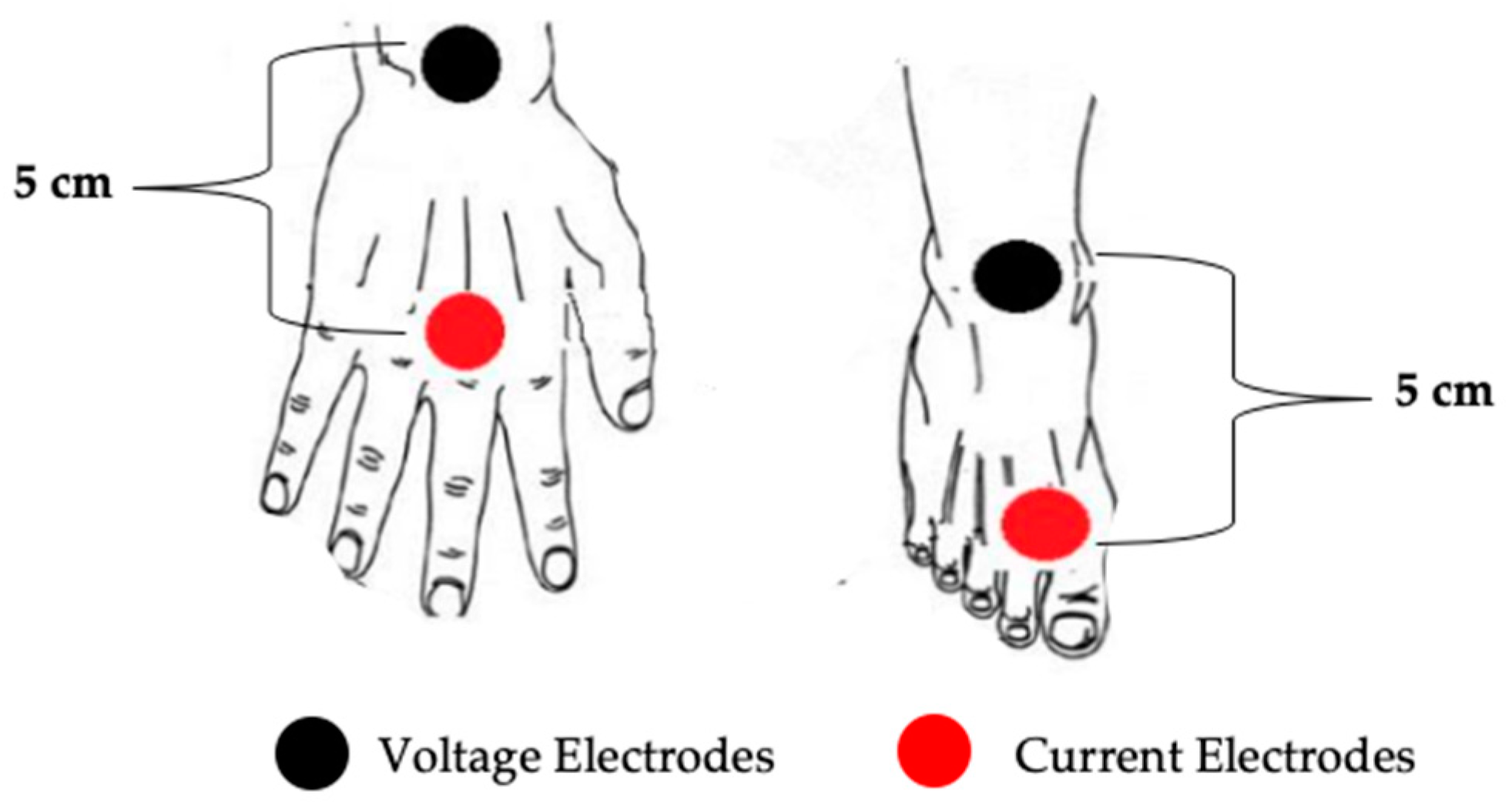
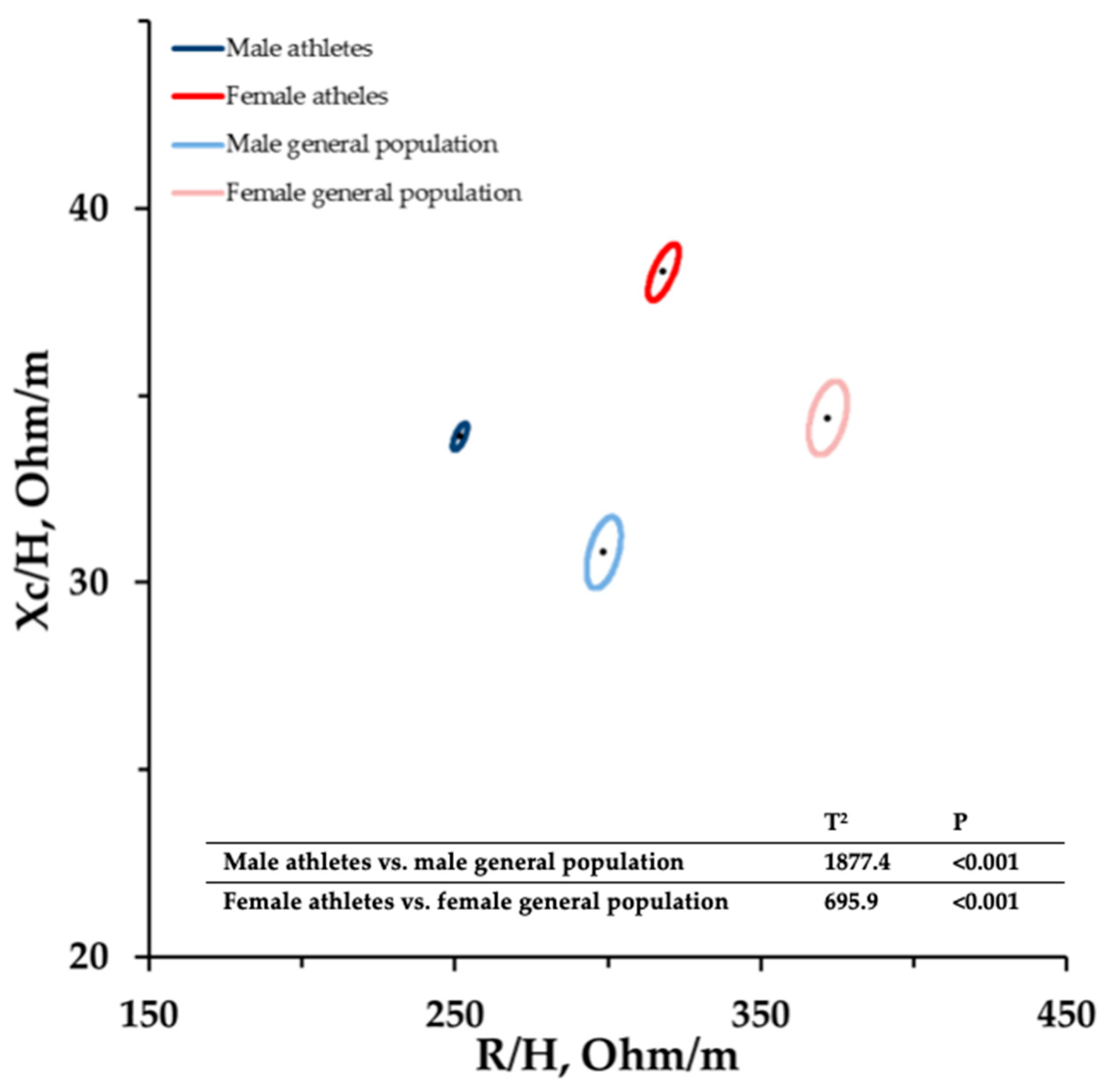
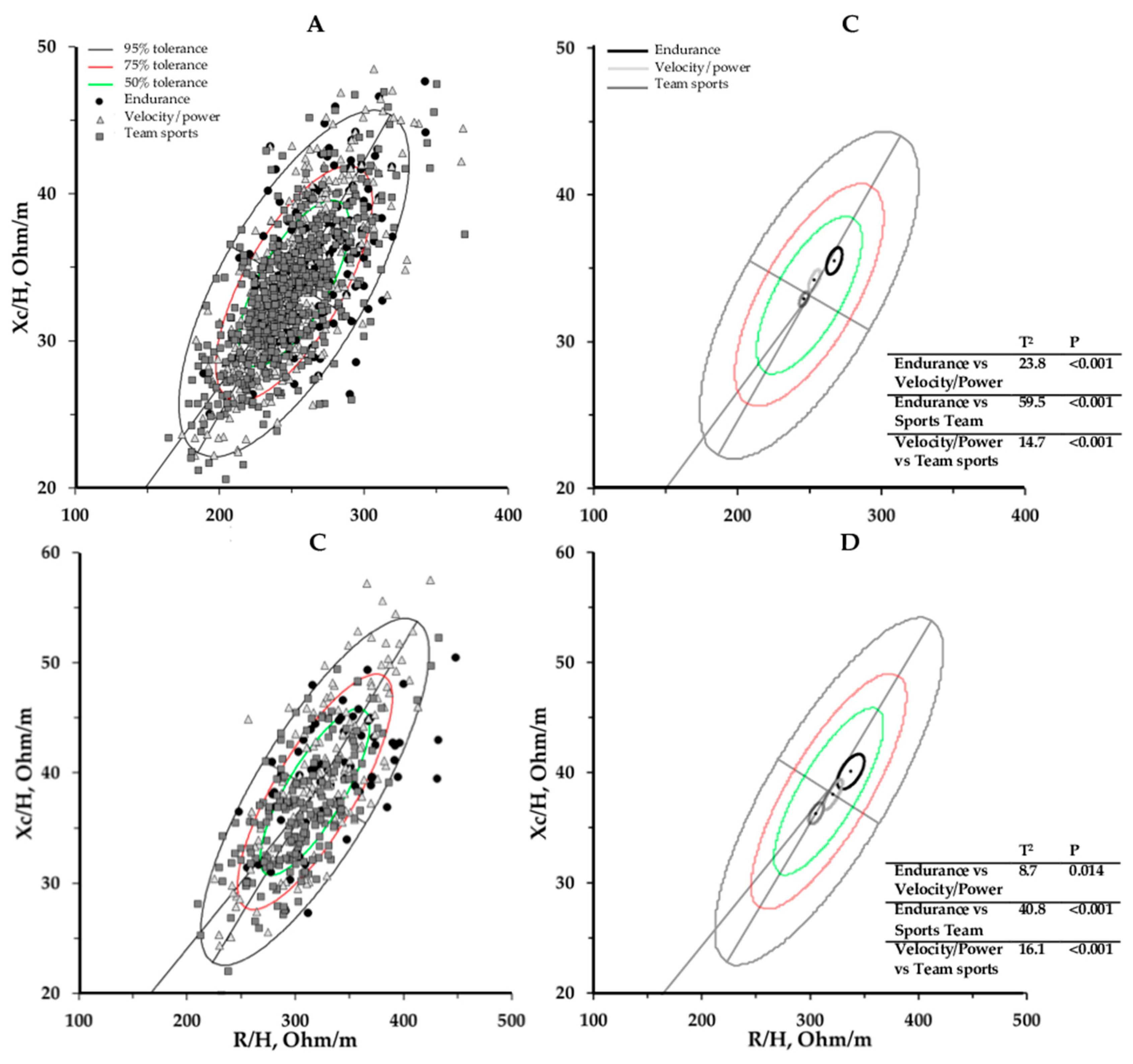
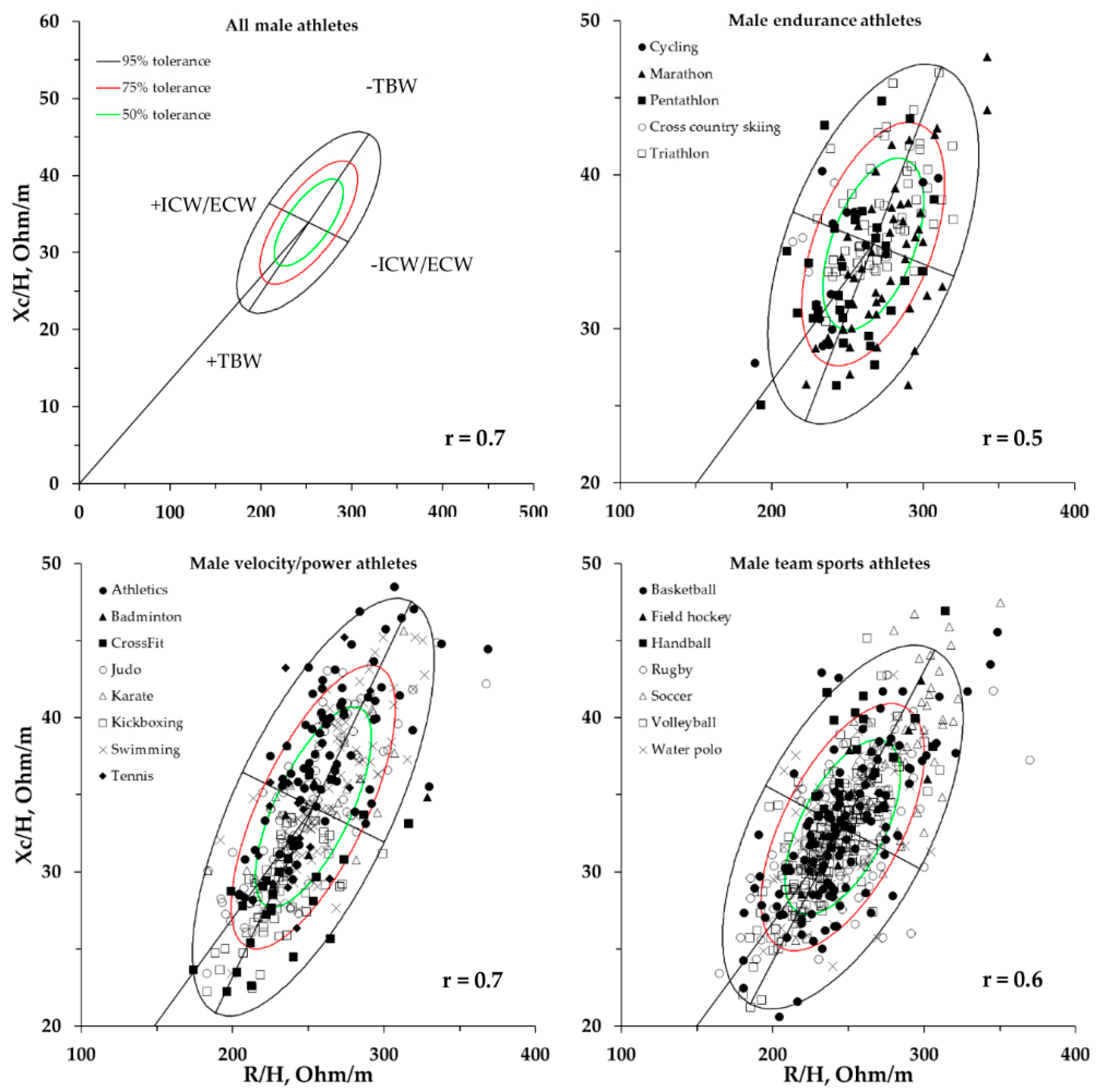
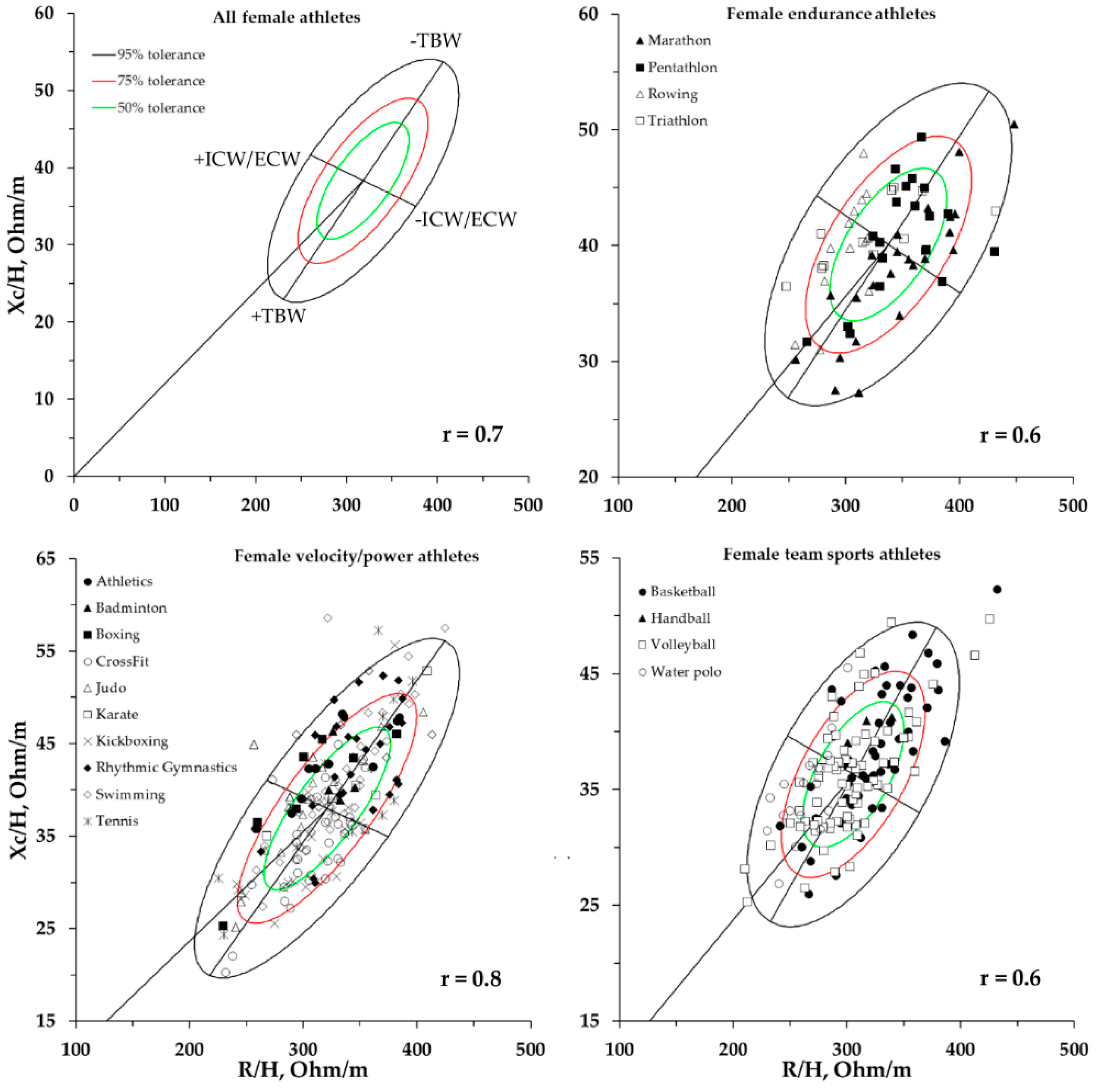
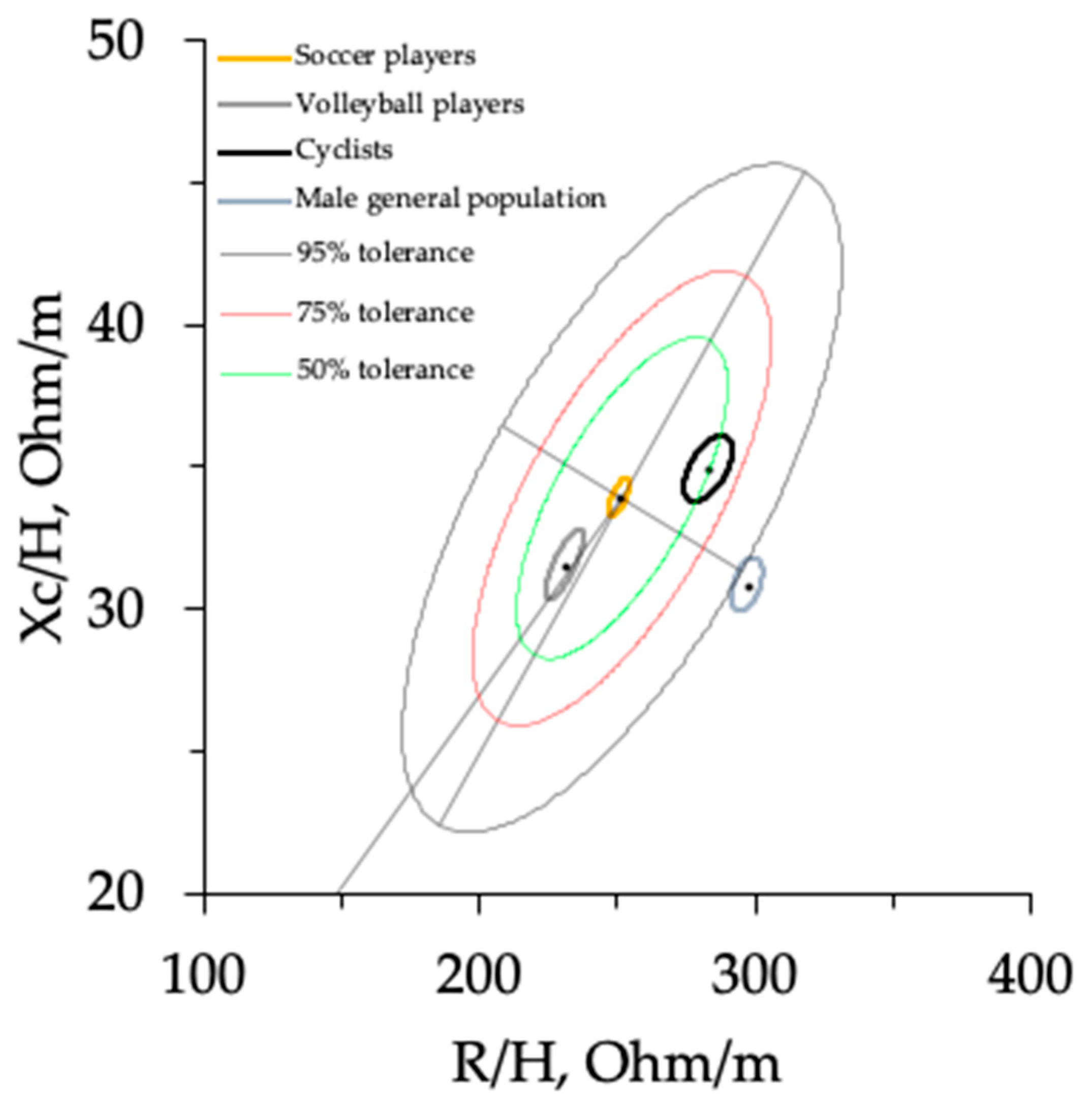

| Variable | Male | Female | ||||||||
|---|---|---|---|---|---|---|---|---|---|---|
| Endurance n = 165 | Velocity/Power n = 375 | Team Sports n = 576 | ANOVA p | All n = 1116 | Endurance n = 76 | Velocity/Power n = 177 | Team Sports n = 187 | ANOVA p | All n = 440 | |
| Age (years) | 23.5 ± 6.2 | 23.6 ± 7.4 | 22.7 ± 6.5 | 0.098 | 23.1 ± 6.8 | 27.4 ± 7.0 | 26.2 ± 5.5 | 27.5 ± 7.4 | 0.116 | 26.9 ± 6.6 |
| Weight (kg) | 69.8 ± 8.1 #§ | 74.7 ± 9.8 *§ | 84.7 ± 13.8 *# | <0.001 | 79.5 ± 13.5 | 61.2 ± 8.4 § | 62.5 ± 7.9 § | 68.5 ± 9.1 *# | <0.001 | 65.4 ± 9.2 |
| Height (cm) | 175.9 ± 6.2 #§ | 178.3 ± 7.5 *§ | 185.9 ± 11.2 *# | <0.001 | 181.9 ± 10.4 | 169.2 ± 7.7 § | 167.2 ± 7.9 § | 176.1 ± 9.9 *# | <0.001 | 171.4 ± 9.8 |
| BMI (kg/m2) | 21.9 ± 4.1 #§ | 23.5 ± 2.5 * | 24.4 ± 4.4 * | <0.001 | 23.7 ± 4.0 | 21.4 ± 2.3 | 22.1 ± 1.8 | 22.1 ± 2.3 | 0.087 | 21.9 ± 2.1 |
| R/H (ohm/m) | 267.2 ± 28.0 #§ | 253.3 ± 32.4 *§ | 246.2 ± 32.3 *# | <0.001 | 251.6 ± 32.5 | 337.5 ± 42.9 § | 321.0 ± 46.9 § | 305.6 ± 37.6 *# | <0.001 | 318.1 ± 42.8 |
| Xc/H (ohm/m) | 35.5 ± 4.7 #§ | 34.2 ± 5.5 *§ | 32.9 ± 4.8 *# | <0.001 | 33.9 ± 4.8 | 40.1 ± 5.5 § | 38.0 ± 7.4 § | 36.3 ± 5.3 *# | <0.001 | 38.3 ± 6.4 |
| Z/H (ohm/m) | 269.6 ± 28.1 #§ | 255.6 ± 32.3 *§ | 248.4 ± 32.4 *# | <0.001 | 253.8 ± 32.7 | 338.5 ± 42.9 § | 326.1 ±44.8 § | 307.8 ± 37.7 *# | <0.001 | 320.4 ± 43.1 |
| PA (degree) | 7.6 ± 0.8 | 7.7 ± 0.8 | 7.6 ± 0.8 | 0.446 | 7.7 ± 0.8 | 6.8 ± 0.8 | 7.0 ± 0.8 | 6.8 ± 0.8 | 0.060 | 6.9 ± 0.8 |
| FM (kg) | 10.4 ± 3.6 § | 11.6 ± 4.2 § | 15.7 ± 5.8 *# | <0.001 | 13.7 ± 5.6 | 12.8 ± 6.3 | 12.6 ± 4.5 § | 14.3 ± 5.6 # | 0.015 | 13.6 ± 5.5 |
| FM (%) | 14.6 ± 3.5 § | 15.2 ± 3.5 § | 18.1 ± 3.8 *# | <0.001 | 16.7 ± 4.1 | 20.2 ± 8.8 | 19.8 ± 5.6 | 20.5 ± 6.2 | 0.719 | 20.2 ± 6.7 |
| FFM (kg) | 59.4 ± 5.3 #§ | 63.2 ± 6.2 *§ | 68.9 ± 8.8 *# | <0.001 | 65.7 ± 8.5 | 48.4 ± 5.5 § | 49.9 ± 5.5 § | 54.6 ± 6.2 *# | <0.001 | 51.9 ± 6.4 |
| TBW (L) | 43.9 ± 4.5 #§ | 47.3 ± 5.3 *§ | 51.8 ± 7.5 *# | <0.001 | 49.3 ± 7.3 | 35.2 ± 4.2 § | 36.6 ± 4.4 § | 39.8 ± 4.8 *# | <0.001 | 38.0 ± 4.9 |
© 2019 by the authors. Licensee MDPI, Basel, Switzerland. This article is an open access article distributed under the terms and conditions of the Creative Commons Attribution (CC BY) license (http://creativecommons.org/licenses/by/4.0/).
Share and Cite
Campa, F.; Matias, C.; Gatterer, H.; Toselli, S.; Koury, J.C.; Andreoli, A.; Melchiorri, G.; Sardinha, L.B.; Silva, A.M. Classic Bioelectrical Impedance Vector Reference Values for Assessing Body Composition in Male and Female Athletes. Int. J. Environ. Res. Public Health 2019, 16, 5066. https://doi.org/10.3390/ijerph16245066
Campa F, Matias C, Gatterer H, Toselli S, Koury JC, Andreoli A, Melchiorri G, Sardinha LB, Silva AM. Classic Bioelectrical Impedance Vector Reference Values for Assessing Body Composition in Male and Female Athletes. International Journal of Environmental Research and Public Health. 2019; 16(24):5066. https://doi.org/10.3390/ijerph16245066
Chicago/Turabian StyleCampa, Francesco, Catarina Matias, Hannes Gatterer, Stefania Toselli, Josely C. Koury, Angela Andreoli, Giovanni Melchiorri, Luis B. Sardinha, and Analiza M. Silva. 2019. "Classic Bioelectrical Impedance Vector Reference Values for Assessing Body Composition in Male and Female Athletes" International Journal of Environmental Research and Public Health 16, no. 24: 5066. https://doi.org/10.3390/ijerph16245066
APA StyleCampa, F., Matias, C., Gatterer, H., Toselli, S., Koury, J. C., Andreoli, A., Melchiorri, G., Sardinha, L. B., & Silva, A. M. (2019). Classic Bioelectrical Impedance Vector Reference Values for Assessing Body Composition in Male and Female Athletes. International Journal of Environmental Research and Public Health, 16(24), 5066. https://doi.org/10.3390/ijerph16245066

