Study on Spatial and Temporal Distribution Characteristics of Coordinated Development Degree among Regional Water Resources, Social Economy, and Ecological Environment Systems



Abstract
1. Introduction
2. Materials and Methods
2.1. Overview of Research Area and Data Sources
2.2. Comprehensive Development Evaluation of Three Systems
2.2.1. Selection of Comprehensive Development Evaluation Indexes
2.2.2. Calculation of Comprehensive Development Evaluation Index
- Determine the evaluation object, establish the evaluation index system and construct the index matrixwhere stands for the total number of the evaluation projects , stands for the total number of the indicators .
- Standardize the index matrix to get the standardized matrixFor the positive properties index, then:For the negative properties index, then:where is the actual value of the indicator in evaluation project , means the maximum value of indicator means the minimum value of indicator means the standardized value of the actual value .Then, the standardized matrix is
- Calculate the entropy of the indicator .According to the definition of information entropy in the information theory, the information entropy of the indicator .where is the proportion of the standardized value in the sum of the standard values of the indicator , . If , then .
- Calculate the entropy weight of the indicator .
2.3. Evaluation Model of Regional Coordinated Development Degree
2.3.1. Comprehensive Development Evaluation Indexes of the Three Systems
2.3.2. Calculation of Coordinated Development Degree (CDD)
2.3.3. Classification and Standard Division of Coordinated Development Degree
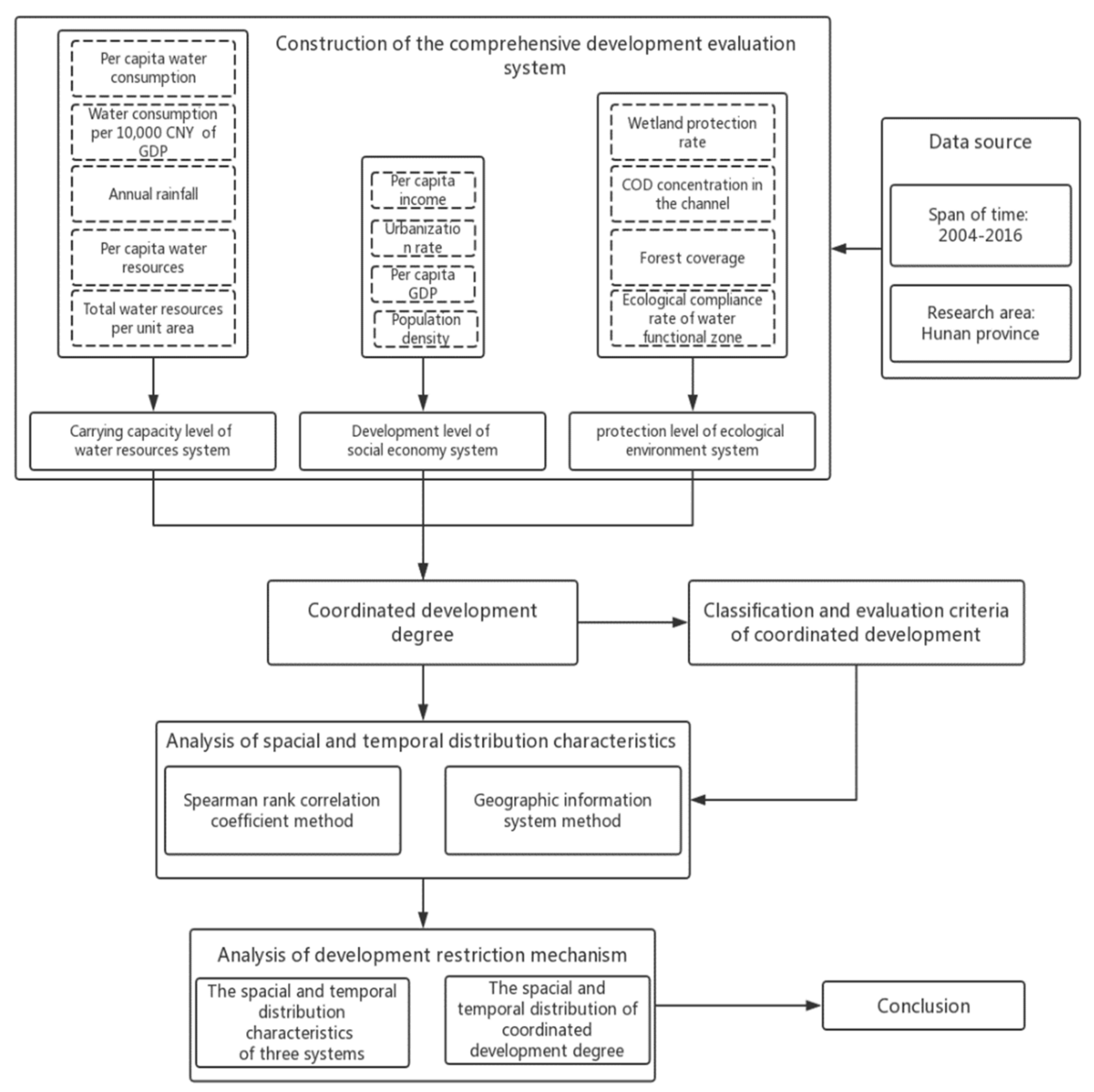
2.4. Research Framework
3. Results
3.1. Weight Calculation Results of Comprehensive Development Evaluation of the Three Systems
3.2. Spatial and Temporal Distribution Characteristics of Comprehensive Development Evaluation of Three Systems
3.2.1. Spatial and Temporal Distribution Characteristics of the Carrying Capacity Level of the Water Resources System
3.2.2. Spatial and Temporal Distribution Characteristics of the Development Level of the Social Economy System
3.2.3. Spatial and Temporal Distribution Characteristics of the Protection Level of the Ecological Environment System
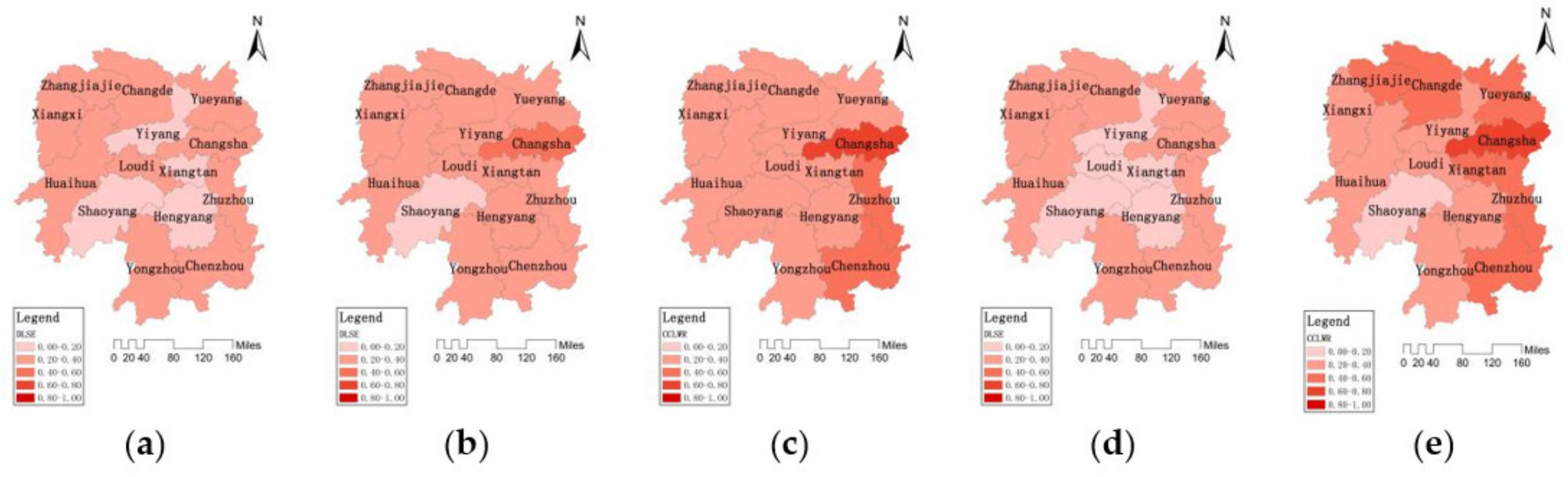
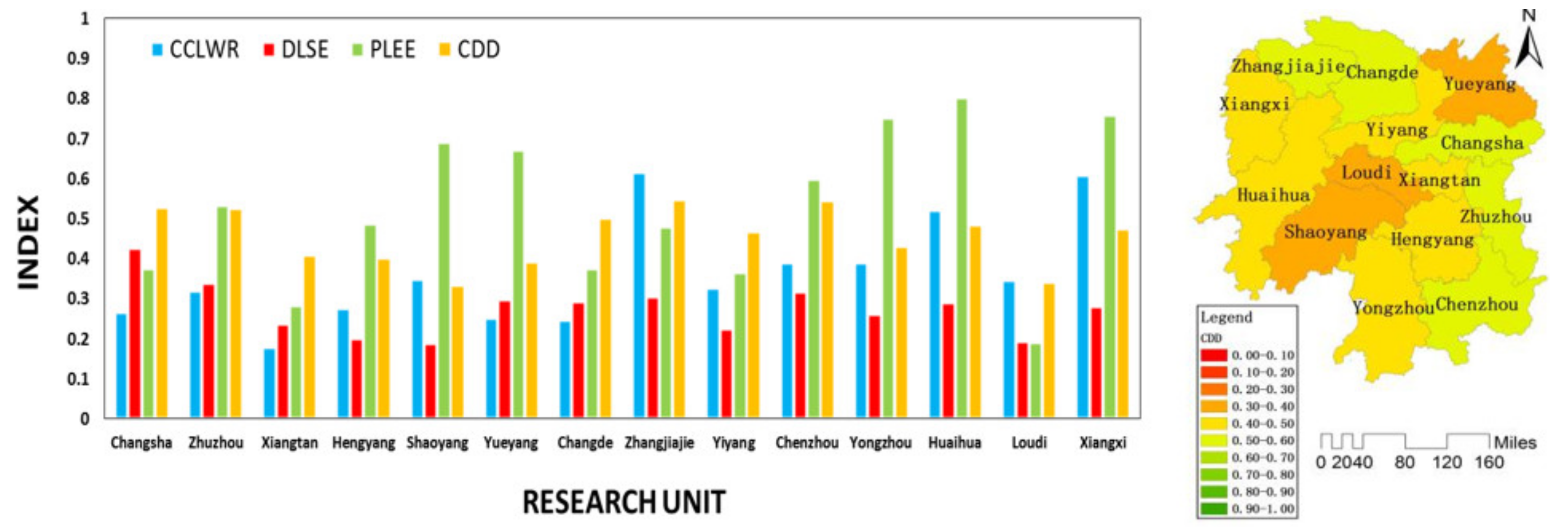
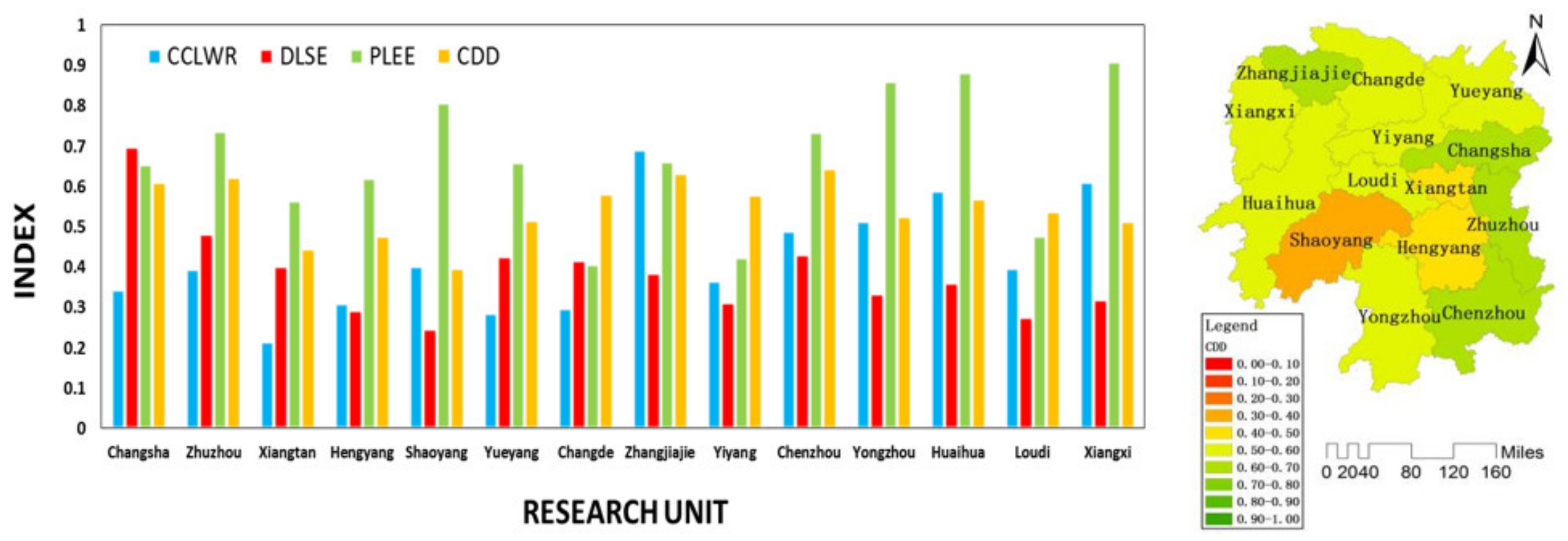
3.3. Spatial and Temporal Distribution Characteristics of the Coordinated Development Degree
4. Discussion
- 1.
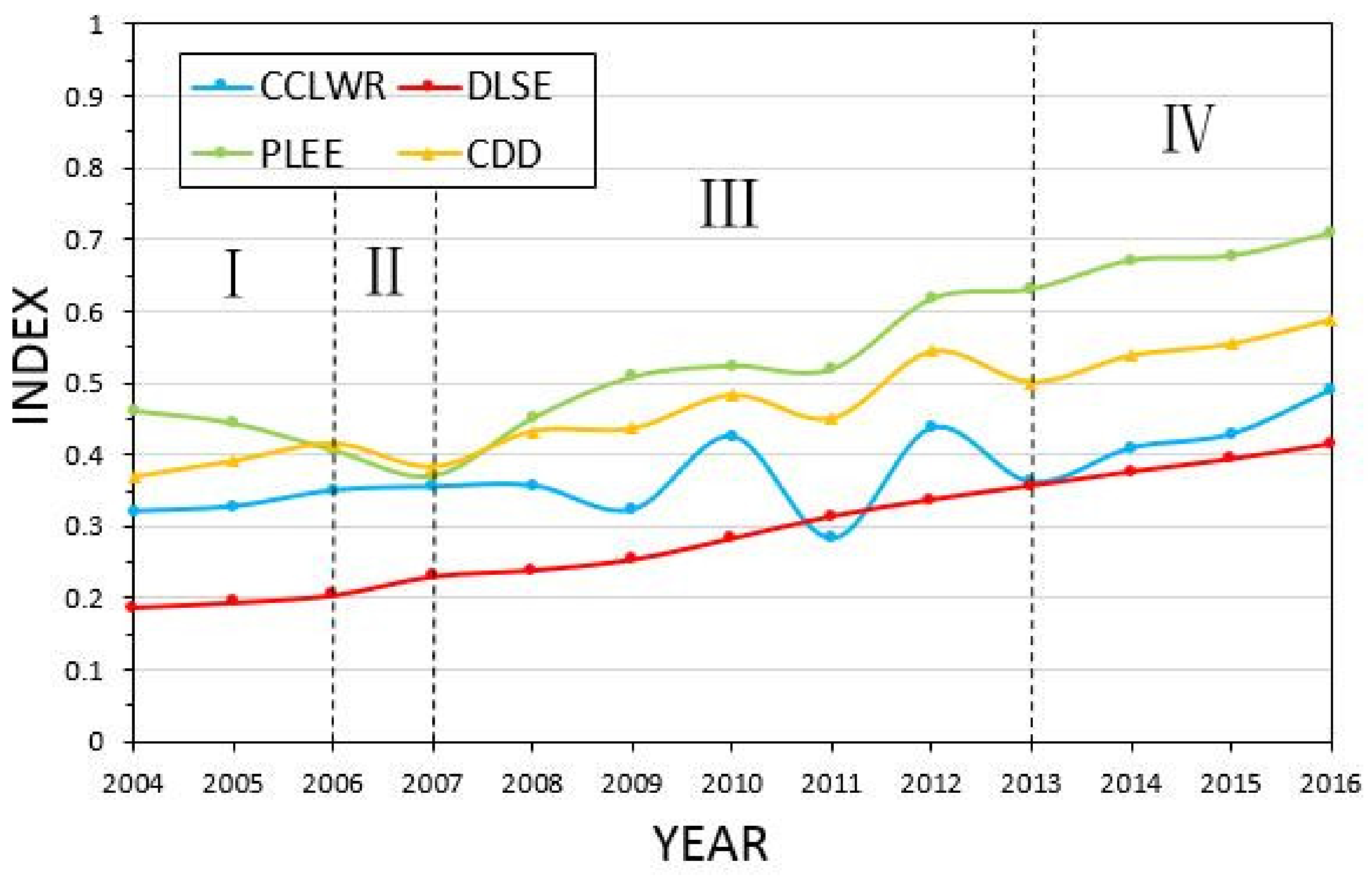
- Stage I (2004–2006): Social economy system restriction stage.
- 2.
- Stage II (2006–2007): Ecological environment system restriction stage.
- 3.
- Stage III (2006–2007): Water resources system restriction stage.
- 4.
- Stage IV (2013–2016): Reluctance coordinated development stage.
5. Conclusions
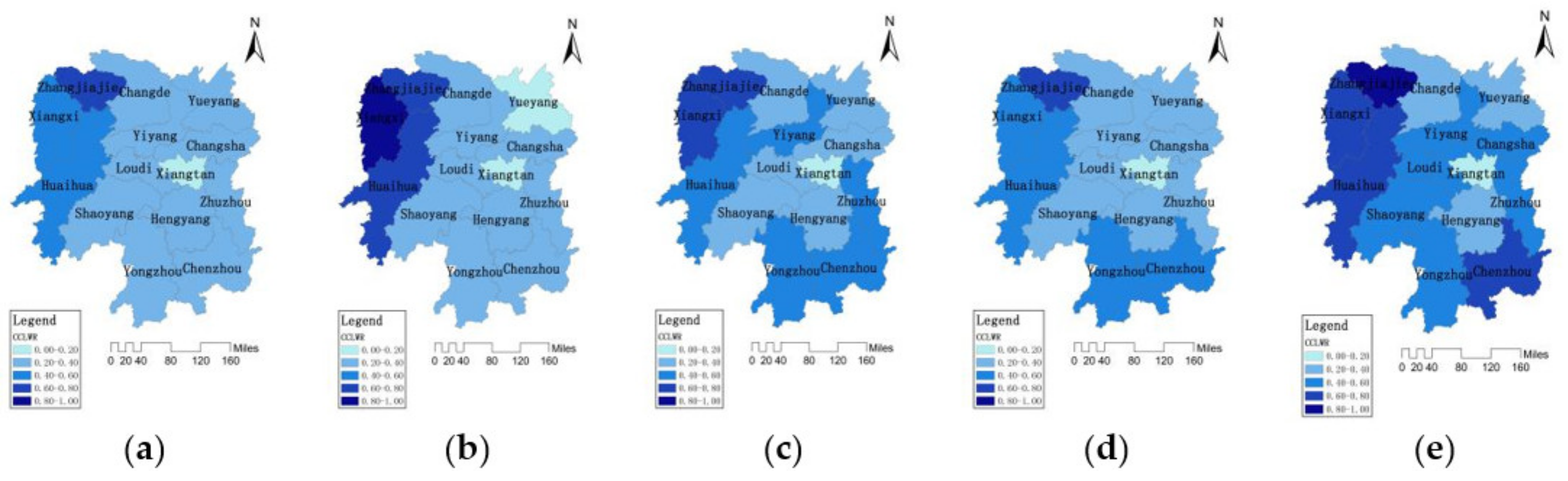
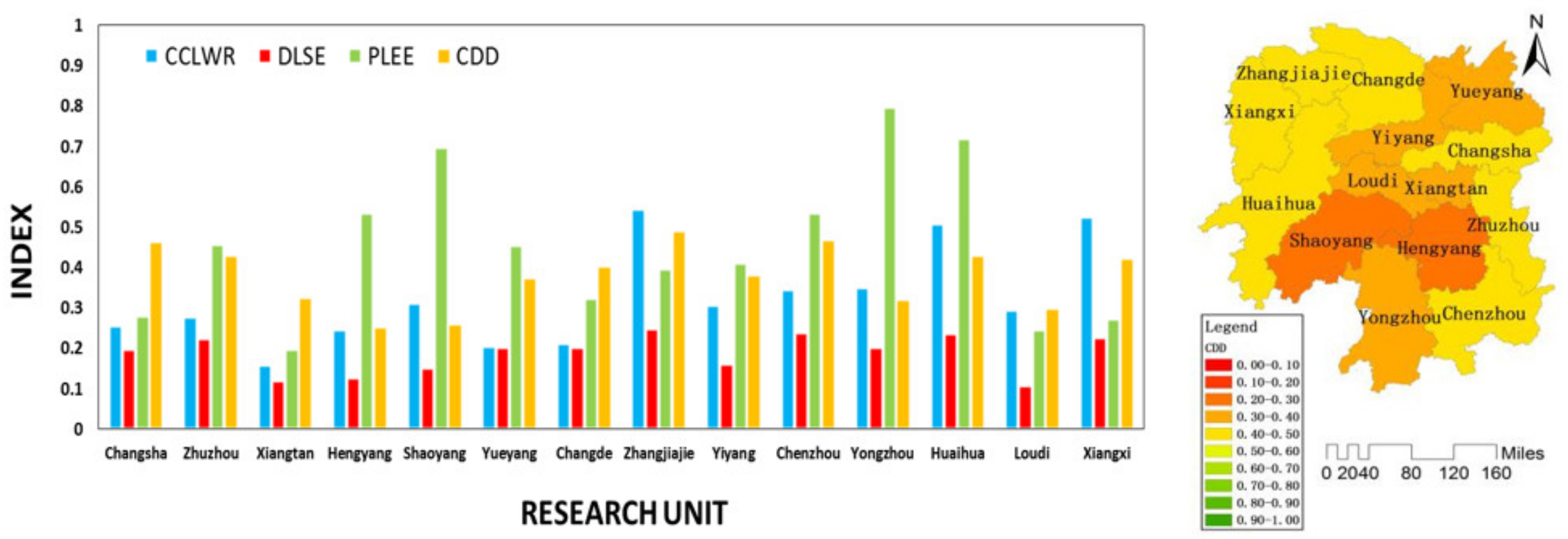
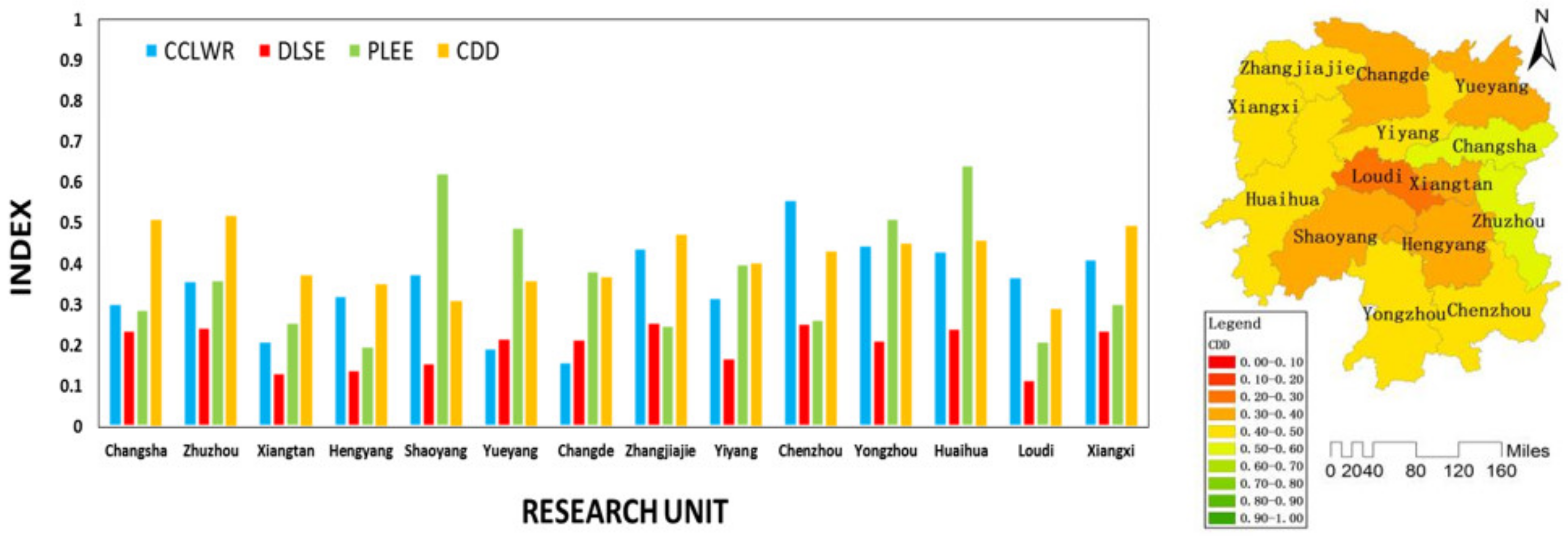
- The CCLWR in Hunan Province from 2004 to 2016 presented a pattern of “high in the west and low in the east” and showed a fluctuating growth trend. The fluctuation of CCLWR was mainly affected by the changes in total water resources per unit, water consumption per 104 CNY of GDP and annual rainfall. Zhangjiajie, Xiangxi and Huaihua in the west region were rich in water resources, while Changsha and Zhuzhou in the east had fewer water resources. Therefore, decision-makers need to put forward a scientific management program to solve the uneven temporal and spatial distribution of water resources and ensure healthy and sustainable development of the water resources system.
- The DLSE in Hunan Province from 2004 to 2016 presented a pattern of “high on all sides, low in the middle” and showed a continuous growth trend. The growth of DLSE was mainly affected by the changes of urbanization rate, population density, and per capita GDP. As the capital of Hunan Province, Changsha was the most vigorous growth point and gathering place of regional economic development. The rapid growth of the social economy system in Changsha radiated the development of surrounding city clusters, such as Zhuzhou and Xiangtan. However, due to the unscientific urban management in the process of economic development, the ecological environment in some cities was damaged to some extent. Therefore, decision-makers need to adjust the industrial layout and find a sustainable development model.
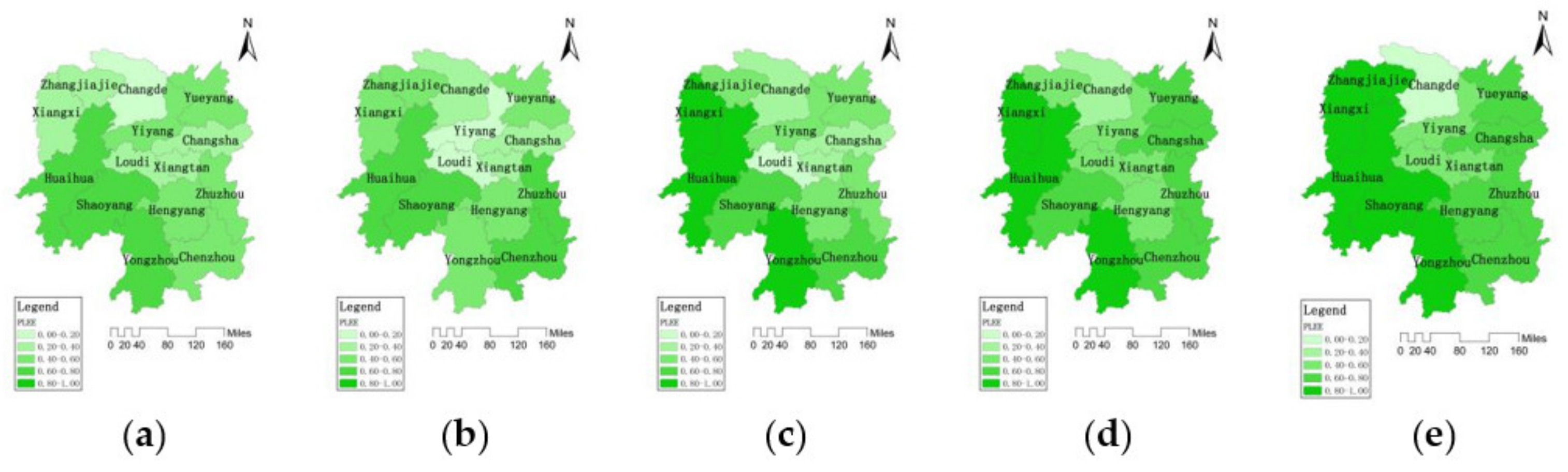
- The PLEE in Hunan Province from 2004 to 2016 presented a pattern of “high in southwest, low in central and low in northeast” and showed a fluctuating growth trend. The PLEE growth was mainly affected by the change of ecological compliance rate of water functional zone and wetland protection rate. From 2004 to 2007, the PLEE of the whole province continued to decline, mainly due to the one-sided pursuit of social economy development and the neglect of the importance of the ecological environment. After 2007, decision-makers began to pay attention to the protection of the ecological environment, and the province′s ecological environment quality was greatly improved. The ecological environment protection in Xiangxi, Zhangjiajie, Huaihua achieved remarkable results, while the level of ecological environment protection in Changsha, Changde, and other areas still needs to be improved.
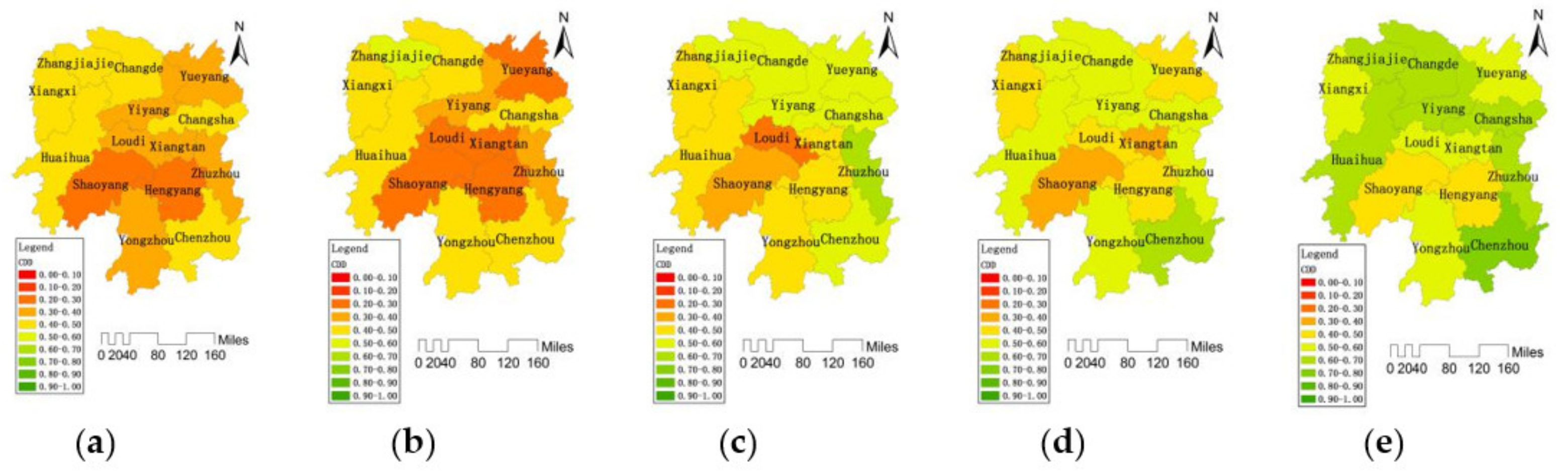
- The CDD of Hunan Province from 2004 to 2016 evolved from “Light disorder recession (V4)” to “Nearly disorder recession (V5)”, then to “Reluctance coordinated development (V6)”, which presented a fluctuating growth trend. The CDD was restricted by different systems in different development periods and had a large regional difference. From 2004 to 2006, Hunan Province was in the social economy system restriction stage. Due to the rapid development of social economy, the CDD of the whole province presented a growth trend during this period. However, the ecological environment was destroyed at the same time. From 2006 to 2007, Hunan Province was in the ecological environment system restriction stage. Due to the destruction, the ecological environment system was degraded to a certain extent and began to restrict the coordinated development of the whole province. From 2007 to 2013, Hunan Province was in the water resources system restriction stage. During this period, the rainfall and available water resources in Hunan Province vary greatly from year to year, and the distribution of water resources was not uniform in time and space. As a result, the coordinated development of the whole province was mainly restricted by the water resources system. From 2013 to 2016, Hunan Province was in the reluctance coordinated the development stage. With the rapid development of social economy, the protection of the ecological environment and the management of water resources were also improved. Therefore, Hunan Province began to be in a stable and sustainable coordinated development process.
Author Contributions
Funding
Conflicts of Interest
References
- Zhang, J.; Hua, P.; Krebs, P. Influences of land use and antecedent dry-weather period on pollution level and ecological risk of heavy metals in road-deposited sediment. Environ. Pollut. 2017, 228, 158–168. [Google Scholar] [CrossRef] [PubMed]
- O’Mahony, T.; Escardó-Serra, P.; Dufour, J. Revisiting ISEW Valuation Approaches: The Case of Spain Including the Costs of Energy Depletion and of Climate Change. Ecol. Econom. 2018, 144, 292–303. [Google Scholar] [CrossRef]
- Ochoa-Hueso, R.; Munzi, S.; Alonso, R.; Arróniz-Crespo, M.; Avila, A.; Bermejo, V.; Bobbink, R.; Branquinho, C.; Concostrina-Zubiri, L.; Cruz, C.; et al. Ecological impacts of atmospheric pollution and interactions with climate change in terrestrial ecosystems of the Mediterranean Basin: Current research and future directions. Environ. Pollut. 2017, 227, 194–206. [Google Scholar] [CrossRef] [PubMed]
- Ren, C.; Guo, P.; Li, M.; Li, R. An innovative method for water resources carrying capacity research–Metabolic theory of regional water resources. J. Environ. Manag. 2016, 167, 139–146. [Google Scholar] [CrossRef] [PubMed]
- Ye, W.; Xu, X.; Wang, H.; Wang, H.; Yang, H.; Yang, Z. Quantitative assessment of resources and environmental carrying capacity in the northwest temperate continental climate ecotope of China. Environ. Earth Sci. 2016. [Google Scholar] [CrossRef]
- Bregoli, F.; Crosato, A.; Paron, P.; McClain, M.E. Humans reshape wetlands: Unveiling the last 100 years of morphological changes of the Mara Wetland, Tanzania. Sci. Total Environ. 2019, 691, 896–907. [Google Scholar] [CrossRef]
- Jones, J.; Jones, P.; Börger, L.; Tummers, J.; Lucas, M.; Kerr, J.; Kemp, P.; Bizzi, S.; Consuegra, S.; Marcello, L.; et al. comprehensive assessment of stream fragmentation in Great Britain. Sci. Total Environ. 2019, 673, 756–762. [Google Scholar] [CrossRef]
- Dou, X. China’s inter-basin water management in the context of regional water shortage. Sustain. Water Resour. Manag. 2018, 4, 519–526. [Google Scholar] [CrossRef]
- Cui, X.; Fang, C.; Liu, H.; Liu, X. Assessing sustainability of urbanization by a coordinated development index for an Urbanization-Resources-Environment complex system: A case study of Jing-Jin-Ji region, China. Ecol. Indic. 2019, 96, 383–391. [Google Scholar] [CrossRef]
- Duan, H.; Xiao, Y.; Ding, Z.; Wang, X. Research on scenario prediction of coordinated development of regional population, economy, energy and environment. J. Popul. 2017, 39, 47–56. (In Chinese) [Google Scholar]
- Sjöstedt, M. Governing for sustainability: How research on large and complex systems can inform governance and institutional theory. Environ. Policy Gov. 2019, 29, 293–302. [Google Scholar] [CrossRef]
- Guodong, C.X.L.W. Integrated study of the water–ecosystem–economy in the Heihe River Basin. Natl. Sci. Rev. Engl. 2014. [Google Scholar] [CrossRef]
- Zhang, F.; Wang, Y.; Ma, X.; Wang, Y.; Yang, G.; Zhu, L. Evaluation of resources and environmental carrying capacity of 36 large cities in China based on a support-pressure coupling mechanism. Sci. Total Enviro. 2019, 688, 838–854. [Google Scholar] [CrossRef] [PubMed]
- Ke, W.; Sha, J.; Yan, J.; Zhang, G.; Wu, R. A Multi-Objective Input–Output Linear Model for Water Supply, Economic Growth and Environmental Planning in Resource-Based Cities. Sustainability 2016. [Google Scholar] [CrossRef]
- Haimes, Y.Y.; Nainis, W.S. Coordination of regional water resource supply and demand planning models. Water Resour. Res. 1974, 10, 1051–1059. [Google Scholar] [CrossRef]
- Jiang, S.; Peng, J.; Song, Y.; Liu, R.; Zhang, M. Analysis of water footprint and water resource carrying capacity in Shenyang from 2005 to 2012. J. Environ. Eng. Technol. 2017, 7, 15–23. (In Chinese) [Google Scholar]
- Zhou, S.B.; Qi, W.T.; Du, A.M.; He, H. A method to evaluate coordination between regional economic, social development and water resources. IOP Conf. Ser. Earth Environ. Sci. 2016. [Google Scholar] [CrossRef]
- Du, J.; Chen, L.; Ye, D. Spatial and temporal characteristics of coordinated development of water resources and regional economy in arid areas–a case study of hexi corridor. Agric. Resour. Reg. China 2017, 38, 161–169. (In Chinese) [Google Scholar]
- Li, Y.; Li, Y.; Zhou, Y.; Shi, Y.; Zhu, X. Investigation of a coupling model of coordination between urbanization and the environment. J. Environ. Manag. 2012, 98, 127–133. [Google Scholar] [CrossRef]
- Bao, C.; He, D. The Causal Relationship between Urbanization, Economic Growth and Water Use Change in Provincial China. Sustainability 2015, 7, 16076–16085. [Google Scholar] [CrossRef]
- Beekman, G.B. Social Change and Water Resource Planning and Development. Int. J. Water Resour. Dev. 2002, 1, 183–195. [Google Scholar]
- Qin, P.; Mitsch, W.J. Wetland restoration and ecological engineering: International Conference of Wetland Restoration and Ecological Engineering. Ecol. Eng. 2009, 35, 437–441. [Google Scholar] [CrossRef]
- Sun, H. Development of central cities, formation of city clusters and rise of central China–based on the study of Changsha metropolitan area and the rise of Hunan Province. Chin. Ind. Econ. 2012, 11, 31–43. [Google Scholar]
- Tong, Z. Urbanization evolution characteristics and trend under the background of the rise of central China. Res. Urban Dev. 2017, 24, 44–50. (In Chinese) [Google Scholar]
- Xu, X. Comprehensive Assessment of the Water Ecological Security of the Xiangjiang River Basin Based on Physico-chemistry and Organisms Indices. Appl. Ecol. Environ. Res. 2019, 17, 4547–4574. [Google Scholar] [CrossRef]
- Hunan Province Bureau of Hydrology. Hunan Province Hydrological Statistical Yearbook; China Statistics Press: Beijing, China, 2004–2016. (In Chinese)
- Hunan Province Bureau of Statistics. Hunan Province Statistical Yearbook on National Economic and Social Development; China Statistics Press: Beijing, China, 2004–2016. (In Chinese)
- Hunan Province Bureau of Forestry. Hunan Province Forestal Statistical Yearbook; China Statistics Press: Beijing, China, 2004–2016. (In Chinese)
- Zhang, J.; Wang, L. Assessment of water resource security in Chongqing City of China: What has been done and what remains to be done? Nat. Hazards 2015, 75, 2751–2772. [Google Scholar] [CrossRef]
- Gong, L.; Jin, C. Fuzzy Comprehensive evaluation for Carrying Capacity of Regional Water Resources. Water Resour. Manag. 2009, 23, 2505–2513. [Google Scholar] [CrossRef]
- Ji, X. Ecological accounting and evaluation of urban economy: Taking Beijing city as the case. Commun. Nonlinear Sci. Numer. Simul. 2011, 16, 1650–1669. [Google Scholar] [CrossRef]
- Yang, Z.; Song, J.; Cheng, D.; Xia, J.; Li, Q. Comprehensive evaluation and scenario simulation for the water resources carrying capacity in Xi’an city, China. J. Environ. Manag. 2019, 230, 221–233. [Google Scholar] [CrossRef]
- Zhang, M.; Liu, Y.; Wu, J.; Wang, T. Index system of urban resource and environment carrying capacity based on ecological civilization. Environ. Impact Assess. Rev. 2018, 68, 90–97. [Google Scholar] [CrossRef]
- Zhao, C.; Pan, T.; Dou, T.; Liu, J.; Liu, C.; Ge, Y.; Zhang, Y.; Yu, X.; Mitrovic, S.; Lim, R. Making global river ecosystem health assessments objective, quantitative and comparable. Sci. Total Environ. 2019, 667, 500–510. [Google Scholar] [CrossRef] [PubMed]
- Meng, X.; Chang, J.; Wang, X.; Wang, Y.; Wang, Z. Flood control operation coupled with risk assessment for cascade reservoirs. J. Hydrol. 2019, 572, 543–555. [Google Scholar] [CrossRef]
- Cui, Y.; Feng, P.; Jin, J.; Liu, L. Water Resources Carrying Capacity Evaluation and Diagnosis Based on Set Pair Analysis and Improved the Entropy Weight Method. Entropy 2018, 20, 359. [Google Scholar] [CrossRef]
- Wang, Q.; Yuan, X.; Zhang, J.; Gao, Y.; Hong, J.; Zuo, J.; Liu, W. Assessment of the Sustainable Development Capacity with the Entropy Weight Coefficient Method. Sustainability 2015, 7, 13542–13563. [Google Scholar] [CrossRef]
- Delgado, A.; Romero, I. Environmental conflict analysis using an integrated grey clustering and entropy-weight method: A case study of a mining project in Peru. Environ. Model. Softw. 2016, 77, 108–121. [Google Scholar] [CrossRef]
- Yu, Y.; Zhang, L.; Chen, X.; Yang, K.; Huang, Y. Analysis of coordinated development of water resources and social economy in Hubei Province. Resour. Environ. Yangtze River Basin 2018, 27, 809–817. (In Chinese) [Google Scholar]
- Yao, L.; Li, X.; Li, Q.; Wang, J. Spatial and temporal Changes in Coupling and Coordinating Degree of New Urbanization and Ecological-Environmental Stress in China. Sustainability 2019, 11, 1171. [Google Scholar] [CrossRef]
- Sun, Y.; Cui, Y. Analyzing the Coupling Coordination among Economic, Social, and Environmental Benefits of Urban Infrastructure: Case Study of Four Chinese Autonomous Municipalities. Math. Probl. Eng. 2018, 2018, 1–13. [Google Scholar] [CrossRef]
- Yang, S.; Yang, Z.; Gao, S. Analysis on the effect of different coordination functions on the coordination degree of ecology-economy-society complex system–A case study of Ziyang district, Yiyang city, Hunan Province. Chin. J. Ecol. Agric. 2007, 2, 151–154. (In Chinese) [Google Scholar]
- Zhang, X.; Wang, C.; Wang, Y. Study on the coordination of population, economic development and ecological environment system–taking Xinjiang as an example. Ecol. Econ. 2006, 11, 123–126. (In Chinese) [Google Scholar]
- Dang, J.; Yao, S.; Huang, H. An empirical study on the coordinated development of county eco-economy-social system–A case study of Zhidan County, Shanxi Province. Resour. Sci. 2013, 35, 1984–1990. (In Chinese) [Google Scholar]
- Deng, F.; Liu, C.; Liang, X. Measurement of Regional Agricultural Sustainable Development System Based on Dissipative Structure Theory: A Case Study in Sichuan Province, China. Sustainability 2017, 9, 2047. [Google Scholar] [CrossRef]
- Gauthier, T. Detecting Trends Using Spearman’s Rank Correlation Coefficient. Environ. Forensics 2001, 2, 359–362. [Google Scholar] [CrossRef]
- Blest, D.C. Rank Correlation–An Alternative Measure. Aust. N. Z. J. Stat. 2000, 42, 101–111. [Google Scholar] [CrossRef]
- Dikbaş, F. A New Two-Dimensional Rank Correlation Coefficient. Water Resour. Manag. 2018, 32, 1539–1553. [Google Scholar] [CrossRef]
- Zhou, B. Report on the Work of the Hunan Government; People’s Government of Hunan Province: Changsha, China, 2006. (In Chinese)
- Zhou, Q. Report on the Work of the Hunan Government; People’s Government of Hunan Province: Changsha, China, 2007. (In Chinese)
- Zhan, X. Report on the Work of the Hunan Water Resources Department; Water Resources Department of Hunan Province: Changsha, China, 2013. (In Chinese)
- Du, J. Report on the Work of the Hunan Government; People’s Government of Hunan Province: Changsha, China, 2016. (In Chinese)
- Lu, C.; Li, W.; Pang, M.; Xue, B.; Miao, H. Quantifying the Economy-Environment Interactions in Tourism: Case of Gansu Province, China. Sustainability 2018, 10, 711. [Google Scholar] [CrossRef]




| System Layer | Indicator Layer | Properties | Data Source |
|---|---|---|---|
| Water resources system | Per capita water consumption (104m³/person) | + | [26] |
| Water consumption per 104 CNY of GDP (m³/104 CNY) | − | [26] | |
| Annual rainfall (mm) | + | [26] | |
| Per capita water resources (104m³/person) | − | [26] | |
| Total water resources per unit (109 m³) | + | [26] | |
| Social economy system | Per capita income (CNY) | + | [27] |
| Urbanization rate (%) | + | [27] | |
| Per capita GDP (CNY) | + | [27] | |
| Population density (person/ km2) | − | [27] | |
| Ecological environment system | Wetland protection rate (%) | + | [28] |
| COD concentration in the channel (mg/L) | − | [26] | |
| Forest coverage (%) | + | [28] | |
| Ecological compliance rate of water functional zone (%) | + | [26] |
| Category | CDD | Subclass |
|---|---|---|
| Coordination category | 0.90~1.00 | High coordinated development (V10) |
| 0.80~0.89 | Good coordinated development (V9) | |
| 0.70~0.79 | Middle coordinated development (V8) | |
| Transition category | 0.60~0.69 | Primary coordinated development (V7) |
| 0.50~0.59 | Reluctance coordinated development (V6) | |
| 0.40~0.49 | Nearly disorder recession (V5) | |
| Imbalanced recessional category | 0.30~0.39 | Light disorder recession (V4) |
| 0.20~0.29 | Moderate disorder recession (V3) | |
| 0.10~0.19 | Serious disorder recession (V2) | |
| 0.00~0.09 | Extreme disorder recession (V1) |
| System Layer | Indicator Layer | Properties | Weight |
|---|---|---|---|
| Water resources system | Per capita water consumption (104 m³/person) | + | 0.1039 |
| Water consumption per 104 CNY of GDP (m³/104 CNY) | − | 0.3145 | |
| Annual rainfall (mm) | + | 0.1484 | |
| Per capita water resources (104 m³/person) | − | 0.0684 | |
| Total water resources per unit (109 m³) | + | 0.3649 | |
| Social economy system | Per capita income (CNY) | + | 0.1531 |
| Urbanization rate (%) | + | 0.4514 | |
| Per capita GDP (CNY) | + | 0.0460 | |
| Population density (person/km2) | − | 0.3747 | |
| Ecological environment system | Wetland protection rate (%) | + | 0.3191 |
| COD concentration in the channel (mg/L) | − | 0.2047 | |
| Forest coverage (%) | + | 0.1047 | |
| Ecological compliance rate of water functional zone (%) | + | 0.3715 |
| n | Significance Level | |||
|---|---|---|---|---|
| 0.10 | 0.05 | 0.02 | 0.01 | |
| 12 | 0.503 | 0.587 | 0.671 | 0.727 |
| 13 | 0.484 | 0.560 | 0.648 | 0.703 |
| 14 | 0.464 | 0.538 | 0.622 | 0.675 |
| CITIES | (a) 2004 | (b) 2007 | (c) 2010 | (d) 2013 | (e) 2016 | Rn |
|---|---|---|---|---|---|---|
| Changsha | 0.4386 | 0.4703 | 0.5619 | 0.5262 | 0.6903 | 0.9999 |
| Zhuzhou | 0.3519 | 0.3138 | 0.6183 | 0.5757 | 0.6805 | 0.9997 |
| Xiangtan | 0.3035 | 0.2635 | 0.4803 | 0.3433 | 0.5451 | 0.9999 |
| Hengyang | 0.2408 | 0.2915 | 0.4095 | 0.4612 | 0.4993 | 0.9999 |
| Shaoyang | 0.2292 | 0.2916 | 0.3679 | 0.3609 | 0.4280 | 1.0000 |
| Yueyang | 0.3983 | 0.2760 | 0.5231 | 0.4310 | 0.5611 | 0.9998 |
| Changde | 0.4463 | 0.4335 | 0.5524 | 0.5604 | 0.6263 | 0.9999 |
| Zhangjiajie | 0.4619 | 0.5088 | 0.5177 | 0.5967 | 0.6327 | 0.9999 |
| Yiyang | 0.3704 | 0.3819 | 0.5042 | 0.5417 | 0.6087 | 0.9999 |
| Chenzhou | 0.4474 | 0.4808 | 0.5614 | 0.6208 | 0.7056 | 0.9999 |
| Yongzhou | 0.3272 | 0.4379 | 0.4460 | 0.5046 | 0.5546 | 0.9998 |
| Huaihua | 0.4392 | 0.4913 | 0.4683 | 0.5206 | 0.6036 | 0.9999 |
| Loudi | 0.3043 | 0.2570 | 0.2866 | 0.4906 | 0.5681 | 0.9998 |
| Xiangxi | 0.4140 | 0.4712 | 0.4733 | 0.4891 | 0.5401 | 1.0000 |
| AVG | 0.3695 | 0.3835 | 0.4836 | 0.5016 | 0.5889 | 0.9999 |
| CITIES | (a) 2004 | (b) 2007 | (c) 2010 | (d) 2013 | (e) 2016 |
|---|---|---|---|---|---|
| Changsha | V5 | V5 | V6 | V6 | V7 |
| Zhuzhou | V4 | V4 | V7 | V6 | V7 |
| Xiangtan | V4 | V3 | V5 | V4 | V6 |
| Hengyang | V3 | V3 | V5 | V5 | V5 |
| Shaoyang | V3 | V3 | V4 | V4 | V5 |
| Yueyang | V4 | V3 | V6 | V5 | V6 |
| Changde | V5 | V5 | V6 | V6 | V7 |
| Zhangjiajie | V5 | V5 | V6 | V6 | V7 |
| Yiyang | V4 | V4 | V6 | V6 | V7 |
| Chenzhou | V5 | V5 | V6 | V7 | V8 |
| Yongzhou | V4 | V5 | V5 | V6 | V6 |
| Huaihua | V5 | V5 | V5 | V6 | V7 |
| Loudi | V4 | V3 | V3 | V5 | V6 |
| Xiangxi | V5 | V5 | V5 | V5 | V6 |
| AVG | V4 | V4 | V5 | V6 | V6 |
© 2019 by the authors. Licensee MDPI, Basel, Switzerland. This article is an open access article distributed under the terms and conditions of the Creative Commons Attribution (CC BY) license (http://creativecommons.org/licenses/by/4.0/).
Share and Cite
Wang, X.; Dong, Z.; Xu, W.; Luo, Y.; Zhou, T.; Wang, W. Study on Spatial and Temporal Distribution Characteristics of Coordinated Development Degree among Regional Water Resources, Social Economy, and Ecological Environment Systems. Int. J. Environ. Res. Public Health 2019, 16, 4213. https://doi.org/10.3390/ijerph16214213
Wang X, Dong Z, Xu W, Luo Y, Zhou T, Wang W. Study on Spatial and Temporal Distribution Characteristics of Coordinated Development Degree among Regional Water Resources, Social Economy, and Ecological Environment Systems. International Journal of Environmental Research and Public Health. 2019; 16(21):4213. https://doi.org/10.3390/ijerph16214213
Chicago/Turabian StyleWang, Xinkui, Zengchuan Dong, Wei Xu, Yun Luo, Tao Zhou, and Wenzhuo Wang. 2019. "Study on Spatial and Temporal Distribution Characteristics of Coordinated Development Degree among Regional Water Resources, Social Economy, and Ecological Environment Systems" International Journal of Environmental Research and Public Health 16, no. 21: 4213. https://doi.org/10.3390/ijerph16214213
APA StyleWang, X., Dong, Z., Xu, W., Luo, Y., Zhou, T., & Wang, W. (2019). Study on Spatial and Temporal Distribution Characteristics of Coordinated Development Degree among Regional Water Resources, Social Economy, and Ecological Environment Systems. International Journal of Environmental Research and Public Health, 16(21), 4213. https://doi.org/10.3390/ijerph16214213