

Further Insights on Predictors of Environmental Tobacco Smoke Exposure during the Pediatric Age



 ,
,  and
and 
Abstract
1. Introduction
2. Materials and Methods
2.1. Study Population and Design
2.2. Covariates Gathered by the Questionnaires and Statistical Analysis
2.3. Statistical Analysis
3. Results
4. Discussion
5. Conclusions
Author Contributions
Funding
Acknowledgments
Conflicts of Interest
References
- Pelkonen, M.K.; Laatikainen, T.K.; Jousilahti, P. The relation of environmental tobacco smoke (ETS) to chronic bronchitis and mortality over two decades. Respir. Med. 2019, 154, 34–39. [Google Scholar] [CrossRef] [PubMed]
- Flexeder, C.; Zock, J.P.; Jarvis, D.; Verlato, G.; Olivieri, M.; Benke, G.; Abramson, M.J.; Sigsgaard, T.; Svanes, C.; Torén, K.; et al. Second-hand smoke exposure in adulthood and lower respiratory health during 20 year follow up in the European Community Respiratory Health Survey. Respir. Res. 2019, 20, 33. [Google Scholar] [CrossRef] [PubMed]
- Lee, W.; Hwang, S.H.; Choi, H.; Kim, H. The association between smoking or passive smoking and cardiovascular diseases using a Bayesian hierarchical model: Based on the 2008–2013 Korea Community Health Survey. Epidemiol. Health 2017, 39, e2017026. [Google Scholar] [CrossRef]
- Cheraghi, M.; Salvi, S. Environmental tobacco smoke (ETS) and respiratory health in children. Eur. J. Pediatr. 2009, 168, 897–905. [Google Scholar] [CrossRef] [PubMed]
- Vanker, A.; Gie, R.P.; Zar, H.J. The association between environmental tobacco smoke exposure and childhood respiratory disease: A review. Expert. Rev. Respir. Med. 2017, 11, 661–673. [Google Scholar] [CrossRef]
- Chang, J.S.; Selvin, S.; Metayer, C.; Crouse, V.; Golembesky, A.; Buffler, P.A. Parental smoking and the risk of childhood leukemia. Am. J. Epidemiol. 2006, 163, 1091–1100. [Google Scholar] [CrossRef]
- Chunxia, D.; Meifang, W.; Jianhua, Z.; Ruijuan, Z.; Xiue, L.; Zhuanzhen, Z.; Linhua, Y. Tobacco smoke exposure and the risk of childhood acute lymphoblastic leukemia and acute myeloid leukemia: A meta-analysis. Med. (Baltim.) 2019, 98, e16454. [Google Scholar] [CrossRef]
- Remesh Kumar, R.; Jayakumar, P.R.; Krishna Mohan, R. Children Deserve Smoke Free World. Indian J. Pediatrics 2018, 85, 295–299. [Google Scholar] [CrossRef]
- Protano, C.; Vitali, M. The new danger of third-hand smoke: Why passive smoking does not stop at secondhand smoke. Environ. Health Perspect. 2011, 119, A422. [Google Scholar] [CrossRef]
- Szabo, L. Babies May Absorb Smoke Residue in Home. USA Today. 6 August 2006. Available online: http://www.usatoday.com/news/health/2006-08-06-thirdhand-smoke-usat_x.htm (accessed on 2 July 2019).
- Behera, S.N.; Xian, H.; Balasubramanian, R. Human health risk associated with exposure to toxic elements in mainstream and sidestream cigarette smoke. Sci. Total Environ. 2014, 472, 947–956. [Google Scholar] [CrossRef]
- Protano, C.; Manigrasso, M.; Avino, P.; Vitali, M. Second-hand smoke generated by combustion and electronic smoking devices used in real scenarios: Ultrafine particle pollution and age-related dose assessment. Environ. Int. 2017, 107, 190–195. [Google Scholar] [CrossRef] [PubMed]
- Matt, G.E.; Quintana, P.J.; Destaillats, H.; Gundel, L.A.; Sleiman, M.; Singer, B.C.; Jacob, P.; Benowitz, N.; Winickoff, J.P.; Rehan, V.; et al. Thirdhand tobacco smoke: Emerging evidence and arguments for a multidisciplinary research agenda. Environ. Health Perspect. 2011, 119, 1218–1226. [Google Scholar] [CrossRef] [PubMed]
- Ganjre, A.P.; Sarode, G.S. Third hand smoke—A hidden demon. Oral Oncol. 2016, 54, 3–4. [Google Scholar] [CrossRef]
- Anderson, L.M.; Diwan, B.A.; Fear, N.T.; Roman, E. Critical windows of exposure for children’s health: Cancer in human epidemiological studies and neoplasms in experimental animal models. Environ. Health Perspect. 2000, 108, 573–594. [Google Scholar]
- Protano, C.; Andreoli, R.; Manini, P.; Vitali, M. How home-smoking habits affect children: A cross-sectional study using urinary cotinine measurement in Italy. Int. J. Public Health 2012, 57, 885–892. [Google Scholar] [CrossRef] [PubMed]
- Protano, C.; Andreoli, R.; Mutti, A.; Manigrasso, M.; Avino, P.; Vitali, M. Reference Intervals for Urinary Cotinine Levels and the Influence of Sampling Time and Other Predictors on Its Excretion Among Italian Schoolchildren. Int. J. Environ. Res. Public Health 2018, 21, 15. [Google Scholar] [CrossRef] [PubMed]
- Protano, C.; Valeriani, F.; Macedonio, A.; Cammarota, F.; Romano Spica, V.; Orsi, G.B.; Vitali, M. Family-based social determinants and child health: A cross-sectional study. Pediatr. Int. 2017, 59, 201–208. [Google Scholar] [CrossRef] [PubMed]
- Díez-Izquierdo, A.; Cassanello Peñarroya, P.; Cartanyà-Hueso, À.; Matilla-Santander, N.; Martín Sánchez, J.C.; Balaguer Santamaría, A.; Martínez-Sánchez, J.M. Prevalence of smoke-free homes and passive exposure to tobacco in pediatric population (children from 3 to 36 months). Rev. Esp. Salud Publica 2019, 16, 93. [Google Scholar]
- Berman, T.; Barnett-Itzhaki, Z.; Axelrod, R.; Keinan-Boker, L.; Shimony, T.; Goldsmith, R.; Göen, T.; Geva, H.; Rosen, L. Socioeconomic inequalities in exposure to environmental tobacco smoke in children in Israel. Environ. Int. 2018, 121, 643–648. [Google Scholar] [CrossRef]
- Chen, X.; Stanton, B.; Hopper, J.; Khankari, N. Sources, locations, and predictors of environmental tobacco smoke exposure among young children from inner-city families. J. Pediatr. Health Care 2011, 25, 365–372. [Google Scholar] [CrossRef]
- Vitali, M.; Protano, C. How relevant are fathers who smoke at home to the passive smoking exposure of their children? Acta Paediatr. 2017, 106, 74. [Google Scholar] [CrossRef] [PubMed]
- Wang, Y.; Yang, M.; Huang, Z.; Tian, L.; Niu, L.; Xiao, S. Urinary cotinine concentrations in preschool children showed positive associations with smoking fathers. Acta Paediatr. 2017, 106, 67–73. [Google Scholar] [CrossRef]
- Rosen, L.J.; Lev, E.; Guttman, N.; Tillinger, E.; Rosenblat, S.; Zucker, D.M.; Myers, V. Parental Perceptions and Misconceptions of Child Tobacco Smoke Exposure. Nicotine Tob. Res. 2018, 20, 1369–1377. [Google Scholar] [CrossRef] [PubMed]
- Protano, C.; Andreoli, R.; Manini, P.; Guidotti, M.; Vitali, M. A tobacco-related carcinogen: Assessing the impact of smoking behaviours of cohabitants on benzene exposure in children. Tob. Control 2012, 21, 325–329. [Google Scholar] [CrossRef]
- Protano, C.; Andreoli, R.; Manini, P.; Vitali, M. Urinary trans, trans-muconic acid and S-phenylmercapturic acid are indicative of exposure to urban benzene pollution during childhood. Sci. Total Environ. 2012, 435, 115–123. [Google Scholar] [CrossRef] [PubMed]
- Protano, C.; Andreoli, R.; Mutti, A.; Petti, S.; Vitali, M. Biomarkers of oxidative stress to nucleic acids: Background levels and effects of body mass index and life-style factors in an urban paediatric population. Sci. Total Environ. 2014, 500, 44–51. [Google Scholar] [CrossRef]
- Protano, C.; Astolfi, M.L.; Canepari, S.; Vitali, M. Urinary levels of trace elements among primary school-aged children from Italy: The contribution of smoking habits of family members. Sci. Total Environ. 2016, 557, 378–385. [Google Scholar] [CrossRef]
- Andreoli, R.; Spatari, G.; Pigini, D.; Poli, D.; Banda, I.; Goldoni, M.; Riccelli, M.G.; Petyx, M.; Protano, C.; Vitali, M.; et al. Urinary biomarkers of exposure and of oxidative damage in children exposed to low airborne concentrations of benzene. Environ. Res. 2015, 142, 264–272. [Google Scholar] [CrossRef]
- Protano, C.; Canepari, S.; Astolfi, M.L.; D’Onorio De Meo, S.; Vitali, M. Urinary reference ranges and exposure profile for lithium among an Italian paediatric population. Sci. Total Environ. 2018, 619, 58–64. [Google Scholar] [CrossRef]
- Unesco Institute for Statistics. International Standard Classification of Education (ISCED 2011). Available online: http://uis.unesco.org/sites/default/files/documents/international-standard-classification-of-education-isced-2011-en.pdf (accessed on 22 July 2019).
- Lugo, A.; Zuccaro, P.; Pacifici, R.; Gorini, G.; Colombo, P.; La Vecchia, C.; Gallus, S. Smoking in Italy in 2015–2016: Prevalence, trends, roll-your-own cigarettes, and attitudes towards incoming regulations. Tumori J. 2017, 103, 353–359. [Google Scholar] [CrossRef]
- Orton, S.; Coleman, T.; Jones, L.L.; Cooper, S.; Lewis, S. Smoking in the home after childbirth: Prevalence and determinants in an English cohort. BMJ Open 2015, 5, e008856. [Google Scholar] [CrossRef] [PubMed]
- Sevcikova, L.; Babjakova, J.; Jurkovicova, J.; Samohyl, M.; Stefanikova, Z.; Machacova, E.; Vondrova, D.; Janekova, E.; Hirosova, K.; Filova, A.; et al. Exposure to Environmental Tobacco Smoke in Relation to Behavioral, Emotional, Social and Health Indicators of Slovak School Children. Int. J Environ. Res. Public Health 2018, 15, 1374. [Google Scholar] [CrossRef] [PubMed]
- Vitória, P.D.; Nunes, C.; Precioso, J. Parents’ educational level and second-hand tobacco smoke exposure at home in a sample of Portuguese children. Rev. Port. Pneumol. 2017, 23, 221–224. [Google Scholar] [CrossRef] [PubMed]
- Orton, S.; Jones, L.L.; Cooper, S.; Lewis, S.; Coleman, T. Predictors of children’s secondhand smoke exposure at home: A systematic review and narrative synthesis of the evidence. PLoS ONE 2014, 9, e112690. [Google Scholar] [CrossRef]
- Precioso, J.; Frias, S.; Silva, C.N.; Rocha, V.; Cunha-Machado, J.; Gonçalves, F.; Sousa, I. Prevalence of children exposed to secondhand smoke at home and in the car in Azores (Portugal). Pulmonology 2019, 25, 283–288. [Google Scholar] [CrossRef] [PubMed]
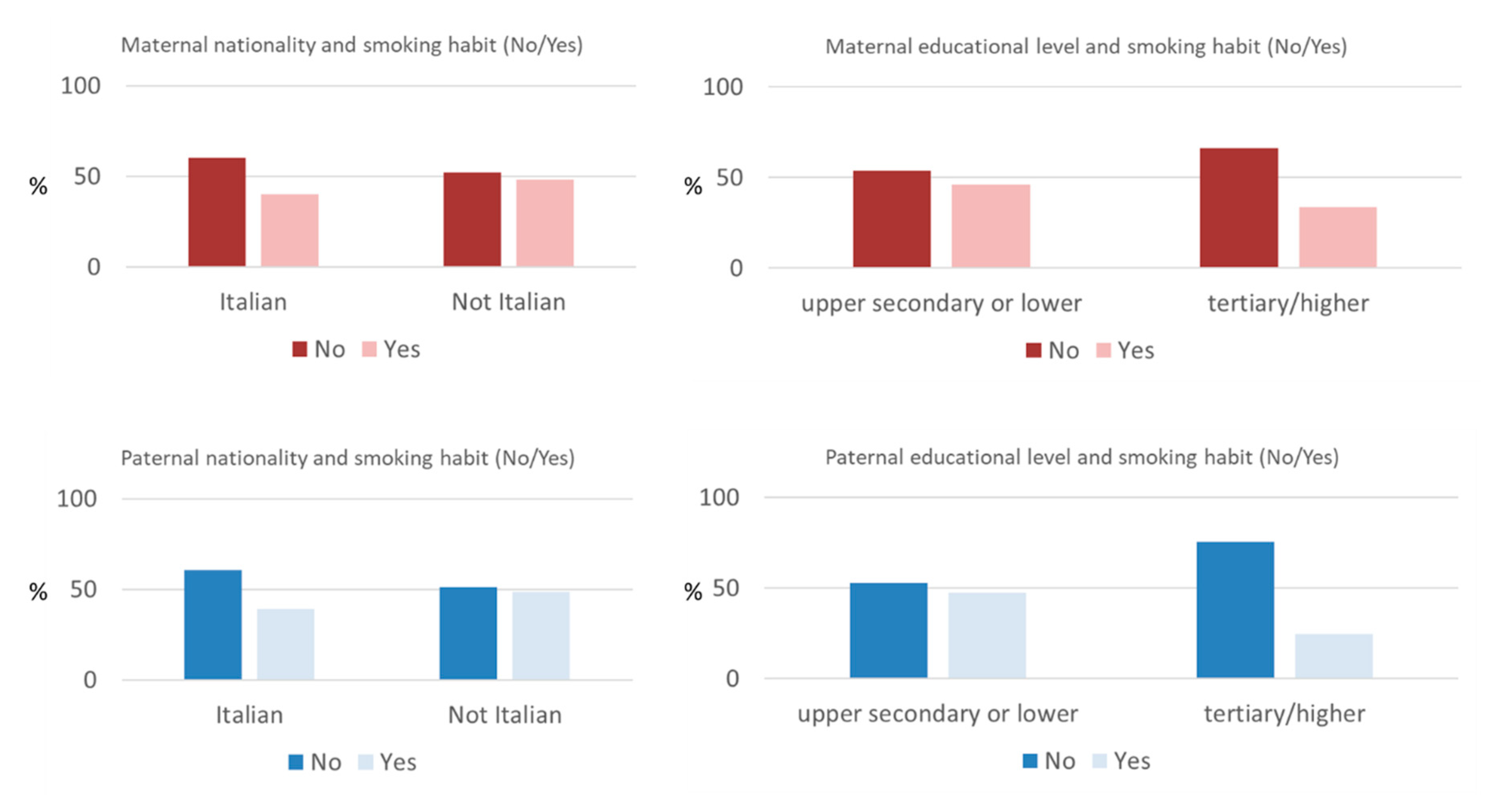
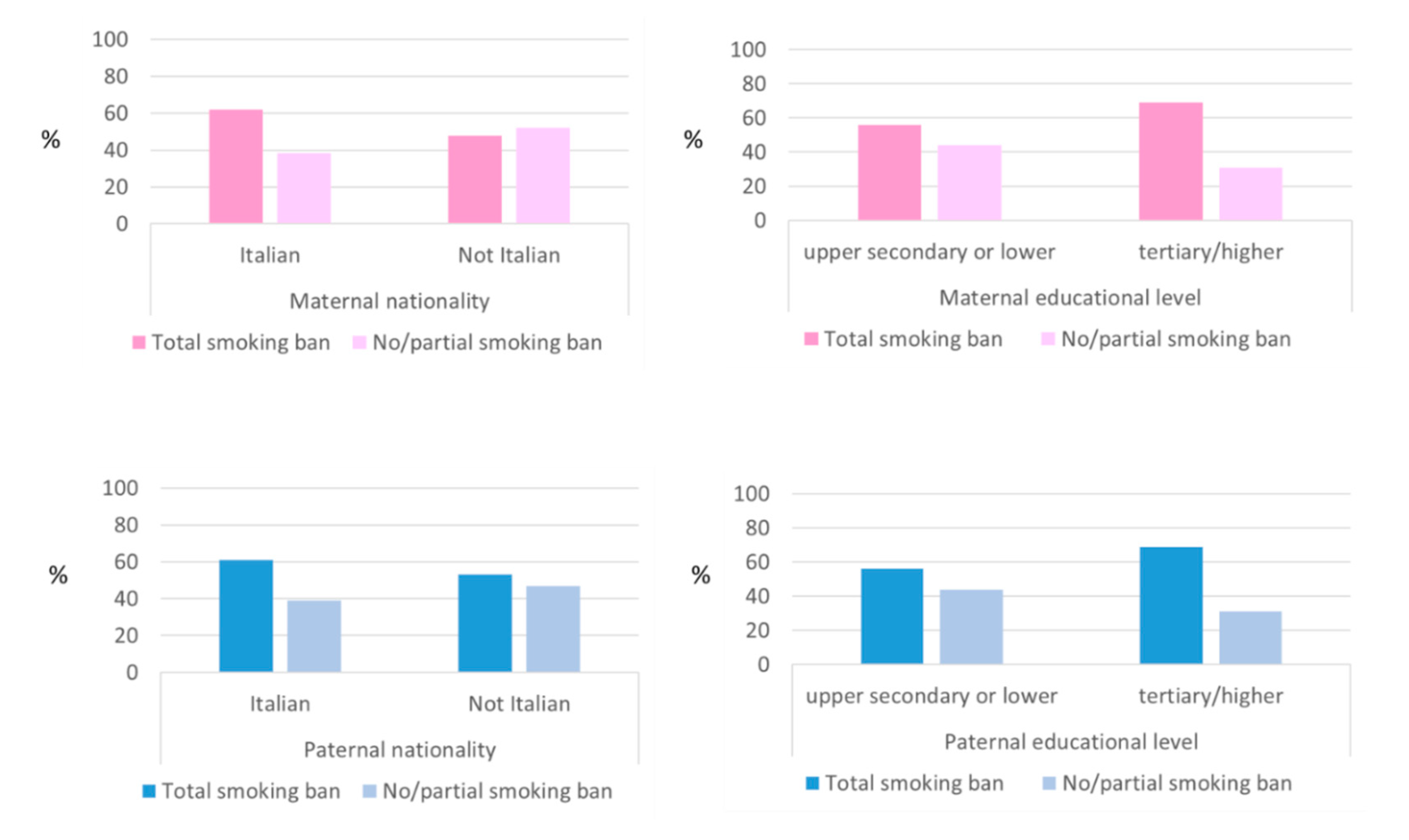
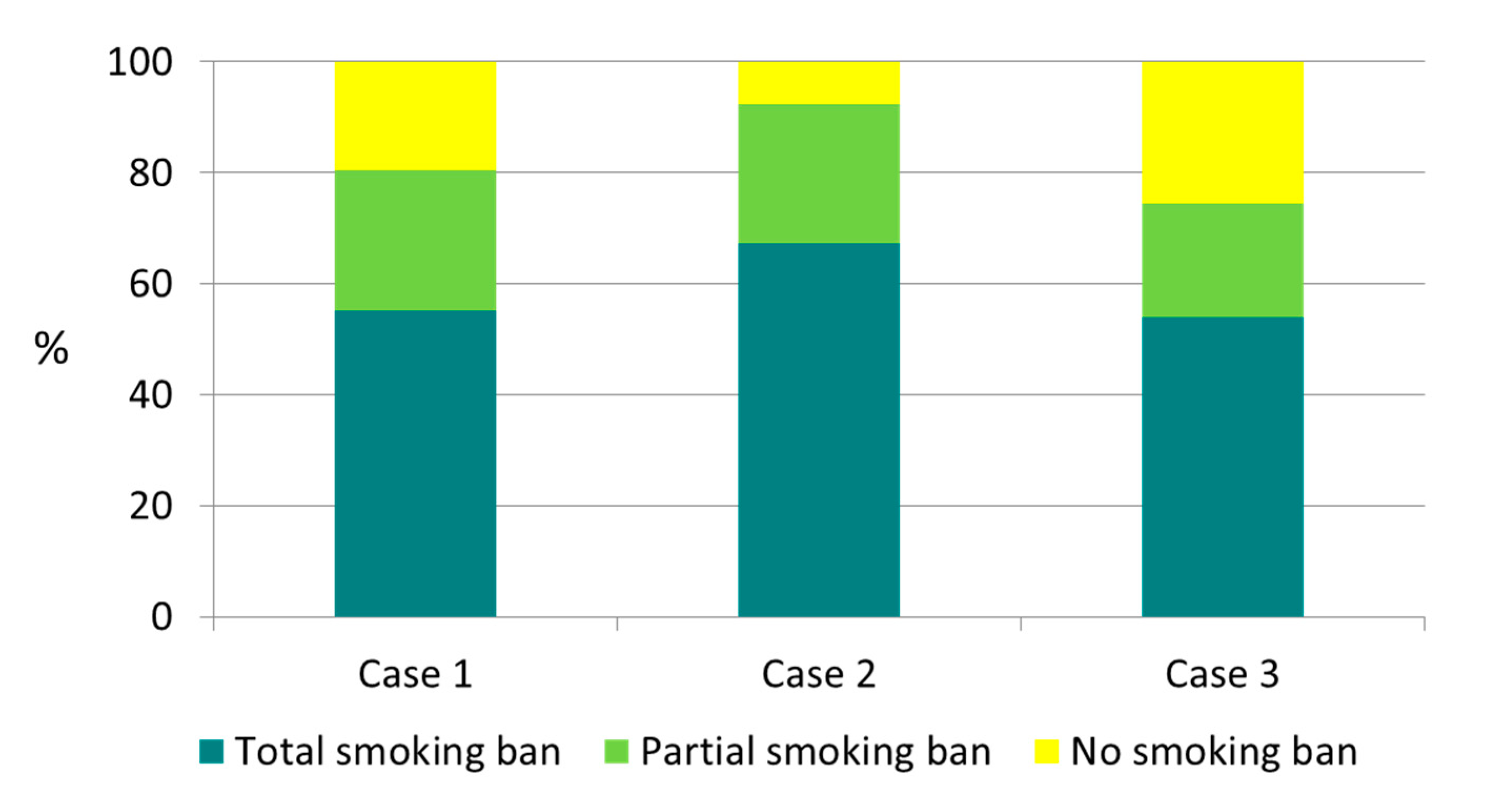

| Variable | Descriptives in % if not Stated Otherwise (N) | ||
|---|---|---|---|
| Whole Studied Population | Participants Exposed to Environmental Tobacco Smoke (ETS) | ||
| Age | Mean 8.24 (standard deviation 1.48) | Mean 8.19 (standard deviation 1.50) | |
| Gender | Male | 49.3 (N = 187) | 47.7 (N = 74) |
| Female | 50.7 (N = 192) | 52.3 (N = 81) | |
| Maternal nationality | Italian | 84.7 (N = 321) | 81.3 (N = 126) |
| Not Italian | 15.3 (N = 58) | 18.7 (N = 29) | |
| Paternal nationality | Italian | 86.8 (N = 329) | 82.6 (N = 128) |
| Not Italian | 13.2 (N = 156) | 17.4 (N = 27) | |
| Maternal education (years) | Basic (≤9 years) | 15.6 (N = 59) | 20.0 (N = 31) |
| Upper secondary (≤14 years) | 47.8 (N = 181) | 52.3 (N = 81) | |
| Tertiary/higher (≥17 years) | 33.2 (N = 126) | 27.1 (N = 42) | |
| Unknown | 3.4 (N = 13) | 0.6 (N = 1) | |
| Paternal education (years) | Basic (≤9 years) | 26.4 (N = 100) | 34.8 (N = 54) |
| Upper secondary (≤14 years) | 45.1 (N = 171) | 47.7 (N = 74) | |
| Tertiary/higher (≥17 years) | 23.8 (N = 90) | 14.2 (N = 22) | |
| Unknown | 4.7 (N = 18) | 3.3 (N = 5) | |
| Exposure to ETS | Not exposed | 58.9 (N = 224) | 0 (N = 0) |
| Exposed | 41.1 (N = 155) | 100 (N = 155) | |
| Number of cohabitant smoker(s) | 1 | - | 70.3 (N = 109) |
| >1 | - | 29.7 (N = 46) | |
| Home smoking policy | Total smoking ban | - | 58.7 (N = 91) |
| Partial smoking ban | - | 20.0 (N = 31) | |
| No smoking ban | - | 18.7 (N = 29) | |
| Unknown | - | 2.6 (N = 4) | |
| Number of cigarettes smoked in total/day | - | Mean 15.94 (standard deviation 9.71) | |
| Number of cigarettes smoked at home/day | - | Mean 2.46 (standard deviation 4.20) | |
| Number of cigarettes smoked at home in the presence of child/day | - | Mean 0.94 (standard deviation 2.85) | |
| Independent Variables | Adjusted 1 OR (95% CI) | p | |
|---|---|---|---|
| Maternal nationality | Italian | 0.844 (0.365, 1.953) | 0.692 |
| Not Italian | Reference | ||
| Paternal nationality | Italian | 0.809 (0.310, 2.110) | 0.664 |
| Not Italian | Reference | ||
| Maternal education (years) | Upper secondary (≤14 years) | 1.254 (1.098, 1.908) | 0.046 |
| Tertiary/higher (≥17 years) | Reference | ||
| Paternal education (years) | Upper secondary (≤14 years) | 2.0603 (1.458, 4.647) | 0.001 |
| Tertiary/higher (≥17 years) | Reference | ||
| Independent Variables | Adjusted 1 OR (95% CI) | p | |
|---|---|---|---|
| Maternal nationality | Italian | 0.564 (0.155, 2.050) | 0.385 |
| Not Italian | Reference | ||
| Paternal nationality | Italian | 0.783 (0.175, 3.495) | 0.748 |
| Not Italian | Reference | ||
| Maternal education (years) | Upper secondary (≤14 years) | 1.656 (0.754, 3.636) | 0.209 |
| Tertiary/higher (≥17 years) | Reference | ||
| Paternal education (years) | Upper secondary (≤14 years) | 0.861 (0.332, 2.231) | 0.758 |
| Tertiary/higher (≥17 years) | Reference | ||
© 2019 by the authors. Licensee MDPI, Basel, Switzerland. This article is an open access article distributed under the terms and conditions of the Creative Commons Attribution (CC BY) license (http://creativecommons.org/licenses/by/4.0/).
Share and Cite
Protano, C.; Cammalleri, V.; Antonucci, A.; Ungureanu, A.S.; Santilli, F.; Martellucci, S.; Mattei, V.; Vitali, M. Further Insights on Predictors of Environmental Tobacco Smoke Exposure during the Pediatric Age. Int. J. Environ. Res. Public Health 2019, 16, 4062. https://doi.org/10.3390/ijerph16214062
Protano C, Cammalleri V, Antonucci A, Ungureanu AS, Santilli F, Martellucci S, Mattei V, Vitali M. Further Insights on Predictors of Environmental Tobacco Smoke Exposure during the Pediatric Age. International Journal of Environmental Research and Public Health. 2019; 16(21):4062. https://doi.org/10.3390/ijerph16214062
Chicago/Turabian StyleProtano, Carmela, Vittoria Cammalleri, Arianna Antonucci, Alexandra Sabina Ungureanu, Francesa Santilli, Stefano Martellucci, Vincenzo Mattei, and Matteo Vitali. 2019. "Further Insights on Predictors of Environmental Tobacco Smoke Exposure during the Pediatric Age" International Journal of Environmental Research and Public Health 16, no. 21: 4062. https://doi.org/10.3390/ijerph16214062
APA StyleProtano, C., Cammalleri, V., Antonucci, A., Ungureanu, A. S., Santilli, F., Martellucci, S., Mattei, V., & Vitali, M. (2019). Further Insights on Predictors of Environmental Tobacco Smoke Exposure during the Pediatric Age. International Journal of Environmental Research and Public Health, 16(21), 4062. https://doi.org/10.3390/ijerph16214062

