The Impacts of Spatiotemporal Landscape Changes on Water Quality in Shenzhen, China



Abstract
:1. Introduction
2. Materials and Methods
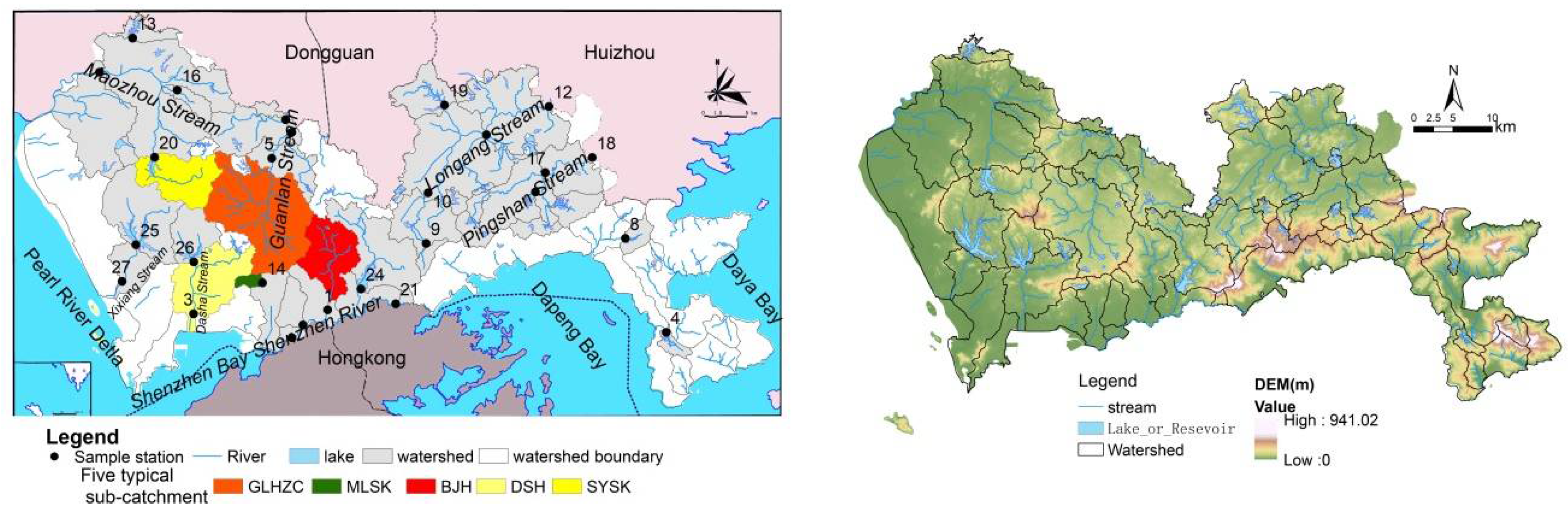
2.1. Site Description
2.2. Data Sources
2.3. Multivariate Statistical Analysis
2.4. Landscape Pattern Analysis
2.5. Panel Regression Analysis
3. Results
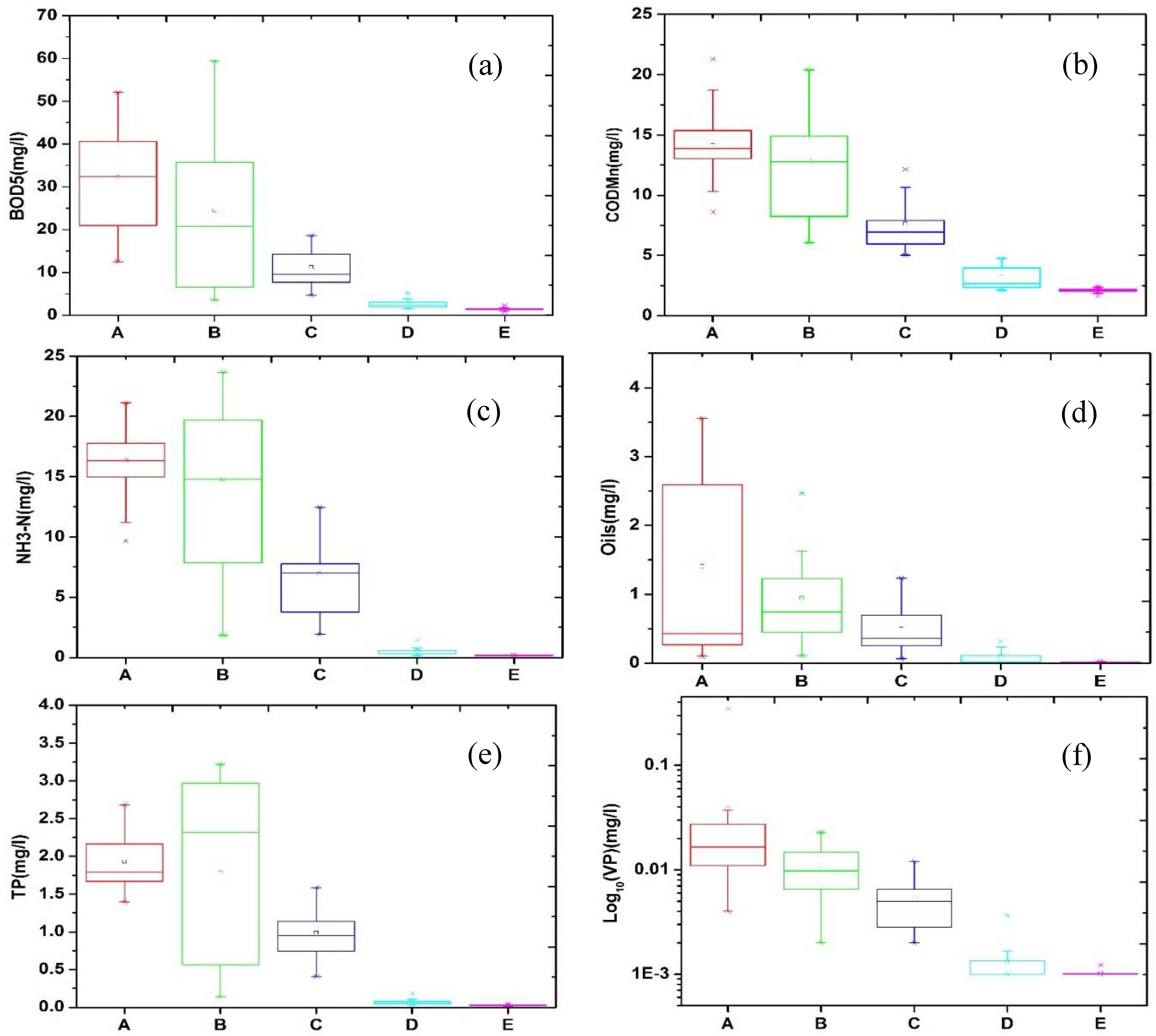
3.1. Spatial and Temporal Variations in Water Quality
3.2. Landscape Characteristics
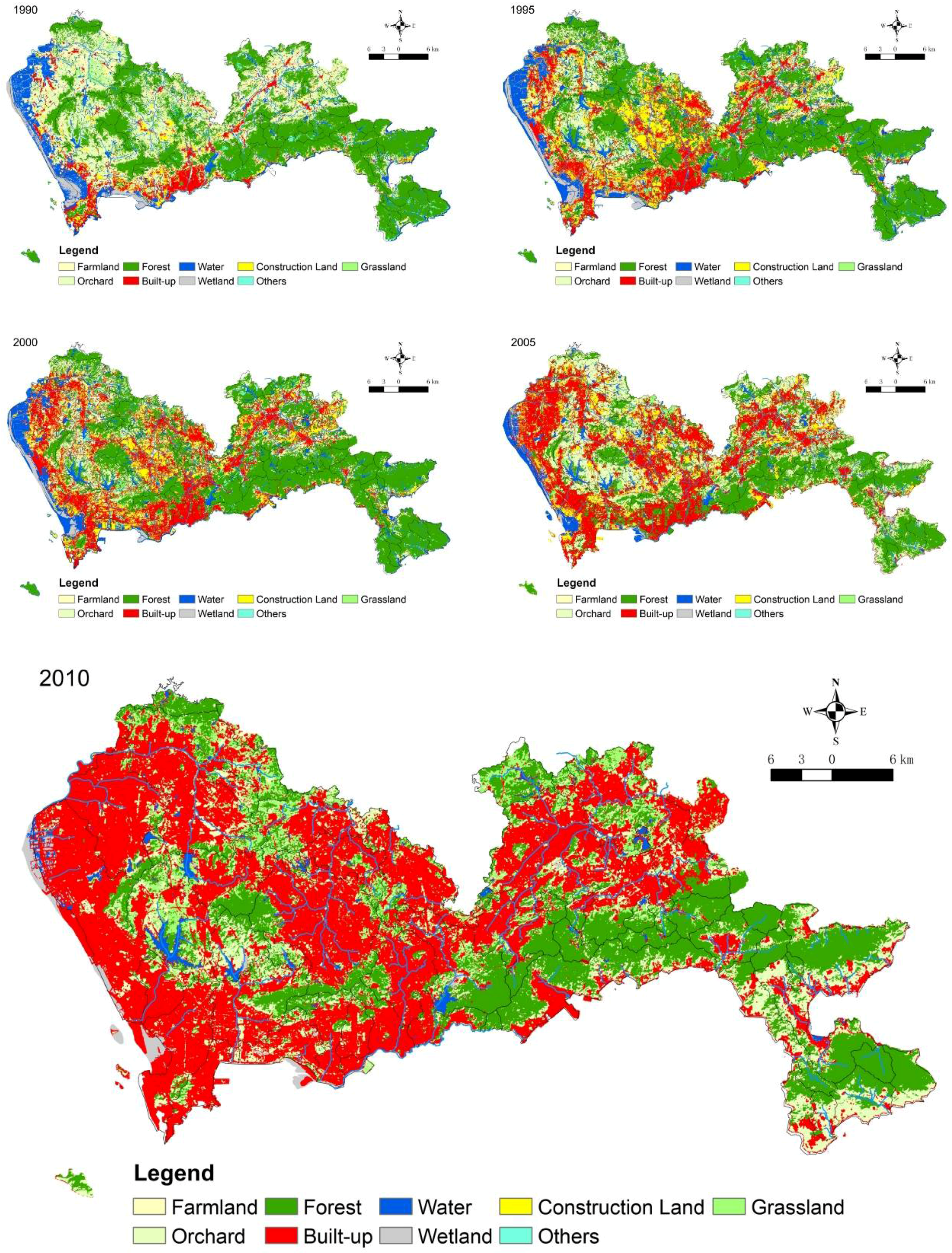
3.2.1. Changes in Watershed Landscape Patterns
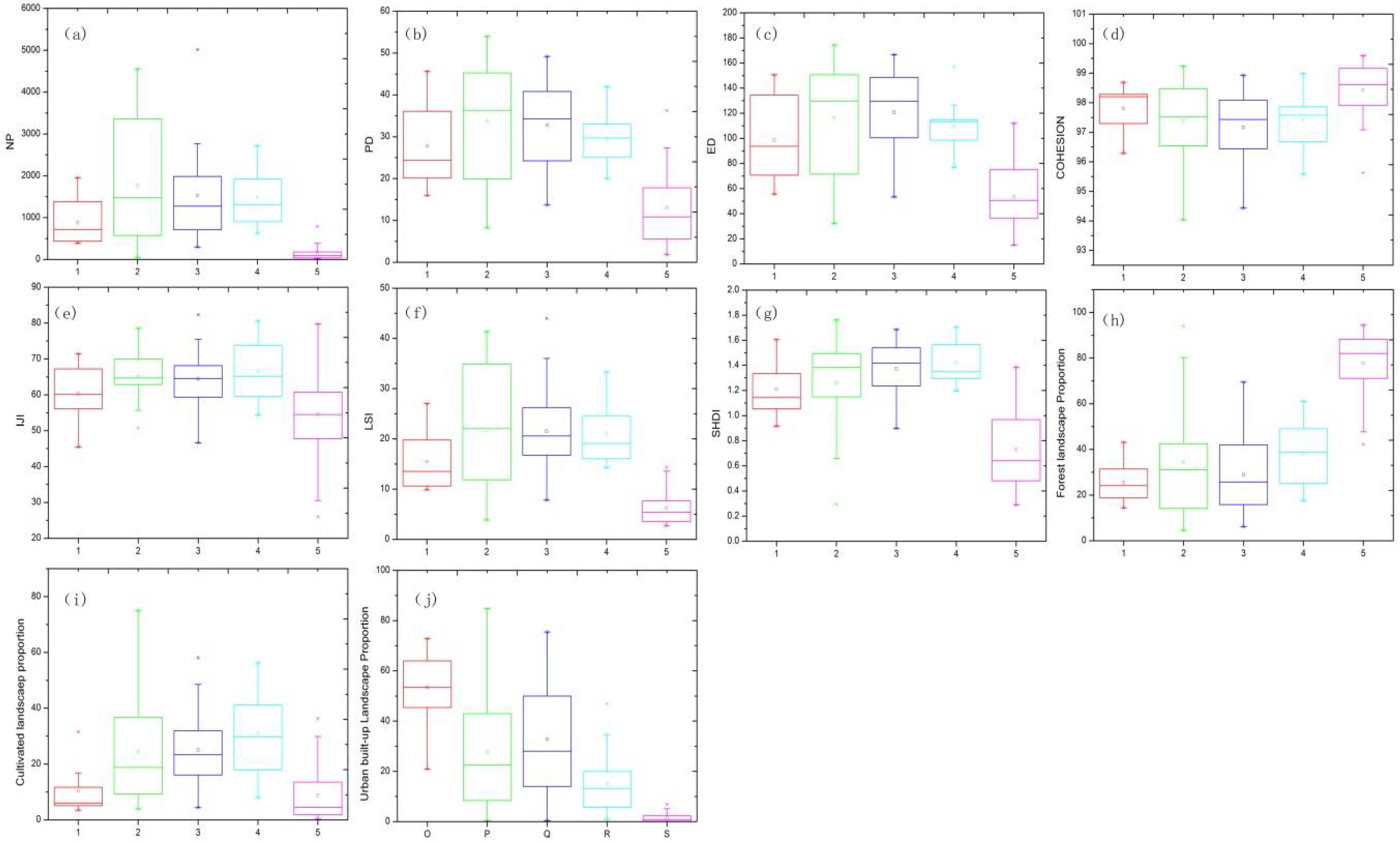
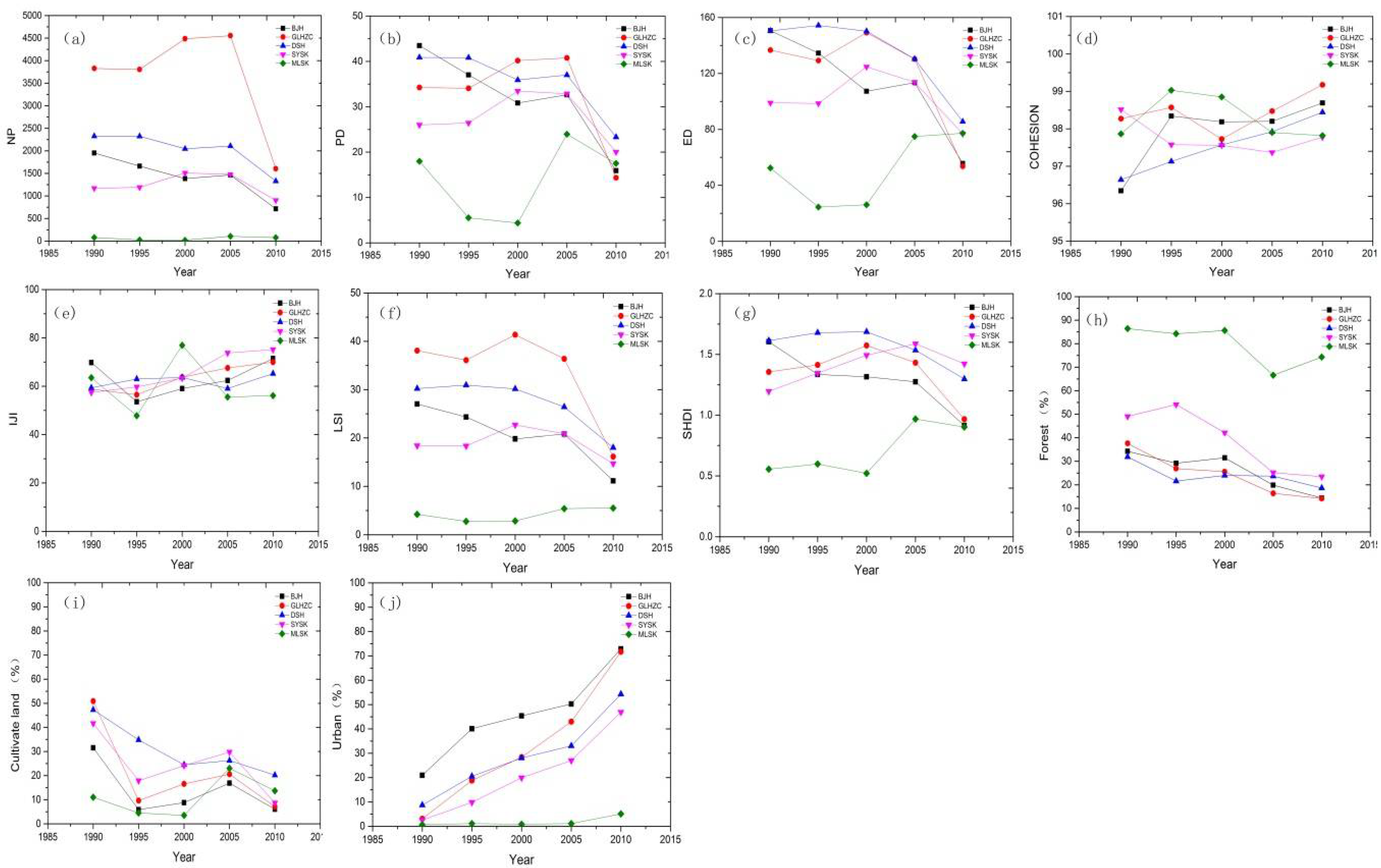
3.2.2. Temporal Changes in Landscape Patterns in Five Typical Catchments
3.3. Effects of Landscape Changes on Water Quality Degradation
4. Discussion
4.1. Relationships between Urban Landscape Changes and Water Quality
4.2. Policy Implications for Water Quality Management
5. Conclusions
- (1)
- A clear spatial and temporal distribution of water quality along with urban landscape change was identified in Shenzhen, which considerably affected stream water quality degradation during urbanization.
- (2)
- Water quality is sensitive to different landscape changes, particularly changes in urban and forest areas. Landscape composition change is an important process that affects water quality degradation; specifically, decreases in the proportions of cultivated and forest landscapes influence water quality changes more than increases in the proportions of urban built-up landscapes.
- (3)
- The landscape changes explained 39–58% of the variations in water quality based on different water quality parameters. The landscape configuration also influences water quality degradation, but landscape metrics are not highly correlated with water quality parameters, except for landscape fragment indices, such as NP and PD, which play significant roles.
- (4)
- Water quality degradation and landscape changes have kept pace with each other in sub-catchment, so reducing landscape fragmentation and enhancing the natural landscape composition at the watershed scale are of vital importance for improving water quality. Therefore, optimizing the landscape pattern is an alternative strategy for alleviating urban water quality degradation. The results of this study reflect the relationships between urban landscape development and stream water quality and can be used to improve water quality in urban areas.
Author Contributions
Acknowledgments
Conflicts of Interest
References
- Seto, K.C.; Satterthwaite, D. Interactions between urbanization and global environmental change. Curr. Opin. Environ. Sustain. 2010, 2, 127–128. [Google Scholar] [CrossRef]
- Alberti, M. Maintaining ecological integrity and sustaining ecosystem function in urban areas. Curr. Opin. Environ. Sustain. 2010, 2, 178–184. [Google Scholar] [CrossRef]
- Qin, H.; Su, Q.; Khu, S.; Tang, N. Water quality changes during rapid urbanization in the Shenzhen river catchment: An integrated view of socio-economic and infrastructure development. Sustainability 2014, 6, 7433–7451. [Google Scholar] [CrossRef]
- Xiao, R.; Wang, G.; Zhang, Q.; Zhang, Z. Multi-scale analysis of relationship between landscape pattern and urban river water quality in different seasons. Sci. Rep. 2016, 6, 25250. [Google Scholar] [CrossRef] [PubMed]
- Li, Y.; Li, Y.; Wu, W. Threshold and resilience management of coupled urbanization and water environmental system in the rapidly changing coastal region. Environ. Pollut. 2016, 208, 87–95. [Google Scholar] [CrossRef] [PubMed]
- Zhao, W.; Zhu, X.; Sun, X.; Shu, Y.; Li, Y. Water quality changes in response to urban expansion: Spatially varying relations and determinants. Environ. Sci. Pollut. Res. 2015, 22, 16997–17011. [Google Scholar] [CrossRef] [PubMed]
- Jarvie, H.P.; Oguchi, T.; Neal, C. Exploring the linkages between river water chemistry and watershed characteristics using GIS-based catchment and locality analyses. Reg. Environ. Chang. 2002, 3, 36–50. [Google Scholar] [CrossRef]
- Lee, S.W.; Hwang, S.J.; Lee, S.B.; Hwang, H.S.; Sung, H.C. Landscape ecological approach to the relationships of land use patterns in watersheds to water quality characteristics. Landsc. Urban Plan. 2009, 92, 80–89. [Google Scholar] [CrossRef]
- Alberti, M.; Booth, D.; Hill, K.; Coburn, B.; Avolio, C.; Coe, S.; Spirandelli, D. The impact of urban patterns on aquatic ecosystems: An empirical analysis in Puget lowland sub-basins. Landsc. Urban Plan. 2007, 80, 345–361. [Google Scholar] [CrossRef]
- Zhou, T.; Wu, J.; Peng, S. Assessing the effects of landscape pattern on river water quality at multiple scales: A case study of the Dongjiang River watershed, China. Ecol. Indic. 2012, 23, 166–175. [Google Scholar] [CrossRef]
- Shen, Z.; Hou, X.; Li, W.; Aini, G.; Chen, L.; Gong, Y. Impact of landscape pattern at multiple spatial scales on water quality: A case study in a typical urbanized watershed in China. Ecol. Indic. 2015, 48, 417–427. [Google Scholar] [CrossRef]
- Huang, J.; Huang, Y.; Zhang, Z. Coupled Effects of Natural and Anthropogenic Controls on Seasonal and Spatial Variations of River Water Quality during Baseflow in a Coastal Watershed of Southeast China. PLoS ONE 2014, 9, e91528. [Google Scholar] [CrossRef] [PubMed]
- Zhao, J.; Lin, L.; Yang, K.; Liu, Q.; Qian, G. Influences of land use on water quality in a reticular river network area: A case study in Shanghai, China. Landsc. Urban Plan. 2015, 137, 20–29. [Google Scholar] [CrossRef]
- Ding, J.; Jiang, Y.; Liu, Q.; Hou, Z.; Liao, J.; Fu, L.; Peng, Q. Influences of the land use pattern on water quality in low-order streams of the Dongjiang River basin, China: A multi-scale analysis. Sci. Total Environ. 2016, 551, 205–216. [Google Scholar] [CrossRef] [PubMed]
- Chen, X.; Zhou, W.; Pickett, S.T.; Li, W.; Han, L. Spatial-Temporal Variations of Water Quality and Its Relationship to Land Use and Land Cover in Beijing, China. Int. J Environ. Res. Public Health 2016, 13, 449. [Google Scholar] [CrossRef] [PubMed]
- Uriarte, M.; Yackulic, C.B.; Lim, Y.; Arce-Nazario, J.A. Influence of land use on water quality in a tropical landscape: A multi-scale analysis. Landsc. Ecol. 2011, 26, 1151–1164. [Google Scholar] [CrossRef] [PubMed]
- Nash, M.S.; Heggem, D.T.; Ebert, D.; Wade, T.G.; Hall, R.K. Multi-scale landscape factors influencing stream water quality in the state of Oregon. Environ. Monit. Assess. 2009, 156, 343–360. [Google Scholar] [CrossRef] [PubMed]
- Liu, Z.H.; Wang, Y.L.; Li, Z.G.; Peng, J. Impervious surface impact on water quality in the process of rapid urbanization in Shenzhen, China. Environ. Earth Sci. 2013, 68, 2365–2373. [Google Scholar] [CrossRef]
- Bu, H.; Meng, W.; Zhang, Y.; Wan, J. Relationships between land use patterns and water quality in the Taizi River basin, China. Ecol. Indic. 2014, 41, 187–197. [Google Scholar] [CrossRef]
- Peng, J.; Zhao, M.; Guo, X.; Pan, Y.; Liu, Y. Spatial-temporal dynamics and associated driving forces of urban ecological land: A case study in Shenzhen City, China. Habitat Int. 2017, 60, 81–90. [Google Scholar] [CrossRef]
- Jackson, R.B.; Carpenter, S.R.; Dahm, C.N.; McKnight, D.M.; Naiman, R.J.; Postel, S.L.; Running, S.W. Water in a changing world. Ecol. Appl. 2001, 11, 1027–1045. [Google Scholar] [CrossRef]
- Paul, M.J.; Meyer, J.L. Streams in the urban landscape. Annu. Rev. Ecol. Syst. 2001, 32, 333–365. [Google Scholar] [CrossRef]
- Liu, W.; Li, S.; Bu, H.; Zhang, Q.; Liu, G. Eutrophicatiosn in the Yunnan Plateau lakes: The influence of lake morphology, watershed land use, and socioeconomic factors. Environ. Sci. Pollut. Res. 2012, 19, 858–870. [Google Scholar] [CrossRef] [PubMed]
- Tian, L.; Chen, J.; Yu, S.X. Coupled dynamics of urban landscape pattern and socioeconomic drivers in Shenzhen, China. Landsc. Ecol. 2014, 29, 715–727. [Google Scholar] [CrossRef]
- Bai, X.M.; Chen, J.; Shi, P.J. Landscape urbanization and economic growth in China: Positive feedbacks and sustainability dilemmas. Environ. Sci. Technol. 2012, 46, 132–139. [Google Scholar] [CrossRef] [PubMed]
- Shi, P.; Yu, D. Assessing urban environmental resources and services of Shenzhen, China: A landscape-based approach for urban planning and sustainability. Landsc. Urban Plan. 2014, 25, 290–297. [Google Scholar] [CrossRef]
- Peng, J.; Liu, Y.; Wu, J.; Lv, H.; Hu, X. Linking ecosystem services and landscape patterns to assess urban ecosystem health: A case study in Shenzhen City, China. Landsc. Urban Plan. 2015, 143, 56–68. [Google Scholar] [CrossRef]
- Li, W.; Wang, Y.; Peng, J.; Li, G. Landscape spatial changes associated with rapid urbanization in Shenzhen, China. Int. J. Sustain. Dev. World 2005, 12, 314–325. [Google Scholar] [CrossRef]
- Shrestha, S.; Kazama, F. Assessment of surface water quality using multivariate statistical techniques: A case study of the Fuji river basin, Japan. Environ. Model. Softw. 2007, 22, 464–475. [Google Scholar] [CrossRef]
- McGarigal, K.; Cushman, S.A.; Ene, E. FRAGSTATS v4: Spatial Pattern Analysis Program for Categorical and Continuous Maps. Computer Software Program Produced by the Authors at the University of Massachusetts, Amherst, 2012. Available online: http://www.umass.edu/landeco/research/fragstats/fragstats.html (accessed on 12 December 2015).
- Zhou, P.; Huang, J.; Pontius, R.G.; Hong, H. New insight into the correlations between land use and water quality in a coastal watershed of China: Does point source pollution weaken it? Sci. Total Environ. 2016, 543, 591–600. [Google Scholar] [CrossRef] [PubMed]
- Dauer, D.M.; Ranasinghe, J.A.; Weisberg, S.B. Relationships between benthic community condition, water quality, sediment quality, nutrient loads, and land use patterns in Chesapeake Bay. Estuaries 2000, 23, 80–96. [Google Scholar] [CrossRef]
- Sliva, L.; Williams, D.D. Buffer zone versus whole catchment approaches to studying land use impact on river water quality. Water Res. 2001, 35, 3462–3472. [Google Scholar] [CrossRef]
- Uuemaa, E.; Roosaare, J.; Mander, Ü. Landscape metrics as indicators of river water quality at catchment scale. Hydrol. Res. 2007, 38, 125–138. [Google Scholar] [CrossRef]
- Chaplin-Kramer, R.; Hamel, P.; Sharp, R.; Kowal, V.; Wolny, S.; Sim, S.; Mueller, C. Landscape configuration is the primary driver of impacts on water quality associated with agricultural expansion. Environ. Res. Lett. 2016, 11, 074012. [Google Scholar] [CrossRef]
- Schauman, S.; Salisbury, S. Restoring nature in the city: Puget Sound experiences. Landsc. Urban Plan. 1998, 42, 287–295. [Google Scholar] [CrossRef]
- Li, S.; Gu, S.; Tan, X.; Zhang, Q. Water quality in the upper Han River basin, China: The impacts of land use/land cover in riparian buffer zone. J. Hazard. Mater. 2009, 165, 317–324. [Google Scholar] [CrossRef] [PubMed]
- Meyer, J.L.; Paul, M.J.; Taulbee, W.K. Stream ecosystem function in urbanizing landscapes. J. North Am. Benthol. Soc. 2005, 24, 602–612. [Google Scholar] [CrossRef]
- Qin, H.; Jiang, J.; Fu, G.; Zheng, Y. Optimal water quality management considering spatial and temporal variations in a tidal river. Water Resour. Manag. 2013, 27, 843–858. [Google Scholar] [CrossRef]
- Caccia, V.G.; Boyer, J.N. Spatial patterning of water quality in Biscayne Bay, Florida as a function of land use and water management. Mar. Pollut. Bull. 2005, 50, 1416–1429. [Google Scholar] [CrossRef] [PubMed]
- Praskievicz, S.; Chang, H. A review of hydrological modelling of basin-scale climate change and urban development impacts. Prog. Phys. Geogr. 2009, 33, 650–671. [Google Scholar] [CrossRef]
- Huang, G.H.; Xia, J. Barriers to sustainable water-quality management. J. Environ. Manag. 2001, 61, 1–23. [Google Scholar] [CrossRef] [PubMed]
- Turner, R.E.; Rabalais, N.N. Linking landscape and water quality in the Mississippi River basin for 200 years. BioScience 2003, 53, 563–572. [Google Scholar] [CrossRef]



| Water Quality Indicator | Obs. | Mean | S.D. | CV | Max. | Min. | National Quality Standards for Surface Waters in China (GB3838-2002) | ||||
|---|---|---|---|---|---|---|---|---|---|---|---|
| Level I | Level II | Level III | Level IV | Level V | |||||||
| CODMn | 540 | 6.21 | 6.02 | 0.97 | 27.90 | 1.09 | ≤2 | 4 | 6 | 10 | 15 |
| BOD5 | 540 | 10.33 | 16.35 | 1.58 | 100.1 | 0.50 | <3 | 3 | 4 | 6 | 10 |
| NH3-N | 540 | 5.44 | 8.02 | 1.47 | 37.56 | 0.03 | ≤1.5 | 0.5 | 1.0 | 1.5 | 2.0 |
| VP | 540 | 0.01 | 0.04 | 4.86 | 0.67 | 0.00 | <0.002 | 0.002 | 0.005 | 0.01 | 0.1 |
| Oils | 540 | 0.40 | 0.76 | 1.89 | 5.14 | 0.01 | <0.05 | 0.05 | 0.05 | 0.5 | 1.0 |
| TP | 540 | 0.67 | 1.04 | 1.55 | 4.95 | 0.01 | ≤0.02 | 0.1 | 0.2 | 0.3 | 0.4 |
| Landscape Indicator | Water Quality Indicator | |||||||||||
|---|---|---|---|---|---|---|---|---|---|---|---|---|
| Log(BOD5) | Log(CODMn) | Log(NH3-N) | Log(TP) | Log(VP) | Log(Oils) | |||||||
| Coefficient | Std. Err. | Coefficient | Std. Err. | Coefficient | Std. Err. | Coefficient | Std. Err. | Coefficient | Std. Err. | Coefficient | Std. Err. | |
| Log(NP) | −3.44 ** | 1.10 | −1.63 ** | 0.60 | −0.78 | 1.23 | 0.58 | 1.77 | −0.95 | 1.17 | −4.98 ** | 1.62 |
| Log(PD) | 4.37 *** | 1.22 | 2.03 ** | 0.67 | 1.26 | 1.37 | −0.93 | 2.03 | 1.97 | 1.30 | 5.44 ** | 1.78 |
| Log(ED) | −2.58 | 1.82 | −1.23 | 0.99 | 1.76 | 2.04 | 5.27 | 3.29 | −0.45 | 1.94 | −2.57 | 2.67 |
| Log(LSI) | 3.11 | 1.89 | 1.74 | 1.04 | −1.69 | 2.12 | −4.90 | 3.17 | −0.50 | 2.02 | 6.13 * | 2.83 |
| Log(IJI) | −0.51 | 0.71 | −0.57 | 0.39 | −0.11 | 0.80 | 1.82 | 1.18 | −1.47 * | 0.76 | 0.61 | 1.04 |
| Log(Cohesion) | 4.32 | 11.77 | −1.87 * | 6.46 | 12.65 | 13.20 | 42.97 * | 18.51 | 16.07 | 12.56 | 15.53 | 17.25 |
| Log(SHDI) | −1.05 | 0.90 | −1.06 * | 0.49 | −0.68 | 1.01 | −0.36 | 1.44 | 0.99 | 0.96 | −1.87 | 1.32 |
| Log(CultiP(%)) | −0.21 | 0.17 | −0.009 | 0.093 | −0.43 * | 0.19 | −4.82 | 0.26 | −0.37 * | 0.18 | −3.83 | 0.26 |
| Log(ForestP(%)) | −0.80 ** | 0.31 | −0.34 * | 0.17 | −0.75 * | 0.34 | −3.63 | 0.46 | −0.03 | 0.33 | 0.23 | 0.45 |
| Log(UrbanP(%)) | 0.14 | 0.11 | 0.07 | 0.06 | 0.01 | 0.13 | −0.48 ** | 0.18 | 0.13 | 0.12 | 0.16 | 0.187 |
| Constant | −0.94 | 54.68 | 18.87 | 30.00 | −55.35 | 61.37 | −215.47 | 86.84 | −69.32 | 58.37 | −65.38 | 80.24 |
| σu | 0.482 | 0.395 | 1.011 | 1.142 | 0.533 | 0.527 | ||||||
| σe | 0.733 | 0.403 | 0.823 | 1.099 | 0.783 | 1.067 | ||||||
| p | 0.301 | 0.491 | 0.601 | 0.519 | 0.317 | 0.195 | ||||||
| Within R2 | 0.16 | 0.10 | 0.14 | 0.05 | 0.14 | 0.16 | ||||||
| Between R2 | 0.77 | 0.74 | 0.69 | 0.55 | 0.74 | 0.83 | ||||||
| Overall R2 | 0.58 | 0.58 | 0.56 | 0.39 | 0.50 | 0.57 | ||||||
© 2018 by the authors. Licensee MDPI, Basel, Switzerland. This article is an open access article distributed under the terms and conditions of the Creative Commons Attribution (CC BY) license (http://creativecommons.org/licenses/by/4.0/).
Share and Cite
Liu, Z.; Yang, H. The Impacts of Spatiotemporal Landscape Changes on Water Quality in Shenzhen, China. Int. J. Environ. Res. Public Health 2018, 15, 1038. https://doi.org/10.3390/ijerph15051038
Liu Z, Yang H. The Impacts of Spatiotemporal Landscape Changes on Water Quality in Shenzhen, China. International Journal of Environmental Research and Public Health. 2018; 15(5):1038. https://doi.org/10.3390/ijerph15051038
Chicago/Turabian StyleLiu, Zhenhuan, and Haiyan Yang. 2018. "The Impacts of Spatiotemporal Landscape Changes on Water Quality in Shenzhen, China" International Journal of Environmental Research and Public Health 15, no. 5: 1038. https://doi.org/10.3390/ijerph15051038
APA StyleLiu, Z., & Yang, H. (2018). The Impacts of Spatiotemporal Landscape Changes on Water Quality in Shenzhen, China. International Journal of Environmental Research and Public Health, 15(5), 1038. https://doi.org/10.3390/ijerph15051038