

Primary Care Comprehensiveness Can Reduce Emergency Department Visits and Hospitalization in People with Hypertension in South Korea


Abstract
1. Introduction
2. Materials and Methods
2.1. Data Source
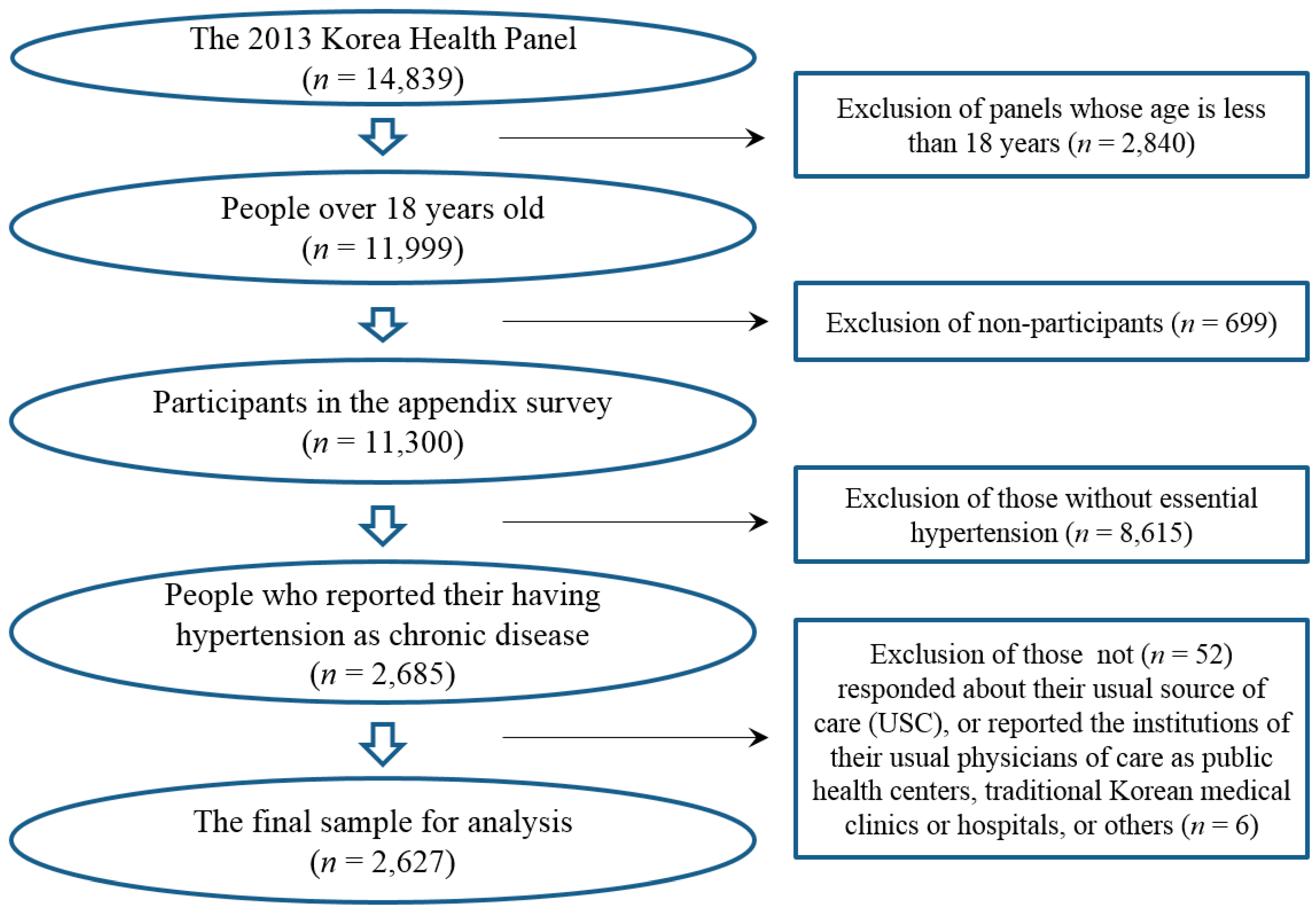
2.2. Sample Selection Process
2.3. Measurement
2.3.1. Sociodemographic Variables
2.3.2. Self-Rated Health Variable
2.3.3. Charlson Comorbidity Index
2.3.4. Variable of Interest
2.4. Statistical Analysis
3. Results
3.1. Sociodemographic Characteristics of Adults with Essential Hypertension by Types of Physicians as a Usual Source of Care
3.2. Adjusted ORs of Types of Physician as a USC for an Experience of ED Visits Within a Year
3.3. Adjusted ORs of Types of Physician as a USC for an Experience of Hospital Admission within a Year
4. Discussion
5. Conclusions
Author Contributions
Conflicts of Interest
References
- GBD 2013 Risk Factors Collaborators. Global, regional, and national comparative risk assessment of 79 behavioral, environmental and occupational, and metabolic risk factors or clusters of risks in 188 countries, 1990–2013: A systematic analysis for the Global Burden of Disease Study 2013. Lancet 2015, 386, 2287–2323. [Google Scholar]
- Aronow, W.S. Treatment of systemic hypertension. Am. J. Cardiovasc. Dis. 2012, 2, 160–170. [Google Scholar] [PubMed]
- Korea Centers for Disease Control and Prevention. The Report of Korea National Health and Nutrition Examination Survey. 2015. Available online: https://knhanes.cdc.go.kr/knhanes/sub04/sub04_03.do?classType=7 (accessed on 18 December 2017).
- Yoon, S.S.; Carroll, M.D.; Fryar, C.D. Hypertension prevalence and control among adults: United States, 2011–2014. NCHS Data Briefs 2015, 220, 1–8. [Google Scholar]
- WHO EMRO. High Blood Pressure and the Role of Primary Health Care. Available online: http://www.emro.who.int/pdf/world-health-days/2013/phc-factsheet-2013.pdf?ua=1 (accessed on 18 December 2017).
- Manns, B.J.; Tonelli, M.; Zhang, J.; Campbell, D.J.; Sargious, P.; Ayyalasomayajula, B.; Clement, F.; Johnson, J.A.; Laupacis, A.; Lewanczuk, R.; et al. Enrolment in primary care networks: Impact on outcomes and processes of care for patients with diabetes. CMAJ 2012, 184, E144–E152. [Google Scholar] [CrossRef] [Scilit] [PubMed]
- US Department of Health & Human Services. Medical Expenditure Panel Survey (MEPS) Topics: Usual Source of Care. Available online: http://meps.ahrq.gov/mepsweb/data_stats/MEPS_topics.jsp?topicid=44Z-1 (accessed on 26 December 2017).
- Dinkler, J.M.; Sugar, C.A.; Escarce, J.J.; Ong, M.K.; Mangione, C.M. Does age matter? Association between usual source of care and hypertension control in the US population: Data from NHANES 2007–2012. Am. J. Hypertens. 2016, 29, 934–940. [Google Scholar] [CrossRef] [Scilit] [PubMed]
- Spatz, E.S.; Ross, J.S.; Desai, M.M.; Canavan, M.E.; Krumholz, H.M. Beyond insurance coverage: Usual source of care in the treatment of hypertension and hypercholesterolemia. Data from the 2003–2006 National Health and Nutrition Examination Survey. Am. Heart J. 2010, 160, 115–121. [Google Scholar] [CrossRef] [Scilit] [PubMed]
- Starfield, B.; Shi, L. The medical home, access to care, and insurance: A review of evidence. Pediatrics 2004, 113, 1493–1498. [Google Scholar] [PubMed]
- Blewett, L.A.; Joonson, P.J.; Lee, B.; Scal, P.B. When a usual source of care and usual provider matter: Adult prevention and screening services. J. Gen. Intern. Med. 2008, 23, 1354–1360. [Google Scholar] [CrossRef] [Scilit] [PubMed]
- DeVoe, J.E.; Tillotson, C.J.; Wallace, L.S.; Lesko, S.E.; Pandhi, N. Is health insurance enough? A usual source of care may be more important to ensure a child to receive preventive health counseling. Matern. Child Health J. 2012, 16, 306–315. [Google Scholar] [CrossRef] [Scilit] [PubMed]
- Kim, K.M.; Jeon, H.; Lee, J.H. Having a physician rather than a place as a usual source of care would be better—From 2012 Korea Health Panel Data. J. Korean Med. Sci. 2017, 32, 4–12. [Google Scholar] [CrossRef] [Scilit] [PubMed]
- Ahn, S.H. Assessment of primary care level in Korea and comparison with the developed countries. J. Korean Acad. Fam. Med. 2001, 22, 483–497. [Google Scholar]
- Im, G.J.; Min, H.Y.; Choi, J.W.; Lim, S.M.; Park, Y.H. Financial state of primary care physicians under the Korean insurance system. J. Korean Med. Assoc. 2011, 54, 98–111. [Google Scholar] [CrossRef] [Scilit]
- Kwon, S. Thirty years of national health insurance in South Korea: Lessons for achieving universal health care coverage. Health Policy Plan. 2009, 24, 63–71. [Google Scholar] [CrossRef] [Scilit] [PubMed]
- Chun, C.B.; Kim, S.Y.; Lee, J.Y.; Lee, S.Y. Republic of Korea: Health system review. Health Syst. Trans. 2009, 11, 1–184. [Google Scholar]
- An, A.R.; Kim, K.; Lee, J.H.; Sung, N.J.; Lee, S.I.; Hyun, M.K. Having a usual source of care and its associated factors in Korean adults: A cross-sectional study of the 2012 Korea Health Panel Survey. BMC Fam. Pract. 2016, 17, 167. [Google Scholar] [CrossRef] [Scilit] [PubMed]
- Schoen, C.; Osborn, R.; Doty, M.M.; Bishop, M.; Peugh, J.; Murukutla, N. Toward higher-performance health systems: Adults’ health care experiences in seven countries, 2007. Health Aff. 2007, 26, w717–w734. [Google Scholar] [CrossRef] [Scilit] [PubMed]
- OECD. Health at a Glance 2017: OECD Indicators; OECD: Paris, France, 2017. Available online: http://dx.doi.org/10.1787/health_glance-2017-en (accessed on 26 December 2017).
- Jung, J.W.; Sung, N.J.; Park, K.H.; Kim, S.W.; Lee, J.H. Patients’ assessment of community primary and non-primary care physicians in Seoul city of South Korea. Korean J. Fam. Med. 2011, 32, 226–233. [Google Scholar] [CrossRef] [Scilit] [PubMed]
- Lee, J.Y.; Eun, S.J.; Kim, H.J.; Jo, M.W. Finding the primary care providers in the specialist-dominant primary care setting of Korea: A cluster analysis. PLoS ONE 2016, 11, e0161937. [Google Scholar] [CrossRef] [Scilit] [PubMed]
- Korea Health Panel. About Korea Health Panel. Available online: https://www.khp.re.kr:444/eng/main.do (accessed on 26 December 2017).
- Charlson, M.E.; Pompei, P.; Ales, K.L.; MacKenzie, C.R. A new method of classifying prognostic comorbidity in longitudinal studies: Development and validation. J. Chronic Dis. 1987, 40, 373–383. [Google Scholar] [CrossRef] [Scilit]
- Deyo, R.A.; Cherkin, D.C.; Ciol, M.A. Adapting a clinical comorbidity index for use with ICD-9-CM administrative databases. J. Clin. Epidemiol. 1992, 45, 613–619. [Google Scholar] [CrossRef] [Scilit]
- Quan, H.; Sundararajan, V.; Halfon, P.; Fong, A.; Burnand, B.; Luthi, J.C.; Saunders, L.D.; Beck, C.A.; Feasby, T.E.; Ghali, W.A. Coding algorithms for defining comorbidities in ICD-9-CM and ICD-10 administrative data. Med. Care 2005, 43, 1130–1139. [Google Scholar] [CrossRef] [Scilit] [PubMed]
- Jung, K.W.; Won, Y.J.; Kong, H.J.; Oh, C.M.; Shin, A.; Lee, J.S. Survival of Korean adult cancer patients by stage at diagnosis, 2006–2010: National cancer registry study. Cancer Res. Treat. 2013, 45, 162–171. [Google Scholar] [CrossRef] [Scilit] [PubMed]
- Kang, C.; Lee, J.H.; Kim, D.K.; Lee, C.; Oh, J.H. Current status of having a usual source of care and its associated factors in Korean adults with hypertension. Korean J. Fam. Pract. 2018. forthcoming. [Google Scholar]
- Starfield, B. Primary Care: Balancing Health Needs, Services, and Technology; Oxford University Press: New York, NY, USA, 1998; pp. 181–183. [Google Scholar]
- Macinko, J.; Starfield, B.; Shi, L. The contribution of primary care systems to health outcomes within Organization for Economic Cooperation and Development (OECD) countries, 1970–1998. Health Serv. Res. 2003, 38, 831–865. [Google Scholar] [CrossRef] [Scilit] [PubMed]
- Starfield, B.; Shi, L.; Macinko, J. Contribution of primary care to health systems and health. Milbank Q. 2005, 83, 457–502. [Google Scholar] [CrossRef] [Scilit] [PubMed]
- Masseria, C.; Irwin, R.; Thomson, S.; Gemmill, M.; Mossialos, E. Primary Care in Europe (Policy Brief); London School of Economics and Political Science: London, UK, 2009. [Google Scholar]
- Kringos, D.S.; Boerma, W.G.W.; Hutchinson, A.; Saltman, R.B. Building Primary Care in a Changing Europe; WHO Regional Office for Europe: Copenhagen, Denmark, 2015. [Google Scholar]
- Mossialos, E.; Djordjevic, A.; Osborn, R.; Sarnak, D. (Eds.) International Profiles of Health Care Systems; The Commonwealth Fund: New York, NY, USA, 2017; Available online: http://www.commonwealthfund.org/publications/fund-reports/2017/may/international-profiles (accessed on 26 December 2017).
- Organization for Economic Cooperation and Development. OECD Reviews of Health Care Quality; Korea 2012: Raising Standards; OECD Publishing: Paris, France, 2012; Available online: http://www.oecd.org/publications/oecd-reviews-of-health-care-quality-korea-9789264173446-en.htm (accessed on 26 December 2017).
- Wu, S.; Wang, R.; Zhao, Y.; Ma, X.; Wu, M.; Yan, X.; He, J. The relationship between self-rated health and objective health status: A population-based study. BMC Public Health 2013, 13, 320. [Google Scholar] [CrossRef] [Scilit] [PubMed]

| Disease | Diagnostic Codes Compatible to the ICD-10 Coding in the KHP Data | CCI Score |
|---|---|---|
| Diabetes mellitus | E10–E14 | 1 |
| Myocardial infarct | I21, I22, I25 | 1 |
| Congestive heart failure | I50 | 1 |
| Peripheral vascular disease | I70–I79 | 1 |
| Cerebrovascular disease | I60–I69 | 1 |
| Dementia | F03, G30 | 1 |
| Chronic pulmonary disease | J41, J42, J43, J44, J45, J47, J64 | 1 |
| Rheumatic or connective tissue disease | M30–M36, M06 | 1 |
| Gastric or peptic ulcer | K25, K26 | 1 |
| Mild liver disease | B18, B19, K70–K77 | 1 |
| Hemiplegia or paraplegia | G80, G81, G82 | 2 |
| Moderate or severe renal disease | N17–N19 | 2 |
| Any malignancy, including lymphoma and leukemia, except basal cell cancer of skin | C00–C41, C43, C45–C72, C74, C75, C81–C96 | 2 |
| Metastatic solid tumor | C76–C80 | 6 |
| Acquired immune deficiency syndrome | B20-B24 | 6 |
| Variables | Total | Not Having a Usual Physician | Comprehensive CCPs | Non-Comprehensive CCPs | Hospital Specialists | p | |
|---|---|---|---|---|---|---|---|
| n (%) | n (%) | n (%) | n (%) | n (%) | |||
| Age | 18–49 | 224 (12.1) | 144 (12.7) | 45 (11.4) | 15 (12.9) | 20 (9.6) | 0.370 |
| 50–64 | 756 (37.1) | 457 (36.0) | 155 (36.8) | 52 (44.8) | 92 (39.1) | ||
| 65– | 1647 (50.8) | 1024 (51.3) | 352 (51.9) | 83 (42.3) | 188 (51.3) | ||
| Sex | Male | 1166 (46.8) | 728 (47.2) | 226 (43.5) | 64 (45.0) | 148 (52.0) | 0.201 |
| Female | 1461 (53.2) | 897 (52.8) | 326 (56.5) | 86 (55.0) | 152 (48.0) | ||
| Education (year) | –6 | 1196 (38.9) | 759 (40.3) | 249 (38.1) | 63 (34.9) | 125 (35.0) | 0.132 |
| 7–12 | 1097 (45.0) | 670 (43.9) | 240 (48.4) | 59 (42.5) | 128 (46.4) | ||
| 13– | 334 (16.1) | 196 (15.8) | 63 (13.5) | 28 (22.6) | 47 (18.6) | ||
| Household income (quintile) (missing, 1) | 1st (the lowest) | 765 (24.2) | 460 (23.4) | 199 (29.9) | 32 (18.9) | 74 (21.3) | 0.225 |
| 2nd | 599 (20.9) | 378 (21.1) | 116 (19.6) | 38 (22.3) | 67 (21.7) | ||
| 3rd | 507 (19.7) | 329 (20.4) | 91 (18.1) | 32 (21.6) | 55 (17.6) | ||
| 4th | 410 (17.7) | 242 (17.0) | 86 (18.2) | 25 (17.5) | 57 (20.7) | ||
| 5th (the highest) | 345 (17.5) | 216 (18.1) | 60 (14.2) | 22 (19.7) | 47 (18.7) | ||
| Marital status | Married | 1891 (74.0) | 1175 (74.0) | 389 (72.8) | 109 (77.4) | 218 (74.7) | 0.767 |
| Others 1 | 736 (26.0) | 450 (26.0) | 163 (27.2) | 41 (22.6) | 82 (25.3) | ||
| Health coverage (missing, 1) | Employed | 1696 (64.7) | 1055 (65.8) | 362 (65.9) | 94 (58.0) | 185 (60.1) | 0.029 |
| Self-employed | 690 (26.6) | 433 (26.1) | 137 (25.0) | 46 (36.2) | 74 (26.7) | ||
| Medical Aid or others 2 | 240 (8.7) | 136 (8.1) | 53 (9.1) | 10 (5.8) | 41 (13.2) | ||
| Self-rated health (missing, 99) | Good | 687 (28.0) | 443 (29.5) | 150 (29.2) | 31 (22.4) | 63 (21.8) | 0.018 |
| Moderate | 1119 (45.7) | 671 (45.2) | 252 (46.5) | 77 (52.7) | 119 (43.0) | ||
| Poor | 722 (26.3) | 438 (25.4) | 135 (24.3) | 39 (24.9) | 110 (35.2) | ||
| CCI score | 0 | 1445 (57.5) | 937 (59.7) | 320 (61.5) | 91 (63.2) | 97 (35.7) | <0.001 |
| 1 | 763 (28.1) | 449 (27.0) | 168 (28.3) | 43 (25.7) | 103 (34.5) | ||
| 2 or higher | 419 (14.4) | 239 (13.3) | 64 (10.2) | 16 (11.1) | 100 (29.8) | ||
| ED visit, yearly | Yes | 289 (10.6) | 188 (11.1) | 43 (7.1) | 14 (11.5) | 44 (13.9) | 0.033 |
| No | 2338 (89.4) | 1437 (88.9) | 509 (92.9) | 136 (88.5) | 256 (86.1) | ||
| Admission, yearly | Yes | 501 (17.2) | 307 (16.9) | 82 (12.5) | 27 (18.7) | 85 (26.7) | <0.001 |
| No | 2126 (82.8) | 1318 (83.1) | 470 (87.5) | 123 (81.3) | 215 (73.3) | ||
| Total | 2627 (100) | 1625 (100) | 552 (100) | 150 (100) | 300 (100) | ||
| Variables | Model 1 | Model 2 | |||||
|---|---|---|---|---|---|---|---|
| OR | 95% CI | p | OR | 95% CI | p | ||
| Age | 18–49 | 1 | 1 | ||||
| 50–64 | 0.64 | 0.39–1.04 | 0.073 | 0.62 | 0.37–1.02 | 0.057 | |
| 65– | 0.81 | 0.49–1.34 | 0.413 | 0.73 | 0.44–1.23 | 0.242 | |
| Sex | Male | 1 | 1 | ||||
| Female | 0.95 | 0.68–1.32 | 0.749 | 0.92 | 0.66–1.29 | 0.623 | |
| Education (year) | –6 | 1 | 1 | ||||
| 7–12 | 0.92 | 0.64–1.32 | 0.642 | 0.99 | 0.68–1.43 | 0.942 | |
| 13– | 0.92 | 0.54–1.59 | 0.771 | 1.07 | 0.62–1.85 | 0.810 | |
| Household income (quintile) (missing, 1) | 1st (the lowest) | 1 | 1 | ||||
| 2nd | 1.13 | 0.74–1.72 | 0.580 | 1.12 | 0.73–1.72 | 0.600 | |
| 3rd | 0.85 | 0.53–1.39 | 0.523 | 0.92 | 0.56–1.50 | 0.723 | |
| 4th | 1.27 | 0.79–2.06 | 0.326 | 1.36 | 0.83–2.21 | 0.222 | |
| 5th (the highest) | 0.73 | 0.41–1.28 | 0.269 | 0.75 | 0.42–1.33 | 0.328 | |
| Marital status | Married | 1 | 1 | ||||
| Others | 1.32 | 0.93–1.87 | 0.118 | 1.31 | 0.92–1.86 | 0.132 | |
| Health coverage (missing, 1) | Employed | 1 | 1 | ||||
| Self-employed | 0.98 | 0.69–1.37 | 0.890 | 0.97 | 0.69–1.37 | 0.856 | |
| Medical Aid or others 1 | 1.70 | 1.02–2.85 | 0.044 | 1.36 | 0.80–2.31 | 0.261 | |
| Self-rated health (missing, 99) | Poor | 1 | |||||
| Moderate | 0.52 | 0.37–0.73 | < 0.001 | ||||
| Good | 0.40 | 0.27–0.61 | < 0.001 | ||||
| Charlson Comorbidity Index score | 0 | 1 | |||||
| 1 | 0.85 | 0.59–1.21 | 0.362 | ||||
| 2 or higher | 1.48 | 1.00–2.20 | 0.052 | ||||
| Types of physicians as a USC | Not having a usual physician | 1 | 1 | ||||
| CCPs, comprehensive | 0.59 | 0.39–0.89 | 0.013 | 0.61 | 0.40–0.93 | 0.023 | |
| CCPs, non-comprehensive | 1.09 | 0.61–1.95 | 0.780 | 1.08 | 0.60–1.95 | 0.803 | |
| Hospital specialists | 1.26 | 0.83–1.91 | 0.275 | 1.11 | 0.73–1.71 | 0.623 | |
| Hosmer and Lemeshow goodness-of-fit test | p = 0.834 | p = 0.183 | |||||
| Concordance index | C = 0.606 | C = 0.650 | |||||
| Variables | Model 1 | Model 2 | |||||
|---|---|---|---|---|---|---|---|
| OR | 95% CI | p | OR | 95% CI | p | ||
| Age | 18–49 | 1 | 1 | ||||
| 50–64 | 1.73 | 1.01–2.99 | 0.048 | 1.64 | 0.95–2.83 | 0.078 | |
| 65– | 2.54 | 1.47–4.40 | 0.001 | 2.23 | 1.28–3.89 | 0.005 | |
| Sex | Male | 1 | 1 | ||||
| Female | 0.86 | 0.66–1.13 | 0.277 | 0.84 | 0.64–1.11 | 0.227 | |
| Education (year) | –6 | 1 | 1 | ||||
| 7–12 | 0.88 | 0.66–1.18 | 0.383 | 0.93 | 0.70–1.26 | 0.650 | |
| 13– | 0.55 | 0.34–0.89 | 0.015 | 0.60 | 0.37–0.98 | 0.041 | |
| Household income (quintile) (missing, 1) | 1st (the lowest) | 1 | 1 | ||||
| 2nd | 0.79 | 0.56–1.12 | 0.187 | 0.78 | 0.55–1.10 | 0.153 | |
| 3rd | 0.76 | 0.52–1.11 | 0.157 | 0.79 | 0.54–1.16 | 0.232 | |
| 4th | 0.82 | 0.55–1.23 | 0.335 | 0.85 | 0.57–1.28 | 0.441 | |
| 5th (the highest) | 0.71 | 0.46–1.11 | 0.138 | 0.75 | 0.48–1.17 | 0.203 | |
| Marital status | Married | 1 | 1 | ||||
| Others | 0.98 | 0.73–1.32 | 0.888 | 0.98 | 0.73–1.33 | 0.914 | |
| Health coverage (missing, 1) | Employed | 1 | 1 | ||||
| Self-employed | 0.84 | 0.63–1.11 | 0.221 | 0.81 | 0.60–1.08 | 0.143 | |
| Medical Aid or others 1 | 1.41 | 0.91–2.18 | 0.130 | 1.11 | 0.71–1.75 | 0.640 | |
| Self-rated health (missing, 99) | Poor | 1 | |||||
| Moderate | 0.64 | 0.48–0.84 | 0.001 | ||||
| Good | 0.49 | 0.35–0.68 | < 0.001 | ||||
| Charlson Comorbidity Index score | 0 | 1 | |||||
| 1 | 1.41 | 1.07–1.87 | 0.015 | ||||
| 2 or higher | 1.81 | 1.30–2.53 | < 0.001 | ||||
| Types of physicians as a USC | Not having a usual physician | 1 | 1 | ||||
| CCPs, comprehensive | 0.66 | 0.48–0.92 | 0.015 | 0.69 | 0.49–0.96 | 0.027 | |
| CCPs, non-comprehensive | 1.26 | 0.78–2.05 | 0.342 | 1.28 | 0.79–2.09 | 0.316 | |
| Hospital specialists | 1.80 | 1.29–2.51 | 0.001 | 1.52 | 1.07–2.14 | 0.018 | |
| Hosmer and Lemeshow goodness-of-fit test | p = 0.076 | p = 0.220 | |||||
| Concordance index | C = 0.622 | C = 0.663 | |||||
© 2018 by the authors. Licensee MDPI, Basel, Switzerland. This article is an open access article distributed under the terms and conditions of the Creative Commons Attribution (CC BY) license (http://creativecommons.org/licenses/by/4.0/).
Share and Cite
Sung, N.-J.; Choi, Y.-J.; Lee, J.-H. Primary Care Comprehensiveness Can Reduce Emergency Department Visits and Hospitalization in People with Hypertension in South Korea. Int. J. Environ. Res. Public Health 2018, 15, 272. https://doi.org/10.3390/ijerph15020272
Sung N-J, Choi Y-J, Lee J-H. Primary Care Comprehensiveness Can Reduce Emergency Department Visits and Hospitalization in People with Hypertension in South Korea. International Journal of Environmental Research and Public Health. 2018; 15(2):272. https://doi.org/10.3390/ijerph15020272
Chicago/Turabian StyleSung, Nak-Jin, Yong-Jun Choi, and Jae-Ho Lee. 2018. "Primary Care Comprehensiveness Can Reduce Emergency Department Visits and Hospitalization in People with Hypertension in South Korea" International Journal of Environmental Research and Public Health 15, no. 2: 272. https://doi.org/10.3390/ijerph15020272
APA StyleSung, N.-J., Choi, Y.-J., & Lee, J.-H. (2018). Primary Care Comprehensiveness Can Reduce Emergency Department Visits and Hospitalization in People with Hypertension in South Korea. International Journal of Environmental Research and Public Health, 15(2), 272. https://doi.org/10.3390/ijerph15020272

