Adsorption of Pb(II) and Cu(II) by Ginkgo-Leaf-Derived Biochar Produced under Various Carbonization Temperatures and Times


Abstract
1. Introduction
2. Materials and Methods
2.1. Preparation of the Biochars
2.2. Characterization of the Produced Biochars
2.3. Metal Adsorption Experiments
3. Results
3.1. Elemental Compositions and pH of the Ginkgo-Leaf-Derived Biochars
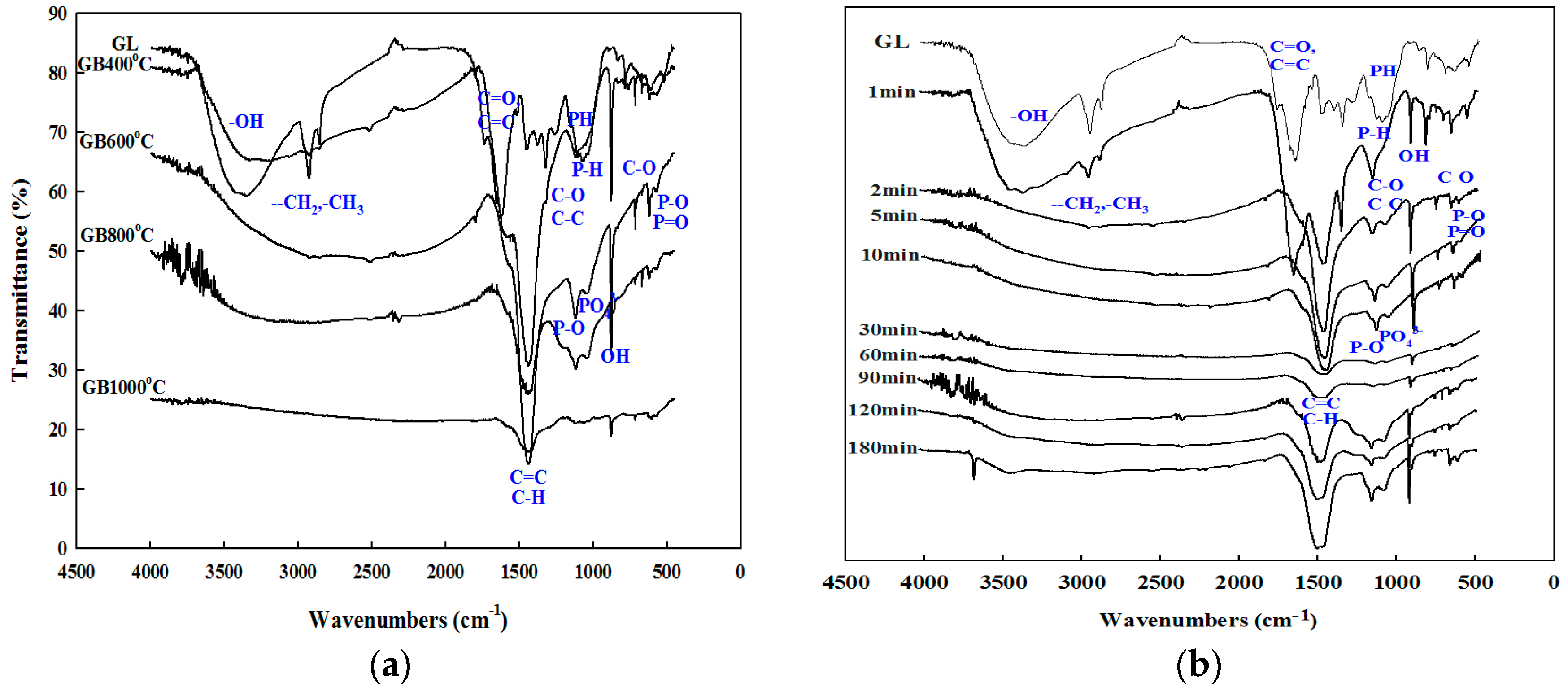
3.2. Functional Groups of the Ginkgo-Leaf-Derived Biochars
3.3. Lead(II) and Cu(II) Adsorption Characteristics of the Biochars
4. Discussion
5. Conclusions
Acknowledgments
Author Contributions
Conflicts of Interest
References
- Demirbas, A. Effects of temperature and particle size on bio-char yield from pyrolysis of agricultural residues. J. Anal. Appl. Pyrolysis 2004, 72, 243–248. [Google Scholar] [CrossRef] [Scilit]
- Song, W.; Guo, M. Quality variations of poultry litter biochar generated at different pyrolysis temperatures. J. Anal. Appl. Pyrolysis 2012, 94, 138–145. [Google Scholar] [CrossRef] [Scilit]
- Jeong, C.Y.; Dodla, S.K.; Wang, J.J. Fundamental and molecular composition characteristics of biochars produced from sugarcane and rice crop residues and by-products. Chemosphere 2016, 142, 4–13. [Google Scholar] [CrossRef] [Scilit] [PubMed]
- Lehmann, J. A handful of carbon. Nature 2007, 447, 143–144. [Google Scholar] [CrossRef] [Scilit] [PubMed]
- Sohi, S.P.; Krull, E.; Lopez-Capel, E.; Bol, R. A review of biochar and its use and function in soil. In Advances in Agronomy; Sparks, D.L., Ed.; Academic Press: Burlington, MA, USA, 2010; pp. 47–82. ISBN 978-0-12-381023-6. [Google Scholar]
- Spokas, K.A. Review of the stability of biochar in soils: Predictability of O:C molar ratios. Carbon Manag. 2010, 1, 289–303. [Google Scholar] [CrossRef] [Scilit]
- Yu, X.Y.; Ying, G.G.; Kookana, R.S. Reduced plant uptake of pesticides with biochar additions to soil. Chemosphere 2009, 76, 665–671. [Google Scholar] [CrossRef] [Scilit] [PubMed]
- Ahmad, M.; Lee, S.S.; Lim, J.E.; Lee, S.E.; Cho, J.S.; Moon, D.H.; Hashimoto, Y.; Ok, Y.S. Speciation and phytoavailability of lead and antimony in a small arms range soil amended with mussel shell, cow bone and biochar: EXAFS spectroscopy and chemical extractions. Chemosphere 2014, 95, 433–441. [Google Scholar] [CrossRef] [Scilit] [PubMed]
- Cao, X.; Ma, L.; Liang, Y.; Gao, B.; Harris, W. Simultaneous immobilization of lead and atrazine in contaminated soils using dairy-manure biochar. Environ. Sci. Technol. 2011, 45, 4884–4889. [Google Scholar] [CrossRef] [Scilit] [PubMed]
- Choi, I.W.; Seo, D.C.; Kang, S.W.; Lee, S.G.; Seo, Y.J.; Lim, B.J.; Heo, J.S.; Cho, J.S. Adsorption characteristics of heavy metals using sesame waste biochar. Korean J. Soil Sci. Fertil. 2013, 46, 8–15. [Google Scholar] [CrossRef] [Scilit]
- Xu, X.; Cao, X.; Zhao, L. Comparison of rice husk- and dairy manure-derived biochars for simultaneously removing heavy metals from aqueous solutions: Role of mineral components in biochars. Chemosphere 2013, 92, 955–961. [Google Scholar] [CrossRef] [Scilit] [PubMed]
- Chen, X.; Chen, G.; Chen, L.; Chen, Y.; Lehmann, J.; McBride, M.B.; Hay, A.G. Adsorption of copper and zinc by biochars produced from pyrolysis of hardwood and corn straw in aqueous solution. Bioresour. Technol. 2011, 102, 8877–8884. [Google Scholar] [CrossRef] [Scilit] [PubMed]
- Tong, X.J.; Li, J.Y.; Yuan, J.H.; Xu, R.K. Adsorption of Cu(II) by biochar generated from three crop straws. Chem. Eng. J. 2011, 172, 828–834. [Google Scholar] [CrossRef] [Scilit]
- Lee, S.; Park, J.H.; Ahn, Y.; Chung, J.W. Comparison of heavy metal adsorption by peat moss and peat moss-derived biochar produced under different carbonization conditions. Water Air Soil Pollut. 2015, 226, 9. [Google Scholar] [CrossRef] [Scilit]
- Ippolito, J.A.; Strawn, D.G.; Scheckel, K.G.; Novak, J.M.; Ahmedena, M.; Niandou, M.A.S. Macroscopic and molecular investigations of copper sorption by a steam-activated biochar. J. Environ. Qual. 2012, 41, 150–156. [Google Scholar] [CrossRef] [Scilit] [PubMed]
- Shinogi, Y.; Yoshida, H.; Koizumi, T.; Yamaok, M.; Saito, T. Basic characteristics of low temperature carbon products from waste sludge. Adv. Environ. Res. 2003, 7, 661–665. [Google Scholar] [CrossRef] [Scilit]
- Sun, L.; Wan, S.; Luo, W. Biochars prepared from anaerobic digestion residue, palm bark, and eucalyptus for adsorption of cationic methylene blue dye: Characterization, equilibrium, and kinetic studies. Bioresour. Technol. 2013, 140, 406–413. [Google Scholar] [CrossRef] [Scilit] [PubMed]
- Yaman, S. Pyrolysis of biomass to produce fuels and chemical feedstocks. Energy Convers. Manag. 2004, 45, 651–671. [Google Scholar] [CrossRef] [Scilit]
- Singh, G.; Rana, D.; Matsuura, T.; Ramakrishna, S.; Narbaitz, R.M.; Tabe, S. Removal of disinfection byproducts from water by carbonized electrospun nanofibrous membranes. Sep. Purif. Technol. 2010, 74, 202–212. [Google Scholar] [CrossRef] [Scilit]
- Al-Wabel, M.I.; Al-Omran, A.; El-Naggar, A.H.; Nadeem, M.; Usman, A.R.A. Pyrolysis temperature induced changes in characteristics and chemical composition of biochar produced from conocarpus wastes. Bioresour. Technol. 2013, 131, 374–379. [Google Scholar] [CrossRef] [Scilit] [PubMed]
- Stefaniuk, M.; Olesczuk, P. Characterization of biochars produced from residues from biogas production. J. Anal. Appl. Pyrolysis 2015, 115, 157–165. [Google Scholar] [CrossRef] [Scilit]
- Chen, J.P.; Wu, S. Acid/base-treated activated carbons: Characterization of functional groups and metal adsorptive properties. Langmuir 2004, 20, 2233–2242. [Google Scholar] [CrossRef] [Scilit] [PubMed]
- Yuan, J.H.; Xu, R.K.; Zhang, H. The forms of alkalis in the biochar produced from crop residues at different temperatures. Bioresour. Technol. 2011, 102, 3488–3497. [Google Scholar] [CrossRef] [Scilit] [PubMed]
- Jindo, K.; Mizumoto, H.; Sawada, Y.; Sonoki, T. Physical and chemical characterization of biochars derived from different agricultural residues. Biogeosciences 2014, 11, 6613–6621. [Google Scholar] [CrossRef] [Scilit]
- Ahmad, M.; Lee, S.S.; Dou, X.; Mohan, D.; Sung, J.K.; Yang, J.E.; Ok, Y.S. Effects of pyrolysis temperature on soybean stover- and peanut shell-derived biochar properties and TCE adsorption in water. Bioresour. Technol. 2012, 118, 536–544. [Google Scholar] [CrossRef] [Scilit] [PubMed]
- Novak, J.M.; Lima, I.; Xing, B.; Gaskin, J.W.; Steiner, C.; Das, K.C.; Ahmedna, M.A.; Rehrah, D.; Watts, D.W.; Busscher, W.J.; et al. Characterization of designer biochar produced at different temperatures and their effects on a loamy sand. Ann. Environ. Sci. 2009, 3, 195–206. [Google Scholar]
- Rafiq, M.K.; Bachmann, R.T.; Rafiq, M.T.; Shang, Z.; Joseph, S.; Long, R. Influence of pyrolysis temperature on physico-chemical properties of corn stover (Zea mays L.) biochar and feasibility for carbon capture and energy balance. PLoS ONE 2016, 11, e0156894. [Google Scholar] [CrossRef] [Scilit] [PubMed]
- Gai, X.; Wang, H.; Liu, J.; Zhai, L.; Liu, S.; Ren, T.; Liu, H. Effects of feedstock and pyrolysis temperature on biochar adsorption of ammonium and nitrate. PLoS ONE 2014, 9, e113888. [Google Scholar] [CrossRef] [Scilit] [PubMed]
- Krumins, J.; Klavins, M.; Seglins, V. Comparative study of peat composition by using FT-IR spectroscopy. Mater. Sci. Appl. Chem. 2012, 26, 106–114. [Google Scholar]
- Cao, X.D.; Harris, W. Properties of dairy-manure-derived biochar pertinent to its potential use in remediation. Bioresour. Technol. 2010, 101, 5222–5228. [Google Scholar] [CrossRef] [Scilit] [PubMed]
- Socrates, G. Infrared and Raman Characteristic Group Frequencies: Tables and Charts, 3rd ed.; John Wily & Sons Ltd.: Chichester, UK, 2004; ISBN 978-0-470-09307-8. [Google Scholar]
- Kennedy, L.J.; Vijaya, J.J.; Sekaran, G. Effect of two-stage process on the preparation and characterization of porous carbon composite from rice husk by phosphoric acid activation. Ind. Eng. Chem. Res. 2004, 43, 1832–1838. [Google Scholar] [CrossRef] [Scilit]
- Bekiaris, G.; Peltre, C.; Jensen, L.S.; Bruun, S. Using FTIR-photoacoustic spectroscopy for phosphorus speciation analysis of biochars. Spectrochim. Acta Part A 2016, 168, 29–36. [Google Scholar] [CrossRef] [Scilit] [PubMed]
- Cantrell, K.B.; Hunt, P.G.; Uchimiya, M.; Novak, J.M.; Ro, K.S. Impact of pyrolysis temperature and manure source on physicochemical characteristics of biochar. Bioresour. Technol. 2012, 107, 419–428. [Google Scholar] [CrossRef] [Scilit] [PubMed]
- Echeverria, J.C.; Morera, M.T.; Mazkiaran, C.; Garrido, J.J. Competitive sorption of heavy metal by soils. Isotherms and fractional factorial experiments. Environ. Pollut. 1998, 101, 275–284. [Google Scholar] [CrossRef] [Scilit]
- Cao, X.; Ma, L.; Gao, B.; Harris, W. Dairy-manure derived biochar effectively sorbs lead and atrazine. Environ. Sci. Technol. 2009, 43, 3285–3291. [Google Scholar] [CrossRef] [Scilit] [PubMed]
- Hashimoto, Y.; Matsufuru, H.; Takaoka, M.; Tanida, H.; Sato, T. Impacts of chemical amendments and plant growth on lead speciation and enzyme activities in a shooting range soil: An X-ray absorption fine structure investigation. J. Environ. Qual. 2009, 38, 1420–1428. [Google Scholar] [CrossRef] [Scilit] [PubMed]
- Ryan, J.A.; Zhang, P.; Hesterberg, D.; Chou, J.; Sayers, D.E. Formation of chloropyromorphite in a lead-contaminated soil smended with hydroxyapatite. Environ. Sci. Technol. 2001, 35, 3798–3803. [Google Scholar] [CrossRef] [Scilit] [PubMed]
- Gheorghe, C.; Marculescu, C.; Badea, A.; Dinca, C.; Apostol, T. Effect of Pyrolysis Conditions on Bio-Char Production from Biomass. In Proceedings of the 3rd WSEAS International Conference on Renewable Energy Sources, Tenerife, Canary Islands, Spain, 1–3 July 2009; pp. 239–241. [Google Scholar]
- Park, J.H.; Lee, S.J.; Lee, M.E.; Chung, J.W. Comparison of heavy metal immobilization in contaminated soils amended with peat moss and peat moss-derived biochar. Environ. Sci. Process. Impacts 2016, 18, 514–520. [Google Scholar] [CrossRef] [Scilit] [PubMed]


| Sample | Carbonization Temperature (°C) | Elemental Composition (%) | Atomic Ratio | pH | |||||||
|---|---|---|---|---|---|---|---|---|---|---|---|
| C | H | N | S | O | Ash | O/C | H/C | (O + N)/C | |||
| GL | 45.14 | 5.54 | 1.21 | 0.73 | 33.99 | 13.40 | 0.565 | 1.473 | 0.588 | 4.60 | |
| GB | 400 | 51.15 | 2.07 | 1.37 | 1.02 | 16.38 | 28.02 | 0.240 | 0.486 | 0.263 | 10.19 |
| 600 | 48.14 | 3.81 | 1.29 | 0.87 | 17.31 | 32.63 | 0.270 | 0.950 | 0.293 | 10.72 | |
| 800 | 42.48 | 0.47 | 1.65 | 1.85 | 17.96 | 35.60 | 0.317 | 0.133 | 0.350 | 12.43 | |
| 1000 | 43.34 | 0.33 | 0.78 | 2.19 | 6.81 | 46.56 | 0.118 | 0.091 | 0.133 | 12.90 | |
| Elemental Composition (%) | Carbonization Time (min) | ||||||||
|---|---|---|---|---|---|---|---|---|---|
| 1 | 2 | 5 | 10 | 30 | 60 | 90 | 120 | 180 | |
| C | 51.19 | 44.55 | 41.94 | 40.33 | 48.30 | 45.84 | 40.51 | 39.31 | 23.32 |
| H | 1.09 | 1.061 | 0.92 | 0.85 | 1.30 | 1.31 | 1.13 | 1.27 | 1.19 |
| N | 1.32 | 1.08 | 1.05 | 1.09 | 1.28 | 1.25 | 1.55 | 1.26 | 1.26 |
| S | 1.08 | 1.01 | 1.04 | 1.17 | 1.64 | 1.70 | 1.77 | 1.79 | 0.59 |
| O | 14.02 | 17.05 | 18.54 | 19.37 | 11.93 | 14.21 | 19.44 | 16.09 | 19.33 |
| Ash | 31.31 | 35.26 | 36.52 | 37.18 | 35.55 | 35.69 | 35.6 | 40.29 | 54.31 |
| Carbonization Temperature (°C) | Biochar Yield (%) | Equilibrium Adsorption Capacity (mg/g) | |
|---|---|---|---|
| Pb(II) | Cu(II) | ||
| Control (GL) | - | 24.81 ± 0.19 d | 11.71 ± 0.35 c |
| 400 | 34.63 ± 2.28 a | 51.13 ± 0.42 b | 14.28 ± 0.32 b |
| 600 | 29.47 ± 1.21 b | 56.53 ± 0.00 a | 9.88 ± 0.11 d |
| 800 | 26.90 ± 0.89 b | 57.55 ± 0.02 a | 18.22 ± 1.00 a |
| 1000 | 20.62 ± 3.88 c | 42.89 ± 2.76 c | 11.03 ± 0.72 c,d |
| Carbonization Time (min) | Biochar Yield (%) | Equilibrium Adsorption Capacity (mg/g) | |
|---|---|---|---|
| Pb(II) | Cu(II) | ||
| Control (GL) | - | 39.17 ± 0.74 f | 18.50 ± 0.71 b,c |
| 1 | 44.50 ± 0.37 a | 67.71 ± 1.30 d | 17.89 ± 1.09 c |
| 2 | 35.54 ± 0.46 b | 63.06 ± 3.53 e | 10.58 ± 1.52 e |
| 5 | 31.38 ± 0.65 c | 67.51 ± 0.61 d | 15.46 ± 1.99 d |
| 10 | 28.77 ± 0.44 d,e | 74.1 ± 0.31 c | 19.37 ± 0.57 b,c |
| 30 | 27.47 ± 0.12 e | 60.03 ± 1.89 e | 14.41 ± 0.75 d |
| 60 | 30.31 ± 0.16 c,d | 73.22 ± 1.86 c | 17.83 ± 0.18 c |
| 90 | 26.90 ± 0.89 e | 93.22 ± 1.63 a | 22.58 ± 0.20 a |
| 120 | 26.90 ± 0.31 e | 88.28 ± 0.26 b | 21.25 ± 0.64 b |
| 180 | 19.30 ± 2.96 f | 85.37 ± 0.52 b | 20.02 ± 0.28 b |
© 2017 by the authors. Licensee MDPI, Basel, Switzerland. This article is an open access article distributed under the terms and conditions of the Creative Commons Attribution (CC BY) license (http://creativecommons.org/licenses/by/4.0/).
Share and Cite
Lee, M.-E.; Park, J.H.; Chung, J.W. Adsorption of Pb(II) and Cu(II) by Ginkgo-Leaf-Derived Biochar Produced under Various Carbonization Temperatures and Times. Int. J. Environ. Res. Public Health 2017, 14, 1528. https://doi.org/10.3390/ijerph14121528
Lee M-E, Park JH, Chung JW. Adsorption of Pb(II) and Cu(II) by Ginkgo-Leaf-Derived Biochar Produced under Various Carbonization Temperatures and Times. International Journal of Environmental Research and Public Health. 2017; 14(12):1528. https://doi.org/10.3390/ijerph14121528
Chicago/Turabian StyleLee, Myoung-Eun, Jin Hee Park, and Jae Woo Chung. 2017. "Adsorption of Pb(II) and Cu(II) by Ginkgo-Leaf-Derived Biochar Produced under Various Carbonization Temperatures and Times" International Journal of Environmental Research and Public Health 14, no. 12: 1528. https://doi.org/10.3390/ijerph14121528
APA StyleLee, M.-E., Park, J. H., & Chung, J. W. (2017). Adsorption of Pb(II) and Cu(II) by Ginkgo-Leaf-Derived Biochar Produced under Various Carbonization Temperatures and Times. International Journal of Environmental Research and Public Health, 14(12), 1528. https://doi.org/10.3390/ijerph14121528