

Control of Pollutants in the Trans-Boundary Area of Taihu Basin, Yangtze Delta

Abstract
:1. Introduction
2. Research Materials
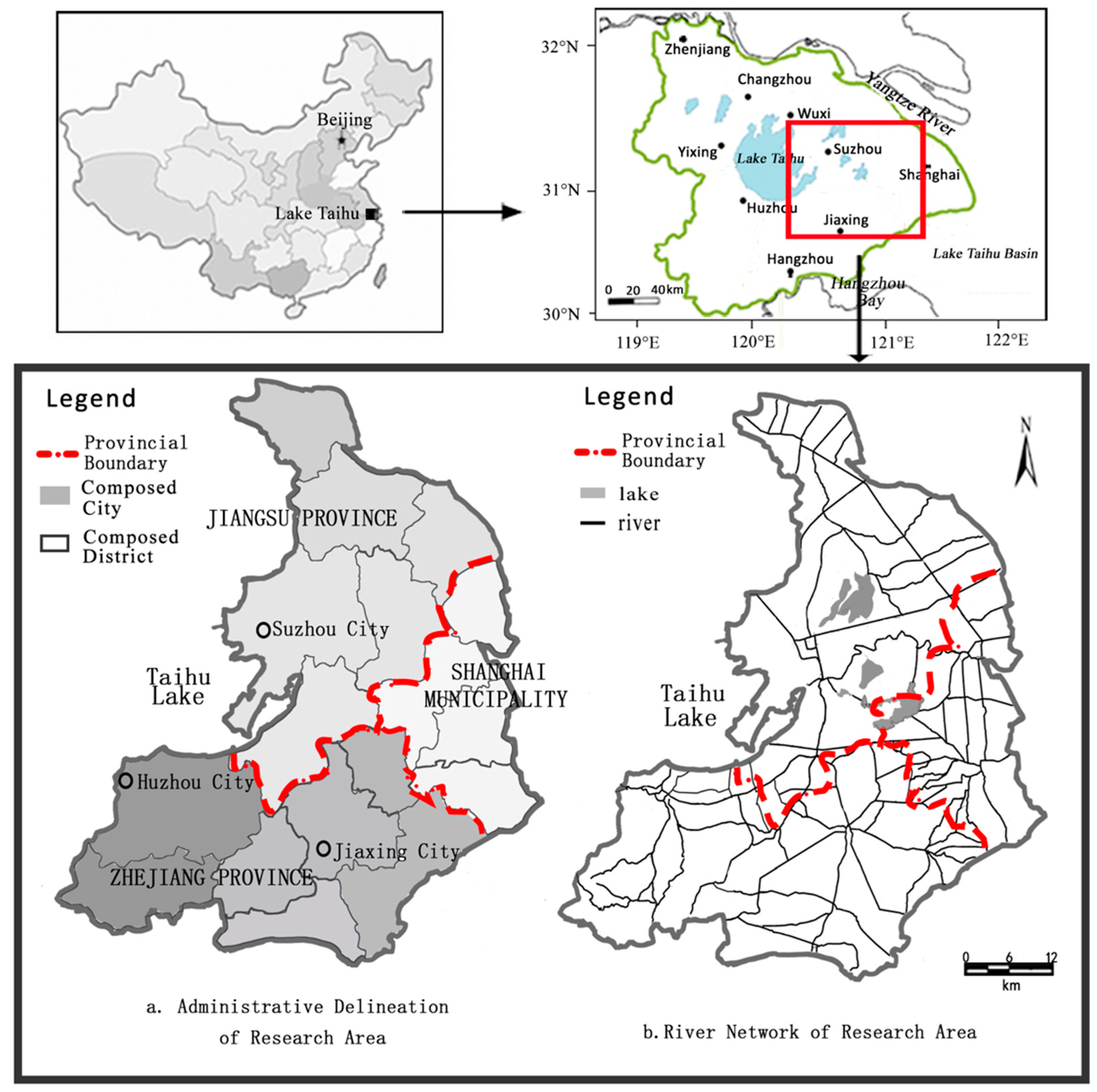
2.1. Study Area
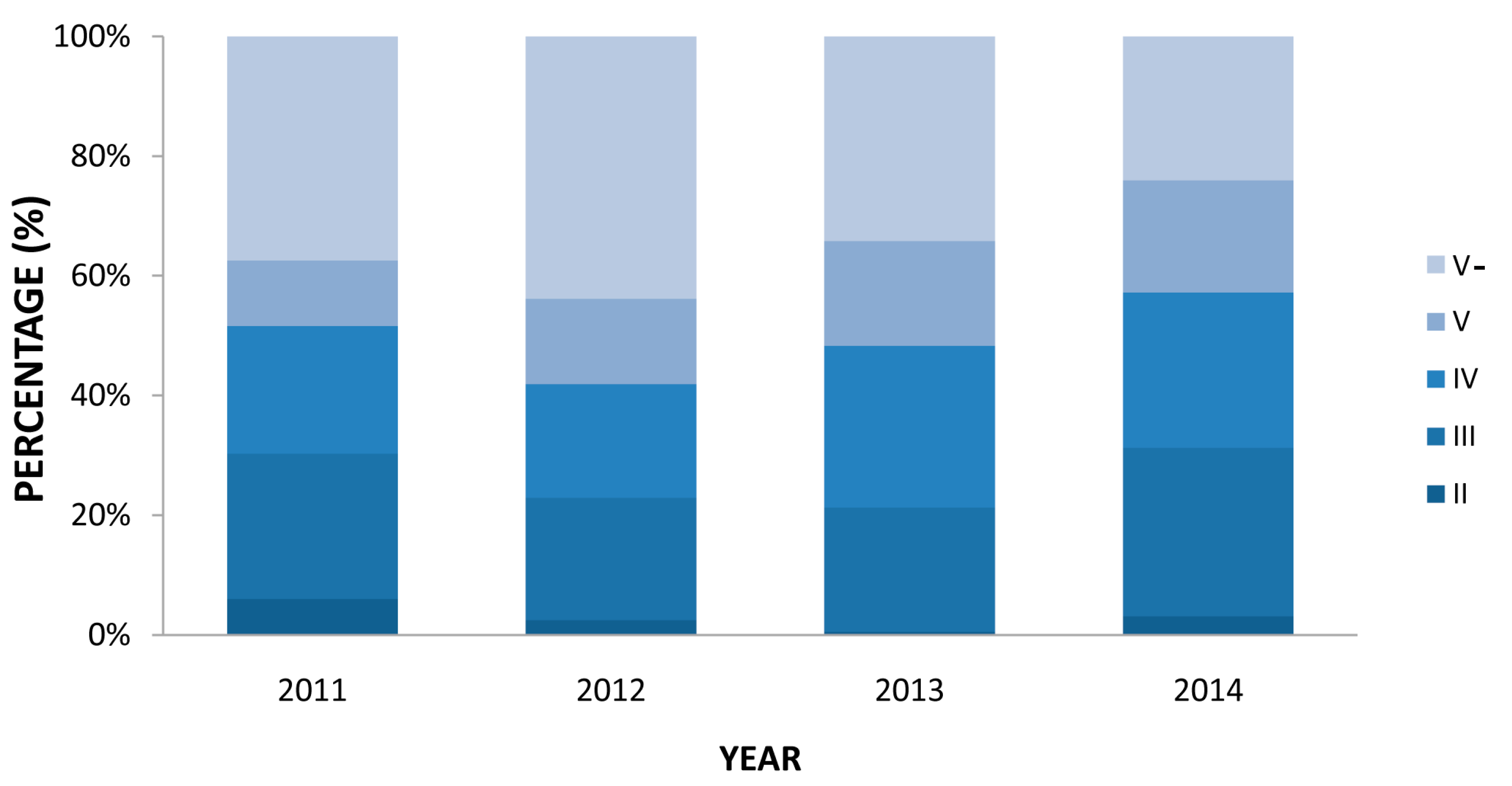
2.2. Water Quality Monitoring and Evaluation at Boundary
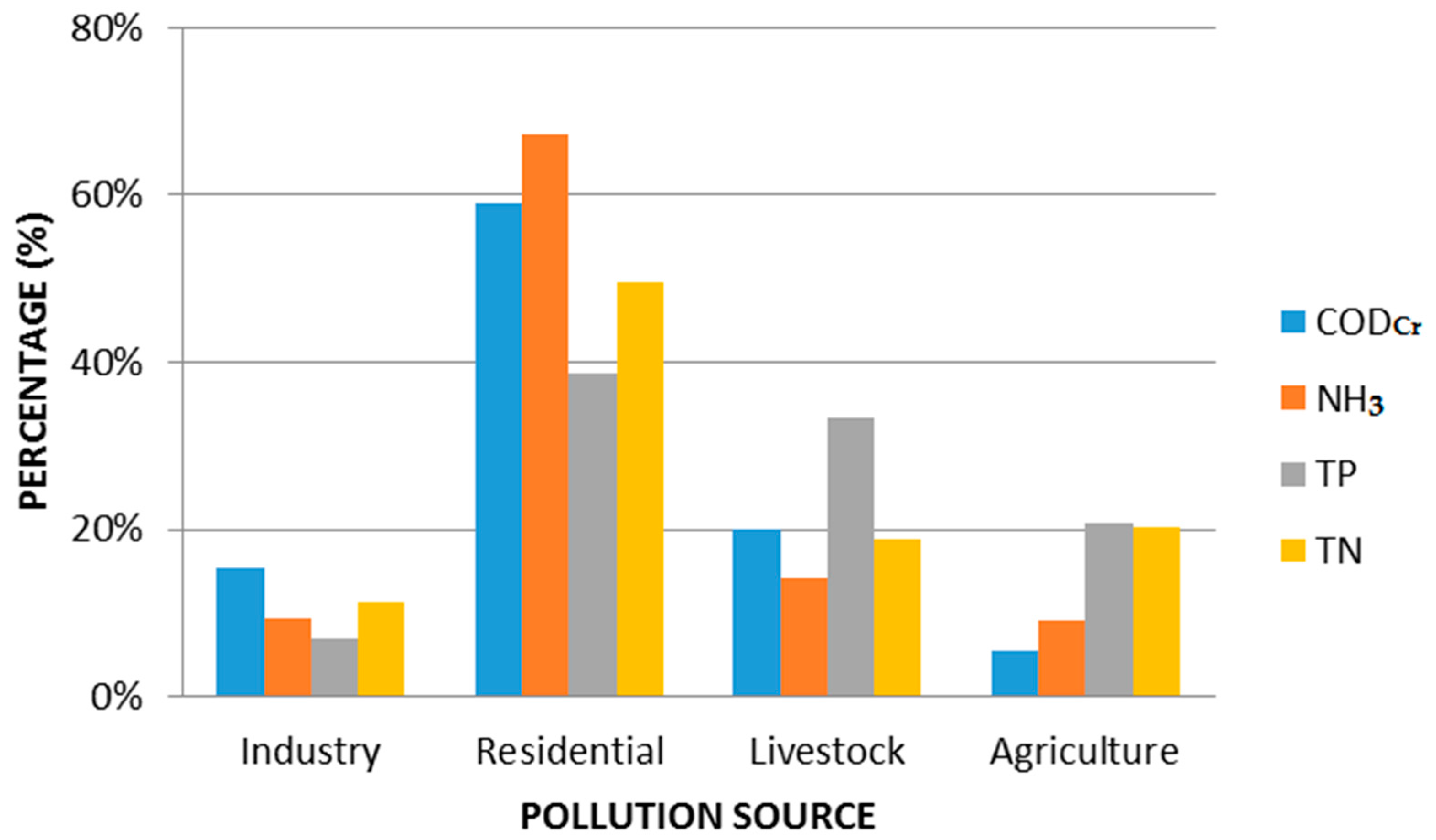
2.3. Pollution Sources in Study Area
3. Research Method
3.1. Data Sources and Calculation Conditions
3.2. Delineation of the Trans-Boundary Effective Control Scope
3.3. Calculating Water Environmental Capacity
4. Results and Discussion
4.1. Delineation of TECS
4.2. Analysis of TACP
5. Conclusions
Acknowledgments
Author Contributions
Conflicts of Interest
References
- Zhang, L.; Xia, M.; Zhang, L.; Wang, C.; Lu, J.L. Eutrophication status and control strategy of Taihu Lake. Front. Environ. Sci. Eng. China 2008, 2, 280–290. [Google Scholar] [CrossRef]
- Yao, H.; Qian, X.; Gao, H.; Wang, Y.; Xia, B. Seasonal and spatial variations of heavy metals in two typical Chinese rivers: Concentrations, environmental risks, and possible sources. Int. J. Environ. Res. Public Health 2014, 11, 11860–11878. [Google Scholar] [CrossRef] [PubMed]
- Wang, Q.G.; Gang, G.; Higano, Y. Toward integrated environmental management for challenges in water environmental protection of Lake Taihu Basin in China. Environ. Manag. 2006, 37, 579–588. [Google Scholar] [CrossRef] [PubMed]
- Zhang, T. Application of constructed wetland for water pollution control in China during 1990–2010. Ecol. Eng. 2012, 47, 189–197. [Google Scholar] [CrossRef]
- Zhang, H.J.; Zhang, H.H.; Wang, C.G. Total pollutant amount control in inter-provincial border area of Taihu Basin. Water Resour. Prot. 2010, 26, 42–44. (In Chinese) [Google Scholar]
- Zhang, R.; Qian, X.; Yuan, X.; Ye, R.; Xia, B.; Wang, Y. Simulation of water environmental capacity and pollution load reduction using QUAL2K for water environmental management. Int. J. Environ. Res. Public Health 2012, 9, 4504–4521. [Google Scholar] [CrossRef] [PubMed]
- Zhao, L.; Qian, Y.; Huang, R.; Li, C.; Xue, J.; Hu, Y. Model of transfer tax on transboundary water pollution in China’s river basin. Oper. Res. Lett. 2012, 40, 218–222. [Google Scholar] [CrossRef]
- Ai, L. Approaches to Countermeasures for Trans-Boundary Water Pollution Control in Taihu Lake Basin. Shanghai Environ. Sci. 2009, 28, 212–215. (In Chinese) [Google Scholar]
- Cai, Y.; Zhao, D.; Xu, D.; Jiang, H.; Yu, M.; Leng, X.; Xie, D.; An, S. Influences of land use on sediment pollution across multiple spatial scales in Taihu Basin. CLEAN-Soil Air Water 2015, 43, 1616–1622. [Google Scholar] [CrossRef]
- Yin, Y.; Xu, Y.; Chen, Y. Relationship between changes of river-lake networks and water levels in typical regions of Taihu Lake Basin, China. Chin. Geogr. Sci. 2012, 22, 673–682. [Google Scholar] [CrossRef]
- Viras, A.D.C.C.; Grilo, C.B.S.; Silva, J.Â.G.D. Transboundary MPAs: A challenge for the twenty-first century. Manag. Environ. Qual. Int. J. 2012, 23, 328–346. [Google Scholar]
- Merrill, T.W. Golden rules for transboundary pollution. Duke Law J. 1996, 46, 931–1019. [Google Scholar] [CrossRef]
- Copel, B.R.; Taylor, M.S. Trade and transboundary pollution. Am. Econ. Rev. 1995, 85, 716–737. [Google Scholar]
- Hills, P.; Zhang, L.; Liu, J. Transboundary pollution between Guangdong province and Hong Kong: Threats to water quality in the Pearl river estuary and their implications for environmental policy and planning. J. Environ. Plan. Manag. 1998, 41, 375–396. [Google Scholar] [CrossRef]
- Zhang, R.; Gao, H.; Zhu, W.; Hu, W.; Ye, R. Calculation of permissible load capacity and establishment of total amount control in the Wujin River Catchment—A tributary of Taihu Lake, China. Environ. Sci. Pollut. Res. 2015, 22, 11493–11503. [Google Scholar] [CrossRef] [PubMed]
- Parry, R. Agricultural phosphorus and water quality: A U.S. Environmental Protection Agency perspective. J. Environ. Q. 1998, 27, 258–261. [Google Scholar] [CrossRef]
- Wang, X.; Pang, Y.; Xie, R.R.; Wu, D.G. Total amount control in Tuwei River basin under the control of characteristic parameters of pollution zone. Beijing Gongye Daxue Xuebao 2015, 41, 1098–1107. (In Chinese) [Google Scholar]
- Xie, R.R.; Pang, Y.; Wang, X.; Wang, M. Delineation of the water environmental comprehensive management area and control unit in the trans-river cross-section of Taihu Basin. J. Fujian Norm. Univ. 2015, 31, 103–109. (In Chinese) [Google Scholar]
- Gao, Y.; Gao, J.; Chen, J.; Xu, Y.; Zhao, J. Regionalizing aquatic ecosystems based on the river subbasin taxonomy concept and spatial clusteringtechniques. Int. J. Environ. Res. Public Health 2011, 8, 4367–4385. [Google Scholar] [CrossRef] [PubMed]
- Su, W.; Yang, G. Scale-free structure of the Nanhe drainage of Lake Taihu watershed. J. Lake Sci. 2008, 20, 514–519. (In Chinese) [Google Scholar]
- Tian, Y.; Wang, L.C.; Jiao, S.X. Discussion and analysis on water-network system for urbanizing region: A case study of downtown Fenhu and the industrial zone of Wujiang. Water Resour. Prot. 2009, 26, 36–39. (In Chinese) [Google Scholar]
- Zhang, Z.; Zhu, Y.; Guo, P.; Liu, G. Potential loss of phosphorus from a rice field in Taihu Lake Basin. J. Environ. Q. 2004, 33, 1403–1412. [Google Scholar] [CrossRef]
- China’s Statistical Yearbook, 2011. Available online: http://www.stats.gov.cn/tjsj/ndsj/2012/indexch.htm (accessed on 1 January 2012).
- China’s Statistical Yearbook, 2013. Available online: http://www.stats.gov.cn/tjsj/ndsj/2014/indexch.htm (accessed on 1 September 2014).
- Xie, R.; Pang, Y.; Bao, K. Spatiotemporal distribution of water environmental capacity—A case study on the western areas of Taihu Lake in Jiangsu Province, China. Environ. Sci. Pollut. Res. 2014, 21, 5465–5473. [Google Scholar] [CrossRef] [PubMed]
- Cheng, W.; Yan, R.R.; Liu, Y.; Sun, W.H. Water Pollution Control and Management of River Watershed Based on Control Unit—Sunan segment of Jinghang River watershed as a case study. Environ. Sci. Technol. 2010, 23, 70–74. (In Chinese) [Google Scholar]
- Bao, K.; Pang, Y.; Sun, H. A Water Environment Capacity Calculation Method Based on Water Quality Standards at the Control Sections: A Case Study of the Yincun Port. Resour. Sci. 2011, 33, 249–252. [Google Scholar]
- Ministry of Environmental Protection of People’s Republic of China. GB3838-2002 Environmental Quality Standard for Surface Water; Ministry of Environmental Protection of People’s Republic of China: Beijing, China, 2002.

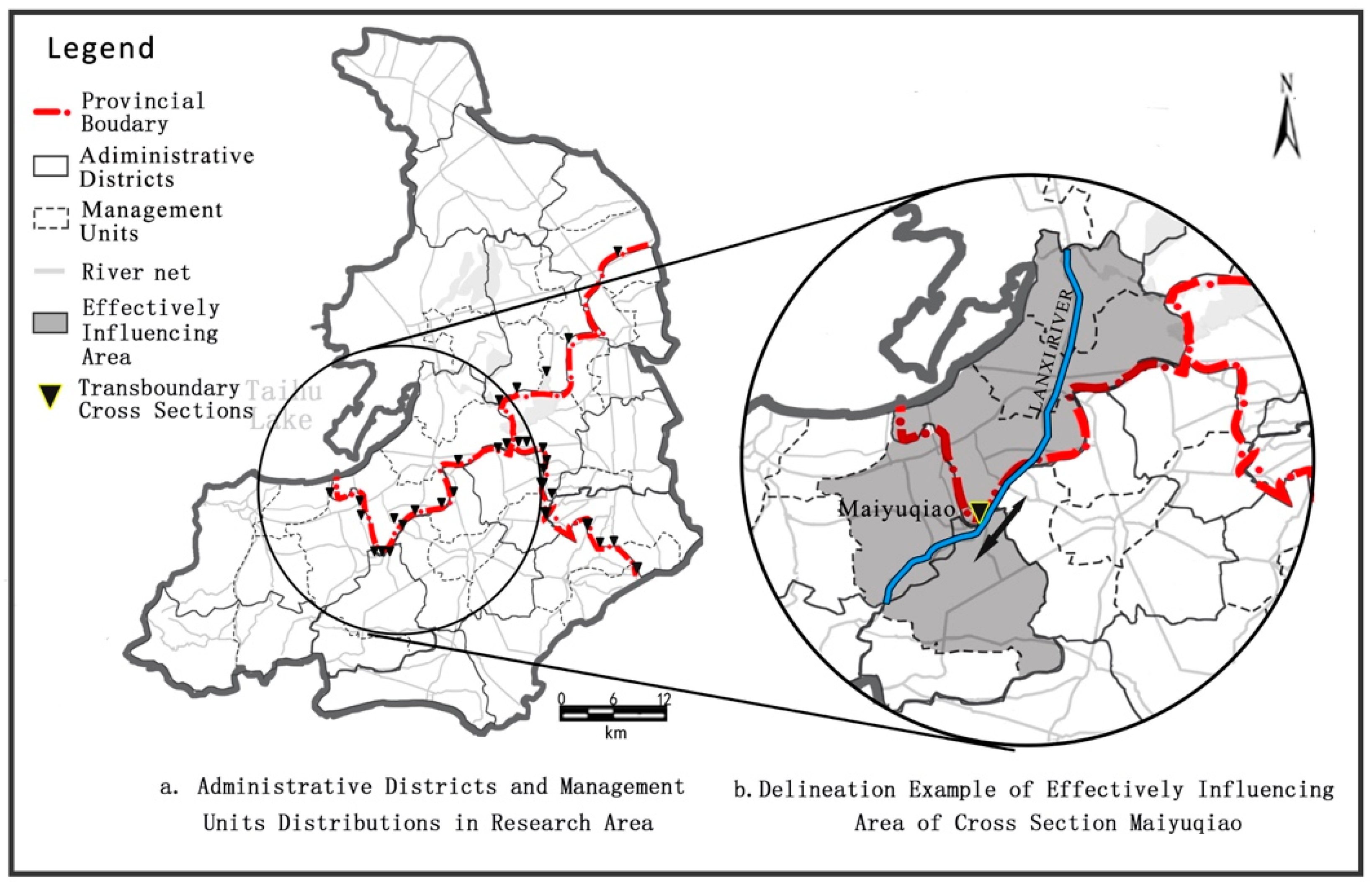

| Province | City | Area (km2) | Number of Administrative Districts |
|---|---|---|---|
| Jiangsu | Suzhou | 8488 | 5 |
| Zhejiang | Huzhou (Partial) | 5815 | 2 |
| Jiaxing | 3915 | 6 | |
| Shanghai Municipality (Partial) | 2649 | 5 | |
| Province | City | Amount of Pollution Discharged in River Network (t/year) | |||||||
|---|---|---|---|---|---|---|---|---|---|
| 2011 | 2013 | ||||||||
| CODCr | NH3-N | TP | TN | CODCr | NH3-N | TP | TN | ||
| Jiangsu | Suzhou | 158,068 | 22,453 | 2976 | 36,882 | 163,090 | 22,872 | 2598 | 35,005 |
| Zhejiang | Jiaxing | 107,389 | 12,235 | 2523 | 25,126 | 87,827 | 9968 | 1994 | 21,375 |
| Huzhou (partial) | 88,949 | 8675 | 1752 | 18,341 | 83,321 | 8059 | 1696 | 17,192 | |
| Shanghai Municipality (partial) | 52,429 | 6169 | 981 | 12,575 | 51,616 | 5959 | 942 | 11,750 | |
| SUM | 406,835 | 49,532 | 9232 | 92,924 | 385,854 | 46,858 | 8130 | 85,322 | |
| Trans-Boundary Control Unit | Location | Main Target of Influence | Area (km2) |
|---|---|---|---|
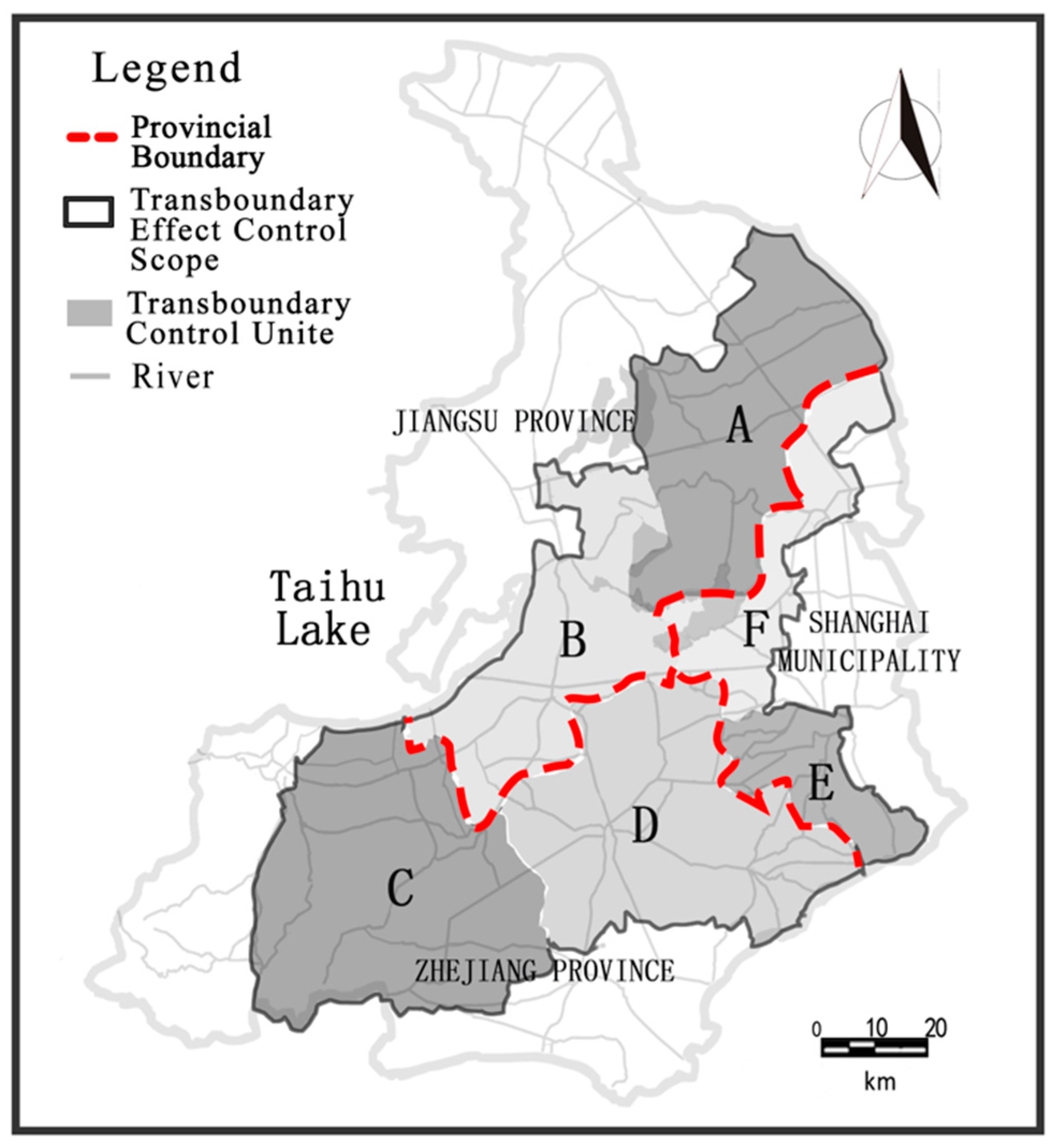
| Unit A | Jiangsu Province | Jiangsu-Shanghai boundary | 1465.5 |
| Unit B | Jiangsu Province | Jiangsu-Zhejiang boundary | 1461.2 |
| Unit C | Zhejiang Province | Jiangsu-Zhejiang boundary | 2085.9 |
| Unit D | Zhejiang Province | Jiangsu-Zhejiang boundary Zhejiang-Shanghai boundary | 2013.9 |
| Unit E | Shanghai Municipality | Zhejiang-Shanghai boundary | 516.2 |
| Unit F | Shanghai Municipality | Jiangsu-Shanghai boundary | 764.1 |
| Factors | Chemical Oxygen Demand (CODCr) | Ammonia Nitrogen (NH3-N) | Total Phosphorus (TP) | Total Nitrogen (TN) |
|---|---|---|---|---|
| Concentration (mg/L) | 20 | 1 | 0.2 | 1 |
| Trans-Boundary Management Unit | Trans-Boundary Water Environmental Capacity (t/year) | Trans-Boundary Pollution Reduction Rate (%) | ||||||
|---|---|---|---|---|---|---|---|---|
| COD | NH3-N | TP | TN | COD | NH3-N | TP | TN | |
| Unit A | 32,475 | 2964 | 592 | 8010 | 27.60 | 26.80 | 15.90 | 2.40 |
| Unit B | 29,720 | 2769 | 554 | 7357 | 11.30 | 24.50 | 21.10 | 6.20 |
| Unit C | 39,669 | 4413 | 922 | 9888 | 23.80 | 33.40 | 19.50 | 4.70 |
| Unit D | 32,638 | 3262 | 875 | 7866 | 25.60 | 39.30 | 34.90 | 12.10 |
| Unit E | 10,606 | 1085 | 222 | 2680 | 14.50 | 23.80 | 17.10 | 10.40 |
| Unit F | 15,698 | 1605 | 328 | 3967 | 16.80 | 24.40 | 20.40 | 13.70 |
© 2016 by the authors; licensee MDPI, Basel, Switzerland. This article is an open access article distributed under the terms and conditions of the Creative Commons Attribution (CC-BY) license (http://creativecommons.org/licenses/by/4.0/).
Share and Cite
Wang, X.; Katopodes, N.; Shen, C.; Wang, H.; Pang, Y.; Zhou, Q. Control of Pollutants in the Trans-Boundary Area of Taihu Basin, Yangtze Delta. Int. J. Environ. Res. Public Health 2016, 13, 1253. https://doi.org/10.3390/ijerph13121253
Wang X, Katopodes N, Shen C, Wang H, Pang Y, Zhou Q. Control of Pollutants in the Trans-Boundary Area of Taihu Basin, Yangtze Delta. International Journal of Environmental Research and Public Health. 2016; 13(12):1253. https://doi.org/10.3390/ijerph13121253
Chicago/Turabian StyleWang, Xiao, Nikolaos Katopodes, Chunqi Shen, Hua Wang, Yong Pang, and Qi Zhou. 2016. "Control of Pollutants in the Trans-Boundary Area of Taihu Basin, Yangtze Delta" International Journal of Environmental Research and Public Health 13, no. 12: 1253. https://doi.org/10.3390/ijerph13121253
APA StyleWang, X., Katopodes, N., Shen, C., Wang, H., Pang, Y., & Zhou, Q. (2016). Control of Pollutants in the Trans-Boundary Area of Taihu Basin, Yangtze Delta. International Journal of Environmental Research and Public Health, 13(12), 1253. https://doi.org/10.3390/ijerph13121253