


Validation Analysis of a Geriatric Dehydration Screening Tool in Community-Dwelling and Institutionalized Elderly People
 ,
, 
Abstract
1. Introduction
2. Experimental Section
2.1. Study Design and Sample
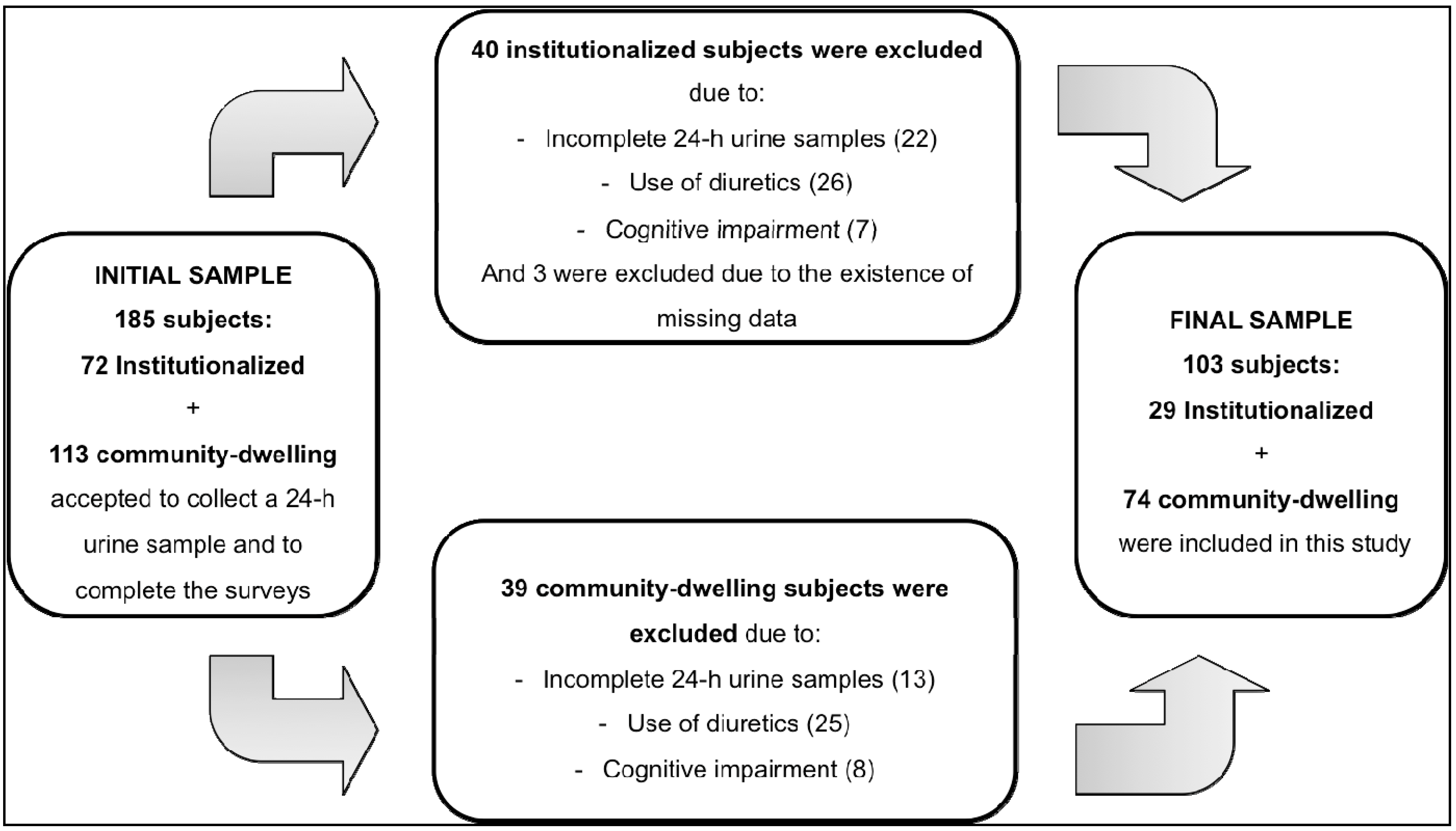
2.2. Data Collection
2.3. Urine Collection and Hydration Markers
2.4. Dehydration Screening Tool
2.5. Statistical Analysis
3. Results and Discussion

| Characteristics | Institutionalized (n = 29) | Community-Dwelling (n = 74) | p-value | Total (n = 103) |
|---|---|---|---|---|
| Age (years), mean ± SD | 82.5 ± 7.2 | 70.2 ± 6.0 | <0.001 * | 73.7 ± 8.4 |
| 60–79 years | 8 (27.6%) | 67 (90.5%) | <0.001 ‡ | 75 (72.8%) |
| ≥80 years | 21 (72.4%) | 7 (9.5%) | -- | 28 (27.2%) |
| Sex, n (%) | ||||
| Male | 13 (44.8%) | 28 (37.8%) | 0.515 ‡ | 41 (39.8%) |
| Female | 16 (55.2%) | 46 (62.2%) | 62 (60.2%) | |
| Score MMSE, median (range) | 24 (22, 29) | 29 (22, 30) | <0.001 * | 28 (22, 30) |
| Education level, n (%) | ||||
| No schooling | 14 (48.3%) | 14 (18.9%) | 0.002 ‡ | 28 (27.2%) |
| Primary school | 15 (51.7%) | 29 (39.2%) | -- | 44 (42.7%) |
| Middle school | 0 (0.0%) | 19 (25.7%) | -- | 19 (18.4%) |
| Secondary school | 0 (0.0%) | 6 (8.1%) | -- | 6 (5.8%) |
| Higher school | 0 (0.0%) | 6 (8.1%) | -- | 6 (5.8%) |
| BMI (kg/m2), mean ± SD | 27.8 ± 4.0 | 27.1 ± 3.7 | 0.410 † | 27.3 ± 3.8 |
| Underweight (<18.5 kg/m2) | 1 (3.4%) | 2 (2.7%) | 0.644 ‡ | 3 (2.9%) |
| Normal weight (18.5–24.9 kg/m2) | 4 (13.8%) | 18 (24.3%) | -- | 22 (21.4%) |
| Overweight (25.0–29.9 kg/m2) | 15 (51.7%) | 37 (50.0%) | -- | 52 (50.5%) |
| Obesity (≥30 kg/m2) | 9 (31.0%) | 17 (23.0%) | -- | 26 (25.2%) |
| Total number of drugs, median (range) | 6 (1, 14) | 3 (0, 8) | < 0.001 * | 3 (0, 14) |
| Health condition, n (%) | ||||
| Hypertension | 23 (79.3%) | 39 (52.7%) | 0.010 ‡ | 62 (60.2%) |
| Dyslipidemias | 10 (34.5%) | 37 (50.5%) | 0.123 ‡ | 47 (45.6%) |
| Arthritis | 4 (13.8%) | 3 (4.1%) | 0.075 ‡ | 7 (6.8%) |
| Diabetes mellitus | 9 (31.0%) | 10 (13.5%) | 0.037 ‡ | 19 (18.4%) |
| Renal impairment | 0 (0.0%) | 4 (5.4%) | 0.206 ‡ | 4 (3.9%) |
| Alcoholic beverages consumption, n (%) | 4 (13.8%) | 28 (37.8%) | 0.014 ‡ | 32 (31.1%) |
| 24-h wine consumption (mL), median (range) § | 175 (100, 300) | 225 (40, 1250) | 0.931 * | 200 (40, 1250) |
| 24-h alcohol intake (g), median (range) § | 16.1 (9.2, 27.6) | 20.7 (3.7, 115.0) | 0.934 * | 18.4 (3.7, 115.0) |
| Urinary Parameters | Institutionalized (n = 29) | Community-dwelling (n = 74) | p-value | Total (n = 103) |
|---|---|---|---|---|
| Males | ||||
| 24-h urine volume, mL | 1750 (800, 2100) | 1835 (650, 3300) | 0.049 * | 1790 (650, 3300) |
| 24-h UOSM, mOsm/kg | 564 (391, 781) | 414 (225, 768) | 0.015 † | 462 (225, 781) |
| Renal solute excretion, mOsm/24-h | 880 (586, 1562) | 801 (499, 1262) | 0.195 * | 865 (499, 1562) |
| Free Water Reserve, mL/24-h | 134 (−537, 595) | 780 (−157, 1823) | <0.001 * | 461 (−537, 1823) |
| Females | ||||
| 24-h urine volume, mL | 1450 (750, 2800) | 1750 (760, 3450) | 0.927 * | 1625 (750, 3450) |
| 24-h UOSM, mOsm/kg | 380 (272, 620) | 377 (84, 799) | 0.129 * | 377 (84, 799) |
| Renal solute excretion, mOsm/24-h | 623 (257, 1056) | 619 (260, 1073) | 0.300 * | 621 (257, 1073) |
| Free Water Reserve, mL/24-h | 621 (−1, 1184) | 720 (−207, 2706) | 0.147 * | 706 (−207, 2706) |
| Dehydration Screening Tool (DST) Items | Pain Score (Factor 1) | Hydration Score (Factor 2) |
|---|---|---|
| 1—Do you ever feel thirsty? | 0.383 | 0.539 |
| 2—Did you feel thirsty yesterday? | 0.386 | 0.504 |
| 3—Do you have difficulty moving your shoulders, arms or hands? | −0.851 | −0.007 |
| 4— In the past 2 weeks, did pain interfere with your daily activities? | 0.987 | 0.161 |
| 5—In the past 2 weeks did you have problems with pain of any kind? | 0.785 | 0.044 |
| 6—In the last 2 weeks, did you drop something? | 0.466 | 0.037 |
| 7—How many times have you had a headache in the past week? | 0.569 | 0.278 |
| 8—Do you like to drink water? | 0.058 | −0.685 |
| 9—Do you usually drink at meals? | 0.064 | −0.189 |
| 10—If you have several beverages available, do you usually choose water? | 0.038 | −0.585 |
| 11—Are you concerned about being well hydrated? | 0.197 | −0.927 |
3.1. “Pain Score”, “Hydration Score” and Urinary Parameters
| Socio-Demographic Variables | n | Hydration Score | p-value * | Pain Score | p-value * |
|---|---|---|---|---|---|
| Settings | |||||
| Institutionalized | 29 | 3 (0, 5) | 0.013 | 3 (0, 5) | 0.003 |
| Community-dwelling | 74 | 2 (0, 5) | 1 (0, 5) | ||
| Age | |||||
| 60–79 years | 75 | 2 (0, 5) | 0.010 | 1 (0, 5) | 0.016 |
| ≥ 80 years | 28 | 3 (0, 5) | 3 (0, 5) | ||
| Sex | |||||
| Male | 41 | 2 (0, 5) | 0.989 | 1 (0, 4) | <0.001 |
| Female | 62 | 2 (0, 5) | 2 (0, 5) | ||
| Education level | |||||
| No schooling | 28 | 3 (0, 5) | 0.115 | 2 (0, 5) | 0.145 |
| At least primary level | 75 | 2 (0, 5) | 1 (0, 5) | ||
| BMI | |||||
| ≤27.0 kg/m2 | 52 | 2 (0, 5) | 0.793 | 1 (0, 5) | 0.774 |
| >27.0 kg/m2 | 51 | 2 (0, 5) | 1 (0, 5) |
| 24-h Urine Volume (mL) | ||||||
| Total Sample (n = 103) | Institutionalized (n = 29) | Community-Dwelling (n = 74) | ||||
| B (95% CI) | p value | B (95% CI) | p value | B (95% CI) | p value | |
| Model 1 * | ||||||
| Pain Score | −5.0 (−88.1, 78.2) | 0.906 | 124.0 (15.7, 232.3) | 0.026 | −32.7 (−146.7, 81.2) | 0.569 |
| Hydration Score | 61.9 (−39.1, 162.8) | 0.227 | 69.4 (−60.3, 199.1) | 0.282 | 123.8 (−20.9, 268.4) | 0.092 |
| Model 2 † | ||||||
| Pain Score | 25.1 (−65.9, 116.1) | 0.060 | 155.6 (39.6, 271.6) | 0.011 | −11.4 (−138.4, 115.6) | 0.858 |
| Hydration Score | 69.5 (−31.5, −170.5) | 0.135 | 75.9 (−62.5, 214.2) | 0.270 | 119.8 (−26.7, 266.3) | 0.107 |
| 24-h Urine Osmolality (mOsm/kg) | ||||||
| Total Sample (n = 103) | Institutionalized (n = 29) | Community-dwelling (n = 74) | ||||
| B (95% CI) | p value | B (95% CI) | p value | B (95% CI) | p value | |
| Model 1 * | ||||||
| Pain Score | −13.0 (−33.4, 7.4) | 0.208 | −45.9 (−77.2, −14.6) | 0.006 | −6.0 (−32.8, 20.8) | 0.658 |
| Hydration Score | −19.3 (−44.1, 5.5) | 0.126 | −15.4 (−55.3, 24.4) | 0.435 | −37.4 (−70.9, −3.8) | 0.029 |
| Model 2 † | ||||||
| Pain Score | −1.1 (−22.9, 20.7) | 0.921 | −29.6 (−59.4, 0.1) | 0.051 | 1.3 (−27.2, 29.7) | 0.929 |
| Hydration Score | −19.6 (−43.7, 4.5) | 0.109 | −10.3 (−44.5, 23.8) | 0.539 | −40.9 (−72.9, −9.0) | 0.013 |
| Free Water Reserve (mL/24-h) | ||||||
| Total Sample (n = 103) | Institutionalized (n = 29) | Community-dwelling (n = 74) | ||||
| B (95% CI) | p value | B (95% CI) | p value | B (95% CI) | p value | |
| Model 1 * | ||||||
| Pain Score | 17.4 (−62.8, 97.7) | 0.668 | 144.6 (60.4, 228.8) | 0.002 | 11.2 (−98.0, 120.5) | 0.838 |
| Hydration Score | 67.0 (−30.3, 164.4) | 0.175 | 72.2 (−37.7, 182.0) | 0.189 | 154.7 (18.3, 291.1) | 0.027 |
| Model 2 † | ||||||
| Pain Score | 7.5 (−79.0, 93.9) | 0.864 | 110.1 (26.6, 193.6) | 0.012 | −1.3 (−122.9, 120.3) | 0.983 |
| Hydration Score | 79.6 (−15.8, 175.0) | 0.101 | 45.8 (−54.1, 145.7) | 0.354 | 160.8 (23.1, 298.4) | 0.023 |
| Scores | Euhydrated | Hypohydrated | p-value |
|---|---|---|---|
| Total Sample, n | 91 | 12 | -- |
| Pain Score | 1 (0, 5) | 1 (0,3) | 0.280 † |
| Hydration Score | 2 (0, 5) | 2 (0, 5) | 0.290 † |
| Institutionalized, n | 23 | 6 | -- |
| Pain Score | 3 (0, 5) | 1.5 (0, 3) | 0.065 * |
| Hydration Score | 3 (0, 5) | 2.5 (0, 5) | 0.670 * |
| Community-dwelling, n | 68 | 6 | -- |
| Pain Score | 1 (0, 5) | 1 (0, 3) | 0.623 † |
| Hydration Score | 2 (0, 5) | 1.5 (1, 2) | 0.065 † |
3.2. Discussion
4. Conclusions
Acknowledgments
Author Contributions
Conflicts of Interest
References
- Maughan, R.J. Hydration, morbidity, and mortality in vulnerable populations. Nutr. Rev. 2012, 70, S152–S155. [Google Scholar] [CrossRef] [PubMed]
- Manz, F. Hydration and disease. J. Amer. Coll. Nutr. 2007, 26, S535–S541. [Google Scholar] [CrossRef]
- Vivanti, A.; Harvey, K.; Ash, S.; Battistutta, D. Clinical assessment of dehydration in older people admitted to hospital: What are the strongest indicators? Arch. Gerontol. Geriatr. 2008, 47, 340–355. [Google Scholar] [CrossRef] [PubMed]
- Bunn, D.; Jimoh, F.; Wilsher, S.H.; Hooper, L. Increasing fluid intake and reducing dehydration risk in older people living in long-term care: A systematic review. J. Amer. Med. Dir. Assn. 2015, 16, 101–113. [Google Scholar] [CrossRef]
- Vivanti, A.; Harvey, K.; Ash, S. Developing a quick and practical screen to improve the identification of poor hydration in geriatric and rehabilitative care. Arch. Gerontol. Geriatr. 2010, 50, 156–164. [Google Scholar] [CrossRef] [PubMed]
- Baron, S.; Courbebaisse, M.; Lepicard, E.M.; Friedlander, G. Assessment of hydration status in a large population. Brit. J. Nutr. 2015, 113, 147–158. [Google Scholar] [CrossRef]
- Shirreffs, S.M. Markers of hydration status. Eur. J. Clin. Nutr. 2003, 57, S6–S9. [Google Scholar] [CrossRef] [PubMed]
- Goldberg, L.R.; Heiss, C.J.; Parsons, S.D.; Foley, A.S.; Mefferd, A.S.; Hollinger, D.; Parham, D.F.; Patterson, J. Hydration in older adults: The contribution of bioelectrical impedance analysis. Int. J. Speech lang. Pathol. 2014, 16, 273–281. [Google Scholar] [CrossRef] [PubMed]
- Manz, F.; Wentz, A. 24-h hydration status: parameters, epidemiology and recommendations. Eur. J. Clin. Nutr. 2003, 57, S10–S18. [Google Scholar] [CrossRef] [PubMed]
- Lancaster, K.J.; Smiciklas-Wright, H.; Heller, D.A.; Ahern, F.M.; Jensen, G. Dehydration in Black and White older adults using diuretics. Ann. Epidemiol. 2003, 13, 525–529. [Google Scholar] [CrossRef] [PubMed]
- Wotton, K.; Crannitch, K.; Munt, R. Prevalence, risk factors and strategies to prevent dehydration in older adults. Contemp. Nurse 2008, 31, 44–56. [Google Scholar] [CrossRef] [PubMed]
- Morgado, J.; Rocha, C.S.; Maruta, C.; Guerreiro, M.; Martins, I.P. New normative values of Mini-mental state examination. Sinapse 2009, 9, 10–16. [Google Scholar]
- Folstein, M.F.; Folstein, S.E.; McHugh, P.R. “Mini-mental state”. A practical method for grading the cognitive state of patients for the clinician. J. Psychiatr. Res. 1975, 12, 189–198. [Google Scholar] [CrossRef] [PubMed]
- Liu, L.; Ikeda, K.; Yamori, Y. Inverse relationship between urinary markers of animal protein intake and blood pressure in Chinese: Results from the WHO cardiovascular diseases and alimentary comparison (CARDIAC) study. Int. J. Epidemiol. 2002, 31, 227–233. [Google Scholar] [CrossRef] [PubMed]
- Vivanti, A. Screening and Identification of Dehydration in Older People Admitted to a Geriatric and Rehabilitation Unit. Ph.D. Dissertation/Thesis, Queensland University of Technology, Queensland, Australia, 2007. [Google Scholar]
- Sanchez-Garcia, S.; Garcia-Pena, C.; Duque-Lopez, M.X.; Juarez-Cedillo, T.; Cortes-Nunez, A.R.; Reyes-Beaman, S. Anthropometric measures and nutritional status in a healthy elderly population. BMC Public Health 2007, 7. [Google Scholar] [CrossRef]
- Obesity: Preventing and Managing the Global Epidemic. Report of a WHO Consultation; World Health Organization: Geneva, Switzerland, 2000; Volume 894, pp. 1–253.
- Physical Status: The Use and Interpretation of Anthropometry. Report of a WHO Expert Committee; Health Organization: Geneva, Switzerland, 1995; Volume 854, pp. 1–452.
- Shirreffs, S.M.; Maughan, R.J. Restoration of fluid balance after exercise-induced dehydration: Effects of alcohol consumption. J. Appl. Physiol. 1997, 83, 1152–1158. [Google Scholar] [PubMed]
- Hobson, R.M.; Maughan, R.J. Hydration status and the diuretic action of a small dose of alcohol. Alcohol Alcohol. 2010, 45, 366–373. [Google Scholar] [CrossRef] [PubMed]
- Rombo, M.M.; Silveira, D.; Martins, I.; Cruz, A. Modelos Fotográficos para Inquéritos Alimentares; Centro de Estudos de Nutrição do Instituto Nacional de Saúde Dr. Ricardo Jorge: Lisbon, Portugal, 1996. (In Portuguese) [Google Scholar]
- INSA: Tabela da Composição dos Alimentos; Instituto Nacional de Saúde Dr. Ricardo Jorge: Lisbon, Portugal, 2006. (In Portuguese)
- Armstrong, L.E. Assessing hydration status: the elusive gold standard. J. Amer. Coll. Nutr. 2007, 26, S575–S584. [Google Scholar] [CrossRef]
- Manz, F.; Wentz, A. Hydration status in the United States and Germany. Nutr. Rev. 2005, 63, S55–S62. [Google Scholar] [CrossRef] [PubMed]
- Manz, F.; Johner, S.A.; Wentz, A.; Boeing, H.; Remer, T. Water balance throughout the adult life span in a German population. Brit. J. Nutr. 2012, 107, 1673–1681. [Google Scholar] [CrossRef] [PubMed]
- Stevens, J. Applied Multivariate Statistics for the Social Sciences, 2nd ed.; Hillsdale, N.J., Ed.; Lawrence Erlbaum Associates: London, UK, 1992. [Google Scholar]
- Basic Item Analysis for Multiple-Choice Tests; ERIC Clearinghouse on Assessment and Evaluation. Available online: http://ericae.net/digests/tm9511.htm (accessed on 27 February 2015).
- Phillips, P.A.; Rolls, B.J.; Ledingham, J.G.; Forsling, M.L.; Morton, J.J.; Crowe, M.J.; Wollner, L. Reduced thirst after water deprivation in healthy elderly men. N. Engl. J. Med. 1984, 311, 753–759. [Google Scholar] [CrossRef] [PubMed]
- Gross, C.R.; Lindquist, R.D.; Woolley, A.C.; Granieri, R.; Allard, K.; Webster, B. Clinical indicators of dehydration severity in elderly patients. J. Emerg. Med. 1992, 10, 267–274. [Google Scholar] [CrossRef] [PubMed]
- Kenney, W.L.; Chiu, P. Influence of age on thirst and fluid intake. Med. Sci. Sport. Exerc. 2001, 33, 1524–1532. [Google Scholar] [CrossRef]
- Rosler, A.; Lehmann, F.; Krause, T.; Wirth, R.; von Renteln-Kruse, W. Nutritional and hydration status in elderly subjects: Clinical rating vs. bioimpedance analysis. Arch. Gerontol. Geriatr. 2010, 50, 81–85. [Google Scholar] [CrossRef]
- Popkin, B.M.; D’Anci, K.E.; Rosenberg, I.H. Water, hydration, and health. Nutr. Rev. 2010, 68, 439–458. [Google Scholar] [CrossRef] [PubMed]
- Millard-Stafford, M.; Wendland, D.M.; O’Dea, N.K.; Norman, T.L. Thirst and hydration status in everyday life. Nutr. Rev. 2012, 70, S147–S151. [Google Scholar] [CrossRef] [PubMed]
- Gaspar, P.M. Comparison of four standards for determining adequate water intake of nursing home residents. Res. Theory Nurs. Pract. 2011, 25, 11–22. [Google Scholar] [CrossRef] [PubMed]
- Lavizzo-Mourey, R.; Johnson, J.; Stolley, P. Risk factors for dehydration among elderly nursing home residents. J. Amer. Geriatr. Soc. 1988, 36, 213–218. [Google Scholar]
- Leiper, J.B.; Seonaid Primrose, C.; Primrose, W.R.; Phillimore, J.; Maughan, R.J. A comparison of water turnover in older people in community and institutional settings. J. Nutr. Health Aging 2005, 9, 189–193. [Google Scholar] [PubMed]
- Kayser-Jones, J.; Schell, E.S.; Porter, C.; Barbaccia, J.C.; Shaw, H. Factors contributing to dehydration in nursing homes: inadequate staffing and lack of professional supervision. J. Amer. Geriatr. Soc. 1999, 47, 1187–1194. [Google Scholar]
- Spangler, A.A.; Chidester, J.C. Age, dependency and other factors influencing fluid intake by long term care residents. J. Nutr. Elder. 1999, 18, 21–35. [Google Scholar] [CrossRef]
- Gaspar, P.M. Water intake of nursing home residents. J. Gerontol. Nurs. 1999, 25, 23–29. [Google Scholar] [CrossRef] [PubMed]
- Mentes, J.C.; Culp, K. Reducing hydration-linked events in nursing home residents. Clin. Nurs. Res. 2003, 12, 210–225. [Google Scholar] [CrossRef] [PubMed]
- Mentes, J. Oral hydration in older adults: Greater awareness is needed in preventing, recognizing, and treating dehydration. Amer. J. Nurs. 2006, 106, 40–49. [Google Scholar] [CrossRef]
- Luppa, M.; Luck, T.; Weyerer, S.; Konig, H.H.; Brahler, E.; Riedel-Heller, S.G. Prediction of institutionalization in the elderly: A systematic review. Age Ageing 2010, 39, 31–38. [Google Scholar] [CrossRef] [PubMed]
- Luppa, M.; Riedel-Heller, S.G.; Luck, T.; Wiese, B.; van den Bussche, H.; Haller, F.; Sauder, M.; Mosch, E.; Pentzek, M.; Wollny, A.; et al. Age-related predictors of institutionalization: Results of the German study on ageing, cognition and dementia in primary care patients (AgeCoDe). Soc. Psychiat. Psychiatr. Epidemiol. 2012, 47, 263–270. [Google Scholar] [CrossRef]
- Wu, S.J.; Wang, H.H.; Yeh, S.H.; Wang, Y.H.; Yang, Y.M. Hydration status of nursing home residents in Taiwan: A cross-sectional study. J. Adv. Nurs. 2011, 67, 583–590. [Google Scholar] [CrossRef] [PubMed]
- Chidester, J.C.; Spangler, A.A. Fluid intake in the institutionalized elderly. J. Amer. Diet. Assn. 1997, 97, 23–28. [Google Scholar] [CrossRef]
- Presse, N.; Ferland, G. Risk factors contributing to insufficient water intake in elderly living in nursing homes and long-term care units: a review of the literature. Can. J. Diet. Pract. Res. 2010, 71, 94–99. [Google Scholar] [CrossRef]
- Mentes, J.C. A typology of oral hydration problems exhibited by frail nursing home residents. J. Gerontol. Nurs. 2006, 32, 13–19. [Google Scholar] [CrossRef] [PubMed]
- Shimizu, M.; Kinoshita, K.; Hattori, K.; Ota, Y.; Kanai, T.; Kobayashi, H.; Tokuda, Y. Physical signs of dehydration in the elderly. Intern. Med. 2012, 51, 1207–1210. [Google Scholar] [CrossRef] [PubMed]
- Kinoshita, K.; Hattori, K.; Ota, Y.; Kanai, T.; Shimizu, M.; Kobayashi, H.; Tokuda, Y. The measurement of axillary moisture for the assessment of dehydration among older patients: A pilot study. Exp. Gerontol. 2013, 48, 255–258. [Google Scholar] [CrossRef] [PubMed]
- Weinberg, A.D.; Minaker, K.L. Dehydration. Evaluation and management in older adults. Council on Scientific Affairs, American Medical Association. JAMA 1995, 274, 1552–1556. [Google Scholar] [CrossRef] [PubMed]
- Bennett, J.A.; Thomas, V.; Riegel, B. Unrecognized chronic dehydration in older adults: Examining prevalence rate and risk factors. J. Gerontol. Nurs. 2004, 30, 22–28. [Google Scholar] [CrossRef] [PubMed]
© 2015 by the authors; licensee MDPI, Basel, Switzerland. This article is an open access article distributed under the terms and conditions of the Creative Commons Attribution license (http://creativecommons.org/licenses/by/4.0/).
Share and Cite
Rodrigues, S.; Silva, J.; Severo, M.; Inácio, C.; Padrão, P.; Lopes, C.; Carvalho, J.; Carmo, I.D.; Moreira, P. Validation Analysis of a Geriatric Dehydration Screening Tool in Community-Dwelling and Institutionalized Elderly People. Int. J. Environ. Res. Public Health 2015, 12, 2700-2717. https://doi.org/10.3390/ijerph120302700
Rodrigues S, Silva J, Severo M, Inácio C, Padrão P, Lopes C, Carvalho J, Carmo ID, Moreira P. Validation Analysis of a Geriatric Dehydration Screening Tool in Community-Dwelling and Institutionalized Elderly People. International Journal of Environmental Research and Public Health. 2015; 12(3):2700-2717. https://doi.org/10.3390/ijerph120302700
Chicago/Turabian StyleRodrigues, Susana, Joana Silva, Milton Severo, Cátia Inácio, Patrícia Padrão, Carla Lopes, Joana Carvalho, Isabel Do Carmo, and Pedro Moreira. 2015. "Validation Analysis of a Geriatric Dehydration Screening Tool in Community-Dwelling and Institutionalized Elderly People" International Journal of Environmental Research and Public Health 12, no. 3: 2700-2717. https://doi.org/10.3390/ijerph120302700
APA StyleRodrigues, S., Silva, J., Severo, M., Inácio, C., Padrão, P., Lopes, C., Carvalho, J., Carmo, I. D., & Moreira, P. (2015). Validation Analysis of a Geriatric Dehydration Screening Tool in Community-Dwelling and Institutionalized Elderly People. International Journal of Environmental Research and Public Health, 12(3), 2700-2717. https://doi.org/10.3390/ijerph120302700

