
Article

Three Sulfated Triterpene Glycosides from the Sea Cucumber Psolus phantapus—Biological Activity Against Human Cancer Cell Lines


by
Alexandra S. Silchenko
1,*,
Ekaterina A. Chingizova
1,
Ekaterina S. Menchinskaya
1,
Kseniya M. Tabakmakher
1,
Anatoly I. Kalinovsky
1,
Sergey A. Avilov
1,
Roman S. Popov
1,
Vadim G. Stepanov
2 and
Vladimir I. Kalinin
1
1
G.B. Elyakov Pacific Institute of Bioorganic Chemistry, Far Eastern Branch of the Russian Academy of Sciences, Pr. 100-letya Vladivostoka 159, 690022 Vladivostok, Russia
2
Kamchatka Branch of Pacific Institute of Geography, Far Eastern Branch of the Russian Academy of Sciences, Partizanskaya St. 6, 683000 Petropavlovsk-Kamchatsky, Russia
*
Author to whom correspondence should be addressed.
Mar. Drugs 2026, 24(6), 202; https://doi.org/10.3390/md24060202 (registering DOI)
Submission received: 13 May 2026 / Revised: 2 June 2026 / Accepted: 4 June 2026 / Published: 8 June 2026
(This article belongs to the Special Issue Novel Biomaterials and Active Compounds from Sea Cucumbers)

Abstract

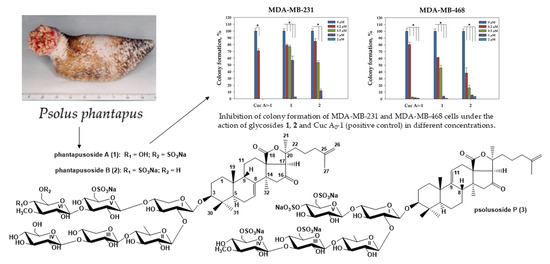
The glycosidic composition of Psolus phantapus was studied for the first time. Two new glycosides, phantapusosides A (1) and B (2), and the known psolusoside P (3) were isolated and their structures were established by analysis of 1H, 13C NMR, 1D TOCSY, and 2D NMR (1H,1H COSY, HMBC, HSQC, ROESY), and HR-ESI mass spectra. These compounds are structurally close to those isolated from other representatives of the genus Psolus: P. fabricii, P. peronii and P. chitonoides. These data confirm the chemotaxonomic significance of triterpene glycosides of sea cucumbers, demonstrating that closely related species biosynthesize structurally similar metabolites. The cytotoxic activity of compounds 1 and 2 was studied against four human breast cancer cell lines (MCF-7, T-47D, MDA-MB-231, MDA-MB-468), as well as the non-tumorigenic mammary epithelial cell line MCF-10A and the pancreatic epithelioid carcinoma cell line PANC-1. The glycosides were selectively active against the TNBC cell lines MDA-MB-231 and MDA-MB-468. Notably, both glycosides inhibited the clonogenic potential of TNBC cell lines more significantly than their metabolic activity (MTT assay) and demonstrated a more pronounced colony-inhibiting effect toward the basal-like cell line MDA-MB-468, making this cell line a promising model for future investigation of the antitumor effects of glycosides.

Graphical Abstract

1. Introduction

Marine invertebrates belonging to the class Holothuroidea are known as sea cucumbers or holothurians. They have attracted significant scientific interest over several decades due to their rich content of bioactive compounds, particularly triterpene glycosides. These secondary metabolites, also known as saponins, exhibit a wide range of pharmacological properties, including cytotoxic, antifungal, hemolytic, immunomodulatory [1,2,3,4,5,6], and anticancer activities [7,8,9,10,11]. Triterpene glycosides of sea cucumbers are characterized by unique aglycone structures, derived from lanostane, and oligosaccharide chains consisting of two to six sugar moieties that contribute to their biological activity and taxonomic specificity [12,13,14]. A distinctive feature of many holothurious glycosides is the presence of sulfate groups (from one to four) attached to different monosaccharide residues, which also affects their bioactivity and polarity.
The aglycones consist of a tetra- (non-holostane aglycones without a lactone) or pentacyclic (holostane-type aglycones with 18(20)-lactone, or non-holostane aglycones with 18(16)-lactone) backbone, with structural modifications such as the presence of a 7(8)-, 9(11), or rarely 8(9)-double bond, and various oxygen-containing functional groups (e.g., hydroxyl, keto-, epoxy- and acetate groups). The carbohydrate chains, always attached at the C-3 position of aglycones, vary in length, architecture and composition, commonly including xylose, quinovose, glucose, and 3-O-methylated glucose, xylose or even quinovose. This structural diversity leads to a wide array of compounds with distinct biological properties, providing an opportunity to study the structure–activity relationships (SARs), including the application of the modern quantitative structure–activity relationship (QSAR) technique [15,16].
The study of holothurian triterpene glycosides is of great importance for both chemotaxonomy [12,13,14] and drug discovery. The structural diversity of these compounds makes it possible to distinguish species and genera, while their potent bioactivity makes them promising candidates for the development of novel therapeutics. Nevertheless, despite extensive research on glycosides, several related issues remain unresolved. Among these are the functional characteristics of the genes and enzymes participating in glycoside biosynthesis, as well as ecological aspects, including variability in glycoside composition in relation to the geographical distribution of the species and seasonal changes.
A notable example of structural diversity is the series of triterpene glycosides from sea cucumbers of the genus Psolus. This genus comprises 58 species of sea cucumbers, five of which have been studied chemically: P. fabricii [17,18,19], P. eximius [20], P. patagonicus [21], P. chitonoides [22,23,24] and P. peronii [25]. These species produce glycosides with highly oxidized aglycones, containing all three possible positions of the intranuclear double bond (7(8)-, 8(9)- and 9(11)-); hydroxy-, epoxy-, keto-, or O-acetic functionalities in the polycyclic systems; and hydroxy-, keto- and peroxy-groups in the side chains. The aglycones of glycosides of Psolus species are related to the holostane type (with 18(20)-lactone) and to the non-holostane type (with 18(16)-lactone or the unique 18(20)-epoxy-group). Carbohydrate chains also contribute to chemical diversity due to their uncommon architecture (tetrasaccharide chains containing two units each in the upper and lower semi-chains and rare trisaccharide sugar moieties in the glycosides of P. fabricii [17,18], or three units in the upper and one unit in the lower semi-chain in the glycosides of P. chitonoides [22,23]), their sugar composition characterized by the presence of rare 3-O-methylxylose as a terminal unit [22,23], or glucose or xylose as the second sugar moiety in the chains [17,18,19,20,25]. However, the most significant distinguishing features of these compounds are the positions and number of sulfate groups. In P. fabricii, the glycosides bearing sulfate groups at C-2 and C-4 of the glucose unit have been found, while the common position of sulfation is the hydroxymethylene group (C-6) of hexoses. Moreover, the simultaneous attachment of two sulfate groups to a single monosaccharide residue is also a unique structural characteristic [18,25]. In P. chitonoides, and subsequently in P. fabricii, tetrasulfated glycosides were discovered, for the first time, among sea cucumbers [18,24].
In continuation of our investigations of glycosides from the sea cucumbers belonging to the genus Psolus, we isolated three triterpene glycosides from Psolus phantapus, including new phantapusosides A (1) and B (2) and known psolusoside P (3), found earlier in Psolus fabricii [18]. Their structures were elucidated by extensive analyses of 1H, 13C NMR, 1D TOCSY, and 2D NMR (1H,1H COSY, HMBC, HSQC, ROESY), and HR-ESI mass spectra. All original spectra are provided in Figures S1–S18 in the Supplementary Data. The hemolytic activity against human erythrocytes and the cytotoxicity against human breast cancer cell lines MCF-7, T-47D, triple-negative MDA-MB-231 and MDA-MB-468, and the non-tumorigenic mammary epithelial cell line MCF-10A, as well as against pancreatic carcinoma PANC-1 cells, were tested for new compounds 1 and 2.

2. Results and Discussion

2.1. Structure Elucidation of Glycosides

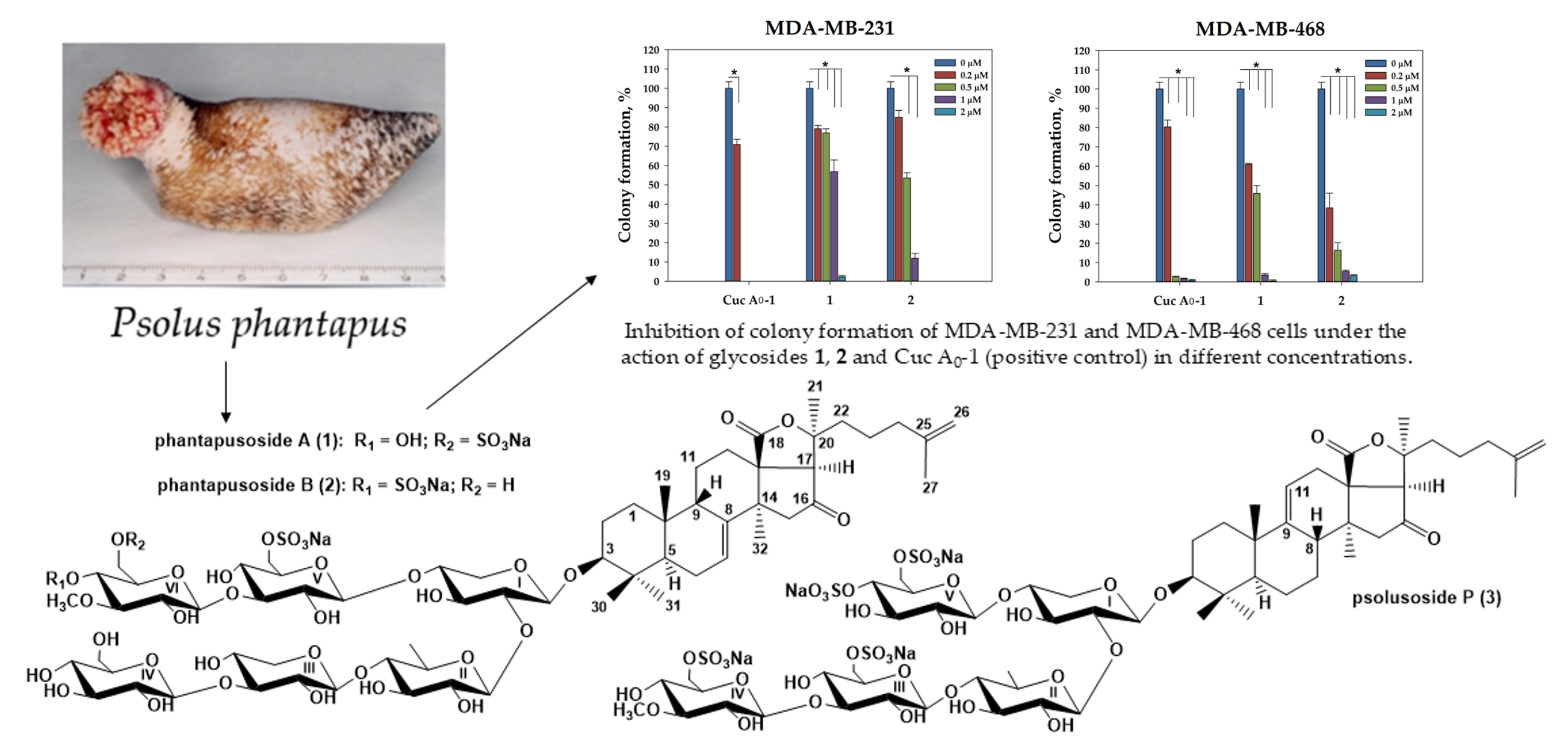
Specimens of P. phantapus (five pieces) were collected from Avacha Bay by scuba diving. Glycosides were isolated from the concentrated ethanolic extract which was previously subjected to hydrophobic chromatography on Polychrom-1-eluting glycosides with 50% EtOH followed by silica gel column chromatography with solvent system CHCl3/EtOH/H2O (4/5/1) as the mobile phase, giving a total fraction weighing 51.5 mg. Such a small total glycosidic weight did not allow us to elucidate the structures of some minor compounds, because their weights were insufficient for NMR spectra registration. So, only three glycosides 13 (Figure 1) were isolated by subsequent HPLC on reversed-phase columns in acceptable amounts for structure elucidation.
The monosaccharides composing the glycosides of P. phantapus were assigned to the D-series based on biogenetic considerations, since the D-configuration has been experimentally established for all monosaccharide residues of the glycosides of Psolus fabricii, including psolusoside P (3) [26,27]. Furthermore, all known sea cucumber triterpene glycosides are characterized by the D-configuration of their monosaccharide constituents.
The molecular formula of phantapusoside A (1) was determined to be C65H100O37S2Na2 from the [M2Na − Na] ion peak at m/z 1559.5249 (calc. for C65H100O37S2Na as 1559.5288, Δ 2.5 ppm) and the [M2Na − 2Na]2− ion peak at m/z 768.2699 (calc. for C65H100O37S2 as 768.2698, Δ −0.1 ppm) in ()HR-ESI-MS (Figure S8). As deduced from extensive analysis of the NMR spectra, the aglycone of 1 was a holostanetype, i.e., contained 18(20)-lactone (from the signals of C-18 at δC 179.3 and C-20 at δC 83.8), as well as a 7(8)-double bond (from the signals at δC 121.7 (C-7), 143.9 (C-8) and the corresponding proton at δH 5.66 m (H-7) in the 13C and 1H NMR spectra), 25(26)-double bond (from the signals at δC 145.5 (C-25), δC 110.4 (C-26) and 4.69 (H-26′, s) and 4.68 (H-26′′, s) in the 13C and 1H NMR spectra, correspondingly), and 16-keto group (from the signal at δC 214.2 (C-16) (Table 1, Figures S1–S6)). As the spatial structure of holostane-type aglycones is well-established, the orientation of methyl (CH3-19, CH3-21, CH3-30, CH3-31, CH3-32) as well as the characteristic configuration of the C-9 chiral center of the sea cucumber glycosides were confirmed by NOE-correlations: H-19/H-9, H-30; H-21/H-17; H-31/H-3, H-5; H-32/H-7 and H-9/H-19 observed in the spectrum of 1 (Table 1). Hence, the structure of the aglycone part of 1 was identified as holosta-7,25-dien-3β-ol-16-one, which was found first in cucumarioside A2-2, the main component of the glycosidic fraction of Cucumaria japonica [28], and is common for sea cucumbers.
Analysis of the 1H, 13C NMR, and HSQC spectra of the carbohydrate moiety of phantapusoside A (1) (Table 2; Figures S1–S7) revealed the presence of six doublets of the anomeric protons at δH 4.66–5.22 (J = 7.5–8.1 Hz) and the signals of the corresponding anomeric carbons at δC 102.2–104.8, indicating the presence of a hexasaccharide chain with β-glycosidic bonds [29]. The first monosaccharide residue is always attached to C-3 of the aglycone. So, the anomeric proton of the first sugar unit at δH 4.66 (H-1 Xyl1, d, J = 7.5 Hz) was deduced from the NOE correlation of H-3 of the aglycone at δH 3.19 (H-3, dd, J = 11.8; 3.4 Hz) with H-1 Xyl1. The subsequent analysis of the 1H, 1H COSY, 1D TOCSY, HSQC, and ROESY spectra allowed for the establishment of the structure of this monosaccharide as xylose (Xyl1). The signals of C-2 and C-4 Xyl1 were deshielded to 82.0 and 77.9, respectively, indicating the glycosylation of these positions. Indeed, further analysis of the ROESY spectrum revealed the correlations H-2 Xyl1/H-1 Qui2 and H-4 Xyl1/H-1 Glc5, which confirmed the positions of glycosidic bonds. Additionally, coupling patterns of protons and NOE correlations H-1/H-3, H-1/H-5, and H-3/H-5 of the xylose, glucose and 3-O-methylglucose, as well as H-2/H-4 of quinovose (Table 1), unambiguously indicate the nature of monosaccharides. It was concluded that the oligosaccharide moiety of 1 consisted of two xyloses (as the first and third units in the chain), quinovose (as the second unit), glucose (as the fourth and fifth residues) and 3-O-methylglucose (as the terminal (sixth) unit). Analysis of NOE and HMBC correlations showed the positions of glycosidic bonds. Correlations were observed between the H-1 Xyl1 and H-3 (C-3) of the aglycone, H-1 Qui2 and H-2 (C-2) Xyl1, H-1 Xyl3 and H-4 (C-4) Qui2, H-1 Glc4 and H-3 (C-3) Xyl3, H-1 Glc5 and H-4 (C-4) Xyl1, and H-1 MeGlc6 and H-3 (C-3) Glc5 (Table 2). Notably, that terminal sugar residue in the lower semi-chain was non-methylated glucose, which is a rare structural feature. The presence of two sulfate groups was deduced from HR-ESI-MS data and also confirmed by the 13C NMR spectrum of 1. Their positions were established based on α- and β-shifting effects, which were observed for the signals of C-6 Glc5 (δC 68.2) and C-5 Glc5 (δC 76.0), and for C-6 MeGlc6 (δC 67.8) and C-5 MeGlc5 (δC 76.5), correspondingly [29]. By contrast, the signals of non-sulfated carbons of hydroxymethylene groups of hexoses (C-6) are usually observed at δC ~ 61.0–61.3, and the adjacent C-5 signals are usually observed at δC ~ 77.0–77.5 [18,19,22,24]. Thus, the sulfate groups were attached to C-6 of Glc5 and C-6 of MeGlc6 in phantapusoside A (1).
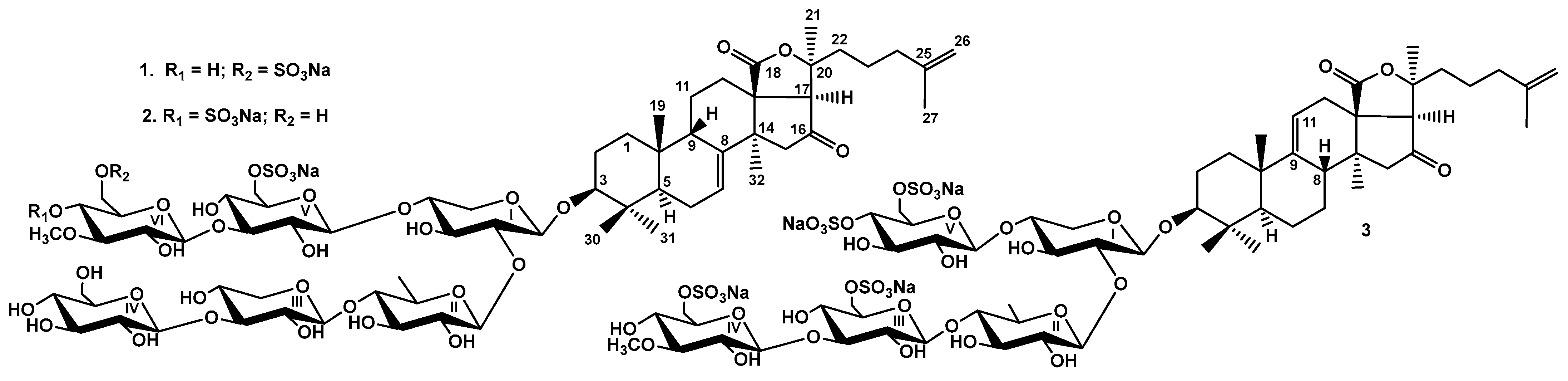
The ()ESI-MS/MS of 1 (Figure S8) demonstrated the fragmentation of the [M2Na − Na] ion at m/z 1559.5, leading to the appearance of fragment ions at m/z 1439.5 [M2Na − Na − NaHSO4], 1397.5 [M2Na − Na − Glc], 1281.5 [M2Na − Na − MeGlcSO3Na], 1265.4 [M2Na − Na − Glc − Xyl], 1119.4 [M2Na − Na − Glc − Xyl − Qui], 999.4 [M2Na − Na − Glc − Xyl − Qui − NaHSO4], 973.4 [M2Na − Na − Agl − NaSO4], and 667.0 [M2Na − Na − Agl − Glc − Xyl − Qui − H], corroborating the structure of both the sugar chain and aglycone of 1 (Figure 2).
These data indicate that phantapusoside A (1) is 3β-O-{β-D-glucopyranosyl-(1→3)-β-D-xylopyranosyl-(1→4)-β-D-quinovopyranosyl-(1→2)-[6-O-sodium sulfate-3-O-methyl-β-D-glucopyranosyl-(1→3)-6-O-sodium sulfate-β-D-glucopyranosyl-(1→4)]-β-D-xylopyranosyl}-16-keto-holosta-7(8),25-diene.
The molecular formula of phantapusoside B (2) was determined to be C65H100O37S2Na2 from the [M2Na − Na] ion peak at m/z 1559.5281 (calc. for C65H100O37S2Na as 1559.5288, Δ 0.4 ppm), and from the [M2Na − 2Na]2− ion peak at m/z 768.2702 (calc. for C65H100O37S2 as 768.2698, Δ −0.5 ppm) in ()HR-ESI-MS (Figure S16). The coincidence of molecular formulae of 1 and 2 indicated their isomerism. The aglycone of 2 was the same as in 1, as deduced from their identical NMR spectra (Table S1, Figures S9–S14). Hence, the structural differences of these glycosides were attributed to the carbohydrate chains.
Analysis of the 1H, 13C NMR, and HSQC spectra of the carbohydrate moiety of phantapusoside B (2) (Table 3; Figures S9–S15) also demonstrated the presence of six doublets of the anomeric protons at δH 4.66–5.19 (J = 7.2–8.6 Hz) and the signals of the corresponding anomeric carbons at δC 102.2–104.8. Thus, analogously to 1, the carbohydrate chain of 2 consisted of six monosaccharide residues linked through β-glycosidic bonds. Applying the same algorithm of analysis of NMR data, it was concluded that the oligosaccharide moiety of 2 had the same sugar composition and architecture, arising out of the positions of glycosidic linkages, which glycoside 1 had. Therefore, the difference could only lie in the position of sulfate groups. The comparison of chemical shifts of sulfated monosaccharide residues in 1 and 2 showed the varying values only for terminal 3-O-methylglucose. The signals of C-4 MeGlc6 and C-6 MeGlc6 in the spectrum of 2 were shifted downfield to δC 76.2 and upfield to δC 61.8, respectively, as compared with the corresponding values at δC 70.6 (C-4 MeGlc6) and δC 67.8 (C-6 MeGlc6) for 1. These data indicated the bonding of the sulfate group to C-4 MeGlc6 in 2, whose signal was deshielded due to an α-shifting effect [29]. Meanwhile, the signal of C-6 Meglc6 in the spectrum of 2 was shielded due to the absence of a sulfate group. The second sulfate group occupied the same position as in 1—at C-6 Glc5 (δC 67.2). The glycosides with the sulfate group attached to C-4 of monosaccharide residues were first discovered relatively recently (in 2017) in the sea cucumber Stichopus horrens [30], and were then isolated from Psolus fabricii [18], P. chitonoides [22,23,24], Colochirus quadrangularis [31], and Paracaudina chilensis [32]. The carbohydrate chain of phantapusoside B (2) turned out to be the same as the chain of chitonoidoside I from P. chitonoides [24]. The comparison of the 13C NMR spectra of sugar parts of phantapusoside B (2) and chitonoidoside I showed the proximity of corresponding δC values that confirmed their identity.
The ()ESI-MS/MS spectrum of 2 (Figure S16) demonstrated the fragmentation of the [M2Na − Na] ion at m/z 1559.5, leading to the appearance of a number of the same fragment ions as in the MS/MS spectrum of 1 at m/z: 1439.5 [M2Na − Na − NaHSO4], 1281.5 [M2Na − Na − MeGlcSO3Na], 1119.4 [M2Na − Na − Glc − Xyl − Qui], and 667.0 [M2Na − Na − Agl − Glc − Xyl − Qui − H]. Additional ion peaks were deciphered from the (+)HR-ESI-MS/MS, which were observed at m/z 1485 [M2Na + Na − NaHSO4]+, 1327 [M2Na + Na − MeGlcSO3]+, 1165 [M2Na + Na − MeGlcSO3 − Glc]+, 1045 [M2Na + Na − MeGlcSO3 − GlcSO3]+, and 697 [M2Na + Na − Agl − Glc − Xyl − Qui − H]+, corroborating the structure of 2.
These data indicate that phantapusoside B (2) is 3β-O-{β-D-glucopyranosyl-(1→3)-β-D-xylopyranosyl-(1→4)-β-D-quinovopyranosyl-(1→2)-[4-O-sodium sulfate-3-O-methyl-β-D-glucopyranosyl-(1→3)-6-O-sodium sulfate-β-D-glucopyranosyl-(1→4)]-β-D-xylopyranosyl}-16-keto-holosta-7(8),25-diene.
The molecular formula of glycoside 3 was determined to be C60H90O39S4Na4 from the [M4Na − Na] ion peak at m/z 1631.3648 (calc. for C60H90O39S4Na3 as 1631.3641, Δ −0.4 ppm), the [M4Na − 2Na]2− ion peak at m/z 804.1873 (calc. for C60H90O39S4Na2 as 804,1873, Δ 0.1 ppm), the [M4Na − 3Na]3− ion peak at m/z 528.4616 (calc. for C60H90O39S4Na as 528.4619, Δ 0.6 ppm), and the [M4Na − 4Na]4− ion peak at m/z 390.5987 (calc. for C60H90O39S4 as 390.5991, Δ 1.0 ppm) in ()HR-ESI-MS (Figure S18). The 13C NMR spectrum of 3 (Figure S17) was coincident with that of psolusoside P (3), isolated earlier from Psolus fabricii [18] and P. peronii [25]. It was the first tetrasulfated glycoside that was found with two sulfate groups connected to one monosaccharide residue.
Thus, the glycosides isolated from the sea cucumber P. phantapus are structurally close to those isolated from the other representatives of genus Psolus: P. fabricii, P. peronii and P. chitonoides. They have the same aglycones as the glycosides of both of the latter species; phantapusoside B (2) possesses a carbohydrate chain identical to that of chitonoidoside I, and finally P. fabricii, P. peronii and P. phantapus all contain psolusoside P (3). These data further demonstrate the chemotaxonomic significance of triterpene glycosides of the sea cucumbers, showing that closely related species biosynthesize structurally similar metabolites.

2.2. Biological Activity of Phantapusosides A (1) and B (2)

The cytotoxic activity of the compounds 1 and 2 was studied against four types of human breast cancer cells (MCF-7, T-47D, and two triple-negative (TNBC) lines MDA-MB-231 (mesenchymal-like) and MDA-MB-468 (basal-like)), as well as the non-tumorigenic mammary epithelial cell line MCF-10A and pancreatic epithelioid carcinoma PANC-1 cell line. Cucumarioside A0-1 [11] was used as the positive control. Cytotoxic activity against all the selected cell lines was assessed using the MTT method (Table 4).
Phantapusosides A (1) and B (2) exhibited strong hemolytic activity against human erythrocytes, indicating membranolytic action due to binding to membrane cholesterol and lipids [15]. In contrast, their cytotoxic activity against cancer cells was comparatively lower, although some selectivity of the glycosides towards different cancer cell lines was observed. The TNBC cell lines MDA-MB-231 and MDA-MB-468, and to a lesser extent the pancreatic cancer cell line PANC-1, were more sensitive to the cytotoxic action of the glycosides than the other tested cell lines.
As previously reported, MDA-MB-231 cells were more sensitive to the cytotoxic action of the glycosides, while the MCF-7 and T-47D cell lines were more resistant [33,34,35]; the same was observed for compounds 1 and 2. It has been established that, beyond their interaction with membrane lipids, the glycosides appear to target the adenosine receptor subtype A2B (A2BAR), which is highly expressed on MDA-MB-231 cells. The sea cucumber glycosides act as functionally selective antagonists of A2BAR, exhibiting signaling bias towards the inhibition of the MAPK pathway—a process underlying the antitumor action of the glycosides [36,37]. Thus, the higher activity of 1 and 2 against MDA-MB-231, MDA-MB-468 and PANC-1, in comparison with MCF-7 and T-47D, can be explained by the increased expression of A2BAR on these cells. However, the cytotoxicity of phantapusosides A (1) and B (2) against MDA-MB-231 cells was considerably lower than that of the lead glycosides (okhotoside A1-1 and cucumarioside A0-1 (used as positive control)) selected earlier from a large series of tested glycosides [11,34,35]. This can be explained by the presence of bulky hexasaccharide chains in 1 and 2, which limit their incorporation into the membrane. This is in good agreement with the previous findings, where the glycosides with linear tetrasaccharide chains and holostane-type aglycones are generally the most active [15,16].
Notably, compound 2 was more active than compound 1, and its IC50 was close to that of cucumarioside A0-1 (positive control). Since glycoside 2 differed from 1 by the attachment of the sulfate group at C-4 MeGlc6 instead of C-6 MeGlc6, the difference in their activity was directly related to this structural feature, which has been shown to strongly influence the cytotoxic properties of the glycosides [15]. Additionally, the nearly identical hemolytic ED50 values of 1 and 2 (Table 4) contrast with their divergent anticancer cytotoxicity, implying that the differential positioning of the sulfate group primarily modulates the receptor-mediated antitumor mechanisms rather than general membranolytic properties.
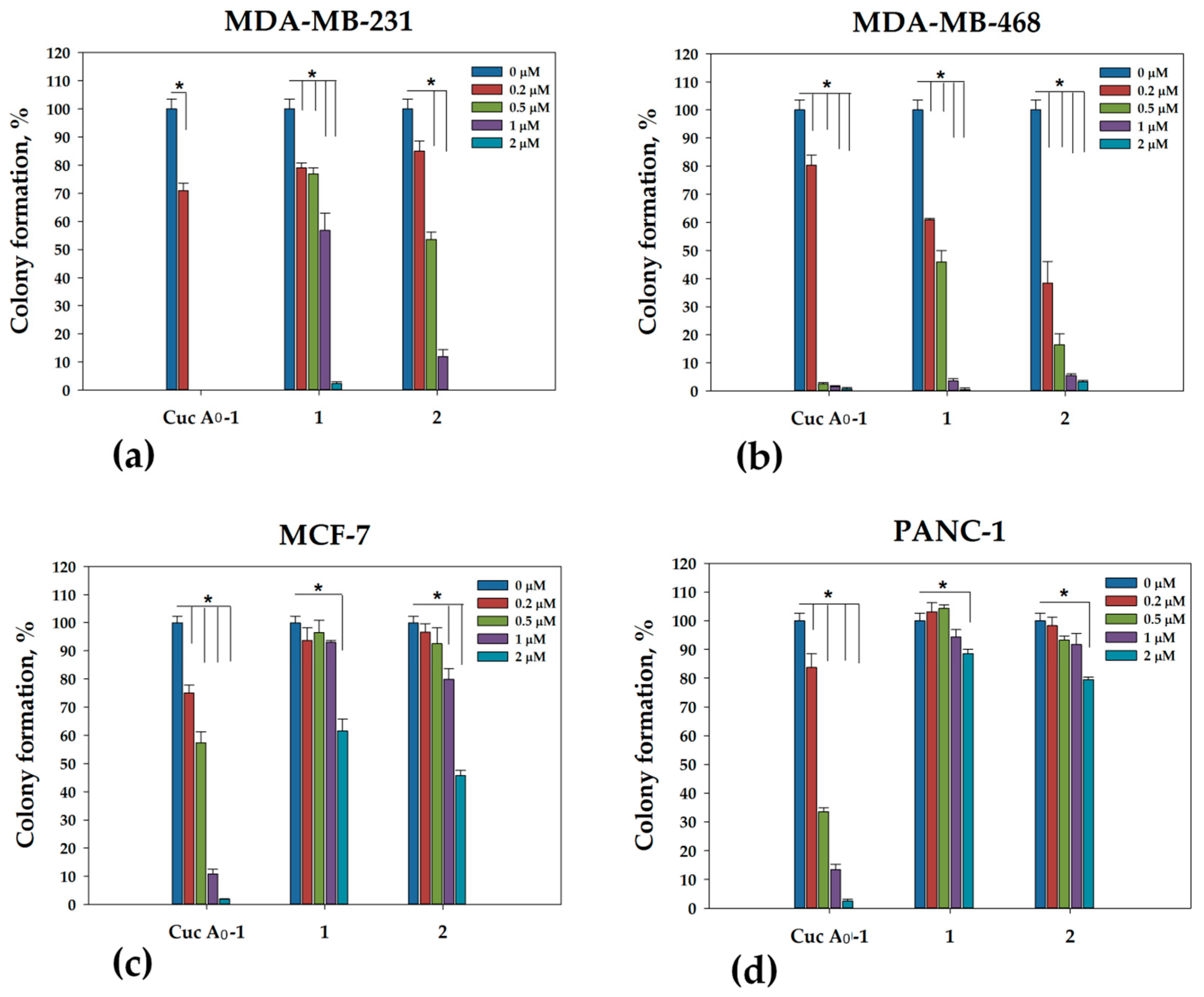
The reproductive integrity of a single cell—its capacity to divide and produce a visible colony—forms the basis of the colony formation assay, a standard tool for in vitro survival studies. This phenomenon directly mirrors the in vivo situation, where the unrestrained proliferative potential of malignant cells is responsible for the development of metastases. To study the effect of the tested glycosides on the formation and growth of tumor cell colonies, a range of non-toxic concentrations was used against the MDA-MB-231, MDA-MB-468, MCF-7 and PANC-1 cell lines (Figure 3). A dose-dependent effect of colony growth inhibition was observed for both compounds, but it was less pronounced in relation to MCF-7 and PANC-1 lines. Phantapusoside B (2) more strongly inhibited colony formation and growth than phantapusoside A (1) (Table 5).
At a concentration of 0.5 μM, compound 2 demonstrated inhibition of MDA-MB-231 cells by 47% and MDA-MB-468 cells by 84%. The increased concentration of 2 (1 μM) led to a stronger inhibition of colony formation of MDA-MB-231 cells by 88% and of MDA-MB-468 cells by 95%. The dosage of 2 μM of phantapusoside B (2) almost completely blocked colony formation of both the MDA-MB-231 and MDA-MB-468 lines, and caused 54% of growth inhibition of MCF-7 cell colonies (Figure 3).
Compound 1 at a concentration of 0.5 μM inhibited colony formation of MDA-MB-231 cells by 23% and MDA-MB-468 cells by 54%, at a concentration of 1 μM—by 43% and 94%, respectively. An amount of 2 μM of phantapusoside A (1) acted similarly to glycoside 2, almost completely blocking colony formation of MDA-MB-231 and MDA-MB-468 lines, and causing 39% of growth inhibition of MCF-7 cell colonies (Figure 3).
Notably, both glycosides (1, 2) inhibited the clonogenic potential of TNBC cell lines more significantly than their metabolic activity (MTT assay). They demonstrated a more pronounced colony-inhibiting effect toward the basal-like cell line MDA-MB-468. Colony formation and growth of PANC-1 cells were not affected by the tested concentrations of glycosides 1 and 2, whereas cucumarioside A0-1 (positive control) significantly inhibited both PANC-1 and MCF-7 cell colonies at concentrations of 1 and 2 μM. Thus, compounds 1 and 2 exhibit a narrower spectrum of anticlonogenic action than the control, making them more selective toward TNBC cells. Additionally, the pronounced inhibitory effect of the glycosides against MDA-MB-468 cells makes this cell line a promising model for future investigation of the antitumor effects of glycosides.

3. Materials and Methods

3.1. General Experimental Procedures

The PerkinElmer 343 Polarimeter (PerkinElmer, Waltham, MA, USA) was used for specific rotation measurement. NMR spectra were registered on an Avance III 700 Bruker FT-NMR spectrometer (Bruker BioSpin GmbH, Rheinstetten, Germany) (700.13/176.04 MHz (1H/13C, 30 °C, δC 148.9 resonance of C5D5N/D2O for 13C and δH 7.21 resonance of C5D5N/D2O for 1H used as the references, BBO probe)). ESI MS (negative ion mode) spectra were obtained on an Agilent 6510 Q-TOF apparatus (Agilent Technology, Santa Clara, CA, USA), with a sample concentration of 0.01 mg/mL. HPLC was conducted on an Agilent 1260 Infinity II equipped with a differential refractometer (Agilent Technology, Santa Clara, CA, USA). The following columns were used: Supelco Discovery HS F5-5 (10 × 250 mm, 5 μM) (flow rate of 1.5 mL/min) and Diasfer C-8 (4.6 × 250 mm, 5 μM) (flow rate of 0.5 mL/min) (BioChemMac, Moscow, Russia).

3.2. Animals and Cells

Specimens of Psolus phantapus (family Psolidae; order Dendrochirotida) were collected from Avacha Bay by scuba diving. Sampling was performed in August 2014 at a depth of 5–15 m. Taxonomic identification of the animals was performed by Dr. Stepanov V.G. A voucher specimen is being kept in the Pacific Institute of Geography, Kamchatka Branch, Petropavlovsk-Kamchatsky, Russia.
Human erythrocytes were purchased from the Station of Blood Transfusion (Vladivostok, Russia). Human mammary epithelial cell line MCF-10A CRL-10317; human breast cancer cell lines T-47D HTB-133, MCF-7 HTB-22, MDA-MB-468 HTB-132, and MDA-MB-231 CRM-HTB-26; and human pancreatic carcinoma PANC-1 CRL-1469 were received from ATCC (Manassas, VA, USA).
The MCF-10 A cells were cultured in DMEM/F12 (Biolot, St. Petersburg, Russia) medium with 20% FBS (Biolot, St. Petersburg, Russia), 20 ng/mL of EGF (Sci-Store, Moscow, Russia) and 1% penicillin/streptomycin (Biolot, St. Petersburg, Russia).
The T-47D cells were cultured in RPMI-1640 medium (Biolot, St. Petersburg, Russia) with 10% FBS (Biolot, St. Petersburg, Russia) and 1% penicillin/streptomycin (Biolot, St. Petersburg, Russia).
The MCF-7, MDA-MB-468 and MDA-MB-231 cells were cultured in MEM medium (Biolot, St. Petersburg, Russia) with 10% FBS (Biolot, St. Petersburg, Russia) and 1% penicillin/streptomycin (Biolot, St. Petersburg, Russia).
The PANC-1 cells were cultured in DMEM (Biolot, St. Petersburg, Russia) with 10% FBS (Biolot, St. Petersburg, Russia) and 1% penicillin/streptomycin (Biolot, St. Petersburg, Russia).
All cell lines were incubated at 37 °C in an incubator with an atmosphere of 5% CO2.

3.3. Extraction and Isolation

Sea cucumbers (5 pieces) were minced and extracted twice with refluxing 60% EtOH (~4−5 h each time; the volume of the solvent is approximately equal to the volume occupied by animal material). After filtration, the extracts were evaporated in vacuo and chromatographed on a silica gel column with the solvent system CHCl3/EtOH (9/1) (V ~ 300 mL) to remove non-polar compounds (controlled with TLC). The remaining substances were eluted with the solvent system CHCl3/EtOH/H2O (10/15/4) (V ~ 400 mL), evaporated, then dissolved in H2O (V = 200 mL) and loaded on a Polychrom-1 column. The column was washed with H2O (V = 1000 mL) to remove salts and inorganic impurities. Crude glycosidic fraction (458 mg) was eluted with 50% EtOH (V = 350 mL). Then, it was subjected to twice-repeated silica gel column chromatography using solvent system CHCl3/EtOH/H2O (4:5:1) (V = 500 mL each), which resulted in isolation of one glycosidic subfraction (51.5 mg). The subsequent high-pressure liquid chromatography (HPLC) of this subfraction on a reversed-phase column Supelco Discovery HS F5-5 (10 × 250 mm) with MeOH/H2O/NH4OAc (1M water solution) in a ratio of (70/28/2) as the mobile phase yielded three fractions (fr. 1, Rt = 9–10 min; fr. 2, Rt = 12−13 min; and fr. 3, Rt = 14–14.5 min). Fractions 2 and 3 were re-chromatographed on a Diasfer C-8 (4.6 × 250 mm) column with solvent system MeOH/H2O/NH4OAc (1M water solution) in a ratio of (60/38/2) as the mobile phase resulted in the isolation of phantapusosides B (2) (1.0 mg, Rt = 13.5 min) and A (1) (1.0 mg, Rt = 15 min), correspondingly. Fraction 1 was subjected to HPLC on the Supelco Discovery HS F5-5 (10 × 250 mm) column with MeOH/H2O/NH4OAc (1M water solution) in a ratio of (60/38/2) as the mobile phase and gave psolusoside P (3) (1.5 mg, Rt = 16 min).

3.3.1. Phantapusoside A (1)

Colorless powder; [α]D20-46° (c 0.1, H2O), mp 216 °C. Data of NMR: Table 1 and Table 2, Figures S1–S7. ()HR-ESI-MS m/z: 1559.5249 (calc. 1559.5288) [M2Na − Na], 768.2699 (calc. 768.2698) [M2Na − Na]2−; ()ESI-MS/MS m/z: 1439.5 [M2Na − Na − NaHSO4], 1397.5 [M2Na − Na − Glc (C6H10O5)], 1281.5 [M2Na − Na − MeGlcSO3Na (C7H11O8SNa)], 1265.4 [M2Na − Na − Glc (C6H10O5) − Xyl (C5H8O4)], 1119.4 [M2Na − Na − Glc (C6H10O5)– Xyl (C5H8O4) − Qui (C6H10O4)], 999.4 [M2Na − Na − Glc (C6H10O5)– Xyl (C5H8O4) − Qui (C6H10O4) − NaHSO4], 973.4 [M2Na − Na − Agl (C30H43O4) − NaSO4], 667.0 [M2Na − Na − Agl (C30H43O3) − Glc (C6H10O5) − Xyl (C5H8O4) − Qui (C6H10O4)– H].

3.3.2. Phantapusoside B (2)

Colorless powder; [α]D20-38° (c 0.1, H2O), mp 204 °C. Data of NMR: Table 3 and Table S1, Figures S9–S15. (−)HR-ESI-MS m/z: 1559.5281 (calc. 1559.5288) [M2Na − Na], 768.2702 (calc. 768.2698) [M2Na − Na]2−; ()ESI-MS/MS m/z: 1439.5 [M2Na − Na − NaHSO4], 1281.5 [M2Na − Na − MeGlcSO3Na (C7H11O8SNa)], 1119.4 [M2Na − Na − Glc (C6H10O5)– Xyl (C5H8O4) − Qui (C6H10O4)], 667.0 [M2Na − Na − Agl (C30H43O3) − Glc (C6H10O5) − Xyl (C5H8O4) − Qui (C6H10O4)– H]; (+)ESI-MS/MS m/z: 1485 [M2Na + Na − NaHSO4]+, 1327 [M2Na + Na − MeGlcSO3 (C7H11O8SNa)]+, 1165 [M2Na + Na − MeGlcSO3 (C7H11O8SNa) − Glc (C6H10O5)]+, 1045 [M2Na + Na − MeGlcSO3 (C7H12O9SNa) − GlcSO3 (C6H9O8SNa) − H]+, 697 [M2Na + Na − Agl (C30H43O4) − Glc (C6H10O5) − Xyl (C5H8O4) − Qui (C6H10O4) − H]+.

3.4. Cytotoxic Activity (MTT Assay)

The studied tumor cell lines (MCF-7, T-47D, MDA-MB-231, MDA-MB-468, and PANC-1), as well as a non-transformed human breast epithelial cell line (MCF-10A), were seeded in 96-well plates at a concentration of 6 × 10³ per well and allowed to adhere for 24 h. After the cells were plated, the studied glycosides were added to the plates at various concentrations (0.07–20 μM). Cucumarioside A0-1 (Cuc A0-1) was used at the same concentrations as a positive control. The cells were incubated for 24 h and then the medium was replaced with 100 μL of fresh medium, and 10 μL (5 mg/mL) of MTT (3-(4,5-dimethylthiazol-2-yl)-2,5-diphenyltetrazolium bromide) solution (neoFroxx, D-Einhausen, Germany) was added. The plates were incubated for 4 h and 100 μL of SDS-HCl solution (1 g of SDS/10 mL of d-H2O/17 μL of 6 N HCl) was added. The plates with cells were placed in a CO2 incubator overnight. The optical density was measured at a wavelength of 570 nm using a Synergy H1 microplate reader (BioTek Instruments Inc., Winooski, VT, USA). The cytotoxic activity of the studied glycosides was assessed by the IC50 value, the concentration at which the metabolic activity of cells is suppressed by 50%. The experiments were conducted in triplicate, p < 0.05.

3.5. Colony Formation Assay

A clonogenic assay was performed using the MDA-MB-231, MDA-MB-468, MCF-7, and PANC-1 cell lines. The cell lines were seeded in 6-well plates at a concentration of 0.3 × 10²/mL. Glycosides were added at concentrations of 0.2, 0.5, 1, and 2 μM 24 h after adhesion. The plates were left for 10–14 days in a CO2 incubator. Formed colonies (at least 50 cells) were fixed with methanol for 25 min and then stained with 0.5% crystal violet for 25 min. The plates containing the stained colonies were washed and air-dried. Colonies were quantified using the BIO-PRINT-Cx4 system (Vilber, Paris, France) in conjunction with Bio-Vision software (v. 18.01), following the manufacturer’s protocols. The data are expressed as the percentage of colony growth inhibition relative to the control group.

Supplementary Materials

The following supporting information can be downloaded at https://www.mdpi.com/article/10.3390/md24060202/s1, Figures S1–S18: The original spectral data of compounds 13; Table S1: One and two-dimensional NMR data of aglycone of phantapusoside B (2).

Author Contributions

Conceptualization, A.S.S. and V.I.K.; investigation, A.S.S., S.A.A., A.I.K., R.S.P., E.A.C., E.S.M., K.M.T. and V.G.S.; methodology, A.S.S., E.A.C. and E.S.M.; writing—original draft preparation, A.S.S.; review and editing, V.I.K. All authors have read and agreed to the published version of the manuscript.

Funding

The research was carried out within the framework of the State assignment of the G.B. Elyakov Pacific Institute of Bioorganic Chemistry, Far-Eastern Branch, Russian Academy of Science (agreement N 075-03-2026-098).

Institutional Review Board Statement

Not applicable.

Data Availability Statement

The original contributions presented in this study are included in the article. Further inquiries can be directed to the corresponding author.

Acknowledgments

This study was carried out on the equipment of the Collective Facilities Center “The Far Eastern Center for Structural Molecular Research (NMR/MS) PIBOC FEB RAS”.

Conflicts of Interest

The authors declare no conflicts of interest.

References

  1. Chludil, H.D.; Murray, A.P.; Seldes, A.M.; Maier, M.S. Biologically active triterpene glycosides from sea cucumbers (Holothuroidea, Echinodermata). In Studies in Natural Products Chemistry; Rahman, A.U., Ed.; Elsevier Science B.V.: Amsterdam, The Netherlands, 2003; Volume 28, pp. 587–616. [Google Scholar]
  2. Kim, S.-K.; Himaya, S.W.A. Triterpene glycosides from sea cucumbers and their biological activities. Adv. Food Nutr. Res. 2012, 63, 297–319. [Google Scholar] [CrossRef]
  3. Gomes, A.R.; Freitas, A.C.; Duarte, A.C.; Rocha-Santos, T.A.P. Echinoderms: A review of bioactive compounds with potential health effects. In Studies in Natural Products Chemistry; Rahman, A.U., Ed.; Elsevier B.V.: Amsterdam, The Netherlands, 2016; Volume 49, pp. 1–54. [Google Scholar]
  4. Aminin, D.; Pisliagin, E.; Astashev, M.; Es’kov, A.; Kozhemyako, V.; Avilov, S.; Zelepuga, E.; Yurchenko, E.; Kaluzhskiy, L.; Kozlovskaya, E.; et al. Glycosides from edible sea cucumbers stimulate macrophages via purinergic receptors. Sci. Rep. 2016, 6, 39683. [Google Scholar] [CrossRef]
  5. Zhao, Y.-C.; Xue, C.-H.; Zhang, T.T.; Wang, Y.-M. Saponins from sea cucumber and their biological activities. Agric. Food Chem. 2018, 66, 7222–7237. [Google Scholar] [CrossRef] [PubMed]
  6. Khotimchenko, Y. Pharmacological potential of sea cucumbers. Int. J. Mol. Sci. 2020, 19, 1342. [Google Scholar] [CrossRef]
  7. Aminin, D.L.; Menchinskaya, E.S.; Pislyagin, E.A.; Silchenko, A.S.; Avilov, S.A.; Kalinin, V.I. Sea cucumber triterpene glycosides as anticancer agents. In Studies in Natural Product Chemistry; Rahman, A.U., Ed.; Elsevier B.V.: Amsterdam, The Netherlands, 2016; Volume 49, pp. 55–105. [Google Scholar]
  8. Dyshlovoy, S.A.; Madanchi, R.; Hauschild, J.; Otte, K.; Alsdorf, W.H.; Schumacher, U.; Kalinin, V.I.; Silchenko, A.S.; Avilov, S.A.; Honecker, F.; et al. The marine triterpene glycoside frondoside A induces p53-independent apoptosis and inhibits autophagy in urothelial carcinoma cells. BMC Cancer 2017, 17, 93. [Google Scholar] [CrossRef]
  9. Yun, S.-H.; Sim, E.-H.; Han, S.-H.; Kim, T.-R.; Ju, M.-H.; Han, J.-Y.; Jeong, J.-S.; Kim, S.-H.; Silchenko, A.S.; Stonik, V.A.; et al. In vitro and in vivo anti-leukemic effects of cladoloside C2 are mediated by activation of Fas/ceramide syntase 6/P38 kinase/C-Jun NH2-terminal kinase/caspase-8. Oncotarget 2018, 9, 495–511. [Google Scholar] [CrossRef]
  10. Menchinskaya, E.S.; Gorpenchenko, T.Y.; Silchenko, A.S.; Avilov, S.A.; Aminin, D.L. Modulation of doxorubicin intracellular accumulation and anticancer activity by triterpene glycoside cucumarioside A2-2. Mar. Drugs 2019, 17, 597. [Google Scholar] [CrossRef]
  11. Menchinskaya, E.S.; Chingizova, E.A.; Pislyagin, E.A.; Yurchenko, E.A.; Klimovich, A.A.; Zelepuga, E.A.; Aminin, D.L.; Avilov, S.A.; Silchenko, A.S. Mechanisms of action of sea cucumber triterpene glycosides cucumarioside A0-1 and djakonovioside A against human triple-negative breast cancer. Mar. Drugs 2024, 22, 474. [Google Scholar] [CrossRef]
  12. Omran, N.E.; Salem, H.K.; Eissa, S.H.; Kabbash, A.M.; Kandeil, M.A.; Salem, M.A. Chemotaxonomic study of the most abundant Egyptian sea-cucumbers using ultra-performance liquid chromatography (UPLC) coupled to high-resolution mass spectrometry (HRMS). Chemoecology 2020, 30, 35–48. [Google Scholar] [CrossRef]
  13. Honey-Escandon, M.; Arreguin-Espinosa, R.; Solis-Martin, F.A.; Samyn, Y. Biological and taxonomic perspective of triterpenoid glycosides of sea cucumbers of the family Holothuriidae (Echinodermata, Holothuroidea). Comp. Biochem. Physiol. 2015, 180B, 16–39. [Google Scholar] [CrossRef]
  14. Kalinin, V.I.; Avilov, S.A.; Silchenko, A.S.; Stonik, V.A. Triterpene glycosides of sea cucumbers (Holothuroidea, Echinodermata) as taxonomic markers. Nat. Prod. Commun. 2015, 10, 21–26. [Google Scholar] [CrossRef]
  15. Zelepuga, E.A.; Silchenko, A.S.; Avilov, S.A.; Kalinin, V.I. Structure-activity relationships of holothuroid’s triterpene glycosides and some in silico insights obtained by molecular dynamics study on the mechanisms of their membranolytic action. Mar. Drugs 2021, 19, 604. [Google Scholar] [CrossRef]
  16. Silchenko, A.S.; Zelepuga, E.A.; Chingizova, E.A.; Menchinskaya, E.S.; Tabakmakher, K.M.; Kalinovsky, A.I.; Avilov, S.A.; Popov, R.S.; Dmitrenok, P.S.; Kalinin, V.I. Cladolosides of groups S and T: Triterpene glycosides from the sea cucumber Cladolabes schmeltzii with unique sulfation; human breast cancer cytotoxicity and QSAR. Mar. Drugs 2025, 23, 265. [Google Scholar] [CrossRef]
  17. Silchenko, A.S.; Kalinovsky, A.I.; Avilov, S.A.; Kalinin, V.I.; Andrijaschenko, P.V.; Dmitrenok, P.S.; Popov, R.S.; Chingizova, E.A.; Ermakova, S.P.; Malyarenko, O.S. Structures and bioactivities of six new triterpene glycosides, psolusosides E, F, G, H, H1 and I and the corrected structure of psolusoside B from the sea cucumber Psolus fabricii. Mar. Drugs 2019, 17, 358. [Google Scholar] [CrossRef]
  18. Silchenko, A.S.; Kalinovsky, A.I.; Avilov, S.A.; Kalinin, V.I.; Andrijaschenko, P.V.; Dmitrenok, P.S.; Popov, R.S.; Chingizova, E.A. Structures and bioactivities of psolusosides B1, B2, J, K, L, M, N, O, P, and Q from the sea cucumber Psolus fabricii. The first finding of tetrasulfated marine low molecular weight metabolites. Mar. Drugs 2019, 17, 631. [Google Scholar] [CrossRef] [PubMed]
  19. Silchenko, A.S.; Avilov, S.A.; Kalinovsky, A.I.; Kalinin, V.I.; Andrijaschenko, P.V.; Dmitrenok, P.S.; Popov, R.S.; Chingizova, E.A.; Kasakin, M.F. Psolusosides C3 and D2–D5, five novel triterpene hexaosides from the sea cucumber Psolus fabricii (Psolidae, Dendrochirotida): Chemical structures and bioactivities. Nat. Prod. Commun. 2019, 14, 7. [Google Scholar] [CrossRef]
  20. Kalinin, V.I.; Avilov, S.A.; Kalinina, E.Y.; Korolkova, O.G.; Kalinovsky, A.I.; Stonik, V.A.; Riguera, R.; Jimenez, C. Structure of eximisoside A, a novel triterpene glycoside from the Far-Eastern sea cucumber Psolus eximius. J. Nat. Prod. 1997, 60, 817–819. [Google Scholar] [CrossRef]
  21. Murray, A.P.; Muniain, C.; Seldes, A.M.; Maier, M. Patagonicoside A: A novel antifungal disulfated triterpene glycoside from the sea cucumber Psolus patagonicus. Tetrahedron 2001, 57, 9563–9568. [Google Scholar] [CrossRef]
  22. Silchenko, A.S.; Kalinovsky, A.I.; Avilov, S.A.; Andrijaschenko, P.V.; Popov, R.S.; Dmitrenok, P.S.; Chingizova, E.A.; Kalinin, V.I. Unusual structures and cytotoxicities of chitonoidosides A, A1, B, C, D, and E, six triterpene glycosides from the Far Eastern sea cucumber Psolus chitonoides. Mar. Drugs 2021, 19, 449. [Google Scholar] [CrossRef]
  23. Silchenko, A.S.; Kalinovsky, A.I.; Avilov, S.A.; Andrijaschenko, P.V.; Popov, R.S.; Chingizova, E.A.; Kalinin, V.I.; Dmitrenok, P.S. Triterpene glycosides from the Far Eastern sea cucumber Psolus chitonoides: Chemical structures and cytotoxicities of chitonoidosides E1, F., G, and H. Mar. Drugs 2021, 19, 696. [Google Scholar] [CrossRef]
  24. Silchenko, A.S.; Avilov, S.A.; Andrijaschenko, P.V.; Popov, R.S.; Chingizova, E.A.; Dmitrenok, P.S.; Kalinovsky, A.I.; Rasin, A.B.; Kalinin, V.I. Structures and biologic activity of chitonoidosides I, J, K, K1 and L—Triterpene di-, tri- and tetrasulfated hexaosides from the sea cucumber Psolus chitonoides. Mar. Drugs 2022, 20, 369. [Google Scholar] [CrossRef]
  25. Silchenko, A.S.; Kalinovsky, A.I.; Avilov, S.A.; Popov, R.S.; Chingizova, E.A.; Menchinskaya, E.S.; Zelepuga, E.A.; Tabakmakher, K.M.; Stepanov, V.G.; Kalinin, V.I. The composition of triterpene glycosides in the sea cucumber Psolus peronii: Anticancer activity of the glycosides against three human breast cancer cell lines and quantitative structure–activity relationships (QSAR). Mar. Drugs 2024, 22, 292. [Google Scholar] [CrossRef]
  26. Kalinin, V.I.; Stepanov, V.R.; Stonik, V.A. Psolusoside A—A new triterpene glycoside from the holothurian Psolus fabricii. Chem. Nat. Compd. 1983, 19, 754. [Google Scholar] [CrossRef]
  27. Silchenko, A.S.; Avilov, S.A.; Kalinovsky, A.I.; Kalinin, V.I.; Andrijaschenko, P.V.; Dmitrenok, P.S. Psolusosides C1, C2, and D1, novel triterpene hexaosides from the sea cucumber Psolus fabricii (Psolidae, Dendrochirotida). Nat. Prod. Commun. 2018, 13, 1623–1628. [Google Scholar] [CrossRef]
  28. Avilov, S.A.; Tishchenko, L.Y.; Stonik, V.A. Structure of cucumarioside A2-2—A triterpene glycoside from the holothurian Cucumaria japonica. Chem. Nat. Compd. 1984, 20, 759–760. [Google Scholar] [CrossRef]
  29. Shashkov, A.S.; Chizhov, O.S. C-13-NMR spectroscopy in chemistry of carbohydrates and related compounds. Bioorg. Khim. 1976, 2, 437–497. [Google Scholar]
  30. Cuong, N.X.; Vien, L.T.; Hoang, L.; Hanh, T.T.H.; Thao, D.T.; Thann, N.V.; Nam, N.H.; Thung, D.C.; Kiem, P.V.; Minh, C.V. Cytotoxic triterpene glycosides from the sea cucumber Stichopus horrens. Bioorg. Med. Chem. Lett. 2017, 27, 2939–2942. [Google Scholar] [CrossRef]
  31. Silchenko, A.S.; Kalinovsky, A.I.; Avilov, S.A.; Andrijaschenko, P.V.; Popov, R.S.; Dmitrenok, P.S.; Chingizova, E.A.; Ermakova, S.P.; Malyarenko, O.S.; Dautov, S.S.; et al. Structures and bioactivities of quadrangularisosides A, A1, B, B1, B2, C, C1, D, D1–D4, and E from the sea cucumber Colochirus quadrangularis: The first discovery of the glycosides, sulfated by C-4 of the terminal 3-O-methylglucose residue. Synergetic effect on colony formation of tumor HT-29 cells of these glycosides with radioactive irradiation. Mar. Drugs 2020, 18, 394. [Google Scholar] [CrossRef]
  32. Silchenko, A.S.; Avilov, S.A.; Andrijaschenko, P.V.; Popov, R.S.; Chingizova, E.A.; Grebnev, B.B.; Rasin, A.B.; Kalinin, V.I. The isolation, structure elucidation and bioactivity study of chilensosides A, A1, B, C, and D, holostane triterpene di-, tri- and tetrasulfated pentaosides from the sea cucumber Paracaudina chilensis (Caudinidae, Molpadida). Molecules 2022, 27, 7655. [Google Scholar] [CrossRef] [PubMed]
  33. Silchenko, A.S.; Kalinovsky, A.I.; Avilov, S.A.; Popov, R.S.; Dmitrenok, P.S.; Chingizova, E.A.; Menchinskaya, E.S.; Panina, E.G.; Stepanov, V.G.; Kalinin, V.I.; et al. Djakonoviosides A, A1, A2, B1–B4—Triterpene Monosulfated Tetra- and Pentaosides from the Sea Cucumber Cucumaria djakonovi: The First Finding of a Hemiketal Fragment in the Aglycones; Activity against Human Breast Cancer Cell Lines. Int. J. Mol. Sci. 2023, 24, 11128. [Google Scholar] [CrossRef]
  34. Silchenko, A.S.; Kalinovsky, A.I.; Avilov, S.A.; Popov, R.S.; Chingizova, E.A.; Menchinskaya, E.S.; Zelepuga, E.A.; Panina, E.G.; Stepanov, V.G.; Kalinin, V.I.; et al. Sulfated Triterpene Glycosides from the Far Eastern Sea Cucumber Cucumaria djakonovi: Djakonoviosides C1, D1, E1, and F1; Cytotoxicity against Human Breast Cancer Cell Lines; Quantitative Structure–Activity Relationships. Mar. Drugs 2023, 21, 602. [Google Scholar] [CrossRef]
  35. Silchenko, A.S.; Chingizova, E.A.; Menchinskaya, E.S.; Zelepuga, E.A.; Kalinovsky, A.I.; Avilov, S.A.; Tabakmakher, K.M.; Popov, R.S.; Dmitrenok, P.S.; Dautov, S.S.; et al. Composition of Triterpene Glycosides of the Far Eastern Sea Cucumber Cucumaria conicospermium Levin et Stepanov; Structure Elucidation of Five Minor Conicospermiumosides A3-1, A3-2, A3-3, A7-1, and A7-2; Cytotoxicity of the Glycosides Against Human Breast Cancer Cell Lines; Structure–Activity Relationships. Mar. Drugs 2024, 22, 560. [Google Scholar] [CrossRef] [PubMed]
  36. Zelepuga, E.A.; Chingizova, E.A.; Menchinskaya, E.S.; Pislyagin, E.A.; Avilov, S.A.; Kalinin, V.I.; Aminin, D.L.; Silchenko, A.S. Anticancer activity of triterpene glycosides cucumarioside A0-1 and djakonovioside A against MDA-MB-231 as A2B adenosine receptor antagonists. Int. J. Mol. Sci. 2025, 26, 10327. [Google Scholar] [CrossRef] [PubMed]
  37. Chingizova, E.A.; Menchinskaya, E.S.; Yurchenko, E.A.; Zelepuga, E.A.; Pislyagin, E.A.; Nesterenko, L.E.; Avilov, S.A.; Kalinin, V.I.; Aminin, D.L.; Silchenko, A.S. A2BAR-mediated antiproliferative and anticancer effects of okhotoside A1-1 in monolayer and 3D culture of human breast cancer MDA-MB-231 cells. Mar. Drugs 2025, 23, 456. [Google Scholar] [CrossRef]
Figure 1. Chemical structures of the glycosides from Psolus phantapus: 1—phantapusoside A; 2—phantapusoside B; 3—psolusoside P.
Marinedrugs 24 00202 g001
Figure 2. The scheme of phantapusoside A (1) fragmentation in the (−)ESI-MS/MS spectrum.
Marinedrugs 24 00202 g002
Figure 3. Colony formation by MDA-MB-231 (a), MDA-MB-468 (b), MCF-7 (c) and PANC-1 (d) cells under the action of glycosides 1 and 2 and Cuc A0-1 in different concentrations. Data are presented as means ± SEM. * p value < 0.05 considered significant.
Marinedrugs 24 00202 g003
Table 1. One- and two-dimensional NMR data of the aglycone moiety of phantapusoside A (1).
PositionδC, mult. aδH, mult. (J in Hz) bHMBCROESY
135.7, CH21.39, m
1.34, m
226.8, CH22.04, m
1.84, m H-19, H-30
389.1, CH3.19, dd (11.8; 3.4)C: 1 Xyl1H-5, H-31, H-1 Xyl1
439.3, C
548.2, CH0.92, d (11.0; 4.2)C: 19H-3, H-31
623.1, CH21.93, m
7121.7, CH5.66, m H-15
8143.9, C
947.1, CH3.54, brd (12.6) H-19
1035.5, C
1122.3, CH21.83, m
1.55, m H-32
1229.6, CH22.23, brd (11.0) H-21
1356.7, C
1445.6, C
1551.9, CH22.66, d (16.0)C: 13, 16, 32H-7, H-32
2.33, d (16.0)C: 14
16214.2, C
1763.4, CH2.91, sC: 12, 13, 16, 18, 20, 21H-12, H-21, H-32
18179.3, C
1923.9, CH31.13, sC: 1, 5, 9, 10H-1, H-2, H-9, H-30
2083.8, C
2126.1, CH31.47, sC: 17, 20, 22H-12, H-17, H-22
2238.2, CH21.70, m
1.55, m
2322.1, CH21.71, m
1.43, m
2437.8, CH21.88, mC: 23, 25, 26
25145.5, C
26110.4, CH24.69, brsC: 24, 27H-27
4.68, brs H-27
2722.1, CH31.62, sC: 24, 25, 26
3017.2, CH31.02, sC: 3, 4, 5, 31H-2, H-6, H-31
3128.6, CH31.17, sC: 3, 4, 5, 30H-3, H-5, H-6
3231.8, CH31.17, sC: 8, 13, 14, 15H-11, H-15, H-17
a Recorded at 176.04 MHz in C5D5N/D2O (4/1). b Recorded at 700.13 MHz in C5D5N/D2O (4/1). The original spectra of 1 are provided in Figures S1–S6.
Table 2. One- and two-dimensional NMR data of carbohydrate moiety of phantapusoside A (1).
AtomδC mult. a,b,cδH mult. (J in Hz) dHMBCROESY
Xyl1 (1→C-3)
1104.8, CH4.66, d (7.5)C: 3H-3; H-5 Xyl1
282.0, CH3.98, t (8.6)C: 1 Qui2; C: 1 Xyl1H-1 Qui2
375.2, CH4.18, t (8.6)
477.9, CH4.17, m H-1 Glc5
563.6, CH24.39, dd (11.4; 5.1)
3.62, t (10.5)
Qui2 (1→2Xyl1)
1104.5, CH5.07, d (8.0)C: 2 Xyl1H-2 Xyl1; H-3, 5 Qui2
275.8, CH3.87, t (9.0)C: 1 Qui2H-4 Qui2
375.1, CH3.99, t (9.0)C: 4 Qui2
485.7, CH3.48, t (9.0)C: 1 Xyl3H-1 Xyl3; H-2 Qui2
571.4, CH3.69, dd (9.0; 6.0) H-1 Qui2
617.8, CH31.60, d (6.0)C: 4, 5 Qui2H-4 Qui2
Xyl3 (1→4Qui2)
1104.5, CH4.75, d (8.1)C: 4 Qui2H-4 Qui2; H-3, 5 Xyl3
273.4, CH3.88, t (9.1)C: 1, 3 Xyl3
386.3, CH4.12, t (9.1)C: 2, 4 Xyl3, C: 1 Glc4H-1 Glc4; H-1 Xyl3
468.8, CH3.94, m
565.9, CH24.12, m H-1 Xyl3
3.60, t (11.1) H-1 Xyl3
Glc4 (1→3Xyl3)
1104.6, CH5.22, d (7.9)C: 3 Xyl3H-3 Xyl3; H-3, 5 Glc4
274.8, CH3.95, t (9.2)C: 1, 3 Glc4
377.2, CH4.13, t (9.2)C: 4 Glc4
471.1, CH3.92, mC: 3, 5 Glc4
577.7, CH3.92, m H-1, 3 Glc4
662.0, CH24.40, d (12.6)
4.05, dd (12.6; 5.4)
Glc5 (1→4Xyl1)
1102.2, CH4.90, d (7.5)C: 4 Xyl1H-4 Xyl1; H-3, 5 Glc5
273.2, CH3.83, t (9.5)C: 1 Glc5
386.1, CH4.14, t (9.5)C: 1 MeGlc6; C: 2, 4 Glc5H-1 MeGlc6; H-1 Glc5
469.0, CH3.86, t (9.5)
574.9, CH4.06, m H-1 Glc5
667.3, CH24.98, brd (9.4)
4.68, brd (9.4)
MeGlc6 (1→3Glc51)
1104.4, CH5.15, d (7.7)C: 3 Glc5H-3 Glc5; H-3,5 MeGlc6
274.2, CH3.78, t (9.5)C: 1,3 MeGlc6
386.4, CH3.63, t (9.5)C: 2, 4 MeGlc6; OMeH-1 MeGlc6
469.7, CH4.04, t (9.5)C: 5 MeGlc6
575.6, CH3.99, m H-1 MeGlc6
666.9, CH24.93, d (10.7)
4.78, dd (12.6; 5.8)
OMe60.5, CH33.75, sC: 3 MeGlc6
a Recorded at 176.04 MHz in C5D5N/D2O (4/1). b Bold = interglycosidic positions. c Italic = sulfate positions. d Recorded at 700.13 MHz in C5D5N/D2O (4/1). Multiplicity by 1D TOCSY. The original spectra of 1 are provided in Figures S1–S7.
Table 3. One- and two-dimensional NMR data of carbohydrate moiety of phantapusoside B (2).
AtomδC mult. a,b,cδH mult. (J in Hz) dHMBCROESY
Xyl1 (1→C-3)
1104.8, CH4.66, d (7.2)C: 3H-3; H-3, 5 Xyl1
282.0, CH3.97, t (8.0)C: 1 Qui2; C: 3 Xyl1H-1 Qui2
375.2, CH4.17, mC: 4 Xyl1
477.9, CH4.17, m
563.6, CH24.38, brd (10.9)
3.62, t (9.4) H-1 Xyl1
Qui2 (1→2Xyl1)
1104.4, CH5.07, d (7.8)C: 2 Xyl1H-2 Xyl1; H-5 Qui2
275.8, CH3.86, t (9.3)C: 1 Qui2
374.8, CH3.99, t (9.3)C: 4 Qui2
485.7, CH3.48, t (9.3)C: 1 Xyl3; C: 3, 5 Qui2H-1 Xyl3
571.4, CH3.69 dd, (9.3; 5.4) H-1 Qui2
617.8, CH31.59, d (5.4)C: 4, 5 Qui2
Xyl3 (1→4Qui2)
1104.4, CH4.75, d (7.1)C: 4 Qui2H-4 Qui2; H-3, 5 Xyl3
273.4, CH3.88, t (8.4)C: 1 Xyl3
386.4, CH4.10, t (8.4)C: 2 Xyl3, C: 1 Glc4H-1 Glc4; H-1, 5 Xyl3
468.8, CH3.93, m
565.9, CH24.12, dd (11.6; 5.2)C: 3, 4 Xyl3
3.59 t (11.0)C: 1, 3, 4 Xyl3H-1 Xyl3
Glc4 (1→3Xyl3)
1104.6, CH5.19, d (7.3)C: 3 Xyl3H-3 Xyl3; H-3, 5 Glc4
274.9, CH3.94, t (8.1)C: 1, 3 Glc4
377.2, CH4.11, t (8.1)C: 4 Glc4
471.1, CH3.90, mC: 5 Glc4
577.7, CH3.90, mC: 6 Glc4H-1 Glc4
662.0, CH24.39, d (11.1)
4.05, dd (11.1; 4.2)C: 5 Glc4
Glc5 (1→4Xyl1)
1102.2, CH4.90, d (8.6)C: 4 Xyl1H-4 Xyl1; H-3, 5 Glc5
273.4, CH3.84, t (9.4)C: 1, 3 Glc5
386.0, CH4.16, t (9.4)C: 1 MeGlc6; C: 2, 4 Glc5H-1 MeGlc6; H-1 Glc5
468.9, CH3.86, t (9.4)C: 5, 6 Glc5
574.9, CH4.04, m H-1 Glc5
667.2, CH24.95, brd (10.9)
4.67, m
MeGlc6 (1→3Glc51)
1104.4, CH5.17, d (7.9)C: 3 Glc5H-3 Glc5; H-3,5 MeGlc6
274.0, CH3.86, t (9.4)C: 1,3 MeGlc6H-4 MeGlc5
385.3, CH3.72, t (9.4)C: 2, 4 MeGlc6; OMeH-1 MeGlc6
476.2, CH4.89, t (9.4)C: 3, 5, 6 MeGlc6H-2 MeGlc6
576.5, CH3.84, m H-1 MeGlc6
661.8, CH24.49, d (11.6)
4.34, d (12.3; 5.1)
OMe60.7, CH33.93, sC: 3 MeGlc6
a Recorded at 176.04 MHz in C5D5N/D2O (4/1). b Bold = interglycosidic positions. c Italic = sulfate positions. d Recorded at 700.13 MHz in C5D5N/D2O (4/1). Multiplicity by 1D TOCSY. The original spectra of 1 are provided in Figures S9–S15.
Table 4. The cytotoxic activities of glycosides 1 and 2 and cucumarioside A0-1 (positive control) against human erythrocytes and MCF-10A, MCF-7, T-47D, MDA-MB-231, MDA-MB-468, and PANC-1 human cell lines.
GlycosidesED50, µM,
Erythrocytes
Cytotoxicity, IC50 µM
MCF-10AMCF-7T-47DMDA-MB-231MDA-MB-468PANC-1
phantapusoside A (1)0.48 ± 0.02>20.015.33 ± 0.57>20.014.41 ± 0.65 13.82 ± 0.3113.38 ± 0.33
phantapusoside B (2)0.47 ± 0.0214.01 ± 0.6212.71 ± 0.8117.10 ± 0.279.52 ± 0.457.46 ± 0.337.68 ± 0.26
cucumarioside A0-11.05 ± 0.1512.48 ± 0.8713.30 ± 1.2614.16 ± 1.535.58 ± 0.785.02 ± 0.545.23 ± 0.48
Table 5. The inhibition of colony formation of MDA-MB-231, MDA-MB-468, MCF-7, and PANC-1 human cell lines by the glycosides 1 and 2 and cucumarioside A0-1 (positive control).
GlycosidesColony Formation, IC50, µM
MDA-MB-231MDA-MB-468MCF-7PANC-1
phantapusoside A (1)1.120.411.87>2.0
phantapusoside B (2)0.54<0.2>2.0>2.0
cucumarioside A0-10.290.320.600.40
Disclaimer/Publisher’s Note: The statements, opinions and data contained in all publications are solely those of the individual author(s) and contributor(s) and not of MDPI and/or the editor(s). MDPI and/or the editor(s) disclaim responsibility for any injury to people or property resulting from any ideas, methods, instructions or products referred to in the content.