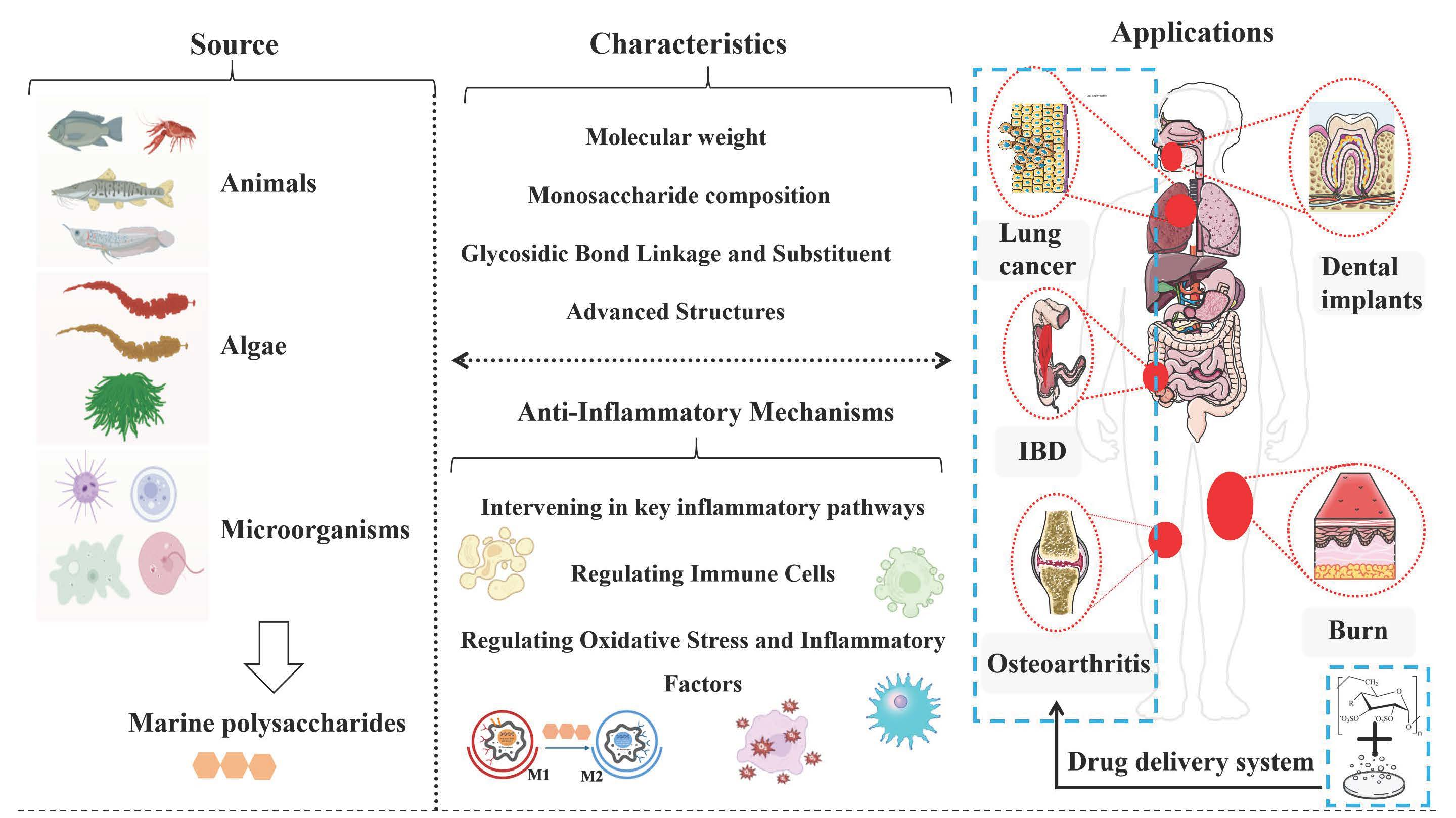

Recent Advance in Marine Polysaccharides: Structure, Anti-Inflammatory Mechanisms, and Functional Applications
 , and
, and 
Abstract
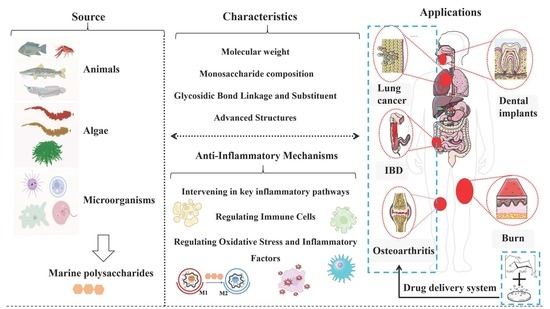
1. Introduction
2. Structure–Activity Relationship of Marine Polysaccharides
2.1. Structural Characteristics of Marine Polysaccharides
2.1.1. Algal Polysaccharides
2.1.2. Animal Polysaccharides
2.1.3. Microbial Polysaccharides
2.2. Structural–Functional Relationship of Marine Polysaccharides
2.2.1. Molecular Weight
2.2.2. Monosaccharide Composition
2.2.3. Glycosidic Bond Linkage and Substituent
2.2.4. Characteristics of Advanced Structures
3. Anti-Inflammatory Mechanisms
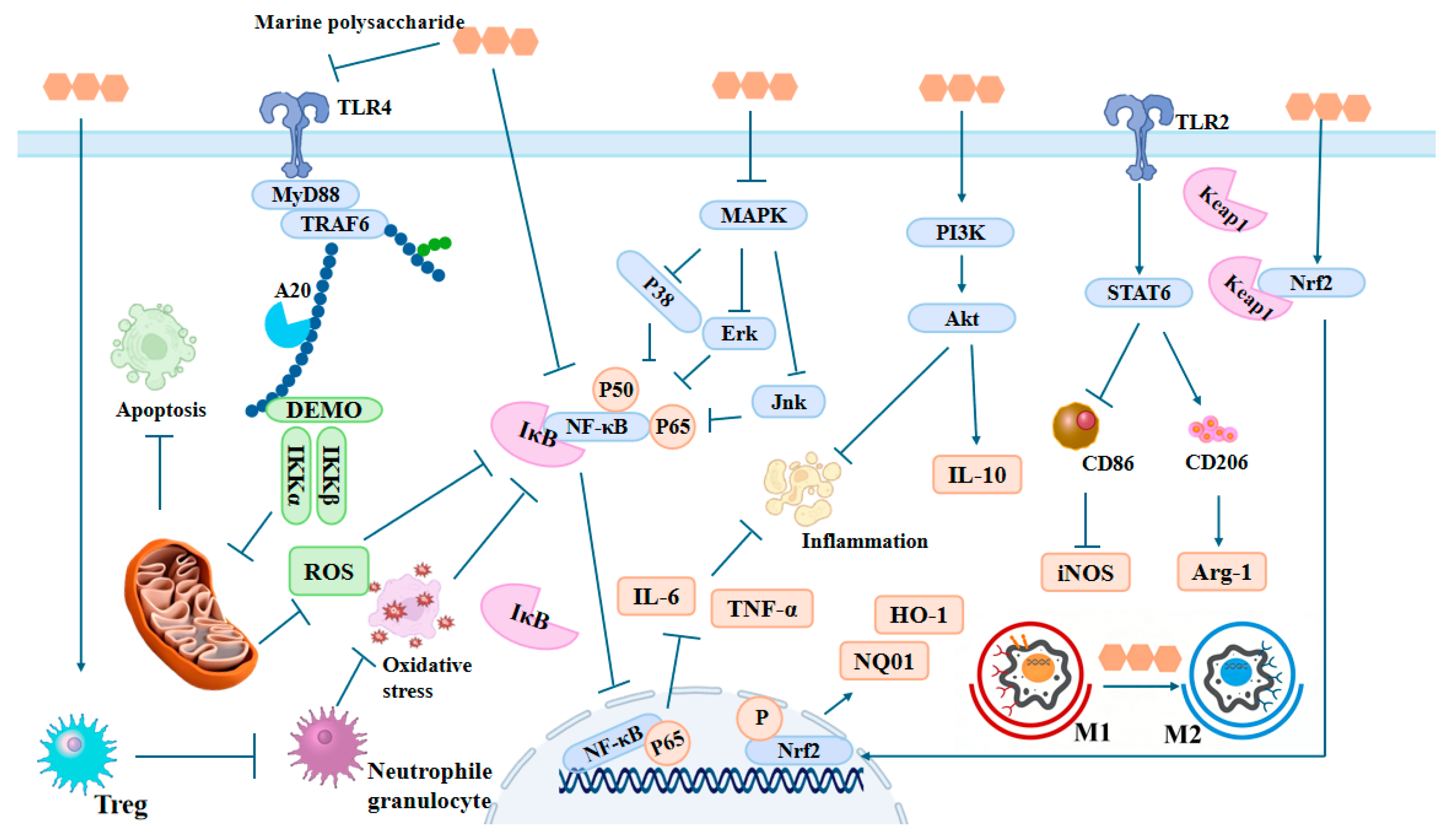
3.1. Intervening in Key Inflammatory Pathways
3.2. Regulating Immune Cells
3.3. Regulating Oxidative Stress and Inflammatory Factors
4. Potential Emerging Functional Applications in Food and Biomedical Fields
4.1. Functional Food Additives
4.2. Anti-Inflammatory Drugs
4.2.1. Therapeutic Agents for Gastrointestinal Inflammatory Diseases
4.2.2. Osteoarthritis Treatment Medications
4.2.3. Dental Anti-Inflammatory Therapeutics
4.3. Wound Repair and Tissue Regeneration Materials
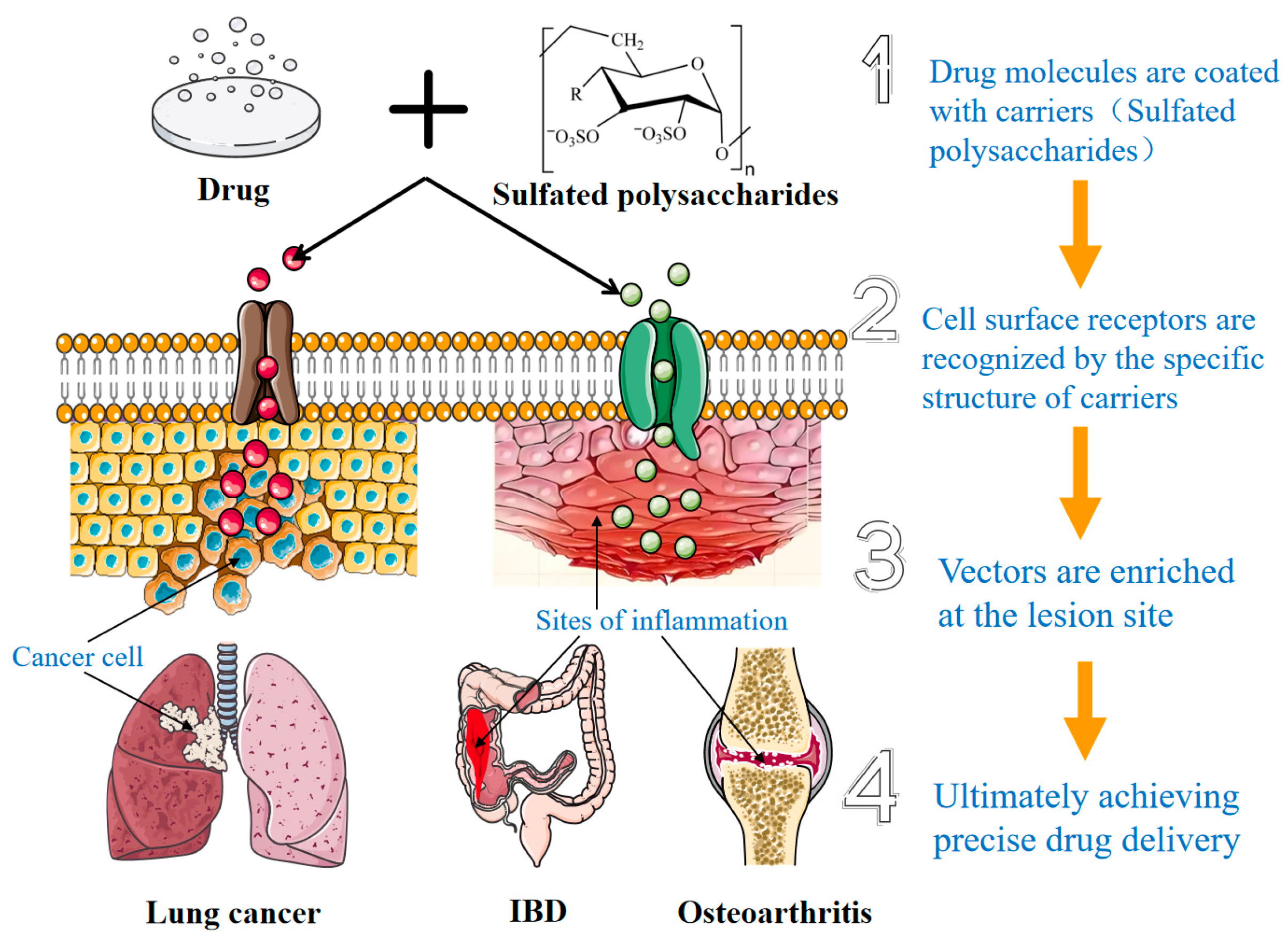
4.4. Drug Delivery System
5. Challenges and Future Prospects
5.1. Extraction and Standardization
5.2. The Potential of Marine Polysaccharide Synthesis Genomics
5.3. Clinical Trials
5.4. Food Industry Applications
Author Contributions
Funding
Institutional Review Board Statement
Data Availability Statement
Conflicts of Interest
References
- Ghallab, D.S.; Ibrahim, R.S.; Mohyeldin, M.M.; Shawky, E. Marine algae: A treasure trove of bioactive anti-inflammatory compounds. Mar. Pollut. Bull. 2024, 199, 116023. [Google Scholar] [CrossRef]
- Yang, J.; Chen, X.; Lin, J.; Shen, M.; Wang, Y.; Sarkar, A.; Wen, H.; Xie, J. Co-delivery of resveratrol and curcumin based on Mesona chinensis polysaccharides/zein nanoparticle for targeted alleviation of ulcerative colitis. Food Biosci. 2024, 59, 104060. [Google Scholar] [CrossRef]
- d’Angelo, M.; Brandolini, L.; Catanesi, M.; Castelli, V.; Giorgio, C.; Alfonsetti, M.; Tomassetti, M.; Zippoli, M.; Benedetti, E.; Cesta, M.C.; et al. Differential Effects of Nonsteroidal Anti-Inflammatory Drugs in an In Vitro Model of Human Leaky Gut. Cells 2023, 12, 728. [Google Scholar] [CrossRef] [PubMed]
- Yang, J.; Shen, M.; Wen, H.; Luo, Y.; Huang, R.; Rong, L.; Xie, J. Recent advance in delivery system and tissue engineering applications of chondroitin sulfate. Carbohydr. Polym. 2020, 230, 115650. [Google Scholar] [CrossRef] [PubMed]
- Feng, Y.; Wassie, T.; Gan, R.; Wu, X. Structural characteristics and immunomodulatory effects of sulfated polysaccharides derived from marine algae. Crit. Rev. Food Sci. Nutr. 2023, 63, 7180–7196. [Google Scholar] [CrossRef] [PubMed]
- Hsieh, T.-H.; Ho, J.-Y.; Wang, C.-C.; Liu, F.-C.; Lee, C.-H.; Lee, H.-S.; Peng, Y.-J. Fucoidan Modulates Osteoarthritis Progression Through miR-22/HO-1 Pathway. Cells 2025, 14, 1208. [Google Scholar] [CrossRef]
- Rui, Y.; Lee, Q.; Guo, Y.; Huang, Y.; Xu, H.; Liu, B.; Ge, X.; Lin, H.; Zeng, F. Structure, Function and Application of Tremella Fuciformis Polysaccharide: A Review. J. Food Sci. 2025, 90, e70494. [Google Scholar] [CrossRef]
- John, R.M.; Raj, A.L.T.; Dinakarkumar, Y.; Selvaraj, A.; Radhakrishnan, M. Review on seaweed derived sulfated and non-sulfated marine polysaccharides as multifunctional food ingredients: Structure–function relationships, bioactivities and applications in functional foods. Int. J. Biol. Macromol. 2025, 330, 148071. [Google Scholar] [CrossRef]
- Kraiem, M.; Ben Hamouda, S.; Eleroui, M.; Ajala, M.; Feki, A.; Dghim, A.; Boujhoud, Z.; Bouhamed, M.; Badraoui, R.; Pujo, J.M. Anti-Inflammatory and immunomodulatory properties of a crude polysaccharide derived from green seaweed Halimeda tuna: Computational and experimental evidences. Mar. Drugs 2024, 22, 85. [Google Scholar] [CrossRef]
- Li, K.; Li, R.; Liu, Y.; Li, G.; Liu, S. Diversity, mechanism and structure-activity relationships of marine anticoagulant-active polysaccharides: A review. Int. J. Biol. Macromol. 2025, 306, 141742. [Google Scholar] [CrossRef]
- Polat, S.; Ozogul, Y. Bioactive polysaccharides from seaweeds: Applications, mechanisms, and toxicological insights. Food Chem. 2026, 501, 147600. [Google Scholar] [CrossRef] [PubMed]
- Alizadeh, S.; Ameri, Z.; Daemi, H.; Pezeshki-Modaress, M. Sulfated polysaccharide as biomimetic biopolymers for tissue engineering scaffolds fabrication: Challenges and opportunities. Carbohydr. Polym. 2024, 336, 122124. [Google Scholar] [CrossRef] [PubMed]
- Bojorges, H.; López-Rubio, A.; Fabra, M.J.; Martínez-Abad, A. Estimation of alginate purity and M/G ratio by methanolysis coupled with anion exchange chromatography. Carbohydr. Polym. 2023, 321, 121285. [Google Scholar] [CrossRef] [PubMed]
- Wang, H.; Hunter, R.; Zhang, Q.; Yu, H.; Wang, J.; Yue, Y.; Geng, L.; Wu, N. The application of marine polysaccharides to antitumor nanocarriers. Carbohydr. Polym. 2024, 342, 122407. [Google Scholar] [CrossRef]
- Zha, X.-Q.; Lu, C.-Q.; Cui, S.-H.; Pan, L.-H.; Zhang, H.-L.; Wang, J.-H.; Luo, J.-P. Structural identification and immunostimulating activity of a Laminaria japonica polysaccharide. Int. J. Biol. Macromol. 2015, 78, 429–438. [Google Scholar] [CrossRef]
- Campo, V.L.; Kawano, D.F.; Silva, D.B.d.; Carvalho, I. Carrageenans: Biological properties, chemical modifications and structural analysis—A review. Carbohydr. Polym. 2009, 77, 167–180. [Google Scholar] [CrossRef]
- Fanina, S.; Casillo, A.; Corsaro, M.M. Mediterranean Seaweed Polysaccharides: Insight into Chemical Structures, Applications, and Structure/Application Correlations. Mar. Drugs 2026, 24, 11. [Google Scholar] [CrossRef]
- Tziveleka, L.-A.; Ioannou, E.; Roussis, V. Ulvan, a bioactive marine sulphated polysaccharide as a key constituent of hybrid biomaterials: A review. Carbohydr. Polym. 2019, 218, 355–370. [Google Scholar] [CrossRef]
- Chen, C.; Zhang, X.; Zhang, W.; Ding, D.; Loka, R.S.; Zhao, K.; Ling, P.; Wang, S. Dermatan Sulfate: Structure, Biosynthesis, and Biological Roles. Biomolecules 2025, 15, 1158. [Google Scholar] [CrossRef]
- Kou, S.; Peters, L.M.; Mucalo, M.R. Chitosan: A review of sources and preparation methods. Int. J. Biol. Macromol. 2021, 169, 85–94. [Google Scholar] [CrossRef]
- Kokoulin, M.S.; Savicheva, Y.V.; Otstavnykh, N.Y.; Kurilenko, V.V.; Meleshko, D.A.; Isaeva, M.P. Structure and Biosynthetic Gene Cluster of Sulfated Capsular Polysaccharide from the Marine Bacterium Vibrio sp. KMM 8419. Int. J. Mol. Sci. 2024, 25, 12927. [Google Scholar] [CrossRef]
- Wang, N.; Xu, W.; Duan, W.; Qin, J.; Huang, H.; Liu, J.; Zhu, L.; Xiang, W. A review on marine algae polysaccharides: From extraction, structural characteristics to anti-type 2 diabetes mellitus mechanisms and structure-activity relationship. J. Agric. Food Res. 2026, 26, 102653. [Google Scholar] [CrossRef]
- Lee, K.Y.; Mooney, D.J. Alginate: Properties and biomedical applications. Prog. Polym. Sci. 2012, 37, 106–126. [Google Scholar] [CrossRef] [PubMed]
- Van Weelden, G.; Bobiński, M.; Okła, K.; Van Weelden, W.J.; Romano, A.; Pijnenborg, J.M.A. Fucoidan Structure and Activity in Relation to Anti-Cancer Mechanisms. Mar. Drugs 2019, 17, 32. [Google Scholar] [CrossRef]
- Madsen, M.; Westh, P.; Khan, S.; Ipsen, R.; Almdal, K.; Aachmann, F.L.; Svensson, B. Impact of Alginate Mannuronic-Guluronic Acid Contents and pH on Protein Binding Capacity and Complex Size. Biomacromolecules 2021, 22, 649–660. [Google Scholar] [CrossRef]
- Li, L.; Ni, R.; Shao, Y.; Mao, S. Carrageenan and its applications in drug delivery. Carbohydr. Polym. 2014, 103, 1–11. [Google Scholar] [CrossRef]
- Zhang, Y.; Fu, X.; Duan, D.; Xu, J.; Gao, X. Preparation and characterization of agar, agarose, and agaropectin from the red alga Ahnfeltia plicata. J. Oceanol. Limnol. 2019, 37, 815–824. [Google Scholar] [CrossRef]
- Cunha, L.; Grenha, A. Sulfated Seaweed Polysaccharides as Multifunctional Materials in Drug Delivery Applications. Mar. Drugs 2016, 14, 42. [Google Scholar] [CrossRef]
- Akter, A.; Sobuj, M.K.A.; Islam, M.S.; Chakroborty, K.; Tasnim, N.; Ayon, M.H.; Hossain, M.F.; Rafiquzzaman, S.M. Seaweed polysaccharides: Sources, structure and biomedical applications with special emphasis on antiviral potentials. Future Foods 2024, 10, 100440. [Google Scholar] [CrossRef]
- Thu, Q.T.M.; Bang, T.H.; Nu, N.T.; Luong, Đ.V.; Ly, B.M.; Van, T.T.T.; Thuy, T.T.T. Structural Determination of Ulvan from Green Seaweed Ulva reticulata Collected at Central Coast of Vietnam. Chem. Lett. 2015, 44, 788–790. [Google Scholar] [CrossRef]
- Kidgell, J.T.; Magnusson, M.; de Nys, R.; Glasson, C.R.K. Ulvan: A systematic review of extraction, composition and function. Algal Res. 2019, 39, 101422. [Google Scholar] [CrossRef]
- Li, N.; Liu, X.; He, X.; Wang, S.; Cao, S.; Xia, Z.; Xian, H.; Qin, L.; Mao, W. Structure and anticoagulant property of a sulfated polysaccharide isolated from the green seaweed Monostroma angicava. Carbohydr. Polym. 2017, 159, 195–206. [Google Scholar] [CrossRef]
- Sundaresan, G.; Abraham, R.J.; Appa Rao, V.; Narendra Babu, R.; Govind, V.; Meti, M.F. Established method of chondroitin sulphate extraction from buffalo (Bubalus bubalis) cartilages and its identification by FTIR. J. Food Sci. Technol. 2018, 55, 3439–3445. [Google Scholar] [CrossRef]
- Huang, L.; Shen, M.; Morris, G.A.; Xie, J. Sulfated polysaccharides: Immunomodulation and signaling mechanisms. Trends Food Sci. Technol. 2019, 92, 1–11. [Google Scholar] [CrossRef]
- Tang, W.; Ye, L.; Han, T.; He, J.; Liu, J. Effect of chitosan with different molecular weights on the freeze-thaw stability of gluten protein: Protein structures, functional characteristics, and cryo-protective mechanism. Food Hydrocoll. 2025, 160, 110763. [Google Scholar] [CrossRef]
- Pellis, A.; Guebitz, G.; Nyanhongo, G. Chitosan: Sources, processing and modification techniques. Gels 2022, 8, 393. [Google Scholar] [CrossRef]
- Barbosa, A.I.; Coutinho, A.J.; Costa Lima, S.A.; Reis, S. Marine polysaccharides in pharmaceutical applications: Fucoidan and chitosan as key players in the drug delivery match field. Mar. Drugs 2019, 17, 654. [Google Scholar] [CrossRef]
- Mourão, P.A.S. Perspective on the Use of Sulfated Polysaccharides from Marine Organisms as a Source of New Antithrombotic Drugs. Mar. Drugs 2015, 13, 2770–2784. [Google Scholar] [CrossRef]
- Huang, Y.; Chen, H.; Zhang, K.; Lu, Y.; Wu, Q.; Chen, J.; Li, Y.; Wu, Q.; Chen, Y. Extraction, purification, structural characterization, and gut microbiota relationship of polysaccharides: A review. Int. J. Biol. Macromol. 2022, 213, 967–986. [Google Scholar] [CrossRef]
- Lesco, K.C.; Williams, S.K.R.; Laurens, L.M.L. Marine Algae Polysaccharides: An Overview of Characterization Techniques for Structural and Molecular Elucidation. Mar. Drugs 2025, 23, 105. [Google Scholar] [CrossRef]
- Cui, J.; Wang, Y.; Kim, E.; Zhang, C.; Zhang, G.; Lee, Y. Structural characteristics and immunomodulatory effects of a long-chain polysaccharide from Laminaria japonica. Front. Nutr. 2022, 9, 762595. [Google Scholar] [CrossRef]
- Keshvardoostchokami, M.; Majidi, M.; Zamani, A.; Liu, B. A review on the use of chitosan and chitosan derivatives as the bio-adsorbents for the water treatment: Removal of nitrogen-containing pollutants. Carbohydr. Polym. 2021, 273, 118625. [Google Scholar]
- Salati, M.A.; Khazai, J.; Tahmuri, A.M.; Samadi, A.; Taghizadeh, A.; Taghizadeh, M.; Zarrintaj, P.; Ramsey, J.D.; Habibzadeh, S.; Seidi, F. Agarose-based biomaterials: Opportunities and challenges in cartilage tissue engineering. Polymers 2020, 12, 1150. [Google Scholar] [CrossRef]
- Xu, S.-Y.; Huang, X.; Cheong, K.-L. Recent advances in marine algae polysaccharides: Isolation, structure, and activities. Mar. Drugs 2017, 15, 388. [Google Scholar] [CrossRef]
- Kawamura, D.; Funakoshi, T.; Mizumoto, S.; Sugahara, K.; Iwasaki, N. Sulfation patterns of exogenous chondroitin sulfate affect chondrogenic differentiation of ATDC5 cells. J. Orthop. Sci. 2014, 19, 1028–1035. [Google Scholar] [CrossRef]
- Paulose, S.K.; Chakraborty, K. Anti-inflammatory potential of sulfated heteropolysaccharide from marine pharaoh cuttlefish Sepia pharaonis on LPS-activated THP-1 monocytes and RAW 264.7 macrophages. Food Res. Int. 2025, 221, 117183. [Google Scholar]
- Zhang, T.; Ma, C.; Zhang, Z.; Zhang, H.; Hu, H. NF-κB signaling in inflammation and cancer. MedComm 2021, 2, 618–653. [Google Scholar] [CrossRef]
- Karin, M.; Yamamoto, Y.; Wang, Q.M. The IKK NF-κB system: A treasure trove for drug development. Nat. Rev. Drug Discov. 2004, 3, 17–26. [Google Scholar]
- Arunrat, K.; Wangtueai, S.; Palanisamy, S.; You, S.; Rod-in, W.; Surayot, U. Sulfated fucan polysaccharide from Holothuria scabra attenuates LPS-induced inflammation in RAW264.7 macrophages via modulation of NF-κB and MAPK signalling pathways. J. Agric. Food Res. 2025, 22, 102122. [Google Scholar]
- Wang, J.; Hu, S.; Jiang, W.; Song, W.; Cai, L.; Wang, J. Fucoidan from sea cucumber may improve hepatic inflammatory response and insulin resistance in mice. Int. Immunopharmacol. 2016, 31, 15–23. [Google Scholar] [CrossRef]
- Lee, S.; Rauch, J.; Kolch, W. Targeting MAPK signaling in cancer: Mechanisms of drug resistance and sensitivity. Int. J. Mol. Sci. 2020, 21, 1102. [Google Scholar] [CrossRef]
- Ma, P.; Liu, H.-T.; Wei, P.; Xu, Q.-S.; Bai, X.-F.; Du, Y.-G.; Yu, C. Chitosan oligosaccharides inhibit LPS-induced over-expression of IL-6 and TNF-α in RAW264.7 macrophage cells through blockade of mitogen-activated protein kinase (MAPK) and PI3K/Akt signaling pathways. Carbohydr. Polym. 2011, 84, 1391–1398. [Google Scholar] [CrossRef]
- Lopes, A.H.; Silva, R.L.; Fonseca, M.D.; Gomes, F.I.; Maganin, A.G.; Ribeiro, L.S.; Marques, L.M.M.; Cunha, F.Q.; Alves-Filho, J.C.; Zamboni, D.S. Molecular basis of carrageenan-induced cytokines production in macrophages. Cell Commun. Signal. 2020, 18, 141. [Google Scholar] [CrossRef]
- Cui, M.; Wu, J.; Wang, S.; Shu, H.; Zhang, M.; Liu, K.; Liu, K. Characterization and anti-inflammatory effects of sulfated polysaccharide from the red seaweed Gelidium pacificum Okamura. Int. J. Biol. Macromol. 2019, 129, 377–385. [Google Scholar] [CrossRef]
- Wu, F.; Zhou, C.; Zhou, D.; Ou, S.; Liu, Z.; Huang, H. Immune-enhancing activities of chondroitin sulfate in murine macrophage RAW 264.7 cells. Carbohydr. Polym. 2018, 198, 611–619. [Google Scholar] [CrossRef]
- Liu, S.; Deng, Z.; Chen, K.; Jian, S.; Zhou, F.; Yang, Y.; Fu, Z.; Xie, H.; Xiong, J.; Zhu, W. Cartilage tissue engineering: From proinflammatory and anti-inflammatory cytokines to osteoarthritis treatments. Mol. Med. Rep. 2022, 25, 1–15. [Google Scholar] [CrossRef]
- Chen, L.; Deng, H.; Cui, H.; Fang, J.; Zuo, Z.; Deng, J.; Li, Y.; Wang, X.; Zhao, L. Inflammatory responses and inflammation-associated diseases in organs. Oncotarget 2017, 9, 7204. [Google Scholar] [CrossRef]
- Montuori, E.; de Pascale, D.; Lauritano, C. Recent discoveries on marine organism immunomodulatory activities. Mar. Drugs 2022, 20, 422. [Google Scholar] [CrossRef]
- Sica, A.; Mantovani, A. Macrophage plasticity and polarization: In vivo veritas. J. Clin. Investig. 2012, 122, 787–795. [Google Scholar] [CrossRef]
- Premarathna, A.D.; Ahmed, T.A.E.; Rjabovs, V.; Critchley, A.T.; Hincke, M.T.; Tuvikene, R. Green seaweed-derived polysaccharides: Insights into various bioactivities for biomedical applications. Int. J. Biol. Macromol. 2024, 282, 136858. [Google Scholar] [CrossRef]
- Bordon, J.; Aliberti, S.; Fernandez-Botran, R.; Uriarte, S.M.; Rane, M.J.; Duvvuri, P.; Peyrani, P.; Morlacchi, L.C.; Blasi, F.; Ramirez, J.A. Understanding the roles of cytokines and neutrophil activity and neutrophil apoptosis in the protective versus deleterious inflammatory response in pneumonia. Int. J. Infect. Dis. 2013, 17, e76–e83. [Google Scholar] [CrossRef] [PubMed]
- Niu, W.; Dong, Y.; Fu, Z.; Lv, J.; Wang, L.; Zhang, Z.; Huo, J.; Ju, J. Effects of molecular weight of chitosan on anti-inflammatory activity and modulation of intestinal microflora in an ulcerative colitis model. Int. J. Biol. Macromol. 2021, 193, 1927–1936. [Google Scholar] [CrossRef] [PubMed]
- Wang, L.; Wang, Y.; Liu, C.; He, J.; He, X.; Zhang, X.; Zhu, C.; Sun, J.; Wang, Q.; Chen, H.; et al. Treg-targeted efficient-inducible platform for collagen-induced arthritis treatment. Mater. Today Bio 2023, 19, 100557. [Google Scholar] [PubMed]
- Wang, M.; Xiao, Y.; Miao, J.; Zhang, X.; Liu, M.; Zhu, L.; Liu, H.; Shen, X.; Wang, J.; Xie, B. Oxidative Stress and Inflammation: Drivers of Tumorigenesis and Therapeutic Opportunities. Antioxidants 2025, 14, 735. [Google Scholar] [CrossRef]
- Liu, J.; Han, X.; Zhang, T.; Tian, K.; Li, Z.; Luo, F. Reactive oxygen species (ROS) scavenging biomaterials for anti-inflammatory diseases: From mechanism to therapy. J. Hematol. Oncol. 2023, 16, 116. [Google Scholar] [CrossRef]
- Wang, H.; Li, Y.; Li, C.; Liu, X.; Liu, B.; Wu, C.; Zeng, F. Anticancer effects of Sargassum pallidum polysaccharide through the modulation of ROS-mediated signaling pathways. Int. J. Biol. Macromol. 2025, 318, 145026. [Google Scholar] [CrossRef]
- Lu, W.; Yang, Z.; Chen, J.; Wang, D.; Zhang, Y. Recent advances in antiviral activities and potential mechanisms of sulfated polysaccharides. Carbohydr. Polym. 2021, 272, 118526. [Google Scholar] [CrossRef]
- Zhang, R.; Ren, Y.; Ren, T.; Yu, Y.; Li, B.; Zhou, X. Marine-Derived Antioxidants: A Comprehensive Review of Their Therapeutic Potential in Oxidative Stress-Associated Diseases. Mar. Drugs 2025, 23, 223. [Google Scholar]
- Pramod Kumar, P.; Harish Prashanth, K.V. Diet with Low Molecular Weight Chitosan exerts neuromodulation in Rotenone induced Drosophila model of Parkinson’s disease. Food Chem. Toxicol. 2020, 146, 111860. [Google Scholar]
- Pi, Y.; Yuan, Q.; Qin, S.; Lan, C.; Nong, Q.; Yun, C.; Tang, H.; Leng, J.; Xiao, J.; Zhao, L.; et al. Chlorella pyrenoidosa Polysaccharide CPP-3a Promotes M1 Polarization of Macrophages via TLR4/2-MyD88-NF-κB/p38 MAPK Signaling Pathways. Mar. Drugs 2025, 23, 290. [Google Scholar] [CrossRef]
- Xiao, T.; Yu, Z.; Yang, H.; You, J.; Wu, X. Marine polysaccharides hydrogel with encapsulated mesalazine for the treatment of ulcerative colitis: Integrative effects on inflammation, microbiota, and mucosal repair. Colloids Surf. B Biointerfaces 2025, 253, 114722. [Google Scholar] [CrossRef] [PubMed]
- Bahmani, R.; Razavi, F.; Mortazavi, S.N.; Gohari, G.; Juárez-Maldonado, A. Enhancing Postharvest Quality and Shelf Life of Strawberries through Advanced Coating Technologies: A Comprehensive Investigation of Chitosan and Glycine Betaine Nanoparticle Treatments. Plants 2024, 13, 1136. [Google Scholar] [CrossRef]
- Xu, L.; Qin, J.; Ma, X.; Wang, Q.; Wu, W.; Huang, H.; Cai, L. Chitosan-based self-healing thermosensitive hydrogel loaded with siHMGB1 for treatment of rheumatoid arthritis via macrophage repolarization. Int. J. Biol. Macromol. 2024, 282, 137102. [Google Scholar] [CrossRef] [PubMed]
- Hallmann, L.; Gerngroß, M.D. Antibacterial Polysaccharides in Dental Implantology. Mar. Drugs 2025, 23, 321. [Google Scholar] [CrossRef] [PubMed]
- Victoria, S.; Castro, A.; Pittini, A.; Olivera, D.; Russo, S.; Cebrian, I.; Mombru, A.W.; Osinaga, E.; Pardo, H.; Segovia, M.; et al. Formulating a TMEM176B blocker in chitosan nanoparticles uncouples its paradoxical roles in innate and adaptive antitumoral immunity. Int. J. Biol. Macromol. Struct. Funct. Interact. 2024, 279, 135327. [Google Scholar] [CrossRef]
- Jabeen, F.; Ahmad, R.; Mir, S.; Awwad, N.S.; Ibrahium, H.A. Carrageenan: Structure, properties and applications with special emphasis on food science. RSC Adv. 2025, 15, 22035–22062. [Google Scholar] [CrossRef]
- Daviaud, C.; Main, H.; Chassaing, D.; Havret, R.; Musnier, B.; Colin, B.; Saliba, J.; Zapata, M.P.; Manseur, C.; Mersni-Achour, R. λ-CO, an oligosaccharide with anti-inflammatory properties. Biomed. Pharmacother. 2026, 195, 118954. [Google Scholar] [CrossRef]
- Berrueta, L.; Muñoz-Vergara, D.; Martin, D.; Thompson, R.; Sansbury, B.E.; Spite, M.; Badger, G.J.; Langevin, H.M. Effect of stretching on inflammation in a subcutaneous carrageenan mouse model analyzed at single-cell resolution. J. Cell. Physiol. 2023, 238, 2778–2793. [Google Scholar] [CrossRef]
- Cao, J.; Yao, M.; Wang, K.; Qin, L.; Zhang, Q.; Zhang, H.; Wei, J.; Qu, C.; Xue, C.; Miao, J. Sea Cucumber Fucoidan Inhibits Helicobacter pylori Gastritis via MAPK/NF-κB Signaling and Gut Microbiota Modulation. J. Agric. Food Chem. 2025, 73, 14333–14352. [Google Scholar]
- Ye, J.; Zheng, L.; Pan, W.; Huang, Y.; Zhang, N.; Yang, D.; Yang, Y.; Zheng, B.; Zhang, X.; Xiao, M. Sulfated polysaccharide from Apostichopus japonicus viscera exhibits anti-inflammatory properties in vitro and in vivo. Int. J. Biol. Macromol. 2024, 280, 135500. [Google Scholar] [CrossRef]
- Long, J.; Ye, Z.; Li, X.; Tian, Y.; Bai, Y.; Chen, L.; Qiu, C.; Xie, Z.; Jin, Z.; Svensson, B. Enzymatic preparation and potential applications of agar oligosaccharides: A review. Crit. Rev. Food Sci. Nutr. 2024, 64, 5818–5834. [Google Scholar] [CrossRef]
- Gong, W.; Wang, R.; Huang, H.; Hou, Y.; Wang, X.; He, W.; Gong, X.; Hu, J. Construction of double network hydrogels using agarose and gallic acid with antibacterial and anti-inflammatory properties for wound healing. Int. J. Biol. Macromol. 2023, 227, 698–710. [Google Scholar] [CrossRef] [PubMed]
- Cui, S.; Yang, F.; Yu, D.; Shi, C.; Zhao, D.; Chen, L.; Chen, J. Double Network Physical Crosslinked Hydrogel for Healing Skin Wounds: New Formulation Based on Polysaccharides and Zn2+. Int. J. Mol. Sci. 2023, 24, 13042. [Google Scholar] [CrossRef]
- Liu, Q.; Wang, C.; Cheng, M.; Hu, L.; Zhang, Z.; Sun, Q.; Wang, S.; Fan, Y.; Pan, P.; Chen, J. Self-Healing Conductive Hydrogels with Dynamic Dual Network Structure Accelerate Infected Wound Healing via Photothermal Antimicrobial and Regulating Inflammatory Response. ACS Appl. Mater. Interfaces 2024, 16, 30776–30792. [Google Scholar] [CrossRef]
- Hwang, P.-A.; Chen, H.-Y.; Chang, J.-S.; Hsu, F.-Y. Electrospun nanofiber composite mat based on ulvan for wound dressing applications. Int. J. Biol. Macromol. 2023, 253, 126646. [Google Scholar] [CrossRef]
- Statha, D.; Papaioannou, A.; Kikionis, S.; Kostaki, M.; Sfiniadakis, I.; Vitsos, A.; Anastassopoulou, J.; Ioannou, E.; Roussis, V.; Rallis, M.C. Healing Potential of the Marine Polysaccharides Carrageenan and Ulvan on Second-Degree Burns. J. Funct. Biomater. 2024, 15, 257. [Google Scholar] [CrossRef]
- Pradhan, B.; Bhuyan, P.P.; Ki, J.-S. Immunomodulatory, antioxidant, anticancer, and pharmacokinetic activity of Ulvan, a seaweed-derived sulfated polysaccharide: An updated comprehensive review. Mar. Drugs 2023, 21, 300. [Google Scholar] [CrossRef]
- Zhang, C.; Yang, Y.; Chen, K.; Liao, Y.; Xu, M.; Chen, J.; Liang, L.; Yu, R. Effects of different low-phosphate formulations on the quality of prepared pork patties under repeated freeze-thaw cycles: Water retention, texture, and sensory properties. Food Chem. X 2026, 35, 103752. [Google Scholar] [CrossRef]
- Wang, W.; Xia, J.; Zhang, M.; Pei, E.; Wang, C.; Xu, M.; Yu, R. Pea protein-steviol glycosides complexes: Fabrication, characterization and evaluation for the emulsifying capacity. Food Chem. 2026, 509, 148520. [Google Scholar] [CrossRef]
- Ajayi, E.I.; Oladele, J.O.; Nkumah, A.O. Application of algae in wound healing. Next-Gener. Algae 2023, 2, 251–284. [Google Scholar]
- Yang, J.; Lin, J.; Luo, Y.; Chen, X.; Shen, M.; Wang, Y.; Xie, J. Nutritional intervention based on curcumin-loaded polysaccharides nanoparticle for synergetic improvement of ulcerative colitis. Food Sci. Hum. Health 2025, 14, 3437–3449. [Google Scholar] [CrossRef]
- Liyanage, N.; Nagahawatta, D.; Jayawardena, T.U.; Jeon, Y.-J. The role of seaweed polysaccharides in gastrointestinal health: Protective effect against inflammatory bowel disease. Life 2023, 13, 1026. [Google Scholar] [CrossRef]
- Yang, Y.; Liang, M.; Ouyang, D.; Tong, H.; Wu, M.; Su, L. Research progress on the protective effect of brown algae-derived polysaccharides on metabolic diseases and intestinal barrier injury. Int. J. Mol. Sci. 2022, 23, 10784. [Google Scholar] [CrossRef]
- Yuan, D.; Li, C.; Huang, Q.; Fu, X.; Dong, H. Current advances in the anti-inflammatory effects and mechanisms of natural polysaccharides. Crit. Rev. Food Sci. Nutr. 2023, 63, 5890–5910. [Google Scholar] [CrossRef]
- Kong, H.; Han, J.-J.; Bian, Y.-Y.; Zhang, X.-A. Marine-derived compounds applied in osteoarthritis: Function, challenges and future prospects. Crit. Rev. Food Sci. Nutr. 2025, 65, 7671–7692. [Google Scholar] [CrossRef]
- Ramamoorthi, L.; Jeyabalan, S.; Sankar, S.; Begum, M.Y.; Duraipandian, C.; Sekar, M.; Wong, L.S.; Subramaniyan, V. Anti-arthritic potential of crude sulfated polysaccharide from marine macroalgae Sargassum ilicifolium (Turner) C. Agardh: Regulation of cytokine cascade. Biomol. Concepts 2025, 16, 20220050. [Google Scholar] [CrossRef]
- Nagahawatta, D.; Liyanage, N.; Jayawardena, T.U.; Yang, F.; Jayawardena, H.; Kurera, M.; Wang, F.; Fu, X.; Jeon, Y.-J. Functions and values of sulfated polysaccharides from seaweed. Algae 2023, 38, 217–240. [Google Scholar] [CrossRef]
- Jeyachandran, S. Therapeutic applications of red marine seaweeds in dental care: Innovations in oral health and treatment. Biomater. Investig. Dent. 2025, 12, 45224. [Google Scholar] [CrossRef]
- Liu, Y.; Liu, J.; Zhang, A.; Zhao, G.; Jiang, B.; Zhao, X. Application prospect of Marine polysaccharide hydrogels in promoting wound healing: A Review. Carbohydr. Res. 2025, 558, 109673. [Google Scholar] [CrossRef]
- Lukova, P.; Katsarov, P. Contemporary aspects of designing marine polysaccharide microparticles as drug carriers for biomedical application. Pharmaceutics 2023, 15, 2126. [Google Scholar] [CrossRef]
- Cha, M.; Yan, S.; Zhang, Y.; Wang, P. Progress in the application of marine polysaccharide drug delivery systems in tumor immunotherapy: Multiple mechanisms and material forms. Mar. Drugs 2025, 23, 384. [Google Scholar] [CrossRef]
- Wathoni, N.; Herdiana, Y.; Suhandi, C.; Mohammed, A.F.A.; El-Rayyes, A.; Narsa, A.C. Chitosan/alginate-based nanoparticles for antibacterial agents delivery. Int. J. Nanomed. 2024, 19, 5021–5044. [Google Scholar] [CrossRef]
- Yang, J.; Lin, J.; Chen, X.; Li, C.; Wang, Y.; Xie, J. Tailored strategies based on polysaccharide structural and functional properties for nutrients delivery in inflammatory bowel disease. Carbohydr. Polym. 2025, 351, 123129. [Google Scholar] [CrossRef]
- Haggag, Y.A.; Abd Elrahman, A.A.; Ulber, R.; Zayed, A. Fucoidan in pharmaceutical formulations: A comprehensive review for smart drug delivery systems. Mar. Drugs 2023, 21, 112. [Google Scholar] [CrossRef]
- Liu, X.; Ren, X.; Zhou, L.; Liu, K.; Deng, L.; Qing, Q.; Li, J.; Zhi, F.; Li, M. Tollip orchestrates macrophage polarization to alleviate intestinal mucosal inflammation. J. Crohn’s Colitis 2022, 16, 1151–1167. [Google Scholar] [CrossRef]
- Yang, R.; Xu, K.; Li, H.; Feng, Y.; Xiang, G.; Zhou, X.; Zhang, C. Laminarin-mediated oral delivery of miRNA-223 for targeted macrophage polarization in inflammatory bowel disease. Int. J. Biol. Macromol. 2025, 311, 143052. [Google Scholar] [CrossRef]
- Liu, X.; Dong, J.; Wu, Z.; Cui, J.; Zheng, Y.; Zhou, M. Microalgae-based hydrogel drug delivery system for treatment of gouty arthritis with alleviated colchicine side effects. Bioact. Mater. 2025, 52, 17–35. [Google Scholar] [CrossRef]
- Shi, S.; Zhang, L.; Jiang, K. Polysaccharide nanosystems for osteoarthritis therapy: Mechanisms, combinations, and future directions. Int. J. Biol. Macromol. 2024, 279, 135146. [Google Scholar] [CrossRef]
- Jeon, E.Y.; Choi, D.S.; Choi, S.; Won, J.Y.; Jo, Y.; Kim, H.B.; Jung, Y.; Shin, S.C.; Min, H.; Choi, H.W. Enhancing adoptive T-cell therapy with fucoidan-based IL-2 delivery microcapsules. Bioeng. Transl. Med. 2023, 8, e10362. [Google Scholar]
- Burton, C.; Bitaraf, A.; Snyder, K.; Zhang, C.; Yoder, S.J.; Avram, D.; Du, D.; Yu, X.; Lau, E.K. The functional role of L-fucose on dendritic cell function and polarization. Front. Immunol. 2024, 15, 1353570. [Google Scholar] [CrossRef]
- Rashid, M.; Ramezani, M.; Molavi, O.; Ghesmati, Z.; Baradaran, B.; Sabzichi, M.; Ramezani, F. Targeting hypoxia-inducible factor 1 alpha augments synergistic effects of chemo/immunotherapy via modulating tumor microenvironment in a breast cancer mouse model. BioImpacts BI 2024, 15, 30424. [Google Scholar] [CrossRef]
- Bahrami, S.; Nateghi, L.; Rashidi, L.; Nobandegani, B.K.; Ghorbanpour, M. Evaluation of the properties of polysaccharides extracted from brown macroalgae (Sargassum ilicifolium) by methods of conventional, microwave, and subcritical water extraction. Innov. Food Sci. Emerg. Technol. 2025, 102, 103975. [Google Scholar] [CrossRef]
- Yang, J.; Shen, M.; Wu, T.; Chen, X.; Wen, H.; Xie, J. Physicochemical, structural characterization, and an-tioxidant activities of chondroitin sulfate from Oreochromis niloticus bones. Food Sci. Hum. Wellness 2023, 12, 1102–1108. [Google Scholar] [CrossRef]
- Lau, N.-S.; Furusawa, G. Polysaccharide degradation in Cellvibrionaceae: Genomic insights of the novel chitin-degrading marine bacterium, strain KSP-S5-2, and its chitinolytic activity. Sci. Total Environ. 2024, 912, 169134. [Google Scholar] [CrossRef] [PubMed]
- Yi, X.; Xie, J.; Mei, J. Recent Advances in Marine-Derived Polysaccharide Hydrogels: Innovative Applications and Challenges in Emerging Food Fields. Polymers 2025, 17, 2553. [Google Scholar] [CrossRef] [PubMed]
- Kiran, G.S.; Ramasamy, P.; Sekar, S.; Ramu, M.; Hassan, S.; Ninawe, A.; Selvin, J. Synthetic biology approaches: Towards sustainable exploitation of marine bioactive molecules. Int. J. Biol. Macromol. 2018, 112, 1278–1288. [Google Scholar] [CrossRef]
- Scherlach, K.; Hertweck, C. Mining and unearthing hidden biosynthetic potential. Nat. Commun. 2021, 12, 3864. [Google Scholar] [CrossRef]
- Dong, X.; Qiu, Y.; Jia, N.; Wu, Y.; Nie, Q.; Wen, J.; Zhao, C.; Zhai, Y. Recent advances of edible marine algae-derived sulfated polysaccharides in antiviral treatments: Challenges vs. opportunities. Front. Nutr. 2025, 12, 1561119. [Google Scholar] [CrossRef]
- Fan, S.; Ding, Y.; Hu, Z.; Zhang, Z.; Fu, L.; Zhang, J.; Zhu, Y.; Bai, J.; Xiao, X. Inter-individual variation in human microbiota drives differential impacts on the fermentability of insoluble bran by soluble β-glucans from whole barley. Food Hydrocoll. 2025, 162, 111034. [Google Scholar] [CrossRef]
- Krylova, N.V.; Kravchenko, A.O.; Likhatskaya, G.N.; Iunikhina, O.V.; Glazunov, V.P.; Zaporozhets, T.S.; Shchelkanov, M.Y.; Yermak, I.M. Carrageenans and the Carrageenan-Echinochrome Complex as Anti-SARS-CoV-2 Agents. Int. J. Mol. Sci. 2025, 26, 6175. [Google Scholar] [CrossRef]
- Veeragurunathan, V.; Ramalingam, D.; Bhayani, A.; Grace, P.G. Constraints and Challenges on Large-Scale cultivation of economically important algae. In Algal Biotechnology; CRC Press: Boca Raton, FL, USA, 2024; pp. 295–304. [Google Scholar]
- Ali, G.; Sharma, M.; Salama, E.-S.; Ling, Z.; Li, X. Applications of chitin and chitosan as natural biopolymer: Potential sources, pretreatments, and degradation pathways. Biomass Convers. Biorefin. 2024, 14, 4567–4581. [Google Scholar] [CrossRef]
- Patel, A.K.; Vadrale, A.P.; Singhania, R.R.; Michaud, P.; Pandey, A.; Chen, S.-J.; Chen, C.-W.; Dong, C.-D. Algal polysaccharides: Current status and future prospects. Phytochem. Rev. 2023, 22, 1167–1196. [Google Scholar] [CrossRef]
- Gupta, A.; Kang, K.; Pathania, R.; Saxton, L.; Saucedo, B.; Malik, A.; Torres-Tiji, Y.; Diaz, C.J.; Dutra Molino, J.V.; Mayfield, S.P. Harnessing genetic engineering to drive economic bioproduct production in algae. Front. Bioeng. Biotechnol. 2024, 12, 1350722. [Google Scholar] [CrossRef]



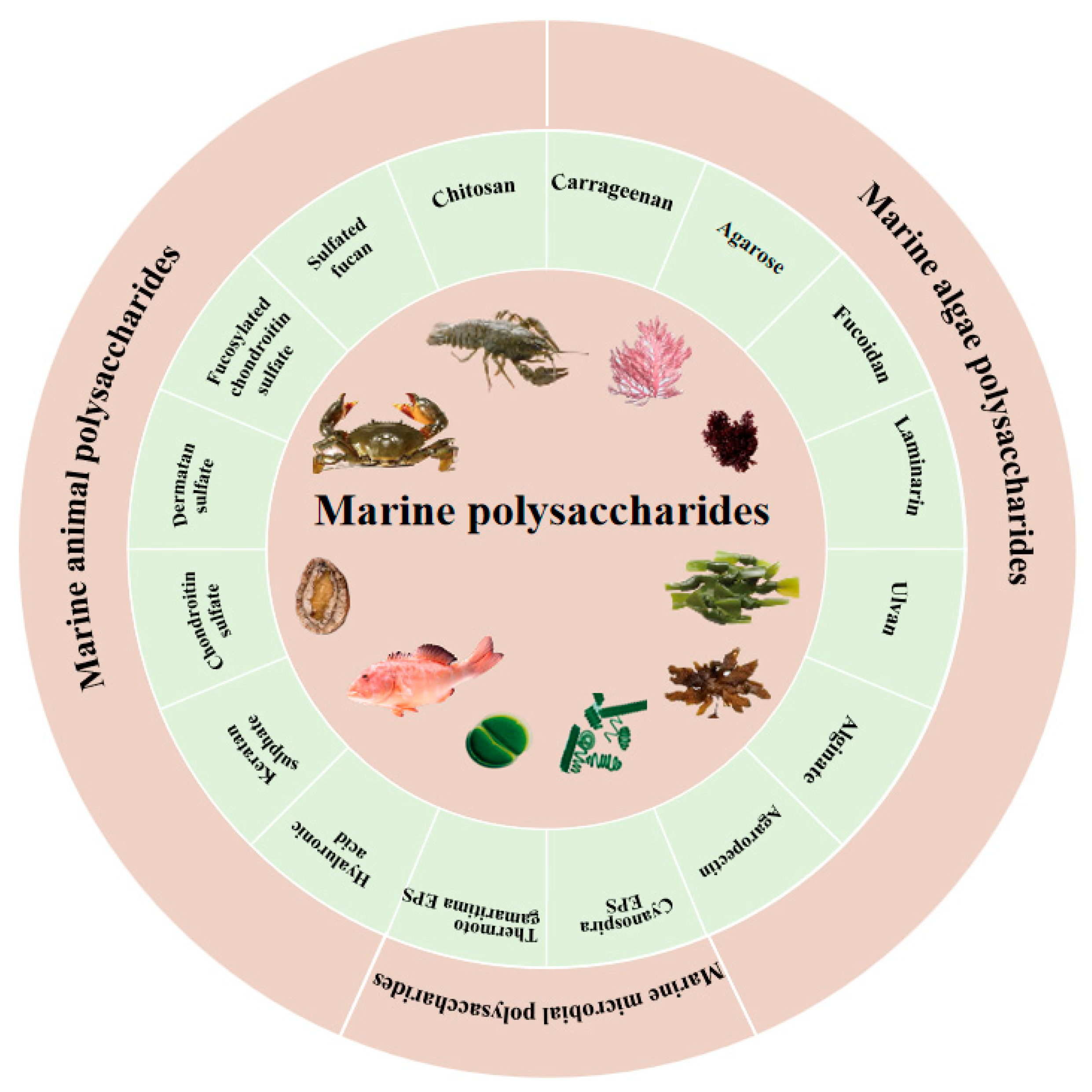
| Source | Type | Structural Information | References |
|---|---|---|---|
| Algal polysaccharides | Alginate | A linear polymer formed by the alternating linkage of β-D-mannuronic acid (M) and α-L-guluronic acid (G) through 1,4-glycosidic bonds | [13] |
| Fucoidan | A sulfated polysaccharide formed by connecting L-fucose as the main structural unit through 1,3- or 1,4-glycosidic bonds. The molecule also contains a small amount of residues such as galactose, mannose, and glucuronic acid | [14] | |
| Laminarin | A type of β-1,3-glucan, composed of D-glucose linked together via 1,3- and 1,6-glycosidic bonds | [15] | |
| Carrageenan | A linear sulfated polysaccharide formed by the alternating linkage of β-D-galactopyranose (namely G-units) and α-D-galactopyranose (namely D-units) through 1,3- and 1,4-glycosidic bonds, or formed by 3,6-anhydro-α-D-galactopyranose (namely DA-units). It can be divided into three main types (κ-type, ι-type, and λ-type) | [14,16] | |
| Agarose | A linear polysaccharide without sulfate groups, formed by the connection of β-D-galactose and 3,6-anhydro-α-L-galactose through 1,3- and 1,4-glycosidic bonds | [11] | |
| Agaropectin | Different from agarose, it contains a small amount of sulfate groups and carboxyl groups | [11] | |
| Ulvan | It is mainly a polyanionic heteropolysaccharide composed of rhamnose, glucuronic acid, iduronic acid, and xylose and contains sulfate groups, and its skeleton is mainly composed of α- and β-(1,4)-bonds, forming repeated disaccharide units; the main repeating disaccharide units are divided into ulvanobiuronic acid 3-sulfate type A (A3s), and type B (B3s), and in some cases type U (U3s and U2′s,3s) | [17,18] | |
| Animal polysaccharides | Chondroitin sulfate | A linear polysaccharide: the main chain is composed of two monomers, D-glucuronic acid and N-acetyl-D-galactosamine, which are alternately linked by β-1,3- and β-1,4-glycosidic bonds. Most of the sulfate groups on its molecule are attached to the C4 or C6 position of N-acetyl-D-galactosamine | [12] |
| Dermatan sulfate | The main chain is composed of L-iduronic acid (or D-glucuronic acid) and N-acetyl-D-galactosamine, linked by β-1,3- and β-1,4-glycosidic bonds. Its sulfate groups are mainly attached to the C4 position of N-acetyl-D-galactosamine, and sulfation also occurs at the C2 position of some iduronic acid molecules | [19] | |
| Chitosan | A linear polysaccharide, specifically known as (1,4)-2-amino-2-deoxy-β-D-glucan | [20] | |
| Microbial polysaccharides | Vibrio sp. KMM 8419 | The sulfate group is attached to the C-3 of the L-rhamnose residue, and the C-4 of L-rhamnose has an acetylation modification | [21] |
| Polysaccharide | Structural Parameters | Functional Impact |
|---|---|---|
| Alginate | High-molecular-weight | Gel properties and viscosity |
| Low-molecular-weight | Solubility and the biological activity is more easily exerted | |
| Laminarin | Long-chain and high-molecular-weight | Exerts both immune-enhancing and anti-inflammatory activities |
| Chitosan | High-molecular-weight | Poor solubility but excellent film-forming and flocculating properties |
| Low-molecular-weight | Water solubility and easier penetration through bacterial cell walls | |
| Fucoidan | L-fucose as its main constituent unit and small amounts of miscellaneous sugar components | Increases the interaction sites between the polysaccharide and inflammatory factors |
| Carrageenan | λ-type | Water solubility; strong electrostatic interactions; anti-inflammatory applications |
| Agaropectin | Sulfate groups; carboxyl groups | Interferes with the formation of the double-helix structure, reducing the gel strength; enhances the adhesion ability between agaropectin cells |
| Chondroitin sulfate | Flexible random coil in aqueous solution; different substitution position of the sulfate groups | Regulates dynamic conformational changes precisely |
| Ulvan | Different glycosidic bond connection modes and sulfation substitution | Recognizes and binds to inflammatory mediators and immune cells; anti-inflammatory activity |
| Types of Marine Polysaccharides and Their Derivatives | Anti-Inflammatory Activity | Main Application Areas | References |
|---|---|---|---|
| Fucoidan | Stabilizing IκB-α can inhibit aspirin-induced NF-κB activation and reduce gastric mucosal inflammation. The MAPK, Akt and NF-κB pathways are inhibited by regulating the miR-22/HO-1 axis to alleviate cartilage damage. It also inhibits colonic inflammation, regulates microflora and repairs the intestinal barrier, relieving ulcerative colitis. | Food industry (dairy products, meal replacement powders and other functional food ingredients); health-care products (joint maintenance and immunomodulation products); biomedical (inflammatory bowel disease therapeutics) | [6,70,71] |
| Chitosan | Low-molecular-weight chitosan inhibits microbial growth and reduces oxidative stress and inflammation. It regulates macrophages and intestinal microbiota, transforms M1 to M2 macrophages, inhibits pro-inflammatory factors, enhances anti-inflammatory factors, and promotes Treg proliferation and immunosuppressive function. | Food industry (edible coatings and preservatives); health products (intestinal immunity health products); biomedical (arthritis drugs, functional coatings for dental implants, wound repair materials, and drug delivery systems) | [72,73,74,75] |
| Carrageenan | Its anti-inflammation can improve food processing safety; λ-carrageenan oligosaccharide reduces IL-6 and TNF-α by inhibiting the MMP-9 and NF-κB/MAPK pathways and improves psoriatic dermatitis in mice. | Food industry (meat products, dairy products, foods containing gelatin, gummies, beverages, etc., which play a role in thickening, stabilizing, gel formation, etc.); health products (skin inflammation-related health products) | [76,77,78] |
| Fucoidan from sea cucumber cooking liquid | Prevents gastritis caused by Helicobacter pylori SS1 (Hp SS1) infection and inhibits inflammatory responses. | Health products (high-end tonics and health supplements) | [79,80] |
| Chondroitin sulfate oxide | The HMGB1/TLR4/NF-κB-p65 pathway regulates macrophage transformation and blocks inflammatory signaling. | Biomedical (arthritis drug) | [73] |
| Agarose | Good biocompatibility; can form hydrogels with anti-inflammatory and antibacterial properties, reducing inflammation and accelerating wound healing. | Biomedical (wound repair and wound healing materials) | [81,82] |
| Sodium Alginate | Forms hydrogels with antibacterial and anti-inflammatory properties that promote wound repair and skin regeneration, while also regulating the polarization of macrophages towards the M2 phenotype to improve the immune microenvironment. | Biomedical (wound repair materials) | [83,84] |
| Ulvan | It can inhibit nociception caused by acetic acid/formalin, block the bradykinin pathway, inhibit foot edema caused by dextran, inhibit the release of TNF-α and IFN-γ induced by LPS, upregulate the anti-inflammatory factors TGF-β1 and IL-10, reduce MMP-3 and IL-6 levels, increase chondrocyte COL2A1 levels, reduce TG/TC/LDL-C in OA rats, inhibit pro-inflammatory cytokines/NO/MMP-3/CTX-II, and reduce cartilage proteoglycan loss. | Biomedical (osteoarthritis therapeutic drugs, second-degree burn wound repair gel and electrospun nanofiber wound dressing materials); health products (blood lipid regulation, joint health, and analgesic and anti-inflammatory health products) | [85,86,87] |
Disclaimer/Publisher’s Note: The statements, opinions and data contained in all publications are solely those of the individual author(s) and contributor(s) and not of MDPI and/or the editor(s). MDPI and/or the editor(s) disclaim responsibility for any injury to people or property resulting from any ideas, methods, instructions or products referred to in the content. |
© 2026 by the authors. Licensee MDPI, Basel, Switzerland. This article is an open access article distributed under the terms and conditions of the Creative Commons Attribution (CC BY) license.
Share and Cite
Wang, Y.; Luo, J.; Xu, C.; Hu, D.; Li, Y.; Ye, Y.; Yang, J.; Chen, X.; Li, C.; Zhu, K. Recent Advance in Marine Polysaccharides: Structure, Anti-Inflammatory Mechanisms, and Functional Applications. Mar. Drugs 2026, 24, 129. https://doi.org/10.3390/md24040129
Wang Y, Luo J, Xu C, Hu D, Li Y, Ye Y, Yang J, Chen X, Li C, Zhu K. Recent Advance in Marine Polysaccharides: Structure, Anti-Inflammatory Mechanisms, and Functional Applications. Marine Drugs. 2026; 24(4):129. https://doi.org/10.3390/md24040129
Chicago/Turabian StyleWang, Yuchen, Jingyi Luo, Chao Xu, Dongyu Hu, Yimeng Li, Yanzuo Ye, Jun Yang, Xianxiang Chen, Chuan Li, and Kexue Zhu. 2026. "Recent Advance in Marine Polysaccharides: Structure, Anti-Inflammatory Mechanisms, and Functional Applications" Marine Drugs 24, no. 4: 129. https://doi.org/10.3390/md24040129
APA StyleWang, Y., Luo, J., Xu, C., Hu, D., Li, Y., Ye, Y., Yang, J., Chen, X., Li, C., & Zhu, K. (2026). Recent Advance in Marine Polysaccharides: Structure, Anti-Inflammatory Mechanisms, and Functional Applications. Marine Drugs, 24(4), 129. https://doi.org/10.3390/md24040129