
Skip to Content
Marine DrugsMarine Drugs
  • Article
  • Open Access

26 February 2026

Crude Venom from Sea Anemone Macrodactyla doreensis Suppresses Glioblastoma via the p53 Pathway
,
,
,
,
,
,
,
,
1
Engineering Research Center of Tropical Medicine Innovation and Transformation of Ministry of Education, Hainan Key Laboratory for Research and Development of Tropical Herbs, International Joint Research Center of Human-Machine Intelligent Collaborative for Tumor Precision Diagnosis and Treatment of Hainan Province, School of Pharmacy, Hainan Medical University, Haikou 571199, China
2
Institute for Biomedicine and Glycomics, School of Environment and Science, Griffith University, Nathan, QLD 4111, Australia
3
Department of Medicine, Section of Hematology-Medical Oncology, Boston University Chobanian & Avedisian School of Medicine, Boston, MA 02118, USA
4
Department of Pharmacy, 928th Hospital of PLA Joint Logistics Support Force, Haikou 571199, China

Abstract

Glioblastoma is a highly invasive primary brain tumor with a poor prognosis, highlighting the need for new therapeutic strategies. Toxins derived from Macrodactyla doreensis have attracted attention for their potential anticancer activity. This study evaluated the anticancer and cytotoxic effects of M. doreensis crude venom on two commonly used glioblastoma cell lines (U251 and LN229), which mirror the phenotype of primary tumors. Cell viability and proliferation were assessed using the CCK-8 assay and colony formation assay, while cell migration and invasion capabilities were detected via wound healing assay and Transwell assay. Annexin V/PI staining and PI-based cell cycle analysis indicated that the crude venom significantly induced cell apoptosis and caused S-phase arrest. Proteomic analysis combined with GO and KEGG enrichment analyses as well as bioinformatics approaches showed that M. doreensis crude venom inhibits glioblastoma cell proliferation by downregulating the expression of CDK2, RRM2, and CHEK1, thereby hindering cell cycle progression and regulating the p53 signaling pathway. Notably, the downregulation of these key glioblastoma-related target genes was validated by qPCR. In addition, network pharmacology analysis indicated that several peptide families present in the sea anemone crude venom, including ShK peptides, inhibitor cystine knot (ICK) peptides, and EGF-like peptides, exhibit notable antitumor potential. Combined with AlphaFold2-based structural modeling and molecular docking, these analyses further elucidated the potential molecular mechanisms underlying their interactions with key targets, such as MD-381 with RRM2, MD-322 with CDK2, and MD-429 with CHEK1. Collectively, these findings highlight the therapeutic potential of M. doreensis crude venom and lay a foundation for the subsequent isolation of novel peptides and their further development in glioblastoma treatment.

1. Introduction

Sea anemones, belonging to the phylum Cnidaria, produce venoms that consist of complex mixtures of diverse bioactive compounds, including peptides, proteins, protease inhibitors, and biogenic amines. These components play essential roles in prey capture and defense mechanisms [1]. The nematocysts located on the tentacles of sea anemones serve as their primary offensive and defensive apparatus. Upon mechanical or chemical stimulation, the nematocysts rapidly discharge venom to facilitate prey capture or deter predators. Beyond their ecological significance, sea anemone toxins have attracted sustained scientific interest due to their high specificity in modulating ion channels, signal transduction pathways, and cellular metabolism, making them promising scaffolds for natural product-based drug discovery and development [2].
Our research group previously established comprehensive peptide libraries for five different species of sea anemones from the South China Sea, including Heteractis crispa, Stichodactyla haddoni, Exaiptasia diaphana, Macrodactyla doreensis, and Heteractis magnifica [3,4,5]. Through multi-omics strategies, we further conducted preliminary pharmacological screening of crude venoms from those sea anemones and found that their venoms exhibited diverse biological activities, including antitumor, analgesic, hypoglycemic, and insecticidal effects [6]. Notably, crude venom from M. doreensis showed particularly potent anti-glioma activity, yet this species remains comparatively unexplored.
Glioblastoma is the most common primary malignant brain tumor, characterized by extensive heterogeneity, aggressive invasiveness, and high recurrence [7]. Despite incremental advances in clinical management, outcomes remain poor (5-year survival rate ~7.2%; median overall survival ~21 months), and the disease imposes substantial emotional and economic burdens on families and society [8]. Current therapies remain insufficient due to limited efficacy and the rapid acquisition of drug resistance, underscoring the urgent need for novel therapeutic agents with distinct mechanisms of action [9]. Recent studies have demonstrated that sea anemone–derived peptides display potent antitumor activities across multiple cancer types, including hepatocellular carcinoma, cervical cancer, breast cancer, and ovarian cancer [10,11]. However, their effects on glioblastoma, particularly on invasion-related phenotypes and underlying molecular mechanisms, remain largely unexplored. Venom-derived peptides are a promising class of emerging anticancer agents because they can suppress tumor growth by perturbing cell cycle progression, inhibiting proliferation, and disrupting apoptotic signaling pathways. Among these mechanisms, the tumor suppressor p53 plays a pivotal role as a central transcription factor, orchestrating cell-cycle arrest, senescence, DNA repair, and apoptosis in response to cellular stress and genomic instability. Activated p53 halts the proliferation of mutated or damaged cells and transduces pro-apoptotic signals to ensure effective elimination of aberrant cells, thereby preventing tumorigenesis [12]. Owing to its central regulatory functions, p53 has emerged as a promising therapeutic target across various cancer types.
In this study, crude venom extracted from M. doreensis was systematically evaluated through in vitro cellular assays, proteomic profiling, and qPCR validation to elucidate its inhibitory effects on glioblastoma cells and the underlying molecular mechanisms. This work provides a scientific foundation for further exploring the anti-glioma potential of M. doreensis venom and contributes to the identification of medically valuable marine-derived peptides as leads for therapeutic development.

2. Results

2.1. Multi-Omics Identification of M. doreensis Peptides and Network-Pharmacology-Based Screening of Anti-Glioblastoma Targets

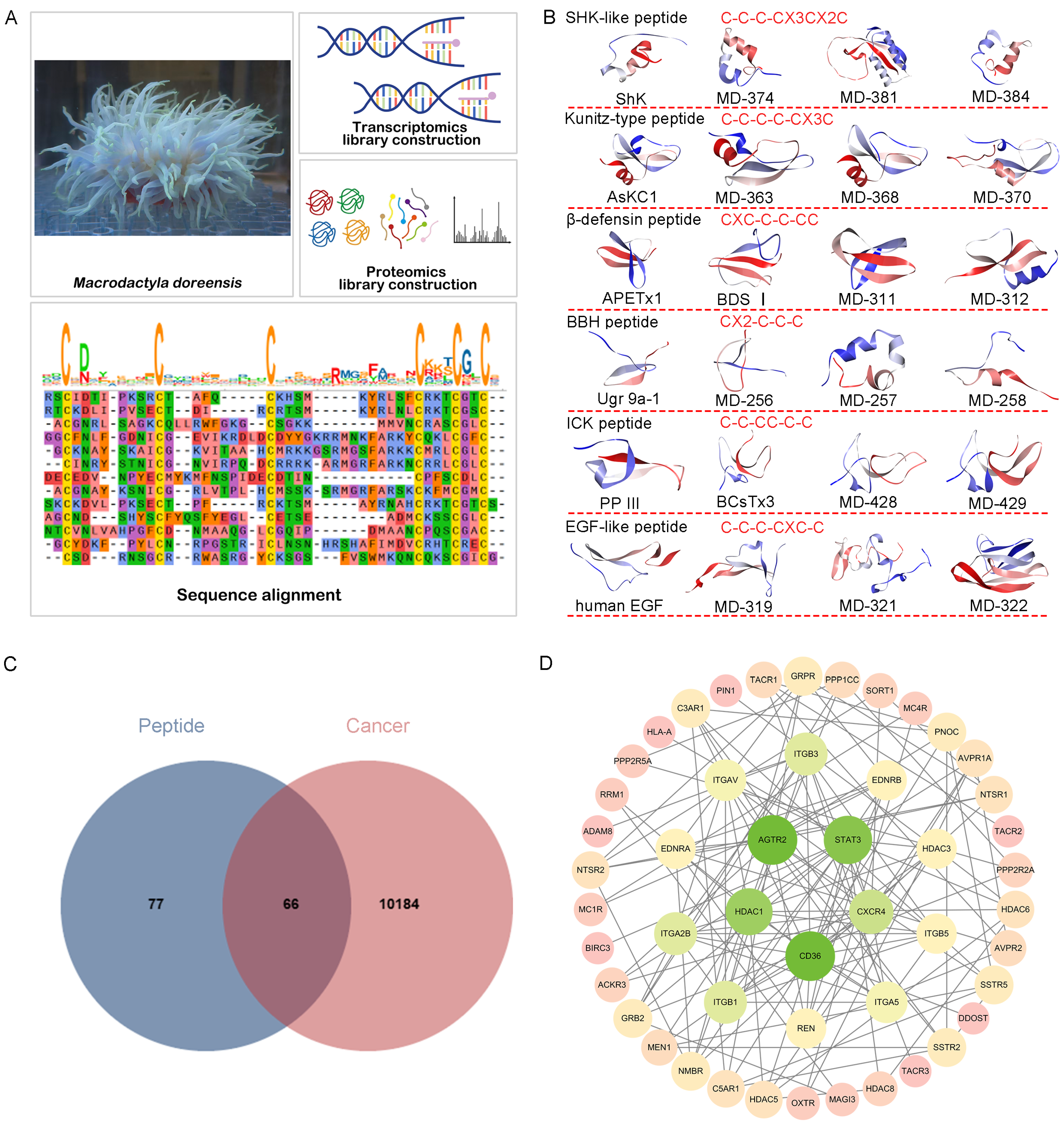
The sea anemone M. doreensis is a common species inhabiting the South China Sea. In our previous work, a peptide library was constructed by integrating transcriptomic and proteomic approaches, yielding 606 sequence reads, including 40 putative peptides from representative families (Figure 1A). These peptides were classified into eight major families according to their cysteine frameworks. Six of these families, including ShK domain, Kunitz-type, β-defensins, boundless β-hairpin (BBH), inhibitor cystine knot (ICK), and EGF-like peptides [13], were prioritized. Sixteen representative peptides (e.g., MD-322, MD-363, MD-374, MD-381, MD-384, and MD-429) were chosen for subsequent structural modeling and functional prediction (Figure 1B).
Figure 1. Integrated multi-omics workflow and identification of key peptide families from M. doreensis, along with network-pharmacology-based prediction of their anti-glioblastoma potential. (A) Schematic overview of the transcriptomics and proteomics workflow, including transcriptome assembly, proteome library construction, and ShK family sequences identified from the transcriptome of M. doreensis. (B) Sixteen peptides screened from the transcriptome of M. doreensis across six different families were subjected to three-dimensional homology modeling. (C) Venn diagram of potential therapeutic targets of peptides in the treatment of glioblastoma. (D) Target-disease protein–protein interaction (PPI) network ranked by degree centrality.
To identify potential therapeutic targets of peptides derived from M. doreensis in glioblastoma, 143 putative targets were predicted using the SEA database [14], while 10,250 glioblastoma-related disease targets were retrieved from GeneCards and OMIM databases [15]. Intersection analysis of these datasets (Figure 1C) resulted in 66 overlapping targets regarded as potential peptide-associated therapeutic targets. These 66 targets were submitted to the STRING database (https://string-db.org/, accessed on 28 November 2025) to construct a protein–protein interaction (PPI) network, comprising 243 nodes and 1208 edges with an average degree of 9.94. Topology analysis performed using Cytoscape [16] identified core nodes based on degree centrality (Figure 1D), with node degree positively correlated with node size and color. Several hub proteins were located at the center of the PPI network, including AGTR2 (angiotensin II receptor type 2), STAT3 (signal transducer and activator of transcription 3), CD36, HDAC1 (histone deacetylase 1), and CXCR4 (C-X-C motif chemokine receptor 4), which have all been reported to participate in glioblastoma-associated signaling networks [17,18,19,20,21]. Collectively, these targets may represent potential therapeutic nodes underlying the anti-glioblastoma activity of M. doreensis peptides.

2.2. Crude Venom Preferentially Suppresses Glioblastoma Cell Viability

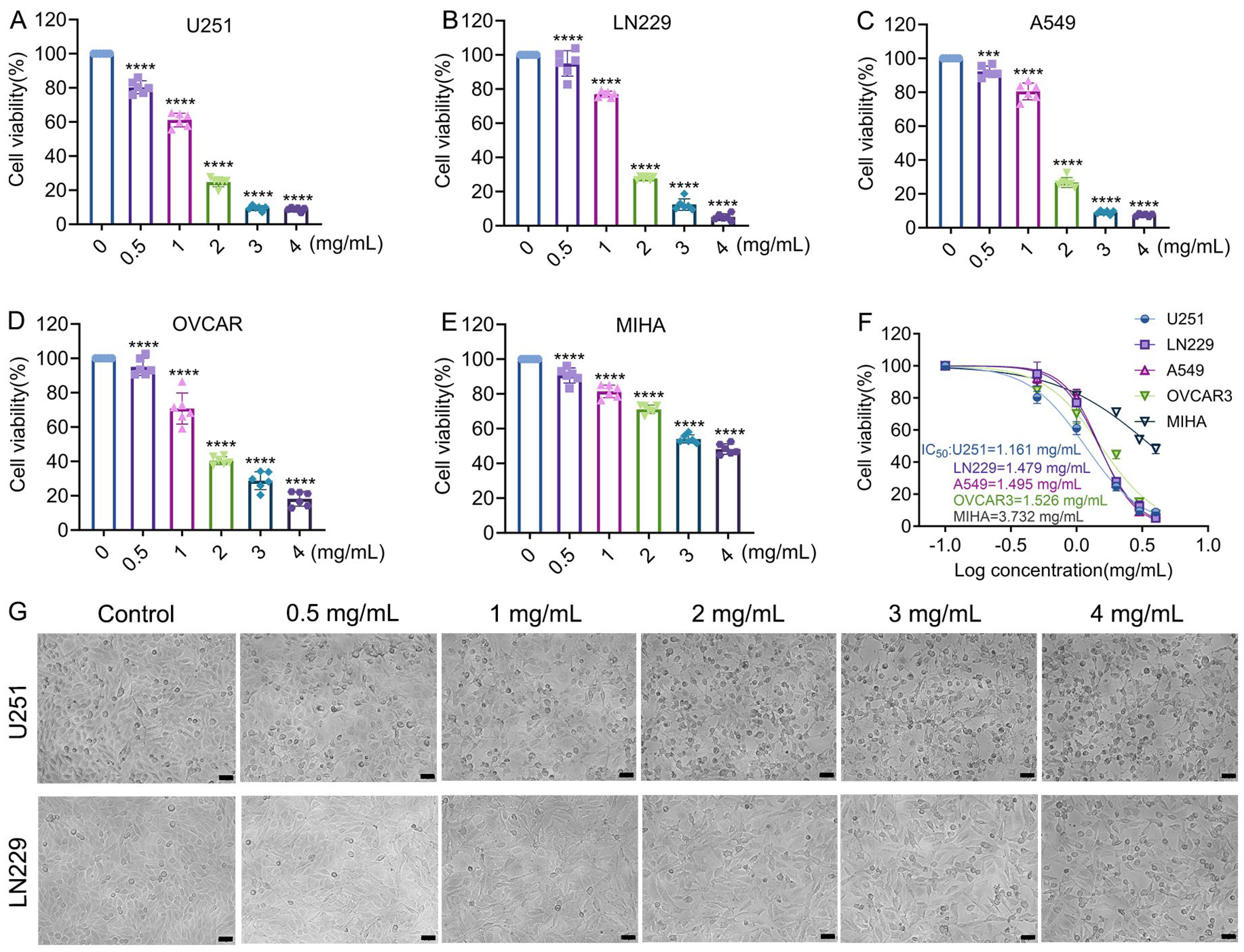
In an initial cross-cancer comparison (U251, LN229, A549, OVCAR3, and MIHA), crude venom exhibited the strongest inhibitory effect on glioblastoma cells. Subsequent experiments therefore focused specifically on glioblastoma models U251 and LN229. CCK-8 assays demonstrated significant, dose-dependent cytotoxicity of crude venom in both cell lines (Figure 2A–F). The results showed that although the crude venom also exerted a significant effect on normal MIHA hepatocytes, its cytotoxicity toward U251 cells was markedly higher, with nearly a threefold difference in IC50 values (1.161 mg/mL vs. 3.732 mg/mL). Notably, at 3 mg/mL, growth inhibition reached 90.42% in U251 cells and 88.8% in LN229 cells. Consistent with this, IC50 values at 24 h were 1.161 mg/mL (U251) and 1.479 mg/mL (LN229) (Figure 2F), indicating a stronger cytotoxic response in U251 cells. This inhibitory effect was further supported by Bright-field (BF) imaging, which further revealed pronounced venom-induced morphological changes in both glioblastoma cell lines (Figure 2G).
Figure 2. Sea anemone M. doreensis crude venom induces dose-dependent cytotoxicity in five cell lines. (AE) Cell viability of U251 (A), LN229 (B), A549 (C), OVCAR3 (D), and MIHA (E) cells following treatment with crude venom at the indicated concentrations (0–4 mg/mL). Viability is expressed as a percentage of the untreated control. Data represent mean  ±  SEM from at least three independent experiments. *** p < 0.001, **** p < 0.0001 versus control group. (F) Dose–response curves generated by nonlinear regression of viability data for U251, LN229, A549, OVCAR3, and MIHA cells. The calculated IC50 values are shown. (G) Representative bright field (BF) micrographs of U251 and LN229 cells without treatment (control) or treated with different doses of crude venom for 24 h. Scale bars: 100 µm.
To select working concentrations for mechanistic assays while avoiding excessive nonspecific cytotoxicity, we assessed cell viability across a range of doses. At 800 µg/mL, the viability of both U251 and LN229 cells remained within the 60–70% range [22]. Therefore, 800 µg/mL was selected as the highest working concentration for subsequent experiments.

2.3. Crude Venom Inhibits Glioblastoma Migration and Invasion

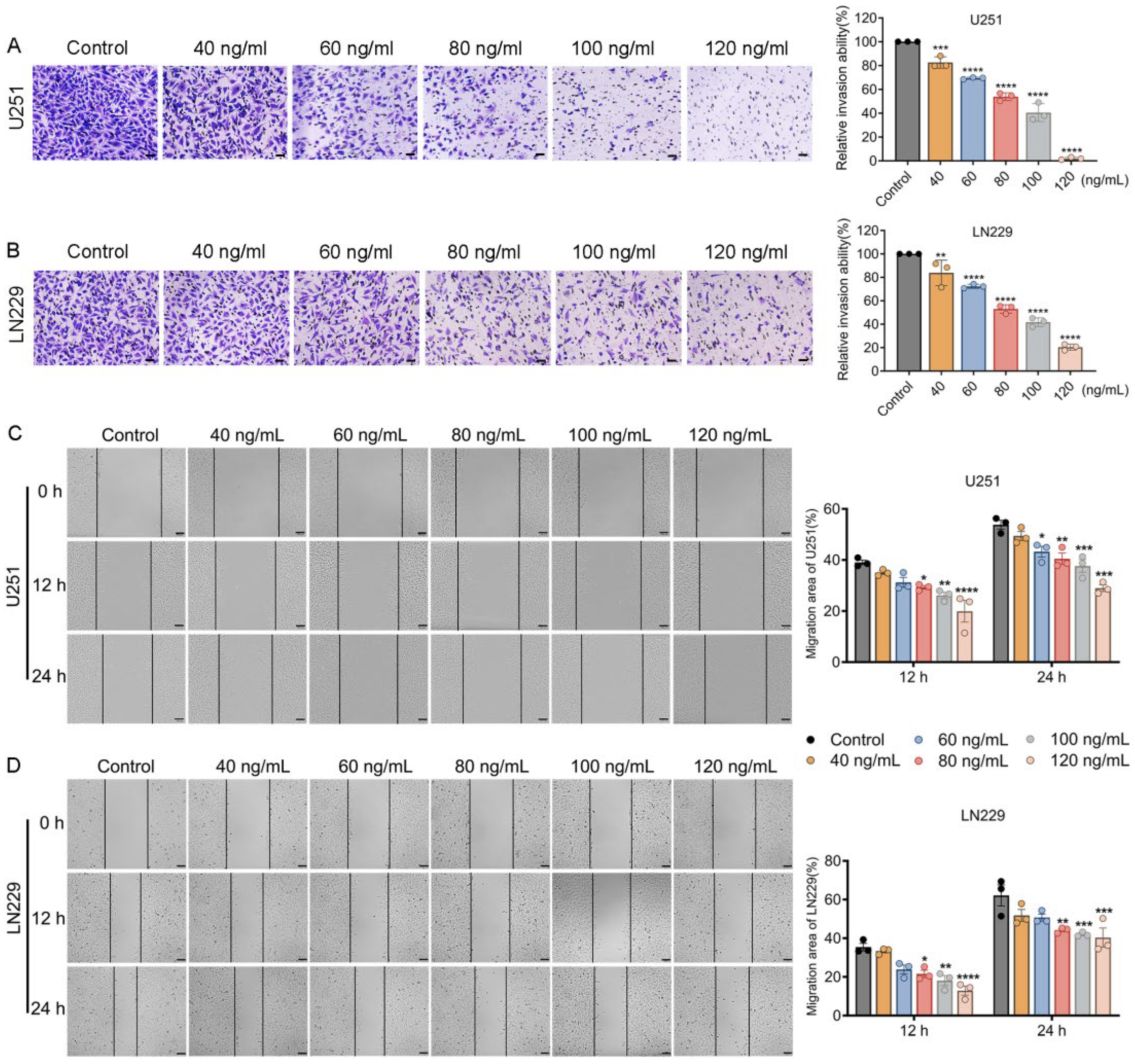
Transwell invasion assays showed that crude venom treatment significantly reduced invasion in both U251 and LN229 cells at all tested concentrations compared with the control group without treatment (Figure 3A,B). Notably, U251 cells exhibited greater sensitivity at the highest concentration (120 ng/mL), with invasion reduced to 3.03% versus 20.46% in LN229 cells (Figure 3B), indicating dose-dependent responses and overall dose-dependent suppression of invasion.
Figure 3. Crude venom suppresses glioblastoma cell migration and invasion in U251 and LN229 cells. (A,B) Transwell invasion assays showing representative images of invaded U251 (A) and LN229 (B) cells following treatment with crude venom (40–120 ng/mL). Invaded cells were fixed, counterstained with crystal violet (purple), and imaged. Bar graphs (right) show quantification of relative invasion ability (%) compared with the untreated control. Scale bars: 50 µm. (C,D) Wound-healing (scratch) migration assays for U251 (C) and LN229 (D) cells treated with crude venom (40–120 ng/mL). Representative images were captured at 0 h, 12 h, and 24 h, illustrating delayed wound closure with increasing venom concentration. Bar graphs (right) show the quantified migration area (%) at 12 h and 24 h. Scale bars: 100 µm. Data represent mean  ±  SEM from at least three independent experiments. * p < 0.05, ** p < 0.01, *** p < 0.001, **** p < 0.0001 versus control group.
Wound-healing assays further demonstrated that untreated controls exhibited substantial gap closure (~40% at 12 h and >50% at 24 h), whereas venom treatment markedly impaired wound closure in both cell lines in a dose-dependent manner, particularly at concentrations ≥80 ng/mL (Figure 3C,D). In line with the invasion data, crude venom exerts a more pronounced inhibitory effect on the migratory capacity of U251 cells compared with LN229 cells. At 24 h, 60 ng/mL significantly slowed down wound closure in U251 cells, while showing no significant effects on LN229 cells. When treated with 120 ng/mL crude venom, U251 cells exhibited a stronger reduction in migration than LN229 cells (28.95% vs. 40.34%).

2.4. Crude Venom Suppresses Clonogenic Growth

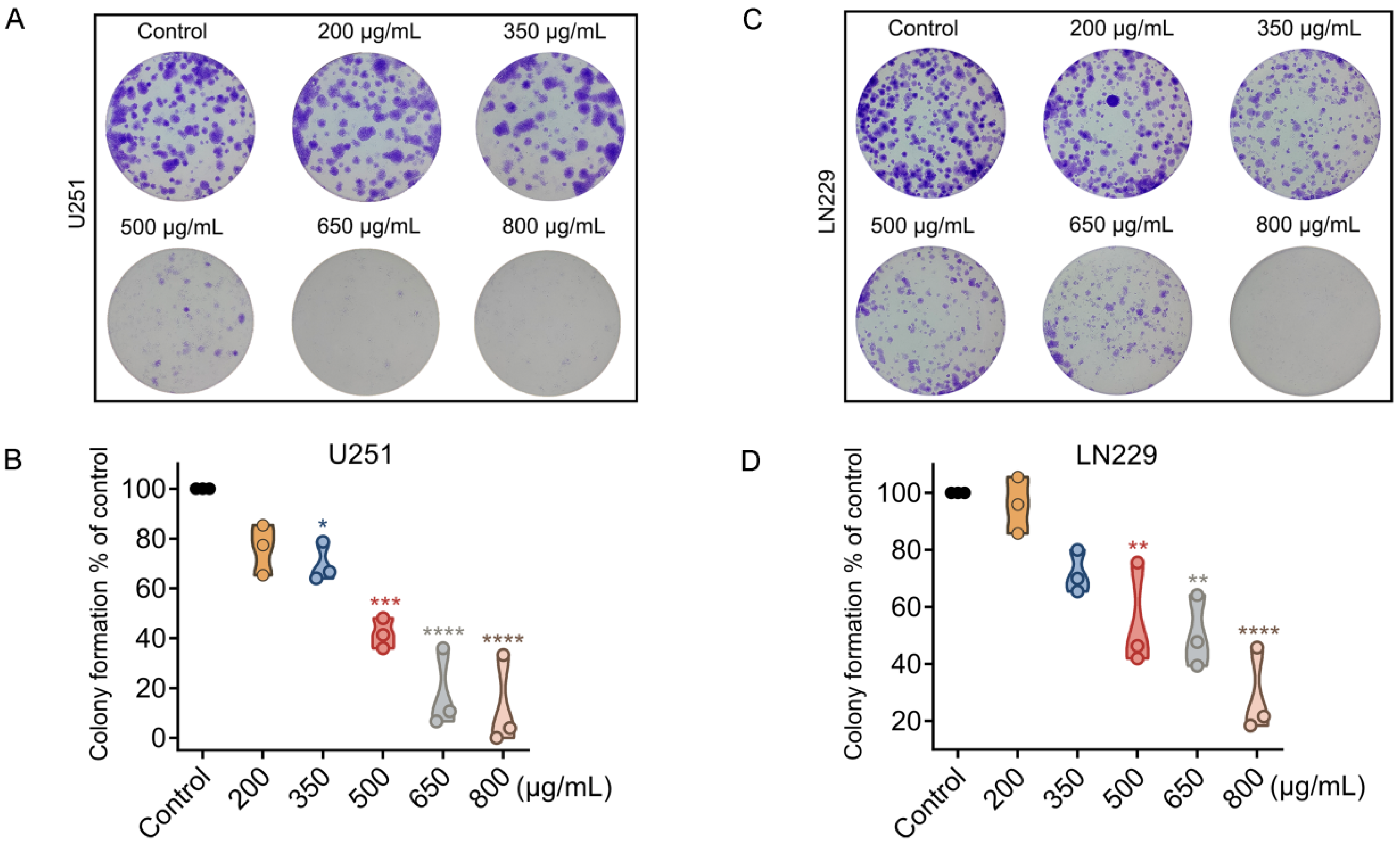
To evaluate the long-term effects of crude venom on the proliferation of glioblastoma cells, a 21-day colony formation assay was performed [23]. Cell colony counting revealed a significant, dose-dependent inhibition of cell proliferation in crude venom-treated U251 and LN229 cells. Colony formation was nearly abolished by the crude venom at 650 µg/mL in U251 cells and at 800 µg/mL in LN229 cells (Figure 4).
Figure 4. Crude venom inhibits clonogenic survival of U251 and LN229 glioblastoma cells. (A,C) Representative images of crystal violet–stained colony formation assays performed in U251 (A) and LN229 (C) cells following treatment with crude venom at indicated concentrations (200–800 µg/mL). (B,D) Quantification of clonogenic growth for U251 (B) and LN229 (D) cells, expressed as colony formation (% of control). Violin plots depict the distribution of replicate values. Data represent mean  ±  SEM from at least three independent experiments. * p < 0.05, ** p < 0.01, *** p < 0.001, **** p < 0.0001 versus control group.

2.5. Crude Venom Induces Cell Cycle Arrest in Human Glioblastoma Cells

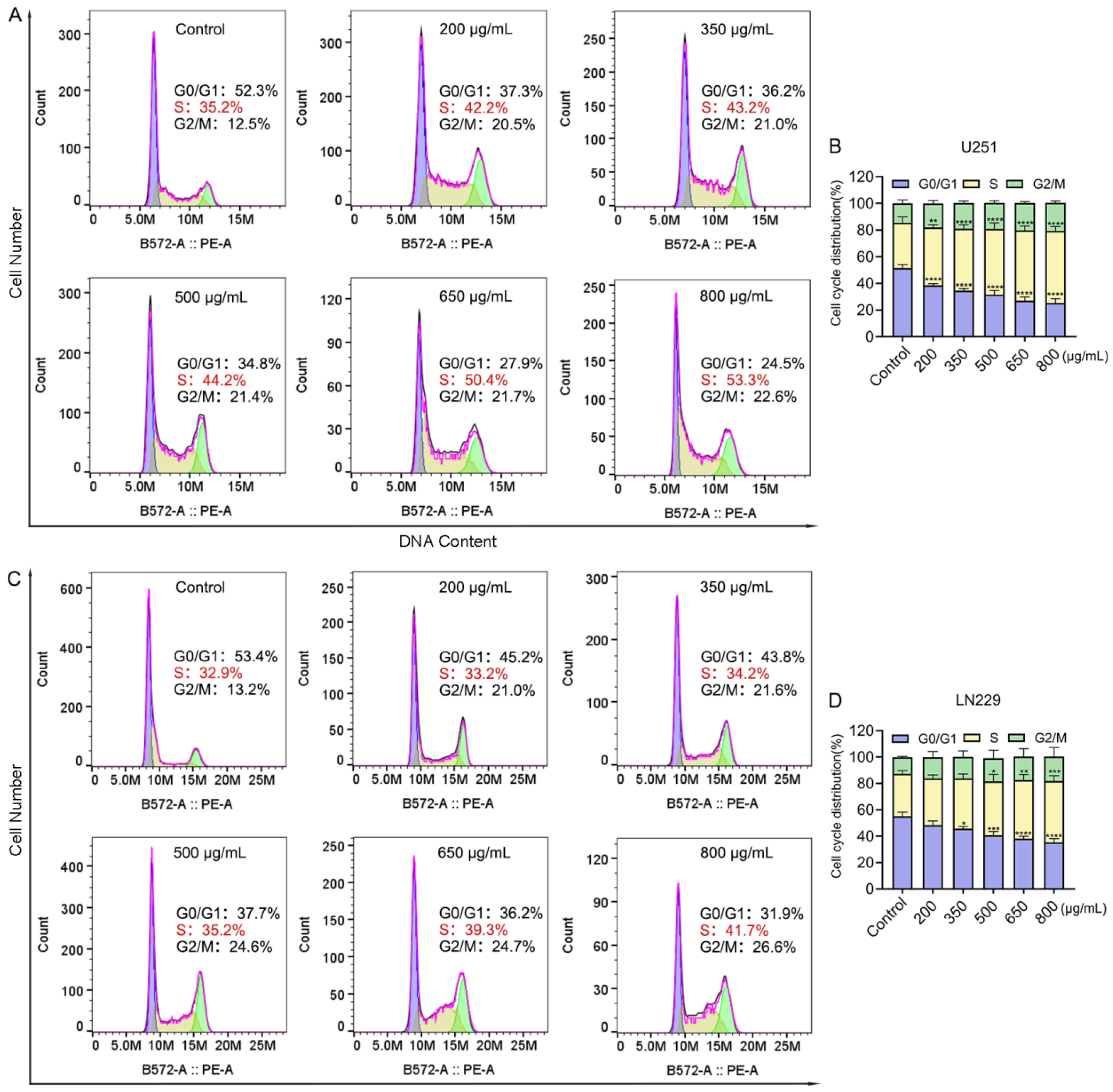
To further investigate whether growth suppression involved cell-cycle disruption in glioblastoma cells, the distribution of cells across different phases (G0/G1, S, and G2/M) was evaluated by flow cytometric analysis following PI staining [24]. Consistent with the antiproliferative results, cell cycle analysis revealed a significant increase in the proportion of cells in the S phase upon treatment, suggesting that cell cycle progression may be disrupted (Figure 5). In U251 cells treated with 800 µg/mL crude venom for 24 h, the percentage of cells in the S phase increased significantly from 35.2% in the control group to 53.3%, indicating the S phase arrest (Figure 5A). Meanwhile, the proportion of cells in the G0/G1 phase decreased significantly from 52.3% to 24.5% (Figure 5B). Similarly, 800 µg/mL crude venom treatment for 24 h in LN229 cells led to a significant rise in the S phase population, increasing from 32.9% to 41.7% (Figure 5C), while the proportion of cells in the G0/G1 phase significantly decreased from 53.4% in the control group to 31.9% (Figure 5D).
Figure 5. Crude venom induces S-phase accumulation and alters cell cycle distribution in glioblastoma cells. (A,C) Representative flow-cytometry histograms of DNA content for U251 (A) and LN229 (C) cells after treatment with different concentrations of crude venom for 24 h. (B,D) Quantification of U251 (B) and LN229 (D) cell cycle distribution following treatment with different crude venom concentrations is shown as stacked columns. Data represent mean  ±  SEM from at least three independent experiments. * p < 0.05, ** p < 0.01, *** p < 0.001, **** p < 0.0001 versus control group.

2.6. Crude Venom Induces Apoptosis in Human Glioblastoma Cells

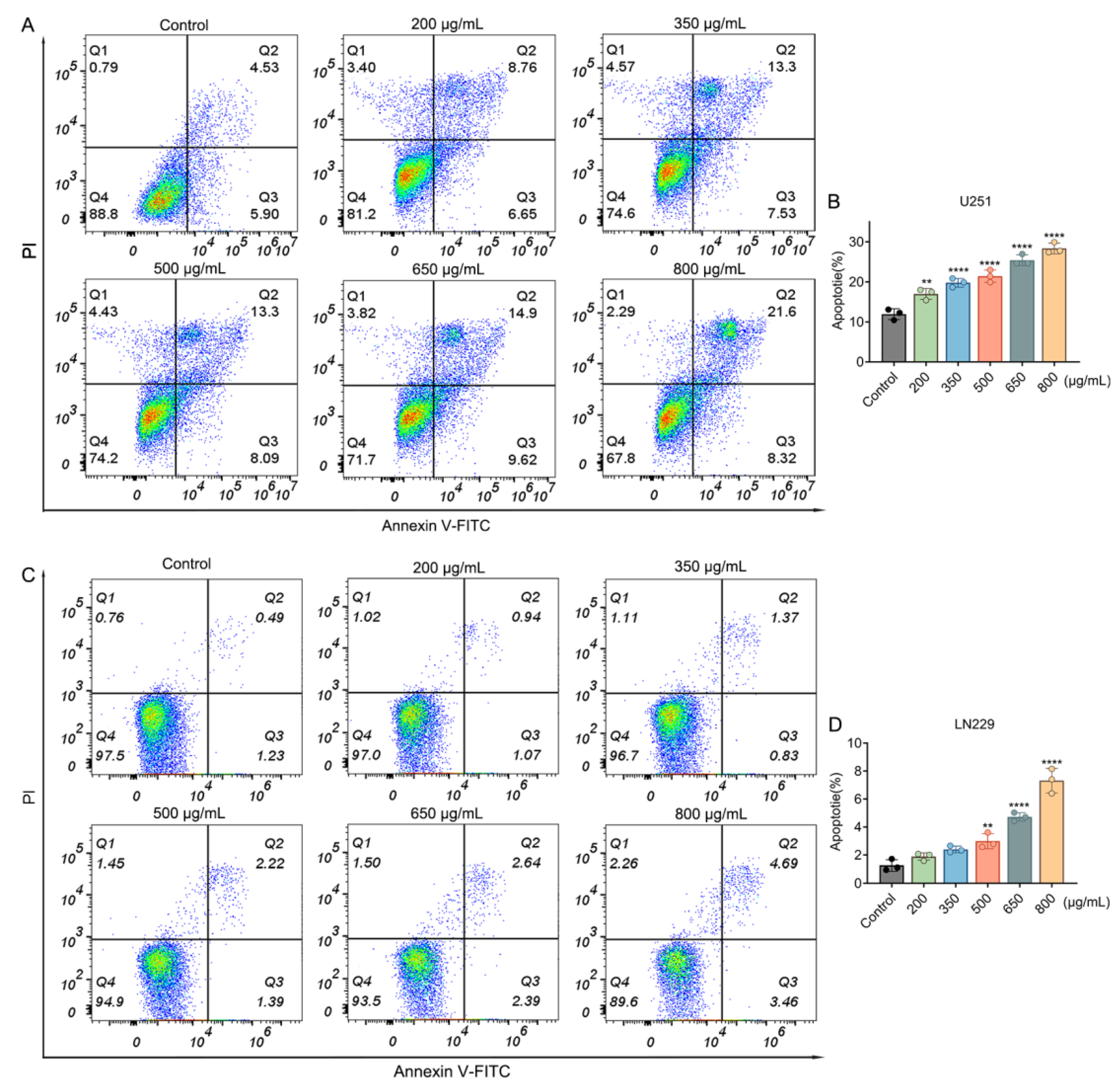
To evaluate whether crude venom induces apoptosis in U251 and LN229 cells, we employed the Annexin V and PI double staining, a method capable of identifying and quantifying apoptotic cells by detecting the binding of cell surface specific markers [25]. The apoptosis rates of U251 and LN229 cells in the control groups were 11.92% and 1.72%, respectively. After 24 h of crude venom exposure, U251 and LN229 cells treated with 800 µg/mL displayed an apoptosis rate of 28.35% and 7.31%, respectively, indicating significant apoptosis induction compared to the control (Figure 6). Although the proportion of apoptotic cells increased with rising concentrations of crude venom, the percentage of necrotic cells labeled as Annexin V/PI+ did not show significant changes, suggesting that crude venom primarily exerts its effects by inducing cell apoptosis rather than necrotic cell death.
Figure 6. Crude venom induces dose-dependent apoptosis in glioblastoma cells. (A,C) Representative Annexin V–FITC/propidium iodide (PI) flow-cytometry plots of U251 (A) and LN229 (C) cells treated with crude venom for 24 h. Quadrants indicate viable cells (Annexin V/PI), early apoptotic cells (Annexin V+/PI), late apoptotic/secondary necrotic cells (Annexin V+/PI+), and primary necrotic cells (Annexin V/PI+). Percentages of cells in each quadrant are shown. (B,D) Quantification of total apoptotic cells (early + late apoptosis; Annexin V+) in U251 (B) and LN229 (D) expressed as a percentage of total cells. Data represent mean  ±  SEM from at least three independent experiments. ** p < 0.01, **** p < 0.0001 versus control group.

2.7. Proteomics Reveals the Potential Anti-Glioblastoma Targets of Crude Venom

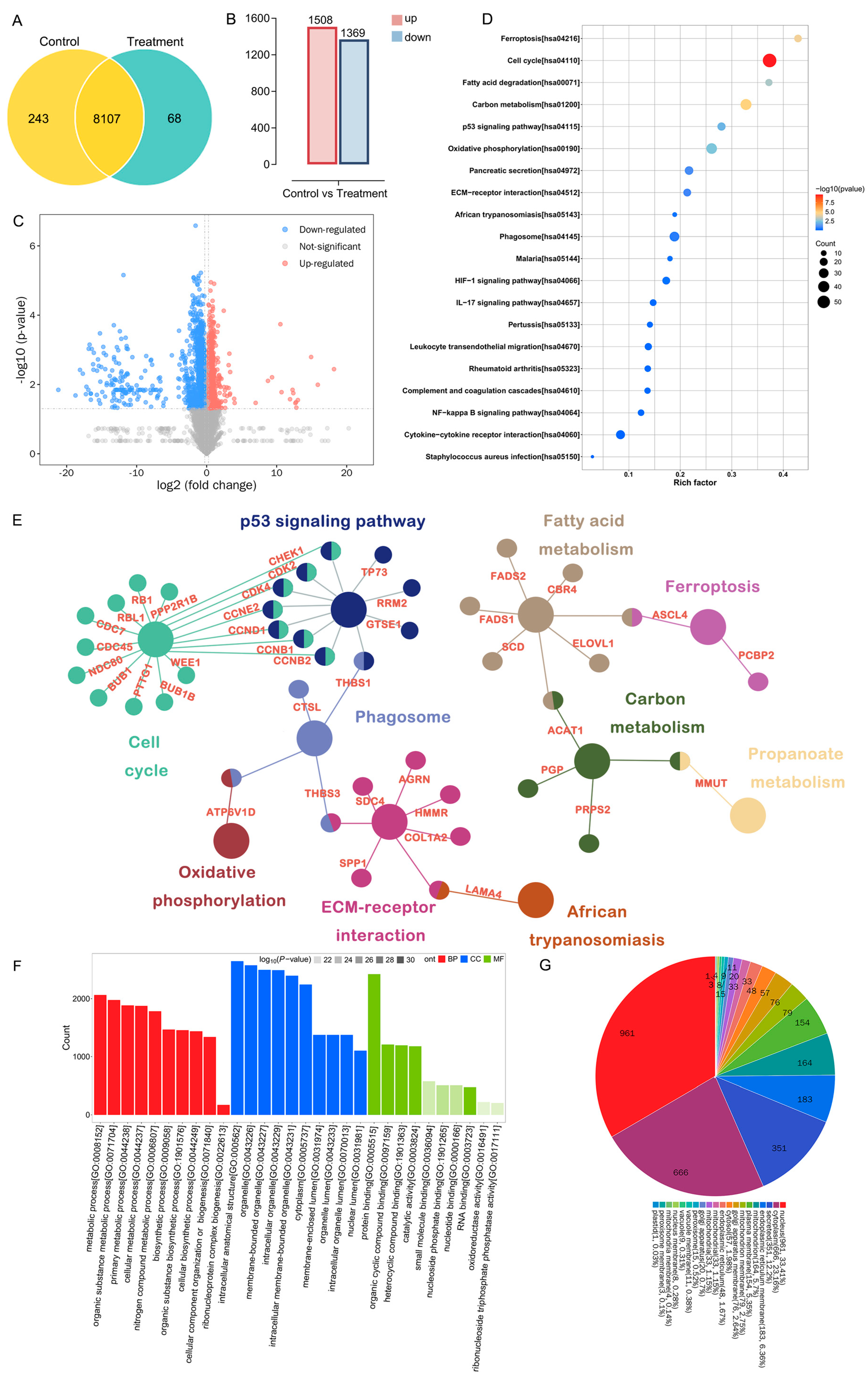
To gain deeper insights into the underlying molecular mechanism of crude venom’s action on glioblastoma, quantitative proteomic analysis [26] was performed on control and crude venom-treated U251 cells detecting a total of 8418 expressed proteins (Figure 7A). Using the threshold of Pfdr < 0.05 and Fold change ≤ 0.83 or Fold change ≥ 1.22, a total of 2877 differentially expressed proteins were identified, including 1508 up-regulated proteins and 1369 down-regulated proteins (Figure 7B,C). Subsequently, Gene Ontology (GO) and Kyoto Encyclopedia of Genes and Genomes (KEGG) enrichment analyses were conducted on the 2877 differentially expressed proteins to explore the potential molecular mechanisms of crude venom in glioblastoma. KEGG enrichment analysis further highlighted significant association with the p53 signaling pathway and cell-cycle regulation, indicating that these pathways may serve as core regulatory mechanisms mediating the venom-mediated antitumor effects (Figure 7D,E). The potential biological functional effects of crude venom on glioblastoma cells were ranked in descending order based on the −log10(p-value) corresponding to each entry. GO enrichment indicated prominent changes in metabolic processes, organic substance metabolic process, primary metabolic processes, and cellular metabolic processes (Figure 7F). In terms of cellular components, the proteins were mainly localized to intracellular anatomical structures and organelles. Regarding molecular functions, they were predominantly associated with protein binding, organic cyclic compound binding, and catalytic activity. The subcellular structure annotation and classification revealed that the differential proteins were predominantly localized in the nucleus (33.41%), cytoplasm (23.16%), secreted proteins (12.2%), and endoplasmic reticulum membrane (6.36%), among others (Figure 7G). Together, GO functional classification and subcellular analyses indicated that crude venom inhibits glioblastoma cells primarily by affecting mitochondrial function and metabolic pathways.
Figure 7. Proteomics revealed the underlying mechanism of crude venom against glioblastoma. (A) Venn diagram of differentially expressed proteins. (B) Screening plot of differentially expressed proteins. (C) Volcano plot of quantitative proteomic analysis, red represents up-regulated proteins and blue represents down-regulated proteins using the threshold of p value < 0.05 and Fold change ≤ 0.83 or Fold change ≥ 1.22. (D) Top 20 significant KEGG pathways. Dot size represents the number of differentially expressed proteins mapped to each pathway (Count), dot color indicates significance, and the x-axis shows the rich factor (ratio of differentially expressed proteins to total annotated proteins in the pathway). (E) Gene–pathway network plot linking enriched KEGG pathways to contributing differentially expressed proteins (displayed as gene symbols), highlighting major functional modules including p53 signaling, cell cycle, oxidative phosphorylation, phagosome, ECM–receptor interaction, fatty acid/carbon metabolism, and ferroptosis. (F) Gene Ontology (GO) enrichment analysis of differentially expressed proteins across biological process (BP), cellular component (CC), and molecular function (MF) categories. Bar height indicates gene count; color scale reflects significance. (G) GO functional classification pie chart showing the subcellular distribution of differentially expressed proteins across enriched GO terms/categories.

2.8. Quantitative PCR Validation and Docking Nominate RRM2, CDK2, and CHEK1 as Candidate Targets

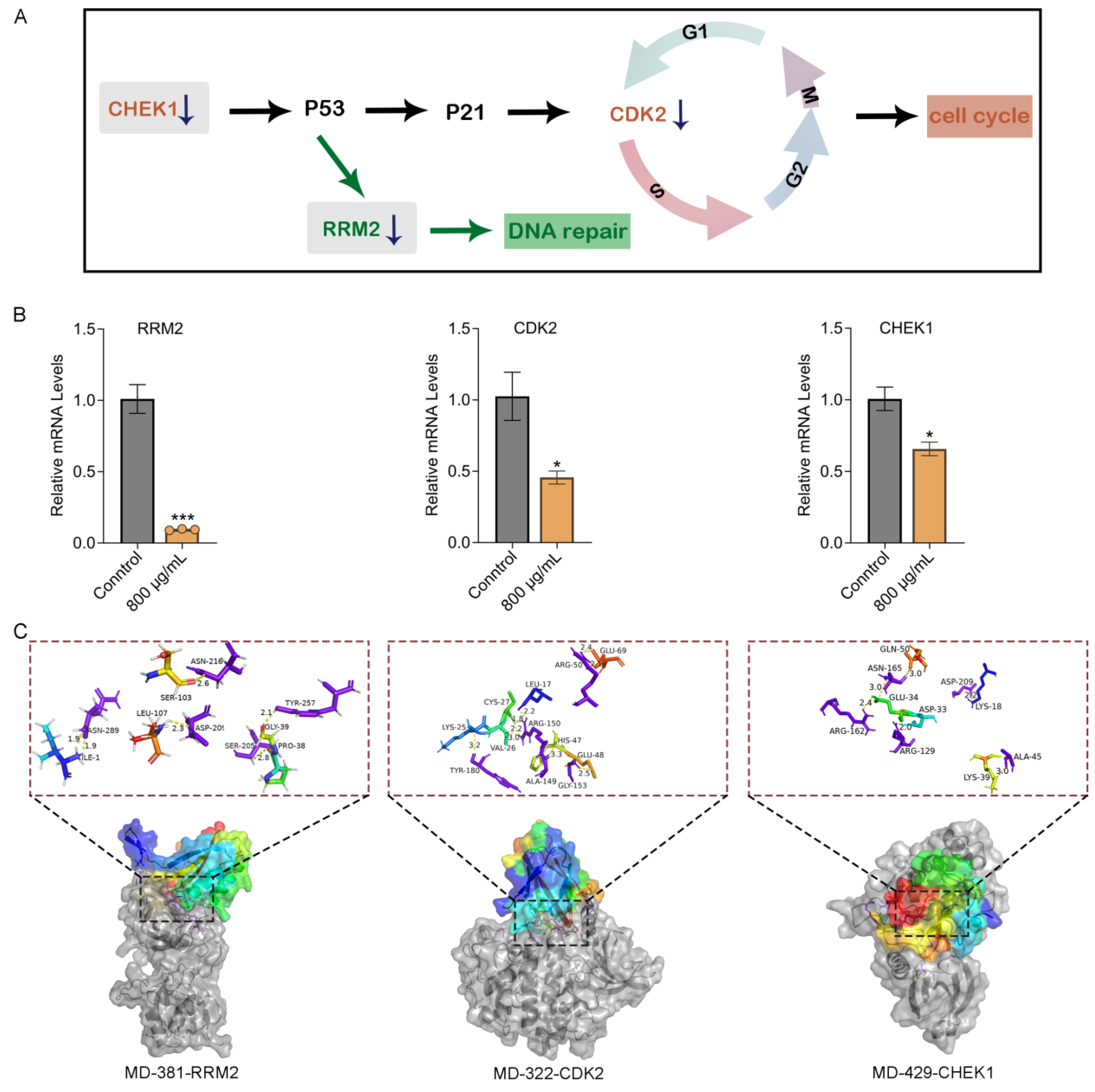
p53 is widely recognized as a central member of the transcription factor family and plays a pivotal role in tumor suppression by regulating cell-cycle arrest, apoptosis, DNA repair, cellular senescence, and differentiation [27]. To identify the key molecular targets potentially regulated by the crude venom, differential protein expression analysis was integrated with KEGG pathway enrichment, GO annotation, and PPI network analysis. Three significantly downregulated genes, RRM2, CDK2, and CHEK1, were identified as central regulatory nodes closely associated with the p53 signaling pathway and cell-cycle control (Figure 8A). RT-qPCR analysis further confirmed that treatment with 800 µg/mL crude venom markedly reduced the expression of RRM2, CDK2, and CHEK1, with fold-change values of 0.09, 0.46, and 0.66, respectively (Figure 8B).
Figure 8. Antiglioblastoma mechanisms of M. doreensis crude venom and molecular docking-based validation of its active anticancer targets. (A) Schematic model illustrating the proposed mechanism whereby M. doreensis venom-induced inhibition/downregulation of CHEK1 activates the p53–p21 checkpoint response, leading to reduced CDK2 activity and cell-cycle arrest, alongside suppression of RRM2 and impaired DNA repair. Downward arrows indicate decreased expression/activity observed after treatment. (B) qPCR validation of RRM2, CDK2, and CHEK1 mRNA levels in cells treated with crude venom (800 μg/mL) relative to control. Data were analyzed using an unpaired t-test and are presented as mean ± SEM. Statistical significance versus control is indicated (* p < 0.05, *** p < 0.001). (C) Representative 3D molecular docking models showing the interactions of MD-381 with RRM2 (PDB: 7EVR), MD-322 with CDK2 (PDB: 3TI1), and MD-429 with CHEK1 (PDB: 6FCK). Protein surfaces are shown with the predicted binding pockets highlighted; enlarged insets depict key amino acid interactions (e.g., hydrogen bonds and hydrophobic contacts) between each peptide and its target protein. Peptides are colored rainbow and their target proteins are colored purple.
In multi-omics assays, sixteen candidate peptides were predicted from the M. doreensis peptide library (Figure 1). To investigate the potential interactions between candidate peptides and these regulatory proteins and thereby screening for peptides that may possess potentially superior biological activity, three-dimensional structural models of these peptides were generated using AlphaFold2, followed by large-scale molecular docking analysis performed in Discovery Studio to evaluate their potential anticancer targets. Several peptides were predicted to form the most stable peptide-protein complexes with the key regulatory targets RRM2, CDK2, and CHEK1. Molecular docking analysis revealed that MD-381 forms sixteen hydrogen bonds and one salt bridge with RRM2, involving residues located within functionally relevant regions, including Pro38–Ser205, Leu107–Asp209, Ser103–Asn216, Gly39–Tyr257, and Ile1–Asn289, consistent with a stable binding mode [28]. In particular, the salt bridge formed between MD-381 and the Gly39-Tyr257 residue pair of RRM2 may contribute to enhanced binding stability and potential interference with RRM2 functional regions. The contact surface areas of the ligand and receptor were 867.44 and 852.98, respectively. Compared with the molecular docking results of other peptides, MD-381 may exhibit more pronounced inhibitory activity toward RRM2. Based on predictive analyses, MD-322 established a total of 26 favorable non-covalent interactions with CDK2 [29], including 19 hydrogen bonds. The contact surface areas between the ligand and the receptor were 777.79 Å2 and 755.76 Å2, respectively. Notably, MD-322 interacted with residues within the C-(PSTAIRE) helix (e.g., Glu69-Arg50) and those adjacent to the T-loop (Arg150, Arg50), suggesting that the peptide may exert its inhibitory effects by modulating T-loop activation or inducing conformational changes through peptide-protein interactions, rather than directly competing for the ATP-binding hinge region. Previous studies have shown that residues including Arg129 and Arg162 are located within phosphorylation-associated regulatory regions of CHEK1 and contribute to ligand binding [30]. MD-429 was predicted to bind CHEK1 through multiple hydrogen bonds involving residues implicated in ligand recognition and regulatory regions (e.g., Arg129 and Arg162). The contact surface areas between the ligand and the receptor were 913.55 Å2 and 932.87 Å2, respectively, supporting a plausible mechanism for functional interference (Figure 8C).

3. Discussion

Cancer remains one of the most critical global health challenges, with its high incidence and mortality rates continuing to impose a substantial burden on public healthcare systems and patients [31]. Although conventional therapeutic approaches such as surgery, radiotherapy, and chemotherapy have achieved considerable progress, their severe side effects, acquired drug resistance [32], and limited efficacy in advanced-stage cancers continue to hinder clinical outcomes [33]. These unmet medical needs have driven the continuous search for novel, safe, and effective anticancer agents. In this context, natural products, particularly those derived from marine ecosystems, have emerged as a significant reservoir for drug discovery. The extreme and diverse physicochemical conditions of the marine environment have driven marine organisms to evolve unique biosynthetic pathways [34], leading to the production of structurally diverse and biologically potent natural compounds. Within this landscape, peptide toxins isolated from cnidarians (such as sea anemones, jellyfish, and corals) are of particular interest because they often combine high target specificity with strong bioactivity and can modulate cancer-relevant signaling pathways [35]. As a result, they are emerging as highly promising anticancer candidates and may offer new avenues for overcoming the limitations of conventional therapies.
Glioblastoma remains difficult to treat, and standard chemotherapeutic agents, including cisplatin, lomustine, and temozolomide (TMZ) [36,37], are limited by intrinsic and acquired resistance [38]. Therefore, the development of novel, naturally derived compounds with alternative mechanisms of action is highly desired. TMZ, the frontline chemotherapeutic agent for glioblastoma [39], exerts its cytotoxicity primarily through DNA methylation, which activates the mismatch repair pathway and ultimately induces apoptosis. In addition, TMZ typically causes G2/M-phase arrest [40], reflecting its interference with DNA replication fidelity and checkpoint activation. In contrast, the M. doreensis crude venom elicited a distinct phenotype, including significant suppression of cell viability, strong suppression of migration/invasion, robust apoptosis induction, and preferential accumulation in S phase, consistent with disruption of DNA synthesis or replication-associated processes rather than the G2/M blockade commonly triggered by TMZ. Lomustine (CCNU), a nitrosourea compound [41], induces cytotoxicity through interstrand crosslinks and protein carbamoylation, resulting in apoptosis and cell-cycle arrest. Although both CCNU and the crude venom promote apoptosis, the apoptotic patterns differ. CCNU typically increases early apoptosis accompanied by prominent DNA fragmentation. In contrast, crude venom treatment led to a pronounced accumulation of late apoptotic cells, suggesting a more sustained or progressive form of cellular stress, potentially mediated by peptide-membrane interactions or modulation of intracellular signaling pathways. Furthermore, CCNU is known to inhibit migration and invasion by suppressing tumor cell adhesion and extracellular matrix (ECM) remodeling. Our wound-healing and Transwell assays demonstrated that the crude venom exerted similar inhibitory effects on glioblastoma cell motility, implying that venom-derived peptides may interfere with cytoskeletal organization or motility-related signaling pathways (Figure 3). Cisplatin exerts its antitumor activity primarily by forming DNA adducts and interstrand crosslinks, which subsequently activate p53-dependent apoptotic pathways [42]. However, cisplatin resistance commonly arises through enhanced DNA repair and impaired apoptotic signaling [43]. In contrast, apoptosis induced by the M. doreensis crude venom appears to be less reliant on DNA crosslinking-mediated mechanisms, as evidenced by the observed morphological alterations, elevated cell death as well as the induction of both early and late apoptosis (Figure 2, Figure 4 and Figure 6). These phenotypes suggest involvement of alternative mechanisms, potentially including ion channel modulation, membrane disruption, or peptide-mediated interference with intracellular signaling cascades [44,45,46]. Taken together, these differences suggest that sea anemone-derived peptides may complement existing therapies by engaging distinct mechanisms and targeting alternative vulnerabilities in glioblastoma.
Previous studies have shown that numerous sea anemone toxins, including neurotoxins, actinoporins, pore-forming proteins, and cysteine-rich peptides, can inhibit tumor proliferation, induce apoptosis, or enhance chemosensitivity. For example, APETx4 from Anthopleura elegantissima selectively inhibits the oncogenic potassium channel Kv10.1 [38], thereby suppressing proliferation and inducing apoptosis across various tumor types. Similarly, the recombinant actinoporin rHct-S3 from Heteractis crispa inhibits the growth of breast, colorectal, and melanoma cancer cells, reduces migration via MMP-2/-9 downregulation [47], and induces apoptosis through caspase activation. Other sea anemone derived toxins, such as ATXII, FraC, EqTx-II, and StI-based immunotoxins [48,49,50], have demonstrated potent cytotoxic effects and potential synergistic actions in anticancer therapy through mechanisms including modulation of sodium and potassium channels, pore formation, membrane disruption, PI3K/Akt pathway inhibition, and mitochondria or caspase dependent apoptosis [51,52,53].
Quantitative proteomics and pathway enrichment implicate p53 signaling and cell-cycle control as central axes underlying the anti-glioblastoma effects of M. doreensis crude venom. We further identified three downregulated genes, RRM2, CDK2, and CHEK1, and validated their suppression by qPCR (Figure 7B). These targets are mechanistically consistent with S-phase perturbation and checkpoint dysregulation and are frequently implicated in glioblastoma proliferation and therapeutic resistance. Moreover, to improve component-level resolution, we integrated multi-omics resource development, functional screening, and mechanistic inference and identified three candidate peptides, MD-381, MD-322, and MD-429, from M. doreensis as candidates capable of engaging these targets. The interactions between these peptide toxins and the target proteins were structurally evaluated using 3D modeling and molecular docking (Figure 7C).
Interestingly, crude venom appears to exert anticancer activity through multiple pathways, rather than through a single classical mechanism such as membrane disruption or ion-channel modulation. MD-381, an ShK domain peptide resembling traditional sea-anemone potassium channel blockers, formed a highly stable complex with RRM2, which is an essential regulator of DNA synthesis and a major driver of glioblastoma progression. MD-322, an EGF peptide, exhibited strong binding to CDK2, a central kinase controlling DNA replication and S-phase progression. MD-429, an ICK peptide, demonstrated high affinity for CHEK1, a key checkpoint kinase in the DNA-damage response. Therefore, our study expands the understanding of sea anemone toxins from their classical roles in ion channel modulation to intracellular signaling targets, thereby providing an effective strategy for discovering novel anticancer agents from marine organisms.
In future studies, specific peptides will be screened from multi-omics databases, followed by solid-phase peptide synthesis (SPPS) and structural identification. Their anticancer activities will then be systematically evaluated through in vitro and in vivo experiments. However, despite the strong therapeutic potential demonstrated by sea anemone-derived peptides, their application in glioblastoma treatment remains constrained by several inherent challenges, most notably the limited ability of peptide molecules to penetrate the blood–brain barrier (BBB). Therefore, encapsulating the screened candidate peptides into nanodelivery systems [54] or combining them with targeted drug delivery systems such as peptide-drug conjugates (PDCs) [55] may help enhance their BBB penetration and tumor targeting. Such targeted delivery strategies may provide a feasible approach for exploring peptide-based anti-glioblastoma therapies and for overcoming the limitations of conventional chemotherapy.

4. Materials and Methods

4.1. Cell Lines

Human glioblastoma cell lines (U251 and LN229), lung carcinoma cells (A549), ovarian cancer cells (OVCAR3), and normal human hepatocyte cell line (MIHA) were obtained from the Key Laboratory of Carcinogenesis and Intervention of Hainan Province. U251, LN229, and A549 cells were cultured in DMEM supplemented with 10% fetal bovine serum (FBS) at 37 °C in a humidified atmosphere containing 5% CO2. OVCAR3 and MIHA cells were maintained in 1640 medium containing 10% FBS under the same culture conditions.

4.2. Animals and Venom Extraction

Specimens of M. doreensis used in this study were collected from the South China Sea (18°N, 112°E) at a depth of approximately 4 m in June 2024. The collected sea anemones were maintained in glass aquariums containing filtered natural seawater under controlled laboratory conditions for 1–2 weeks to allow acclimatization. Crude venom extracts were subsequently obtained from fresh tissues using a homogenization method as previously described [3].

4.3. Identification of Overlapping Targets Between Sea Anemone Peptides and Glioblastoma and Construction of the Protein–Protein Interaction Network

The peptide sequences were first imported into ChemDraw (version 23.1.1) to obtain their SMILES IDs, which were then submitted to the SEA database (https://sea.bkslab.org/, accessed on 19 November 2025) to identify potential peptide-related targets. Subsequently, the term “glioblastoma” was used as a search keyword to retrieve glioblastoma-associated disease targets from the GeneCards (https://www.genecards.org/, accessed on 23 November 2025) and OMIM (https://omim.org/, accessed on 23 November 2025) databases. The results from the two databases were merged, and duplicate targets were removed. A Venn diagram analysis was then performed to illustrate the overlapping targets between glioblastoma and the peptides. Protein–protein interaction (PPI) analysis was conducted to more effectively identify core regulatory genes. The genes identified as overlapping targets between the peptides and the disease were imported into the STRING database. The database parameters were set to focus on the “Homo sapiens” species, with the PPI confidence score threshold set to 0.4. Nodes with interaction scores greater than 0.4 were retained, and those with higher degree values were identified as core targets. The network of potential key targets was constructed using Cytoscape software (version 3.9.1) [56].

4.4. Bioinformatics Analysis

To elucidate the functions of the core targets and investigate their associated biological processes and signaling pathways, enrichment analyses were performed on the core targets. Differentially expressed proteins between control and crude venom-treated U251 cells were identified using the limma R package (v4.0). Subsequently, Gene Ontology (GO) enrichment analyses (BP, MF, and CC) and KEGG pathway analyses were conducted, and the results were visualized using bar plots and bubble plots [57].

4.5. Cell Viability Assay

U251, LN229, A549, and OVCAR3 cells were seeded into 96-well plates at a density of 1 × 10⁴ cells per well and treated with various concentrations of crude venom (0, 0.5, 1, 2, 3, and 4 mg/mL; and 100 µL per well). After 24 h of incubation, cell viability was assessed using the CCK-8 assay [58]. Briefly, 100 µL of CCK-8 solution was added to each well, followed by a further 2 h incubation at 37 °C. The absorbance at 450 nm was then measured using a microplate reader.

4.6. Wound Healing (Scratch) Experiment

The wound-healing assay was performed to evaluate the migratory capacity of U251 and LN229 cells. Log-phase cells were seeded into 6-well plates at a density of 1 × 10⁵ cells per well [59]. After serum starvation for 24 h, a straight scratch was created across the cell monolayer using a sterile 200 µL pipette tip. Cellular debris was removed by washing the wells three times with PBS. The cells were then incubated in serum-free medium containing different concentrations of crude venom at 37 °C in a 5% CO2 incubator, while untreated cells served as the control group. Images of the wound area were captured at 0, 12, and 24 h using an inverted microscope (10× magnification). Wound area was quantified using ImageJ 1.8.0 software [60].
Wound closure (%) was calculated as Equation (1):
[(A0 − At)/A0] × 100
where A0 is the initial wound area and At is the wound area at time t.

4.7. Transwell Invasion Assay

Transwell chambers were coated with matrigel (1:8 dilution) at 37 °C for 3 h [61]. U251 and LN229 cells (8 × 10⁴ per well) were then seeded into the upper chamber and treated with crude venom at final concentrations of 40, 60, 80, 100, and 120 ng/mL. Cells without venom treatment served as the control group. DMEM supplemented with 10% FBS was added to the lower chamber as a chemoattractant. After incubation at 37 °C for 24 h, invaded cells were fixed with 4% paraformaldehyde for 30 min, stained with 0.1% crystal violet for 20 min, and subsequently imaged under a light microscope (20× magnification). The number of invading cells was counted using ImageJ.

4.8. Colony Formation Assay

A single cell that undergoes continuous proliferation for more than six generations in vitro can form a colony, which serves as an indicator of cellular proliferative capacity and clonogenic potential. U251 and LN229 cells were seeded into 6-well plates at a density of 1000 cells per well. The medium was not replaced during the first week to allow colonies to form under the given culture conditions. After one week, the culture medium was removed, and cells were treated with crude venom at concentrations of 200, 350, 500, 650, and 800 µg/mL, while untreated cells served as the control group. After 24 h of treatment, the medium was replaced with fresh DMEM supplemented with 10% FBS, and cells were cultured for an additional week. At the end of the incubation period, the cells were washed twice with pre-cooled PBS, fixed with 4% paraformaldehyde for 20 min, and stained with 0.1% crystal violet for 20 min. The number of colonies was quantified using ImageJ software.

4.9. Cell Cycle Analysis by Propidium Iodide (PI) Staining

Cell-cycle distribution was analyzed by flow cytometry using a DNA content-based quantification method. U251 and LN229 cells were seeded into 6-well plates at a density of 1.5 × 10⁵ cells per well and incubated for 24 h [62], followed by treatment with crude venom at concentrations of 200, 350, 500, 650, and 800 µg/mL. Untreated cells served as the control group. After 24 h of incubation, cells were harvested and fixed in 70% ice-cold ethanol at 4 °C for 12 h. The fixed cells were centrifuged at 1000× g for 5 min, and the resulting pellet was collected, resuspended in 1 mL PBS, and centrifuged again to remove residual ethanol. The cell pellets were then treated with RNase A for 30 min and subsequently stained with propidium iodide (PI) for flow cytometric analysis. The proportion of cells in each phase of the cell cycle was quantified using FlowJo_v10.10.0 software.

4.10. Apoptosis Quantification by Flow Cytometry

Flow cytometry was used to evaluate cell viability, apoptosis, and necrosis based on staining with specific fluorescent markers. U251 and LN229 cells were seeded into six-well plates at a density of 1.5 × 10⁵ cells per well and allowed to adhere for 24 h. The cells were then treated with crude venom at concentrations of 200, 350, 500, 650, and 800 µg/mL for an additional 24 h [63]. Untreated cells served as the control group. After incubation, cells were harvested using EDTA-free trypsin and centrifuged at 1000× g for 5 min. The supernatant was discarded, and the cell pellet was resuspended in 195 µL of 1x Annexin V-FITC binding buffer. Subsequently, 5 µL of Annexin V-FITC and 10 µL of PI were added, gently mixed, and incubated for 10 min at room temperature in the dark. The stained cells were analyzed using a flow cytometer to determine the proportions of viable cells, early apoptotic cells, late apoptotic cells, and necrotic cells.

4.11. Quantitative PCR

Total RNA was extracted using RNA extraction reagent (Servicebio, Wuhan, China) according to the manufacturer’s instructions. Real-time quantitative PCR (qPCR) was performed using SweScript All-in-One RT SuperMix for qPCR (Servicebio, China) with gene-specific primer-probe sets on a Bio-Rad fluorescence quantitative PCR system (Bio-Rad, Shanghai, China). Each sample was analyzed in technical triplicate. The sequences of gene-specific primers are listed in Supplementary Table S1. Relative gene expression was normalized to GAPDH [64] and analyzed using CFX Maestro software system.

4.12. DIA Proteomics and Bioinformatics

Proteomic analysis was performed using liquid chromatography-mass spectrometry (LC-MS) technology. For each sample, 500 ng of total peptides were separated and analyzed with a nano-UPLC (Vanquish neo) coupled to an Astral instrument (Thermo Fisher Scientific, Shanghai, China) with a nano-electrospray ion source. Data independent acquisition (DIA) was performed in profile and positive mode with an Orbitrap analyzer (Thermo Fisher Scientific, Shanghai, China) at 240K resolution over m/z 380–980 for MS1. MS2 scans covered m/z range of 150–2000, with absolute AGC Value 5E4, and maximum injection time 3 ms using HCD with normalized collision energy (NCE) of 25% and an isolation window of 2 m/z.
Raw MS files were processed using DIA-NN software 2.2.0. MS spectra lists were searched against their species-level UniProt FASTA databases. Carbamidomethyl [C] was set as a fixed modification; oxidation (M) and Protein N-terminal acetylation were variable modifications. Trypsin was used as a protease to break down proteins. A maximum of 2 missed cleavages was allowed. The false discovery rate (FDR) was set to 0.01 for both PSM and peptide levels. Peptide identification was performed with an initial precursor mass deviation of up to 20 ppm and a fragment mass deviation of 20 ppm. All the other parameters were default.

4.13. Molecular Docking

To elucidate the molecular interactions and binding modes between representative peptides and key target proteins (Supplementary Table S2), employing the AlphaFold Colab tool (https://colab.research.google.com/github/sokrypton/ColabFold/blob/main/AlphaFold2.ipynb, accessed on 12 September 2025) [65,66]. Energy minimization of the 3D peptide structures was performed using ChemBio 3D (version 14.0.0). The crystal structures of the receptors were obtained from the RCSB Protein Data Bank (http://www.pdb.org/, accessed on 21 October 2025) and subsequently modified using Discovery Studio 2019. The modifications included hydrogen addition, ligand and water removal, amino acid optimization, and charge computation. Docking was performed using ZDOCK (a rigid protein docking algorithm), followed by refinement with RDOCK (evaluating the binding configuration of the complex). Predicted interactions, including hydrogen bonding, π-Alkyl, π-Sigma interactions, and hydrophobic contacts, were analyzed. Lastly, PyMol software 3.1.5.1 facilitated the visualization of the docking results on the optimal conformation.

4.14. Statistical Analysis

All experiments were performed in triplicate unless otherwise stated. Data analysis was carried out using GraphPad Prism version 10.1.2; images were processed using Adobe Photoshop 20.0.4 software. Results are presented as mean ± standard deviation (SD) or mean ± standard error of the mean (SEM), as appropriate. Statistical significance was evaluated using an unpaired t-test or one-way/two-way ANOVA as appropriate, with a p-value ≤ 0.05 considered statistically significant. Statistical significance is denoted as **** (p value <0.0001); *** (p value <0.001); ** (p value <0.01); * (p value <0.05); or ns (not significant).

5. Conclusions

This study provides integrated evidence supporting the potent anti-glioblastoma activity of the crude venom extracted from M. doreensis and identifies promising peptide candidates derived from it. Through a multi-faceted approach combining in vitro functional validation, quantitative proteomics, and computational modeling, we have shown that venom treatment suppresses glioblastoma cell viability, inhibits migration and invasion, induces apoptosis, and promotes S-phase cell-cycle arrest. Mechanistically, proteomic enrichment analyses implicate the p53 signaling network and cell-cycle regulation, and we identified RRM2, CDK2, and CHEK1 as downregulated candidate mediators. Furthermore, we have pinpointed three candidate peptides, MD-381, MD-322, and MD-429, that demonstrate high-affinity predicted binding to the identified pivotal glioblastoma associated targets (RRM2, CDK2, and CHEK1). Collectively, these findings underscore M. doreensis venom as a rich and promising source of novel anti-glioma bioactive agents and delineate a clear mechanistic framework centered on cell cycle disruption and p53-mediated apoptosis, supporting future isolation and experimental validation of individual peptides for therapeutic development.

Supplementary Materials

The following supporting information can be downloaded at: https://www.mdpi.com/article/10.3390/md24030092/s1, Table S1: Primer sequences, fragment lengths, and annealing temperatures for RRM2, CDK2, and CHEK1; Table S2: Molecular docking parameters of representative peptides from the sea anemone M. doreensis with the target proteins CDK2, CHEK1, and RRM2, including the total number of hydrogen bonds, total salt bridges, ligand contact surface area, and receptor contact surface area.

Author Contributions

Conceptualization, B.Y., and B.G.; Methodology, L.L., M.H., W.Y., Z.C., S.C. (Shuaiying Cui), P.H. and L.M.; investigation, L.L.; formal analysis, L.L. and K.M., data curation, L.L., W.Y., Z.H. and P.H.; writing—original draft, L.L. and M.H.; writing—review and editing, W.Y., L.M., S.C. (Shuanghuai Cheng), B.Y. and B.G.; supervision, B.Y. and B.G.; funding acquisition, M.H. and B.G. All authors have read and agreed to the published version of the manuscript.

Funding

This research was supported by the Hainan Provincial International Science and Technology Cooperation Research Project (No. GHYF2025048), Hainan Province Health Industry Research Project (22A200358), Natural Science Foundation of Hainan Province For High-level Talents Project (821RC568), Hainan Provincial Natural Science Foundation of China (no. 424QN258), and the Hainan Provincial Natural Science Foundation of China (822QN321).

Institutional Review Board Statement

Not applicable.

Data Availability Statement

All datasets generated or analyzed for this study are included in the manuscript and the Supplementary Files.

Conflicts of Interest

The authors declare that there are no conflicting personal or financial interests that could have influenced the research reported in this paper.

References

  1. Benedict, C.; Delgado, A.; Pen, I.; Vaga, C.; Daly, M.; Quattrini, A.M. Sea anemone (Anthozoa, Actiniaria) diversity in Mo’orea (French Polynesia). Mol. Phylogenet. Evol. 2024, 198, 108118. [Google Scholar] [CrossRef]
  2. Jouiaei, M.; Yanagihara, A.A.; Madio, B.; Nevalainen, T.J.; Alewood, P.F.; Fry, B.G. Ancient Venom Systems: A Review on Cnidaria Toxins. Toxins 2015, 7, 2251–2271. [Google Scholar] [CrossRef]
  3. He, P.; Li, M.; Fu, J.; Liao, Y.; Yi, B.; Gao, B. Diversity of biological activities of crude venom extracted from five species of South China Sea anemones. Front. Mar. Sci. 2024, 11, 1480745. [Google Scholar] [CrossRef]
  4. Guo, Q.; Fu, J.; Yuan, L.; Liao, Y.; Li, M.; Li, X.; Yi, B.; Zhang, J.; Gao, B. Diversity analysis of sea anemone peptide toxins in different tissues of Heteractis crispa based on transcriptomics. Sci. Rep. 2024, 14, 7684. [Google Scholar] [CrossRef]
  5. Li, M.; Mao, K.; Huang, M.; Liao, Y.; Fu, J.; Pan, K.; Shi, Q.; Gao, B. Venomics Reveals the VenomComplexity of Sea Anemone Heteractis magnifica. Mar. Drugs 2024, 22, 71. [Google Scholar] [CrossRef] [PubMed]
  6. Guo, Q.; Tang, T.; Lu, J.; Huang, M.; Zhang, J.; Ma, L.; Gao, B. Synthesis and Hypoglycemic Effect of Insulin from the Venom of Sea Anemone Exaiptasia diaphana. Mar. Drugs 2024, 22, 111. [Google Scholar] [CrossRef]
  7. Wu, J.; Li, R.; Wang, J.; Zhu, H.; Ma, Y.; You, C.; Shu, K. Reactive Astrocytes in Glioma: Emerging Opportunities and Challenges. Int. J. Mol. Sci. 2024, 26, 2907. [Google Scholar] [CrossRef]
  8. Kaba, S.E.; Kyritsis, A.P. Recognition and Management of Gliomas. Drugs 1997, 53, 235–244. [Google Scholar] [CrossRef] [PubMed]
  9. Lukas, R.V.; Nicholas, M.K. Update in the Treatment of High-grade Gliomas. Neurol. Clin. 2013, 31, 847–867. [Google Scholar] [CrossRef]
  10. Elnahriry, K.A.; Wai, D.C.C.; Krishnarjuna, B.; Badawy, N.N.; Chittoor, B.; MacRaild, C.A.; Williams-Noonan, B.J.; Surm, J.M.; Chalmers, D.K.; Zhang, A.H.; et al. Structural and functional characterisation of a novel peptide from the Australian Sea anemone Actinia tenebrosa. Toxicon 2019, 168, 104–112. [Google Scholar] [CrossRef]
  11. Ramezanpour, M.; da Silva, K.B.; Sanderson, B.J.S. Venom present in sea anemone (Heteractis magnifica) induces apoptosis in non-small-cell lung cancer A549 cells through activation of mitochondria-mediated pathway. Biotechnol. Lett. 2014, 36, 489–495. [Google Scholar] [CrossRef]
  12. Belyi, V.A.; Ak, P.; Markert, E.; Wang, H.; Hu, W.; Puzio-Kuter, A.; Levine, A.J. The Origins and Evolution of the p53 Family of Genes. Cold Spring Harb. Perspect. Biol. 2010, 2, a001198. [Google Scholar] [CrossRef]
  13. Hua, Z.; Lin, L.; Yang, W.; Ma, L.; Huang, M.; Gao, B. Large-Scale AI-Based Structure and Activity Prediction Analysis of ShK Domain Peptides from Sea Anemones in the South China Sea. Mar. Drugs 2025, 23, 85. [Google Scholar] [CrossRef]
  14. Keiser, M.J.; Roth, B.L.; Armbruster, B.N.; Ernsberger, P.; Irwin, J.J.; Shoichet, B.K. Shoichet, Relating protein pharmacology by ligand chemistry. Nat. Biotechnol. 2007, 25, 197–206. [Google Scholar] [CrossRef]
  15. Xu, Y.; Wang, J.; Chen, G. Analyzing the mechanism of rhubarb in the treatment of cervical cancer based on network pharmacology and molecular docking technology. Sci. Rep. 2025, 15, 30027. [Google Scholar] [CrossRef] [PubMed]
  16. Shannon, P.; Markiel, A.; Ozier, O.; Baliga, N.S.; Wang, J.T.; Ramage, D.; Amin, N.; Schwikowski, B.; Ideker, T. Cytoscape: A software environment for integrated models of biomolecular interaction networks. Genome Res. 2003, 13, 2498–2504. [Google Scholar] [CrossRef]
  17. Lozinski, M.; Lumbers, E.R.; Bowden, N.A.; Martin, J.H.; Fay, M.F.; Pringle, K.G.; Tooney, P.A. Upregulation of the renin–angiotensin system is associated with patient survival and the tumour microenvironment in glioblastoma. Cells 2024, 13, 634. [Google Scholar] [CrossRef] [PubMed]
  18. Vítovcová, B.; Skarková, V.; Havelek, R.; Soukup, J.; Pande, A.; Caltová, K.; Rudolf, E. Flubendazole exhibits anti-glioblastoma effect by inhibiting STAT3 and promoting cell cycle arrest. Sci. Rep. 2023, 13, 5993. [Google Scholar] [CrossRef]
  19. Tanase, C.; Enciu, A.M.; Codrici, E.; Popescu, I.D.; Dudau, M.; Dobri, A.M.; Pop, S.; Mihai, S.; Gheorghișan-Gălățeanu, A.A.; Hinescu, M.E. Fatty acids, CD36, thrombospondin-1, and CD47 in glioblastoma: Together and/or separately? Int. J. Mol. Sci. 2022, 23, 604. [Google Scholar] [CrossRef] [PubMed]
  20. Gopinathan, A.; Sankhe, R.; Rathi, E.; Kodi, T.; Upadhya, R.; Pai, K.S.R.; Kishore, A. An in silico drug repurposing approach to identify HDAC1 inhibitors against glioblastoma. J. Biomol. Struct. Dyn. 2025, 43, 9776–9789. [Google Scholar] [CrossRef]
  21. Daniele, S.; La Pietra, V.; Piccarducci, R.; Pietrobono, D.; Cavallini, C.; D’Amore, V.M.; Cerofolini, L.; Giuntini, S.; Russomanno, P.; Puxeddu, M.; et al. CXCR4 antagonism sensitizes cancer cells to novel indole-based MDM2/4 inhibitors in glioblastoma multiforme. Eur. J. Pharmacol. 2021, 897, 173936. [Google Scholar] [CrossRef]
  22. Lin, K.X.; Wu, Z.Y.; Qin, M.L.; Zeng, H.C. Bisphenol S Induces Lipid Metabolism Disorders in HepG2 and SK-Hep-1 Cells via Oxidative Stress. Toxics 2025, 13, 44. [Google Scholar] [CrossRef]
  23. Han, W.; Yu, F.; Wang, R.; Guan, W.; Zhi, F. Valproic Acid Sensitizes Glioma Cells to Luteolin Through Induction of Apoptosis and Autophagy via Akt Signaling. Cell. Mol. Neurobiol. 2021, 41, 1625–1634. [Google Scholar] [CrossRef]
  24. Liu, J.Y.; Fu, W.Q.; Zheng, X.J.; Li, W.; Ren, L.W.; Wang, J.H.; Yang, C.; Du, G.H. Avasimibe exerts anticancer effects on human glioblastoma cells via inducing cell apoptosis and cell cycle arrest. Acta Pharmacol. Sin. 2021, 42, 97–107. [Google Scholar] [CrossRef]
  25. dos Santos, J.S.; Suzan, A.J.; Bonafé, G.A.; Fernandes, A.M.A.P.; Longato, G.B.; Antônio, M.A.; Carvalho, P.O.; Ortega, M.M. Kaempferol and Biomodified Kaempferol from Sophora japonica Extract as Potential Sources of Anti-Cancer Polyphenolics against High Grade Glioma Cell Lines. Int. J. Mol. Sci. 2023, 24, 10716. [Google Scholar] [CrossRef]
  26. Pienkowski, T.; Kowalczyk, T.; Garcia-Romero, N.; Ayuso-Sacido, A.; Ciborowski, M. Proteomics and metabolomics approach in adult and pediatric glioma diagnostics. Biochim. Biophys. Acta Rev. Cancer 2022, 1877, 188721. [Google Scholar] [CrossRef]
  27. Aubrey, B.J.; Kelly, G.L.; Janic, A.; Herold, M.J.; Strasser, A. How does p53 induce apoptosis and how does this relate to p53-mediated tumour suppression? Cell Death Differ. 2018, 25, 104–113. [Google Scholar] [CrossRef] [PubMed]
  28. Zhang, X.; Qi, M.; Huo, K.; Cai, B.; Zhang, J.; Tian, Y.; Zhang, D. Celastrol induces ferroptosis by suppressing RRM2 in hepatocellular carcinoma. Heliyon 2024, 10, e33936. [Google Scholar] [CrossRef] [PubMed]
  29. Li, Y.; Zhang, J.; Gao, W.; Zhang, L.; Pan, Y.; Zhang, S.; Wang, Y. Insights on Structural Characteristics and Ligand Binding Mechanisms of CDK2. Int. J. Mol. Sci. 2015, 16, 9314–9340. [Google Scholar] [CrossRef]
  30. Day, M.; Parry-Morris, S.; Houghton-Gisby, J.; Oliver, A.W.; Pearl, L.H. Structural basis for recruitment of the CHK1 DNA damage kinase by the CLASPIN scaffold protein. Structure 2021, 29, 531–539.e3. [Google Scholar] [CrossRef] [PubMed]
  31. Khan, S.; Mittal, S.; McGee, K.; Alfaro-Munoz, K.D.; Majd, N.; Balasubramaniyan, V.; de Groot, J.F. Role of Neutrophils and Myeloid-Derived Suppressor Cells in Glioma Progression and Treatment Resistance. Int. J. Mol. Sci. 2020, 21, 1954. [Google Scholar] [CrossRef]
  32. Finch, A.; Solomou, G.; Wykes, V.; Pohl, U.; Bardella, C.; Watts, C. Advances in Research of Adult Gliomas. Int. J. Mol. Sci. 2021, 22, 924. [Google Scholar] [CrossRef] [PubMed]
  33. Chen, R.; Smith-Cohn, M.; Cohen, A.L.; Colman, H. Glioma Subclassifications and Their Clinical Significance. Neurotherapeutics 2017, 14, 284–297. [Google Scholar] [CrossRef]
  34. Huang, M.; Li, M.; Zhu, R.; Mao, K.; Pan, K.; Liu, X.; Gao, B. Sea Anemone Stichodactyla haddoni Venom: Extraction Method Dictates Composition and Functional Potency. Mar. Drugs 2025, 23, 333. [Google Scholar] [CrossRef] [PubMed]
  35. Moreels, L.; Peigneur, S.; Galan, D.T.; De Pauw, E.; Béress, L.; Waelkens, E.; Pardo, L.A.; Quinton, L.; Tytgat, J. APETx4, a Novel Sea Anemone Toxin and a Modulator of the Cancer-Relevant Potassium Channel KV10.1. Mar. Drugs 2017, 15, 287. [Google Scholar] [CrossRef] [PubMed]
  36. Zou, Y.; Wang, Y.; Xu, S.; Liu, Y.; Yin, J.; Lovejoy, D.B.; Zheng, M.; Liang, X.-J.; Park, J.B.; Efremov, Y.M.; et al. Brain Co-Delivery of Temozolomide and Cisplatin for Combinatorial Glioblastoma Chemotherapy. Adv. Mater. 2022, 34, 2203958. [Google Scholar] [CrossRef]
  37. Wick, W.; Winkler, F. Regimen of procarbazine, lomustine, and vincristine versus temozolomide for gliomas. Cancer 2018, 124, 2674–2676. [Google Scholar] [CrossRef]
  38. Ling, Z.; Zhang, J.; Liu, Q. Oncogenic Forkhead box D3 antisense RNA 1 promotes cell survival and confers temozolomide resistance in glioblastoma cells through the miR-128-3p/WEE1 G2 checkpoint kinase axis. Bioengineered 2022, 13, 6012–6023. [Google Scholar] [CrossRef]
  39. Gong, L.; Yin, Y.; Chen, C.; Wan, Q.; Xia, D.; Wang, M.; Pu, Z.; Zhang, B.; Zou, J. Characterization of EGFR-reprogrammable temozolomide-resistant cells in a model of glioblastoma. Cell Death Discov. 2022, 8, 438. [Google Scholar] [CrossRef]
  40. Gürsoy, G.T.; Tuncer, M.C.; Özdemir, İ. Resveratrol and temozolomide induce apoptosis and suppress proliferation in glioblastoma cells via the apoptotic signaling pathway. Acta Cir. Bras. 2025, 40, e405525. [Google Scholar] [CrossRef]
  41. Shen, X.; Cheng, H.; Zheng, J.; Xia, Y.; Li, Y.; Guo, Q.; Zhang, Z.; Yin, N.; Liu, Y.; Dong, J.; et al. KIF4A Inhibits Ferroptosis in Glioblastoma via the CHMP4B/GPX4 Axis and Promotes Temozolomide Resistance. Mol. Carcinog. 2025, 64, 1650–1666. [Google Scholar] [CrossRef]
  42. Radtke, L.; Majchrzak-Celińska, A.; Awortwe, C.; Vater, I.; Nagel, I.; Sebens, S.; Cascorbi, I.; Kaehler, M. CRISPR/Cas9-induced knockout reveals the role of ABCB1 in the response to temozolomide, carmustine and lomustine in glioblastoma multiforme. Pharmacol. Res. 2022, 185, 106510. [Google Scholar] [CrossRef]
  43. Lu, E.; Gareev, I.; Yuan, C.; Liang, Y.; Sun, J.; Chen, X.; Beylerli, O.; Sufianov, A.; Zhao, S.; Yang, G. The Mechanisms of Current Platinum Anticancer Drug Resistance in the Glioma. Curr. Pharm. Des. 2022, 28, 1863–1869. [Google Scholar] [CrossRef]
  44. Zuchegna, C.; Leone, S.; Romano, A.; Porcellini, A.; Messina, S. KRAS is a molecular determinant of platinum responsiveness in glioblastoma. BMC Cancer 2024, 24, 77. [Google Scholar] [CrossRef] [PubMed]
  45. Zhang, C.; Xu, C.; Gao, X.; Yao, Q. Platinum-based drugs for cancer therapy and anti-tumor strategies. Theranostics 2022, 12, 2115–2132. [Google Scholar] [CrossRef]
  46. Ashwood, L.M.; Elnahriry, K.A.; Stewart, Z.K.; Shafee, T.; Naseem, M.U.; Szanto, T.G.; van der Burg, C.A.; Smith, H.L.; Surm, J.M.; Undheim, E.A.B.; et al. Genomic, functional and structural analyses elucidate evolutionary innovation within the sea anemone 8 toxin family. BMC Biol. 2023, 21, 121. [Google Scholar] [CrossRef]
  47. Kvetkina, A.; Malyarenko, O.; Pavlenko, A.; Dyshlovoy, S.; von Amsberg, G.; Ermakova, S.; Leychenko, E. Sea Anemone Heteractis crispa Actinoporin Demonstrates In Vitro Anticancer Activities and Prevents HT-29 Colorectal Cancer Cell Migration. Molecules 2020, 25, 5979. [Google Scholar] [CrossRef]
  48. Wang, Z.L.; Zhang, S.Y.; Hao, S.L.; Yang, W.X. Neurotoxins and Pore Forming Toxins in Sea Anemones: Potential Candidates for New Drug Development. Histol. Histopathol. 2023, 38, 9–28. [Google Scholar] [CrossRef] [PubMed]
  49. Abdoli, V.; Sarkhosh-Inanlou, R.; Delirezh, N.; Aghazadeh, S.; Shaykh-Baygloo, N.; Imani, M. Cytotoxic effect of sea anemone pore-forming toxin on K562 chronic myeloid leukemia cells. Vet. Res. Forum 2021, 12, 481–485. [Google Scholar] [CrossRef] [PubMed]
  50. Tejuca, M.; Díaz, I.; Figueredo, R.; Roque, L.; Pazos, F.; Martínez, D.; Iznaga-Escobar, N.; Pérez, R.; Alvarez, C.; Lanio, M.E. Construction of an immunotoxin with the pore forming protein StI and ior C5, a monoclonal antibody against a colon cancer cell line. Int. Immunopharmacol. 2004, 4, 731–744. [Google Scholar] [CrossRef]
  51. Soletti, R.C.; de Faria, G.P.; Vernal, J.; Terenzi, H.; Anderluh, G.; Borges, H.L.; Moura-Neto, V.; Gabilan, N.H. Potentiation of anticancer-drug cytotoxicity by sea anemone pore-forming proteins in human glioblastoma cells. Anticancer Drugs 2008, 19, 517–525. [Google Scholar] [CrossRef]
  52. Kahn, S.A.; Biasoli, D.; Garcia, C.; Geraldo, L.H.; Pontes, B.; Sobrinho, M.; Frauches, A.C.; Romão, L.; Soletti, R.C.; Assunção, F.S.; et al. Equinatoxin II Potentiates Temozolomide- and Etoposide-Induced Glioblastoma Cell Death. Curr. Top. Med. Chem. 2012, 12, 2082–2093. [Google Scholar] [CrossRef]
  53. Li, X.; Tang, Y.; Yu, F.; Sun, Y.; Huang, F.; Chen, Y.; Yang, Z.; Ding, G. Inhibition of Prostate Cancer DU-145 Cells Proliferation by Anthopleura anjunae Oligopeptide (YVPGP) via PI3K/AKT/mTOR Signaling Pathway. Mar. Drugs 2018, 16, 325. [Google Scholar] [CrossRef]
  54. Zheng, Z.; Chen, J.; Kang, Y.; Ding, Z.; Jin, C.; Gan, Z.; Yu, Q. Dual-responsive nanoparticle system for enhanced blood-brain barrier crossing and glioblastoma penetration. Biomaterials 2026, 327, 123730. [Google Scholar] [CrossRef] [PubMed]
  55. Li, Z.; Jiang, S.; Wang, J.; Li, W.; Yang, J.; Liu, W.; Gao, H.; Huang, Y.; Ruan, S. Peptide-drug conjugates repolarize glioblastoma-associated macrophages to resensitize chemo-immunotherapy of glioblastoma. Sci. Adv. 2025, 11, eadr8841. [Google Scholar] [CrossRef] [PubMed]
  56. Ma, G.; Pang, X.; Ran, Y.; Chen, W.; Zhou, Y.; Li, X.; Liu, B.; Li, F.; Hu, S. In silico and in vivo verification of the mechanism of formononetin in treating hepatocellular carcinoma. Ann. Med. 2024, 56, 2404550. [Google Scholar] [CrossRef] [PubMed]
  57. Lin, Z.; Huang, T.; Han, B.; Tao, Z.; Chen, X. Network Pharmacology and Experimental Validation-based Investigation of the Underlying Mechanism of Yi-Yi-Fu-Zi-Bai-Jiang-San of Nasopharyngeal Carcinoma. J. Cancer 2025, 16, 2212–2232. [Google Scholar] [CrossRef]
  58. Yu, X.; Wang, X.; Xu, F.; Zhang, X.; Wang, M.; Zhou, R.; Sun, Z.; Pan, X.; Feng, L.; Zhang, W.; et al. Mir-615-3p promotes osteosarcoma progression via the SESN2/AMPK/mTOR pathway. Cancer Cell Int. 2024, 24, 411. [Google Scholar] [CrossRef]
  59. Stouffer, M.; Wandling, E.; Dickson, L.; Lin, S.; Duan, H.; Powe, E.; Jean-Louis, D.; Tiwari, A.K.; Amos, S. Gedunin modulates cellular growth and apoptosis in glioblastoma cell lines. Cancer Rep. 2024, 7, e2051. [Google Scholar] [CrossRef]
  60. Kim, E.; Ham, S.; Jung, B.K.; Park, J.W.; Kim, J.; Lee, J.H. Effect of Baicalin on Wound Healing in a Mouse Model of Pressure Ulcers. Int. J. Mol. Sci. 2023, 24, 329. [Google Scholar] [CrossRef] [PubMed]
  61. Liang, X.J.; Choi, Y.; Sackett, D.L.; Park, J.K. Nitrosoureas Inhibit the Stathmin-Mediated Migration and Invasion of Malignant Glioma Cells. Cancer Res. 2008, 68, 5267–5272. [Google Scholar] [CrossRef] [PubMed][Green Version]
  62. Cheng, C.; Jiao, J.T.; Qian, Y.; Guo, X.Y.; Huang, J.; Dai, M.C.; Zhang, L.; Ding, X.P.; Zong, D.; Shao, J.F. Curcumin induces G2/M arrest and triggers apoptosis via FoxO1 signaling in U87 human glioma cells. Mol. Med. Rep. 2016, 13, 3763–3770. [Google Scholar] [CrossRef] [PubMed]
  63. Lu, J.; Yu, M.; Lin, Z.; Lue, S.; Zhang, H.; Zhao, H.; Xu, Y.; Liu, H. Effects of Connexin43 Overexpression on U251 Cell Growth, Migration, and Apoptosis. Med. Sci. Monit. 2017, 23, 2917–2923. [Google Scholar] [CrossRef] [PubMed]
  64. Xia, G.; Wang, H.; Song, Z.; Meng, Q.; Huang, X.; Huang, X. Gambogic acid sensitizes gemcitabine efficacy in pancreatic cancer by reducing the expression of ribonucleotide reductase subunit-M2 (RRM2). J. Exp. Clin. Cancer Res. 2017, 36, 107. [Google Scholar] [CrossRef]
  65. Wang, L.; Wen, Z.; Liu, S.W.; Zhang, L.; Finley, C.; Lee, H.J.; Fan, H.S. Overview of AlphaFold2 and breakthroughs in overcoming its limitations. Comput. Biol. Med. 2024, 176, 108620. [Google Scholar] [CrossRef]
  66. Liang, X.; Zhang, H.; Wang, Z.; Zhang, X.; Dai, Z.; Zhang, J.; Luo, P.; Zhang, L.; Hu, J.; Liu, Z.; et al. JMJD8 Is an M2 Macrophage Biomarker, and It Associates with DNA Damage Repair to Facilitate Stemness Maintenance, Chemoresistance, and Immunosuppression in Pan-Cancer. Front. Immunol. 2022, 13, 875786. [Google Scholar] [CrossRef]
Disclaimer/Publisher’s Note: The statements, opinions and data contained in all publications are solely those of the individual author(s) and contributor(s) and not of MDPI and/or the editor(s). MDPI and/or the editor(s) disclaim responsibility for any injury to people or property resulting from any ideas, methods, instructions or products referred to in the content.

Article Metrics

Citations

Article Access Statistics

Multiple requests from the same IP address are counted as one view.