


Abstract
Five previously undescribed steroids, chrysogenones A–E (1–5), were isolated from the deep-sea-derived Penicillium sp. MCCC 3A00121. Their chemical structures were unambiguously established through comprehensive spectroscopic analyses, density functional theory (DFT)-based electronic circular dichroism (ECD) calculations, and X-ray crystallography. Chrysogenones represent a class of oxidatively modified ergosterone-type derivatives, with 1, 2, and 5 featuring an uncommon malonyl substitution at C-12 of the ergosterone skeleton. Biologically, 1–5 exhibited varying degrees of inhibitory activity against renal fibrosis, as evidenced by the downregulation of the key fibrotic markers α-smooth muscle actin (α-SMA) and collagen I (COL1A1). Among them, chrysogenone B (2) emerged as the most promising candidate, demonstrating superior potency and pronounced inhibition of activated NRK-49F cell proliferation. Integrated network pharmacology analysis and molecular docking studies further suggested that the anti-renal fibrotic effects of compound 2 may be mediated through its interaction with putative molecular targets, including AKT1, HSP90AA1, and MDM2.
1. Introduction
Marine organisms have long been recognized as valuable sources for the discovery of bioactive natural products (NPs), owing to the extreme environmental conditions—such as perpetual darkness, low temperatures, hypoxia, and hyper salinity—that distinguish their habitats from terrestrial ecosystems [1,2,3]. To date, approximately 40,000 marine-derived NPs have been documented, with over 20 approved as marketed drugs and a growing number in clinical trials [4,5,6]. Although many of these pharmaceuticals, including cytarabine and eribulin from sponges, ziconotide from cone snails, and the oligosaccharide GV971 from brown algae, originate from marine invertebrates or macroalgae, marine fungi have emerged as a prolific source of novel NPs over the past decade [5,7,8,9]. Steroids represent one of the most significant classes of fungal metabolites, fulfilling essential biological roles such as serving as structural components of fungal cell membranes (e.g., ergosterol) and acting as signaling molecules [10,11]. Recently, ergosterol-derived steroids possessing immunosuppressive, antiproliferative [12,13], anti-inflammatory [14], antimicrobial activities [15] have been discovered from marine fungi, exhibiting a considerable potential of this compound class as drug-like candidates.
Renal fibrosis represents the common pathological endpoint of chronic kidney disease (CKD), characterized by the excessive accumulation and deposition of extracellular matrix (ECM) proteins, predominantly collagens, within the kidney parenchyma [16,17]. The pathogenesis is driven by persistent inflammation, chronic hypoxia, and dysregulated cellular signaling. Key mechanisms involve the activation of resident fibroblasts into matrix-producing myofibroblasts, epithelial–mesenchymal transition (EMT), and the sustained release of pro-fibrotic cytokines, most notably transforming growth factor-beta (TGF-β) [18]. Currently, no therapies specifically target renal fibrosis in clinical practice, which makes it a critical need for the discovery of designated pharmacological agents.
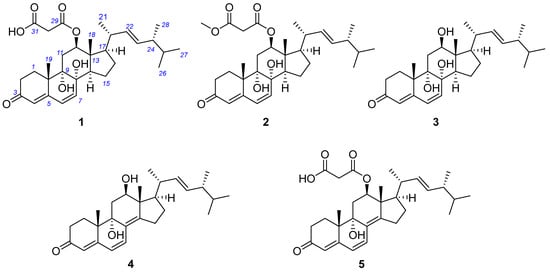
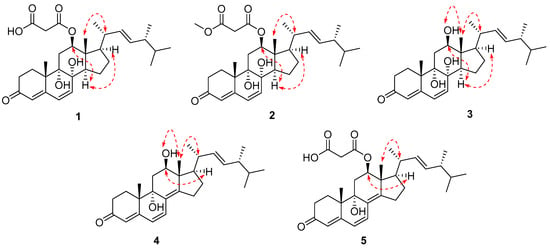
As part of our ongoing search for bioactive and structurally new compounds from marine fungi [19,20], we undertook a chemical investigation into the deep-sea-derived Penicillium sp. MCCC 3A00121. This led to the discovery of five previously undescribed steroids, chrysogenones A–E (1–5), which feature an oxidatively modified ergosterone scaffold (Figure 1). Compounds 1–5 exhibited significant inhibitory activity against renal fibrosis. Herein, we report the isolation, structural elucidation, and anti-fibrotic activities of these new metabolites.
Figure 1.
Structures of compounds 1–5 from Penicillium sp. MCCC 3A00121.
2. Results
2.1. Structure Elucidation
The EtOAc extract obtained from the corn medium cultivation of Penicillium sp. MCCC 3A00121 was subjected to solvent trituration, followed by consecutive purifications through silica gel column chromatography and reversed-phase fractionation to yield 1–5.
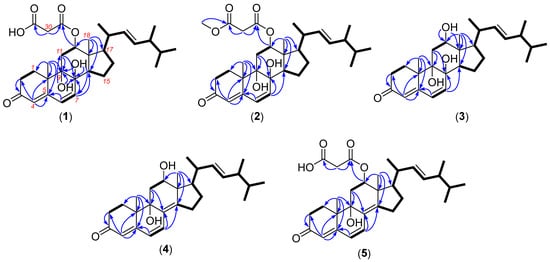
Compound 1 was obtained as a white powder. Its chemical formula was determined to be C31H44O7 (Δmmu +0.5) based on its protonated peaks at m/z 551.2950 ([M + Na]+) in the HRESIMS spectrum, requiring ten degrees of unsaturation. Analysis of the 1H and 13C NMR spectra (Table 1) revealed the resonances for six methyls, including singlets and four doublets, six sp3 methylenes, eleven methines, including five olefinic and six sp3 methines, three carbonyl carbons, as well as six nonhydrogenated carbons, including one olefinic one, accounting for six degrees of unsaturation. Therefore, the molecule incorporates four rings. The 1H-1H COSY correlations of H2-1/H2-2, H-6/H-7, H-12/H2-11, H-20/H3-21, H-24/H3-28, H-25/H3-27, and H2-15/H2-16/H-17, along with the HMBC cross-peaks observed from H3-19 to C-1/5/9/10, H3-18 to C-12/13/14/17, H2-11 to C-8/9, H-7 to C-8/14, H-4 to C-2/5/10, H2-2 to C-3, as well as OH-8 to C-7/8/9, and OH-9 to C-8/9/11, permitted the construction of a tetracyclic, 3-ketone-8,9-dihydroxy-steroid framework (Figure 2). The COSY correlations of H-17/H-20/H-22/H-23/H-24/H-25/H3-26 indicated the side chain of the steroid positioned at C-17. The vinyl protons at δH 5.29 (1H, dd, J = 15.3, 8.4 Hz) and 5.24 (1H, dd, J = 15.3, 7.4 Hz) were characteristic signals for the trans Δ22 double bond found commonly in the side chains of some steroids. A further substitution at the oxygenated C-12 was assigned a malonyl group that was evident from the HMBC cross-peak from H-12 to C-29 and from the deshielding methylene CH2-30 (δH 3.32; δC 42.1) to the carbonyl C-29 and C-31. Therefore, the planar structure of 1 was assigned as shown (Figure 2).
Table 1.
The 1H and 13C NMR spectroscopic data for chrysogenones A–C (1–3) (δ in ppm, J in Hz within the parentheses).
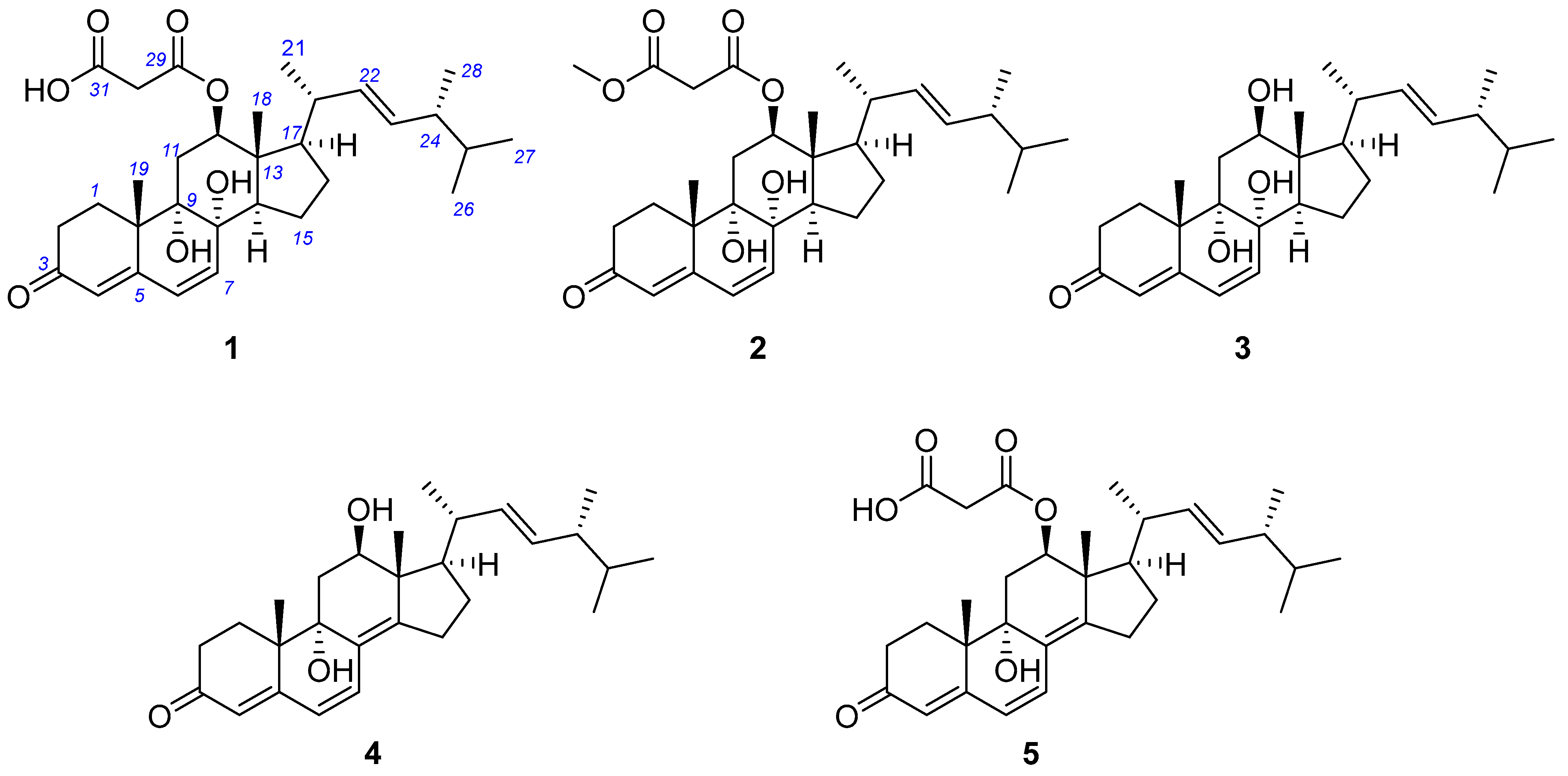
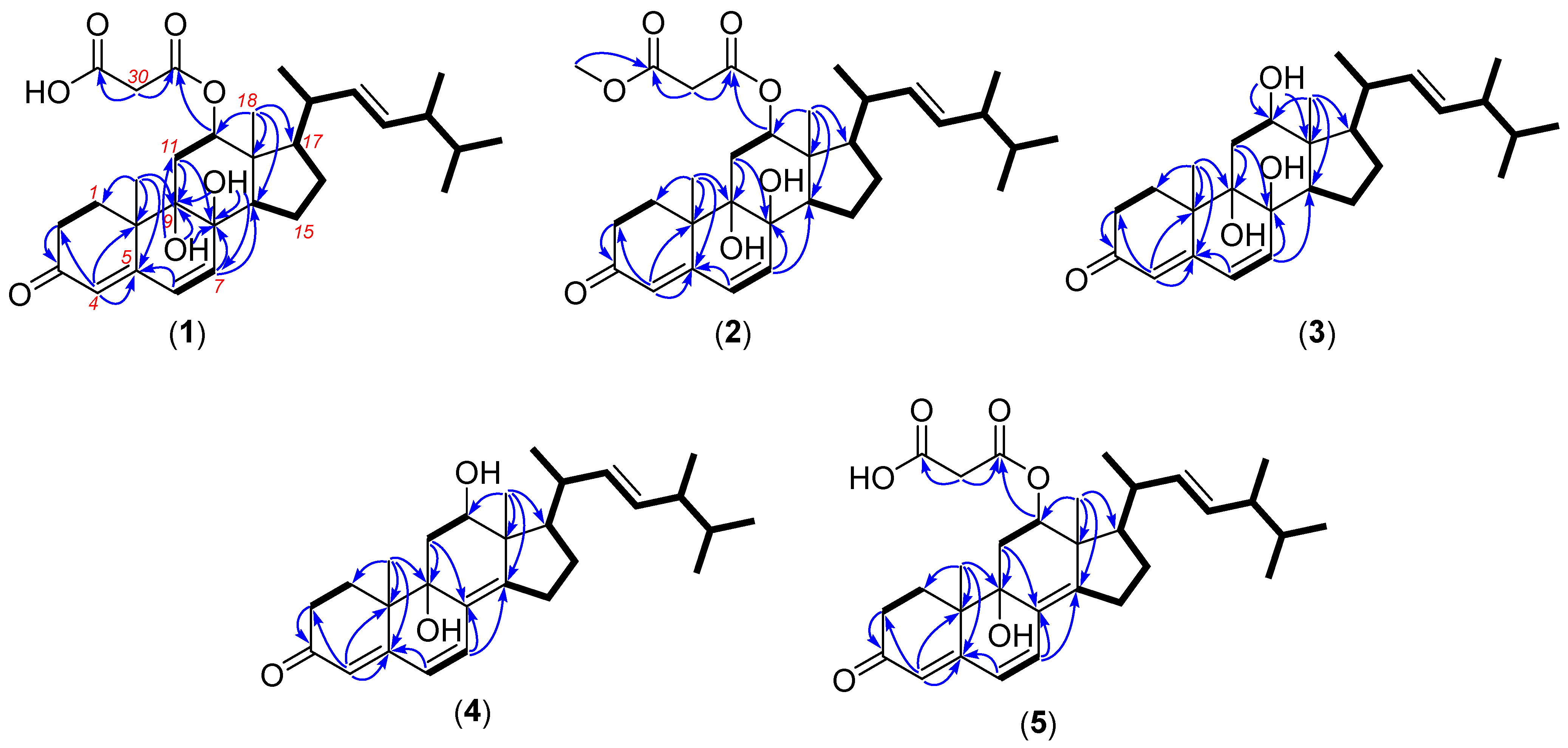
Figure 2.
Selected COSY correlations (bold line) and HMBC correlations (blue arrows) of 1–5.
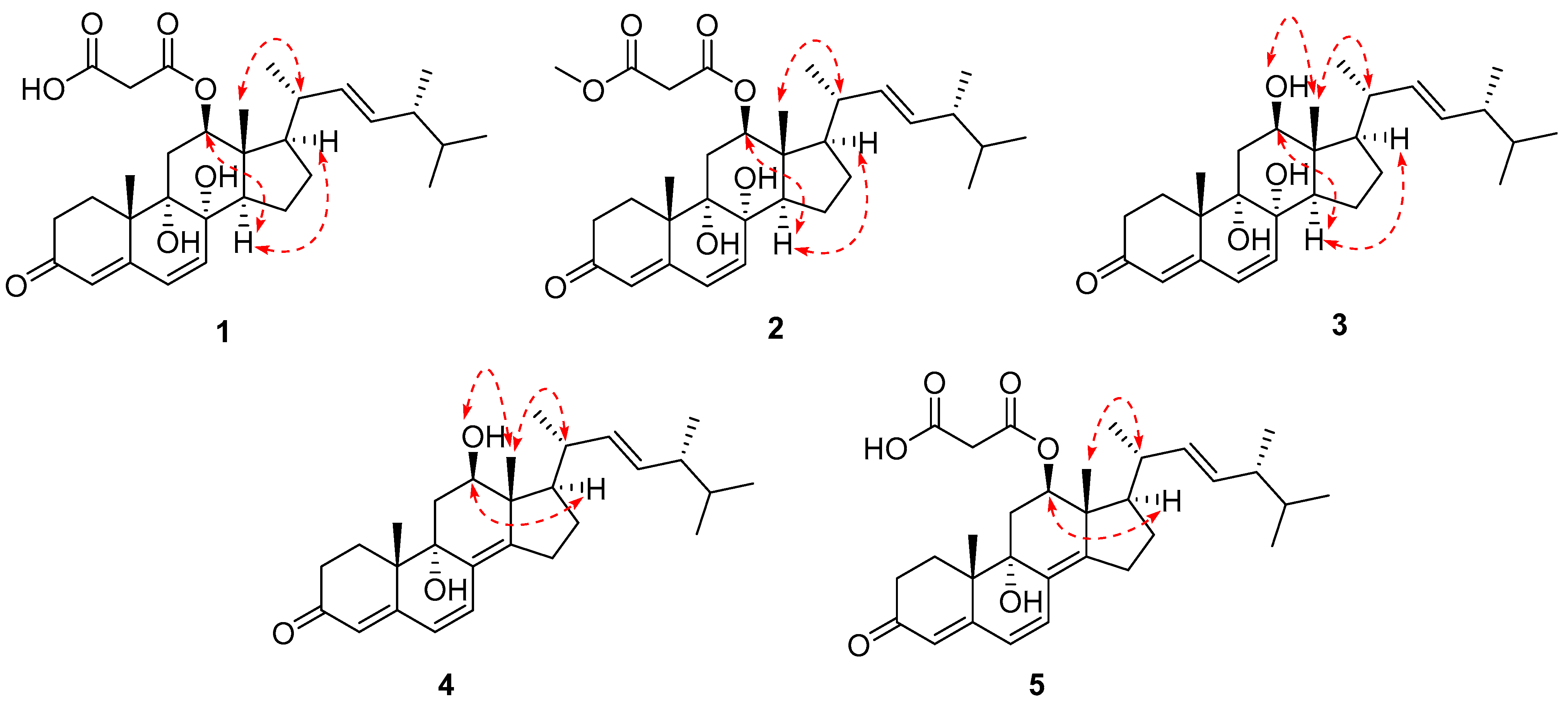
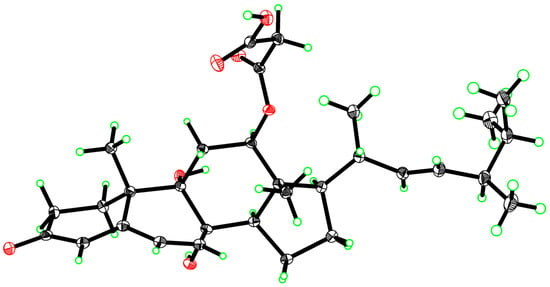
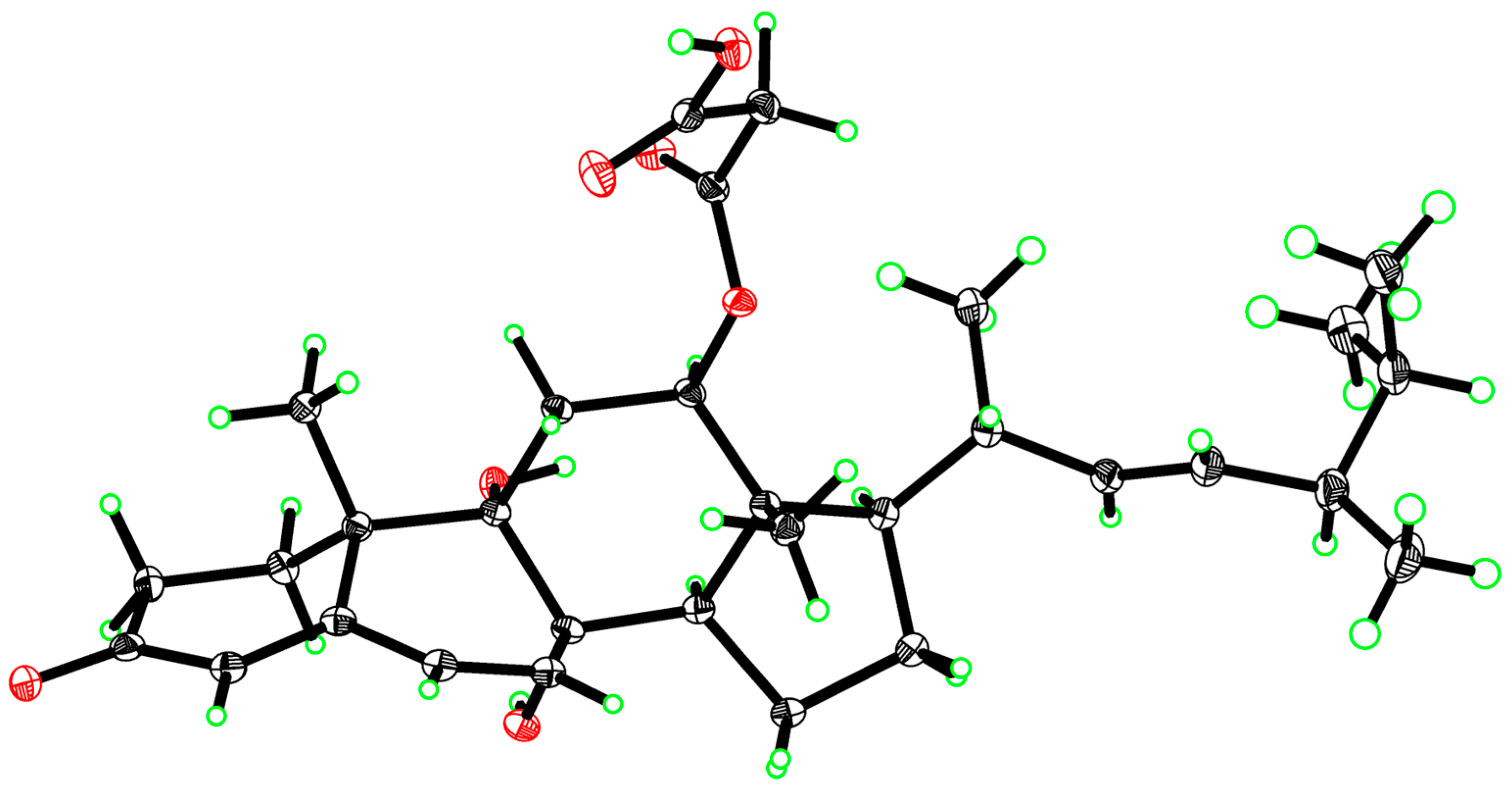
In the NOESY spectrum, diagnostic correlations observed between H-12 and H-14, H-14 and H-17, H3-18/H-20 (in DMSO) suggested that those protons were on the same side, thus determining the relative configuration among C-12/13/14/17 (Figure 3). However, the configurations of the remaining chiral centers are problematic due to either a lack of NOESY signals or the flexible nature of the acyclic side chain. Fortunately, the single crystal of compound 1 was obtained in methanol by slowly evaporating, with the absolute configuration of 1 unambiguously established by an X-ray diffraction analysis (Figure 4). Therefore, the complete structure of 1 was drawn as shown and given the trivial name chrysogenone A.
Figure 3.
Selected NOESY correlations (red dotted line) of 1–5.
Figure 4.
Single-crystal X-ray crystallography of 1.
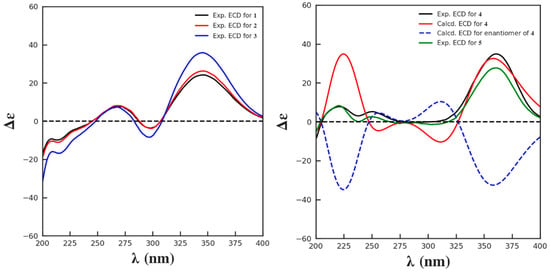
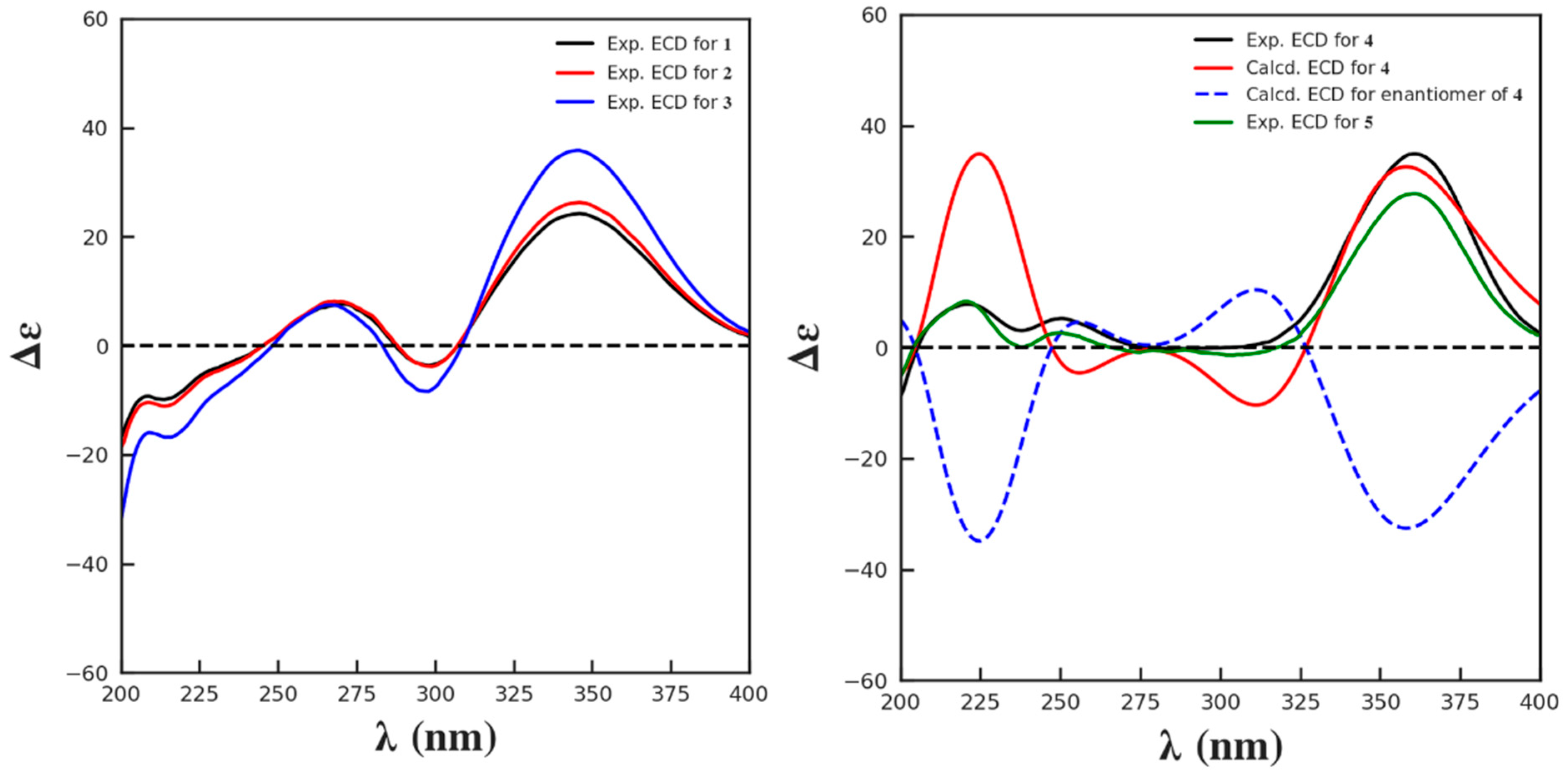
HRESI(+)MS measurement of compound 2 revealed the molecular formula C32H46O7 (Δmmu +2.0), requiring ten degrees of unsaturation, suggestive of a homolog of 1. Comparison of the NMR spectra of 2 and 1 (Table 1) highlighted extreme similarity, except that 2 bears one more oxymethyl (δH 3.62; δC 52.1) positioned at the carbonyl C-31, evident by the HMBC correlation from the oxymethyl to C-31. Due to the biogenetic relationship between 2 and 1, as well as the considerable agreement of their experimental CD curves (Figure 5), the absolute configuration of 2 was assumed to be consistent with that of 1. Therefore, the complete structure of 2 was established and named chrysogenone B.
Figure 5.
Calculated and experimental ECD spectra of 1–5.
The molecular formula of compound 3 was determined to be C28H42O4 (Δmmu +5.3), as indicated by its HRESIMS spectrum, indicating eight degrees of unsaturation. Comparison of the NMR data of 3 with those of 1 and 3 (Table 1) revealed a high degree of similarity, with the primary difference being the shielding of H-12 (δΔH = −1.40–1.42 ppm) as well as the replacement of the malonyl group with hydroxy, supported by the COSY correlation of H-12/OH-12 and HMBC cross-peak from OH-12 to C-12/13. Similar NOESY correlations of H-12/H-14, H14/H-17, and H3-18/H-20 were observed in 3. This, along with a biogenetic consideration and the consistency of experimental CD spectra of 3 with those of 1–3 (Figure 5), permitted the same absolute configuration of 3 as 1–3. Therefore, the structure of 3 was assigned and named chrysogenone C.
HRESI(+)MS analysis of compound 4 returned the molecular formula C28H40O3 (Δmmu −3.2), requiring nine degrees of unsaturation. The NMR spectra of 4 resembled those of 3, with the primary difference being the replacement of two sp3 carbons with two olefinic carbons, which accounts for the additional degree of unsaturation in 4 compared to 3. A scrutiny of the HMBC spectrum of 4 established the double bond formed between C-8 and C-14 by the correlations from H3-18/H-7 to C-14, and H-7/H2-11 to C-8, while the remaining planar structure remains the same as 3 (Figure 2). In the NOESY spectrum, correlations of H-12/H-17 and H3-18/H-20 indicated that those protons were on the same side, consistent with the relative configurations among C-12/13/14 in 1–3. Due to a conserved biosynthesis of the steroid framework in 1–3, the absolute configuration of 4 was assumed to be identical to that of 1–3. This assignment was further supported by ECD calculation for the predicted isomer (6S,8S,9S,12R,13R,14R,17R,20R,24R)-1, whose theoretical ECD curve exhibited good fitness with that of experimental data (Figure 5). Therefore, 4 was assigned the structure as shown and named chrysogenone D.
The molecular formula of compound 5 was identified as C31H42O6 (Δmmu −5.6) based on its protonated HRESI(+)MS peak at m/z 511.3004, suggestive of eleven degrees of unsaturation. Comparison of the NMR data of 5 (Table 2) with those of 4 revealed a high degree of similarity, with the primary difference being the deshielding of H-12 (δΔH = +1.43 ppm) as well as the presence of resonances for a malonyl group instead of a hydroxy positioned at C-12. This assignment was well supported by the HMBC cross-peak from H-12 to C-29 and from the deshielding methylene CH2-30 (δH 3.39; δC 42.1) to the carbonyl C-29 and C-31. Likewise, the similar NOESY correlations of H-12/H-14, H14/H-17, and H3-18/H-20 observed in 5, together with a biogenetic consideration and the consistency of experimental CD spectra of 5 with those of 4, permitted the identical absolute configuration of 5 as 4 (Figure 5). Therefore, the structure of 5 was assigned and named chrysogenone E.
Table 2.
The 1H and 13C NMR spectroscopic data for chrysogenones D–E (4–5) (δ in ppm, J in Hz within the parentheses).
Malonyl substitution is relatively uncommon in natural products, despite malonyl-CoA serving as a key biosynthetic precursor for polyketides. To date, this structural unit has been reported in peptides [21], triterpenes [22,23,24], diterpenes [25], originating from sources such as plants, fungi, and pathogenic bacteria. Chrysogenones A–B and D (1–2, 5) feature a malonyl group at the C-12 position of the steroid skeleton, representing rare examples within this class of natural products. Furthermore, the steroid core of compounds 1–5 displays distinct oxidation patterns at C-9, 12, and/or C-8 compared to their structurally related analogs 9R,11Rdihydroxyergosta-4,6,8(14),22-tetraen-3-one [26], and isocyathisterol [27].
2.2. Anti-Renal Fibrosis Activity
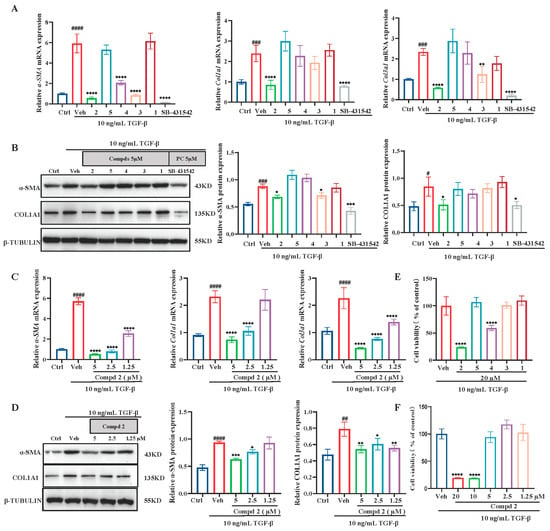
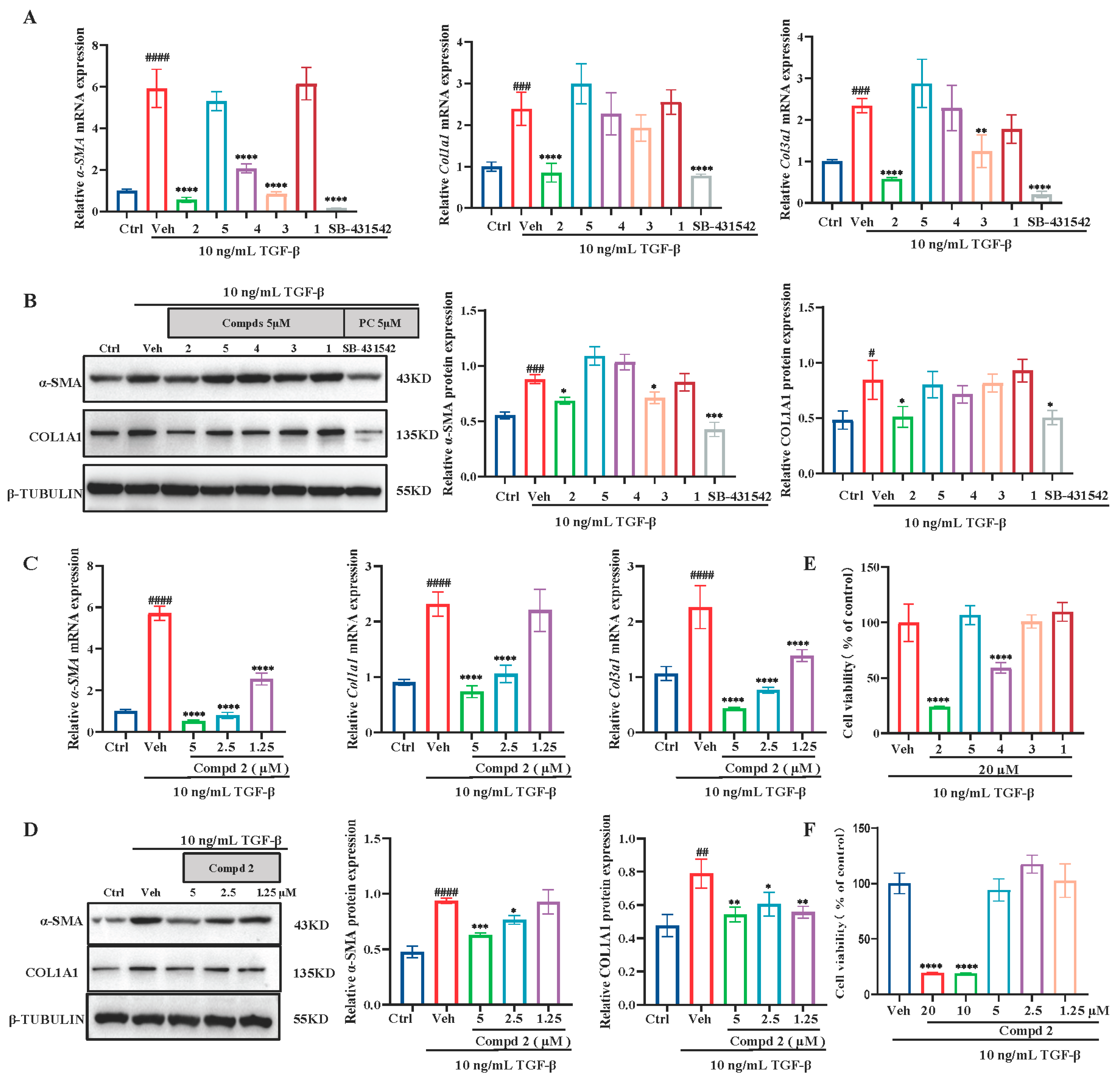
Given the established role of activated renal fibroblasts as drivers of kidney fibrosis, we investigated the effects of chrysogenones A–E (1–5) using an in vitro model of TGF-β1-stimulated rat kidney fibroblasts (NRK-49F) [28]. Treatment with TGF-β1 (10 ng mL−1, 48 h) robustly induced mRNA and protein expression of key fibrotic markers, confirming a stable pro-fibrotic phenotype (Figure 6A,B). Screening of the compounds revealed that, despite sharing a common structural scaffold, they exhibited distinct inhibitory profiles in attenuating TGF-β1-induced pro-fibrotic response at a concentration of 5 µM (Figure 6A,B). Among them, compound 2 demonstrated the strongest activity, significantly downregulating mRNA and protein levels of α-smooth muscle actin (α-SMA) and collagen I (COL1A1) compared to the TGF-β1 group (Figure 6A,B). The anti-renal fibroblast activation effect of compound 2 was confirmed to be dose-dependent across multiple markers at non-cytotoxic concentrations (Figure 6C,D).
Figure 6.
Identification of compound 2 as an anti-fibrotic compound in TGF-β1-activated renal fibroblasts. (A,B): mRNA and protein expression of fibrotic markers were assessed via quantitative real-time PCR (A) and Western blot (B) following 48 h treatment with vehicle or 5 μM of compounds 1–5. (C,D): Dose-dependent effects of compound 2 on the mRNA expression of α-Sma, Col1a1, and Col3a1 (C) and the protein expression of α-SMA and COL1A1 (D) were measured after 48 h of treatment at the indicated concentrations. (E,F): Cytotoxicity was evaluated using a CCK-8 assay after 24 h. Cell viability was assessed following treatment with 20 μM of compounds 1–5 (E) and with indicated concentrations of compound 2 (F). In all panels, NRK-49F cells were activated with 10 ng/mL TGF-β1. SB431542, a TGF-β receptor kinase inhibitor, served as a positive control where indicated. Data are presented as mean ± SEM and were analyzed using one-way ANOVA with Bonferroni’s multiple comparisons test. Significance is denoted as follows: # p < 0.05, ## p < 0.01, ### p < 0.001, #### p < 0.0001 vs. ctrl group; * p < 0.05, ** p < 0.01, *** p < 0.001, **** p < 0.0001 vs. vehicle group.
In addition to renal fibroblast activation, the proliferation of activated fibroblasts contributes to fibrotic lesion expansion [29]. We therefore examined the effect of chrysogenones A–E on fibroblast proliferation. As a result, chrysogenone B (2) and chrysogenone D (4) showed pronounced inhibition of activated NRK-49F cell proliferation at concentrations above 20 µM, with 2 exhibiting the greatest potency (Figure 6E,F). By contrast, none of those compounds exhibited cytotoxicity on normal NRK-49F cells at above concentration (Figure S36). Taken together, these results identify chrysogenone B (2) as the most effective congener in inhibiting both fibrotic marker expression and fibroblast proliferation, warranting its selection for further mechanistic study.
2.3. Anti-Renal Fibrosis Target Prediction for Chrysogenone B (2)
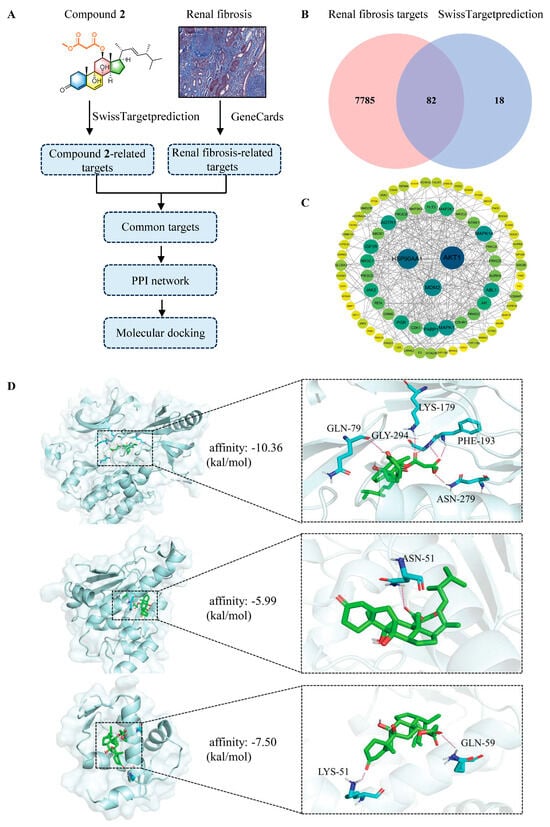
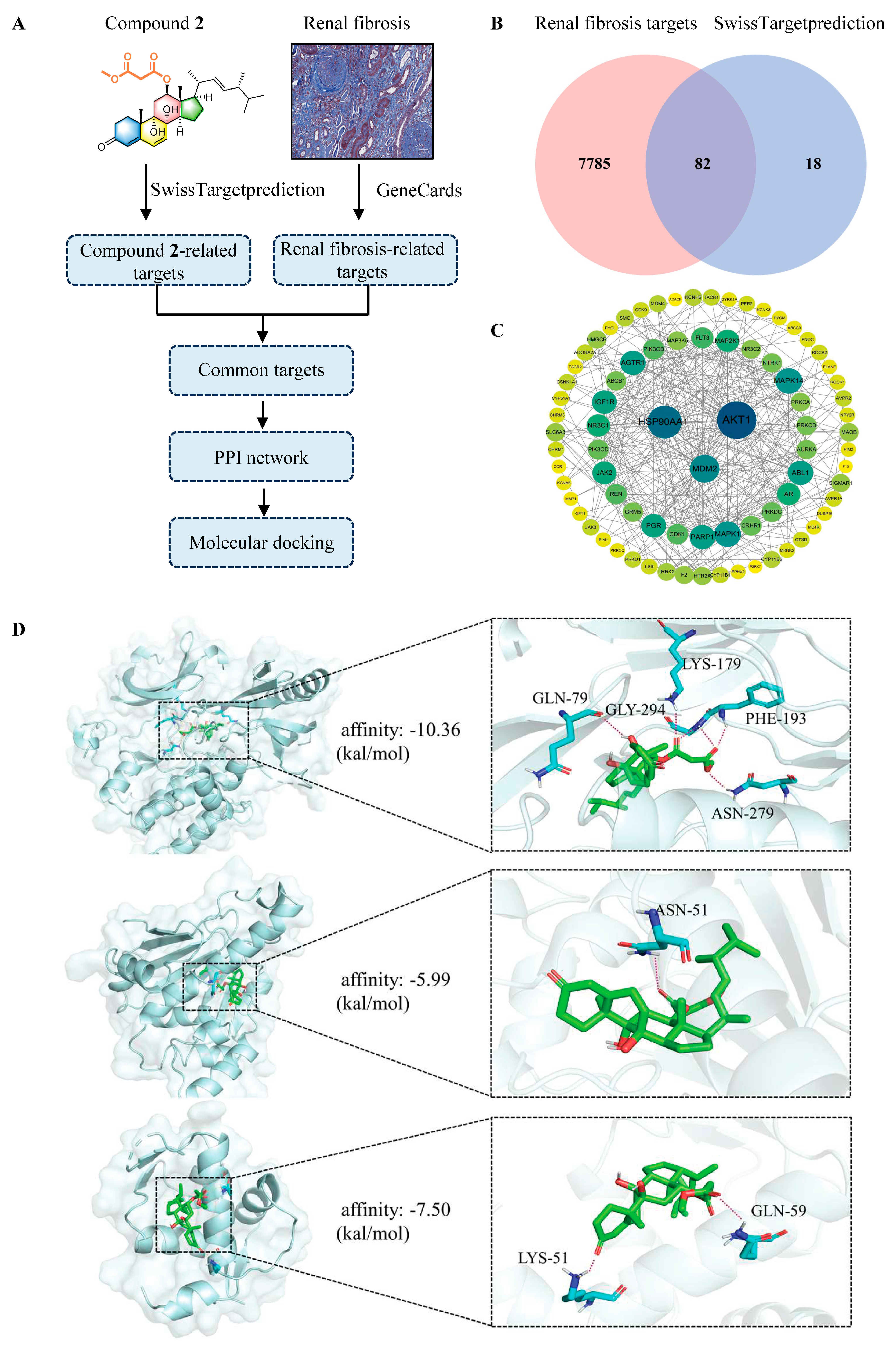
To investigate the potential molecular target of compound 2 underlying its renal fibrosis inhibitory activity, we performed a theoretical analysis integrating network pharmacology and molecular docking. The overall workflow is summarized in Figure 7A. A representative histology image of renal fibrosis was sourced from the Kidney Tissue Atlas database [https://atlas.kpmp.org/ (accessed on 20 January 2026)]. A total of 100 compound 2-related targets were obtained from the SwissTargetPrediction database, while 7867 renal fibrosis-related targets were collated from the GeneCards database. Intersection of these datasets using the Venny platform revealed 82 overlapping genes, constituting putative targets for the compound 2 in renal fibrosis (Figure 7B). To prioritize core targets from this set, we constructed a protein–protein interaction (PPI) network for the 82 candidates using the STRING database and visualized it in Cytoscape (v3.9). Network topology was analyzed with the CytoHubba plugin. Based on the Degree algorithm, three genes—AKT1, HSP90AA1, and MDM2—were identified as top-ranked hubs, representing key candidate targets for therapeutic intervention (Figure 7C). In this regard, these three core targets of compound 2 for renal fibrosis were chosen for further molecular docking.
Figure 7.
Anti-renal fibrosis target prediction for chrysogenone B (2). (A): Overall workflow of prediction of molecular target of 2. (B): Overlaps between compound 2-related targets and renal fibrosis-related targets. (C): PPI of overlapped targets. (D): Binding modes between compound 2 and the three candidate targets, AKT1 (top), HSP90AA1 (middle), MDM2 (bottom), with hydrogen bonds drawn in dotted lines.
Molecular docking studies indicate that compound 2 binds strongly to the three putative target proteins: AKT1 (PDB: 6HHG; Vina score: −10.36 kcal/mol), HSP90AA1 (PDB: 3BM9; Vina score: −5.99 kcal/mol), and MDM2 (PDB: 4OBA; Vina score: −7.5 kcal/mol) (Figure 7D). Notably, the binding pose of compound 2 within AKT1 closely resembles that of known AKT1 inhibitors, positioning it at the interface between the kinase and pleckstrin homology (PH) domains [30]. This interaction is stabilized by six hydrogen bonds with the key residues GLN-79, LYS-179, GLY-294, PHE-193, and ASN-279, most of which are contributed by the malonyl substitution. This likely explains the superior activity of compound 2 compared to compounds 3 and 4. Despite the high structural similarity within compounds 1, 2, and 5, we hypothesized that the observed activity variation might be associated with differences in their lipophilic properties (2: malonyl methyl ester; 1 and 5: malonic acid), which could impact cell penetration. However, such findings are preliminary and require further experimental support in the future.
3. Materials and Methods
3.1. General Experimental Procedures
NMR spectra were recorded on a Jeol 600 MHz (JEOL Ltd., Tokyo, Japan) and a Bruker 400 MHz. ECD (Nantucket, MA, USA) spectra were measured on a Chirascan spectrometer (Applied Photophysics, Surrey, UK). Optical rotations were measured with an Anton Paar MCP100 polarimeter (Graz, Austria). The HRESIMS spectra were measured on a Waters Xevo G2 Q-TOF mass spectrometer (Waters Corporation, Milford, MA, USA). The semi-preparative HPLC was conducted on an Agilent Technologies 1260 Infinity instrument (Shanghai Yuanxi Instrument Co., Ltd., Shanghai, China) equipped with a DAD detector. The reversed-phase C-18 medium-pressure liquid chromatography (MPLC) was soochow high tech chromatography. Column chromatography (CC) was performed on silica gel (100–200 m, 200–300 m, 300–400 m; Qiaodao Marine Chemistry Co., Ltd., Qingdao, China), Sephadex LH-20 (Amersham Pharmacia Biotech AB, Uppsala, Sweden), and ODS (octadecylsilyl; 50 μm, Daiso, Hiroshima, Japan), respectively. The NRK-49F cells (rat renal fibroblast cells) were purchased from Wuhan Purcell Life Science and Technology Co., Ltd., Wuhan, China.
3.2. Fungal Strain and Identification
The fungal strain MCCC 3A00121 was isolated from a deep-sea sediment sample of the western Pacific Ocean at a depth of 2682 m. It was identified to be Penicillium sp. or Penicillium cf chrysogenum, as the ITS gene sequence alignment (PQ623891) demonstrated that it showed great similarity (99.8%) to Penicillium chrysogenum (GenBank accession number NR_077145.1). The strain was preserved at the Key Laboratory of Marine Genetic Resources, Third Institute of Oceanography, Ministry of Natural Resources (Xiamen, China).
3.3. Fermentation, Extraction, and Isolation
The fermentation was reconducted in 100 Erlenmeyer flasks (1000 mL), each containing 80 g of corn and 100 mL of artificial seawater, and the contents were soaked for 1 h before autoclaving for 20 min at 15 psi. Each flask was inoculated with 5.0 mL of the spore inoculum and incubated at r. t. for 30 days. The fermented materials were extracted with EtOAc (3 × 1000 mL) in an ultrasonic bath at 25 °C for 30 min to obtain brown crude extract (51.6 g). The crude extract (36.5 g) was separated into eight fractions (Fr.1–Fr.8) via CC over silica gel using a gradient of EtOAc-PE (0% → 100%, 8 h, 20 mL/min). Fraction Fr,4 (3.4 g) was subjected to column chromatography on ODS silica gel eluted with MeOH/H2O to give five subfractions (Fr.4.1–Fr.4.5). Fr.4.3 was separated by HPLC using MeOH/H2O (60–90, 3 mL/min) to obtain 1 (28.8 mg) and 4 (4.2 mg). Fr.4.4 was separated by HPLC using MeOH/H2O (65–95, 3 mL/min) to obtain 2 (4.1 mg) and 3 (3.2 mg). Fr.4.5 was purified by HPLC (70–100% MeOH/H2O, 3 mL/min) to afford 5 (1.3 mg).
Chrysogenones A (1): White powder; [α]20D + 206 (c 0.1, MeOH); UV (MeOH) λmax(log ε) 233 (2.01) nm, 282 (2.85) nm; ECD (MeOH) λmax (Δε) 209 (+2.97) nm, 214 (−3.16) nm, 270 (+2.46) nm, 298 (−1.16) nm, 346 (+7.76) nm; 1H and 13C NMR data, see Table 1; HRESIMS m/z 551.2950 [M + Na]+ (calcd for C31H44O7Na+, 551.2985).
Chrysogenones B (2): White powder; [α]20D + 234 (c 0.1, MeOH); UV (MeOH) λmax(log ε) 233 (2.07) nm, 281 (2.90) nm; ECD (MeOH) λmax (Δε) 209 (+3.42) nm, 214 (−3.65) nm, 268 (+2.68) nm, 299 (−1.25) nm, 346 (+8.64) nm; 1H and 13C NMR data, see Table 1; HRESIMS m/z 565.3161 [M + Na]+ (calcd for C32H46O7Na+, 565.3141).
Chrysogenones C (3): White powder; [α]20D + 281 (c 0.1, MeOH); UV (MeOH) λmax(log ε) 228 (2.17) nm, 282 (2.94) nm; ECD (MeOH) λmax (Δε) 209 (+4.27) nm, 214 (−4.51) nm, 267 (+2.01) nm, 298 (−2.25) nm, 346 (+9.61) nm; 1H and 13C NMR data, see Table 1; HRESIMS m/z 465.3034 [M + Na]+ (calcd for C28H42O4Na+, 465.2981).
Chrysogenones D (4): White powder; [α]20D + 286 (c 0.1, MeOH); UV (MeOH) λmax(log ε) 219 (2.24) nm, 232 (2.29) nm, 248 (2.17) nm, 339 (2.87) nm; ECD (MeOH) λmax (Δε) 221 (+2.01) nm, 238 (−0.78) nm, 250 (+1.34) nm, 289 (−0.06) nm, 361 (+8.97) nm; 1H and 13C NMR data, see Table 2; HRESIMS m/z 425.3024 [M + H]+ (calcd for C28H41O3+, 425.3056).
Chrysogenones E (5): White powder; [α]20D + 219 (c 0.1, MeOH); UV (MeOH) λmax(log ε) 221 (2.39) nm, 229 (2.40) nm, 248 (2.31) nm, 335 (2.91) nm; ECD (MeOH) λmax (Δε) 221 (+2.56) nm, 238 (−0.03) nm, 250 (+0.81) nm, 304 (−0.44) nm, 361 (+8.57) nm; 1H and 13C NMR data, see Table 2; HRESIMS m/z 511.3004 [M + H]+ (calcd for C31H43O6+, 511.3060).
3.4. ECD Calculation
At room temperature, the experimental ECD spectra of compounds 1–5 in methanol at a concentration of 1.0 mg/mL were recorded by a Chirascan spectrometer. The calculated ECD spectra of compound 4 were calculated by the IEFPCM model in MeOH at the B3LYP/6-311G (d, p) level using time-dependent density functional theory (TD-DFT).
3.5. X-Ray Crystallographic Data
Experimental. Single colorless block-shaped crystals of 1 were used as supplied. A suitable crystal with dimensions 0.18 × 0.08 × 0.08 mm3 was selected. Single-crystal X-ray diffraction data were collected by a Bruker D8 Venture diffractometer with Cu Kα radiation (λ = 1.54178 Å). The crystal was kept at a steady T = 100(2) K during data collection. The structure was solved with the ShelXT structure program using Intrinsic Phasing and refined with ShelXL using full-matrix least-squares minimization on F2. The crystallographic data were deposited in the Cambridge Crystallographic Data Center (CCDC) with the deposition number 2537563.
Crystal data for 1: C31H44O7, M = 528.66 g/mol, monoclinic, space group P21 (no. 4), a = 11.891(2) Å, b = 39.192(8) Å, c = 13.238(3) Å, α = 90°, β = 107.940(30)°, γ = 90°, V = 5870.00(2) Å3, T = 100(2) K, Z = 8, μ(Cu Kα) = 0.674 mm−1, 61339 reflections measured, 23147 independent reflections (Rint = 0.0657). The final R1 value was 0.0451 (I > 2σ(I)). The final wR(F2) value was 0.1034 (I > 2σ(I)). The final R1 value was 0.0557 (all data). The final wR(F2) value was 0.1096 (all data). The goodness of fit on F2 was 1.041. Flack parameter = −0.01(7).
3.6. Cell Culture and Anti-Renal Fibrosis Activity Assays In Vitro
Normal rat kidney fibroblasts (NRK-49F) were maintained in DMEM supplemented with 10% FBS and 1% penicillin/streptomycin. For the screening of chrysogenones A–E (1–5) possessing anti-renal fibrotic activity, cells were seeded into 12-well plates. Following overnight incubation, the cells were serum-starved for 6 h and subsequently treated with 10 ng mL−1 recombinant TGF-β1 (PeproTech) for 48 h, either in the presence or absence of a candidate compound at the specified concentration.
3.7. Ability of Small-Molecule Compounds to Inhibit Proliferation of Myofibroblasts
The anti-proliferative effects of chrysogenones A–E (1–5) were evaluated on both TGF-β1-stimulated and unstimulated NRK-49F fibroblasts using a Cell Counting Kit-8 (CCK-8; Abbkine, Wuhan, China). Cells were seeded in 96-well plates at a density of 5·× 103 cells per well and allowed to adhere overnight. For the TGF-β1 stimulated group, adherent cells were subjected to serum starvation for 6 h, followed by a 24 h exposure to 10 ng/mL recombinant human TGF-β1 in combination with specified concentrations of each compound. For the unstimulated group, cells were incubated for 24 h with specified concentrations of chrysogenones A–E alone. Subsequently, the CCK-8 reagent was then added, followed by a 1–2 h incubation at 37 °C in the dark. Absorbance was measured at 450 nm using a microplate reader (BioTek, Agilent, Winooski, VT, USA). Background absorbance from wells containing medium alone was subtracted as blank controls.
3.8. qPCR Analysis
Total RNA was isolated from NRK-49F cells with AG RNAex Pro reagent (Accurate Biology, Wuhan, China) following the manufacturer’s instructions. cDNA was synthesized from 1 μg total RNA using HiScript III RT SuperMix (Vazyme, Nanjing, China). Target gene expression was quantified by SYBR Green-based RT-qPCR, with data normalized to the reference gene HPRT1 and analyzed via the 2−ΔΔCT method.
3.9. Western Blot Analysis
For immunoblotting, total protein lysates from NRK-49F cells were resolved by SDS-PAGE and electrotransferred onto PVDF membranes. Membranes were blocked in 5% skimmed milk prior to incubation with primary antibodies (4 °C, overnight) and corresponding secondary antibodies (room temperature, 1 h). Chemiluminescent detection was performed with ECL, and images were acquired on a Tanon 5200CE system. Densitometric analysis was conducted in ImageJ (Version 1.53a), with values normalized to the β-tubulin loading control. Primary antibodies included anti-Collagen I (Abcam, Cambridge, UK), anti-α-SMA (Cell Signaling Technology, Danvers, MA, USA), and anti-β-tubulin (Cell Signaling Technology, Danvers, MA, USA).
3.10. Network Pharmacology
We employed a bioinformatic workflow to identify potential targets of Compound 2 in renal fibrosis. Protein targets of compound 2 were predicted using SwissTargetPrediction, and known disease-associated targets were sourced from GeneCards. The intersecting target set was identified with the Venny 2.1 website. These overlapping targets were then submitted to the STRING database to construct a protein–protein interaction (PPI) network. The resulting network was imported into Cytoscape software (v3.9.1) for visualization and further analysis. Core targets were defined via the cytoHubba plugin based on the top 3 rankings in maximal node connect degree (Degree).
3.11. Molecular Docking
Molecular docking studies were performed to investigate the binding mode between compound 2 and the three putative target proteins encoded by AKT1, HSP90AA1, and MDM2 using Autodock Vina (v1.2.x). The three-dimensional (3D) coordinates of the AKT1 protein (PDB ID: 6HHG), HSP90AA1 protein (PDB ID: 3BM9), and MDM2 protein (PDB ID: 4OBA) were downloaded from the Protein Data Bank [http://www.rcsb.org (accessed on 27 January 2026)] and later prepared by removing water and adding hydrogen using PyMol 3.1.6.1 software. The 3D structure of compound 2 was obtained by ChemDraw Professional 17.0 and Chem3D 17.0 software. Docking input files were generated by the AutoDockTools 1.5.7 package. The search grid of the AKT1 protein was identified as center_x 13.6, center_y −11.8, center_z −15.8, with dimensions size_x 17.9, size_y = 17.9, size_z = 17.9; HSP90AA1 protein as center_x 0.5, center_y 30, center_z 20, with dimensions size_x 16.4, size_y 20.5, size_z 20.5; and MDM2 protein as center_x 26.8, center_y 17.5, center_z −3.1, with dimensions size_x 33.1, size_y 28.8, size_z 33.1. The best-scoring pose, as judged by the Vina docking score, was chosen and visually analyzed using PyMoL 3.1.6.1 software.
4. Conclusions
The chemical investigation of the deep-sea-derived Penicillium sp. MCCC 3A00121 led to the discovery of five previously undescribed metabolites, chrysogenones A–E (1–5), belonging to a rare class of oxidatively modified ergostane-type steroids. Among them, chrysogenones A–B, E (1–2, 5) possessed an unusual malonyl moiety attached to the C-12 position of the ergostane core. Compounds 2–4 demonstrated varying degrees of inhibition of renal fibrosis, as indicated by the suppressed expression of the fibrotic biomarkers α-SMA and COL1A1. Of particular note, chrysogenone B (2) exhibited the most potent activity and effectively inhibited the proliferation of activated NRK-49F cells above 20 μM. Furthermore, integrative network pharmacology profiling coupled with molecular docking simulations suggested that the anti-fibrotic effects of compound 2 may involve modulation of key targets such as AKT1, HSP90AA1, and MDM2. However, further enzymatic investigations are still needed to validate these putative interactions and the regulatory relationship between the aforementioned proteins and the TGF-β signaling pathway in the near future. Such results will substantially enhance the robustness of our conclusions.
Supplementary Materials
The following supporting information can be downloaded at https://www.mdpi.com/article/10.3390/md24030121/s1. Figures S1–S35. NMR, HRMS, HSQC, COSY, HMBC and NOESY spectrums of compounds 1−5; Figure S36. cytotoxicity data of 1−5.
Author Contributions
Conceptualization, T.W. and T.Z.; methodology, Z.L., L.C. and Y.W.; formal analysis, Z.L., L.C., Y.W. and T.W.; investigation and data curation, Z.L., L.C., M.J., S.F. and R.C.; writing—original draft preparation, T.W., L.C. and Z.L.; writing—review and editing, T.W., L.C. and Y.W.; supervision and project administration, T.W. and T.Z.; funding acquisition, T.W. All authors have read and agreed to the published version of the manuscript.
Funding
This research was financially funded by the National Natural Science Foundation of China (22407147 and 82300963), the Fujian Provincial Science and Technology Planning Project (2024Y0077), and the Shenzhen Key Laboratory of Chinese Medicine Active Substance Screening and Translational Research (ZDSYS20220606100801003).
Institutional Review Board Statement
Not applicable.
Data Availability Statement
The data presented in this study are available in Supplementary Materials.
Conflicts of Interest
The authors declare no conflicts of interest.
References
- Cong, M.; Pang, X.; Zhao, K.; Song, Y.; Liu, Y.; Wang, J. Deep-sea natural products from extreme environments: Cold seeps and hydrothermal vents. Mar. Drugs 2022, 20, 404. [Google Scholar] [CrossRef] [Scilit]
- Giordano, D. Bioactive molecules from extreme environments. Mar. Drugs 2020, 18, 640. [Google Scholar] [CrossRef] [Scilit] [PubMed]
- Pietra, F. Secondary metabolites from marine microorganisms: Bacteria, protozoa, algae and fungi. Achievements and pro-spects. Nat. Prod. Rep. 1997, 14, 453–464. [Google Scholar] [CrossRef] [Scilit] [PubMed]
- Newman, D.J.; Cragg, G.M. Natural products as sources of new drugs over the nearly four decades from 01/1981 to 09/2019. J. Nat. Prod. 2020, 83, 770–803. [Google Scholar] [CrossRef] [Scilit] [PubMed]
- Carroll, A.R.; Copp, B.R.; Davis, R.A.; Keyzers, R.A.; Prinsep, M.R. Marine natural products. Nat. Prod. Rep. 2019, 36, 122–173. [Google Scholar] [CrossRef] [Scilit]
- Jiménez, C. Marine natural products in medicinal chemistry. ACS Med. Chem. Lett. 2018, 9, 959–961. [Google Scholar] [CrossRef] [Scilit]
- Blunt, J.W.; Copp, B.R.; Keyzers, R.A.; Munro, M.H.G.; Prinsep, M.R. Marine natural products. Nat. Prod. Rep. 2017, 34, 235–294. [Google Scholar] [CrossRef] [Scilit]
- Carroll, A.R.; Copp, B.R.; Davis, R.A.; Keyzers, R.A.; Prinsep, M.R. Marine natural products. Nat. Prod. Rep. 2022, 39, 1122–1171. [Google Scholar] [CrossRef] [Scilit]
- Carroll, A.R.; Copp, B.R.; Davis, R.A.; Keyzers, R.A.; Prinsep, M.R. Marine natural products. Nat. Prod. Rep. 2023, 40, 275–325. [Google Scholar] [CrossRef] [Scilit]
- Hillier, S.G.; Lathe, R. Terpenes, hormones and life: Isoprene rule revisited. J. Endocrinol. 2019, 242, R9–R22. [Google Scholar] [CrossRef] [Scilit]
- Gao, Y.; Wang, G.; Huang, H.; Gao, H.; Yao, X.; Hu, D. Biosynthesis of fungal triterpenoids and steroids. Chin. J. Org. Chem. 2018, 38, 2335–2347. [Google Scholar] [CrossRef] [Scilit]
- Xie, C.L.; Zhang, D.; Xia, J.-M.; Hu, C.-C.; Lin, T.; Lin, Y.-K.; Wang, G.H.; Tian, W.J.; Li, Z.P.; Zhang, X.K.; et al. Steroids from the deep-sea-derived fungus Penicillium granulatum MCCC 3A00475 induced apoptosis via retinoid X receptor (RXR)-α pathway. Mar Drugs 2019, 17, 178. [Google Scholar] [CrossRef] [Scilit] [PubMed]
- Zhang, Z.; Li, Y.; Wang, H.; Xu, W.; Wang, C.; Ma, H.; Zhong, F.; Ou, J.; Luo, Z.; Luo, H.-B.; et al. Ergone derivatives from the deep-sea-derived fungus Aspergillus terreus YPGA10 and 25,28-dihydroxyergone-induced apoptosis in human colon cancer SW620 cells. J. Nat. Prod. 2024, 87, 1563–1573. [Google Scholar] [CrossRef] [Scilit] [PubMed]
- Pang, C.; Chen, Y.H.; Bian, H.H.; Zhang, J.P.; Su, L.; Han, H.; Zhang, W. Anti-inflammatory ergosteroid derivatives from the coral-associated fungi Penicillium oxalicum HL-44. Molecules 2023, 28, 7784. [Google Scholar] [CrossRef] [Scilit]
- Ren, Z.; Yang, L.; Ma, Q.; Xie, Q.; Dai, H.; Sun, K.; Zhao, Y. Meroterpenoids and steroids from the marine-derived fungus Trametes sp. ZYX-Z-16. Molecules 2022, 27, 8782. [Google Scholar] [CrossRef] [Scilit]
- Huang, R.; Fu, P.; Ma, L. Kidney fibrosis: From mechanisms to therapeutic medicines. Sig Transduct. Target. Ther. 2023, 8, 129. [Google Scholar] [CrossRef] [Scilit]
- Humphreys, B.D. Mechanisms of Renal Fibrosis. Annu. Rev. Physiol. 2018, 80, 309–326. [Google Scholar] [CrossRef] [Scilit]
- Meng, X.-M.; Nikolic-Paterson, D.J.; Lan, H.Y. TGF-β: The master regulator of fibrosis. Nat. Rev. Nephrol. 2016, 12, 325–338. [Google Scholar] [CrossRef] [Scilit]
- Wu, T.Z.; He, Z.H.; Lin, C.Y.; Li, Y.; Zou, Z.B.; Xie, C.L.; Zhong, T.H.; Yang, X.W. Dimeric citrinins diversity revealed by the deep-sea-derived Penicillium citrinum W23. Phytochemistry 2025, 237, 114532. [Google Scholar] [CrossRef] [Scilit]
- Xie, C.L.; Wu, T.Z.; Wang, Y.; Capon, R.J.; Xu, R.; Yang, X.W. Genome mining of a deep-sea-derived Penicillium allii-sativi revealed polyketide-terpenoid hybrids with antiosteoporosis activity. Org. Lett. 2024, 26, 3889–3895. [Google Scholar] [CrossRef] [Scilit]
- Pérez-Bonilla, M.; Oves-Costales, D.; González, I.; de la Cruz, M.; Martín, J.; Vicente, F.; Genilloud, O.; Reyes, F. Krisynomycins, Imipenem Potentiators against Methicillin-Resistant Staphylococcus aureus, Produced by Streptomyces canus. J. Nat. Prod. 2020, 83, 2597–2606. [Google Scholar] [CrossRef] [Scilit] [PubMed]
- Han, J.; Li, L.; Zhong, J.; Tohtaton, Z.; Ren, Q.; Han, L.; Huang, X.; Yuan, T. Officimalonic acids A−H, lanostane triterpenes from the fruiting bodies of Fomes officinalis. Phytochemistry 2016, 130, 193–200. [Google Scholar] [CrossRef] [Scilit] [PubMed]
- Chairul; Tokuyama, T.; Nishizawa, M.; Shiro, M.; Tokuda, H.; Hayashiji, Y. Malonate half-esters of homolanostanoid from an asian Ganoderma fungus. Phytochemistry 1990, 29, 923–928. [Google Scholar] [CrossRef] [Scilit]
- Sun, L.R.; Yan, J.; Zhou, L.; Li, Z.R.; Qiu, M.H. Two new triterpene glycosides with monomethyl malonate groups from the rhizome of Cimifuga foetida L. Molecules 2011, 16, 5701–5708. [Google Scholar] [CrossRef] [Scilit]
- Hilpisch, U.; Hartmann, R.; Glombitza, K.W. New dammaranes, esterified with malonic acid, from leaves of Betula pendula. Planta Med. 1997, 63, 347–351. [Google Scholar] [CrossRef] [Scilit]
- Gawas, D.; Garcia, R.; Huch, V.; Müller, R. A Highly Conjugated Dihydroxylated C28 Steroid from a Myxobacterium. J. Nat. Prod. 2011, 74, 1281–1283. [Google Scholar] [CrossRef] [Scilit]
- Liu, X.H.; Miao, F.P.; Liang, X.R.; Ji, N.Y. Ergosteroid derivatives from an algicolous strain of Aspergillus ustus. Nat. Prod. Res. 2014, 28, 1182–1186. [Google Scholar] [CrossRef] [Scilit]
- Hu, X.; Gan, L.; Tang, Z.; Lin, R.; Liang, Z.; Li, F.; Zhu, C.; Han, X.; Zheng, R.; Shen, J.; et al. A natural small molecule mitigates kidney fibrosis by targeting cdc42-mediated GSK-3β/β-catenin signaling. Adv. Sci. 2024, 11, e2307850. [Google Scholar] [CrossRef] [Scilit]
- Falke, L.L.; Gholizadeh, S.; Goldschmeding, R.; Kok, R.J.; Nguyen, T.Q. Diverse origins of the myofibroblast—Implications for kidney fibrosis. Nat. Rev. Nephrol. 2015, 11, 233–244. [Google Scholar] [CrossRef] [Scilit]
- Uhlenbrock, N.; Smith, S.; Weisner, J.; Landel, I.; Lindemann, M.; Le, T.A.; Hardick, J.; Gontla, R.; Scheinpflug, R.; Czodrowski, P.; et al. Structural and chemical insights into the covalent-allosteric inhibition of the protein kinase Akt. Chem. Sci. 2019, 10, 3573–3585. [Google Scholar] [CrossRef] [Scilit]

Disclaimer/Publisher’s Note: The statements, opinions and data contained in all publications are solely those of the individual author(s) and contributor(s) and not of MDPI and/or the editor(s). MDPI and/or the editor(s) disclaim responsibility for any injury to people or property resulting from any ideas, methods, instructions or products referred to in the content. |
© 2026 by the authors. Licensee MDPI, Basel, Switzerland. This article is an open access article distributed under the terms and conditions of the Creative Commons Attribution (CC BY) license.