
Diarrhetic Shellfish Poisoning Toxins: Current Insights into Toxicity, Mechanisms, and Ecological Impacts

Abstract
1. Introduction

2. Mechanisms of Toxicity
3. Toxicity and Pathology
4. Cytotoxicity and Gastrointestinal Toxicity
5. Neurotoxicity and Embryotoxicity
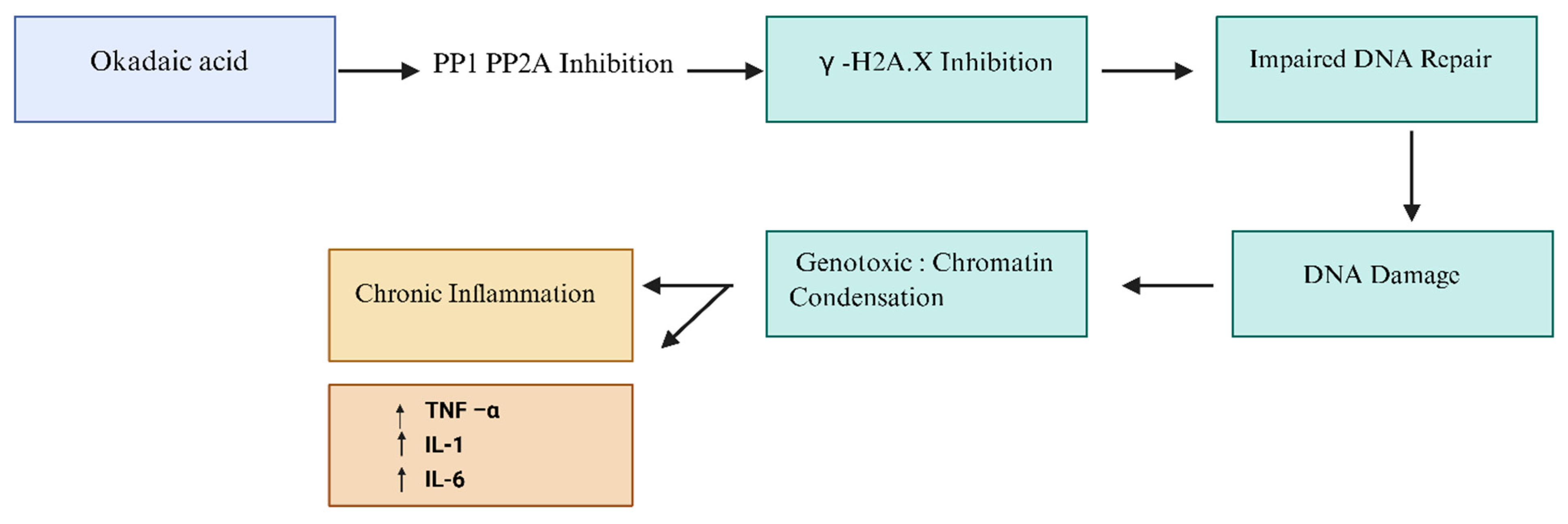
6. Genotoxicity and Immunotoxicity
7. Metabolism and Esterification of DST in Bivalves

| Species | Toxin Concentration | Exposure Route | Endpoint(s) | References |
|---|---|---|---|---|
| Mytilus galloprovincialis | 0.5–0.54 mg OA/g Organ/matrix: hepatopancreas (HP) | Oral uptake via contaminated microalgae/purified OA | Oxidative stress (↑ ROS), reduced SOD/catalase activity, lysosomal destabilization, immune suppression (hemocytes), impaired cellular homeostasis | [94] |
| Cerastoderma edule (cockle) | NR Organ/matrix: whole soft tissues | OA-contaminated seston ingestion | Rapid depuration; high esterification efficiency (>98% acyl derivatives) | [89,90] |
| Crassostrea gigas | 3 µg OA eq/mL Organ/matrix: hemocytes (in vitro exposure) | In vitro exposure (hemocytes) to OA/DTX | Programmed cell death (apoptosis/pyroptosis), caspase-1 and caspase-7 modulation, low cytotoxicity, high esterification efficiency, potential metabolic alterations | [56,67] |
| Scrobicularia plana | 2.1–1780 ng/L OA Organ/matrix: environmental water (water column) | Exposure to OA in the environment | Efficient esterification; limited accumulation | [88,89] |
| Patinopecten yessoensis | NR Organ/matrix: whole soft tissues | Natural exposure to Dinophysis toxins | Biotransformation of DTX-1 → DTX-3 (esterification) | [89] |
| Ilyanassa obsoleta | NR Organ/matrix: whole soft tissues | Exposure to environmental OA | Esterification capacity known; detoxification via DTX3 | [95] |
8. Ecotoxicological Effects of DSTs on Aquatic Organisms
9. Effects of DSTs on Marine Mammals
10. Detection Techniques
11. Perspectives
12. Conclusions
Author Contributions
Funding
Institutional Review Board Statement
Data Availability Statement
Conflicts of Interest
References
- Hallegraeff, G.M. Ocean Climate Change, Phytoplakton Community Reponses, and Harmful Algal Blooms: A Formidable Predictive Challenge. J. Phycol. 2010, 46, 220–235. [Google Scholar] [CrossRef]
- Leal, J.F.; Cristiano, M.L.S. Marine Paralytic Shellfish Toxins: Chemical Properties, Mode of Action, Newer Analogues, and Structure–Toxicity Relationship. Nat. Prod. Rep. 2022, 39, 33–57. [Google Scholar] [CrossRef] [PubMed]
- Van Egmond, H.P. Natural Toxins: Risks, Regulations and the Analytical Situation in Europe. Anal. Bioanal. Chem. 2004, 378, 1152–1160. [Google Scholar] [CrossRef] [PubMed]
- Berdalet, E.; Fleming, L.E.; Gowen, R.; Davidson, K.; Hess, P.; Backer, L.C.; Moore, S.K.; Hoagland, P.; Enevoldsen, H. Marine Harmful Algal Blooms, Human Health and Wellbeing: Challenges and Opportunities in the 21st Century. J. Mar. Biol. Assoc. U. K. 2016, 96, 61–91. [Google Scholar] [CrossRef]
- Trainer, V.; Moore, L.; Bill, B.; Adams, N.; Harrington, N.; Borchert, J.; Da Silva, D.; Eberhart, B.-T. Diarrhetic Shellfish Toxins and Other Lipophilic Toxins of Human Health Concern in Washington State. Mar. Drugs 2013, 11, 1815–1835. [Google Scholar] [CrossRef]
- Faggio, C.; Torre, A.; Lando, G.; Sabatino, G.; Trischitta, F. Carbonate Precipitates and Bicarbonate Secretion in the Intestine of Sea Bass, Dicentrarchus Labrax. J. Comp. Physiol. B 2011, 181, 517–525. [Google Scholar] [CrossRef]
- Messina, C.M.; Faggio, C.; Laudicella, V.A.; Sanfilippo, M.; Trischitta, F.; Santulli, A. Effect of Sodium Dodecyl Sulfate (SDS) on Stress Response in the Mediterranean Mussel (Mytilus galloprovincialis): Regulatory Volume Decrease (Rvd) and Modulation of Biochemical Markers Related to Oxidative Stress. Aquat. Toxicol. 2014, 157, 94–100. [Google Scholar] [CrossRef]
- Pagano, M.; Capillo, G.; Sanfilippo, M.; Palato, S.; Trischitta, F.; Manganaro, A.; Faggio, C. Evaluation of Functionality and Biological Responses of Mytilus galloprovincialis after Exposure to Quaternium-15 (Methenamine 3-Chloroallylochloride). Molecules 2016, 21, 144. [Google Scholar] [CrossRef]
- Yamochi, S.; Joh, H. Effects of Temperature on the Vegetative Cell Liberation of Seven Species of Red-Tide Algae from the Bottom Mud in Osaka Bay. J. Oceanogr. 1986, 42, 266–275. [Google Scholar] [CrossRef]
- Raven, J.A.; Geider, R.J. Temperature and Algal Growth. New Phytol. 1988, 110, 441–461. [Google Scholar] [CrossRef]
- FAO. The State of World Fisheries and Aquaculture 2020; FAO: Rome, Italy, 2020; ISBN 978-92-5-132692-3. [Google Scholar]
- European Commission, Joint Research Centre. Algal Bloom and Its Economic Impact; JRC Technical Reports; Publications Office of the European Union: Luxembourg, 2016. [Google Scholar]
- Gao, X.; Wang, H.; Chen, K.; Guo, Y.; Zhou, J.; Xie, W. Toxicological and Pharmacological Activities, and Potential Medical Applications, of Marine Algal Toxins. Int. J. Mol. Sci. 2024, 25, 9194. [Google Scholar] [CrossRef] [PubMed]
- Bialojan, C.; Takai, A. Inhibitory Effect of a Marine-Sponge Toxin, Okadaic Acid, on Protein Phosphatases. Specificity and Kinetics. Biochem. J. 1988, 256, 283–290. [Google Scholar] [CrossRef] [PubMed]
- Huang, L.; Zou, Y.; Weng, H.; Li, H.-Y.; Liu, J.-S.; Yang, W.-D. Proteomic Profile in Perna Viridis after Exposed to Prorocentrum lima, a Dinoflagellate Producing DSP Toxins. Environ. Pollut. 2015, 196, 350–357. [Google Scholar] [CrossRef]
- Yasumoto, T.; Murata, M.; Oshima, Y.; Sano, M.; Matsumoto, G.K.; Clardy, J. Diarrhetic Shellfish Toxins. Tetrahedron 1985, 41, 1019–1025. [Google Scholar] [CrossRef]
- Garibo, D.; De La Iglesia, P.; Diogène, J.; Campàs, M. Inhibition Equivalency Factors for Dinophysistoxin-1 and Dinophysistoxin-2 in Protein Phosphatase Assays: Applicability to the Analysis of Shellfish Samples and Comparison with LC-MS/MS. J. Agric. Food Chem. 2013, 61, 2572–2579. [Google Scholar] [CrossRef]
- Cembella, A.D.; Milenkovic, L.; Doucette, G.; Fernandez, M. In Vitro Biochemical Methods and Mammalian Mouse Bioassays for Phycotoxins. In Manual on Harmful Marine Microalgae; UNESCO Publishing: Paris, France, 1995; pp. 177–179. ISBN 92-3-103275-2. [Google Scholar]
- Alexander, J.; Benford, D.; Boobis, A.; Ceccatelli, S.; Cravedi, J.-P.; Di, A.; Doerge, D.; Dogliotti, E.; Edler, L.; Farmer, P.; et al. Marine Biotoxins in Shellfish—Summary on Regulated Marine Biotoxins; EFSA Journal; European Food Safety Authority (EFSA): Parma, Italy, 2009; pp. 1–23. [Google Scholar]
- Gerssen, A.; Pol-Hofstad, I.E.; Poelman, M.; Mulder, P.P.J.; Van Den Top, H.J.; De Boer, J. Marine Toxins: Chemistry, Toxicity, Occurrence and Detection, with Special Reference to the Dutch Situation. Toxins 2010, 2, 878–904. [Google Scholar] [CrossRef]
- Manita, D.; Alves, R.N.; Braga, A.C.; Fogaça, F.H.S.; Marques, A.; Costa, P.R. In Vitro Bioaccessibility of the Marine Biotoxins Okadaic Acid, Dinophysistoxin-2 and Their 7-O-Acyl Fatty Acid Ester Derivatives in Raw and Steamed Shellfish. Food Chem. Toxicol. 2017, 101, 121–127. [Google Scholar] [CrossRef]
- Souid, G.; Souayed, N.; Haouas, Z.; Maaroufi, K. Does the Phycotoxin Okadaic Acid Cause Oxidative Stress Damages and Histological Alterations to Seabream (Sparus aurata)? Toxicon 2018, 144, 55–60. [Google Scholar] [CrossRef]
- Ferron, P.-J.; Dumazeau, K.; Beaulieu, J.-F.; Le Hégarat, L.; Fessard, V. Combined Effects of Lipophilic Phycotoxins (Okadaic Acid, Azapsiracid-1 and Yessotoxin) on Human Intestinal Cells Models. Toxins 2016, 8, 50. [Google Scholar] [CrossRef]
- Kamat, P.K.; Tota, S.; Shukla, R.; Ali, S.; Najmi, A.K.; Nath, C. Mitochondrial Dysfunction: A Crucial Event in Okadaic Acid (ICV) Induced Memory Impairment and Apoptotic Cell Death in Rat Brain. Pharmacol. Biochem. Behav. 2011, 100, 311–319. [Google Scholar] [CrossRef]
- Del Campo, M.; Zhong, T.-Y.; Tampe, R.; García, L.; Lagos, N. Sublethal Doses of Dinophysistoxin-1 and Okadaic Acid Stimulate Secretion of Inflammatory Factors on Innate Immune Cells: Negative Health Consequences. Toxicon 2017, 126, 23–31. [Google Scholar] [CrossRef]
- Le Du, J.; Tovar-Ramírez, D.; Núñez-Vázquez, E.J. Embryotoxic Effects of Dissolved Okadaic Acid on the Development of Longfin Yellowtail Seriola Rivoliana. Aquat. Toxicol. 2017, 190, 210–216. [Google Scholar] [CrossRef]
- Prego-Faraldo, M.V.; Vieira, L.R.; Eirin-Lopez, J.M.; Méndez, J.; Guilhermino, L. Transcriptional and Biochemical Analysis of Antioxidant Enzymes in the Mussel Mytilus galloprovincialis during Experimental Exposures to the Toxic Dinoflagellate Prorocentrum lima. Mar. Environ. Res. 2017, 129, 304–315. [Google Scholar] [CrossRef]
- Thompson, E.J.; MacGowan, J.; Young, M.R.; Colburn, N.; Bowden, G.T. A Dominant Negative C-Jun Specifically Blocks Okadaic Acid-Induced Skin Tumor Promotion. Cancer Res. 2002, 62, 3044–3047. [Google Scholar]
- Fu, L.; Zhao, X.; Ji, L.; Xu, J. Okadaic Acid (OA): Toxicity, Detection and Detoxification. Toxicon 2019, 160, 1–7. [Google Scholar] [CrossRef]
- Valdiglesias, V.; Prego-Faraldo, M.; Pásaro, E.; Méndez, J.; Laffon, B. Okadaic Acid: More than a Diarrheic Toxin. Mar. Drugs 2013, 11, 4328–4349. [Google Scholar] [CrossRef]
- Vilariño, N.; Louzao, M.; Abal, P.; Cagide, E.; Carrera, C.; Vieytes, M.; Botana, L. Human Poisoning from Marine Toxins: Unknowns for Optimal Consumer Protection. Toxins 2018, 10, 324. [Google Scholar] [CrossRef]
- Park, J.B.; Cho, S.; Lee, S.Y.; Park, S.M.; Chun, H.S. Occurrence and Risk Assessment of Okadaic Acid, Dinophysistoxin-1, Dinophysistoxin-2, and Dinophysistoxin-3 in Seafood from South Korea. Environ. Sci. Pollut. Res. 2023, 31, 6243–6257. [Google Scholar] [CrossRef] [PubMed]
- Franchini, A.; Malagoli, D.; Ottaviani, E. Targets and Effects of Yessotoxin, Okadaic Acid and Palytoxin: A Differential Review. Mar. Drugs 2010, 8, 658–677. [Google Scholar] [CrossRef]
- Yuan, K.-K.; Li, H.-Y.; Yang, W.-D. Marine Algal Toxins and Public Health: Insights from Shellfish and Fish, the Main Biological Vectors. Mar. Drugs 2024, 22, 510. [Google Scholar] [CrossRef]
- Xing, Y.; Xu, Y.; Chen, Y.; Jeffrey, P.D.; Chao, Y.; Lin, Z.; Li, Z.; Strack, S.; Stock, J.B.; Shi, Y. Structure of Protein Phosphatase 2A Core Enzyme Bound to Tumor-Inducing Toxins. Cell 2006, 127, 341–353. [Google Scholar] [CrossRef]
- Swingle, M.R.; Amable, L.; Lawhorn, B.G.; Buck, S.B.; Burke, C.P.; Ratti, P.; Fischer, K.L.; Boger, D.L.; Honkanen, R.E. Structure-Activity Relationship Studies of Fostriecin, Cytostatin, and Key Analogs, with PP1, PP2A, PP5, and (Β12–Β13)-Chimeras (PP1/PP2A and PP5/PP2A), Provide Further Insight into the Inhibitory Actions of Fostriecin Family Inhibitors. J. Pharmacol. Exp. Ther. 2009, 331, 45–53. [Google Scholar] [CrossRef]
- Huhn, J.; Jeffrey, P.D.; Larsen, K.; Rundberget, T.; Rise, F.; Cox, N.R.; Arcus, V.; Shi, Y.; Miles, C.O. A Structural Basis for the Reduced Toxicity of Dinophysistoxin-2. Chem. Res. Toxicol. 2009, 22, 1782–1786. [Google Scholar] [CrossRef]
- Abal, P.; Louzao, M.C.; Cifuentes, J.M.; Vilariño, N.; Rodriguez, I.; Alfonso, A.; Vieytes, M.R.; Botana, L.M. Characterization of the Dinophysistoxin-2 Acute Oral Toxicity in Mice to Define the Toxicity Equivalency Factor. Food Chem. Toxicol. 2017, 102, 166–175. [Google Scholar] [CrossRef]
- Maynes, J.T.; Bateman, K.S.; Cherney, M.M.; Das, A.K.; Luu, H.A.; Holmes, C.F.B.; James, M.N.G. Crystal Structure of the Tumor-Promoter Okadaic Acid Bound to Protein Phosphatase-1. J. Biol. Chem. 2001, 276, 44078–44082. [Google Scholar] [CrossRef] [PubMed]
- Dounay, A.; Forsyth, C. Okadaic Acid: The Archetypal Serine/Threonine Protein Phosphatase Inhibitor. Curr. Med. Chem. 2002, 9, 1939–1980. [Google Scholar] [CrossRef] [PubMed]
- Honkanan, R.E.; Codispoti, B.A.; Tse, K.; Boynton, A.L. Characterization of Natural Toxins with Inhibitory Activity against Serine/Threonine Protein Phosphatases. Toxicon 1994, 32, 339–350. [Google Scholar] [CrossRef]
- Takai, A.; Murata, M.; Torigoe, K.; Isobe, M.; Mieskes, G.; Yasumoto, T. Inhibitory Effect of Okadaic Acid Derivatives on Protein Phosphatases. A Study on Structure-Affinity Relationship. Biochem. J. 1992, 284, 539–544. [Google Scholar] [CrossRef]
- Larsen, K.; Petersen, D.; Wilkins, A.L.; Samdal, I.A.; Sandvik, M.; Rundberget, T.; Goldstone, D.; Arcus, V.; Hovgaard, P.; Rise, F.; et al. Clarification of the C-35 Stereochemistries of Dinophysistoxin-1 and Dinophysistoxin-2 and Its Consequences for Binding to Protein Phosphatase. Chem. Res. Toxicol. 2007, 20, 868–875. [Google Scholar] [CrossRef]
- Louzao, M.C.; Abal, P.; Costas, C.; Suzuki, T.; Watanabe, R.; Vilariño, N.; Botana, A.M.; R Vieytes, M.; Botana, L.M. DSP Toxin Distribution across Organs in Mice after Acute Oral Administration. Mar. Drugs 2021, 19, 23. [Google Scholar] [CrossRef]
- Liu, Y.; Yuan, T.; Zheng, J.; Li, D.; Jiao, Y.; Li, H.; Li, R.; Yang, W. Exposure to Okadaic Acid Could Disrupt the Colonic Microenvironment in Rats. Ecotoxicol. Environ. Saf. 2023, 263, 115376. [Google Scholar] [CrossRef] [PubMed]
- Sosa, S.; Ardizzone, M.; Beltramo, D.; Vita, F.; Dell’Ovo, V.; Barreras, A.; Yasumoto, T.; Tubaro, A. Repeated Oral Co-Exposure to Yessotoxin and Okadaic Acid: A Short Term Toxicity Study in Mice. Toxicon 2013, 76, 94–102. [Google Scholar] [CrossRef] [PubMed]
- Dietrich, J.; Grass, I.; Günzel, D.; Herek, S.; Braeuning, A.; Lampen, A.; Hessel-Pras, S. The Marine Biotoxin Okadaic Acid Affects Intestinal Tight Junction Proteins in Human Intestinal Cells. Toxicol. Vitr. 2019, 58, 150–160. [Google Scholar] [CrossRef]
- Fujiki, H.; Sueoka, E.; Watanabe, T.; Suganuma, M. The Concept of the Okadaic Acid Class of Tumor Promoters Is Revived in Endogenous Protein Inhibitors of Protein Phosphatase 2A, SET and CIP2A, in Human Cancers. J. Cancer Res. Clin. Oncol. 2018, 144, 2339–2349. [Google Scholar] [CrossRef]
- Jiao, Y.; Wang, G.; Li, D.; Li, H.; Liu, J.; Yang, X.; Yang, W. Okadaic Acid Exposure Induced Neural Tube Defects in Chicken (Gallus gallus) Embryos. Mar. Drugs 2021, 19, 322. [Google Scholar] [CrossRef]
- Topal, A.; Oğuş, H.; Sulukan, E.; Comaklı, S.; Ceyhun, S.B. Okadaic Acid Enhances NfKB, TLR-4, Caspase 3, ERK ½, c-FOS, and 8-OHdG Signaling Pathways Activation in Brain Tissues of Zebrafish Larvae. Fish Shellfish Immunol. 2024, 149, 109529. [Google Scholar] [CrossRef]
- Huang, H.; Huang, A.; Zhuang, Z.; Huang, W.; Fu, Y.; Peng, C.; Liu, J. Study of Cytoskeletal Changes Induced by Okadaic Acid in HL-7702 Liver Cells and Development of a Fluorimetric Microplate Assay for Detecting Diarrhetic Shellfish Poisoning. Environ. Toxicol. 2013, 28, 98–106. [Google Scholar] [CrossRef]
- Jiao, Y.; Dou, M.; Wang, G.; Li, H.; Liu, J.; Yang, X.; Yang, W. Exposure of Okadaic Acid Alters the Angiogenesis in Developing Chick Embryos. Toxicon 2017, 133, 74–81. [Google Scholar] [CrossRef]
- Opsahl, J.; Ljostveit, S.; Solstad, T.; Risa, K.; Roepstorff, P.; Fladmark, K. Identification of Dynamic Changes in Proteins Associated with the Cellular Cytoskeleton after Exposure to Okadaic Acid. Mar. Drugs 2013, 11, 1763–1782. [Google Scholar] [CrossRef]
- Ferron, P.-J.; Hogeveen, K.; Fessard, V.; Hégarat, L. Comparative Analysis of the Cytotoxic Effects of Okadaic Acid-Group Toxins on Human Intestinal Cell Lines. Mar. Drugs 2014, 12, 4616–4634. [Google Scholar] [CrossRef]
- Chi, C.; Giri, S.; Jun, J.; Kim, H.; Yun, S.; Kim, S.; Park, S. Marine Toxin Okadaic Acid Affects the Immune Function of Bay Scallop (Argopecten irradians). Molecules 2016, 21, 1108. [Google Scholar] [CrossRef]
- Ehlers, A.; Scholz, J.; These, A.; Hessel, S.; Preiss-Weigert, A.; Lampen, A. Analysis of the Passage of the Marine Biotoxin Okadaic Acid through an in Vitro Human Gut Barrier. Toxicology 2011, 279, 196–202. [Google Scholar] [CrossRef] [PubMed]
- Liu, Y.; Xu, S.; Cai, Q.; Li, D.; Li, H.; Yang, W. In Vitro Interactions between Okadaic Acid and Rat Gut Microbiome. Mar. Drugs 2022, 20, 556. [Google Scholar] [CrossRef]
- Liu, Y.; Lu, Y.; Jiao, Y.-H.; Li, D.-W.; Li, H.-Y.; Yang, W.-D. Multi-Omics Analysis Reveals Metabolism of Okadaic Acid in Gut Lumen of Rat. Arch. Toxicol. 2022, 96, 831–843. [Google Scholar] [CrossRef]
- Emery, H.; Traves, W.; Rowley, A.F.; Coates, C.J. The Diarrhetic Shellfish-Poisoning Toxin, Okadaic Acid, Provokes Gastropathy, Dysbiosis and Susceptibility to Bacterial Infection in a Non-Rodent Bioassay, Galleria mellonella. Arch. Toxicol. 2021, 95, 3361–3376. [Google Scholar] [CrossRef]
- Yang, Y.; Li, A.; Qiu, J.; Gao, D.; Yin, C.; Li, D.; Yan, W.; Dang, H.; Li, P.; Wu, R.; et al. Responses of the Intestinal Microbiota to Exposure of Okadaic Acid in Marine Medaka Oryzias melastigma. J. Hazard. Mater. 2024, 465, 133087. [Google Scholar] [CrossRef]
- Yi, K.D.; Covey, D.F.; Simpkins, J.W. Mechanism of Okadaic Acid-induced Neuronal Death and the Effect of Estrogens. J. Neurochem. 2009, 108, 732–740. [Google Scholar] [CrossRef]
- Fuster-Matanzo, A.; Hernández, F.; Ávila, J. Tau Spreading Mechanisms; Implications for Dysfunctional Tauopathies. Int. J. Mol. Sci. 2018, 19, 645. [Google Scholar] [CrossRef]
- Chen, X.; Jiang, S. Maduramicin-Activated Protein Phosphatase 2A Results in Extracellular Signal-Regulated Kinase 1/2 Inhibition, Leading to Cytotoxicity in Myocardial H9c2 Cells. Toxicol. Lett. 2018, 284, 96–102. [Google Scholar] [CrossRef]
- Kamat, P.K.; Rai, S.; Swarnkar, S.; Shukla, R.; Nath, C. Molecular and Cellular Mechanism of Okadaic Acid (OKA)-Induced Neurotoxicity: A Novel Tool for Alzheimer’s Disease Therapeutic Application. Mol. Neurobiol. 2014, 50, 852–865. [Google Scholar] [CrossRef] [PubMed]
- Çakır, M.; Tekin, S.; Doğanyiğit, Z.; Erden, Y.; Soytürk, M.; Çiğremiş, Y.; Sandal, S. Cannabinoid Type 2 Receptor Agonist JWH-133, Attenuates Okadaic Acid Induced Spatial Memory Impairment and Neurodegeneration in Rats. Life Sci. 2019, 217, 25–33. [Google Scholar] [CrossRef]
- Chighladze, M.; Beselia, G.; Burjanadze, M.; Dashniani, M. Recognition Memory Impairment and Neuronal Degeneration Induced by Intracerebroventricular or Intrahippocampal Administration of Okadaic Acid. Eur. Neuropsychopharmacol. 2019, 29, S254–S255. [Google Scholar] [CrossRef]
- Koehler, D.; Williams, F. Utilizing Zebrafish and Okadaic Acid to Study Alzheimer’s Disease. Neural Regen. Res. 2018, 13, 1538. [Google Scholar] [CrossRef]
- Del Barrio, L.; Martín-de-Saavedra, M.D.; Romero, A.; Parada, E.; Egea, J.; Avila, J.; McIntosh, J.M.; Wonnacott, S.; López, M.G. Neurotoxicity Induced by Okadaic Acid in the Human Neuroblastoma SH-SY5Y Line Can Be Differentially Prevented by A7 and B2* Nicotinic Stimulation. Toxicol. Sci. 2011, 123, 193–205. [Google Scholar] [CrossRef]
- Baker, S.; Götz, J. A Local Insult of Okadaic Acid in Wild-Type Mice Induces Tau Phosphorylation and Protein Aggregation in Anatomically Distinct Brain Regions. Acta Neuropathol. Commun. 2016, 4, 32. [Google Scholar] [CrossRef]
- Wang, D.; Zhang, Y.; Yang, Y.; Tang, Y.; Liu, Y.; Shen, H.; Li, X.; Wang, L.; Lu, F. Toxic Effects of Environmental Biotoxin Okadaic Acid by Network Toxicology Analysis and Deep Learning Prediction. Aquat. Toxicol. 2025, 289, 107578. [Google Scholar] [CrossRef] [PubMed]
- Casarini, L.; Franchini, A.; Malagoli, D.; Ottaviani, E. Evaluation of the Effects of the Marine Toxin Okadaic Acid by Using FETAX Assay. Toxicol. Lett. 2007, 169, 145–151. [Google Scholar] [CrossRef]
- Escoffier, N.; Gaudin, J.; Mezhoud, K.; Huet, H.; Chateau-Joubert, S.; Turquet, J.; Crespeau, F.; Edery, M. Toxicity to Medaka Fish Embryo Development of Okadaic Acid and Crude Extracts of Prorocentrum Dinoflagellates. Toxicon 2007, 49, 1182–1192. [Google Scholar] [CrossRef] [PubMed]
- Jiao, Y.; Liu, M.; Wang, G.; Li, H.; Liu, J.; Yang, X.; Yang, W. EMT Is the Major Target for Okadaic Acid-Suppressed the Development of Neural Crest Cells in Chick Embryo. Ecotoxicol. Environ. Saf. 2019, 180, 192–201. [Google Scholar] [CrossRef]
- Matias, W.G.; Traore, A.; Creppy, E.E. Variations in the Distribution of Okadaic Acid in Organs and Biological Fluids of Mice Related to Diarrhoeic Syndrome. Hum. Exp. Toxicol. 1999, 18, 345–350. [Google Scholar] [CrossRef]
- Vale, C.; Botana, L.M. Marine Toxins and the Cytoskeleton: Okadaic Acid and Dinophysistoxins. FEBS J. 2008, 275, 6060–6066. [Google Scholar] [CrossRef]
- Franchini, A.; Marchesini, E.; Poletti, R.; Ottaviania, E. Swiss Mice CD1 Fed on Mussels Contaminated by Okadaic Acid and Yessotoxins: Effects on Thymus and Spleen. Eur. J. Histochem. 2005, 49, 179–188. [Google Scholar]
- Danielsen, E.M.; Hansen, G.H.; Severinsen, M.C.K. Okadaic Acid: A Rapid Inducer of Lamellar Bodies in Small Intestinal Enterocytes. Toxicon 2014, 88, 77–87. [Google Scholar] [CrossRef] [PubMed]
- Blanco, J.; Estévez-Calvar, N.; Martín, H. Excretion Routes of Okadaic Acid and Dinophysistoxin-2 from Mussels (Mytilus galloprovincialis) and Cockles (Cerastoderma edule). Toxins 2025, 17, 128. [Google Scholar] [CrossRef]
- Gooding, M.P.; LeBlanc, G.A. Biotransformation and Disposition of Testosterone in the Eastern Mud Snail Ilyanassa Obsoleta. Gen. Comp. Endocrinol. 2001, 122, 172–180. [Google Scholar] [CrossRef]
- Janer, G.; Mesia-Vela, S.; Porte, C.; Kauffman, F.C. Esterification of Vertebrate-Type Steroids in the Eastern Oyster (Crassostrea virginica). Steroids 2004, 69, 129–136. [Google Scholar] [CrossRef] [PubMed]
- Konoki, K.; Onoda, T.; Watanabe, R.; Cho, Y.; Kaga, S.; Suzuki, T.; Yotsu-Yamashita, M. In Vitro Acylation of Okadaic Acid in the Presence of Various Bivalves’ Extracts. Mar. Drugs 2013, 11, 300–315. [Google Scholar] [CrossRef]
- Labadie, P.; Peck, M.; Minier, C.; Hill, E.M. Identification of the Steroid Fatty Acid Ester Conjugates Formed in Vivo in Mytilus edulis as a Result of Exposure to Estrogens. Steroids 2007, 72, 41–49. [Google Scholar] [CrossRef]
- Qiu, J.; Ji, Y.; Fang, Y.; Zhao, M.; Wang, S.; Ai, Q.; Li, A. Response of Fatty Acids and Lipid Metabolism Enzymes during Accumulation, Depuration and Esterification of Diarrhetic Shellfish Toxins in Mussels (Mytilus galloprovincialis). Ecotoxicol. Environ. Saf. 2020, 206, 111223. [Google Scholar] [CrossRef]
- Kameneva, P.; Krasheninina, E.; Slobodskova, V.; Kukla, S.; Orlova, T. Accumulation and Tissue Distribution of Dinophysitoxin-1 and Dinophysitoxin-3 in the Mussel Crenomytilus grayanus Feeding on the Benthic Dinoflagellate Prorocentrum foraminosum. Mar. Drugs 2017, 15, 330. [Google Scholar] [CrossRef]
- Vale, P. Profiles of Fatty Acids and 7-O-Acyl Okadaic Acid Esters in Bivalves: Can Bacteria Be Involved in Acyl Esterification of Okadaic Acid? Comp. Biochem. Physiol. Part C Toxicol. Pharmacol. 2010, 151, 18–24. [Google Scholar] [CrossRef]
- Rossignoli, A.E.; Fernández, D.; Regueiro, J.; Mariño, C.; Blanco, J. Esterification of Okadaic Acid in the Mussel Mytilus galloprovincialis. Toxicon 2011, 57, 712–720. [Google Scholar] [CrossRef]
- Suzuki, T.; Kamiyama, T.; Okumura, Y.; Ishihara, K.; Matsushima, R.; Kaneniwa, M. Liquid-Chromatographic Hybrid Triple–Quadrupole Linear-Ion-Trap MS/MS Analysis of Fatty-Acid Esters of Dinophysistoxin-1 in Bivalves and Toxic Dinoflagellates in Japan. Fish. Sci. 2009, 75, 1039–1048. [Google Scholar] [CrossRef]
- Torgersen, T.; Lindegarth, S.; Ungfors, A.; Sandvik, M. Profiles and Levels of Fatty Acid Esters of Okadaic Acid Group Toxins and Pectenotoxins during Toxin Depuration, Part I: Brown Crab (Cancer pagurus). Toxicon 2008, 52, 407–417. [Google Scholar] [CrossRef]
- Vale, P. Detailed Profiles of 7-O-Acyl Esters in Plankton and Shellfish from the Portuguese Coast. J. Chromatogr. A 2006, 1128, 181–188. [Google Scholar] [CrossRef] [PubMed]
- Torgersen, T.; Aasen, J.; Aune, T. Diarrhetic Shellfish Poisoning by Okadaic Acid Esters from Brown Crabs (Cancer pagurus) in Norway. Toxicon 2005, 46, 572–578. [Google Scholar] [CrossRef]
- Torgersen, T.; Miles, C.O.; Rundberget, T.; Wilkins, A.L. New Esters of Okadaic Acid in Seawater and Blue Mussels (Mytilus edulis). J. Agric. Food Chem. 2008, 56, 9628–9635. [Google Scholar] [CrossRef]
- Marielle, G.; Arne, D.; Claire, M.; Laurent, B.; Aasen, J.A.B. A First Approach to Localizing Biotoxins in Mussel Digestive Glands. In Proceedings of the ICMSS09—International Conference, Nantes, France, 14–19 June 2009; Symposcience/Ifremer: Nantes, France, 2009; pp. 1–9. [Google Scholar]
- Kingtong, S.; Chitramvong, Y.; Janvilisri, T. ATP-Binding Cassette Multidrug Transporters in Indian-Rock Oyster Saccostrea Forskali and Their Role in the Export of an Environmental Organic Pollutant Tributyltin. Aquat. Toxicol. 2007, 85, 124–132. [Google Scholar] [CrossRef]
- Prego-Faraldo, M.V.; Valdiglesias, V.; Laffon, B.; Eirín-López, J.M.; Méndez, J. In Vitro Analysis of Early Genotoxic and Cytotoxic Effects of Okadaic Acid in Different Cell Types of the Mussel Mytilus galloprovincialis. J. Toxicol. Environ. Health A 2015, 78, 814–824. [Google Scholar] [CrossRef]
- Quilliam, M.A.; Reeves, K.; MacKinnon, S.L.; Craft, C.; Walter, J.A.; Stobo, L.; Gallacher, S. Preparation of reference materials for azaspiracids. In Proceedings of the 5th International Conference on Molluscan Shellfish Safety, Galway, Ireland, 14–18 June 2004; Ifremer/Symposcience: Nantes, France, 2006; pp. 111–115. [Google Scholar]
- Corriere, M.; Soliño, L.; Costa, P.R. Effects of the Marine Biotoxins Okadaic Acid and Dinophysistoxins on Fish. J. Mar. Sci. Eng. 2021, 9, 293. [Google Scholar] [CrossRef]
- Figueroa, D.; Ríos, J.; Araneda, O.; Contreras, H.; Concha, M.; García, C. Oxidative Stress Parameters and Morphological Changes in Japanese Medaka (Oryzias latipes) after Acute Exposure to OA-Group Toxins. Life 2022, 13, 15. [Google Scholar] [CrossRef]
- Silva, M.; Barreiro, A.; Rodriguez, P.; Otero, P.; Azevedo, J.; Alfonso, A.; Botana, L.; Vasconcelos, V. New Invertebrate Vectors for PST, Spirolides and Okadaic Acid in the North Atlantic. Mar. Drugs 2013, 11, 1936–1960. [Google Scholar] [CrossRef]
- Song, H.; Dong, M.; Wei, L.; Zhang, Y.; Huang, H.; Chu, X.; Wang, X. Short-Term Exposure to Okadaic Acid Induces Behavioral and Physiological Responses in Sea Urchin (Strongylocentrotus intermedius). Mar. Environ. Res. 2024, 202, 106823. [Google Scholar] [CrossRef]
- Mafra, L.L.; Nolli, P.K.W.; Mota, L.E.; Domit, C.; Soeth, M.; Luz, L.F.G.; Sobrinho, B.F.; Leal, J.G.; Di Domenico, M. Multi-Species Okadaic Acid Contamination and Human Poisoning during a Massive Bloom of Dinophysis Acuminata Complex in Southern Brazil. Harmful Algae 2019, 89, 101662. [Google Scholar] [CrossRef]
- Prego-Faraldo, M.; Valdiglesias, V.; Méndez, J.; Eirín-López, J. Okadaic Acid Meet and Greet: An Insight into Detection Methods, Response Strategies and Genotoxic Effects in Marine Invertebrates. Mar. Drugs 2013, 11, 2829–2845. [Google Scholar] [CrossRef] [PubMed]
- Vale, P.; Sampayo, M.A.d.M. First Confirmation of Human Diarrhoeic Poisonings by Okadaic Acid Esters after Ingestion of Razor Clams (Solen marginatus) and Green Crabs (Carcinus maenas) in Aveiro Lagoon, Portugal and Detection of Okadaic Acid Esters in Phytoplankton. Toxicon 2002, 40, 989–996. [Google Scholar] [CrossRef] [PubMed]
- Jørgensen, K.; Cold, U.; Fischer, K. Accumulation and Depuration of Okadaic Acid Esters in the European Green Crab (Carcinus maenas) during a Feeding Study. Toxicon 2008, 51, 468–472. [Google Scholar] [CrossRef] [PubMed]
- Castro-Ferreira, M.P.; Roelofs, D.; Van Gestel, C.A.M.; Verweij, R.A.; Soares, A.M.V.M.; Amorim, M.J.B. Enchytraeus Crypticus as Model Species in Soil Ecotoxicology. Chemosphere 2012, 87, 1222–1227. [Google Scholar] [CrossRef]
- Nielsen, P.; Krock, B.; Hansen, P.J.; Vismann, B. Effects of the DSP-Toxic Dinoflagellate Dinophysis Acuta on Clearance and Respiration Rate of the Blue Mussel, Mytilus edulis. PLoS ONE 2020, 15, e0230176. [Google Scholar] [CrossRef]
- Campos, A.; Freitas, M.; De Almeida, A.M.; Martins, J.C.; Domínguez-Pérez, D.; Osório, H.; Vasconcelos, V.; Reis Costa, P. OMICs Approaches in Diarrhetic Shellfish Toxins Research. Toxins 2020, 12, 493. [Google Scholar] [CrossRef]
- Fire, S.E.; Wang, Z.; Byrd, M.; Whitehead, H.R.; Paternoster, J.; Morton, S.L. Co-Occurrence of Multiple Classes of Harmful Algal Toxins in Bottlenose Dolphins (Tursiops truncatus) Stranding during an Unusual Mortality Event in Texas, USA. Harmful Algae 2011, 10, 330–336. [Google Scholar] [CrossRef]
- Broadwater, M.H.; Van Dolah, F.M.; Fire, S.E. Marine Mammal Vulnerabilities to Harmful Algal Blooms in the U.S. Atlantic and Gulf of Mexico; NOAA Technical Memorandum NOS NCCOS 223; NOAA National Ocean Service: Charleston, SC, USA, 2018; pp. 1–24. [Google Scholar]
- Bosch-Orea, C.; Sanchís, J.; Farré, M.; Barceló, D. Analysis of Lipophilic Marine Biotoxins by Liquid Chromatography Coupled with High-Resolution Mass Spectrometry in Seawater from the Catalan Coast. Anal. Bioanal. Chem. 2017, 409, 5451–5462. [Google Scholar] [CrossRef]
- Zou, L.; Tian, Y.; Zhang, X.; Fang, J.; Hu, N.; Wang, P. A Competitive Love Wave Immunosensor for Detection of Okadaic Acid Based on Immunogold Staining Method. Sens. Actuators B Chem. 2017, 238, 1173–1180. [Google Scholar] [CrossRef]
- Garibo, D.; Campbell, K.; Casanova, A.; De La Iglesia, P.; Fernández-Tejedor, M.; Diogène, J.; Elliott, C.T.; Campàs, M. SPR Immunosensor for the Detection of Okadaic Acid in Mussels Using Magnetic Particles as Antibody Carriers. Sens. Actuators B Chem. 2014, 190, 822–828. [Google Scholar] [CrossRef]
- Hendrickson, O.D.; Zvereva, E.A.; Zherdev, A.V.; Dzantiev, B.B. Cascade-Enhanced Lateral Flow Immunoassay for Sensitive Detection of Okadaic Acid in Seawater, Fish, and Seafood. Foods 2022, 11, 1691. [Google Scholar] [CrossRef]
- Wang, R.; Zeng, L.; Yang, H.; Zhong, Y.; Wang, J.; Ling, S.; Saeed, A.F.; Yuan, J.; Wang, S. Detection of Okadaic Acid (OA) Using ELISA and Colloidal Gold Immunoassay Based on Monoclonal Antibody. J. Hazard. Mater. 2017, 339, 154–160. [Google Scholar] [CrossRef]
- Poole, C.F.; Poole, S.K.; Abraham, M.H. Recommendations for the Determination of Selectivity in Micellar Electrokinetic Chromatography. J. Chromatogr. A 1998, 798, 207–222. [Google Scholar] [CrossRef]
- Soliño, L.; Sureda, F.X.; Diogène, J. Evaluation of Okadaic Acid, Dinophysistoxin-1 and Dinophysistoxin-2 Toxicity on Neuro-2a, NG108-15 and MCF-7 Cell Lines. Toxicol. Vitr. 2015, 29, 59–62. [Google Scholar] [CrossRef]
- Louppis, A.P.; Badeka, A.V.; Katikou, P.; Paleologos, E.K.; Kontominas, M.G. Determination of Okadaic Acid, Dinophysistoxin-1 and Related Esters in Greek Mussels Using HPLC with Fluorometric Detection, LC-MS/MS and Mouse Bioassay. Toxicon 2010, 55, 724–733. [Google Scholar] [CrossRef]
- Chen, H.; Zhang, W.; Liu, G.; Ding, Q.; Xu, J.; Fang, M.; Zhang, L. Highly Sensitive Detection of Okadaic Acid in Seawater by Magnetic Solid-Phase Extraction Based on Low-Cost Metal/Nitrogen-Doped Carbon Nanotubes. J. Chromatogr. A 2023, 1689, 463772. [Google Scholar] [CrossRef]
- Heredia-Tapia, A.; Arredondo-Vega, B.O.; NunÄez-VaÂzquez, E.J.; Yasumoto, T.; Yasuda, M.; Ochoa, J.L. Isolation of Prorocentrum lima (Syn. Exuviaella lima) and Diarrhetic Shellfish Poisoning (DSP) Risk Assessment in the Gulf of California, Mexico. Toxicon 2002, 40, 1121–1127. [Google Scholar] [CrossRef]
- Sivonen, K.; Namikoshi, M.; Evans, W.R.; Fardig, M.; Carmichael, W.W.; Rinehart, K.L. Three New Microcystins, Cyclic Heptapeptide Hepatotoxins, from Nostoc sp. Strain 152. Chem. Res. Toxicol. 1992, 5, 464–469. [Google Scholar] [CrossRef]
- Bouaïcha, N.; Hennion, M.-C.; Sandra, P. Determination of Okadaic Acid by Micellar Electrokinetic Chromatography with Ultraviolet Detection. Toxicon 1997, 35, 273–281. [Google Scholar] [CrossRef]


| Techniques | Advantages | Disadvantages | Limit of Detection LOD | Limit of Quantification LOQ | References |
|---|---|---|---|---|---|
| LC-MS/MS (Liquid Chromatography–Tandem Mass Spectrometry) | High sensitivity and specificity; accurate quantification of OA and analogs; standard in regulatory monitoring programs; applicable to various matrices | Requires expensive instrumentation and skilled personnel; non-portable; complex sample pretreatment often needed. | 0.045 mg/g HP (OA)/5–10 ng/g (tissues)/0.2 ng/mL | 0.135 mg/g HP (OA)/1.3 ng/mL | [87] |
| HRMS (High-Resolution Mass Spectrometry) | Accurate mass determination analysis; enables untargeted screening and identification of novel analogs; valuable in research and environmental surveys | High costs; complex data analysis; less suitable for routine large-scale monitoring | 5 fg (column); 0.4 ng/L (particulate); 0.3 ng/L (seawater) | 15 fg (column); 1 ng/L (particulate/seawater) | [4,109] |
| Biosensors/Immunosensors/SPR | Rapid and on-site detection; field-deployable; cost-effective; adaptable detection modalities, allows diverse detection modalities (optical, electrochemical, luminescent) | Lower sensitivity compared to LC-MS/MS; potential cross-reactivity; requires validation for complex samples; may suffer from environmental stability | 2.6 ng/mL (=2.6 µg/L) | ND | [110,111] |
| ELISA (Enzyme-Linked Immunosorbent Assay) | Cost-effective and sensitive; enables high-throughput screening; simple execution | Cannot differentiate toxin analogs; potential false positives; results dependent on antibody specificity | 12 pg/mL | ND | [112,113] |
| RIA (Radioimmunoassay) | High sensitivity; suitable for quantitative analysis of toxins | Uses radioactive materials with regulatory and disposal constraints decreasing use due to safety concerns. | ~1 ng/mL | ND | [114] |
| MBA (Mouse Bioassay) | Historically reliable; indicates overall toxicity profile without complex equipment | Low sensitivity and reproducibility; ethical concerns; unable to distinguish toxin types; time-consuming | 20 µg OA/kg | ND | [115] |
| HPLC (High-Performance Liquid Chromatography) | Precise quantification; suitable for routine monitoring; highly accurate and applicable for routine monitoring; requires only small sample volumes | Requires toxin standard; limited multiplexing; no specific detectors; costly instrumentation | 0.015 mg/g HP | 0.015 mg/g HP | [116,117] |
| TLC (Thin-Layer Chromatography) | Simple; low-cost; no need for advanced method; useful for qualitative analysis | Low sensitivity and specificity; not suitable for quantification; labor-intensive and prone to subjective interpretation | ND | ND | [118] |
| MEKC (Micellar Electrokinetic Chromatography) | Fast and efficient separation; low sample and reagent consumption; can separate neutral and charged analytes | Sensitive to variations in buffer composition and temperature; limited handling of complex biological samples | 40 pg (on-column); ~10 ng/g in mussel tissue | ND | [119,120] |
| GC (Gas Chromatography) | High sensitivity and accuracy for volatile and derivatized toxins; robust analytical method | Requires derivatization for non-volatile toxins; high cost; complex data interpretation; potential false positives if preparation is inadequate | ~50 ng (after derivatization; low sensitivity) | ND | [119] |
Disclaimer/Publisher’s Note: The statements, opinions and data contained in all publications are solely those of the individual author(s) and contributor(s) and not of MDPI and/or the editor(s). MDPI and/or the editor(s) disclaim responsibility for any injury to people or property resulting from any ideas, methods, instructions or products referred to in the content. |
© 2025 by the authors. Licensee MDPI, Basel, Switzerland. This article is an open access article distributed under the terms and conditions of the Creative Commons Attribution (CC BY) license.
Share and Cite
Bouda, H.; El Bourki, R.; Fattah, A.; Takati, N. Diarrhetic Shellfish Poisoning Toxins: Current Insights into Toxicity, Mechanisms, and Ecological Impacts. Mar. Drugs 2026, 24, 9. https://doi.org/10.3390/md24010009
Bouda H, El Bourki R, Fattah A, Takati N. Diarrhetic Shellfish Poisoning Toxins: Current Insights into Toxicity, Mechanisms, and Ecological Impacts. Marine Drugs. 2026; 24(1):9. https://doi.org/10.3390/md24010009
Chicago/Turabian StyleBouda, Hajar, Rajae El Bourki, Abderrazzak Fattah, and Nadia Takati. 2026. "Diarrhetic Shellfish Poisoning Toxins: Current Insights into Toxicity, Mechanisms, and Ecological Impacts" Marine Drugs 24, no. 1: 9. https://doi.org/10.3390/md24010009
APA StyleBouda, H., El Bourki, R., Fattah, A., & Takati, N. (2026). Diarrhetic Shellfish Poisoning Toxins: Current Insights into Toxicity, Mechanisms, and Ecological Impacts. Marine Drugs, 24(1), 9. https://doi.org/10.3390/md24010009