Long Term Outcomes and Predictors of Reverse Remodelling After Cardiac Resynchronization Therapy Upgrade

 , ,
, ,
Abstract
1. Introduction
2. Materials and Methods
2.1. Study Population
2.2. Data Collection
2.3. Outcomes and Definitions
2.4. Statistical Analysis
3. Results
3.1. Patient Characteristics
3.2. Long-Term Clinical Outcomes
3.3. Clinical, Laboratory, and Imaging Outcomes
3.4. Subgroup Comparison
3.5. Safety Outcomes
4. Discussion
5. Conclusions
Supplementary Materials
Author Contributions
Funding
Institutional Review Board Statement
Informed Consent Statement
Data Availability Statement
Acknowledgments
Conflicts of Interest
Abbreviations
| CRT | cardiac resynchronization therapy |
| CRT-P | cardiac resynchronization therapy with pacemaker |
| CRT-D | cardiac resynchronization therapy with defibrillator |
| LVEF | left ventricular ejection fraction |
| PICMP | Pacing-induced cardiomyopathy |
| ICD | implantable cardioverter–defibrillator |
| HF | heart failure |
| RV | right ventricular |
| ICMP | ischemic cardiomyopathy |
| NYHA | New York Heart Association |
| ECG | electrocardiogram |
| LV | left ventricular |
| NICMP | non-ischemic cardiomyopathy |
| IQR | interquartile range |
| LVEDD | left ventricular end-diastolic diameter |
| MR | mitral regurgitation |
| TR | tricuspid regurgitation |
References
- Linde, C.M.; Normand, C.; Bogale, N.; Auricchio, A.; Sterlinski, M.; Marinskis, G.; Sticherling, C.; Bulava, A.; Pérez, Ó.C.; Maass, A.H.; et al. Upgrades from a previous device compared to de novo cardiac resynchronization therapy in the European Society of Cardiology CRT Survey II: Upgrade vs. de novo CRT implantation. Eur. J. Heart Fail. 2018, 20, 1457–1468. [Google Scholar] [CrossRef]
- Glikson, M.; Nielsen, J.C.; Kronborg, M.B.; Michowitz, Y.; Auricchio, A.; Barbash, I.M.; Barrabés, J.A.; Boriani, G.; Braunschweig, F.; Brignole, M.; et al. 2021 ESC Guidelines on cardiac pacing and cardiac resynchronization therapy. Eur. Heart J. 2021, 42, 3427–3520. [Google Scholar] [CrossRef]
- Andersen, H.R.; Nielsen, J.C.; Thomsen, P.E.B.; Thuesen, L.; Mortensen, P.T.; Vesterlund, T.; Pedersen, A.K. Long-term follow-up of patients from a randomised trial of atrial versus ventricular pacing for sick-sinus syndrome. Lancet 1997, 350, 1210–1216. [Google Scholar] [CrossRef]
- Nielsen, J.C.; Andersen, H.R.; Thomsen, P.E.B.; Thuesen, L.; Mortensen, P.T.; Vesterlund, T.; Pedersen, A.K. Heart Failure and Echocardiographic Changes During Long-term Follow-up of Patients With Sick Sinus Syndrome Randomized to Single-Chamber Atrial or Ventricular Pacing. Circulation 1998, 97, 987–995. [Google Scholar] [CrossRef] [PubMed]
- Lamas, G.A.; Lee, K.L.; Sweeney, M.O.; Silverman, R.; Leon, A.; Yee, R.; Marinchak, R.A.; Flaker, G.; Schron, E.; Orav, E.J.; et al. Ventricular Pacing or Dual-Chamber Pacing for Sinus-Node Dysfunction. N. Engl. J. Med. 2002, 346, 1854–1862. [Google Scholar] [CrossRef]
- The DAVID Trial Investigators*. Dual-Chamber Pacing or Ventricular Backup Pacing in Patients With an Implantable Defibrillator: The Dual Chamber and VVI Implantable Defibrillator (DAVID) Trial. JAMA 2002, 288, 3115. [CrossRef]
- Khurshid, S.; Obeng-Gyimah, E.; Supple, G.E.; Schaller, R.; Lin, D.; Owens, A.T.; Epstein, A.E.; Dixit, S.; Marchlinski, F.E.; Frankel, D.S.; et al. Reversal of Pacing-Induced Cardiomyopathy Following Cardiac Resynchronization Therapy. JACC Clin. Electrophysiol. 2018, 4, 168–177. [Google Scholar] [CrossRef] [PubMed]
- Cherian, T.S.; Upadhyay, G.A. Right Ventricular Pacing and Cardiac Resynchronization Devices. Card. Electrophysiol. Clin. 2018, 10, 31–42. [Google Scholar] [CrossRef]
- Merchant, F.M.; Mittal, S. Pacing induced cardiomyopathy. J. Cardiovasc. Electrophysiol. 2020, 31, 286–292. [Google Scholar] [CrossRef] [PubMed]
- Somma, V.; Ha, F.J.; Palmer, S.; Mohamed, U.; Agarwal, S. Pacing-induced cardiomyopathy: A systematic review and meta-analysis of definition, prevalence, risk factors, and management. Heart Rhythm 2023, 20, 282–290. [Google Scholar] [CrossRef]
- St John Sutton, M.G.; Plappert, T.; Hilpisch, K.E.; Abraham, W.T.; Hayes, D.L.; Chinchoy, E. Sustained Reverse Left Ventricular Structural Remodeling With Cardiac Resynchronization at One Year Is a Function of Etiology: Quantitative Doppler Echocardiographic Evidence From the Multicenter InSync Randomized Clinical Evaluation (MIRACLE). Circulation 2006, 113, 266–272. [Google Scholar] [CrossRef] [PubMed]
- Daubert, C.; Gold, M.R.; Abraham, W.T.; Ghio, S.; Hassager, C.; Goode, G.; Szili-Török, T.; Linde, C. Prevention of Disease Progression by Cardiac Resynchronization Therapy in Patients With Asymptomatic or Mildly Symptomatic Left Ventricular Dysfunction. J. Am. Coll. Cardiol. 2009, 54, 1837–1846. [Google Scholar] [CrossRef]
- Goldenberg, I.; Moss, A.J.; Hall, W.J.; Foster, E.; Goldberger, J.J.; Santucci, P.; Shinn, T.; Solomon, S.; Steinberg, J.S.; Wilber, D.; et al. Predictors of Response to Cardiac Resynchronization Therapy in the Multicenter Automatic Defibrillator Implantation Trial With Cardiac Resynchronization Therapy (MADIT-CRT). Circulation 2011, 124, 1527–1536. [Google Scholar] [CrossRef]
- Tan, L.; Ganesananthan, S.; Huzaien, H.; Elsayed, H.; Shah, N.; Shah, P.; Yousef, Z. Upgrading to cardiac resynchronisation therapy: Concordance of real-world experience with clinical guidelines. IJC Heart Vasc. 2021, 33, 100746. [Google Scholar] [CrossRef]
- Rath, B.; Willy, K.; Wolfes, J.; Ellermann, C.; Reinke, F.; Köbe, J.; Eckardt, L.; Frommeyer, G. Predictors of response to cardiac resynchronization therapy in patients with chronic right ventricular pacing. Clin. Res. Cardiol. 2021, 110, 877–883. [Google Scholar] [CrossRef] [PubMed]
- Merkely, B.; Hatala, R.; Wanicz, J.K.; Duray, G.; Földesi, C.; Som, Z.; Németh, M.; Goscinska-Bis, K.; Gellér, L.; Zima, E.; et al. Upgrade of right ventricular pacing to cardiac resynchronization therapy in heart failure: A randomized trial. Eur. Heart J. 2023, 44, 4259–4269. [Google Scholar] [CrossRef] [PubMed]
- Wokhlu, A.; Rea, R.F.; Asirvatham, S.J.; Webster, T.; Brooke, K.; Hodge, D.O.; Wiste, H.J.; Dong, Y.; Hayes, D.L.; Cha, Y.-M. Upgrade and de novo cardiac resynchronization therapy: Impact of paced or intrinsic QRS morphology on outcomes and survival. Heart Rhythm 2009, 6, 1439–1447. [Google Scholar] [CrossRef]
- Merkely, B.; Gellér, L.; Zima, E.; Osztheimer, I.; Molnár, L.; Földesi, C.; Duray, G.; Wranicz, J.K.; Németh, M.; Goscinska-Bis, K.; et al. Baseline clinical characteristics of heart failure patients with reduced ejection fraction enrolled in the BUDAPEST-CRT Upgrade trial. Eur. J. Heart Fail. 2022, 24, 1652–1661. [Google Scholar] [CrossRef]
- Kosztin, A.; Vamos, M.; Aradi, D.; Schwertner, W.R.; Kovacs, A.; Nagy, K.V.; Zima, E.; Geller, L.; Duray, G.Z.; Kutyifa, V.; et al. De novo implantation vs. upgrade cardiac resynchronization therapy: A systematic review and meta-analysis. Heart Fail. Rev. 2018, 23, 15–26. [Google Scholar] [CrossRef]
- Kaza, N.; Htun, V.; Miyazawa, A.; Simader, F.; Porter, B.; Howard, J.P.; Arnold, A.D.; Naraen, A.; Luria, D.; Glikson, M.; et al. Upgrading right ventricular pacemakers to biventricular pacing or conduction system pacing: A systematic review and meta-analysis. EP Eur. 2022, 25, euac188. [Google Scholar] [CrossRef]
- Nunez, A.; Alberca, M.T.; Cosio, F.G.; Pastor, A.; Montero, M.; Ramos, M.; Carbonell, R. Severe Mitral Regurgitation with Right Ventricular Pacing, Successfully Treated with Left Ventricular Pacing. Pacing Clin. Electrophysiol. 2002, 25, 226–230. [Google Scholar] [CrossRef]
- Irwin, J.M.; Glover, M.U.; Barold, S.S. Treatment of Pacemaker Induced Severe Mitral Regurgitation with Biventricular Pacing in Two Patients with a Normal Left Ventricular Ejection Fraction. Pacing Clin. Electrophysiol. 2003, 26, 2333–2335. [Google Scholar] [CrossRef] [PubMed]
- Fanari, Z.; Hammami, S.; Hammami, M.B.; Hammami, S.; Shuraih, M. The effects of right ventricular apical pacing with transvenous pacemaker and implantable cardioverter defibrillator on mitral and tricuspid regurgitation. J. Electrocardiol. 2015, 48, 791–797. [Google Scholar] [CrossRef] [PubMed]
- Frohlich, G.; Steffel, J.; Hurlimann, D.; Enseleit, F.; Luscher, T.F.; Ruschitzka, F.; Abraham, W.T.; Holzmeister, J. Upgrading to resynchronization therapy after chronic right ventricular pacing improves left ventricular remodelling. Eur. Heart J. 2010, 31, 1477–1485. [Google Scholar] [CrossRef] [PubMed]
- Vamos, M.; Erath, J.W.; Bari, Z.; Vagany, D.; Linzbach, S.P.; Burmistrava, T.; Israel, C.W.; Duray, G.Z.; Hohnloser, S.H. Effects of Upgrade Versus De Novo Cardiac Resynchronization Therapy on Clinical Response and Long-Term Survival: Results from a Multicenter Study. Circ. Arrhythmia Electrophysiol. 2017, 10, e004471. [Google Scholar] [CrossRef]
- Kiehl, E.L.; Makki, T.; Kumar, R.; Gumber, D.; Kwon, D.H.; Rickard, J.W.; Kanj, M.; Wazni, O.M.; Saliba, W.I.; Varma, N.; et al. Incidence and predictors of right ventricular pacing-induced cardiomyopathy in patients with complete atrioventricular block and preserved left ventricular systolic function. Heart Rhythm 2016, 13, 2272–2278. [Google Scholar] [CrossRef]
- Stankovic, I.; Prinz, C.; Ciarka, A.; Daraban, A.M.; Mo, Y.; Aarones, M.; Szulik, M.; Winter, S.; Neskovic, A.N.; Kukulski, T.; et al. Long-Term Outcome After CRT in the Presence of Mechanical Dyssynchrony Seen With Chronic RV Pacing or Intrinsic LBBB. JACC Cardiovasc. Imaging 2017, 10, 1091–1099. [Google Scholar] [CrossRef]
- Tayal, B.; Gorcsan, J.; Delgado-Montero, A.; Goda, A.; Ryo, K.; Saba, S.; Risum, N.; Sogaard, P. Comparative long-term outcomes after cardiac resynchronization therapy in right ventricular paced patients versus native wide left bundle branch block patients. Heart Rhythm 2016, 13, 511–518. [Google Scholar] [CrossRef]
- Barra, S.; Duehmke, R.; Providencia, R.; Marijon, E.; Boveda, S.; Virdee, M.; Heck, P.; Fynn, S.; Begley, D.; Grace, A.; et al. Patients upgraded to cardiac resynchronization therapy due to pacing-induced cardiomyopathy are at low risk of life-threatening ventricular arrhythmias: A long-term cause-of-death analysis. EP Eur. 2018, 20, 89–96. [Google Scholar] [CrossRef]
- Leyva, F.; Zegard, A.; Patel, K.; Panting, J.; Marshall, H.; Qiu, T. Clinical outcomes after upgrading from pacemakers to cardiac resynchronization therapy. Pacing Clin. Electrophysiol. 2018, 41, 290–298. [Google Scholar] [CrossRef]
- Trenson, S.; Voros, G.; Martens, P.; Ingelaere, S.; Betschart, P.; Voigt, J.U.; Dupont, M.; Breitenstein, A.; Steffel, J.; Willems, R.; et al. Long-term outcome after upgrade to cardiac resynchronization therapy: A propensity score-matched analysis. Eur. J. Heart Fail. 2024, 26, 511–520. [Google Scholar] [CrossRef] [PubMed]
- Poole, J.E.; Gleva, M.J.; Mela, T.; Chung, M.K.; Uslan, D.Z.; Borge, R.; Gottipaty, V.; Shinn, T.; Dan, D.; Feldman, L.A.; et al. Complication rates associated with pacemaker or implantable cardioverter-defibrillator generator replacements and upgrade procedures: Results from the REPLACE registry. Circulation 2010, 122, 1553–1561. [Google Scholar] [CrossRef] [PubMed]
- De Maria, E.; Diemberger, I.; Vassallo, P.L.; Pastore, M.; Giannotti, F.; Ronconi, C.; Romandini, A.; Biffi, M.; Martignani, C.; Ziacchi, M.; et al. Prevention of infections in cardiovascular implantable electronic devices beyond the antibiotic agent. J. Cardiovasc. Med. 2024, 15, 554–564. [Google Scholar] [CrossRef] [PubMed]
- Kirkfeldt, R.E.; Johansen, J.B.; Nohr, E.A.; Jorgensen, O.D.; Nielsen, J.C. Complications after cardiac implantable electronic device implantations: An analysis of a complete, nationwide cohort in Denmark. Eur. Heart J. 2014, 35, 1186–1194. [Google Scholar] [CrossRef]



| Characteristic | Entire Cohort (n = 97) | Cohort with CRT-D (n = 40) | Cohort with CRT-P (n = 57) | p |
|---|---|---|---|---|
| Age—years, median (IQR) | 75 (70–79) | 74 (68–76) | 77 (72–80) | 0.005 |
| Female sex—n (%) | 27 (28) | 4 (10) | 23 (40) | 0.001 |
| Body-mass index—median (IQR) | 29 (26–33) | 29 (26–32) | 29 (26–33) | 0.716 |
| Ischemic cardiomyopathy—n (%) | 50 (52) | 33 (83) | 17 (30) | <0.001 |
| Arterial hypertension—n (%) | 81 (84) | 34 (85) | 47 (82) | 0.714 |
| Atrial fibrillation—n (%) | 67 (69) | 22 (55) | 45 (79) | 0.012 |
| paroxysmal—n (%) | 19 (20) | 8 (20) | 11 (19) | 0.563 |
| persistent—n (%) | 29 (30) | 9 (23) | 20 (35) | |
| permanent—n (%) | 19 (20) | 5 (13) | 14 (25) | |
| Valvular heart disease—n (%) | 30 (31) | 11 (28) | 19 (33) | 0.541 |
| Chronic obstructive pulmonary disease—n (%) | 10 (10) | 3 (8) | 7 (12) | 0.517 |
| Diabetes mellitus—n (%) | 44 (45) | 22 (55) | 22 (39) | 0.110 |
| Chronic kidney disease grade 3 and more—n (%) | 57 (59) | 21 (53) | 36 (63) | 0.305 |
| Anemia—n (%) | 39 (40) | 16 (40) | 23 (40) | 0.972 |
| Device characteristics | ||||
| Time to upgrade—months, median (IQR) | 74 (29–105) | 77 (33–106) | 72 (27–104) | 0.665 |
| Ventricular pacing—%, median (IQR) | 97 (73–100) | 94 (27–99) | 99 (90–100) | 0.082 |
| Pacemaker | 73 (75) | 16 (40) | 57 (100) | <0.001 |
| ICD | 24 (25) | 24 (60) | 0 | <0.001 |
| Indication | ||||
| Pacing induced cardiomyopathy—n (%) | 60 (62) | 17 (43) | 43 (75) | 0.001 |
| Progression of heart failure—n (%) | 29 (30) | 20 (50) | 9 (16) | |
| Arrhythmia induced cardiomyopathy—n (%) | 8 (8) | 3 (8) | 5 (9) | |
| Previous medication | ||||
| Betablocker—n (%) | 84 (87) | 38 (95) | 46 (81) | 0.067 |
| ACEi/ARB/ARNI—n (%) | 71 (73) | 31 (78) | 40 (70) | 0.423 |
| MRA—n (%) | 46 (48) | 23 (58) | 23 (40) | 0.096 |
| Loop diuretic—n (%) | 64 (67) | 30 (75) | 34 (60) | 0.066 |
| Amiodarone—n (%) | 40 (41) | 20 (50) | 20 (35) | 0.142 |
| Antiplatelet drug—n (%) | 45 (47) | 27 (68) | 18 (32) | <0.001 |
| Anticoagulation—n (%) | 65 (67) | 21 (53) | 44 (77) | 0.016 |
| DOACs—n (%) | 23 (23) | 4 (10) | 19 (33) | 0.091 |
| Warfarin—n (%) | 41 (43) | 17 (43) | 24 (42) | |
| LMWH—n (%) | 1 | 0 | 1 (2) | |
| Parameter | Before Upgrade | 1 Year After Upgrade | p-Value |
|---|---|---|---|
| Laboratory samplings | |||
| Creatinin—mcg/L, median (IQR) | 130 (94–156) | 133 (96–166) | 0.002 |
| NTproBNP—ng/L, median (IQR) | 3920 (864–4890) | 1177 (659–2436) | 0.004 |
| Hemoglobin—g/L, median (IQR) | 134 (124–147) | 132 (122–142) | 0.073 |
| Electrocardiographic parameters | |||
| QRS—ms, median (IQR) | 188 (174–200) | 142 (132–154) | <0.001 |
| Echocardiographic parameters | |||
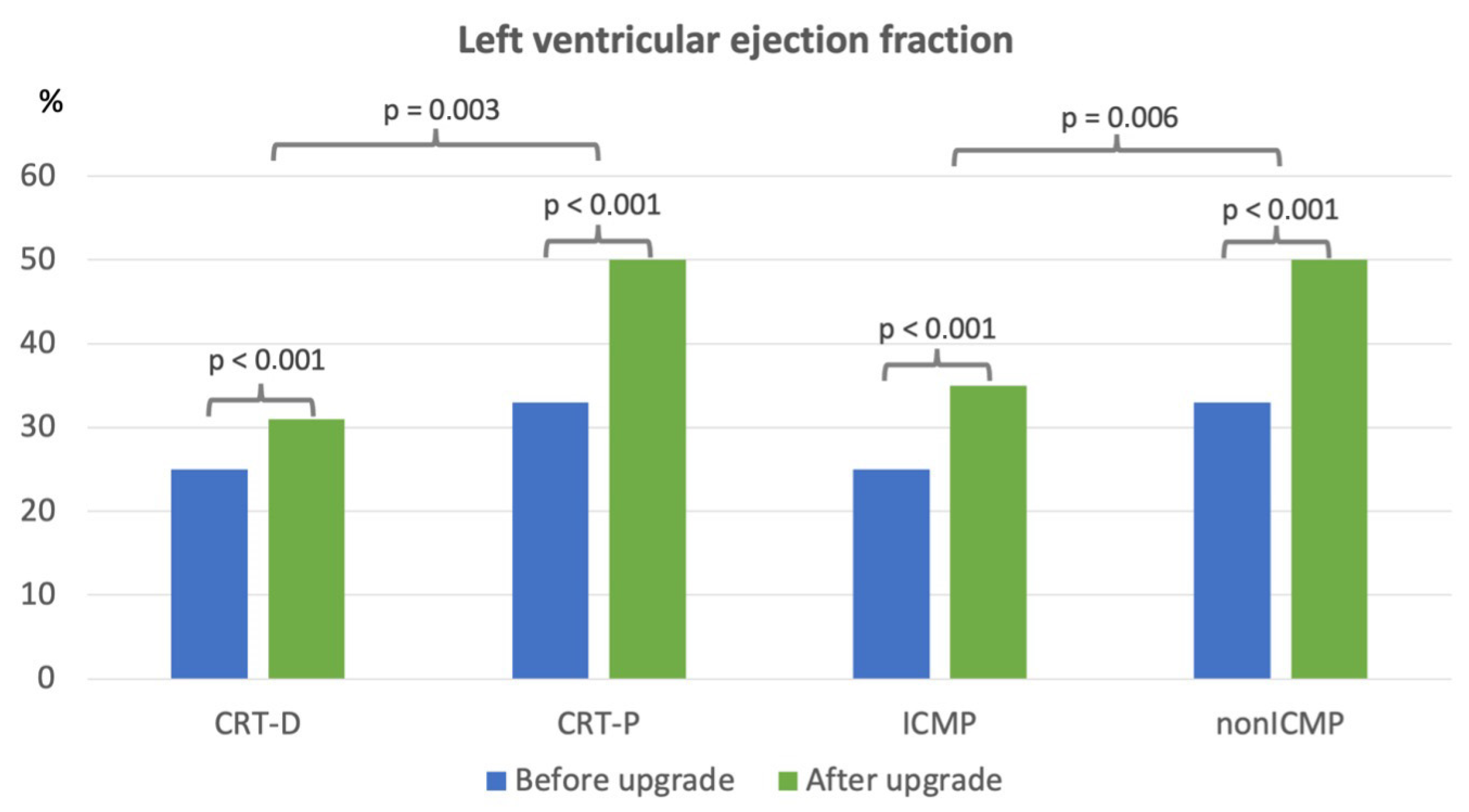
| LVEF—%, median (IQR) | 25 (20–35) | 43 (30–52) | <0.001 |
| LVEDD—mm, median (IQR) | 59 (55–65) | 57 (51–64) | 0.004 |
| Device interrogation | |||
| Biventricular pacing—%, median (IQR) | - | 99 (98–100) | |
| Biventricular pacing >95%, n (%) | - | 91 (94) | |
| Mitral regurgitation | 0.193 | ||
| None | 2 (2) | 5 (5) | |
| Mild | 31 (32) | 37 (38) | |
| Moderate | 38 (39) | 36 (37) | |
| Severe | 26 (27) | 19 (20) | |
| Tricuspid regurgitation | 0.646 | ||
| None | 5 (5) | 4 (4) | |
| Mild | 38 (39) | 43 (44) | |
| Moderate | 38 (39) | 31 (32) | |
| Severe | 16 (16) | 19 (20) | |
| Pulmonary hypertension | <0.001 | ||
| None | 35 (36) | 64 (66) | |
| Mild | 35 (36) | 24 (25) | |
| Moderate | 24 (25) | 5 (5) | |
| Severe | 3 (3) | 3 (3) | |
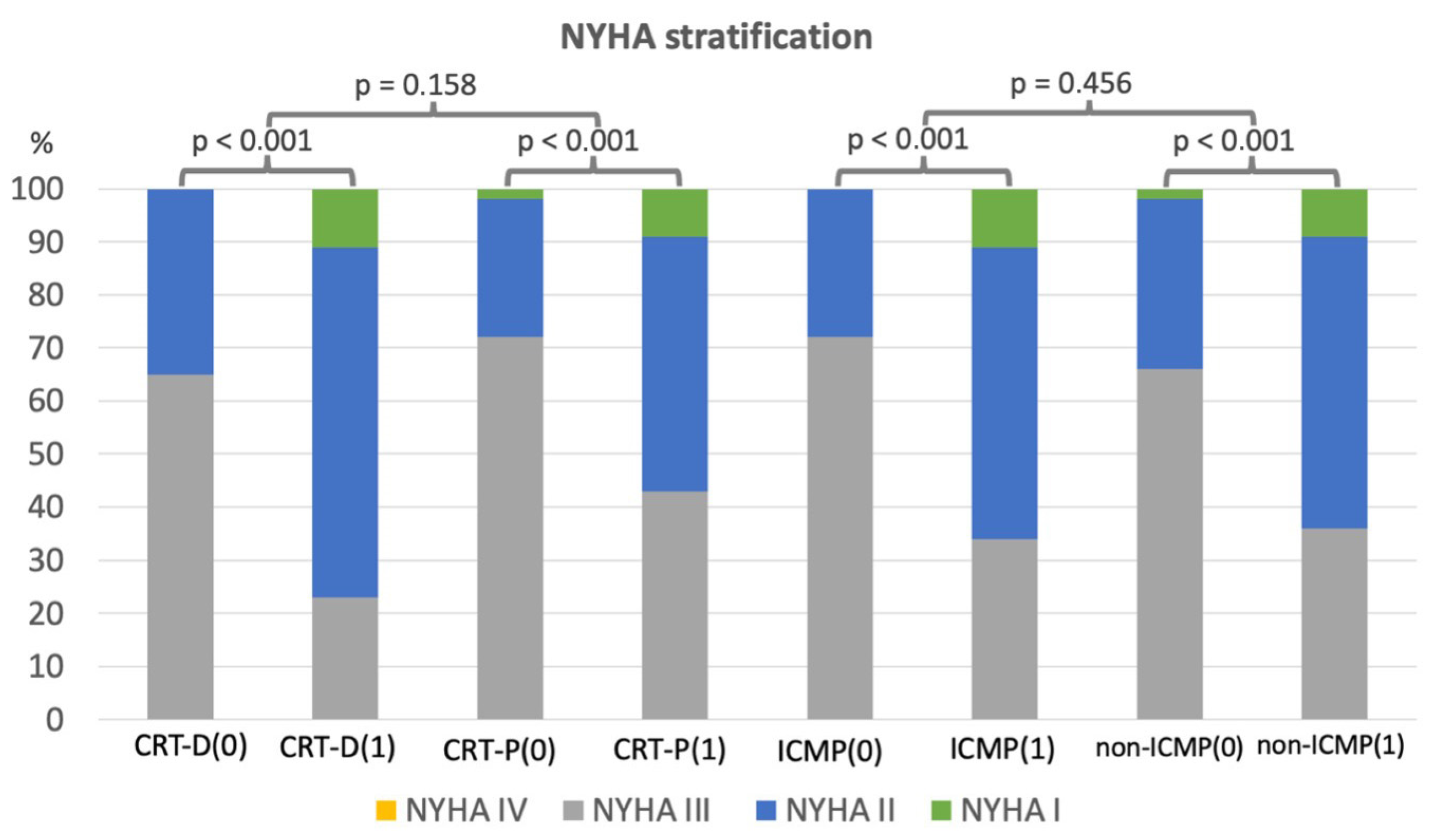
| NYHA classification | <0.001 | ||
| NYHA I | 1 (1) | 9 (10) | |
| NYHA II | 29 (31) | 52 (55) | |
| NYHA III | 64 (68) | 33 (35) | |
| NYHA IV | 0 | 0 | |
Disclaimer/Publisher’s Note: The statements, opinions and data contained in all publications are solely those of the individual author(s) and contributor(s) and not of MDPI and/or the editor(s). MDPI and/or the editor(s) disclaim responsibility for any injury to people or property resulting from any ideas, methods, instructions or products referred to in the content. |
© 2026 by the authors. Published by MDPI on behalf of the Lithuanian University of Health Sciences. Licensee MDPI, Basel, Switzerland. This article is an open access article distributed under the terms and conditions of the Creative Commons Attribution (CC BY) license.
Share and Cite
Simka, J.; Cermakova, E.; Praus, R.; Dokoupil, J.; Stritecky, J.; Haman, L.; Varhanik, F.; Pudil, R.; Parizek, P. Long Term Outcomes and Predictors of Reverse Remodelling After Cardiac Resynchronization Therapy Upgrade. Medicina 2026, 62, 513. https://doi.org/10.3390/medicina62030513
Simka J, Cermakova E, Praus R, Dokoupil J, Stritecky J, Haman L, Varhanik F, Pudil R, Parizek P. Long Term Outcomes and Predictors of Reverse Remodelling After Cardiac Resynchronization Therapy Upgrade. Medicina. 2026; 62(3):513. https://doi.org/10.3390/medicina62030513
Chicago/Turabian StyleSimka, Jakub, Eva Cermakova, Rudolf Praus, Jiri Dokoupil, Jakub Stritecky, Ludek Haman, Filip Varhanik, Radek Pudil, and Petr Parizek. 2026. "Long Term Outcomes and Predictors of Reverse Remodelling After Cardiac Resynchronization Therapy Upgrade" Medicina 62, no. 3: 513. https://doi.org/10.3390/medicina62030513
APA StyleSimka, J., Cermakova, E., Praus, R., Dokoupil, J., Stritecky, J., Haman, L., Varhanik, F., Pudil, R., & Parizek, P. (2026). Long Term Outcomes and Predictors of Reverse Remodelling After Cardiac Resynchronization Therapy Upgrade. Medicina, 62(3), 513. https://doi.org/10.3390/medicina62030513