
Serum Trimethylamine N-Oxide Levels Are Associated with Peripheral Artery Disease in Patients with Type 2 Diabetes Mellitus
 , ,
, , 
Abstract
1. Introduction
2. Materials and Methods
2.1. Patients
2.2. Anthropometric Analysis and Biochemical Determinations
2.3. ABI Measurements
2.4. Measurement of Serum TMAO Concentration
2.5. Statistical Analysis
3. Results
3.1. Participants’ Baseline Characteristics
3.2. Association Between TMAO and PAD
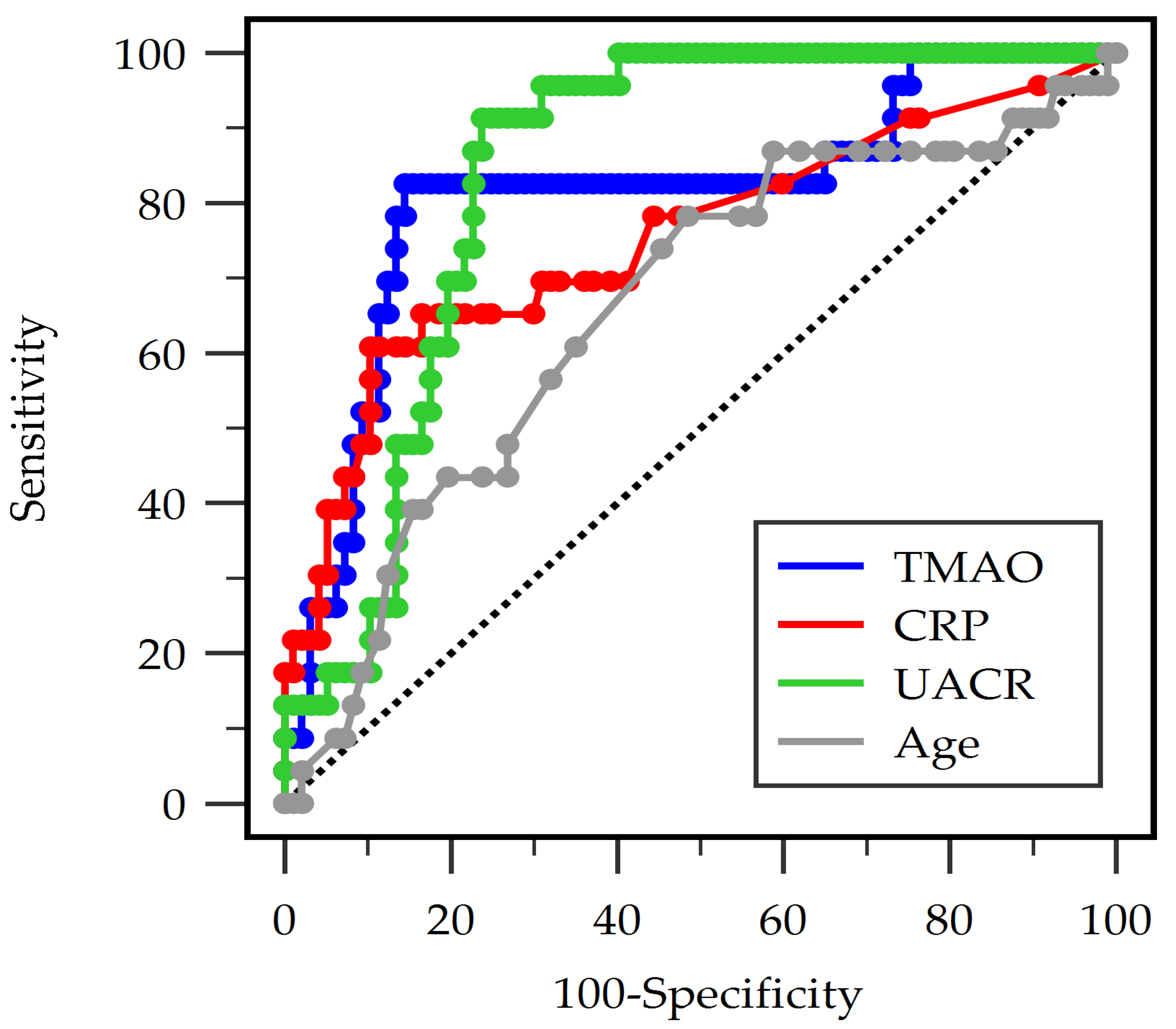
3.3. Diagnostic Accuracy of TMAO, CRP, UACR, and Age for PAD
3.4. Correlations Between TMAO, ABI, and Clinical Parameters
4. Discussion
5. Conclusions
Author Contributions
Funding
Institutional Review Board Statement
Informed Consent Statement
Data Availability Statement
Conflicts of Interest
Abbreviations
| ABI | ankle–brachial index |
| aOR | adjusted odds ratio |
| AUC | area under the curve |
| BP | blood pressure |
| BUN | blood urea nitrogen |
| CI | confidence interval |
| CTA | computed tomographic angiography |
| CVD | cardiovascular disease |
| CRP | C-reactive protein |
| DBP | diastolic blood pressure |
| DM | diabetes mellitus |
| DSA | digital subtraction angiography |
| eGFR | estimated glomerular filtration rate |
| HbA1c | glycated hemoglobin |
| MRA | magnetic resonance angiography |
| OR | odds ratio |
| ROC | receiver operating characteristic |
| SBP | systolic blood pressure |
| T2DM | type 2 diabetes mellitus |
| TMAO | trimethylamine N-oxide |
| UACR | urine albumin-to-creatinine ratio |
References
- GBD 2021 Diabetes Collaborators. Global, regional, and national burden of diabetes from 1990 to 2021, with projections of prevalence to 2050: A systematic analysis for the Global Burden of Disease Study 2021. Lancet 2023, 402, 203–234. [Google Scholar] [CrossRef] [PubMed]
- Caturano, A.; Rocco, M.; Tagliaferri, G.; Piacevole, A.; Nilo, D.; Di Lorenzo, G.; Iadicicco, I.; Donnarumma, M.; Galiero, R.; Acierno, C.; et al. Oxidative stress and cardiovascular complications in type 2 diabetes: From pathophysiology to lifestyle modifications. Antioxidants 2025, 14, 72. [Google Scholar] [CrossRef] [PubMed]
- Buso, G.; Aboyans, V.; Mazzolai, L. Lower extremity artery disease in patients with type 2 diabetes. Eur. J. Prev. Cardiol. 2019, 26, 114–124. [Google Scholar] [CrossRef] [PubMed]
- Marso, S.P.; Hiatt, W.R. Peripheral arterial disease in patients with diabetes. J. Am. Coll. Cardiol. 2006, 47, 921–929. [Google Scholar]
- van Sloten, T.T.; Henry, R.M.; Dekker, J.M.; Nijpels, G.; Unger, T.; Schram, M.T.; Stehouwer, C.D. Endothelial dysfunction plays a key role in increasing cardiovascular risk in type 2 diabetes: The Hoorn study. Hypertension 2014, 64, 1299–1305. [Google Scholar]
- Normahani, P.; Epstein, D.M.; Gaggero, A.; Davies, A.H.; Sounderajah, V.; Jaffer, U. Cost-effectiveness of diagnostic tools to establish the presence of peripheral arterial disease in people with diabetes. Ann. Surg. 2023, 277, e184–e191. [Google Scholar]
- Polonsky, T.S.; McDermott, M.M. Lower extremity peripheral artery disease without chronic limb-threatening ischemia: A review. JAMA 2021, 325, 2188–2198. [Google Scholar] [CrossRef]
- Cerqueira, M.M.B.D.F.; Bastos, N.S.S.G.; Silva, D.A.R.D.; Gregori, D.; Magalhães, L.B.N.C.; Pimentel, M.M.W. Accuracy of ankle-brachial index in screening for peripheral arterial disease in people with diabetes. PLoS ONE 2024, 19, e0309083. [Google Scholar]
- AbuRahma, A.F.; Adams, E.; AbuRahma, J.; Mata, L.A.; Dean, L.S.; Caron, C.; Sloan, J. Critical analysis and limitations of resting ankle-brachial index in the diagnosis of symptomatic peripheral arterial disease patients and the role of diabetes mellitus and chronic kidney disease. J. Vasc. Surg. 2020, 71, 937–945. [Google Scholar]
- Pomposelli, F. Arterial imaging in patients with lower extremity ischemia and diabetes mellitus. J. Vasc. Surg. 2010, 52, 81s–91s. [Google Scholar] [CrossRef]
- Chen, M.C.; Kuo, C.H.; Lin, Y.L.; Hsu, B.G. Gut-derived uremic toxins and cardiovascular health in chronic kidney disease. Tzu Chi Med. J. 2025, 37, 264–274. [Google Scholar] [CrossRef] [PubMed]
- El Hage, R.; Al-Arawe, N.; Hinterseher, I. The role of the gut microbiome and trimethylamine oxide in atherosclerosis and age-related disease. Int. J. Mol. Sci. 2023, 24, 2399. [Google Scholar] [CrossRef] [PubMed]
- Biscetti, F.; Nardella, E.; Cecchini, A.L.; Landolfi, R.; Flex, A. The Role of the microbiota in the diabetic peripheral artery disease. Mediators Inflamm. 2019, 2019, 4128682. [Google Scholar] [CrossRef] [PubMed]
- Hsu, B.G.; Wang, Y.C.; Wu, D.A.; Chen, M.C. Serum 25-hydroxyvitamin D level is positively associated with vascular reactivity index in patients with type 2 diabetes mellitus. Nutrients 2024, 16, 1575. [Google Scholar] [CrossRef]
- Chiu, L.T.; Hsu, B.G.; Lai, Y.H.; Wang, C.H.; Tsai, J.P. High serum galectin-3 level as a potential biomarker of peripheral artery disease in patients undergoing hemodialysis. Rev. Cardiovasc. Med. 2024, 25, 124. [Google Scholar] [CrossRef]
- Huang, P.Y.; Hsu, B.G.; Lai, Y.H.; Wang, C.H.; Tsai, J.P. Serum trimethylamine N-oxide level is positively associated with aortic stiffness measured by carotid-femoral pulse wave velocity in patients undergoing maintenance hemodialysis. Toxins 2023, 15, 572. [Google Scholar]
- Faul, F.; Erdfelder, E.; Buchner, A.; Lang, A.G. Statistical power analyses using G*Power 3.1: Tests for correlation and regression analyses. Behav. Res. Methods 2009, 41, 1149–1160. [Google Scholar] [CrossRef]
- Bacchetti, P. Current sample size conventions: Flaws, harms, and alternatives. BMC Med. 2010, 8, 17. [Google Scholar] [CrossRef]
- Kullo, I.J.; Rooke, T.W. Peripheral artery disease. N. Engl. J. Med. 2016, 374, 861–871. [Google Scholar] [CrossRef]
- Cecchini, A.L.; Biscetti, F.; Manzato, M.; Lo Sasso, L.; Rando, M.M.; Nicolazzi, M.A.; Rossini, E.; Eraso, L.H.; Dimuzio, P.J.; Massetti, M.; et al. Current medical therapy and revascularization in peripheral artery disease of the lower limbs: Impacts on subclinical chronic inflammation. Int. J. Mol. Sci. 2023, 24, 16099. [Google Scholar] [CrossRef]
- Donato, A.J.; Gano, L.B.; Eskurza, I.; Silver, A.E.; Gates, P.E.; Jablonski, K.; Seals, D.R. Vascular endothelial dysfunction with aging: Endothelin-1 and endothelial nitric oxide synthase. Am. J. Physiol. Heart Circ. Physiol. 2009, 297, H425–H432. [Google Scholar] [CrossRef]
- Ungvari, Z.; Tarantini, S.; Kiss, T.; Wren, J.D.; Giles, C.B.; Griffin, C.T.; Murfee, W.L.; Pacher, P.; Csiszar, A. Endothelial dysfunction and angiogenesis impairment in the ageing vasculature. Nat. Rev. Cardiol. 2018, 15, 555–565. [Google Scholar] [CrossRef]
- Woleli, D.A.; Tsegaye, G.W.; Abuhay, T.; Teshome, A.T.; Alemu, G.G. The incidence and predictors of peripheral arterial disease among type 2 diabetes mellitus patients at Felege Hiwot Comprehensive Specialized Hospital, Northwest Ethiopia, 2023: A retrospective follow-up study. PLoS ONE 2025, 20, e0320948. [Google Scholar] [CrossRef]
- Emdin, C.A.; Anderson, S.G.; Callender, T.; Conrad, N.; Salimi-Khorshidi, G.; Mohseni, H.; Woodward, M.; Rahimi, K. Usual blood pressure, peripheral arterial disease, and vascular risk: Cohort study of 4.2 million adults. BMJ 2015, 351, h4865. [Google Scholar] [CrossRef]
- Jia, G.; Sowers, J.R. Hypertension in diabetes: An update of basic mechanisms and clinical disease. Hypertension 2021, 78, 1197–1205. [Google Scholar] [CrossRef]
- Libianto, R.; Batu, D.; MacIsaac, R.J.; Cooper, M.E.; Ekinci, E.I. Pathophysiological links between diabetes and blood pressure. Can. J. Cardiol. 2018, 34, 585–594. [Google Scholar] [CrossRef]
- Lu, Y.; Ballew, S.H.; Tanaka, H.; Szklo, M.; Heiss, G.; Coresh, J.; Matsushita, K. 2017 ACC/AHA blood pressure classification and incident peripheral artery disease: The Atherosclerosis Risk in Communities (ARIC) Study. Eur. J. Prev. Cardiol. 2020, 27, 51–59. [Google Scholar]
- Burger, P.M.; Pradhan, A.D.; Dorresteijn, J.A.N.; Koudstaal, S.; Teraa, M.; de Borst, G.J.; van der Meer, M.G.; Mosterd, A.; Ridker, P.M.; Visseren, F.L.J.; et al. C-reactive protein and risk of cardiovascular events and mortality in patients with various cardiovascular disease locations. Am. J. Cardiol. 2023, 197, 13–23. [Google Scholar] [CrossRef]
- Mohammedi, K.; Woodward, M.; Hirakawa, Y.; Zoungas, S.; Williams, B.; Lisheng, L.; Rodgers, A.; Mancia, G.; Neal, B.; Harrap, S.; et al. Microvascular and macrovascular disease and risk for major peripheral arterial disease in patients with type 2 diabetes. Diabetes Care 2016, 39, 1796–1803. [Google Scholar] [CrossRef]
- Kim, B.G.; Seo, J.; Kim, G.S.; Jin, M.N.; Lee, H.Y.; Byun, Y.S.; Kim, B.O. Elevated C-reactive protein/albumin ratio is associated with lesion complexity, multilevel involvement, and adverse outcomes in patients with peripheral artery disease. Angiology 2022, 73, 843–851. [Google Scholar]
- Brunt, V.E.; Gioscia-Ryan, R.A.; Casso, A.G.; VanDongen, N.S.; Ziemba, B.P.; Sapinsley, Z.J.; Richey, J.J.; Zigler, M.C.; Neilson, A.P.; Davy, K.P.; et al. Trimethylamine-N-oxide promotes age-related vascular oxidative stress and endothelial dysfunction in mice and healthy humans. Hypertension 2020, 76, 101–112. [Google Scholar] [CrossRef]
- Chen, L.; Jin, Y.; Wang, N.; Yuan, M.; Lin, T.; Lu, W.; Wang, T. Trimethylamine N-oxide impairs perfusion recovery after hindlimb ischemia. Biochem. Biophys. Res. Commun. 2020, 530, 95–99. [Google Scholar] [CrossRef]
- Croyal, M.; Saulnier, P.J.; Aguesse, A.; Gand, E.; Ragot, S.; Roussel, R.; Halimi, J.M.; Ducrocq, G.; Cariou, B.; Montaigne, D.; et al. Plasma trimethylamine N-oxide and risk of cardiovascular events in patients with type 2 diabetes. J. Clin. Endocrinol. Metab. 2020, 105, dgaa188. [Google Scholar] [CrossRef]
- Morsy, Y.; Shafie, N.S.; GP2324 consortium; Amer, M. Integrative analysis of gut microbiota and metabolic pathways reveals key microbial and metabolomic alterations in diabetes. Sci. Rep. 2025, 15, 30686. [Google Scholar] [CrossRef]
- Huo, L.; Li, H.; Zhu, M.; Liu, Y.; Ren, L.; Hu, J.; Wang, X. Enhanced trimethylamine metabolism and gut dysbiosis in type 2 diabetes mellitus with microalbumin. Front. Endocrinol. 2023, 14, 1257457. [Google Scholar] [CrossRef]
- Al-Obaide, M.A.I.; Singh, R.; Datta, P.; Rewers-Felkins, K.A.; Salguero, M.V.; Al-Obaidi, I.; Kottapalli, K.R.; Vasylyeva, T.L. Gut microbiota-dependent trimethylamine-N-oxide and serum biomarkers in patients with T2DM and advanced CKD. J. Clin. Med. 2017, 6, 86. [Google Scholar] [CrossRef]
- Lemaitre, R.N.; Jensen, P.N.; Wang, Z.; Fretts, A.M.; McKnight, B.; Nemet, I.; Biggs, M.L.; Sotoodehnia, N.; de Oliveira Otto, M.C.; Psaty, B.M.; et al. Association of trimethylamine N-Oxide and related metabolites in plasma and incident type 2 diabetes: The cardiovascular health study. JAMA Network Open 2021, 4, e2122844. [Google Scholar] [CrossRef]
- Farhangi, M.A.; Vajdi, M. Novel findings of the association between gut microbiota-derived metabolite trimethylamine N-oxide and inflammation: Results from a systematic review and dose-response meta-analysis. Crit. Rev. Food Sci. Nutr. 2020, 60, 2801–2823. [Google Scholar] [CrossRef]
- Kalagi, N.A.; Thota, R.N.; Stojanovski, E.; Alburikan, K.A.; Garg, M.L. Plasma trimethylamine N-oxide levels are associated with poor kidney function in people with type 2 diabetes. Nutrients 2023, 15, 812. [Google Scholar] [CrossRef]
- Zeng, Y.; Guo, M.; Fang, X.; Teng, F.; Tan, X.; Li, X.; Wang, M.; Long, Y.; Xu, Y. Gut microbiota-derived trimethylamine N-oxide and kidney function: A systematic review and meta-analysis. Adv. Nutr. 2021, 12, 1286–1304. [Google Scholar] [CrossRef]
- Roncal, C.; Martínez-Aguilar, E.; Orbe, J.; Ravassa, S.; Fernandez-Montero, A.; Saenz-Pipaon, G.; Ugarte, A.; Estella-Hermoso de Mendoza, A.; Rodriguez, J.A.; Fernández-Alonso, S.; et al. Trimethylamine-N-oxide (TMAO) predicts cardiovascular mortality in peripheral artery disease. Sci. Rep. 2019, 9, 15580. [Google Scholar] [CrossRef]
- Querio, G.; Antoniotti, S.; Geddo, F.; Levi, R.; Gallo, M.P. Modulation of endothelial function by TMAO, a gut microbiota-derived metabolite. Int. J. Mol. Sci. 2023, 24, 5806. [Google Scholar] [CrossRef]
- Sun, X.; Jiao, X.; Ma, Y.; Liu, Y.; Zhang, L.; He, Y.; Chen, Y. Trimethylamine N-oxide induces inflammation and endothelial dysfunction in human umbilical vein endothelial cells via activating ROS-TXNIP-NLRP3 inflammasome. Biochem. Biophys. Res. Commun. 2016, 481, 63–70. [Google Scholar] [CrossRef]


| Characteristic | All Patients (n = 120) | Control Group (n = 97) | Low-ABI Group (n = 23) | p Value |
|---|---|---|---|---|
| Age (years) | 66.00 (57.25–71.00) | 64.00 (56.50–70.00) | 68.00 (65.00–75.00) | 0.017 * |
| Height (cm) | 161.10 ± 8.61 | 161.84 ± 8.73 | 157.98 ± 7.46 | 0.053 |
| Body weight (kg) | 69.98 ± 13.86 | 70.71 ± 13.94 | 66.93 ± 13.39 | 0.242 |
| Body mass index (kg/m2) | 26.84 ± 4.09 | 26.89 ± 4.11 | 26.66 ± 4.10 | 0.816 |
| Left-ankle–brachial index | 1.06 (1.00–1.12) | 1.07 (1.03–1.13) | 0.89 (0.84–0.94) | <0.001 * |
| Right-ankle–brachial index | 1.07 (1.02–1.13) | 1.10 (1.05–1.15) | 0.91 (0.88–0.96) | <0.001 * |
| SBP (mmHg) | 143.95 ± 20.66 | 142.64 ± 20.32 | 149.48 ± 21.63 | 0.154 |
| DBP (mmHg) | 82.91 ± 11.05 | 82.94 ± 10.52 | 82.78 ± 13.32 | 0.952 |
| Albumin (mg/dL) | 4.24 ± 0.26 | 4.25 ± 0.26 | 4.22 ± 0.27 | 0.591 |
| Total cholesterol (mg/dL) | 162.13 ± 33.18 | 160.27 ± 30.88 | 170.00 ± 41.40 | 0.207 |
| Triglyceride (mg/dL) | 122.00 (84.25–170.50) | 122.00 (84.00–171.00) | 101.00 (84.00–171.00) | 0.957 |
| HDL-C (mg/dL) | 46.97 ± 15.58 | 46.63 ± 16.37 | 48.39 ± 11.88 | 0.628 |
| LDL-C (mg/dL) | 98.61 ± 28.93 | 98.39 ± 28.23 | 99.52 ± 32.38 | 0.867 |
| Fasting glucose (mg/dL) | 137.50 (121.00–168.75) | 136.00 (121.00–165.00) | 138.00 (121.00–196.00) | 0.610 |
| HbA1c (%) | 7.40 (6.60–8.65) | 7.30 (6.60–8.40) | 8.10 (6.70–9.40) | 0.553 |
| Blood urea nitrogen (mg/dL) | 16.00 (12.00–19.00) | 15.00 (12.00–18.00) | 18.00 (12.00–22.00) | 0.265 |
| Creatinine (mg/dL) | 0.90 (0.70–1.10) | 0.90 (0.70–1.10) | 0.80 (0.60–0.90) | 0.206 |
| eGFR (mL/min) | 85.11 ± 30.03 | 84.68 ± 30.25 | 86.90 ± 29.66 | 0.751 |
| UACR (mg/g) | 27.39 (9.96–160.62) | 19.94 (8.73–66.58) | 179.93 (109.73–459.32) | <0.001 * |
| C-reactive protein (mg/dL) | 0.11 (0.08–0.31) | 0.09 (0.08–0.20) | 0.44 (0.11–1.26) | <0.001 * |
| TMAO (μg/L) | 20.82 (14.19–31.31) | 19.72 (13.44–25.41) | 37.92 (30.64–55.62) | <0.001 * |
| Male, n (%) | 65 (54.2) | 56 (57.7) | 9 (39.1) | 0.107 |
| Current smoking, n (%) | 11 (9.2) | 8 (8.2) | 3 (13.0) | 0.474 |
| Hypertension, n (%) | 70 (58.3) | 53 (54.6) | 17 (73.9) | 0.092 |
| ACE inhibitor use, n (%) | 11 (9.2) | 9 (9.2) | 2 (8.7) | 0.931 |
| ARB use, n (%) | 59 (49.2) | 45 (46.4) | 14 (60.9) | 0.212 |
| β-blocker use, n (%) | 13 (10.8) | 10 (10.3) | 3 (13.0) | 0.704 |
| CCB use, n (%) | 30 (25.0) | 24 (24.7) | 6 (26.1) | 0.893 |
| Statin use, n (%) | 63 (52.5) | 51 (52.6) | 12 (52.2) | 0.972 |
| Fibrate use, n (%) | 25 (20.8) | 20 (20.6) | 5 (21.7) | 0.905 |
| Metformin use, n (%) | 64 (53.3) | 52 (53.6) | 12 (52.2) | 0.901 |
| Sulfonylurea use, n (%) | 65 (54.2) | 51 (52.6) | 14 (60.9) | 0.473 |
| DDP-4 inhibitor use, n (%) | 76 (63.3) | 60 (61.9) | 16 (69.6) | 0.490 |
| Insulin use, n (%) | 29 (24.2) | 24 (24.7) | 5 (21.7) | 0.762 |
| SGLT2i use, n (%) | 24 (20.0) | 19 (19.6) | 5 (21.7) | 0.817 |
| Variables | Odds Ratio | 95% Confidence Interval | p Value |
|---|---|---|---|
| TMAO, 1 μg/L | 1.051 | 1.017–1.086 | 0.003 * |
| C-reactive protein, 0.1 mg/dL | 1.155 | 1.012–1.318 | 0.033 * |
| Age, 1 year | 1.031 | 0.982–1.082 | 0.225 |
| UACR, 1 mg/g | 1.001 | 0.999–1.002 | 0.263 |
| Variables | AUC | 95% Confidence Interval | p Value |
|---|---|---|---|
| TMAO | 0.812 | 0.701—0.923 | <0.001 * |
| CRP | 0.754 | 0.626—0.881 | 0.0001 * |
| UACR | 0.840 | 0.770—0.910 | <0.001 * |
| Age | 0.660 | 0.532—0.788 | 0.015 * |
| TMAO + CRP + UACR + age | 0.864 | 0.775—0.953 | <0.001 * |
| Variables | Log-Left ABI | Log-Right ABI | Log-TMAO (μg/L) | |||
|---|---|---|---|---|---|---|
| Spearman Coefficient of Correlation | p Value | Spearman Coefficient of Correlation | p Value | Spearman Coefficient of Correlation | p Value | |
| Log-Age (years) | –0.135 | 0.141 | –0.051 | 0.582 | 0.134 | 0.144 |
| Body mass index (kg/m2) | –0.039 | 0.678 | –0.050 | 0.586 | –0.130 | 0.156 |
| Log-left ABI | — | — | 0.628 | <0.001 * | –0.218 | 0.017 * |
| Log-right ABI | 0.628 | <0.001 * | — | — | –0.289 | 0.001 * |
| Log-TMAO (μg/L) | –0.218 | 0.017 * | –0.289 | 0.001 * | — | — |
| SBP (mmHg) | –0.257 | 0.005 * | –0.200 | 0.028 * | 0.015 | 0.873 |
| DBP (mmHg) | –0.002 | 0.987 | –0.007 | 0.943 | 0.009 | 0.924 |
| Albumin (mg/dL) | 0.230 | 0.012 * | 0.168 | 0.067 | –0.160 | 0.081 |
| Total cholesterol (mg/dL) | –0.165 | 0.072 | –0.233 | 0.010 * | 0.068 | 0.462 |
| Log-Triglyceride (mg/dL) | –0.035 | 0.704 | –0.009 | 0.924 | 0.091 | 0.324 |
| HDL-C (mg/dL) | –0.089 | 0.336 | –0.165 | 0.071 | 0.004 | 0.969 |
| LDL-C (mg/dL) | –0.072 | 0.433 | –0.156 | 0.088 | –0.094 | 0.309 |
| Log-Glucose (mg/dL) | 0.119 | 0.194 | –0.007 | 0.936 | 0.102 | 0.268 |
| Log-HbA1c (%) | –0.012 | 0.893 | –0.113 | 0.221 | 0.104 | 0.260 |
| Log-BUN (mg/dL) | –0.094 | 0.305 | –0.130 | 0.158 | 0.340 | <0.001 * |
| Log-Creatinine (mg/dL) | 0.031 | 0.740 | 0.066 | 0.474 | 0.282 | 0.002 * |
| eGFR (mL/min) | 0.068 | 0.460 | 0.002 | 0.981 | –0.236 | 0.009 * |
| Log-UACR (mg/g) | –0.376 | <0.001 * | –0.384 | <0.001 * | 0.326 | <0.001 * |
| Log-CRP (mg/L) | –0.329 | <0.001 * | –0.217 | 0.014 * | 0.373 | <0.001 * |
Disclaimer/Publisher’s Note: The statements, opinions and data contained in all publications are solely those of the individual author(s) and contributor(s) and not of MDPI and/or the editor(s). MDPI and/or the editor(s) disclaim responsibility for any injury to people or property resulting from any ideas, methods, instructions or products referred to in the content. |
© 2025 by the authors. Published by MDPI on behalf of the Lithuanian University of Health Sciences. Licensee MDPI, Basel, Switzerland. This article is an open access article distributed under the terms and conditions of the Creative Commons Attribution (CC BY) license (https://creativecommons.org/licenses/by/4.0/).
Share and Cite
Liang, C.-Y.; Li, J.-C.; Liu, C.-H.; Wu, D.-A.; Hsu, B.-G. Serum Trimethylamine N-Oxide Levels Are Associated with Peripheral Artery Disease in Patients with Type 2 Diabetes Mellitus. Medicina 2025, 61, 2243. https://doi.org/10.3390/medicina61122243
Liang C-Y, Li J-C, Liu C-H, Wu D-A, Hsu B-G. Serum Trimethylamine N-Oxide Levels Are Associated with Peripheral Artery Disease in Patients with Type 2 Diabetes Mellitus. Medicina. 2025; 61(12):2243. https://doi.org/10.3390/medicina61122243
Chicago/Turabian StyleLiang, Cing-Yu, Jer-Chuan Li, Chin-Hung Liu, Du-An Wu, and Bang-Gee Hsu. 2025. "Serum Trimethylamine N-Oxide Levels Are Associated with Peripheral Artery Disease in Patients with Type 2 Diabetes Mellitus" Medicina 61, no. 12: 2243. https://doi.org/10.3390/medicina61122243
APA StyleLiang, C.-Y., Li, J.-C., Liu, C.-H., Wu, D.-A., & Hsu, B.-G. (2025). Serum Trimethylamine N-Oxide Levels Are Associated with Peripheral Artery Disease in Patients with Type 2 Diabetes Mellitus. Medicina, 61(12), 2243. https://doi.org/10.3390/medicina61122243